Int. J. Food System Dynamics 2(3), 2011, 274-280
Exploring the Relations, Bargaining Forms and Dynamics of
the EU Food Supply Chain under the Perspective of the Key
Actors: Evidence from Greece and Denmark
*
Konstantinos Galanopoulos
1, Konstantinos Karantininis
2,
Konstadinos Mattas
3, and Christos Karelakis
41,4
Democritus University of Thrace, Greece, 2University of Copenhagen, Denmark, 3Aristotle University of Thessaloniki, Greece
1
[email protected];2 [email protected]; [email protected];4 [email protected]
Received June 2010, accepted September 2011, available online December 2011
ABSTRACT
The objective of this paper is to offer qualitative and quantitative insights on the perceptions of the actors in the EU food supply chain on a broad spectrum of topics that characterise its operation and conduct, highlighting also potential differences in North and South European countries. Issues explored pertained to actors’ relations with up - and downstream partners, the future dynamic and challenges of the food sector, the influence of policy intervention and attitudes towards genetically modified products (GMPs) and organic production. For this purpose, a total of 34 food supply chain actors in Denmark and Greece were interviewed using a semi -structured interview process. A comparative analysis of the interviews pinpointed many similarities in the behaviour and the perceptions of the Greek and Danish farmers, cooperatives, processors and retailers alike. Still, while it is evident that companies and farmers of both countries struggle with a lot of the same problems, several differences in perceptions are also identified. These refer mainly to attitudes towards mergers and acquisitions, innovations, GMPs and the effects and limitations of EU policy intervention.
Keywords: Food supply chain structure, vertical integration, stakeholders’ survey.
1
Introduction
the main characteristics of the food supply chain in Greece and Denmark. The third section describes the research design followed by a presenta The food, drink and tobacco industry constitutes the single largest manufacturing sector in the EU in terms of turnover and employment (14.5% of manufacturing turnover and 14% of employment). Its share in the manufacturing industry has been increasing steadily with regard to turnover, value added and employment. Still, the industry’s competitiveness is weak in comparison to its competitors (mainly US and Canada), remaining at the same levels as Australia and Brazil (European Commission, 2007, p. 240).
When considering food industry competitiveness in both European and world context, business structure becomes a key element: Firms in the food industry are becoming larger in size and smaller in number, in a higher rate than that of the overall manufacturing sector. It is worth mentioning that in all European countries with the exception of Hungary, a decrease in the number of food enterprises is reported, whilst future development towards a more concentrated business structure can be expected; caused, among other things, by the internationalization of food markets and price-conscious consumers (Karantininis, 2010).
stages along the supply chain with a growing number of mergers and acqu isitions and on the other, to an increasing pace of innovative technology adoption (i.e. use of new technologies, as well as the launching of new products). With respect to technological innovations, the introduction of genetically modified products (GMPs) into the food system and the significant growth of organic agriculture are among the most notable features of the increasingly industrialized agri-food sector.
Within this context, a European research project, named EU Food Industry Dynamics and Methodological Advances (FOODIMA), initiated in 2007 aiming at developing a set of methodological tools for a systematic economic assessment of the EU food chain. A part of this project also involved the recording of stakeholders’ opinions on a broad spectrum of topics that characterise the industry’s operation and conduct, highlighting also potential differences in the North and South European countries . For this matter, two EU countries, namely Greece and Denmark, were chosen as representative case studie s. The objective of this paper is to summarise the key findings from this research and offer some qualitative and quantitative insights on the perceptions of the key actors in the EU food supply chain. Issues explored pertained to actors’ relations with up- and downstream partners, bargaining forms, the future dynamic and challenges of the food sector, the influence of policy intervention and attitudes towards genetically modified products (GMPs) and organic production.
The remainder of the paper is organised as follows: The next section provides a background on tion of the main findings. Lastly, some final remarks are outlined.
2
Background
2.1 The Greek case
The food processing industry is the largest processing sub-sector in Greece, accounting for nearly 30% of the national industrial output, 6.5% of the national output, 22% of employment in the manufacturing sector and 3.5% of total employment.
Typically, the industry is characterised by small sized firms (with less than 10 employees), notwithstanding that there are also large companies which have expanded by building plant s in other countries, mainly in the Balkans. Overall, the food and drinks sector is characterised by low intensity in capital and high intensity in inputs, as input costs represent almost half of total costs. Large companies dominate particularly the dairy industry, the tomato industry, the confectionery industry, the bread products industry, the pasta industry, the brewery industry and the beverages industry (Baltas 2001).
Key players in the food supply chain, apart from private firms, are the agricultural cooperatives which are divided in three levels: primary cooperatives (6,873 in operation), secondary associations of primary agricultural cooperatives (122 operating) and tertiary cooperatives unions (7 central unions, 4 joint ventures, 88 cooperative businesses and 1 top organization). Cooperatives are actively involved in the supply chain of many food products and in many cases they market considerable shares of the total production volumes (e.g. 41.5% of tomato juice, 38.3% of peaches, 36.8% of oranges, 34.1% of poultry meat, 32.3% of wine, 27.5% of olives, 23.2% of table grapes, 19.3% of cow milk) (Soldatos and Rozakis, 2005).
At the other end of the supply chain, the retail food sector has been growing and concentrating at an accelerating pace over the last two decades and has benefited from a shift of power within the food supply chain. Supermarkets/hypermarkets strengthened their position as the leading retail distributio n channel for packaged food in 2008, with competitive discount policies and private label product launches (Sekliziotis, 2009).
2.2 The Danish case
The structure of the domestic food industry has been largely affected by a substantial consolidation process in the period 1995-2000. The reduction in the numbers of Danish food processing enterprises in that period has been greater, and spread across more sectors than in other EU countries and the same holds also for the food wholesaling sector. Food retailing has also consolidated in specialist and non-specialist retailing, with the decrease in the number of small (i.e. less than 20 employees) enterprises being particularly striking. Nevertheless, small firms are still significant in terms of the numbers of enterprises as 60-80% of all food processing firms have less than 50 employees.
Food processors exhibit a limited, but steady, growth in sales in the recent years as a result of the various changes that have been observed across Europe. Similarly, and despit e the substantial consolidation experienced, Danish food wholesale enterprises have also exhibited increasing turnover volumes. At the
retail level one noticeable difference evidences a significant change in the market structure: sales by non-specialist retail enterprises have increased by 50%, whereas most of specialist food retailers have seen sales decline (e.g. by 10-25% for fruit and vegetable stores, bakeries and other specialist shops) (Karantininis 2010).
3
Survey design and respondents’ profiles
Key informants from different stages of the food supply chain in Greece and Denmark were identified and interviewed to explore potential differences among food actors in the North and South European countries. A total of 34 food supply chain actors in Denmark (five farmers, five processors and four retailers) and Greece (three farmers, five producer cooperatives, six processors and six retailers) were interviewed using a semi-structured interview process. In-depth interviews were conducted based on a set of questions partly of a quantitative nature, where certain options were given to the respondents (Likert scale format and dichotomous), but also consisting of open -ended questions where the respondents could give a more detailed answer.
The respondents were asked about their perceptions of issues associated with their relations with up - and downstream partners, the future dynamic and challenges of the food sector. Specifically, the survey instrument (questionnaire) was divided into seven sub groups of questions including: profiling questions, the vertical structure of the food industry, the mergers and vertical integration, the importance of innovation, the attitudes towards GMPs and organic production, the influence of policy intervention and the impact of the current financial crisis and the former food price crisis. Interviews have been carried out during the summer and fall of 2009.
A general profile of the Danish actors involves farmers with private-owned farms, processors, the majority of which being cooperatives with strong export presence in the European food market and retailers, split into corporations and private-owned firms. Processors were mainly medium-sized firms (50-150 employees) demonstrating an annual turnover ranging from 6.3 to 37.5 million € that has particularly increased during the last five years. Retailers exhibited an annual turnover ranging from 5.4 million € to 34 million €, which also has been increasing in the last five years.
As concerns the Greek actors, they referred to family-type farms with an average annual turnover of 28,000 €, along with cooperatives that averaged a sales turnover of 4 million €. Food processors were mainly medium-sized firms, partly export-oriented (around 40% of their sales derived from exports) with a sales turnover ranging from 27.5 to 147 million €. Finally, Greek retailers were private, mainly small and medium-sized firms (averaging 15-30 employees).
4
Results and Discussion
Vertical Relations. The vertical structure of the food industry and the perceptions of the actors regarding their collaboration with up- and downstream partners exhibit some interesting patterns in the two countries. Farmers are generally contented with their supply chain partners, but this is more often the case when they deal almost exclusively with agricultural cooperatives. Negative responses are often based on the increasing concentration that is taking place among both the suppliers (of inputs) as well as the buyers (of the produce). A common complaint among farmers in both countries was that they are often exploited as a result of their weak bargaining position so that prices and/or quantities agreed upon may change when the product is delivered. They note that the retailers make excessive profits and that there is a big difference between farm gate prices and retail prices. Farmers in Denmark consider wages as a major problem, unlike their Greek counterparts who are concerned more about input costs. All farmers did agree that environmental demands and control are quite strict, a fact that hinders their competitiveness when compared to farmers from non-EU countries.
With a few exceptions, processors appear generally satisfied with their partners, as their most important impediments refer to the credit periods demanded by retailers and the pressure for low prices. Dissatisfaction is more apparent in Denmark, where the main complaints are that processors feel relatively dominated by retailers and also unsure of the quality of their collaboration with distributors; they are often not able to monitor whether their own products get the same treatment as that of their competitors’. Regarding their cooperation with the suppliers (mostly cooperatives) they feel that the latter work only for the interests of the farmers and that th ere is a lack of communication stemming from a poor understanding of the justification for the low prices offered. In Greece, processors appear to have established better cooperation with all other actors but retailers, who also put pressure for lower pric es and higher discounts, while a major point of concern is the private label issue which is regarded as a
potential threat for most processors.
Retailers are generally positive on the cooperation with their partners. In both countries though, they are sceptic mainly about the processors’ ability to develop new products and raise issues related to high prices and small discounts given by big corporations. It is also mentioned that distribution costs are quite expensive, especially when there are many small processors involved, while large wholesalers (in Denmark) distort market signals along the supply chain and present obstacles in new businesses. Punctual delivery is a point of concern in both countries, along with a lack of personal service. In both countr ies, direct relations with farmers appear to be limited due to increased costs and inability of isolated farmers to meet their requirements and standards.
Private Label. The issue of private label appears to be a controversy among the food supply chain partners: It is evident that in both countries all respondents report an increasing importance of private label. Processors view the growing shares of private label products as a major problem in their cooperation with the retailers, arguing that such a strategy could have an adverse effect on their market shares and profits. Retailers on the other hand, see private label as a key part of a strategy to differentiate themselves from competitors and answer the need of economically challenged consumers. Still, mo st respondents agreed that private label shares are going to increase considerably in the next years.
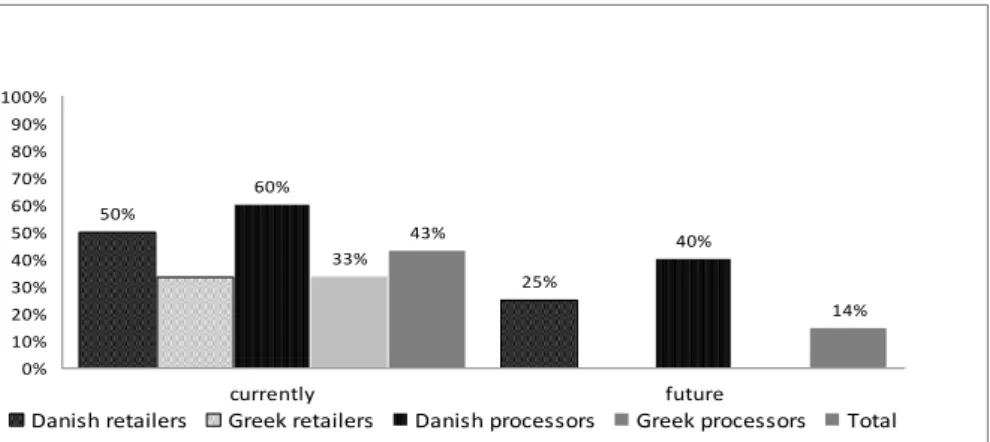
Mergers & Acquisitions. Mergers and acquisitions is a practice actively pursued in Denmark as evidenced by the responses; More than half of the interviewed Danish processors and retailers have at some point engaged in a merger or acquisition. In Greece on the other hand, only one in three processors and retailers alike have engaged in such an action. Of all the interviewed actors, no Greek actor appears to have plans for future mergers and/or acquisitions, whereas two out of five of the Danish processors and one of four of the Danish retailers do (Figure 1). Several reasons were identified as the driving force for engaging in mergers, and they predominantly involve the desire to increase market power and to secure a constant flow of goods.
50%
25% 60%
40% 33%
43%
14% 0%
10% 20% 30% 40% 50% 60% 70% 80% 90% 100%
currently future
Danish retailers Greek retailers Danish processors Greek processors Total
Figure 1. Companies engaged in mergers and acquisitions
Respondents are generally not affected to a great extent by mergers between suppliers, with the exception of Greek retailers that note a considerably big influence on their business. This suggests that the interviewed Greek retailers are more afraid of a potential reversal of bargaining power at their expense. For the rest of the actors, perceptions appear quite alike in both countries and the same holds for the foreign suppliers: very few companies are affected by the concentration of their suppliers. The influence is somewhat bigger when it comes to the mergers and acquisitions of competitors and even bigger when it comes to mergers and acquisitions of retailers: Particularly the processors and also some farmers see concentration in retailing as the major reason for the received low prices.
Performance, Technology and R&D. Except for a few Danish retailers, all the respondents spend less than ten percent of their turnover on R&D, and the majority even less than five percent. Collaborative R&D where the company cooperates with companies at upstream, downstream or at the same level seems to be more commonly used in Denmark than in Greece. In general, Danish companies place a significantly higher interest in R&D as a means for their future growth than the Greek ones. Danish companies regard R&D and product development as an important factor of competition and a way for the small companies to differentiate from the big companies. In certain cases, it appears that they are also ‘forced’ into such collaborative actions by the retailers.
Purity standards and food security. There is a general negative attitude towards GMPs, with Greek actors having a much more negative perception, while Danish farmers have the most positive ones. Interestingly, whilst most Danish farmers consider the current GMP legislation to be hampering their competitiveness
(i.e. compared to non-EU farmers), in Greece farmers are more sceptic towards the introduction of GMPs. Although there is a rather large majority among farmers in both countries that would prefer not to produce GMPs if given the choice, several of the other actors (especially retailers) would in fact sell or produce GMPs.
Food safety and security appears to be major concern for all actors in both countries; almost all respondents apply the national certification systems and most have ISO and HAC CP qualification systems. In fact, quite a few processors and retailers realise the growing need of consumers for safe food and accurate information and are actively involved in the production or selling of organic products – a trend more common in Denmark than in Greece. In both countries, however, product and market segmentation is a common practice for processors and retailers alike, with the main criteria being health and age. The demographic criterion (i.e. ethnic groups) as a source of differentiation was recorded only in Denmark, while in Greece it was not considered as a meaningful practice by the interviewed actors.
Socioeconomic effects and attitudes towards policy measures. There is a general belief that the food industry has a positive impact on rural societies. Rural jobs, economic development and the improvement of the quality of life and living standards are the mentioned positive effects. Only Danish retailers find the positive effects to be low or even non-existing. The interviewed Greek actors widely belief that the food industry has many positive effects, whereas Danish retailers all agree that the increasing concentration in the industry induces substantial negative effects on rural life because of clustering effects. An adverse environmental impact is also a negative consequence that is often cited.
As for the food certification system, with the exception of few Danish actors there is a common satisfaction among respondents. Bureaucracy is also perceived as an overall problem. In both cou ntries, the legislation on food safety appears to have a significant impact on the domestic supply chains. This is especially true for the Greek and Danish processors and the Danish retailers, whereas farmers (in both countries) report a much lesser impact. The effect of legislation on labelling seems quite scattered but not surprisingly, the processors and retailers of each country dominate the ‘high-influence’ responses: it was argued that labelling laws change so often that it is difficult and costly for a firm to comply (FOODIMA Report 2010a).
In general, there is a discontent (that is growing the further down along the supply chain) against the overall legislation and controlling environment as imposed by the EU: it is often argued that it poses severe obstacles to the operation and performance of firms, especially when having to compete with non -EU firms in international markets. Danish respondents also pointed out a stricter national legislative environment that affects their intra-EU competitive edge.
The attitude towards the common European food legislation and its impact on their business is more positive by Greek actors: A strong belief that the European food legislation has strengthened competitiveness was reported by most responses, contrary to Denmark, where the opposite is the case for several of the respondents. Danish actors acknowledge certain exporting opportunities in the common rules, but also feel that they raise obstacles that hinder them when it comes to competing with the rest of the world. Greek actors on the other hand, experience higher quality of food, more investments and more technology being brought to the country; the only downside would be excessive legislation.
Particularly regarding the Common Agricultural Policy (CAP), most respondents have a generally positive opinion and consider that the CAP’s positive impacts are more than the negative ones. Not surprisingly, farmers in both countries have a more favourable attitude towards the CAP than the other supply chain actors. The realisation that the CAP distorts the free market is more apparent in Denmark, while in Greece farmers see a potential abolition of the CAP as a disaster for domestic agriculture. Processors and retailers generally acknowledge the positive impact of the CAP on maintaining social cohesion in rural areas but they are sceptic whether the current regime is the most efficient means of achieving this target. It is argued that the most significant downsides of the CAP are that inefficient farms remain in business, prices are higher and competition with non-EU firms deteriorated.
Finally, regarding the overall image of the food industry, it seems that there is no clear consensus on how the public sees the industry, despite a general trend towards a neutral to positive attitude ( Figure 2). Interestingly, only Greek respondents think that the public has a very negative opinion about the food industry, whereas only Danish respondents think that the pub lic has a very positive opinion. Intuitively it can be argued that is attributed to the fact that Danish consumers have more confidence in the conduct and regulation of the whole food chain. Where the respondents think that the food industry has a negative image, most agree that it is the industry itself to blame for the negative opinion of the public, but some also mention the media and the general attitude towards processed food products among the consumers. When it comes to socioeconomic impacts, the general belief is that the food industry has a positive effect on rural societies with rural jobs, economic development and the improvement of the
quality of life and living standards being the mentioned positive effects. Nevertheless, an adverse environmental impact is also a negative consequence that is often mentioned, perhaps more strongly in Denmark.
3%
47%
3%
19% 28%
14%
36%
43%
7% 6%
22%
56%
17%
0% 10% 20% 30% 40% 50% 60% 70% 80%
Very negative Neutral Very positive
0% 10% 20% 30% 40% 50% 60% 70% 80%
Total Total DK Total GR
Figure 2. What do you think is the main attitude of the public towards the food sector in general?
5
Final Remarks
This paper has given an insight into the perceptions of actors in the food supply chain of both Greece and Denmark. The conducted research on a sample of Greek and Danish farmers, farmer cooperatives, processors and retailers revealed that actors in both countries face, to a great extent, similar problems, notwithstanding that several differences in perceptions can also be identified.
The actors interviewed in both countries seem quite alike when it comes to the cooperation between actors of the food supply chain. In this context, most responses are positive and in both countries, processors and farmers agree that the retailers are the ‘bad guys’. It is also a general trend that the further downstream one goes the more satisfied the actors are with the cooperation. Importantly t he cooperation should be smooth and efficient, since there is a great interdependence to be found. Retailers need product development of the upstream links in their quest to be unique in the eyes of the consumers. Processors depend on the R&D projects that they often perform in cooperation with local retailers and farmers need strong processors to market their produce. The interdependence is however limited in the way that increasing concentration among competitors and partners seems to have a limited effect on many of the individual actors.
Conclusively, the results of this survey confirmed that the food supply chain in Europe, despite national particularities is confronted with similar problems and actors are faced with comparable challenges. The food supply chain has been changing drastically in the last few decades and is expected to do s o in the future. All actors involved need to cope with a volatile environment, which includes negative macroeconomic prospects for the next few years that will affect consumer demand and sales (especially in the South European countries), will increase competition (mainly from non-EU firms), and is going to change consumer habits and legislation on food safety, quality and security . Additionally, the food supply chain is rapidly transforming as affected by mergers and acquisitions, new bargaining forms, vertical integration and innovations that ultimately lead to a complete restructuring. Collaboration among supply chain actors is needed to tackle these challenges, but in some cases this might not be such a straightforward and trouble-free process, as disputes amongst them are not uncommon. EU policy makers are also confronted with intriguing challenges as they will have to balance between increased consumer and environmental protection and enhancing the competitiveness of the European food industry.
The evidence reported in this paper should be interpreted with full awareness of certain limitations. Notably, the research effort was confined to the food industry within a specific “small country” context, examining data from personal interviews in a small percentage of food industry stakeholders in Greece and Denmark; thus broad generalisations of the present findings should be treated cautiously. Additional research requires the replication of the research framework to other countries and industry contexts to test external validity of the study’s findings. Furthermore, possible future research avenues may involve the quantification of stakeholder’s perceptions in a questionnaire form, including subjective or objective measures of supply chain structure and market performance that would necessitate comparison of the findings in different contexts.
References
Baltas, N. (2001). Development Strategy and Investments in the Processing and Marketing of Agricultural Products. Ministry of Agriculture. (in Greek)
European Commission (2007). Competitiveness of the European food industry.
,,http://ec.europa.eu/enterprise/food/competitiveness_study.pdf
Karantininis, K. (2010). “An in-depth picture and evaluation of the market structure, concentration and competition of the food supply chain in the EU”. Deliverable 1.2 of the FOODIMA project at
www.eng.auth.gr/mattas.foodima.htm.
FOODIMA Report (2010a). “A synthetic report on the perceptions of the food chain’s actors”. Deliverable 4.5 of the FOODIMA project at www.eng.auth.gr/mattas.foodima.htm.
Soldatos, P. and Rozakis, S. (2005). “The Food Industry in Europe”. Agricultural University of Athens, pp. 174-175.
Sekliziotis, S. (2009). “Exporter guide annual: Road map to Greece” USDA, Foreign Agricultural Service, Global Agricultural Information Network. Gain report number GR9008.