ISSN: 2252-8938, DOI: 10.11591/ijai.v9.i2.pp252-260 252
OPF for large scale power system using ant lion optimization: a
case study of the Algerian electrical network
Ramzi Kouadri1, Ismail Musirin2, Linda Slimani3, Tarek Bouktir4 1,3,4Department of Electrical Engineering, University of Ferhat Abbas Setif 1, Algeria2Department of Electrical Engineering, Universiti Teknologi MARA (UiTM), 40450 Shah Alam, Selangor, Malaysia
Article Info ABSTRACT
Article history: Received Jan 22, 2020 Revised Mar 10, 2020 Accepted Mar 28, 2020
This paper presents a study of the optimal power flow (OPF) for a large scale power system. A metaheuristic search method based on the Ant Lion Optimizer (ALO) algorithm is presented and has been confirmed in the real and larger scale Algerian 114-bus system for the OPF problem with and without static VAR compensator (SVC) devices. To get the highest impact of SVC devices in terms of improving the voltage profile, minimize the total generation cost and reduction of active power losses, the ALO algorithm was applied to determine the optimal allocation of SVC devices. The results obtained by the ALO method were compared with other methods in the literature such as DE, GA-ED-PS, QP, and MOALO, to see the efficiency of the proposed method. The proposed method has been tested on the Algerian 114-bus system with objective functions is the minimization of total fuel cost (TGC) with two different vectors of variables control.
Keywords:
Ant lion optimizer (ALO) Optimal power flow (OPF) Static VAR compensator (SVC) Total generation cost (TGC)
This is an open access article under the CC BY-SA license.
Corresponding Author: Ramzi Kouadri,
Department of Electrical Engineering, Ferhat Abbas Setif 1 University, Setif, Algeria.
Email: [email protected]
1. INTRODUCTION
Today's power industry needs the development of more complex nonlinear power system models and optimization techniques to solve them, these are called the optimal power flow problem (OPF) techniques. OPF is one of the most important tools for inefficient planning and controlling the operation of power systems. It was first introduced by [1]. The OPF procedure consists in choosing the optimal values of the control variables of an electrical system to optimize an objective function while satisfying the constraints of equality and inequality of the system [2]. Several objective functions related to the electrical system can be optimized, such as: minimize total generation cost (fuel cost, wind energy, cost of flexible transmission system (FACTS) cost, etc.), transmission losses, voltage deviation, voltage stability index, toxic gas emission, system safety, etc. [3-5]. The OPF problem can be considered as a large problem of nonlinear optimization with constraints. The optimization problem solved by several developed mathematical techniques, these techniques may be classified into two groups; conventional methods and recent intelligence methods (evolutionary or metaheuristic methods). Recently, several evolutionary or metaheuristic optimization methods have been proposed to get the best solution to the OPF problem.
Metaheuristic algorithms (MAs) mark a great revolution in the field of optimization, allow finding one or more solutions to complex optimization problems [6]. According to [7], the MAs can be regrouped into four main categories: evolution-based methods, physics-based methods, human-based methods, and swarm-based methods. Several metaheuristic algorithms are implemented in electrical power system for
solving the optimal power flow problem with different objective functions such as moth flame optimizer (MFO) [4], enriched brain storm optimization (EBSO) [8], moth swarm algorithm (MSA) [9], particle swarm optimization (PSO) [10], cat swarm optimization (CSO) [11], chaotic whale optimization algorithm (IABC) [12], improved strength Pareto evolutionary algorithm (IEA) [13], symbiotic organisms search algorithm (SOSA) [14], stud krill herd algorithm (SKH) [15], modified Grey wolf optimizer (MGWO) [16], differential search algorithm (DSA) [17] and integrated algorithm (IA) [18].
This paper presents one of the newest flexibility and efficient optimization metaheuristic method, called ant lion optimization (ALO). Recently, many researchers are interested in this method for solving the optimization problem, as in [19-20]. In this study, the proposed method has been applied for solving the OPF problem for large scale power systems which is the Algerian 114-bus power system. Two different cases are considered, with and without the presence of SVC devices. The objective function used in this paper is minimizing the total fuel cost (TFC).
2. MODELING OF SVC DEVICE
The static VAR compensator SVC is modeled by shunt variable admittance. Since the power loss of the SVC device is assumed negligible, so the admittance is assumed purely imaginary as follow:
SVC SVC
y
jb
(1)The susceptance 𝑏𝑆𝑉𝐶 can be capacitive or inductive to respectively provide or absorb the reactive
power 𝑄𝑆𝑉𝐶. The placement of SVC devices in this study is installed in the power system as a PV bus with
the real power generation equal to 0 MW. The reactive power 𝑄𝑆𝑉𝐶 absorbed by the SVC device and also
injected into node i is given by (2):
2
.
SVC i SVC
Q
V b
(2)3. OPTIMAL POWER FLOW (OPF) PROBLEM FORMULATION
3.1. Formulation problem
The solution of the OPF problem aims to minimize or maximize an objective function for getting an optimal adjustment of control variables in the power system by satisfying both constraints, equality and inequality constraints. Generally, the optimization problem can be represented mathematically as follows:
Min
F x, u
(3)Subjected to
g x, u
0
(4)
,
0
h x u
(5)where: F represents the objective function, 𝑥 represents the vector of the state variables and 𝑢 represents the vector of the control variables.
3.2. Objective function
The objective function in this study is the quadratic equation of generation fuel cost of each available conventional generator subject to operating constraints and formulated as follows:
21
NG
t Gi i i Gi i Gi
i
C P
a
b P
c P
(6)where 𝐶𝑡(𝑃𝐺𝑖) is the fuel cost of the 𝑖th generator, 𝑃𝐺𝑖 is the active power generated by the thermal
Equality constraints:
The equality constraints represent the flow equations of the balanced powers as follows:
1
cos
sin
i i
N
G d i j ij ij ij ij
j
P
P
V
V
g
z
(7)
1
sin
cos
i i
N
G d i j ij ij ij ij
j
Q
Q
V
V
g
z
(8) Inequality constraints:
The equality constraints represent the limits of variable control and state control of the power system and can be given as follows:
min max
Gi Gi Gi
min max
Gi Gi Gi
min max
Gi Gi Gi
min max
NTi NTi NTi
min max
SVCi SVCi SVCi max Li Li
P
P
P
Q
Q
Q
V
V
V
T
T
T
Q
Q
Q
S
S
(9)The vectors of control variables 𝑢1 and 𝑢2 are respectively the cases without and with the presence
of SVC devices on the power system, and can be described as follows:
1 G2 GNG
u
P
P
(10)
2
P
G2P
GNG,
V
G1V
GNG,
Q
SVC1 NSVCu
Q
(11)Where: 𝑃𝐺 are the active powers generated, 𝑉𝐿 is the generator voltage and 𝑄𝑆𝑉𝐶 is the reactive power
injected by the SVC device.
4. THE ANT LION OPTIMIZATION (ALO) ALGORITHM
The ant lion optimizer (ALO) is considered as the most recent nature-inspired proposed by [21]. The modeling of the ALO algorithm based on the hunting mechanism of antlions in nature. The main objective of the ALO algorithm is to solve any optimization problems of constrained engineering, it can get an optimal solution for minimizing the objective function by satisfying various constraints. In the ALO mechanism, it can be hunting the prey (ant) through five main steps as follow; random walk of ants, building traps, trapping in antlions traps, sliding prey toward antlion and final step are catching preys and rebuilding traps for a new step of hunting.
The ALO method mimics the hunting behavior of ant lions, the expression mathematically of the random walks of ants to detect the location of food is describes as follow:
0,
2
1 1 ,
2
2 1 ,
,
2
n 1
X t cumsu r t cumsu r t cumsu r t (12)
where 𝑋 denotes the random walks of ants, 𝑐𝑢𝑚𝑠𝑢 is the cumulative sum, 𝑡 is the step of random walk, 𝑛 is the maximum iterations and 𝑟(𝑡) show the stochastic function and given as follows:
1
0.5
0
0.5
if
rand
r t
if rand
(13)where 𝑟𝑎𝑛𝑑 represents a randomly number uniformly distributed in the range of [0,1].
The Details of different steps describe the relationship between predators and preys in the ALO method are explained as follow:
4.1. Random walk of ants
In every step of optimization in the ALO algorithm, ants move randomly inside the boundaries of the search space based on the (14), the random walks of ants are normalized by using the following:
*
t t t
i i i i
t t
i i
i i
X
a
b
c
X
c
b
a
(14)where the 𝑎𝑖; 𝑏𝑖denotes the minimum and maximum of random walk respectively. 𝑐𝑖𝑡 and 𝑑𝑖𝑡 are indicated
the minimum and maximum of 𝑖𝑡ℎ variables at 𝑡𝑡ℎ iteration. 4.2. Trapping in antlions traps
The random walks of ants are influenced by antlions traps and are modeled as follows:
t t t
i j
c
Antlion
c
(15)t t t
i j
d
Antlion
d
(16)4.3. Building traps
In this work, the ALO algorithm is required to use a roulette wheel selection operator for selecting the better antlions based on their higher fitness, forgive a high chance for catching ants.
4.4. Sliding ants toward antlion
When the ants move toward near the center of the pit. However, once antlions realize that an ant is in the trap, they shoot sands outwards the center of the pit. To model this mechanism mathematically, the radius of the ant’s random walk is decreased correspondingly using (17) and (18):
t t
c
c
I
(17)t t
d
d
I
(18)4.5. Catching preys and rebuilding the traps
The final step of hunting is when the prey reaches into the bottom of the antlion pit and is caught in the antlion’s jaw. After this stage, the antlion pulls the prey inside the sand and consumes its body. Then the antlion updates its new position to the latest position of the ant, to enhance its chance of catching new prey. The equation which models the catching prey and rebuilds the pits is given as follows:
,
t t t t
i i i j
Antlion
Ant
if f Ant
f Antlion
(19)where 𝐴𝑛𝑡𝑙𝑖𝑜𝑛𝑖𝑡, 𝐴𝑛𝑡𝑖𝑡represents the position of the selected jth antlion and ith ant at iteration 𝑡.
4.6. Elitism
The elitism of an ant lion is determined by using the roulette wheel selection (RWs) at each step of optimization. The best antlion selected should be capable to affect the movements of all the ants at any iteration is saved as elite. The elitism mechanism for repositioning of a given ant described in the following equation:
2
t t
t A E
i
R
R
where 𝑅𝐴𝑡 is the random walk around the selected antlion using the roulette wheel at 𝑡 − 𝑡ℎ iteration, 𝑅𝐸𝑡 is the
random walk around the elite antlion at 𝑡 − 𝑡ℎ iteration.
5. RESULTS AND ANALYSIS
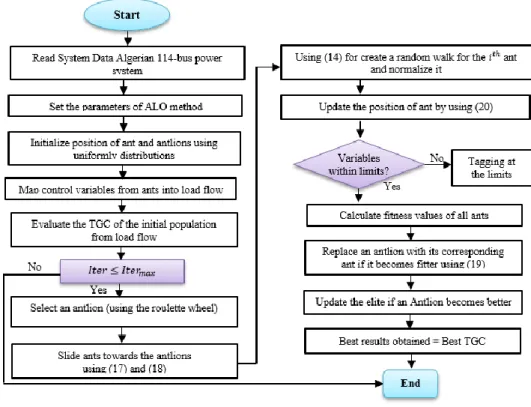
In order to show the performance and efficiency of the proposed algorithm ALO to solve optimization in the larger system dimensions, the OPF has been performed on the Algerian 114-bus system. This system network involves 15 generators, 175 lines, 16 tap changer transformers are located from line 160 to line 175 and 99 load bus of total demand are 3,727 MW and 2070 MVar. The economic and technical parameters of 15 generators in the of the Algerian 114-bus power system in Ref. [22]. In this study, the proposed algorithm has been applied on the system under two different simulation cases that are considered, with and without static VAR compensator (SVC) devices. In the two simulation cases, 30 independent runs were executed for establishing the superiority of the ALO method with the population size equal to NP = 40 and the maximal iterations are 200. The flowchart of the implementation of the proposed algorithm for solving the OPF problem that minimizes the total generation cost is shown in Figure 1.
Figure 1. Flowchart of the proposed algorithm applied to optimization
5.1. OPF for Algerian electrical network system without SVC devices
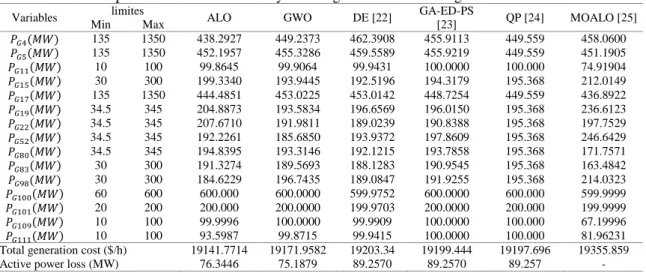
In this first case, we perform simulations on the Algerian 114-bus system without the SVC device. The objective function used is minimizing the fuel cost of 15 thermal generators and the vector of control variables contains the active powers generated as shown in (10). The optimization results obtained by the ALO algorithm compared with the grey wolf optimizer (GWO) and other optimization methods in the literature are tabulated in Table 1. The corresponding convergence of the proposed algorithm and GWO algorithm is shown in Figure 3.
Table 1. Comparison of TGC obtained by ALO algorithm and other algorithms in the literature
Variables limites ALO GWO DE [22] GA-ED-PS
[23] QP [24] MOALO [25]
Min Max
𝑃𝐺4(𝑀𝑊) 135 1350 438.2927 449.2373 462.3908 455.9113 449.559 458.0600
𝑃𝐺5(𝑀𝑊) 135 1350 452.1957 455.3286 459.5589 455.9219 449.559 451.1905
𝑃𝐺11(𝑀𝑊) 10 100 99.8645 99.9064 99.9431 100.0000 100.000 74.91904
𝑃𝐺15(𝑀𝑊) 30 300 199.3340 193.9445 192.5196 194.3179 195.368 212.0149
𝑃𝐺17(𝑀𝑊) 135 1350 444.4851 453.0225 453.0142 448.7254 449.559 436.8922
𝑃𝐺19(𝑀𝑊) 34.5 345 204.8873 193.5834 196.6569 196.0150 195.368 236.6123
𝑃𝐺22(𝑀𝑊) 34.5 345 207.6710 191.9811 189.0239 190.8388 195.368 197.7529
𝑃𝐺52(𝑀𝑊) 34.5 345 192.2261 185.6850 193.9372 197.8609 195.368 246.6429
𝑃𝐺80(𝑀𝑊) 34.5 345 194.8395 193.3146 192.1215 193.7858 195.368 171.7571
𝑃𝐺83(𝑀𝑊) 30 300 191.3274 189.5693 188.1283 190.9545 195.368 163.4842
𝑃𝐺98(𝑀𝑊) 30 300 184.6229 196.7435 189.0847 191.9255 195.368 214.0323
𝑃𝐺100(𝑀𝑊) 60 600 600.000 600.0000 599.9752 600.0000 600.000 599.9999
𝑃𝐺101(𝑀𝑊) 20 200 200.000 200.0000 199.9703 200.0000 200.000 199.9999
𝑃𝐺109(𝑀𝑊) 10 100 99.9996 100.0000 99.9909 100.0000 100.000 67.19996
𝑃𝐺111(𝑀𝑊) 10 100 93.5987 99.8715 99.9415 100.0000 100.000 81.96231
Total generation cost ($/h) 19141.7714 19171.9582 19203.34 19199.444 19197.696 19355.859
Active power loss (MW) 76.3446 75.1879 89.2570 89.2570 89.257 -
The optimal values of control variables, total generation cost, and active power losses are summarized in Table 2. Over 30 independent trial runs were executed in this case as shown in Figure 2. From this results obtained, the best value of total generation cost and active power losses by the proposed method are 19141.7714 $/h and 76.3446 MW respectively, these values are better than the results obtained by different algorithms previously reported in Table 1. The Figure 3, allows us to note, in the first place, that the method ALO converges towards the global optimum at the iteration 100 while the convergence of the GWO method is reached at the iteration 180. So, the results obtained showed the proposed method ALO superior and robust compared to the GWO method in terms of getting the best solution for solving the OPF problem.
Figure 2. Distribution of minimum total generation cost obtained for 30 trails by ALO
Figure 3. The Convergence of ALO and GWO for the Algerian 114-bus power system
19100 19200 19300 19400 19500 19600
Fue
l c
o
st
($/h)
Trial run number
20 40 60 80 100 120 140 160 180 200 1.9
1.95 2 2.05 2.1 2.15
2.2x 10
4
Nbr of Iteration
F
u
e
l C
o
s
t
($
/h
r)
ALO GWO
5.2. OPF for Algerian electrical network system with SVC devices
In this case, the SVC devices are implemented in the Algerian 114-bus system to improve the voltage profile and reduce the TFC. The vector of control variables, in this case, contains the active powers generated, the generator voltage and the reactive power injected by the SVC devices as shown in (11). The first optimal placement of the SVC device in the Algerian 114-bus system at bus N°89 (Souk Ahras), and bus N°68 (Sedjerara). The optimization results are given in Table 2.
Table 2. Optimization results obtained by ALO with different optimal placement of SVC
Variables Limites Without SVC SVC Bus N°89 SVC Bus N°89 SVC Bus N°68 & 89
Min Max
𝑃𝐺4(𝑀𝑊) 135 1350 439.6459 428.7504 422.0728 432.5625
𝑃𝐺5(𝑀𝑊) 135 1350 448.1696 435.1449 426.7332 439.0722
𝑃𝐺11(𝑀𝑊) 10 100 82.0231 93.1780 100.0000 100.0000
𝑃𝐺15(𝑀𝑊) 30 300 171.8617 223.7201 235.9225 229.0151
𝑃𝐺17(𝑀𝑊) 135 1350 443.1784 437.5715 420.1050 441.9554
𝑃𝐺19(𝑀𝑊) 34.5 345 209.4855 196.8190 184.4021 162.6831
𝑃𝐺22(𝑀𝑊) 34.5 345 186.9316 187.4384 167.9495 218.4372
𝑃𝐺52(𝑀𝑊) 34.5 345 216.0484 224.8141 221.2963 198.0932
𝑃𝐺80(𝑀𝑊) 34.5 345 232.0432 211.1695 198.3792 180.6525
𝑃𝐺83(𝑀𝑊) 30 300 192.5640 185.8489 224.2547 221.0994
𝑃𝐺98(𝑀𝑊) 30 300 165.8376 174.1723 186.9096 161.7763
𝑃𝐺100(𝑀𝑊) 60 600 599.9998 600.0000 600.0000 600.0000
𝑃𝐺101(𝑀𝑊) 20 200 199.9999 200.0000 200.0000 199,9999
𝑃𝐺109(𝑀𝑊) 10 100 99.9999 94.2300 99.2689 99.9999
𝑃𝐺111(𝑀𝑊) 10 100 99.9997 94.3467 99.9996 100.0000
Vmin 1 114 0.9023 0.9022 0.9273 0.9393
Qsvc68 (Mvar) -45 45 - 20.9076 - 20.9159
Qsvc89 (Mvar) -45 45 - - 33.4490 33.3790
Total generation cost ($/h) 19061.4915 19042.7382 19023.2724 18999.6809
Active power loss (MW) 60.7884 60.2037 60.2935 58.3467
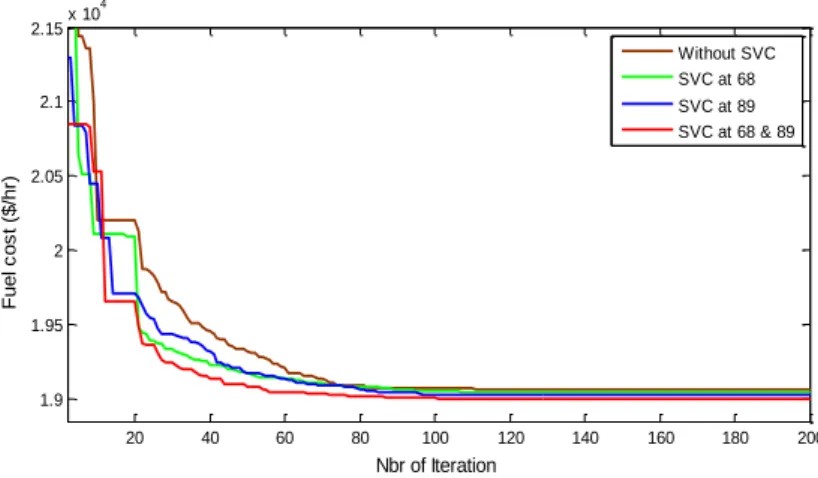
Table 2 shows the results of TFC and real power losses obtained by using the proposed algorithm in the case without and with SVC devices, separately or multiple in buses N°68 and N°89. From these results obtained, it can be observed that the presence of SVC devices in all cases improved considerably the TGC and active power loss. The convergence curve of the proposed algorithm is shown in Figure 4. From this figure, we notice that the algorithm ALO converges towards the global optimum at the iteration 100 for all cases study when the SVC devices installed.
Figure 4. Convergence plot of ALO methods in the Algerian 114 bus power system
On the other hand, SVC devices have managed to improve the voltage profile as shown in Figure 5, from this figure, it can be noted that the case without the presence of SVC, the two circles in this figure determine the two areas that have critical load bus voltage in Algeria 114-bus system. So, when the SVC
20 40 60 80 100 120 140 160 180 200
1.9 1.95 2 2.05 2.1 2.15x 10
4
Nbr of Iteration
F
u
e
l
c
o
s
t
($
/h
r)
Without SVC SVC at 68 SVC at 89 SVC at 68 & 89
devices were installed at busses 68 and 89 separately or multiple, the voltage values of this optimal emplacement were increased to 1 p.u as shown in Figure 5, respectively. Furthermore, this increment in the voltage values in the optimal placement of SVC allows for improving the voltage at the critical load buses compared to the previous case (without the presence of SVC device).
Figure 5. The effect of SVC device on the voltage profile in the Algerian 114-bus power system
6. CONCLUSION
In this paper, we have validated the new metaheuristic technique, called, Ant Lion Optimizer (ALO) for real and large scale Algerian 114-bus power system to solve optimal power flow (ORF) problem. The ALO algorithm was successfully applied to solve the OPF problem with and without SVC devices. From the results obtained in the case without the SVC device, the proposed algorithm has been the best result compared with the method developed by us, called, grey wolf optimization and other methods in the literature defined in this paper, like DE, GA-ED-PS, and OP. In the case with the presence of SVC devices, the ALO algorithm was used to identify the optimal sizing and placement of SVC devices in the Algerian 114-bus system based on the location of the lowest voltage load buses in the power system. The optimization results achieved by using the ALO algorithm with presence the of SVC devices given the best results to minimize the total fuel cost, reduce the active power losses and improving the voltage profile based on the optimal placement and sizing of SVC devices. Based on the results of both case studies in this paper, it can be concluded that the ALO algorithm is capable of solving the OPF problem for a large scale power system with and without the presence of SVC devices.
ACKNOWLEDGEMENTS
The authors would like to acknowledge the Research Management (RMC) UiTM Shah Alam, Selangor, Malaysia and the Ministry of Education, Malaysia (MOE) for the financial support of this research. This research is supported by MOE under Fundamental Research Grant Scheme (FRGS) with project code: 600-IRMI/FRGS 5/3 (082/2019).
REFERENCES
[1] J. Carpentier. Contribution to the economic dispatch problem. Bull Soc Fmnc Efeci, vol. 3, pp. 431–447, 1962.
[2] M. Ebeed, S. Kamel, and F. Jurado, Optimal power flow using recent optimization techniques. Elsevier Inc., 2018.
[3] K. Teeparthi and D. M. Vinod Kumar. Multi-objective hybrid PSO-APO algorithm based security constrained
optimal power flow with wind and thermal generators. Eng. Sci. Technol. an Int. J., vol. 20, no. 2, pp. 411–426,
2017.
[4] I. N. Trivedi, P. Jangir, S. A. Parmar, and N. Jangir. Optimal power flow with voltage stability improvement and
loss reduction in power system using Moth-Flame Optimizer. Neural Comput. Appl., vol. 30, no. 6, pp. 1889–1904,
2018.
[5] A. Mukherjee and V. Mukherjee. Solution of optimal power flow with FACTS devices using a novel oppositional
0,85 0,9 0,95 1 1,05 1,1 1,15
1 4 7 10 13 16 19 22 25 28 31 34 37 40 43 46 49 52 55 58 61 64 67 70 73 76 79 82 85 88 91 94 97
100 103 106 109 112
Vo
lt
ag
e p
ro
fi
le
(
pu
)
Bus N°
krill herd algorithm. Int. J. Electr. Power Energy Syst., vol. 78, pp. 700–714, 2016.
[6] J. Radosavljevic. Metaheuristic Optimization in Power Engineering. Metaheuristic Optim. Power Eng., no.
September, 2018.
[7] S. Mirjalili and A. Lewis. The Whale Optimization Algorithm. Adv. Eng. Softw., vol. 95, pp. 51–67, 2016.
[8] K. Lenin. Shrinkage of real power loss by enriched brain storm optimization algorithm. IAES Int. J. Artif. Intell.,
vol. 8, no. 1, pp. 1–6, 2019.
[9] A. A. A. Mohamed, Y. S. Mohamed, A. A. M. El-Gaafary, and A. M. Hemeida. Optimal power flow using moth
swarm algorithm. Electr. Power Syst. Res., vol. 142, pp. 190–206, 2017.
[10] E. Naderi, M. Pourakbari-Kasmaei, and H. Abdi. An efficient particle swarm optimization algorithm to solve
optimal power flow problem integrated with FACTS devices. Appl. Soft Comput. J., vol. 80, pp. 243–262, 2019.
[11] A. Hamzi and R. Meziane. Cat Swarm optimization to shunt capacitor allocation in algerian radial distribution
power system. IAES Int. J. Artif. Intell., vol. 7, no. 3, pp. 143–152, 2018.
[12] D. Prasad, A. Mukherjee, G. Shankar, and V. Mukherjee. Application of chaotic whale optimisation algorithm for
transient stability constrained optimal power flow. IET Sci. Meas. Technol., vol. 11, no. 8, pp. 1002–1013, 2017.
[13] X. Yuan et al.. Multi-objective optimal power flow based on improved strength Pareto evolutionary algorithm.
Energy, vol. 122, pp. 70–82, 2017.
[14] S. Duman. Symbiotic organisms search algorithm for optimal power flow problem based on valve-point effect and
prohibited zones. Neural Comput. Appl., vol. 28, no. 11, pp. 3571–3585, 2017.
[15] H. Pulluri, R. Naresh, and V. Sharma. Application of stud krill herd algorithm for solution of optimal power flow
problems. Int. Trans. Electr. Energy Syst., vol. 27, no. 6, pp. 9–12, 2017.
[16] M. G. Patel and U. L. Makwana. International Journal of Advance Engineering and Research Optimal Power Flow Using Modified Grey Wolf Optimizer. vol. 0, no. 1, pp. 1016–1023, 2018.
[17] K. Abaci and V. Yamacli. Differential search algorithm for solving multi-objective optimal power flow problem.
Int. J. Electr. Power Energy Syst., vol. 79, pp. 1–10, 2016.
[18] K. Lenin. Integrated algorithm for decreasing active power loss. IAES Int. J. Artif. Intell., vol. 7, no. 1, pp. 33–41,
2018.
[19] S. Mouassa, T. Bouktir, and A. Salhi. Ant lion optimizer for solving optimal reactive power dispatch problem in
power systems. Eng. Sci. Technol. an Int. J., vol. 20, no. 3, pp. 885–895, 2017.
[20] R. Kouadri, L. Slimani, T. Bouktir, and I. Musirin. Optimal power flow solution for wind integrated power in
presence of VSC-HVDC using ant lion optimization. Indones. J. Electr. Eng. Comput. Sci., vol. 12, no. 2, 2018.
[21] S. Mirjalili. The ant lion optimizer. Adv. Eng. Softw., vol. 83, pp. 80–98, 2015.
[22] L. Slimani and T. Bouktir. Optimal power flow solution of the algerian electrical network using differential
evolution algorithm. Telkomnika, vol. 10, no. 2, pp. 199–210, 2012.
[23] B. Mahdad and K. Srairi. Solving practical economic dispatch using hybrid GA-DE-PS method. Int. J. Syst. Assur.
Eng. Manag., vol. 5, no. 3, pp. 391–398, 2014.
[24] I. Ziane, F. Benhamida, and A. Graa. Dynamic Economic Load dispatch Using Quadratic Programming :
Application to Algerian Electrical Network. March, 2015.
[25] O. Herbadji, L. Slimani, and T. Bouktir. Optimal power flow with four conflicting objective functions using
multiobjective ant lion algorithm: A case study of the Algerian electrical network. Iran. J. Electr. Electron. Eng.,