Sharif University of Technology
Scientia IranicaTransactions C: Chemistry and Chemical Engineering www.scientiairanica.com
Study of self-diusion in two binary solutions,
glycerol-water and methanol-water using
diusion-ordered spectroscopy
E. Fadaei and M. Tafazzoli
Department of Chemistry, Sharif University of Technology, Tehran, P.O. Box 11155-9516, Iran. Received 9 August 2015; received in revised form 10 December 2015; accepted 3 January 2016
KEYWORDS Self-diusion; DOSY NMR; Glycerol; Methanol;
Concentration eect; Temperature eect.
Abstract. The concentration and temperature behaviors of the self-diusion coecient were analyzed in glycerol-water and methanol-water solutions using Diusion-Ordered Spectroscopy (DOSY) experiment. Our results indicate that the self-diusion coecient dips with increasing concentration and decreasing temperature. The concentration behavior shows that there is hydrogen bond interaction between water and alcohol, which declines the self-diusion coecients of both in the aqueous binary mixtures. The self-diusion activation energies were estimated 13.6, 29.4, and 32.8 (kJ/mol) for methanol and 24.8, 25.5, and 27.6 (kJ/mol) for water in the methanol-water solutions with 0.03, 0.10, and 0.20 mole fractions of methanol, respectively. The methanol self-diusion activation energy, in the very dilute methanol-water solution (0.03 mole fraction of methanol), is consistent with the formation of iceberg-like structure which helps methanol to diuse quickly. The water self-diusion activation energies indicate that water network is not signicantly perturbed by methanol and the water molecules diuse in the same manner in methanol-water solutions.
© 2016 Sharif University of Technology. All rights reserved.
1. Introduction
The aqueous solutions of alcohols such as methanol, ethylene glycol, and glycerol are commonly used as cryoprotectant to protect biological molecules, cells, and tissues from the freezing damages [1-3].
Methanol is also well-known as an amphiphilic molecule which has both hydrophobic (CH3) and
hy-drophilic (OH) groups and it is suitable for studying the interaction of the proteins in the biological systems [4]. Dierent computational and experimental meth-ods have previously been used to study the molecular structure of the alcohol solutions. These methods include molecular dynamics [5], neutron diraction [6],
*. Corresponding author. Fax: +98 21 66029165 E-mail addresses: e [email protected] (E. Fadaei); [email protected] (M. Tafazzoli)
infrared spectroscopy [7], Raman spectroscopy [4], terahertz time-domain spectroscopy [8], dielectric troscopy [9], and nuclear magnetic resonance spec-troscopy [10]. In spite of numerous studies, the dy-namical and structural properties of alcohol solutions are not still entirely understood. From previous results, it is obvious that the inuence of the alcohol on the hydrogen bonding network of water plays a key role in the physicochemical properties of these solutions [5,11-15].
Self-diusion of molecules is due to their ran-dom translational motions which are driven by in-ternal kinetic energy [16]. This type of diusion takes place in the absence of concentration (or chem-ical potential) gradient. Since self-diusion coe-cient of a single molecule is related to the molec-ular structure and solute-solvent interactions, it is a signicant physicochemical property which helps
NMR experiment which measures the self-diusion coecient of each component in the mixture, sepa-rately [26]. The self-diusion coecient (D) obtained by this technique is described, theoretically, with Stokes-Einstein equation (Eq. (1)) [16]:
D =6rkBT
s; (1)
where kB is the Boltzmann constant, T the
temper-ature, the viscosity of the solution, and rs the
hydrodynamic radius of the molecule.
Temperature and concentration are two principal factors that inuence the self-diusion coecient. In the previous research, the role of the mentioned factors has been studied in the aqueous solutions [9,11,20,27-29]. According to the previous works, the dynamic behavior of water and alcohol in their aqueous mixtures strongly depends on the concentrations of alcohol-water solutions. The alcohol systems have various behaviors in dierent ranges of concentration.
Towey and Dougan have investigated the glycerol solutions in both low- and high-concentration ranges. Their results indicate that, in the dilute solution, the hydrogen bond network is highly mixed between glycerol and water [6]. Moreover, in the concentrated solutions, the water-water hydrogen bonds are signif-icantly perturbed and water molecules take the place of the glycerol molecules in their network. Also, there are a number of studies which investigate the structure of water-methanol binary mixtures in dierent concen-tration ranges. Li et al. have identied three critical composition ranges for studying the molecular struc-ture of alcohol solution. They found that methanol solution has dierent structures at mole fractions of 0.1, 0.3, and 0.7 [8].
However, the eect of concentration and temper-ature on the self-diusion of components in water-glycerol and water-methanol mixtures has not been extensively studied, experimentally.
In this work, we examined the molecular behavior of the aqueous solution of glycerol as a sugar alcohol and methanol as an amphiphilic molecule at dierent concentrations and temperatures with measuring the self-diusion coecient using DOSY NMR experiment. The present results provide insights into the mechanism of the dependence of water and alcohol
self-of 0.008, 0.03, 0.1, and 0.2. D2O (purity>99.8)
was used as solvent in solution preparation for NMR measurements.
The self-diusion coecients were measured by diusion-order NMR spectroscopy. All 1H DOSY
experiments were carried out on a Bruker Avance-500 spectrometer. The pulse sequence of longitudinal eddy current delay with 2 spoil bipolar gradient pulses (ledbpgp2s) [30] was used for all samples. The eddy current and the gradient recovery delay were kept at xed values of 5 and 0.1 ms, respectively. The pulse eld gradient duration () varied from 1.8 to 2 ms. The diusion period () varied from 70 to 100 ms. The strength of the pulse eld gradient increased, gradually, from 2 to 95% of maximum value in 16 steps. The parameters and were optimized so that the intensity of signals can decrease one order of magnitude when eld gradient increases from 2% to 95%. The signal exponential decay is described by the Stejskal-Tanner expression:
I = I0exp
Dq2
3
; (2)
where I is the signal intensity (or integral) and I0 is
the initial signal intensity (or integral); q = HG,
where H is the magnetogyric ratio for 1H and G is
the gradient magnitude [31,32]. The temperature of the sample was carefully controlled with a Bruker BT-3000 unit. It was kept at 298.0 K in Section 3.1 to study the concentration eect, and it varied from 293.0 to 308.0 K in Section 3.2 to study the temperature eect on the self-diusion coecients.
The self-diusion coecients of glycerol and methanol were measured by following CH2 and CH3
NMR signals at chemical shifts of 3.68 and 3.17, respectively. Also, the self-diusion coecient of water was determined by following the NMR signal of OH protons at chemical shifts of 4.72 and 4.76 for glycerol and methanol solutions, respectively. All data processing and analyzing were done with XWINNMR (Beta version 3.5). Finally, log D of each component was obtained from the DOSY map.
In order to conrm correctness of our results, the logarithm of water diusion coecient (logD) measured by DOSY experiment was compared with the corresponding data reported in the previous litera-ture [33]; the uncertainty was 0.14%.
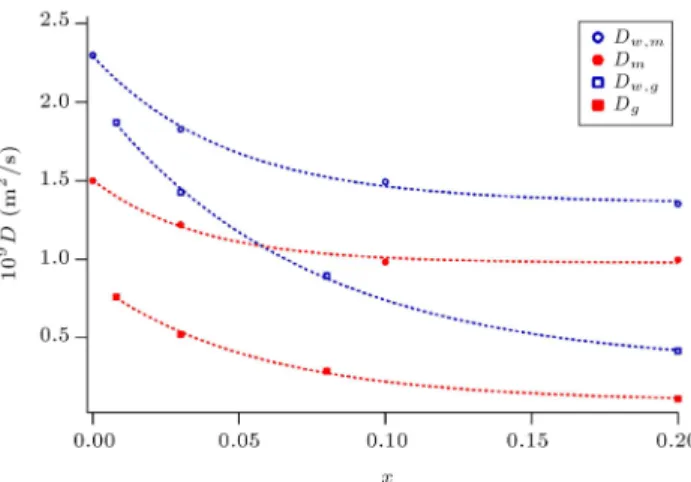
Figure 1. Self-diusion coecients versus mole fraction of alcohols. Water self-diusion coecient in glycerol-water solutions, Dw;g, glycerol self-diusion coecient in
glycerol-water solutions, Dg, water self-diusion coecient
in methanol-water solutions, Dw;m, and methanol
self-diusion coecient in methanol-water solutions, Dm.
The data at x = 0 for methanol solution was calculated from Eq. (3). The dashed lines show interpolation of the experimental data (Eq. (3)).
3. Results and discussion
3.1. Concentration dependence of the self-diusion coecient
In order to examine concentration eect on molecular behavior of the alcohol solutions, the self-diusion coecients of water (Dw), glycerol (Dg), and methanol
(Dm) were measured in binary mixtures of
glycerol-water (0.008, 0.03, 0.08, and 0.2 glycerol mole frac-tions) and methanol-water (0.03, 0.1, and 0.2 methanol mole fractions).
Figure 1 depicts the variation of self-diusion coecients of water and alcohols versus mole fraction of alcohol, x, in the solutions mentioned above. The self-diusion coecients were measured using DOSY NMR experiments at 298.0 K.
The experimental data of the concentration be-havior of both glycerol and methanol solutions was well tted by Eq. (3) (Figure 1) which had been before by D'Errico et al. [20] to describe concentration dependence of the diusion coecient:
D =A Bx1 + Cx; (3)
D is the self-diusion coecient of the components (glycerol, methanol, or water) and x is the mole fraction of alcohol. A, B, and C are the equation constants.
Apart from magnitude, the variation of the self-diusion coecient of water and alcohols has a similar trend. The self-diusion coecients decrease as mole fraction of alcohol increases. This trend indicates that there is a signicant interaction between water and
Figure 2. 3D exhibition of glycerol molecular structure.
alcohol that causes the self-diusion of both water and alcohol to decrease. This trend has also been reported in previous studies [8,20,34].
According to the previous research, three types of hydrogen bonds can be formed in the water-alcohol solutions: water-water (w-w), water-water-alcohol (w-s), and alcohol-alcohol (s-s) hydrogen bonds. In dilute methanol and glycerol solutions studied in this work, the w-w and w-s hydrogen bonds are the most important kinds of hydrogen bonds [6]. Therefore, we should concentrate on these kinds of the hydrogen bonds to understand how the hydrogen bonds inuence the molecular behavior of glycerol-water and methanol-water solutions.
3.1.1. Behavior of the glycerol solution
As seen in Figure 1, the water and glycerol self-diusion coecient decreases sharply in the lower glycerol mole fractions. It depicts the existence of strong bonds between water and glycerol which retards the molecular diusion.
As seen in Figure 2, the glycerol molecule has three hydroxyl groups. According to the computational analysis, these hydroxyl groups are capable to form a maximum of six hydrogen bonds [6].
Glycerol molecules with three hydroxyl groups can attract water molecules in their hydrogen bonding sites. As a result, water self-diusion is controlled by glycerol diusion, and water molecules slow down very fast. This trend is also observed for glycerol. It seems that glycerol has also tendency to bond with water molecules, strongly. According to the ndings of Towey and Dougan [6], glycerol molecules have tendency to form hydrogen bonds with water molecules more than themselves. Towey and Dougan have compared the number of hydrogen bonds per water and glycerol molecules in dilute solutions with that in their pure liquids. They have asserted that the number of water-glycerol hydrogen bonds compensates for reduction in the water-water hydrogen bonds in the dilute solutions. Therefore, the number of hydrogen bonds per water molecules remains constant (3.7 hydrogen bonds). In other words, the glycerol molecules can participate in the water hydrogen bond network like water molecules.
number of water molecules. The high tendency of the water and glycerol to form hydrogen bonds causes the water molecules to be kept by glycerol tightly. This makes the water and glycerol molecules move hardly. As a result, the self-diusion coecients decrease as the glycerol concentration increases.
As seen in Figure 1, the self-diusion coecient of water and glycerol decreases with a slighter slope where concentration increases up to the mole fraction of 0.20. It seems that the hydrogen bonds between water and glycerol change in higher concentrations. Glycerol has three hydroxyl groups and it is capable to form six hydrogen bonds [9]. The hydrogen-bonding sites could be occupied entirely by water molecules in more diluted solutions, because there are a large number of free water molecules which can occupy glycerol binding sites. As concentration increases, some of the hydrogen-bonding sites of the glycerol remain unoccupied (or may be occupied by glycerol molecules). Thereafter, the water and water-glycerol hydrogen bonds are aected by concentration, weakly, when the solution becomes concentrated (up to x = 0:20). As a result, Dw and Dg decrease with
a slighter slope in higher concentration rather than those in dilute solutions. Additionally, the molecular dynamics simulations have shown that the water-water hydrogen bonding lifetime increases when glycerol mole fraction increases [5]; as a consequence, the water molecules remain in their hydrogen bonds network for a longer time. They are not widely available for the glycerol molecules in concentrated solutions (about 0.20 mole fraction of glycerol) compared to very dilute solutions (about 0.03 mole fraction of glycerol). It also causes a fewer number of hydrogen bonds per glycerol. It makes Dwand Dgdecrease slower in higher
concentrations.
Another point in Figure 1 is that Dw tends to
Dg in the concentrated solutions. As mole fraction of
glycerol increases, a point is reached, in which glycerol molecules attract all of the water molecules on their hydrogen bonding sites. At this point, the number of water molecules is fewer than the number of glycerol hydrogen bonding sites. In these conditions, there are no eective free water molecules and all of them are bonded to glycerol. Thus, water diusion will be controlled by glycerol, entirely. As we expect, the larger molecules diuse slower than molecules with
Methanol is an amphiphilic molecule which has a hydrophobic head more than its hydrophilic head. Therefore, the methanol interactions in the aqueous mixture are not easy to be understood. Methanol is capable to form 1:1 compound through the hydrogen bonding interactions with water, and aects the water network, weakly. This interaction impacts just on the rst hydration shell and does not extend to the bulk [12]. Also, the methanol molecules are strongly solvated by a cage of water due to the hydrophobic forces [34]. However, in low concentrations, there is a slight preference for hydrophilic interactions through the hydrogen bonds. Additionally, since the water molecules are enough in the dilute solutions, the hydra-tion shell would be formed and the methanol clusters cannot be formed [34]. Hence, the hydrogen bonds between water and methanol are the major kind of interactions which interpret the behavior of the system. As seen in Figure 1, Dm is larger than Dg at
all concentrations. It is a consequence of smaller size and less steric hindrance of the methanol than those of glycerol that helps it to diuse faster according to Stokes-Einstein equation (Eq. (1)). In the case of water self-diusion, the number of water molecules, which are bonded to glycerol in the glycerol-water solution, is much more than those bonded to methanol in the methanol-water solution. Therefore, the wa-ter molecules motions are more retarded by alcohol molecules in glycerol-water solution than in methanol-water solution. Hence, the methanol-water self-diusion coe-cient exponentially dips and converges to glycerol self-diusion coecient faster than methanol self-self-diusion coecient.
3.2. Temperature dependence of the self-diusion coecient
In order to further examine the molecular behavior of glycerol and methanol solutions, the temperature eect was studied by measuring the self-diusion coecients of water, glycerol, and methanol in glycerol-water and methanol-water solutions (with alcohol mole fraction of 0.03) using DOSY NMR; temperature varied from 293.0 to 308.0 K.
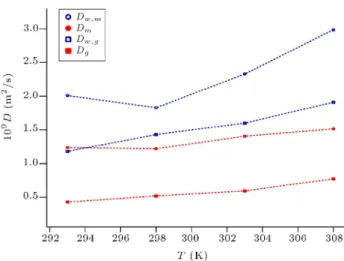
As shown in Figure 3, the self-diusion coecients increase as the temperature increases. This result is consistent with Stokes-Einstein equation (Eq. (1)). Based on this relation, the self-diusion coecient
Figure 3. Temperature dependence of the self-diusion coecient. Water self-diusion coecient in glycerol-water solutions, Dw;g, glycerol self-diusion coecient in
glycerol-water solutions, Dg, water self-diusion coecient
in methanol-water solutions, Dw;m, and methanol
self-diusion coecient in methanol-water solutions, Dm.
The dashed lines are just used to guide the eyes.
is larger in higher temperatures. As expected, the thermal motions of the molecules increase as the temperature rises.
Although the self-diusion deviates from the Stokes-Einstein relation in some cases, it obeys the relation in the temperature ranges studied in this work (above 290 K) [35].
Moreover, the lifetimes of the w-w and w-s hy-drogen bonds (time that two molecules remain con-tinuously hydrogen bonded) decrease as temperature increases [5]. It conrms that the molecules break down their hydrogen bonds faster and release them from the hydrogen bond network easier with temperature rising. Thus, the self-diusion coecients increase as temperature increases.
The measured self-diusion coecients show an Arrhenius temperature behavior as:
D = D0exp
Ea
RT
; (4)
where Ea is activation energy of self-diusion, R is the
gas constant equal to 8.314 (J/mol.K), and D0 is a
parameter allocated to the pre-exponential factor in Arrhenius relation. This temperature behavior has also been reported for diusion in other similar solutions like ethanol [36]. Figure 4 shows interpolation of our experimental data according to the natural logarithm of Arrhenius equation (Eq. (4)).
Approximate values of self-diusion activation energy of water and alcohols in glycerol-water and methanol-water (with 0.03 mole fraction of alcohol) were extracted from Eq. (4). The estimated values are summarized in Table 1.
Figure 4. lnD versus 1=T . Water self-diusion coecient in glycerol-water solutions, Dw;g, glycerol self-diusion
coecient in glycerol-water solutions, Dg, water
self-diusion coecient in methanol-water solutions, Dw;m, and methanol self-diusion coecient in
methanol-water solutions, Dm. The lines show
interpolation of experimental data (Eq. (4)). Table 1. Self-diusion activation energies of alcohol (Ea;s) and water (Ea;w) in glycerol-water and
methanol-water solutions (with 0.03 mole fraction of alcohol) obtained by curve tting (Eq. (4)).
Solution Ea;s/kJ mol 1 Ea;w/kJ mol 1
Glycerol-water 28:0 2:0 23:0 1:0 Methanol-water 13:0 3:0 25:0 0:9
As seen in Table 1, the self-diusion activation energy values of water in two solutions are almost close to each other. This result suggests the same mechanism for water diusion in two solutions. In con-trast, the self-diusion activation energy of methanol is signicantly lower than that of glycerol. It suggests a dierent mechanism for methanol diusion.
3.2.1. Temperature behavior of the methanol solution in dierent concentrations
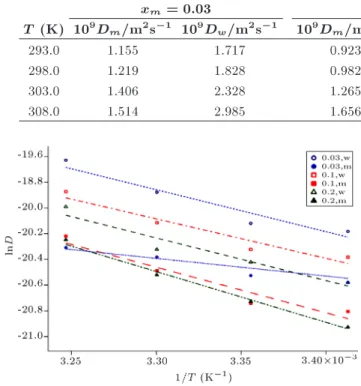
In order to further explore the reasons of the dierent temperature behaviors of methanol, we also investigate the temperature eect on the methanol solutions with dierent concentrations (0.03 to 0.20 mole fractions of methanol). The self-diusion coecients measured using DOSY NMR are summarized in Table 2.
The Arrhenius plots of the measured self-diusion coecients are illustrated in Figure 5 and activation energies are summarized in Table 3.
Ea;w is approximately the same in all solutions
and it just increases by 11%, while Ea;m increases by
148% as mole fraction of methanol increases from 0.03 to 0.20. This result depicts that water diuses in the same mechanism in three solutions but methanol has a dierent behavior.
en-Figure 5. lnD versus 1=T for methanol (solid markers) and water (open markers) in methanol-water solutions with methanol mole fractions of 0.03 (circles), 0.10 (squares), and 0.20 (triangles). Lines show interpolation of the experimental data (Eq. (4)).
Table 3. Self-diusion activation energy of methanol (Ea;m) and water (Ea;w) in methanol-water solutions
(with dierent methanol mole fractions) obtained by curve tting (Eq. (4)).
Methanol mole fraction
Ea;m/kJ mol 1 Ea;w/kJ mol 1
0.03 13:606 0:029 24:811 0:087 0.10 29:431 0:066 25:540 0:057 0.20 32:783 0:028 27:552 0:064
ergy of methanol is signicantly low (13.606 kJ mol 1)
in very dilute solution (mole fraction of 0.03). It shows that methanol diuses freely in this concentration. It can be concluded that diusion mechanism of methanol molecules in this composition is dierent from those of the other two solutions.
The water-methanol hydrogen bonds in diluted solutions are stronger than water-water hydrogen bonds [37]. As seen in Table 3, while the self-diusion activation energy of methanol is more than those of water solutions with 0.1 and 0.2 mole fractions of methanol, this value is smaller than that of water in the solution with 0.03 mole fraction of methanol. This data conrms that hydrogen bonding network in the
solution with 0.03 mole fraction is completely dierent from those in the other two solutions. It seems that water-methanol hydrogen bonds are not formed signif-icantly in the very dilute solution. Although numerous studies have investigated the diusion mechanism of methanol in very dilute solutions, it is not still entirely understood. Lin et al. have suggested four dierent mechanisms depending on the concentration range of the alcohol solutions. For very dilute methanol solution (below the mole fraction of 0.1), they have conrmed the formation of iceberg-like as a possible mechanism to interpret the unusual behavior of methanol [4]. In this mechanism, the water molecules, around methanol, form hydrogen bonds with themselves because of hy-drophobic eect of CH3 group of methanol molecules.
This will free up space for methanol to diuse more freely and more quickly. As a result, the self-diusion activation energy of methanol is signicantly low in very dilute solutions (0.03 mole fraction of methanol solution studied in this work) (Table 3). Corsaro et al. have also conrmed that water molecules in very diluted solutions prefer to make hydrogen bond with themselves rather than methanol molecules. This conclusion also conrms the easy and fast diusion of methanol molecules [38].
For other water-methanol solutions (with 0.1 and 0.2 methanol mole fractions), the structural properties of methanol solutions can be explained by hydrogen bonding. As mentioned before, in dilute solutions, methanol molecules form hydrogen bonds which aect only the rst hydration shell of the water, and the tetrahedral structure of water remains constant in the bulk. Therefore, the water molecules diuse approx-imately in the same manner in dierent solutions. Otherwise, the methanol molecules tend to form much more hydrogen bonds with water molecules when the mole fraction of methanol increases. In more con-centrated solutions, the structure of water molecules is disrupted slightly. This small perturbation occurs in the water network as much as the rst hydration shell is formed around the methanol molecules. As a result, thermal motions of the methanol are retarded and Ea;m increases. At very low temperatures, the
methanol clusters may be formed. This matter should be noticed to investigate the structure of the solutions at lower temperatures [13]. The molecular behavior
of water and alcohols in aqueous binary mixture at very low temperatures is important in the case of their cryoprotection applications. However, study of the molecular dynamics from the hydrogen bonding viewpoint is valuable in other dierent applications of these solutions.
4. Conclusion
In this study, the eect of concentration and tempera-ture on the self-diusion coecient of water, glycerol, and methanol in glycerol-water and methanol-water solutions was investigated by DOSY NMR experiment. Decreasing the self-diusion coecients of both wa-ter and alcohol as mole fraction of alcohol increases indicates that there are hydrogen bond interactions between water and alcohol, which cause slower diusion for both. In the case of glycerol-water solution, the larger number of water molecules bonded to glycerol causes a sharper decline in the self-diusion coecient in very dilute glycerol solutions than in concentrated solutions. It also causes a steeper decrease of the self-diusion coecient of glycerol than that of methanol, which can form one hydrogen bond with water.
Self-diusion coecients increase as temperature rises, which is due to temperature dependence of molecules' thermal motions. In the case of methanol-water solution, the temperature analyses also show that in the dilute solutions (studied in this work), water diuses in the same manner, but methanol's mecha-nism varies in dierent concentrations. The estimated activation energy of the self-diusion provides insights into the hydrogen bond network of the methanol and water in methanol-water solutions. Our ndings are consistent with previous studies, which suggest the formation of iceberg-like structure in the methanol-water solution. This structure helps methanol to diuse faster in the very dilute solution used in this study (0.03 mole fraction of methanol).
Acknowledgment
The authors are grateful to the research vice-president of Sharif University of Technology for nancial support. Also, they appreciate IDB for providing the grant for purchasing the NMR instrument.
References
1. Pagliaro, M. and Rossi, M. \Glycerol: Properties and production", The Future of Glycerol, pp. 20-21 (2010). 2. Lahnsteiner, F., Weismann, T. and Patzner, R.A. \Methanol as cryoprotectant and the suitability of 1.2 ml and 5 ml straws for cryopreservation of semen from salmonid shes", Aquaculture Research, 28(6), pp. 471-479 (1997).
3. Dashnau, J.L., Nucci, N.V., Sharp, K.A. and Van-derkooi, J.M. \Hydrogen bonding and the cryopro-tective properties of glycerol/water mixtures", The Journal of Physical Chemistry B, 110(27), pp. 13670-13677 (2006).
4. Lin, K., Hu, N., Zhou, X., Liu, S. and Luo, Y. \Re-orientation dynamics in liquid alcohols from Raman spectroscopy", Journal of Raman Spectroscopy, 43(1), pp. 82-88 (2012).
5. Zhang, N., Li, W., Chen, C., Zuo, J. and Weng, L. \Molecular dynamics study on water self-diusion in aqueous mixtures of methanol, ethylene glycol and glycerol: investigations from the point of view of hydrogen bonding", Molecular Physics, 111(7), pp. 939-949 (2013).
6. Towey, J.J. and Dougan, L. \Structural examination of the impact of glycerol on water structure", The Journal of Physical Chemistry B, 116(5), pp. 1633-1641 (2011).
7. Nishi, N., Takahashi, S., Matsumoto, M., Tanaka, A., Muraya, K., Takamuku, T. and Yamaguchi, T. \Hydrogen-bonded cluster formation and hydrophobic solute association inaqueous solutions of ethanol", The Journal of Physical Chemistry, 99(1), pp. 462-468 (1995).
8. Li, R, D'Agostino, C., McGregor, J., Mantle, M.D., Zeitler, J.A. and Gladden, L.F. \Mesoscopic structur-ing and dynamics of alcohol/water solutions probed by terahertz time-domain spectroscopy and pulsed eld gradient nuclear magnetic resonance", The Journal of Physical Chemistry B, 118(34), pp. 10156-10166 (2014).
9. Puzenko, A., Hayashi, Y., Ryabov, Y.E., Balin, I., Feldman, Y., Kaatze, U. and Behrends, R. \Relaxation dynamics in glycerol-water mixtures: I. glycerol-rich mixtures", The Journal of Physical Chemistry B, 109(12), pp. 6031-6035 (2015).
10. Makoto, U., Harada, M., Tsukahara, T. and Okada, T. \Behavior of polyhydric alcohols at ice/liquid inter-face", The Journal of Physical Chemistry C, 117(47), pp. 24873-24882 (2013).
11. Weng, L., Chen, C., Zuo, J. and Li, W. \Molecular dynamics study of eects of temperature and concen-tration on hydrogen-bond abilities of ethylene glycol and glycerol: implications for cryopreservation", The Journal of Physical Chemistry A, 115(18), pp. 4729-4737 (2011).
12. Dlugoborski, T., Hawlicka, E. and Swiatla-Wojcik, D. \Eect of a solute on water properties-MD simulation studies", Journal of Molecular Liquids, 85(1), pp. 97-104 (2000).
13. Corsaro, C., Spooren, J., Branca, C., Leone, N., Broc-cio, M., Kim, C., Chen, S.H., Stanley, H.E. and Mal-lamace, F. \Clustering dynamics in water/methanol mixtures: A nuclear magnetic resonance study at 205 K< T< 295 K", The Journal of Physical Chemistry B, 112(34), pp. 10449-10454 (2008).
application of NMR diusion studies", In Modern Mag-netic Resonance, pp. 135-143, Springer, Netherlands (2006).
17. Williams, J.W. and Cady, L.C. \Molecular diusion in solution", Chemical Reviews, 14(2), pp. 171-217 (1934).
18. Hills, E.E., Abraham, M.H., Hersey, A. and Bevan, C.D. \Diusion coecients in ethanol and in water at 298K: Linear free energy relationships", Fluid Phase Equilibria, 303(1), pp. 45-55 (2011).
19. Chen, Q., Wang, Q., Liu, Y.C. and Wu, T. \The eect of hydrogen bonds on diusion mechanism of water inside single-walled carbon nanotubes", The Journal of Chemical Physics, 140(21), pp. 214507 (2014). 20. D'Errico, G., Ortona, O., Capuano, F. and Vitagliano,
V. \Diusion coecients for the binary system glyc-erol+ water at 25C. A velocity correlation study",
Journal of Chemical & Engineering Data, 49(6), pp. 1665-1670 (2004).
21. Chen, N. and Chan, T.C. \Experimental study of hydrogen bonding by mutual diusion", Chem. Com-mun., 7, pp. 719-720 (1997).
22. Karmazina, T.V., Kavitskaya, A.A., Slisenko, V.I., Petrachkov, A.A. and Vasilkevich, A.A. \Changing of mechanisms of self-diusion of water molecules under nanoltration of electrolyte solution", Desalination, 184(1), pp. 337-345 (2005).
23. Almasy, L, Banki, P., Bellissent-Funel, M.C., Bokor, M., Cser, L., Jancso, G., Tompa, K. and Zanotti. J.M. \QENS and NMR studies of 3-picoline-water solutions", Applied Physics A, 74(1), pp. s516-s518 (2002).
24. Mills, R. \Self-diusion in normal and heavy water in the range 1-45", The Journal of Physical Chemistry,
77(5), pp. 685-688 (1973).
25. Masaro, L., Zhu, X.X. and Macdonald, P.M. \Self-diusion of oligo-and poly (ethylene glycol)s in poly (vinyl alcohol) aqueous solutions as studied by pulsed-gradient NMR spectroscopy", Macromolecules, 31(12), pp. 3880-3885 (1998).
26. Johnson, C.S. \Diusion ordered nuclear magnetic resonance spectroscopy: Principles and applications", Progress in Nuclear Magnetic Resonance Spectroscopy, 34(3), pp. 203-256 (1999).
27. Chen, C., Li, W.Z., Song, Y.C., Weng, L.D. and Zhang, N. \Concentration dependence of water self-diusion coecients in dilute glycerol-water binary
glycerol", Physical Review Letters, 96(14), pp. 145502 (2006).
30. Wu, D., Chen, A. and Johnson, C.S. \An improved diusion-ordered spectroscopy experiment incorporat-ing bipolar-gradient pulses", Journal of Magnetic Res-onance, Series A, 115(2), pp. 260-264 (1995). 31. Morris, K.F. and Johnson Jr, C.S. \Diusion-ordered
two-dimensional nuclear magnetic resonance spec-troscopy", Journal of the American Chemical Society, 114(8), pp. 3139-3141 (1992).
32. Morris, G.A. \Diusion-ordered spectroscopy", In En-cyclopedia of Nuclear Magnetic Resonance, David M. Grant and Robin K. Harris, Eds., 9, pp. 35-44, John Wiley & Sons, Ltd, Chichester (2002).
33. Holz, M. and Weingartner, H. \Calibration in accurate spin-echo self-diusion measurements using 1H and
less-common nuclei", Journal of Magnetic Resonance, 92(1), pp. 115-125 (1991).
34. Price, W.S., Ide, H. and Arata, Y. \Solution dynamics in aqueous monohydric alcohol systems", The Jour-nal of Physical Chemistry A, 107(24), pp. 4784-4789 (2003).
35. Xu, L., Mallamace, F., Yan, Z., Starr, F.W., Buldyrev, S.V. and Stanley, H.E. \Appearance of a fractional Stokes-Einstein relation in water and a structural interpretation of its onset", Nature Physics, 5(8), pp. 565-569 (2009).
36. Kholmirzo, K., Dushanov, E., Yasuoka, K., Khalil, H., Galal, A., Ahmed, S., Sweilam, N. and Moharram, H. \Molecular dynamics simulation of the interaction of ethanol-water mixture with a Pt surface", Natural Science, 3(12), pp. 1011-1021 (2011).
37. Zhang, N., Shen, Z., Chen, C., He, G. and Hao, C. \Eect of hydrogen bonding on self-diusion in methanol/water liquid mixtures: A molecular dynam-ics simulation study", Journal of Molecular Liquids, 203, pp. 90-97 (2015).
38. Corsaro, C., Maisano, R., Mallamace, D. and Dugo, G. \NMR study of water/methanol solutions as a function of temperature and concentration", Physica A: Statistical Mechanics and Its Applications, 392(4), pp. 596-601 (2013).
Biographies
Elham Fadaei is currently a PhD student in Physical Chemistry at Sharif University of Technology and works in the eld of NMR spectroscopy. She was
awarded as a talented student in both master and bach-elor's programs at Isfahan University of Technology in 2005-2011. She worked on Ion Mobility Spectrometry (IMS) as her master thesis.
Mohsen Tafazzoli received his PhD degree in 1992 from University of California at Davis, USA, under
supervision of Professor N.S. True. Presently, he is a Professor of Physical Chemistry at Sharif University of Technology, Teheran, Iran. His research involves studies of intermolecular interactions, both in liquid and gas phases and calculation of NMR parameters. Also, he is interested in structure characterization of Carbohydrates.