
The specific identification of faecal pellets
8
0
0
Full text
(2) 360. HILARY B. MOORE.. FIG. I.-Pellets of Syndosmya alba, X 60.. FIG. 3.-Pellets. FIG. 2.-Pellets nitida,. of Nucula. nucleus.. of Syndosmya X 36..
(3) IDENTIFICATION. 361. OF FlECALPELLETS.. or strong caustic soda without breaking down. On the other hand, the pellets of some of the planktonic forms such as Galanus, though quite definite in form, are much more easily destroyed, and are consequently not often identified except on the extreme surface of the mud. The pellets have been examined both by collecting those shed by animals while under observation, and also by clearing the rectum in oil, or-as in the case of Nucula-by embedding the rectum in paraffin wax, and sectioning it. Except where stated, the following descriptions are the result of the examination of a number of specimens. There is a suggestion in the case of forms such as Galanus and Euphausids that the nature of the pellets may depend to some extent on the type of food which has been eaten. Dodgson (1) has found variation in the colour of the f:Bces of Mytilus edulis according to the nature of the food. The following are the chief types distinguishable on this station. Nucula. The pellets of Nucula are voided in the form of a long rod of compact mud which breaks into lengths of 0.2 to 1.0 mm. or more, the breadth being about ,0,15 mm. in pellets from an individual 1 cm. long. The intestine of Nucula shows thickened longitudinal ridges with long cilia, and these form grooves in the smooth surface of the pellet, whose number and position vary according to the species (Fig. 3). These pellets are sufficiently firm to allow identification in muds laid down on the bottom for over fifty years (Moore, 5). Nucula tenuis. Fig. 4, A. Five very prominent equal longitudinal ridges; deeply cut, and the ventral pair are the most open.. all the grooves are '. Nucula nitidx. Fig. 4, B. Seven longitudinal ridges, the ventral one being smaller and sunk between the two on either side; none of the grooves are deeply cut, and in a rubbed or dirty pellet they may appear to be absent. Nucula nitida*-radiate form. Fig. 4, G. Only five longitudinal ridges, but they are of the nitida type, with the lateral and ventro-lateral ridges fused to form one broad ridge; the grooves are shallow and the ventral ridge slightly sunk as in N. nitida. Nucula nucleus and N. radiata. Fig. 4, D and F; and Fig. 3. Seven longitudinal ridges as in N. nitida, but more prominent and with the grooves more deeply cut-sometimes more deeply than shown in the figure and even so much so as to allow the ridges to be split off separately.. .N. *nitida. This form is distinct from N. radiata, but also according to its pellets distinct I am indebted to Mr. R. Winkworth for its identification.. from.
(4) 362. . HILARY. B. MOORE.. Fig. 4, P, shows diagrammatically the position of the grooves as seen m surface view, but identification of all these forms is easier by examination of the ends.. FIG. 4.-All x 200. A, Pellet of Nucula tenuis, end view: B, Pellet of N ucula nitida, end view: C, Pellet of N ucula nitida, radiate form, end view: D, Pellet of Nucula nucleus, end view: E, Pellet of Nucula sulcata., end view: F, Pellet of Nucula nucleus, plan of lower surface.. Nucula sulcata.* Fig. 4, E. Nine longitudinal ridges, separated by grooves of medium depth; ventral ridge deeply sunk as in Nucula nucleus.. the. * Although occurring on this ground, no fresh specimens were available, and the above' description and figure are from a single specimen supplied by Mr. A. C. Stephen from the east coast of Scotland..
(5) IDENTIFICATION. OF FLECAL PELLETS.. 363. Pecten septemradiatus. Fig. 5, A. This also voids its pellets in the form of a long rod, but the surface is less smooth than in Nucula, and frequently marked by transverse clefts so that the pellet breaks into short lengths. In section the pellet is triangular with rounded corners, one being usually sharper than the other two, and with slightly concave sides. From a specimen 3.5 em. acroffil the shell the pellets are about 0..6mm. broad and in lengths of one to three millimetres or more.. A. B ::E ::E .n. 6. ~IO. FED. Q. Q}:. 0 C. FIG. 5.-A, Pellet of Pecten septemradiatus, end view: B, Pellet of Syndosmya alba, seen from above: C, D, and E, Pellets of Syndosmya nitida, to same scale as B: F, Pellet of young Maldanid worm: G, Pellets of Maldanid-Rhodine sp.. Syndosmya alba. Fig. 5, B; and Fig. 1. The pellets are extremely uniform in shape, parallel-sided with rounded ends and circular in section; the surface is smooth and regular; the usual breadth is 0.25 to 0.3 mm., and the ratio of length to breadth about 1.75. Syndosmya nitida. Fig. 5,0, D, and E; and Fig. 2. Much less regular in form than S. alba, and frequently either tapered at one end or constricted at one or more points; surface smooth; narrower than S. alba, breadth 0.2 to 0.25 mm..
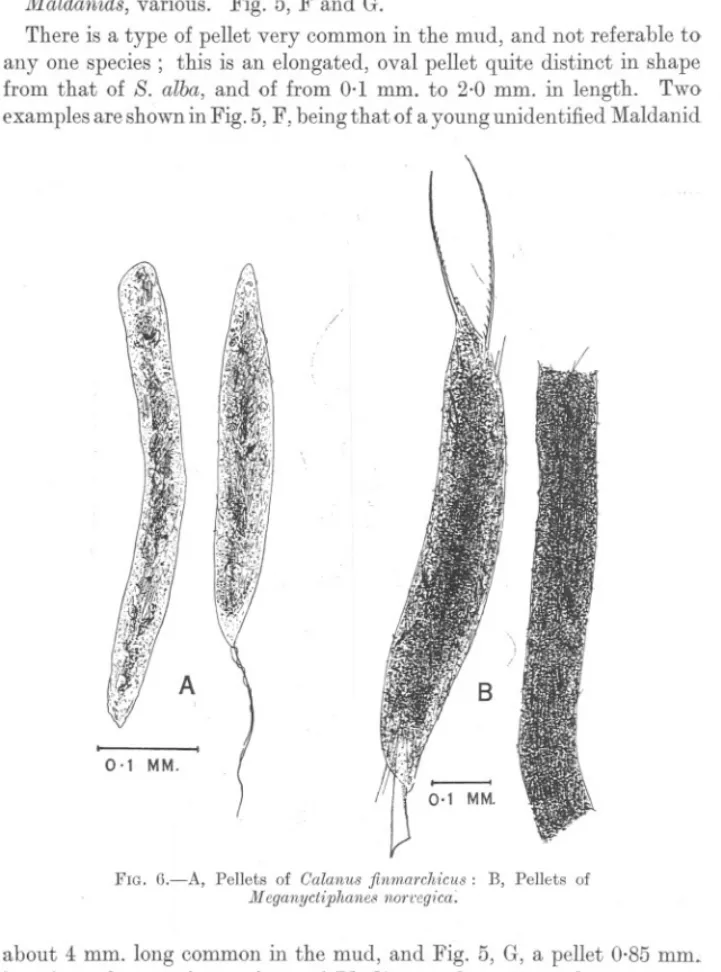
(6) 364. HILARY B. MOORE.. Maldanids, various. Fig. 5, F and G. There is a type of pellet very common in the mud, and not referable to anyone species; this is an elongated, oval pellet quite distinct in shape from that of S. alba, and of from 0.1 mm. to 2.0 mm. in length. Two examples are shown in Fig. 5, F, being that ofa young unidentified Maldanid. A 0.1. MM.. FIG. G.-A, Pellets of Calanu8 finmarchicus: JJI eganyctiphane8. B, Pellets of. norrcgica:. about 4 mm. long common in the mud, and Fig. 5, G, a pellet 0.85 mm. long from the gut of a specimen of Rhodine sp. about 10 em. long. Of the planktonic forms whose pellets may be found on the mud, Calanus is the most abundant; Sagitta, though very abundant, appears not to form a solid pelJet. Euphausids, and to a lesser extent Mysids and Crangonids, are common near the bottom, but it is only possible to describe a single type of pellet common to all three. -.
(7) IDENTIFICATION. OF F.ECAL. PELLETS.. 365. Calanus jinmarchicus. Fig. 6, A. This has a rather transparent pellet usually 0.05 to 0.1 mm. in breadth and 0.2 to 0.4 mm. long. They vary considerably in shape, but are always elongate. The ends may be broken off, but one or both is often rounded or pointed, and one often drawn out into a long clear" tail" (Fig. 6, A). The constitution of the pellets has been described by Marshall (3) who shows that it is largely composed of diatoms and other plankton organisms, including a certain amount of crustacean fragments. The pellet is usually most transparent towards either end. Euphausids. Fig. 6, B-i.e. Meganyctiphanes norvegica, Nyctiphanes couchii, and Thysanoessa raschii. These have pellets somewhat similar to those of Calanus, but larger and more opaque; the ends are sometimes rounded, but they are generally broken off and frayed; crustacean remains are frequent (Macdonald, 2), and large crustacean spines often project from either end of the pellet. They vary greatly in size, those of a 30 mm. Meganyctiphanes being about 0.1 to 0.15 mm. broad and up to 4 mm. long, though pellets collected on the bottom have always been found to be shorter than those shed in captivity. The above description applies also to the pellets of those Mysids and Crangonids occurring on this ground. REFERENCES. 1. DODGSON, R. W. Fishery Investigations.. Ser. II, Vol. X, No.1, 1928.. 2. MACDONALD, R. Food and Habits of Meganydiphanes norvegica. Journ. Mar. BioI. Assoc., N.S., Vol. XIV, No.3, 1927. 3. MARSHALL, S. M. The Food of Calanus jinmarchicus during 1923. Journ. Mar. BioI. Assoc., N.S., Vol. XII, No.2, 1924-. 4. MOORE,H. B. The Muds of the Clyde Sea Area. I. Nitrogen and Phosphate Content. Journ. Mar. BioI. Assoc., N.S., Vol. XVI, No.2,1930. 5. MOORE,H. B. The Muds of the Clyde Sea Area. Ill. Chemical and Physical Conditions; Rate and Nature of Sedimentation; and Fauna. Journ. Mar. BioI. Assoc., N.S., Vol. XVII, No.2, 1931..
(8)
(9)
Figure


Related documents
This essay asserts that to effectively degrade and ultimately destroy the Islamic State of Iraq and Syria (ISIS), and to topple the Bashar al-Assad’s regime, the international
National Conference on Technical Vocational Education, Training and Skills Development: A Roadmap for Empowerment (Dec. 2008): Ministry of Human Resource Development, Department
Marie Laure Suites (Self Catering) Self Catering 14 Mr. Richard Naya Mahe Belombre 2516591 [email protected] 61 Metcalfe Villas Self Catering 6 Ms Loulou Metcalfe
The corona radiata consists of one or more layers of follicular cells that surround the zona pellucida, the polar body, and the secondary oocyte.. The corona radiata is dispersed
○ If BP elevated, think primary aldosteronism, Cushing’s, renal artery stenosis, ○ If BP normal, think hypomagnesemia, severe hypoK, Bartter’s, NaHCO3,
Assessing the Impact of Biodiversity Conservation in the Management of Maize Stalk Borer (Busseola f
Field experiments were conducted at Ebonyi State University Research Farm during 2009 and 2010 farming seasons to evaluate the effect of intercropping maize with
The present herbarium contains the following types of Centaurea species: C.. Kerner (Fig.1) - a species which never acts like a ruderal and is characteristic for
