Working Paper No. 17
Appalachian Collaborative Center for Learning, Assessment and Instruction in Mathematics
The Social Construction of Rural Mathematics
Alan DeYoung
University of Kentucky
November 2003
Copyright © 2003 by the Appalachian Collaborative Center for Learning,
Assessment, and Instruction in Mathematics (ACCLAIM). All rights reserved. The Working Paper Series is published at Ohio University, Athens, Ohio by the ACCLAIM Research Initiative.
Funded by the National Science Foundation as a Center for Learning and Teaching, ACCLAIM is a partnership of the University of Tennessee (Knoxville), University of Kentucky (Lexington), Kentucky Science and Technology Corporation (Lexington), Marshall University (Huntington, WV), West Virginia University (Morgantown), the University of Louisville, and Ohio University (Athens).
ACCLAIM Research Initiative All rights reserved
Address: 119C McCracken Hall Ohio University Athens, OH 45701-2979 Office: 740-593-9869
Fax: 740-593-0477 E-mail: [email protected] Web: http://acclaim.coe.ohiou.edu
The Social Construction of Rural Mathematics
Final Report to ACCLAIM
by Alan DeYoung
University of Kentucky
Particular thanks are given to Lori Spencer, who transcribed the many interviews used in this work. Thanks also to Deana Duff, Kim Zeidler, and Ann Booth, who all also
The Social Construction Of Rural Mathematics
Final Report to ACCLAIM
Project Introduction
An announced aim of the research group for the Appalachian Collaborative
Center for Learning, Assessment and Instruction in Mathematics (ACCLAIM) is to
gather landscape information related to mathematics teaching and learning in rural
Appalachian high schools. Does context (i.e., rural and Appalachian) have meaningful
impacts upon the math instruction and outcomes in rural high schools? This small
research project aimed to give some preliminary data on these topics. The task as defined
was an exploratory one, and its focus was primarily interpretive and not statistical.
Entitled the “Social Reconstruction of Rural Mathematics,” the work that follows was
primarily interested in more subjective variables: perceptions, understandings and
interpretations of the meaning and use of mathematics among teachers, students and
administrators in two participating rural Kentucky high schools.
Some Methodological Considerations
As commissioned, the study focuses upon a “convenience” sample of two
Kentucky high schools and their math programs, along with teachers and students who
volunteered to be observed in classes and interviewed in the schools. There was also an
attempt to collect some basic documents related to school contexts, educational
achievement and schooling objectives during the past several years (2000-2003), and to
rationale and methodology, however, were qualitative. Such work is typically concerned
with discovering and uncovering persistent themes and orientations within self-contained
“cultural scenes,” like American high schools (Spradley, 1979). The role of the
researcher is not to test a hypothesis, but rather to describe and report upon lived
experiences as witnessed and understood by those within the cultural or sub-cultural
milieu (Bogdan and Biklen, 1998).
No research or researcher is in fact information or theory-free during data entry,
observation, or recording. Rather, the qualitative researcher is required to recognize,
consider, and declare sources affecting the research focus. In this work, the focus derives
very loosely from previous interests and research in rural high schools in Appalachia, a
topic this researcher has previously pursued (e.g., DeYoung, 1991; 1995). Choices are
also made within contextual studies of schooling, as disciplinary bias is a constant shaper
of question construction and interpretation. There are in fact many literatures that purport
to assess the life and educational experiences of young rural American adults in this
region. Rural sociology, Appalachian studies (in this case), and adolescent psychology,
for example, all proclaim high school students in rural places within their spheres of
study and expertise. The education literature as well contains many disparate voices and
approaches to the study of academic achievement: there are curriculum specialties and
motivation theorists of many sorts who concern themselves with matters close to this
subject, but who frame and define the research questions differently than is done here.
The literatures that informed this project are primarily contextual and social
scientific. The work is partly situated within the tradition of several classic sociological
perspectives related to the particular regional and state (Kentucky) educational reform
dynamics during this decade. The academic frameworks of the work are anthropological
and sociological. To this extent, I treat the social relations of the high school as most
critical, and the continuing academic trends and debates found at the sites as having an
impact on the social construction of meaning there.
Historical Precedents
Sociologically speaking, American high schools historically pursued two
functions during the early and mid twentieth century: socializing adolescents into
mainstream American life (i.e., giving them a common pre-adult experience and often
enabling students to emigrate to the city), and simultaneously stratifying them into
different futures based upon perceived differences in ability and interest (Brint, 1998;
Perkinson, 1995). The stratification dimension of the high school traditionally pitted
advocates who understood the role of high school to prepare future college goers against
those who believed that high schools should serve primarily as terminal (vocational)
institutions dedicated to preparing future workers for direct entry into local labor markets
(Kliebard, 1986; Trow, 1959).
At the organizational level—the level of lived experience for purposes of this
report—there has invariably been a struggle within schools for the moral high-ground
related to the curriculum: academic versus commercial/vocational/technical (Collins,
1979; Letrende et.al. 2003). School success and school purpose have typically been
couched in terms of winners and losers: students who should be here because they “work
terms, the former students fit the school’s norms and expectations; the latter do not. This
observation, of course, raises issues of what are the norms or the desirable aims of
schooling, and who gets to define them. The answers have changed over time, as many
historical accounts of the transformation rural elementary and high schools in an
urbanizing American nation so eloquently narrate (e.g., Fuller, 1982; Hartford, 1977;
Tyack, 1977).
For example, a primary curricular struggle during the twentieth century took place
between those who championed public high schools as sites for academic instruction,
preparing students for college or at least giving them broad instruction in the humanities,
versus those who championed a practical or vocational focus. This contest has been
particularly characteristic of rural high schools, where teachers may have directed their
students either toward academic courses (e.g., physics, algebra, English literature) or
toward vocational specializations (e.g., agriculture, welding, carpentry) consistent with
their often stated preferences. Unfortunately for many students (both rural and urban),
the debate over these contending normative expectations has historically been cloaked in
arguments over “student ability” or attributed quality.
In many rural places, teachers who championed the high school as the site for
college preparation fought with more locally focused teachers and administrators who
believed the school should create more talented farmers and workers for the local arena
(e.g., Fuller, 1982; DeYoung, 1995; Peshkin, 1978). The classic sociological work on
small-town America and its high school by Hollingshead articulated this tension well at
curriculum, he found tensions that sound similar to some of today’s, although who holds
the moral high ground seems to have changed since then:
Because the academic teachers believe that college preparatory students have
more ability, are more interested, and do better work than those in the
general course, they prefer to teach the former group. Although these
contentions may be true, more probably teachers of the college preparatory
group satisfy their desire to see the students reflect the academic values they
hold…. The vocational teachers differ from the academic teachers in their
estimates of student ability, as they do in most things relative to the school;
they believe that students specializing in their courses are as bright as the rest
of the lot. These divergent beliefs between the two groups are in part a
defense of their own interests and in part a result of the thinly veiled
animosity that prevails between the academic and the vocational teachers. …
The cleavage between the academic and non-academic interests enters into
every aspect of school life--curriculum, grades, student government,
athletics, and the cliques in which one participates (pp. 171-172).
John Dewey understood this issue well, but had hoped the curricular chasm could
be bridged (1899). He argued that such curricular tensions reflected both individual
interests as well as changing demographic and occupational issues. The task was not to
allow either “side” (academics or vocational) to “win,” but rather to create a school
where these competing norms could be reconciled and put to mutually beneficial use. He
college entry (the “knowledge accumulators”) and the “doers and makers,” those students
who had more immediate and practical interests in life but yet needed formal education.
In his view, neither group nor their instructors could claim the moral high ground related
to the curriculum:
Our school methods, and to a very considerable extent our curriculum, are
inherited from the period when learning and command of certain symbols,
affording as they did the only access to learning, were all-important. The
ideas of this period are still largely in control, even where the outward
methods and studies have been changed. It is an education dominated
almost entirely by the medieval conception of learning. It is something
which appeals for the most part simply to the intellectual aspect of our
natures, our desire to learn, to accumulate information, and to get control of
the symbols of learning; not to our impulses and tendencies to make, to do,
to create, to produce, whether in the form of utility or of art. While training
for the procession of learning is regarded as the type of culture, as a liberal
education, that of a mechanic, a musician, a lawyer, a doctor, a farmer, a
merchant, or a railroad manager is regarded as purely technical and
professional. The result is that which we see about us everywhere--the
division into “cultured” people and “workers,” the separation of theory and
practice. … If we were to conceive our educational end and aim in a less
exclusive way, if we were to introduce into educational processes the
make, we should find the hold of the school upon its members to be more
vital, more prolonged, containing more of culture (26-29).
More Recent Rural School/Community Scholarship
Social scientific/interpretive studies of rural American education (i.e., where
rurality is a focus of the research rather than one of several residual categories) are
extremely rare. Alan Peshkin’s 1978 study of “Mansfield” found similar dynamics as
reported earlier: that many rural high schools yet contained advocates for both the
pre-college academic curriculum, as well as for a curriculum for students who did not plan to
travel away to school or to work. The Illinois school and community he studied,
however, seemed to have remained somewhat blessed. It had apparently not experienced
much of the rural economic decline seen even then in many states, and certainly in most
rural places since the 1960s. Most of the students at Mansfield High, as well as their
parents, were thinking of the high school as the last educational institution their children
would inhabit. Their interests were for the more practical, as a whole.
Meanwhile, Martin Trow had already argued that the national trend would be
different and affect all American high schools. Even “practical” occupations in the
future, he claimed in 1959, would require post-secondary education, and the end of the
20th century would see a new struggle over how to transform our high schools from “mass terminal” to “mass-preparatory.” The division of labor in society, in effect, was
undermining the utility of the American high school to be mass terminal by this era.
Most work in the future would require some post-secondary schooling.
At the same time, , national schooling critics like Bester (1953) railed against “life
rhetorically sounded the attack on the high school as mass-terminal. Targeting rural
education more pointedly, James Conant argued that small high schools—far more often
to be found in rural America—were not sufficient to provide the academic rigor and
opportunities to prepare students from small communities for college and more
academic futures (1959). Such widely read works seem to have accelerated a rural
education trend already underway : high school consolidations into larger school units.
School reformers of the 1950s appear to have had major success: by the mid
1960s, Henry Perkinson could argue, most American high schools had already abandoned
a local focus on community improvement and “life adjustment” via the school, and
instead had turned their energies to enabling high school students to escape the local in
favor of careers elsewhere (1995). The route out of rural communities at the time seemed
to be via academic programs and college attendance. These efforts, it should be noted,
were due in part to early efforts of the same National Science Foundation that supports
the initiatives of the present work.
For most of American students, even rural students, the social transition of the US
has increasingly involved the exhortation that “school is a place to use for a good job and
to move.” It seems plausible, however, that some rural students yet consider other
options for schooling that do not involve college and leaving, as in generations past. Or
if it does involve college and leaving, it might be community/technical/vocational college
and regional “leaving” for jobs within commuting distance from home, where they
remain anchored to extended families and religious communities (Bickel, 1989; Herzog
At the state level, rural education policy advocates also have voiced concerns
about teacher recruitment and retention, teacher “quality,” and professional development
issues (Hare, 1991; Horn, 1985). School consolidation—perhaps the primary
community concern related to education in rural places—has also been tied to academic
quality or academic comprehensiveness concerns, as noted above. Smaller high schools,
it has often been claimed, cannot provide concentrated specializations in academic
subjects (like advanced math) since there are not enough students to justify courses for
specialized instruction (DeYoung and Howley, 1990). Optimal rural high school size and
organization has been a major concern of state education departments now for decades
(Monk, 1991).
To sum up, the role of academics in rural American high schools is posited by
many social scientists as not only tied up with the “quality” of academic instruction, but
also with demographics and the structure of local economies. Local economies and local
demographics also are clearly understood to affect school organizational and curricular
issues. This study, then, is keenly interested in the interplay of increasing emphasis on
academic instruction, primarily mathematics, within rural and Appalachian high schools
of the US. This research looks at two rural high schools within the Appalachian Regional
Commission’s definition of Appalachia. Importantly, this “sample” lies within the state
of Kentucky, which is a critical variable. NCLB not withstanding, state education policy
remains the driving force behind any efforts at school quality in the 21st century.
Kentucky, as it turns out, has experienced significant school reform over the past decade
with regard to school quality, and the state accountability scheme will emerge in pages
Ethnographic Methods
Constructivist or interactionist views on schooling dynamics attribute primary
agency to students and teachers, paying less attention to psychological dispositions or
structuralist/organizational variables (Woods, 1983; Atkinson, 1990). This theoretical/
interpretive perspective is central to aims of this research, where the intent is to
understand the intersections of demography, economy, curricula and instructional
strategies at the level of lived experience. As Geertz explains:
Interpretive explanation—and it is a form of explanation, not just exalted
glossography—trains its attention on what institutions, actions, images,
utterances, events, customs, all the usual objects of social-scientific interest, mean
to those whose institutions, actions, images, utterances, events, customs, and so
on they are. As a result, it issues not in laws like Boyle’s, or forces like Volta’s,
or mechanisms like Darwin’s, but in constructions like Burckhardt’s, Weber’s, or
Freud’s: systematic unpackings of the conceptual world in which condottiere,
Calvinists or paranoids live (1983: 22).
We are here interested in explaining how teachers and students “construct” and
interpret curricular meanings and actions they experience or represent at the school
building level. Consider Peter Wood’s explanation of how the school might be
understood or interpreted by individuals in his introduction to the sociology of education.
This citation can quite easily be fashioned to investigate how rural high school students
At the heart of symbolic interactionism is the notion of people as constructors of
their own actions and meanings. People live in a physical world, but the objects
in that world have a “meaning” for them. They are not always the same objects
for the same people, nor are situations interpreted in the same way. To some,
school is a joyful and liberating arena, to others it may appear dull and restrictive,
and be compared to prison or an army barracks. To the same person, a piece of
chalk might be a writing implement on one occasion, a missile on another. In
other words they are symbols—they indicate to a person certain meanings which
are dependent on them for their construction (1983, p.1).
A Note On Appalachia
There is in fact a long tradition of work that proceeds from an “Appalachian
otherness” tradition, where the upland south and east is suggested to outside the norm of
American culture. Much of this work—which originated early in the 20th century, but accelerated during the War on Poverty—suggests that Appalachia is a backward place
occupied by backward people requiring special programs and dollars in order for
residents there to catch up to the national mainstream (see Whisnant, 1980; Eller, 1982).
This research project does not assume this cultural deficit paradigm. Rather, the schools
and communities of this research are considered to be among the larger rural community
and school populations of the US, albeit with some special characteristics.
Gjelten suggested decades ago that there are five rural community types in the US
whose demographic and economic characteristics distinguish them from each other
(1978). Appalachian communities typically fall within each type. There are growing
rail systems to metro hubs. Such community types usually have infrastructures and
information sources approximating metropolitan America. There are also rural
agricultural counties and communities with still-viable farming or extractive economies.
More disadvantaged in many ways are those places in persistent economic decline due to
non-competitive rural economies, and those that never had strong economic bases due to
their geographic isolation. All such places, though, have had schools and high schools
since the early twentieth century, but their pedagogical circumstances have often differed
dramatically during this period.
Unfortunately, many rural Appalachia communities have historically fallen into
one or both of the latter two of Gjelten’s categories since the 1950s: places with declining
economies, or else remote areas of the country (far removed from cities, highways, or
other transportation centers).
Appalachia is typically understood as the large a mountainous region of the
eastern US that once depended upon subsistence agriculture and later on extractive
industries (timber, coal and gas). Portions of 13 different states fall within this region.
With the decline of agriculture and extraction in Appalachia, many rural communities
have struggled financially over the years. Meanwhile, of course, expectations and
demands for schooling have increased.
Schools In The Region
The schools visited for this study lie within the Appalachian Regional
Commission’s designated area, and also have been identified by the National Science
and science. In fact, the two schools researched here volunteered to be part of this project
partly due to their involvement in the Appalachian Rural Systemic Initiative (ARSI),
even though funding for this particular research came via resources of the Appalachian
Collaborative Consortium for Learning and Achievement in Mathematics (ACCLAIM).
One incidental observation in this study was that most interviewed school
teachers in Each of the two high schools about to be discussed understood that the NSF is
actively working to improve mathematics teaching in their schools, but most were a bit
unsure how and under which NSF category the school improvement projects they were
part of were being operated. This may likely become all the more confusing as even
more funding for many regional schools, including the two under review here, may
become available via the NSF’s newest $22 million blockbuster, the Appalachian
Mathematics and Science Partnership (AMSP). In the end, it was probably unimportant
that the teachers did not know exactly where and how the money targeted in each of the
following schools was earmarked. All teachers in this work did know they were
receiving special attention, and all of them reported enjoying the experience.
The Schools And Their Communities: Gaining Entree
Schools were recruited for this study at a meeting of “Teacher Partners” for the
ARSI in the Spring of 2002. I gave a short presentation of aims of the research – to better
understand how mathematics was viewed by students in participating ARSI schools in
hopes that such information might better inform practitioners of the ACCLAIM project.
One of the half-dozen assembled high school Teacher Partners volunteered her school;
might find this ok, but I would have to contact the high school formally. Principals at
both high schools were subsequently contacted, and both agreed to my future visits and
interviews to investigate the “social construction” of mathematics. Importantly, both
schools were already involved and active in the ARSI work, and seemed eager to
cooperate in this undertaking as a potential mechanism to further the math improvement
work their teachers were already doing. As it later proved to be, both schools had long
histories of active and strong math teachers and departments in their schools, thus
suggesting they may be atypical of the larger rural high school population of the US. We
cannot know from these two schools alone.
A partial picture of River County High School (RCHS)1 can be gleaned from several county web sites in 2003. The high school is located in northeastern Kentucky,
near the Ohio River. RCHS serves grades 9-12, with a total 2002 enrollment of slightly
more than 600 students and a teaching staff of 36. RCHS claims, understandably, to have
“an excellent academic program” as well as “a wide variety of extra-curricular
activities.” During the 1996-97 year, the school proudly announced, it became a
Kentucky TeleLinking Network (technology) site. RCHS also describes itself as
“neighbor” to both the local Career and Technical Center and the county middle school.
Like many, if not most, rural counties in this part of Kentucky, the county has only one
high school and one middle school. There are also four elementary schools. The county
also went through a dramatic high school consolidation in the late 1980s that reportedly
let to early retirement of the then-superintendent. He is now a part time administrator in
the high school
1
Although the county lies along the Ohio River, there is currently little local
commercial activity on the river that positively affects community life in River County.
There are also no bridges across the river directly into Ohio from the county seat, which
contains numerous empty storefronts and vacant lots. River County remains one of the
poorest in the state, and had about double the state unemployment average for 2002.
(The official state average was 5.6%.) Earlier this decade a new highway was
constructed, connecting a rapidly growing town on the interstate to the east with the
older, but revitalizing, river town of Maysville to the west. Local accounts, though,
suggest that this highway has helped many more people leave the county than to come
into it, bringing new jobs or ideas.
Lakeway County High School (LCHS) is also in ARC defined Appalachia, but
this county and its county seat are much more centrally located to interstate travel from
north to south and from east to west. Lakeway County is in a better economic and
demographic situation than River County. It has almost twice as many residents (16,629
in 2001); about the state median household income ($23,475 in 1999); only 5.8% of the
workforce was unemployed in 2002. Interstate 75 runs from Cincinnati to the north,
down to Lexington, then passing the county seat of Lakeway County on the way to
Knoxville and Atlanta to the south. Another primary highway connecting I-75 to Lake
Cumberland in south-central Kentucky runs through the center of the county. Compared
to River County, there are a plethora of fast food and convenience stores at the
intersection of these highways. Many employ high school students part time; they also
provide meeting places for young people after school. Tourists passing through are easily
termed. County officials are also quite proud of the fact that virtually every type of
post-secondary educational opportunity is in or nearby their county.
There are also seven schools in Lakeway County: three elementaries, a county
middle school, a small alternative school and the county high school. As well, there is a
vocational-technical center in the county, but it lies down the hill near the middle school
rather than contiguous to the high school. The recently built high school has ample
surrounding space for new facilities, though, and the long-term plan of the school board
has been to enhance and move the vocational/technical center up closer to high school in
coming years. Unlike the River County high school—which is certainly functional and
which has been nicely expanded and upgraded over the past several decades—the
Lakeway County high school is a grand, new mid-1990s architectural specimen. Its entry
way is all glass; to the right, an ascending stairway proudly displays half-a-dozen recent
state awards in academics and sports activities, while to the left, an expansive
administrative center and lobby welcome visitors. There are also several other new
school buildings in the county.
From the Lakeway County High School (LCHS) web site, the school appears
similar in many ways to the high school of River County (RCHS). The Lakeway school
serves a somewhat larger student population (about 800 students), and touts a strong
academic emphasis “reflected in the fact that LCHS has been a school in rewards in three
state bienniums.” (The state accountability system will be discussed more fully later in
In addition to the core curriculum, students may take vocational classes at the
nearby Kentucky Tech Center and on-site dual credit college classes through
Somerset Community College. The Tech Prep program aligns curriculum and
develops articulation agreements with various colleges and technical schools to
help students complete career majors. Seniors may participate in work-based
learning in local banks, businesses, health care facilities and at (the local tourist
music attraction). Special attention is given to transitions, from middle to high
school and from high school to post-secondary education, the world of work, or
the military. Various clubs and organizations enhance learning and promote
academics, community service and leadership. A varied athletic program offers
football, basketball, softball, baseball, volleyball, cross country, and track to
nurture the “well-rounded” student
Academic Themes at the Schools
Cultural anthropologist James Spradley (1972) argues that focusing upon cultural
scenes and embedded themes are important strategies for studying subcultures in
organized social institutions, like the school. Schools provide many sites within and
without their buildings for the construction and negotiation of daily life, as Woods earlier
described. Cultural scenes are those socially created places of human interaction where
much of culture is transmitted and meaning is created and shared among participants.
Cultural scenes are closely linked to recurrent social situations (like classrooms
artifacts that can be observed by the outsider; the former are the definitions of
these situations held by the insider. … If each individual’s culture is an
immensely complex cognitive map, we may think of each cultural scene as a
region or area of that map (Spradley, 1972: 24 & 27).
The aims of this research are obviously concerned with recurrent social situations
like classrooms and teacher spaces where the focus is mathematics. How mathematics is
understood in the social situations and the related cultural scenes where math and those
who teach and study it are to be found is central.
Describing and interpreting cultural themes to be found in and around those places
where high school mathematics is taught and “constructed” is a primary methodology and
focus of this work. Spradley credits Morris Opler (1945) with first defining and using
theme analysis to understand cultures and sub-cultures. A cultural theme is a:
postulate or position, declared or implied, and usually controlling behavior
or stimulating activity, which is tacitly approved or openly promoted … .
Cultural themes are elements in the cognitive maps which make up a
culture. Themes are larger units of thought. They consist of a number of
symbols linked into meaningful relationships. A cognitive principle will
usually take the form of an assertion such as “men are superior to
women,” or “you cannot beat a drunk charge.” A cognitive principal is
something that people believe, accept as true and valid; it is a common
assumption about the nature of their experience (Spradley, 1979: 185 and
More complete educational ethnographies typically include long periods of such
strategies as observation, participant observation, behavior mapping, life histories,
artifact collection or documentation, etc. (Merriam, 1998). Most of these qualitative
techniques either explicitly or implicitly use “what people say” as part of the larger
ethnographic project. In this limited research project, the fieldwork strategy has
primarily had to focus on “what people say” as a primary tool for investigation. The
primary strategy for soliciting and describing cultural themes in this study has been the
ethnographic interview, although other forms of public speech related to academics in
each of the two high schools studied is included. These situations are specified later in
the text.
According to Spradley, “every ethnographer makes use of what people say in
seeking to describe their culture. Both tacit and explicit culture are revealed through
speech, both in casual comments and in lengthy interviews. … and the ethnographic
interview is one strategy for getting people to talk about what they know (1979: 9)—
specifically, how and where they “construct” the meaning of mathematics in the
“recurrent social situations” and cultural scenes they inhabit.
Participants In The Research
This study was limited to several weeks of actual data collection within each of
the two schools of the project. Contacts with each school and its Principal were made in
the Fall of 2002, but data collection did not formally begin until January, 2003. Data
were for the most part collected serially. Normally, visits and observations were made
subsequently, visits, observations and interviews were conducted at LCHS in April
through May.
Visits included participation in math department faculty meetings at both schools,
the collection of school and state academic documents at each site, observation of
school-wide assemblies and activities on days visited, etc. I also collected information related to
internal or statewide academic awards provided to visitors, parents, and citizens that was
available either in the outer lobby of the central office or at libraries at each school. Also,
each school district has a modern web site with links to district and school the annual
updated and state mandated Consolidated (improvement) Plan.
Primary data collection for this study involved ethnographic interviews and field
notes based upon school observations and the interviews. The intent of this research was
not only to describe situations in each school, but also to attempt to understand the
“social construction” of mathematics, which is primarily subjective. Understanding how
affected and involved participants in the school constructed meaning around math and
related academic concerns in their institutions was central. I therefore interviewed
administrative staff at each school, including each principal and at least one academic
guidance counselor, and at least one other staff member with primary responsibilities
involving students and their programs. This also involved interviewing the principal and
guidance counselor at the Technical and Vocational Center, because it was also attached
to but not under the administrative control of the high school.
Primary data/interview sources for this work were the mathematics teachers at
each high school. At one school, all were interviewed. At the other, four of six, plus the
groups—identified as both high-achieving and lesser-achieving by school personnel—
also were interviewed. Parents, another group that would ordinarily be involved in
“constructing” math, were not interviewed due to time constraints of the research. At one
school, however, I did attend and listen to academic concerns of the Site Based Decision
Making Council, which theoretically represented parent academic concerns at that school.
A total of approximately 100 in-school hours went into this project, about twice as many
as were specified in the original project contract. Slightly more of these hours were spent
in RCHS, because documents containing comparable information for LCHS already were
available. The data is presented in case study format, a strategy well rehearsed in
qualitative research (Merriam, 1998).
In the course of visiting, observing, and interviewing, several individuals became
for me “key informants”: staff and student members in the schools who seemed to
understand my interests and who spent extra time explaining contexts and situations to
me. Most of them have some voice in the pages ahead, either directly or indirectly.
Three of these individuals also read and responded to the first compete draft of this study.
Their concerns and suggestions were for the most part incorporated in the revised report
you read now.
The Questions
This work was primarily focused upon collecting and analyzing interview data
related to how students, teachers and administrators thought about mathematics
instruction and the importance in general of math in two Kentucky high schools. The
Descriptive questions were typically asked in each interview attempted in this study:
most of the individuals and groups queried were asked to describe the formal math
curriculum and sequence in the school, who taught the courses, and what sorts of general
issues were involved in classes taught.
A second set of questions involved perceptions of quality of teachers and teaching
in each school and school improvement efforts focusing on curriculum and academics to
be found at each institution. A subset of these questions focused on “barriers” to
instruction, including problems arising from descriptive or relationship issues in math
instruction in school. Additional questions related internal math teaching to external
constraints or opportunities for math teaching and curricular improvement.
A third set of questions focused on some of the rural context issues discussed
earlier. These questions sought to illuminate academic “stratification” in the high
school, particularly as it related to mathematics. Were some kids better or worse at math;
and was this assessment related to external demands for math or to internal student and
faculty subcultures related to academics, as was suggested in the block quotes above from
the literature?
Questions asked changed somewhat during the six months of fieldwork. In each
of the schools, my presence and interests became known during the work. Many
“subjects” of the research learned quickly that I was a professor from the state research
university, and by later stages of the work some of the entry descriptive questions I began
with had already been anticipated or seemed mostly answered. In several cases, teachers
in one or another of the schools had assumed that I was one of them or had already
informants were identified in this process, and in some of the following passages I quote
at length from those who seemed to both understand my intent and who were happy to
tell me their stories.
As an illustration of an entry question set, consider the interview schedule I
composed for my first group interview with the “calculus group,” identified by the
Assistant Principal of RCHS and invited to speak with me as a group. First I asked them
to describe the mathematics graduation requirements at their school; and the possible
options a student could choose to meet those requirements. Then I asked who had input
into the choices students made about what to study in school, and how students were
“assigned” to particular classes. Subsequent questions became more subjective. I asked
the ten students who came to the session—made available, it appears, because they were
advanced students and had the time to give, as opposed to other students who ostensibly
needed more attention during their brief homeroom period—to describe the perceptions
that their friends and classmates voiced regarding course difficulty. I also asked them
what percentages of students, in their opinion, might be considered to be in more
demanding classes, versus those in less demanding classes. I also asked them to tell me
briefly about the “non-academic” math classes, for example, in the technical/vocational
programs of their school. I obviously heard a lot of opinions on such matters in the two
sessions I had with this group.
I then asked these students to talk about their teachers. Did they have opinions
about ease or difficulty of different math classes? Did teachers tend to reveal to these
“better” students their own frustrations regarding students who had a harder time
unmotivated, or what? I also asked directly about motivation. Did their fellow students
who seemed to have greater difficulty in math have these difficulties because they were
less able, or because they were known to not work hard at their studies? Were some
courses considered “hard” by all students; by some students? Which courses; which
students?
Following upon these, I asked students to report on teacher reputations among the
students. Were any clearly “better” than others? Which ones? Why? What were the
characteristics of teachers thought to be better than others? And, which course, if any,
were thought by the students to be most challenging for teachers? Did teachers report
difficulties in teaching any courses? Why?
Principals and teachers, too, were asked variations on each of the questions above,
as well as about other school matters that I judged students might have less information
or concerns about. In general, these questions focused on teacher tenure, how teachers
were reviewed and supported or sanctioned, how the math teachers in the building(s)
compared with teachers in other departments, etc. I also asked administrators questions
about student groups and academics, and about if and how officials and parents external
to the school expressed interest or concern with mathematics in the school or regarding
their teachers. Interviews in the school were for the most part set around class schedules.
Block Scheduling was practiced in both sites, making 90-minute interviews possible. In
some cases I was able to accomplish two interviews in this time period. I also stayed
after school more than once to obtain information and talk with students and teachers,
Themes
Spradley argues that a cultural inventory is achieved partly by synthesizing
cultural domains from observations and mappings of scenes participated in or
systematically observed (1979; 1982). Were this a closer approximation to a full-scale
rural high school “ethnography,” themes and theme analysis would be a part of the larger
ethnographic study. The general format of this work has been to rely on such a qualitative
research strategy, but one that falls short of attempting to systematically map the larger
public school terrain and to discover its greater cultural parameters. The focus has
intentionally been preconceived to dwell on how academics and mathematics is
constructed in the schools in question, which by no means even begins to assess the huge
range of cultural and subcultural dynamics of the modern American high school.
In the following pages, I attempt to depict how mathematics is constructed in the
two schools I investigated. The sorts of entering frames of reference and questions posed
are earlier discussed. In much of what follows, I use the words of students, teachers and
administrators in each school to articulate how they understand what math is about, who
teaches it, who is perceived to use it and why, etc. I try in the following pages to give
some general sense of the themes that emerged in the fieldwork across both sites, but also
try to qualify or elaborate on differences between the schools as well. I am allowing the
following comments to suggest themes I found in many cases above and beyond the
Themes Related To Rurality
Readers of this monograph may not have considered what difference living in a
rural community might entail for local high schools and for instruction. I considered this
question particularly important given that much of the education literature has historically
considered rural communities somehow disadvantaged with regard to possibilities for
young adults (Tyack, 1977; Fuller, 1982). Although state departments have often argued
that rural schools are disadvantaged, the many educators I talked to for this work
interpreted, and stressed, the advantages of rural high schools. The comments of a
guidance counselor at one of the schools in this study are illustrative:
AD (Alan DeYoung): … When I mentioned that some people argued that rural schools are different from other ones, you lit up to that. Maybe, can you tell me why you think a rural high school may be different than some other high schools - what would you say about that? ML: Well, I guess that I look at it mostly as advantageous because in a rural school, in a small school, you can pay so much more attention to those kids. You know them, you know their families, you know where they come from. You can really know that whole person and not just see their name on a paper and know what they’ve accomplished academically. You can really see something there in those kids. And I think that happens in small towns. Now, [when] I was a student and I graduated from [LCHS], … I’m not sure I looked at that as something that was good, because, you know, whenever you’re a kid you want … you don’t want everybody to know everything about you. So, I’m not sure that those kids feel the same way, but as an educator, I feel that that’s a really big positive. [One of her two children attends] ________Elementary and one [attends] the middle school. And I know ________ Elementary is a small elementary school, but I think it’s wonderful that the principal knows every single child and can call them by name. I think, I just think there’s so many wonderful things to that. And whenever I was growing up, I went to school in Louisville until I was 14 years old, and I got a lot of good things there. One of the disadvantages I think of being in a rural school is that we don’t have a lot of programs that a larger school would have, or a city school would have. We don’t have those resources to draw on within the community necessarily. We have our own, but we don’t have as many probably. We don’t have, you know, we don’t have those kinds of, we don’t have the diversity. And again, some people look at that as a positive. I don’t know that that’s really a positive for our kids to not be more diverse. I wish that we had more diversity. So, you know, it’s a trade-off, I guess. I think our kids fair real well. You just have to work extra hard in other areas for those that you don’t have.
Meanwhile, one of the teachers in this study who had grown up in the other site
had positive, but for him, troublesome, opinions about implications of rurality related to
of the relationships between future careers and schooling, and began with a question
about local teachers and their community ties:
CP: We do have a degree of mix. I would say primarily a lot of our instructors are from this area. I don’t know, I think there could be several reasons for that. Partially there are family ties and wherever you have family ties people are often lax to leave it. I think also, in my case, at some point in my college career thought that I don’t really want to live in a city. That doesn’t fit me very well and I had a drive to come back to this school to try to help the students achieve what they needed to, and I would say there’s probably several others that have that same feeling. And then there is also a quality of home. People, especially in rural areas, I think, become very attached to home, whatever that home is, even if it’s 30 miles from where they were—if it’s in the same county that seems to be home to them and they become very attached to it. As far as ties to the community and the interaction between the community and the teachers themselves, um, just like any population, you’re going to have some that have much more interaction then others. Some are very involved in the community. Some are outside the community. We do have several teachers who commute for approximately an hour; as such, they don’t have a whole lot of local community involvement outside of the school. For the most part I think teachers outside of school are treated as having a position of respect as you would from other professionals in the
community. However [emphasis added], they are not approached about school questions. If they’re approached it’s about whatever else they want help with—the lawnmower or whatever it is. It’s something other than a school-related thing. I have never had a single person outside of school ask me anything about school itself. So, it’s a clear break between the two. They don’t see the interaction. It’s almost as if the school environment is a sub-culture of the greater community environment and the interactions, they’re almost mutually exclusive, which is not the model that we’re going for. We would rather have more of the community of learners environment versus the mutually exclusive environment.
The LCHS guidance counselor also talked about the importance as well as the
dilemma of place for rural high school students in Kentucky. (Implications of this
dilemma for the curriculum will also become clearer in later interview passages.)
ML: Yeah, you hear ‘em say “I’m never coming back here after I’m leaving and I’m never coming back here after I graduate.” I was one of those children who said that when I was a senior. “I’m getting out of here and I’m going to so and so … and I’ll do this.” Then I was back in a few years ’cause after you get away you miss that closeness and that community. You know there’s a family here that embraces you and you want to come back to that. You want your kids to have that. So, yeah, we have lots of that.
Another common positive value of rural schooling in the eyes of several
informants is suggested in the passages that follow: In contrast to their understanding of
urban and larger schools, they felt that discipline was not a major issue in their buildings.
Part of this reason was sometimes attributed to the remaining importance of family and
the following pages ) responded in this way to my query about rural and education.
Although she was from the adjacent, rural county, many of her experiences had also been
in urban Florida schools:
BO: Well one of the big things that’s not the same is the family. The family that I saw in poor urban places was very fractured, very nuclear, non-supportive, the custodial parent having as many problems as the kid having. In the rural setting the family usually [functions] as intact even if it’s not. It’s a single mother, [and] she has other family that’s helping her out. She’s got brothers and sisters and mothers and aunts and cousins. In the urban areas, the church did not play a real role. They tried and they did a lot of good work, but they weren’t the central, they didn’t occupy the central-ness in a family’s life that you get in the rural population. Those are two for starters and that makes a huge difference to kids.
On the other hand, the century-long transformation in rural life was viewed as
quite problematic by some long-time educators interviewed here. Many young people, it
was suggested, were harmed by the economic decline and demographic transformations
of their rural communities, because in many families, with the decline of family farming
over the past decade or two, opportunities to learn responsibility at home also had
declined.. Even within these two rural counties, demographic shifts have seen families
and children from outlying areas move toward the county seat and other population
centers, partly subsidized by state and federal housing programs. A former RCHS
administrator bemoaned the impact on the students at his school:
Themes Of Regional Poverty And Economic Development
There were interesting differences (in degree at least) as well as similarities
between the two counties in this study as viewed by school officials and many students.
In both counties, poverty was high. Rural poverty, though, is almost assumed in county
school systems of Eastern Kentucky. More than half of the young people in each school
studied here were from homes below the poverty line and could qualify for free and
reduced price lunches. Depending upon the source, estimates of those eligible for free
and reduced price lunches ranged from 50% at LCHS to a reported 60% by school
officials in RCHS. Both schools had a Youth Services Center in their schools: referral
and support centers for schools with significant numbers of “at-risk” kids in each school.
The centers were made possible under the Kentucky Education Reform Act (KERA) of
1990.
Although rural poverty was a background frame for both schools, there were
difference expressed within the schools and communities regarding future economic
possibilities. River County informants more typically portrayed their county as
historically marginal in terms of the local economy, and did not foresee any dramatic
local turnaround soon. School administrators at RCHS thus generally seemed to assume
that almost any motivated young person in River County would have to leave home to
find gainful employment—either leaving the region entirely or at least migrating to the
more economically viable small cities an hour to the west, east or the north. The object
of helping students gain academic or vocational skills, then, was to help them leave the
area. The former county superintendent at RCHS agreed that college-bound kids usually
vocational programs had to become at least regionally mobile. As he described
employment possibilities in the area:
FM: Well, in the last any number of years, probably at least six, we’ve been in the top 10 if not in the top two or three of unemployment in the state where the county’s concerned. We’ve never had a lot of employment available, readily available in our community. People who have lived here in the past had to travel outside the community if they were going to stay here. As far as higher-level paying jobs or those jobs requiring higher levels of education outside of teaching, a few lawyers, a doctor or two, a pharmacy or two, you know, those are about it as far as jobs that require that level of education. Unfortunately what we’ve been over the years is a provider of people to other places. Our more educated had to leave to find employment. So that’s left us with a base that has a lower level of education, you know logging, the logging industry and that sort of thing has been the major employer outside of the school system. For a time we had a US shoe corporation and were a big employer, but those were at the very best low-paying jobs. So, we had a high rate, always have a high rate of people that participate in free and reduced price lunch program. I can’t think of the percentages right off hand, but it’s a high rate in the state, so that’s always been a problem. Our people don’t have all the opportunities that some other people have in different areas. … As far as any drastic changes I would say in income level I doubt you’d see that if you looked at census figures over the years. We’ve been an isolated area due to roads. If you look at River County on a map, a road map, all the roads for years—they didn’t go through here, none of the main roads. … So, that’s held us back.
School officials in Lakeway County, though, described a more diversified local
economy that was tied in important ways to regional job growth and to nearby college
and university programs, and was the scene of several interrelated regional improvement
schemes and strategies. There were often pronouncements at the school that locally
decent employment was possible if the community kept working hard to improve the
local economy. The school district was also involved in several public and private
education-related linkages, including significant linkages to regional colleges and
universities. Importantly, a major figure in the Lakeway County economic improvement
efforts was the former school superintendent, who was also credited with transforming
the entire school system for the better a decade previously. The school web site makes
special mention of their various innovative programs and connections to local, state and
national programs and organizations:
member of the Tech Prep National Student Registry. LCHS participates in School To Work and School To Careers initiatives and is a Character Education pilot site. We are a 21st Century Community Learning Center, and have been awarded a Gear-Up grant to help 9th graders make a smooth transition to high school and to help prepare students for postsecondary education.
In May of 2003, the LCHS Principal brought in a motivational speaker for
students during the week of the state high-stakes testing (CATS), which will be discussed
shortly. The idea was to convince the students that their hard work was not only
important for their futures, but for the future of the communities in the county as well.
The speaker was from a regional community development group that was also involved
with other business and educational groups in the county. Speaking to the entire student
body of LCHS (in two shifts), he argued:
Themes Related To School Leadership
Both of the schools in this study report dramatic changes in school focus and
school leadership during the past decade. One district apparently transformed itself in the
late 1980s; the other a bit more recently. In each case, a focus on academics and
academic achievement for students that previously might have been ignored or
overlooked seems to have been the theme.
ML: We have a very strong academic base here. We are very progressive as a school, and I think our students know we have high expectations for them and they can perform. They are … a very well behaved group. We don’t see fighting in the halls … we had a big turnover in this county as far as focus goes. There [were] some political events that occurred and as a result we had a new superintendent. … and he was just an incredibly intellectual and visionary type person. I think that was the beginning. He was a visionary. That’s probably the best way I can describe him. He always looked ahead. He was very well read and he had a progressive stance when it came to our education system. And so, he, I think, started that. And whenever he retired, by that time he had made sure that we had that focus as well. And we’ve just tried to maintain that focus throughout. And our superintendent now, _______, is also someone who’s more progressive. He’s someone who’s interested in, you know, being, you know, one of the first ones, I guess, to accomplish whatever’s coming down the pike. So, I think that that has a lot to do with it is our leadership. We do have principals here in our county who are focused as well. And who are people who are life-long learners themselves, and I think that that has everything to do with it. I think that that’s probably it.
In another interview, the current principal of LCHS reports that he dedicated a
great portion of his life to improving his county’s education system after he learned of its
low appreciation in the region from teacher educators he studied under:
HA:- Yeah, I remember when I was in college I just graduated and I was working on my masters degree and I was attending classes at Eastern Kentucky University and I was finishing my program and the department chair asked me to come in and meet with him one day and he was trying to encourage me to go into the doctoral program or specialist program and he asked what I was going to do. I told him I was going to stay in Lakeway County and teach and go into administration. And he told me at that time he said “you don’t want to be there: it’s just a dead end job.” And that was just the attitude that people had about us. It really bothered me that it was that way. So I said it was one of my goals to see that changed. Certainly a lot of other people did as well. We haven’t arrived yet, we are not where we need to be, we’re not going to rank with Anchorage [Kentucky] or some of those types of places. Not Mason County or Oldham County; but that is our goal—to get up there in that category.
The school districts involved in this study have a sustained history of school
improvement over the past decade or two. The statewide reform efforts in the past
an intensive period of school reform under the Kentucky Educational Reform Act. The
Act was the result of litigation against the state by sixty-six property-poor school districts
like those of Lakeway and River Counties. In addition to completely overhauling and
increasing the fiscal support system of all Kentucky Schools, it also introduced a new
accountability system, KIRIS, or the Kentucky Instructional Results Information System.
This assessment was subsequently modified into the current Commonwealth
Accountability Testing System, or CATS.
Throughout the 1990s and into the current era, all Kentucky schools are held
accountable for increasing standards in various academic and retention performance
areas. Every two years, each school is judged as either being at, behind, or ahead of the
mandated performance curve, based upon its own baseline and previous biennial
assessment. By the year 2014, all students in each Kentucky school are required to have
all of their students in the top two categories of the state assessments: either “Proficient”
or “Distinguished.” The lower two categories are termed “Novice” and “Apprentice.”
Although in national comparisons CTBS test scores suggest these schools are below
average in some academic areas, both RCHS and LCHS have either met or exceeded
their school-wide target scores under the state accountability system since 1995. In fact,
a large concern at both schools was that dramatic early gains have become harder to
sustain than was anticipated. For schools statistically ahead of their performance
mandates, the state created a category of “School in Rewards,” and various amounts of
extra funding for such schools were given. Both LCHS and RCHS were in the late 1990s
among those winning awards; but both schools have since seen their increases moderate.
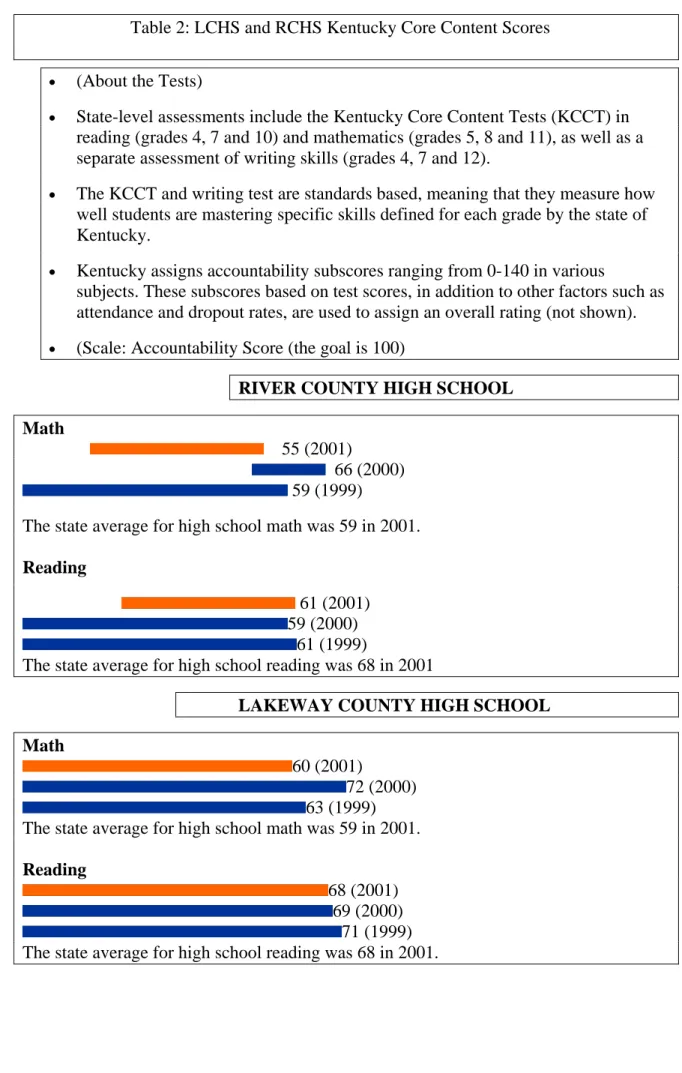
Tables 1 and 2 are from a national web site that profiles all Kentucky public
schools based upon US Education Department data (http//www.greatschools.net). Table
1 attempts to describe the general accountability parameters and consequences for
meeting or not meeting state achievement goals by district. Table 2 presents state
accountability data on Math and Reading for each school. It should be point out that in
several comparisons both RCHS and LCHS are below the state average; the
accountability profiles and mandated improvements are charted from baseline data
relevant to each school (from 1991), however, not against state averages. As well, both
schools have higher percentages of students from low-income families than either state or
national averages. There is also some discussion about Kentucky Core Content in Table
2, which becomes important in later discussions of Algebra coursework in both county
TABLE 1: ABOUT TEST SCORES IN KENTUCKY
The test score information for this state is from the 2000-2001 school year, which is the most recent data available from the U.S. Department of Education.
Although test scores are only one measure of student achievement, they have become increasingly important in assessing student learning. Kentucky’s
Commonwealth Accountability Testing System (CATS) includes both a national, norm-referenced examination and several state- level, standards-based
assessments. The CATS can therefore be used to compare the skills of students in Kentucky to those of students nationwide and to measure whether students are mastering the specific skills defined for each grade by the state of Kentucky.
What does CATS include?
Kentucky administers the national exam, the Comprehensive Test of Basic Skills (CTBS), in grades 3, 6 and 9. The CTBS assesses reading, language arts and mathematics skills. Among the state level assessments are the Kentucky Core Content Tests (KCCT) in reading (grades 4, 7 and 10) and mathematics (grades 5, 8 and 11), as well as a separate assessment of writing skills (grades 4, 7 and 12).
Why does CATS performance matter?
Although Kentucky does not mandate that schools use test scores to make decisions regarding grade-level promotion or retention, individual schools may take CATS performance into account when making such decisions. In general, standardized test scores that are below proficient are one factor that might indicate the need for additional assistance.
Table 2: LCHS and RCHS Kentucky Core Content Scores
• (About the Tests)
• State-level assessments include the Kentucky Core Content Tests (KCCT) in reading (grades 4, 7 and 10) and mathematics (grades 5, 8 and 11), as well as a separate assessment of writing skills (grades 4, 7 and 12).
• The KCCT and writing test are standards based, meaning that they measure how well students are mastering specific skills defined for each grade by the state of Kentucky.
• Kentucky assigns accountability subscores ranging from 0-140 in various
subjects. These subscores based on test scores, in addition to other factors such as attendance and dropout rates, are used to assign an overall rating (not shown).
• (Scale: Accountability Score (the goal is 100)
RIVER COUNTY HIGH SCHOOL
Math
55 (2001)
66 (2000) 59 (1999)
The state average for high school math was 59 in 2001.
Reading
61 (2001)
59 (2000) 61 (1999)
The state average for high school reading was 68 in 2001
LAKEWAY COUNTY HIGH SCHOOL
Math
60 (2001)
72 (2000) 63 (1999) The state average for high school math was 59 in 2001.
Reading
68 (2001) 69 (2000)
For almost two decades in LCHS, and for slightly less time perhaps in RCHS, the
pressure (or the opportunity) to focus more on learner outcomes consistent with aims of
the state have been emphasized. The current principal of LCHS’s sentiments on this
were mentioned above. The former county superintendent and now part-time
administrator at RCHS talked a bit about changes in focus this decade at his school. His
sense is that building principals have been called upon to develop a greatly expanded role
in school leadership than used to be the case:
FM: Well, I think probably the biggest change—I know the big change—is principals going from being just overseers and lecturers and how things are organized to really structured leadership. … It’s hard to do all those things, you know. … I’m not sure that everyone [principal] enjoys it, but I think they’re a lot more comfortable with it. And that’s a good thing. When I was principal, unfortunately I didn’t know how to help people be better teachers. I really didn’t want a math club. Sometime in the mid-80s—when I kind of got retrained in my thinking process—I got re-tooled, so to speak, and realized that there are some ways that you can help people. Before that I thought either you could or you couldn’t. And we, over the years have been able to talk to our principals and they’ve gotten a lot better and a lot better. So I think that’s another big change.
Meanwhile, the sitting principal at RCHS had the following to say about the state
accountability system, her agenda, and her perceptions about math success. I use the
word “sitting” here with some temerity. EN seemed to spend most of her time out and
around the building at RCHS, and could rarely be found in her chair during my visits: