MARKETING RESEARCH AND
INFORMATION SYSTEMS
C
H
A
P
T
E
R
Principles of Marketing 2
C
H
A
P
T
E
R
iv
iv
By Dmitriy V. Kim
Marketing Research & Information Systems
OBJECTIVES OF THE CHAPTER:
1. Explain the concept of the
marketing
information system
, emphasizing ways of
assessing information needs, the sources used
for
developing information
, and ways of
distributing information
.
2. Outline the
marketing research process
,
including
defining the problem
and
research
objectives
and
developing the research
plan
.
3. Discuss the key issues of
planning primary
data collection, implementing the research
plan
,
and
interpreting and reporting the
C
H
A
P
T
E
R
iv
iv
THE MARKETING INFORMATION SYSTEM
Marketing Information System
Principles of Marketing 4
C
H
A
P
T
E
R
iv
iv
By Dmitriy V. Kim
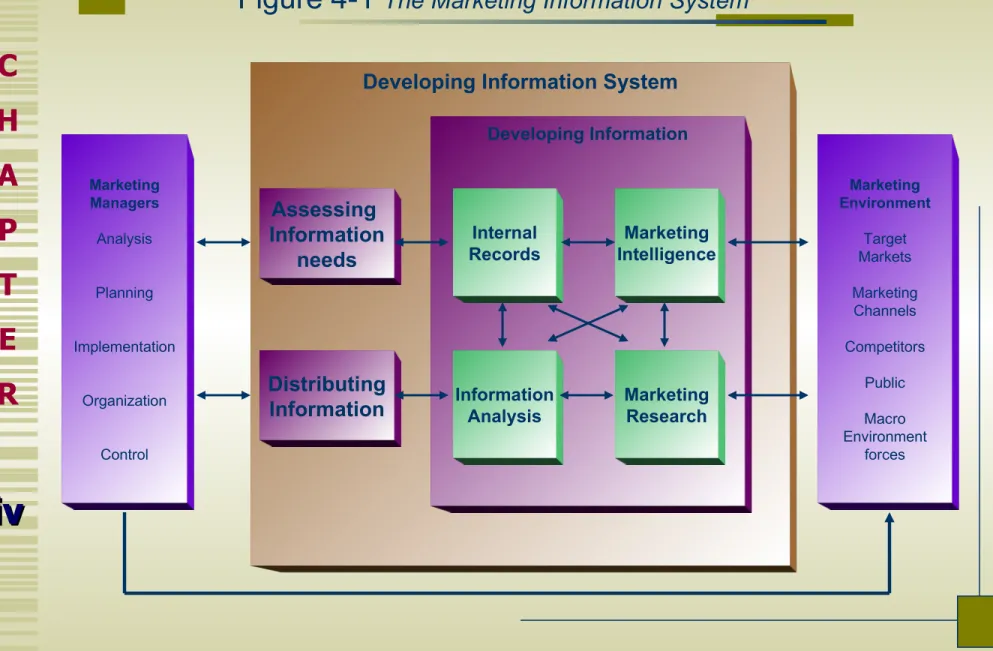
Figure 4-1
The Marketing Information SystemDeveloping Information System
Developing Information Marketing Environment Target Markets Marketing Channels Competitors Public Macro Environment forces Marketing Managers Analysis Planning Implementation Organization Control Assessing Information needs Distributing
Information InformationAnalysis MarketingResearch Marketing Intelligence Internal
C
H
A
P
T
E
R
iv
iv
ASSESSING INFORMATION NEEDS
Table 4-1:
1. What type of decisions do you make regularly?
2. What type of information do you need to make these decisions? 3. What types of useful information do you make regularly?
4. What types of information would you like to get that you are not getting now?
5. What types of information are you getting now that you don’t really need?
6. What information would you want daily? weekly? monthly? yearly? 7. What topics would you like to be kept informed about?
8. What databases would be useful to you?
9. What types of information analysis programs would you like to have?
Principles of Marketing 6
C
H
A
P
T
E
R
iv
iv
By Dmitriy V. Kim
DEVELOPING INFORMATION
•
Internal company records
•
Marketing intelligence
•
Marketing research
C
H
A
P
T
E
R
iv
iv
DEVELOPING INFORMATION
Three ways to obtain information:
•
Internal
company
records
•
Marketing
intelligence
•
Marketing
research
Information gathered from
sources within the company to
evaluate marketing performance
and to detect marketing
Principles of Marketing 8
C
H
A
P
T
E
R
iv
iv
By Dmitriy V. Kim
DEVELOPING INFORMATION
Three ways to obtain information:
•
Internal
company
records
•
Marketing
intelligence
•
Marketing
research
Everyday information about
developments in the marketing
environment that helps
C
H
A
P
T
E
R
iv
iv
DEVELOPING INFORMATION
Three ways to obtain information:
•
Internal
company
records
•
Marketing
intelligence
•
Marketing
research
The function that links the
Principles of Marketing 10
C
H
A
P
T
E
R
iv
iv
By Dmitriy V. Kim
THE MARKETING RESEARCH PROCESS
Marketing Research Process:
Defining the problem and
research objectives
Developing the research plan for
collection information
Implementing the research plan –
collecting and analyzing the data
Interpreting and
reporting the
C
H
A
P
T
E
R
iv
iv
DEFINING THE PROBLEM AND RESEARCH OBJECTIVES
After the problem has been defined carefully, the manager and researcher must set the research objectives. A marketing
research project might have one of three types of objectives:
Exploratory
Exploratory
Research
Research
Marketing
Research to gather preliminary
information that will help to better define problems and suggest hypotheses.
Descriptive
Descriptive
Research
Research
Marketing research to better describe marketing problems, situations, ormarkets, such as the market potential for a product or the demographics and attitudes of consumers.
Casual research
Casual research
Marketing research to test hypotheses about cause-and-effectPrinciples of Marketing 12
C
H
A
P
T
E
R
iv
iv
By Dmitriy V. Kim
DEVELOPING THE RESEARCH PLAN
Determining specific information needs
Gathering secondary information
Planning primary data collection
C
H
A
P
T
E
R
iv
iv
DEVELOPING THE RESEARCH PLAN
Secondary Data:
Secondary Data:
Information that already
exists somewhere,
having been collected for
another purpose.
Primary Data:
Primary Data:
Principles of Marketing 14
C
H
A
P
T
E
R
iv
iv
By Dmitriy V. Kim
DEVELOPING THE RESEARCH PLAN
Secondary Data:
Secondary Data:
Information that already exists somewhere, having been collected for another purpose.
Internal Sources
Government Publications
Periodicals and Books
Commercial Data
International Data Internal Sources
Government Publications
Periodicals and Books
Commercial Data
International Data
C
H
A
P
T
E
R
iv
iv
DEVELOPING THE RESEARCH PLAN
Planning primary data collection:
Research
Approaches MethodsContact Sampling Plan instrumentsResearch
Observation Mail Sampling unit Questionnaire
Survey
Experiment
Telephone Sample size Mechanical instruments
Principles of Marketing 16
C
H
A
P
T
E
R
iv
iv
By Dmitriy V. Kim
DEVELOPING THE RESEARCH PLAN
Survey Research
The gathering of primary data by asking people questions about their knowledge, attitudes, preferences, and buying behavior.
Observational Research
Can be used to obtain information that people are unwilling or unable to provide.
Experimental Research
The gathering of primary data by selecting matched groups of subjects, giving them different treatments, controlling related factors, and checking for differences in group responses.
C
H
A
P
T
E
R
iv
iv
DEVELOPING THE RESEARCH PLAN
Contact Methods:
1. Flexibility
3. Control of interviewer effects
4. Control of sample
5. Speed of data collection
6. Response rate
2. Quantity of data that can be collected
Poor
Good
Good Excellent
Excellent
Fair
Poor
Poor
Fair
Fair
Excellent
Excellent
Good
Excellent
Poor
Fair
Good
Good
Principles of Marketing 18
C
H
A
P
T
E
R
iv
iv
By Dmitriy V. Kim
DEVELOPING THE RESEARCH PLAN
Sampling Plans:
Sample
Sample
A segment of the population selected for
C
H
A
P
T
E
R
iv
iv
DEVELOPING THE RESEARCH PLAN
Sampling Plans:
Types of Samples:
Every member of the population
has a known and equal chance
of selection.
PROBABILITY SAMPLE
Simple
random sample
Stratified
Principles of Marketing 20
C
H
A
P
T
E
R
iv
iv
By Dmitriy V. Kim
DEVELOPING THE RESEARCH PLAN
Sampling Plans:
Types of Samples:
The population is divided into
mutually exclusive groups (such as
age groups), and random samples
are drawn from each group.
The population is divided into
mutually exclusive groups (such as
blocks), and the researcher draws a
sample of the group to interview.
PROBABILITY SAMPLE
Simple
random sample
Stratified
C
H
A
P
T
E
R
iv
iv
DEVELOPING THE RESEARCH PLAN
Sampling Plans:
Types of Samples:
The researcher selects the
easiest population members
from which to obtain
information.
Convenience
sample
Judgment
Sample
Principles of Marketing 22
C
H
A
P
T
E
R
iv
iv
By Dmitriy V. Kim
DEVELOPING THE RESEARCH PLAN
Sampling Plans:
Types of Samples:
The researcher uses his or her
judgment to select population
members who are good prospects
for accurate information.
The researcher finds and interviews
a prescribed number of people in
each of several categories.
NONPROBABILITY SAMPLE
Convenience
sample
C
H
A
P
T
E
R
iv
iv
PRESENTING THE RESEARCH PLAN
WRITTEN PROPOSAL
WRITTEN PROPOSAL
• Management problems
• Research objectives
• Information to be obtained
• Sources of secondary
information
• Methods of collecting primary
data
Principles of Marketing 24
C
H
A
P
T
E
R
iv
iv
By Dmitriy V. Kim