K.-Phong Vo AT&T Labs - Research Murray Hill, NJ 07974
ABSTRACT
This paper presents an interface specification and an efficient implementation of a general purpose library routine,ftwalk, to traverse a UNIX* file system hierarchy. A number of standard file system utilities, e.g., find, ls,rm, and others have been reimplemented using ftwalk. The total source code size is 30% smaller and the efficiency of all commands improves. More importantly, these commands now handle the file system search in a uniform, robust, and secure manner.
New tools have been built withftwalk. A file system perusing tool,tw, will be described. tw subsumes the functionality of find and xargs. Further, it provides a powerful expression language with a syntax similar to C. For typical applications in which commands are executed on generated file names, twis 5 to 10 times faster than find. The combination of a powerful language and performance efficiency in tw should reduce the practice of adding directory recursion to commands.
1. Introduction
Many standard file system utilities such as ls, rm, find and others either require or provide options to traverse file hierarchies exhaustively. Given that traversing a file hierarchy is a common operation, it is desirable to have a standard subroutine implementation for commands that require this functionality. There have been attempts at providing such a routine[ftw][Lin]. In particular, System V and 9thEdition C libraries provide different implementations of a routine,ftw, designed for this purpose. Surprisingly, no attempt has been made to use the routine in implementing the standard commands (except for 9thEdition du). As a result, each command has its own file system walker with a separate set of quirks and problems. As examples, the 4.3BSDlscommand cycles forever if there is a loop in the file hierarchy caused by symbolic links, thermcommand cannot remove a file hierarchy a few hundred levels deep, and thefindcommand cannot search a file hierarchy deeper than the number of available file descriptors. Inertia is a likely cause for not using a common file system walker in standard commands. However, on closer inspection, we also found that current implementations offtw are either too inefficient for general use or simply inadequate in the interface to support the variety of requirements from different commands. The interface inadequacy is further stressed when we want to build commands that are portable across different UNIX flavors such as System V and 4.3BSD that have wildly different file system structures. For these reasons, we decided to design and implement a new file system walking routine. It seems reasonable that such a routine should exhibit the following qualities:
• Generality: The routine must be general enough to support all current standard file system utilities and other tools that we can think of.
• Efficiency: The routine must perform about as well as its hand-coded counterparts in current commands.
__________________
• Finiteness: The routine should terminate even in the event of cycles caused by directory links and/or symbolic links. Such cycles must be detected and avoided.
• Robustness: The routine should work regardless of the depth and extent of the search. For example, the depth of a file hierarchy should not in itself be a limiting factor. John Linderman pointed out to us that this is an important security consideration in preventing hostile users from creating deep files that may be hidden from current file system utilities.
• Portability: The routine should work on all systems that we have access to, e.g., System V, BSD, HP/UX, 9thEdition. In addition, it should be conformant to POSIX 1003.1[IEEE].
We have designed and built a file walking routineftwalkthat satisfies the above quality requirements. The extensive interface features offtwalkwere carefully designed so that all standard utilities (cp,du,find,ls and rm) could be rebuilt usingftwalk. We have, in fact, rebuilt these commands. Inheriting the same qualities inftwalk, the new commands handle file system traversal in a consistent and robust manner. In addition, their efficiency is at least as good or much better than their earlier counterparts. The generality of ftwalkalso enables the construction of new tools. An example istw, a new command that both generalizes and subsumes the functionality offindandxargs. A novel feature oftwis a powerful expression language with a C-like syntax. For recursive execution of commands on a file hierarchy,twis typically between 5 to 10 times faster thanfind. Comparing with commands such aschmodandchgrp,twcomes to within 20% in system time and about the same on CPU time.
The rest of the paper is organized as follows. Section 2 describesftwalk. Section 3 discusses issues and problems in reimplementing standard utilities. Section 4 describes tw. Finally, in the conclusion, we indicate some future directions.
2. TheftwalkRoutine 2.1 Interface Specification
The interface of ftwalk contains many options designed for two purposes: generality and efficiency. Generality means that the interface must provide enough abstractions to support all commands that we know of or want to build. Often, a general abstraction can prevent efficient implementations of particular commands. In such cases, there are features allowing an application to ‘‘control’’ an abstraction to achieve the desired level of efficiency. For example, by default,ftwalkgets file status of all objects as soon as they are found. This enables the walker to determine terminal objects such as files or unreadable directories and process them immediately. However, getting status information of objects is an expensive operation. Thus, an optionFTW_DELAYis provided to control this feature for a command such aslsthat may not need such information for directory children (e.g., in a plainlscall).
Figure-1 shows the function prototypes offtwalkand the user-supplied functionsuserfandcomparfand the basic data structure struct FTW. In a call toftwalk, a depth-first search starts at the directorypath. Though there are many different graph search techniques[AHU], depth-first search is the common search method in all the commands that we studied. In the case of commands such as rm anddu, a postorder depth-first search is, in fact, the method of choice. This is because the descendants of a directory must be processed before the directory itself can be processed.
The user-supplied function, userf, is called at visits of objects. It has a single argument, a pointer to a
struct FTWstructure that stores information on the object being visited. userfis called exactly once on a terminal object such as a file or a directory causing cycles, For a normal directory,userfmay be called once or twice in preorder and/or postorder. As discussed below, it is possible to prune a search after a preorder visit or to restart a search after a postorder visit by setting appropriate values in the ftw->statusfield inuserf. userfshould normally return0. A non-zero return value fromuserfcausesftwalk to return immediately with the same value.
int ftwalk(char *path, int (*userf)(), int flags, int (*comparf)()); int userf(struct FTW *ftw);
int comparf(struct FTW *ftw1, struct FTW *ftw2);
struct FTW {
struct FTW *link; struct FTW *parent; void *local; struct stat *statb; char *path; short pathlen; unsigned short info; unsigned short status; short level; short namelen; char name[]; };
Figure 1. Ftwalkand related functions and data structures
compared. Comparf should return a negative, zero, or positive integer to indicate whether ftw1 is considered smaller, equal or larger thanftw2.
The argumentflagsofftwalkis a bit vector. Currently, the following bits are supported:
FTW_DOT:ftwalkwill not attempt to change directory (chdir) while recursively searching directories. Thus, throughout the search, the current directory (dot) stays the same. FTW_DOT should not be used often since changing directory during a search is a major efficiency gain in system time. FTW_DOT
is needed for applications that try to avoid undesirable file system side effects (e.g., core dumps) in unexpected places. Generally, changing directory is only an option, not a requirement. A successful search depends only on appropriate read permission, not search permission.
FTW_CHILDREN: Preorder visits of directories are implied even ifFTW_POST (below) is turned on. In such a visit, theftw->linkfield contains a linked list of all children objects of the directory being visited. This option is useful for commands (e.g.,ls) that need the children list for local processing purposes (e.g., computing multi-column format).
FTW_DELAY: When FTW_CHILDREN is turned on, the fields ftw->statb (struct stat) of children objects remain undefined until these objects are visited. This helps a command such aslsto avoid expensive computations when only the names of the children of a directory are needed.
FTW_MULTIPLE: The argumentpathofftwalkis really of typechar**and points to a null-terminated array of path names. Ftwalkwill search all hierarchies rooted at these paths.
FTW_PHYSICAL: Symbolic links will not automatically be followed. Each symbolic link object will initially be treated as a terminal object. The user functionuserfmay askftwalkto follow the link by setting the fieldftw->statustoFTW_FOLLOW(below).
FTW_POST: For non-terminal directories, userf is called only on postorder visits. Note that if
FTW_CHILDRENis turned on, preorder calls touserfwill always be performed.
FTW_TWICE: For non-terminal directories,userfis called twice in both preorder and postorder.
link: This field is used in two different ways. For a directory that causes cycles, link points to the object on the current search path that is identical to this directory. For any other directory, in an
FTW_CHILDRENpreorder visit, linkpoints to the list of children of the directory.
parent: This field points to the parent directory of the object being visited. Thus, ancestors of an object can be traced via theparentpointers. For convenience, a parent structure is also provided for level 0 objects. It contains the same file status information as that of its child.
local: This field is provided to users to store any information local to the object being visited. It is initialized to NULL byftwalk. Note that localis wide enough to store pointers. It is the user’s responsibility to free heap allocated data stored in the localfields. This can be done, for example, in a postorder visit.
statb: This field stores thestruct statbuffer containing all file system information available on the object. Note that if the option FTW_DELAY is turned on, such information is undefined when the object is on the children list of a directory being visited in preorder (FTW_CHILDREN).
path andpathlen: These fields contain the path name and the path name length of the object being visited. Thepathbuffer is guaranteed to be large enough so that the name of any child object of the current object can be appended.
info: The type of the object being visited. Following are the types:
FTW_NS: The type of this object is unknown becausestatorlstatfailed.
FTW_F: This object is a file.
FTW_SL: This object is a symbolic link.
FTW_D: This object is a directory being visited in preorder.
FTW_DC: This object is a directory that causes cycles.
FTW_DNR: This object is a directory that is not readable.
FTW_DNX: This object is a directory that is readable but not searchable.
FTW_DP: This object is a directory that is being visited in postorder.
status: This field is used in two different ways. In the call to userf, it is set to either FTW_NAME or
FTW_PATHto indicate whether the user function should use the basenameor thepathname to get file system status of the object. This is important for correct processing when the optionFTW_DOTis off. If FTW_DOT is on, the value of status is always FTW_PATH. In return, userf can set
statusto one of the below values:
FTW_AGAIN: If this is a postorder visit, descend the hierarchy rooted at this object again.
FTW_NOPOST: This is usually set in a preorder visit of an object. It suppresses any postorder visit to this object.
FTW_FOLLOW: If this is a symbolic link, follow it.
FTW_SKIP: Prune the search at this object. Thus, descendants of this object will not be visited.
FTW_STAT: This value can be assigned to thestatusfields of children of the current object when
FTW_DELAYandFTW_CHILDRENwere turned on. It means that thestatbstructure of the respective child has been filled byuserf.
level: This field contains the depth from the root object of the object being visited.
nameandnamelen: These fields contain the base name and name length of the current object.
2.2 TheftwalkSearch Algorithm
an exception may necessitate the unraveling of several recursion layers with extra book-keeping. The non-recursive algorithm also simplifies optimizations such as reducing the number of back-up chdircalls by eliminating the need to use static variables to retain states across recursive calls.
0. struct FTW *todo, *ftw, *first, *last, *f; 1. todo = top level path;
2. while(todo) 3. {
4. ftw = todo;
5. if(preorder processing is needed for ftw) 6. userf(ftw);
7. if(ftw is a directory that does not cause cycles) 8. {
9. first = last = NULL; 10. for(each child f of ftw) 11. {
12. if(first == NULL)
13. first = last = f; 14. else last = last->link = f; 15. }
16. if(last) 17. {
18. last->link = todo; 19. todo = first; 20. }
21. }
22. while(todo && todo == ftw) 23. {
24. if(postorder processing is needed for ftw) 25. userf(ftw);
26. ftw = ftw->parent; 27. todo = todo->link; 28. }
29. }
Figure 2. A non-recursive file system depth-first search
Ignoring detailed interface features such as turning off FTW_DOT and sorting objects, Figure-2 shows a skeleton of the non-recursive depth-first search algorithm in a quasi-C syntax. Note that internal to the algorithm, thelinkfield ofstruct FTW is used to maintain the list of elements being searched. The following discussion is based on the line numbers in Figure-2.
0-1: These statements declare relevant variables and initialize the todo list with the root path of the hierarchy to be searched.
2-29: This is the main loop of the algorithm. The variable todo always points to the element to be processed next. Thetodo list is basically a stack in which the last element put on it is the next element to be processed.
9-20: The list of children offtwis constructed. Since all children of a directory are read, the algorithm only needs one open file pointer at any given time. For efficiency, ifcomparfis given, the children of a directory are sorted using a stable insertion sort based on a self-adjusting binary tree[ST]. A similar tree is also used for efficient checking of cycles.
22-28: The stack is popped. This corresponds to subroutine returns in a recursive implementation of depth-first search. If post-order processing of an element being popped from the stack is required, the user function userfis called. Though not shown in the code, The number of popped levels is also recorded to optimize the number ofchdircalls to back up the current directory.
2.3 An Example
In the appendix, we show the code of a user function,draw, to generate the description of a file hierarchy in the DAG language[GNV]. Figure-3 shows a generated DAG drawing of a small hierarchy. In the drawing, boxes indicate directories, ellipses files, and diamonds symbolic links. Dotted edges represent either symbolic links or hard links.
Figure 3. A file hierarchy
Following is the code fragment to invokeftwalkto walk and draw a given file hierarchy:
printf(".GS\n");
ftwalk(path,draw,FTW_PHYSICAL,NULL); printf(".GE\n");
The twoprintfstatements generate the prologue and epilogue of a DAG description. The root of the hierarchy to be drawn is given inpath. FTW_PHYSICALis turned on to detect symbolic links. Since the relative order of directory entries is not important, comparfis set toNULL.
3. Reimplemented Standard Commands
A good way to test the applicability offtwalkis to reimplement standard utilities that peruse file systems. This allows performance, feature and coding style comparisons. Further motivating factors are to enforce consistency and to enhance robustness across these commands:
Logical vs. Physical: A logical search automatically follows symbolic links to their physical counterparts while a physical search stops at symbolic links. Withftwalk, both types of search can be provided as command options without too much programming effort.
problem on systems with symbolic links.
Robustness: A good deal of effort went intoftwalkto remove artificial constraints. As an example,ftwalk can handle directory structures of arbitrary depths (up to virtual or hard memory limits). Current implementations of important standard utilities such as findandrm, in fact, fail on deep directory structures.
An informal survey of BSD, System V and 9thEdition machines produced the following commands that do some form of file hierarchy traversal:chgrp,chmod,cp,diff,du,find,ls,rm, andtar. Instead of blindly doing wholesale changes to these commands, we study their interfaces and the interrelationships in their use. This allows us to reimplement and extend certain commands selectively while leaving others untouched. We discuss below the issues and problems in rebuilding these commands.
chgrp andchmod: The –R (recursive) option added to the BSD versions of chgrp and chmod can be simulated by using these commands in conjunction withfindas in the following shell[BK]statements:
find dir -exec chmod permissions "{}" ";" chmod permissions $(find dir -print)
The first statement always works but it is slow, since a separatechmod process is created for each generated file name. The second command is faster but it does not always work since it may exceed the argument limit to the system callexec. To avoid the temptation of adding –Rto all our favorite commands (‘‘grep –R pattern .’’ might be nice), we changed the-execprimitive offindto accept+(plus) as a command terminator in addition to the usual;(semicolon). The+instructsfind to execute the command a minimal number of times in the manner ofxargs(see alsotwbelow). cp: The-roption allows copying directory hierarchies (9thEdition, provides reccpto accomplish the
same thing). This operation is better accomplished by the POSIX ‘‘pax –rw’’ command[IEEE] (similar to ‘‘cpio –p’’) sincepaxprovides better control over the attributes of the copied files. With this in mind, cpwas originally redone to execute ‘‘pax –rw’’ for the recursive case. However, a recoding ofcpusingftwalkis more efficient even in the non-recursive case by taking advantage of the information provided in thestruct FTWstructure offtwalk.
diff: This command has an option to compare two directory hierarchies. This exposes a limitation in a function interface such asftwalkthat cannot allow simultaneous explorations of two or more different hierarchies. We shall come back to this issue in the conclusion.
du: This command is simplest of all the commands to reimplement. In reimplementing it, we found the need to have a place to store summaries of information of descendants of directories on a search path. The ftw.local field of struct FTW fulfills this need. The simplicity of du is one of the guiding factors in the design of thetwexpression evaluator described below.
find: This is an indispensible command but it commits a terrible sin of robustness: it will not search beyond a depth higher than the number of available file descriptors (about 20 for our system). This means that files in relatively shallow hierarchies may never be found. Further, the expression interface of find is messy, making any extension difficult. The new command tw described in Section 4 corrects these problems.
ls: The column output mode (-C option) of this command requires that all children of a directory are available when it is visited in preorder. The optionFTW_CHILDRENofftwalksolves this problem. In addition, providing a sort function, comparf, to ftwalk efficiently solves the problem of sorting directory entries.
rm: This command varies the most among different implementations, none of which deal with hard link directories properly. Although hard links to directories are rare, a standard command in /bin
removed.
tar: On our system,taris replaced by a local implementation of the POSIX commandpax, which uses ftwalkfor file system traversal.
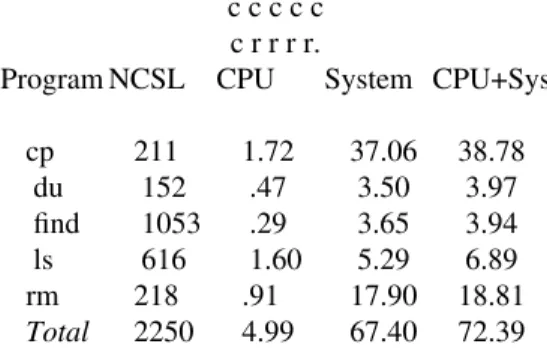
Table-1 and Table-2 summarize comparative performance statistics for the commands:cp,du,find,lsand rm. Table-1 gives statistics for the old commands while Table-2 gives statistics for the reimplemented commands. The statistics include numbers of non-commented source lines (NCSL), and CPU times, System times, and their total. The times are measured in seconds and result from running the programs on
/usr/srcon our local system which is a VAX 8650 running 4.3BSD. This directory system has 201 directories and a total of 3480 entries. To reduce statistical fluctuations, each timing result is an average of three runs at night when the machine is largely idle.
c c c c c c r r r r.
Program NCSL CPU System CPU+Sys
cp 211 1.72 37.06 38.78 du 152 .47 3.50 3.97 find 1053 .29 3.65 3.94 ls 616 1.60 5.29 6.89 rm 218 .91 17.90 18.81 Total 2250 4.99 67.40 72.39
Table 1. Statistics of old commands
c c c c c c r r r r.
Program NCSL CPU System CPU+Sys
cp 208 1.02 36.27 37.29 du 124 .33 3.46 3.79 find 676 .48 3.44 3.92 ls 499 .75 3.80 4.55 rm 184 .62 12.28 12.90 Total 1691 3.20 59.25 62.45
Table 2. Statistics of reimplemented commands
As Table-1 and Table-2 show, overall, there is a reduction of about 30% in source code size. Not all of the code reduction is due to usingftwalksince the commands have been rewritten extensively. The combined time performance for all commands improves about 15%. Major performance gains are inlsandrm. Both of these commands benefit from ftwalk’s efficient utilization of system calls. The more than 100% improvement in CPU time for ls is due to ftwalk’s use of an efficient search tree for sorting directory children.
4. The tw Command
Thefindcommand is a popular tool for recursive processing of objects in file hierarchies. However,find has several drawbacks that limit its use. The most visible problems arefind’s unconventional expression syntax and its use of shell meta-characters as arguments which necessitates awkward quoting. Worse than find’s awkward interface are useful options whose semantics cause extreme inefficiency. For example, the
To alleviate the efficiency problem infind, System V providesxargs, a command which reads file names, one per line, and applies a given command to as many files at one time as possible. As an example, below are two shell command lines that perform more or less the same function though the second one is more efficient on a large directory structure.
find path -exec program "{}" ";" find path -print | xargs program
A problem with using xargs in this manner is that file names that contain the \n (new-line) character cannot be handled. This is a potential security problem as the operating system does not preclude the creation of such files.
Aside from find and xargs, a popular approach in BSD is to add a recursive option to individual commands. This requires modification of every command of interest and lacks the useful pattern matching mechanism offindfor selective command execution.
Inadequacies in current approaches expose the need for a new language and tool to interface to the file system structure that is: flexible to use, efficient, and easily extensible to match frequent changes in file system interface structures. In this spirit, we created a new command,tw, whose interface language is C-like and provides extensive access to file information. Likefind,twrecursively traverses a file hierarchy and performs actions on visited files. Likexargs,twonly executes a given command a minimal number of times. The rest of this section describestwand gives examples of how to use it.
4.1 Interface Description
Without arguments,twis equivalent to ‘‘find . -print’’. When given a command,twexecutes the command with the generated file names as arguments. The given command may be executed more than once depending on the limit of theexecsystem call. Similar toxargs,twcan also read file names from the standard input if its first argument is given as-. As an example, below are four commands that performs equivalent functions:
tw chmod o-w chmod -R o-w
find . -print | xargs chmod o-w find . -print | tw - chmod o-w
Conditional C-style expressions may be specified with the -e option. The expression operands are the fields of the struct FTW and struct statstructures (the prefix ‘‘st_’’ is deleted) of the object being visited. Here is a command to list files withgrouporotherwrite permissions:
tw -e "mode & 022"
Some fields allow"..."and’...’string operands. The first command below is equivalent to the above command but somewhat more readable. The second command lists all objects modified since yesterday morning (most common time and date expressions are allowed).
tw -e "mode & ’go+w’"
tw -e "mtime >= ’yesterday 8am’"
The’...’strings are handy when combined with"shell quoting. Strings may be compared, where==
and != treat the right hand operand as a ksh[BK] file match pattern. The following command executes
grep patternon a selected collection of source files:
tw -e "name == ’*.[chly]’" grep pattern
For convenience, the type bits of the fieldst_modeinstruct statare placed in a separate field. For example, the following lists all subdirectories of the current directory:
tw -e "type == DIR"
tw -e "if (fstype != parent.fstype) status = SKIP"
Explicit file references can also be done by prefixing an identifier with ’filename’. Following is an example script that lists all files newer than the file/etc/backup.time.
tw -e "mtime > ’/etc/backup.time’.mtime"
The complete list of predefined identifiers appears below. Most correspond to the st_ elements of
struct stat. New fields can be added asstruct statgrows.
atime: Most recent access time. Ifatime,ctime, ormtimeis the left hand side operand of a binary operator, the right hand side operand may be a string interpreted as a date expression.
blocks: The number of blocks in the file.
ctime: The inode change time.
dev: The device number.
fstype: The file system type name. The default value isufs.
gid: The group id number. Ifgidis the left hand side operand of a binary operator, the right hand side operand may be a string that is interpreted as a group name.
gidok:1ifgidis a valid group id in the system database, 0otherwise.
ino: The inode or file serial number.
level: The depth of the file relative to the starting directory.
local: Thelocalfield ofstruct FTW. This field may be assigned certain values.
mode: The identifierFMT is recognized and can be used to mask the file format and permission bits. If
modeis the left hand side operand of a binary operator, the right hand side operand may be a string that is interpreted as achmodpermission expression.
mtime: The time at which the object was last modified.
name: The file name of the object with no directory prefix.
nlink: The number of hard links.
path: The full pathname of the current object. Note that this is only defined for the current object. For example,parent.pathis undefined.
perm: The file permission bits ofmode. Ifpermis the left hand side operand of a binary operator, the right hand side operand may be a string that is interpreted as achmodpermission expression.
rdev: The device numbers for special files.
size: The number of bytes in the file.
status: The status field ofstruct FTW. This field may be assigned one of: AGAIN,FOLLOW,
NOPOST, andSKIP which correspond to theftwalkconstants prefixed by ‘‘FTW_’’. For example,
status=SKIPmay be used to prune subdirectories from the search.
type: The file type bits of mode. The identifiers BLK, CHR, DIR, FIFO, LNK, REG, and SOCK are recognized.
uid: The user id number. Ifuidis the left hand side operand of a binary operator, the right hand side operand may be a string that is interpreted as a user name.
uidok:1ifuidis a valid user id in the system database, 0otherwise.
Expressions intware labeled to indicate different types of processing. The default label for an expression is
select. Possible labels are:
action: This expression defines the action to be executed on selected file names (below). The default action is to list the selected file names on the standard output.
begin: If defined, this expression is evaluated once before the file system traversal starts.
end: If defined, this expression is evaluated once after the file system traversal ends.
select: This expression is used to select files to be acted upon. If it evaluates to true (non-zero) then the
actionexpression is evaluated. The default value forselectis1.
sort: This expression specifies an identifier by which child entries are sorted. The below example lists files sorted by newest to oldestmtime(the!inverts the sort sense).
tw -e "sort: !mtime"
Finally,if-else,printfand variable declarations round out the expression language.
4.2 Examples and Discussions
Figure-4 shows atwscript to list the name and inode number of each file and to list the total number of files encountered. Note that the variablecountis automatically initialized to0.
tw -e "
int count; action:
count++;
printf(’name=%s inode=%08ld\n’, name, ino); end:
printf(’%d file%s\n’, count, count == 1 ? ’’ : ’s’); "
Figure 4. Atwscript to list file names and inode numbers
Figure-5 shows a script to emulate theducommand. Here, the -poption specifies a postorder traversal and the-Poption specifies a physical (don’t follow symbolic links) traversal. Note how thelocalfield is used to accumulate the total number of blocks contained in a directory subtree and thevisitfield check is used to ensure that hard links are counted only once. This script is about 40% slower than the standarddu command, where 33% of the difference is in CPU time. This is reasonable since theactionexpression must be evaluated interpretively for each file in the search.
tw -pP -e " action:
if (visit++ == 0) {
parent.local += local + blocks; if (type == DIR)
printf(’%d\t%s\n’, local + blocks, path); }
"
Figure 5. Atwscript to emulatedu
tw -d /usr/src null
find /usr/src -exec null ";" find /usr/src -print | xargs null
Here,nullis a command that does nothing. Usingnullinstead of another standard command such aswcor lsallows us to measure only the system time overhead caused byforkandexecand not the cost of ‘‘real’’ work being performed by these commands. Table-3 shows the comparative timing results. Thetwversion is about 10 times faster than thefindversion and about 6.5 times faster than the combination offindand xargs. The relatively bad timing result for the find and xargs combination is largely due to the poor implementation ofxargs.
c c c c c r r r.
Program CPU System CPU+Sys
tw .55 5.45 6.00 find 1.46 55.81 57.27 findxargs 5.39 34.44 39.83
Table 3. Statistics fortw,findandxargs
5. Conclusions
We presented a new file hierarchy traversal routine,ftwalk, and its use in reimplementing certain standard file system commands and in implementing new commands. The applicability offtwalkin a wide variety of programs shows the generality of its interface. The total source code size for the reimplemented commands reduces by 30% despite the addition of new options in some cases. Timing results show that these commands perform at least as well as before. In cases such as ls or rm, performance improves significantly. More importantly, all commands handle the file hierarchy traversal in a consistent and robust manner. Robustness is crucial for security concerns. Certain important commands such as find andrm previously could not handle deep hierarchies. We have tested our versions of these commands on directory structures deeper than 2000 levels.
New commands such aspax, a new POSIX conformant file archiver, andtw, a file system walker, have been built based onftwalk. The latter command,tw, was described here. It subsumes the functionality of findandxargs. In addition,twprovides a powerful expression language with a syntax that resembles the C language. The expression language fortwis designed to be easily extendible to match any future changes in the file system interface structures. The performance oftwis many times better thanfindwhen a given command must be executed against generated file names. For a command such as chmod (chgrp),
tw chmodperforms nearly as well as its hand-coded counterpartchmod -R. Thetw chmodversion is only about 20% slower in system time than the chmod -R version while CPU time is the same. The efficiency level and the availablility of a powerful language in twshould stop the practice of adding a recursive option to every command in sight.
References
[AHU] A.V. Aho, J.E. Hopcroft and J.D. Ullman, The Design and Analysis of Algorithms, Addison-Wesley, 1974.
[GNV] E.R. Gansner, S.C. North, and K.P. Vo,DAG, A Program to Draw Directed Graphs, Soft. Prac. and Exp., 1988.
[BK] M. Bolsky and D.G. Korn, The KornShell Command and Programming Language, Prentice Hall, 1988.
[ftw] ftw, System V Programmer’s Reference Manual and 9th Edition UNIX Time-Sharing System Programmer’s Manual.
[IEEE]The IEEE Standard Portable Operating System Interface for Computer Environments, IEEE, 1988. [Lin] J.P. Linderman,dwalk, Private communication, 1988.
Appendix
Below is a user functiondrawthat can be used withftwalkto draw file hierarchies.
#include <ftw.h>
draw(ftw)
struct FTW *ftw; {
int linklev; /* level of linked object */ char *shape, /* shape of this object */
name[256], /* unique name of this object */
link[256], /* name of its linked object if any */ parent[256]; /* name of its parent */
static int N = 0; /* to make unique name */
/* follow symlink, set local so we know it was a symlink */ if(ftw->info == FTW_SL)
{
ftw->status = FTW_FOLLOW; ftw->local = (VOID*) 1; return 0;
}
/* an object with no status */ else if(ftw->info == FTW_NS) {
linklev = -1;
sprintf(name,"ns%d",++N); }
else
{ /* linkobj gets the level of the object linked to ftw. If there is no such object, it returns -1. */
linklev = linkobj(ftw);
/* use (dev,ino) to generate a unique name for this object */ sprintf(name,"n%d_%d_%d",
ftw->statb.st_dev,ftw->statb.st_ino, linklev >= 0 ? ++N : 0);
}
/* generate the draw node statement */
shape = ftw->local ? "Diamond" : ftw->info == FTW_F ? "Ellipse" : ftw->info == FTW_NS ? "Plaintext" : "Box";
printf("draw %s as %s label \"%s\";\n",name,shape,ftw->name);
/* generate the (parent,child) edge statement */ if(ftw->level > 0)
{
sprintf(parent,"n%d_%d_0",
ftw->parent->statb.st_dev, ftw->parent->statb.st_ino); printf("edge from %s to %s;\n",parent,name);
}
/* if this is a link, draw the link edge and prune the search */ if(linklev >= 0)
sprintf(link,"n%d_%d_0",
ftw->statb.st_dev,ftw->statb.st_ino); if(linklev == ftw->level)
printf("same rank %s %s;\n",name,link); printf("%sedge from %s to %s dotted;\n",
ftw->level >= linklev ? "back" : "",name,link); ftw->status = FTW_SKIP;
}
return 0; }
For comparison, below is atwscript that is computationally equivalent todraw
tw -P -d $1 -e " begin:
printf(’.GS\n’); end:
printf(’.GE\n’); action:
if (type == LNK) {
status = FOLLOW; local = 1;
} else {
printf(’draw n%d_%ld_%d as ’, dev, ino, visit); if(local)
printf(’Diamond’); else if(type == FILE)
printf(’Ellipse’); else if(type == NS)
printf(’Plaintext’); else printf(’Box’);
printf(’ label \"%s\";\n’, name); if(level > 0)
printf(’edge from n%d_%ld_0 to n%d_%ld_%d;\n’, parent.dev,parent.ino,dev,ino,visit); if(visit == 0)
visit = level+1; else
{
if(visit == level + 1)
printf(’same rank n%d_%ld_%d n%d_%ld_0;\n’, dev,ino,dev,ino,visit);
printf(’%sedge from n%d_%ld_%d to n%d_%ld_0 dotted;\n’, (visit >= level + 1) ? ’’ : ’back’,
dev,ino,dev,ino,visit); status = SKIP;
} }
"
drawstatement defines the shape used to draw a node or collection of nodes and the labels for such nodes if they are different from their names.
.GS
draw n2324_141316_0 as Box label "/home/kpv/Src/TEST"; draw n2324_24634_0 as Box label "dir1";
edge from n2324_141316_0 to n2324_24634_0; draw n2324_24637_0 as Ellipse label "file1"; edge from n2324_24634_0 to n2324_24637_0; draw n2324_122913_0 as Box label "dir2"; edge from n2324_141316_0 to n2324_122913_0; draw n2324_24637_1 as Ellipse label "file2"; edge from n2324_122913_0 to n2324_24637_1; same rank n2324_24637_1 n2324_24637_0;
backedge from n2324_24637_1 to n2324_24637_0 dotted; draw n2324_141316_2 as Diamond label "dir3";
edge from n2324_122913_0 to n2324_141316_2;
backedge from n2324_141316_2 to n2324_141316_0 dotted; .GE