1.2
Atomic structure
One of the most intriguing theories in science is that of the atom. An atom is the smallest possible particle of an element.
The development of Atomic Theory
The concept of the atom has been around for over 2000 years. Over that time our models of the atom have changed significantly as scientists used them to help explain how matter behaves.
Around 400 BCE, early Greek philosophers argued that matter could be sub-divided into tiny indivisible particles called atomos (meaning “cannot be cut” or “indivisible”). Democritus went further: he stated that atoms have different sizes, are in constant motion, and are separated by empty spaces. This idea was rejected by Aristotle, the famous philosopher, who proposed that all matter is composed of four essential substances: earth, air, water, and fire. For almost 2000 years Aristotle’s theory was widely accepted as being correct.
The Alchemists
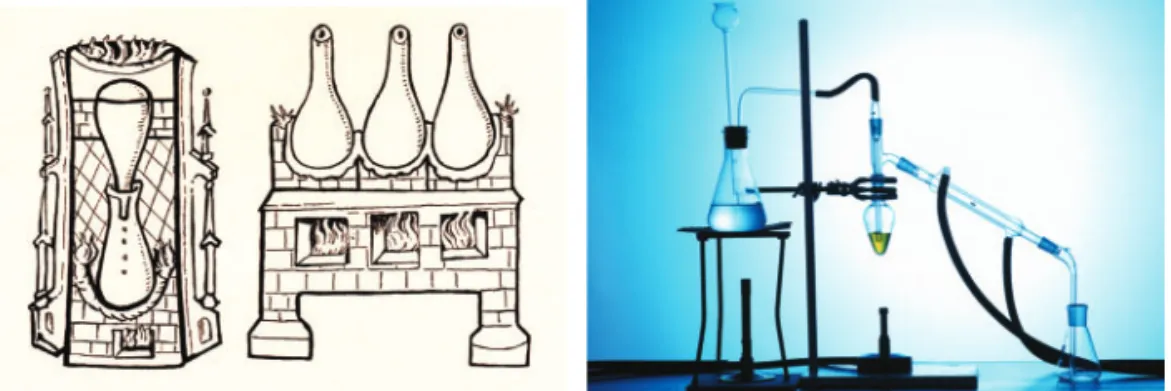
The period of time from the first century CE to the seventeenth century is sometimes known as the period of alchemy. During this period, alchemists explored the nature of matter intensely. Alchemy was practised in many cultures around the world including Egypt, India, Persia (modern Iran), Europe, China, and Japan. Alchemists searched for such elusive prizes as the “elixir of life,” with its hope of immortality, and the philoso-pher’s stone, which was thought to transform common metals into gold. This period saw great technological advances. Their construction of lab glassware and equipment, development of alloys, handling procedures for dangerous chemicals, and various chemical processes are developments that are still in use today (Figure 1).
atom the smallest particle of an element
dalton’s Atomic Theory
The scientific revolution in the seventeenth and eighteenth centuries increased the focus on scientific methods and the importance of evidence. Aristotle’s ideas were eventually dismissed and scientists revisited Democritus’ theory of the indivisible atom. In 1808, English scientist and schoolteacher John Dalton proposed a theory to explain the observations of matter (Figure 2). He suggested that atoms are solid spheres like billiard balls. More specifically, Dalton proposed that
• all matter is made up of tiny, indivisible particles called atoms • all atoms of an element are identical
• atoms of different elements are different
• atoms are rearranged to form new substances in chemical reactions, but they are never created or destroyed
Dalton’s theory was an important step forward. It was not the end of the story, however. Future observations would indicate that Dalton’s theory could not explain some new evidence.
Figure 2 Dalton’s list of the elements from 1808
Figure 1 The alchemists developed lab procedures and equipment that were the precursors of modern apparatus.
Figure 6 (a) Rutherford’s prediction: if Thomson’s model were correct, the alpha particles would pass through the gold atoms unaffected (b) Rutherford’s observation: a small portion of the alpha particles were defl ected by the gold atoms (c) Rutherford’s explanation: each atom has a dense, positively charged nucleus that defl ects alpha particles
(c)
electrons occupying space around the nucleus
alpha particle deflected back
alpha particle deflected slightly
alpha particles not deflected
nucleus
atoms in the sheet of gold foil positively charged alpha particles
directed through narrow slit gold atoms
point where alpha particles will hit the screen fluorescent
screen point where alpha particles will hit
(a)
positively charged alpha particles
gold atoms
point where most alpha particles hit the screen point where other alpha
particles hit the screen after being deflected
point where most alpha particles hit alpha particles hit point where other alpha
particles hit the screen
point where most alpha particles hit point where other alpha
particles hit the screen
(b)
Thomson’s discovery of the Electron
One of the problems was that Dalton’s theory did not address how things acquire electrical charge. In 1897, J.J. Th omson used an apparatus called a cathode ray tube to discover a “new” type of particle: the electron (Figure 3). Th rough experiments, Th omson proposed that an electron is a negatively charged, extremely small part of an atom. A new model of the atom now included electrons spaced evenly in a positively charged sphere: the “plum pudding model.” Th e fruit represents the electrons (Figure 4).
electron a negatively charged particle in an atom or ion
Figure 5 Ernest Rutherford, a brilliant physicist from New Zealand, spent nine years (1898–1907) working at McGill University in Montréal.
Rutherford’s discovery of the nucleus
In 1909 Ernest Rutherford performed a series of important experiments to test Th omson’s model (Figure 5). Rutherford aimed tiny positive alpha particles at a thin sheet of gold foil. (An alpha particle, like a helium nucleus, has 2 protons and 2 neutrons.) He then measured how much the gold foil defl ected the particles by surrounding the foil with a fl uorescent screen. Th e screen glowed where the particles hit it. Rutherford made a prediction based on Th omson’s model: if the electrons were equally distributed throughout the atom, the positively charged alpha particles should pass straight through the atoms of the foil. Th ey would not be defl ected (Figure 6(a)). Aft er extensive trials, Rutherford observed that most of the alpha particles did indeed pass through the gold foil unaff ected. However, a few particles were defl ected at large angles (Figure 6(b)). Rutherford was amazed by his obser-vations. He famously declared “it was almost as incredible as if you fi red a 15-inch shell at a piece of tissue paper and it came back and hit you.” From these observations, Rutherford reasoned that each atom contained a small, dense, positively charged central nucleus (Figure 6(c)).
Figure 4 Thomson’s plum pudding model of the atom could be called the blueberry muffi n model. Figure 3 J.J.Thomson used a device known as
a cathode ray tube to perform his experiments.
To fi nd out more about the work of Ernest Rutherford and his time at McGill University,
WEB LInK
go To nElSon SCiEnCE
In 1920, Rutherford proposed that the nucleus is made up of positively charged particles, each one called a proton. He also suggested that the nucleus is surrounded by mostly empty space occupied by electrons. Th is model of the atom is known as the nuclear model (Figure 7).
Just how far from the nucleus are the surrounding electrons? Imagine that you are standing at one end of a soccer fi eld. If the nucleus of the atom is the size of a dime, the electrons are, on average, as far away as the other end of the fi eld!
Rutherford also predicted the presence of a third subatomic particle with the same mass as the proton but with no charge.
Chadwick’s discovery of neutrons
Other scientists soon modifi ed Rutherford’s nuclear model. In 1932, James Chadwick’s experiments confi rmed that nuclei contain neutral particles as well as protons. Th ese neutral particles became known as neutrons. A neutron is a particle in the nucleus of an atom or ion. A neutron has no charge: it is neither positive nor negative.
Bohr’s Proposal of Energy Levels
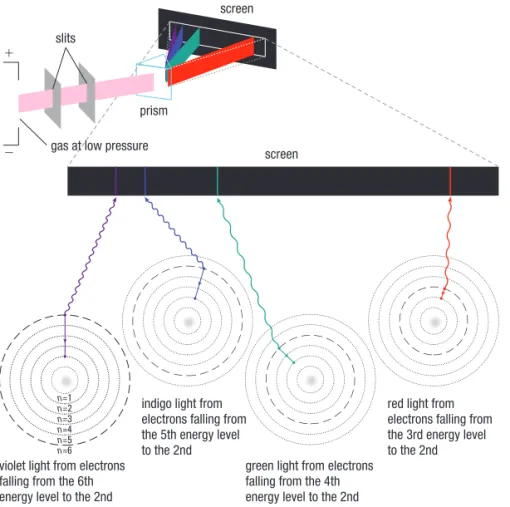
Further work was performed by Niels Bohr, a Danish scientist. He experimented with applying electricity and thermal energy to hydrogen gas. He observed that the hydrogen atoms emitted light when they were “excited” by the additional energy. Bohr directed the light through a prism with a screen behind it (Figure 8). He observed lines of only certain colours of light. He realized that hydrogen has a unique atomic spectrum: a pattern of coloured lines that is not produced by any other element. Astronomers have observed this same emission from stars and interstellar gas clouds.
proton a positively charged particle in the atom’s nucleus
Figure 7 Rutherford’s nuclear model of the atom (not to scale)
nucleus (positively charged)
electrons surrounding nucleus (negatively charged)
neutron a neutral particle in an atom’s nucleus
To view the atomic spectra for various elements,
WEB LInK
go To nElSon SCiEnCE
Figure 8 Bohr’s work showed that electrons release bursts of light energy. The wavelength (colour) of the light depends on where the electrons are jumping from and to. Hydrogen atoms, shown here, can emit four colours of light. Each element emits a unique spectrum.
�
�
n=1
n=2
n=3
n=4
n=5
n=6
indigo light from electrons falling from the 5th energy level to the 2nd
red light from electrons falling from the 3rd energy level to the 2nd slits
screen screen
prism gas at low pressure
violet light from electrons falling from the 6th energy level to the 2nd
green light from electrons falling from the 4th energy level to the 2nd
Figure 9 Bohr’s planetary model of the atom
nucleus containing positively charged protons and electrons electrons in orbits
surrounding the nucleus
Bohr’s observation led to a radical new proposal: that electrons orbit the nucleus of the atom in defi nite energy levels. Bohr had again revised the model of the atom. His revision is called the planetary model of the atom (Figure 9).
energy level a theoretical sphere around an atom where electrons exist; electron orbit
valence shell the outermost energy level or orbit of an atom or ion
valence electron an electron in the outermost energy level or orbit
In the planetary model, electrons only exist in certain allowed orbits. Each orbit has a specifi c quantity of energy associated with it. As a result, electron orbits are sometimes called energy levels. Electrons can jump from and to diff erent energy levels
within an atom. As they jump from higher energy levels back down to lower energy levels, they emit light energy. Th e colours of light emitted by the excited hydrogen atoms correspond to the changes of energy that the electrons experience as they move between energy levels (Figure 8). Since he observed only certain colours, Bohr sug-gested that an atom has only certain specifi c energy levels.
In Bohr’s model of the atom, each energy level can hold a certain number of electrons. For the fi rst 18 elements in the periodic table, the maximum number of electrons in the fi rst, second, and third orbits is 2, 8, and 18 respectively.
Bohr–Rutherford diagrams
We combine ideas from the work of Dalton, Th omson, Rutherford, Chadwick, and Bohr to draw a model of the atom called a Bohr–Rutherford diagram. We can use Bohr–Rutherford diagrams to show the number of each type of subatomic particle in a specifi c atom and to represent the arrangement of electrons around the nucleus. Th ese diagrams are especially useful for the fi rst 20 elements. In a Bohr–Rutherford diagram, concentric circles represent the diff erent energy levels, the electrons are drawn in the appropriate locations, and the numbers of protons and neutrons are indicated in the nucleus.
Most chemical reactions involve only the electrons in the outermost energy level. Th e outermost energy level is also known as the valence shell. Th e electrons in the
valence shell are valence electrons. Figure 10 shows the Bohr–Rutherford diagrams for atoms of helium, He-4; lithium, Li-7; fl uorine, F-19; and sodium, Na-23. (Th e number aft er each chemical symbol represents the total number of protons and neu-trons in the nucleus.)
A Summary of Subatomic Particles
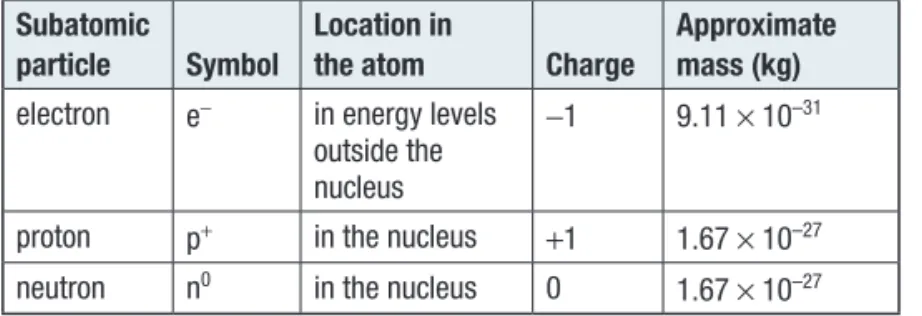
Table 1 summarizes the subatomic particles and their characteristics.
Table 1 Subatomic Particles
Subatomic
particle Symbol
Location in
the atom Charge
Approximate mass (kg) electron e− in energy levels
outside the nucleus
−1 9.11 × 10⁻³¹
proton p+ in the nucleus +1 1.67 × 10⁻²⁷ neutron n0 in the nucleus 0 1.67 × 10⁻²⁷
The value of different Models
Looking back, we can see that the model of the atom has undergone many signifi cant changes. Th e theory of the atom has evolved with continued experimentation and improvements in technology. Th e Bohr–Rutherford model shows electrons orbiting the nucleus like the planets orbiting the Sun. While the model is a simplifi ed one, it is very useful. Th is model allows us to make connections between the atomic structures of diff erent elements and their chemical and physical properties.
Many scientists have contributed to our understanding of the atom. In science there are oft en competing theories, controversies, and setbacks as scientists strive to explain their observations. Later scientists, including Albert Einstein and Erwin Schrödinger, worked to further extend our understanding of the atom. Th ey conducted experiments and proposed explanations regarding the arrangement of electrons in diff erent elements. You will explore more theories about electron arrangement as you move on to further chemistry courses.
The Large Hadron Collider (LHC) is the world’s largest particle accelerator. To learn about Canada’s participation in LHC experiments to investigate the nature of matter and energy,
WEB LInK
go To nElSon SCiEnCE Figure 10 An atom of helium, He, has 2 valence electrons. Lithium, Li, and sodium, Na, both have 1 valence electron. Fluorine, F, has 7 valence electrons.
Na 11p+
12n0
Li 3p+
4n0
F 9p+
10n0
He 2p+
2n0
Atomic number and Mass number
By the 1930s, scientists had found that the Bohr–Rutherford model of the atom was very useful. It helped to explain physical and chemical properties of elements (Figure 11). Scientists knew of the three subatomic particles and had a model of how these par-ticles were arranged in the atom. Th ey summarized this information in the periodic table. We can use the periodic table to fi nd the number of protons and electrons in a neutral atom. As well, given the atomic mass of an element, we can determine the number of neutrons in an atom of that substance.
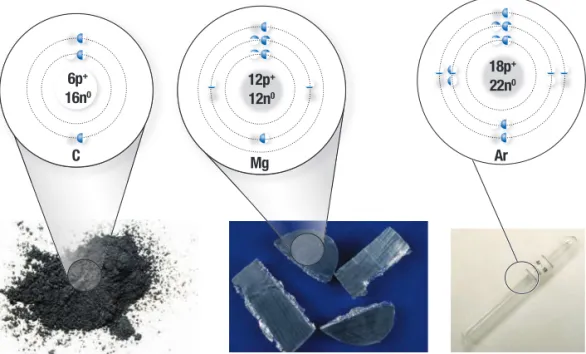
Figure 11 How are the atoms of these three substances different and how are they similar?
Atomic number
Th e number of protons in one atom of a specifi c element is known as the atomic number. Th e symbol “Z” is oft en used to represent the atomic number. All atoms of the same ele-ment have the same atomic number. For example, a carbon atom always has 6 protons, a magnesium atom always has 12 protons, and an atom of argon always has 18 protons. Th e atomic number is usually written in the top left corner of an element’s cell on the peri-odic table (Figure 12). Th e number of protons in a neutral atom is equal to the number of electrons. We can infer this because, in a neutral substance, the positive charges due to the protons must balance the negative charges from the electrons. For example, a carbon atom with 6 protons must have 6 electrons in order for it to be neutral.
Mass number
Th e mass number for an atom is the sum of all the particles in the nucleus. Th e number of protons plus the number of neutrons is equal to the mass number, A. We can there-fore determine the number of neutrons as follows:
number of neutrons 5 mass number 2 atomic number
Figure 13 shows a popular convention used to represent an individual atom of an element. Consider an atom represented by19
9F. From this information, we can determine that this atom has 9 protons (atomic number, Z 5 9), 9 electrons (because atoms are neutral), and 10 neutrons (19 2 9 5 10). Similarly, an atom of 40 19K would have 19 protons, 19 electrons, and 21 neutrons. Th e symbol for an atom is oft en written as C-12 or carbon-12, where 12 is the mass number. You should be able to use all three methods of notation.
atomic number (Z ) the unique number of protons in one atom of an element
mass number (A) the sum of the protons and neutrons in the nucleus of an atom
Figure 13 This notation lets us determine the number of protons, electrons, and neutrons in an atom.
mass number (number of protons and neutrons)
atomic number (number of protons)
X
A
Z
Figure 12 Each element appears in a different cell in the periodic table. The element’s atomic number can be found in the top left-hand corner of its cell.
12.01
carbon
C
6 C6p+ 16n0
CC Ar
18p+ 22n0
Mg 12p+ 12n0
The Mass of an Atom
Atoms are extremely small. In the head of a pin there are approximately 8.0 3 1019 iron atoms: 80 000 000 000 000 000 000 atoms. It would be very cumbersome to represent the mass of atoms using the kilogram. To work with the very small mass quantities of atoms and molecules, scientists use a smaller unit agreed upon by IUPAC and SI convention. Th e accepted unit to measure the mass of atoms is the atomic mass unit, u. Th e atomic mass unit is defi ned as 1
12 the mass of a carbon-12 atom. Scientists have determined experimentally that 1 u 5 1.660 540 2 3 10–27 kg. Th is unit is a relative one based on the mass of carbon-12. Th e masses of all other atoms are consequently measured relative to the mass of carbon-12. For example, F-19 has a mass that is 1912 times that of carbon-12. An atom of F-19 therefore has a mass of 19 u. Each H-1 atom has 121 the mass of a C-12 atom. Its mass is therefore 1 u.
1.2
Summary
• Atomic theory has evolved through several diff erent models over the past 2000 years.
• Th e Bohr–Rutherford model shows electrons orbiting the nucleus. Th is model helps us to predict physical and chemical properties for an element. • Th e atomic number of an element is the number of protons in the nucleus.
Th e mass number is the sum of the number of protons and neutrons. • An atom can be represented in three diff erent ways: 12
6C, C-12, and carbon-12. • An atomic mass unit (u) is defi ned as 121 the mass of one carbon-12 atom. atomic mass unit a very small unit
of mass defi ned as 121 the mass of a carbon-12 atom; unit symbol u
Le Système international d’unités SI units, or le Système international d’unités, is a set of rules used around the world for scientifi c communication. The rules specify which units are used for which quantities. Appendix B1 lists many of the SI units commonly used in chemistry.
lEARning TIP
1.2
Questions
1. Draw Bohr–Rutherford diagrams for the following atoms: K/U C
(a) Ca (b) C (c) Si
2. How many valence electrons are in each of the atoms that you drew in Question 1? K/U
3. Construct a timeline for the development of atomic theory. Include the major milestones and the names of key scientists and brief descriptions or diagrams of their experiments. (You could make an electronic timeline.) K/U C
4. Reread the proposals of Dalton’s atomic theory. Which were still valid after the work of Rutherford and Bohr? Which were no longer valid? Why? K/U T/I
5. Copy and complete Table 2 in your notebook. K/U T/I 6. Draw a fl ow chart showing the historical progression of
different models of the atom. Include the name of and a sketch for each model. K/U C
7. Why should we learn atomic theory? If it is probably incorrect in some way and will undoubtedly change, why do we spend time learning about it? T/I A
8. Suppose your teacher asked you to build a scale model of an atom on your school’s athletic fi eld. Draw a detailed sketch of your model with approximate dimensions. T/I C 9. Most stars are composed primarily of hydrogen and helium.
What might a star’s atomic spectrum look like? A 10. Imagine that you helped to discover a new element:
A = 302; Z = 119. How many protons, electrons, and neutrons are in each atom of this element? T/I
11. You may have heard about quarks and quark theory. Quarks are elementary particles that make up larger particles, called hadrons. Protons and neutrons are two examples of hadrons. Research quark theory and how quarks might fi t into our atomic model. T/I
Name of element Symbol Atomic number Mass number Number of protons Number of neutrons Number of electrons
U 235
magnesium 13
53 131
C 8
technetium 99
Table 2 Atoms of Selected Elements
go To nElSon SCiEnCE