DIGITAL FEMINIST ACTIVISM & THE NEED FOR MALE ALLIES: ASSESSING BARRIERS TO MALE PARTICIPATION IN THE MODERN-DAY WOMEN’S MOVEMENT
Sydney K. Nicolla
A thesis submitted to the faculty at the University of North Carolina at Chapel Hill in partial fulfillment of the requirements for the degree of Master of Arts in Media and Communication
(Theory and Research) in the Hussman School of Journalism and Media.
Chapel Hill 2020
Approved by:
Lucinda Austin
Daniel Kreiss
ABSTRACT
Sydney K. Nicolla: Digital Feminist Activism & the Need for Male Allies: Assessing Barriers to Participation in the Modern-Day Women’s Movement
(Under the direction of Lucinda Austin)
Typically, women instigate and drive participation in digital feminist activism, but
research has suggested that male activists could play a valuable role as allies for the digital
women’s movement. Social media reduce some traditional barriers to activism – time, financial
resources – and force us to consider social and emotional factors that may interfere with outward
male support for feminism. Results of a U.S. based digital survey demonstrated the following
among men who have yet to participate in digital feminist activism (DFA): (1) support from and
characteristics of those in their social networks may play an important role in their willingness to
engage with DFA in the future; (2) there is still a disconnect between support for feminism and
feminist identification, which may affect willingness to participate in DFA; and (3) strong
masculine gender identity may correspond to higher willingness to support abstract, but lower
TABLE OF CONTENTS
LIST OF TABLES……….……….….v
LIST OF ABBREVIATIONS………....….vi
INTRODUCTION………...1
LITERATURE REVIEW………3
Defining Feminism...3
Historical Feminist Activism………...….………..…..….5
Digital Feminist Activism………...…………..………..….7
The Case for Allyship……….………...9
Social Identity and Gender……….………....……....12
The Situational Theory of Publics and Problem Solving………...……....14
Social Relationship Networks……….………...15
Summary………...16
RESEARCH QUESTIONS……….…...17
METHODS………..….….19
Procedure...20
Participants...21
Measures...21
RESULTS...25
DISCUSSION...30
CONCLUSION...34
LIMITATIONS AND FUTURE RESEARCH...35
APPENDIX...36
Survey Codebook...36
LIST OF TABLES
Table 1. Ideological orientation variables correlation coefficients………..…….….26
Table 2. Regression coefficients for social network variables
predicting collective action………....27
Table 3. Regression coefficients for gender identity predicting
situational motivation………...…..28
Table 4. Regression coefficients for gender identity predicting
covert support for feminism………...29
Table 5. Regression coefficients for gender identity predicting
overt feminist identification………...29
LIST OF ABBREVIATIONS
DFA Digital feminist activism
LFAIS Liberal Feminist Attitude and Ideology Scale
MSPSS Multidimensional Scale of Perceived Social Support
mTurk (Amazon’s) Mechanical Turk
STOP Situational Theory of Publics
Introduction
Historically, feminism has been defined in many different ways, these variations marked
by the differences in the supposed primary cause of inequality for women (Schneider & Pham,
2017). Despite and because of the elusiveness of a true ‘definition’ of feminism, feminism may
be best defined by its adaptability. Through many iterations and ideological perspectives that
helped to shape the waves of feminist thought, feminism’s (and feminists’) commitment to
pursuing an inclusive and meaningful feminist movement endured (Thompson, 1994). The
current paper relies on and expands on this adaptability to ask a question that goes largely
unaddressed in scholarly literature – why, exactly, does our intersectional and flexible feminist
movement seem to lack visible support from men?
Public feminist activism can be traced back to the abolitionist movement, and it may be
unsurprising that the women who organized to rally against slavery were many of the same
women who championed women’s suffrage (DuBois, 1978; McConnaughy, 2017). Later, second
wave feminists organized to challenge social inequity – work and paygrade discrimination,
women’s reproductive rights, sexual harassment, and assault (Arnold, 2017; Boris & Elias, 2017;
Goldner, 2017; Staggenborg & Skoczylas, 2017). These issues – in particular sexual harassment,
assault, and violence – remain on the feminist docket in present-day.
Feminists today have harnessed the power of digital media to increase connectivity
among women with shared experiences and broaden visibility for feminist efforts (Mendes,
Ringrose, & Keller, 2019). Social media provide a space and a platform where women can speak
out against prejudice and connect in solidarity (Turley & Fischer, 2018). “Hashtag activism” has
other gendered inequities through social media movements like #MeToo and #YesAllWomen.
The merging of voices through hashtag activism makes womens’ experiences of sexual injustice
seem almost unimaginably prevalent – and appropriately so; according to the CDC, 1 in 3
women will experience sexual assault in their lifetime, and women are twice as susceptible to
sexual violence compared to men (Smith, 2017).
The prevalence of this injustice is reflected in digital harassment experienced by women
online. Digital feminist activists are more likely to be targets of digital harassment, usually by
men, and the most common threats made to women online are rape threats (Cole, 2015). Though
womens’ experiences of harassment online and off occur in huge numbers – emergent studies
suggest that 20-30 percent of adult U.S. women experience some kind of digital cyber abuse
(Beran & Li, 2007; Winkelman, Early, Walker, Chu, & Yick-Flanagan, 2015) – not all men are
perpetrators of harassment. This study proceeds with the opinion that, in order for feminism to
truly eliminate inequality, particularly when it comes to experiences of gender-based violence,
men must be recruited to the ranks of feminism.
Performing feminist activism in digital spaces reduces the physical barriers to activism,
such as financial and geographic limitations (Fernandez & McAdam, 1998), that may prevent
physical activism. Therefore, this study will evaluate emotional and social barriers that may
discourage men from engaging with digital feminist activism (DFA). Drawing from social
identity theory (Tajfel & Turner, 1979), the situational theory of publics and situational theory of
problem solving (Grunig, 1977; Kim & Grunig, 2011), and social network theory (Tolsdorf,
1976), variables such as identification with masculinity, situational motivation, and factors of
social support will be assessed as potential barriers to DFA. The following review of literature
feminist efforts, and the theories that guide research questions that will provide valuable answers
about the potential to mobilize male support for the feminist movement.
Literature Review
Defining Feminism
It is perhaps the lack of one agreed-upon and enduring definition of feminism that makes
it easy to dismiss the term ‘feminism’ as self-evident and easily understood (Delmar, 1986).
Though existing research does not necessarily illuminate one definition of feminism, scholars
have paved the way for us to arrive at a better understanding, of feminism, by understanding it in
its many forms (Hoffman, 2001).
The journey to defining feminism can be started by considering feminism in terms of the
least common denominator. Rosalind Delmar proposes the following to characterize supporters
of the women’s movement in her essay, “What is feminism?”:
“At the very least…someone who holds that women suffer discrimination because of their sex, that they have specific needs which remain negated and unsatisfied, and that the satisfaction of these needs would require a radical change (some would say a revolution even) in the social, economic and political order,” (Delmar, 1986, p. 8).
For some, this definition may serve to represent contemporary feminism well – but for
many, it may be exclusive, overreaching, too radical, too moderate, too narrow, or too broad. The
general inability of women, organizations, and society to come to an agreement about what
constitutes feminism is one way in which we must define feminism.
It is possible to consider feminism in terms of the many schools of feminist thought that
have occurred throughout history. Liberal feminism focused on women’s rights, freedom to
choose, and ability to make personal achievements (Schneider & Pham, 2017). But for many
women, this focus was too limited, and fell short of the full potential of feminism. In response to,
and as a critique of, liberal feminism, social, radical, and lesbian feminisms emerged (Schneider
feminist movements did not act in unison. However, there is an essentially similar critique of
each of these types of feminism: separately, they do not, and cannot, include and work to satisfy
the needs and positionality of all women.
Early feminists struggled to find a definition of feminism that would unify the women’s
movement. That struggle continued throughout the 19th century and still exists in present-day
feminist efforts. There are two themes that make true unity in definition and mobilization of
feminism yet unattainable: (1) Diversity among women (in race, class, sexual orientation,
gender, to start); and (2) Contradictions among feminists (in feminist and social perspectives,
among other things) (Zaretsky, 1988).
Delmar’s definition of feminism, then, may in fact be too narrow, in that it positions
‘women’ in a way that is too homogeneous, and thus exclusive. In order to extend the reach of
feminism, its definition must explicitly and continuously acknowledge and include women who
are not ‘homogenous.’ To be clear: in order to make any movement towards a cohesive
understanding, and more singular definition of feminism, feminism must directly and
continuously acknowledge and include women who are not straight, not white, and not
middle-class (Zaretsky, 1988; Thompson, 1994).
In order to achieve the broadest and most meaningful success, the definition of feminism
must be intersectional. Intersectionality addresses the interactions between gender, race, sexual
orientation, and other differences in individual’s lives, social settings, and cultural ideologies –
as well as how these interactions affect an individual’s social power and collateral (Collins,
2000; Crenshaw, 1989; Davis, 2008). Modern feminist literature tends to agree that an
intersectional perspective is the correct perspective, and contemporary women’s studies scholars
have quickly and agreeably adopted intersectionality (Davis, 2008). This adjustment, and all
Feminism has seen many iterations and many contradictions, but feminism’s ability to
endure is not easily contested. Demise Thompson wrote the following in support, and defense, of
feminism and its many forms:
The feminist willingness to acknowledge and grapple with the contentious issues of race and class (and of disability, age, bodily size, etc.) is admirable. It is also one of the strongest indications that, whatever mistakes are made, however many times we fail to live up to our own exacting standards and fall back into the old male supremacist patterns, feminism itself is not 'racist' or 'classist'. It is not a 'white, middle-class'
movement, devoted solely to the interests of relatively privileged women, but a moral and political commitment available to any woman who cares to engage herself with it.
(Thompson, 1994, p. 187)
I, like Thompson and many others, believe that feminism is adaptable and open enough to
accommodate all women, and, furthermore, all people who care to engage with it. The present
study intends to highlight the continued need for recruitment of supporters of feminism and will
use the terms ‘feminism’ and ‘women’s movement’ to characterize collective feminist efforts. In
order to understand modern feminist activism, the review of literature will first describe how
feminist activism has evolved throughout history, including the first and second waves of
feminism and the driving forces behind women’s movements throughout the 20th century.
Historical Feminist Activism
If defining feminism can be tricky, defining the ‘waves of feminism’ and the activisms
associated with the women’s movement is potentially more complex. The emergence of the
women’s movement (at least to the public) can be traced to mid-19th century abolitionist efforts
(McConnaughy, 2017). Though the fight to abolish slavery may not be an obvious push towards
women’s rights, DuBois (1978) suggests that the abolitionist movement connected early feminist
activists in a particular way – that their participation in the anti-slavery movement was “the key
that unlocked the political potential of women’s discontent” (McConnaughy, 2017). It is no
surprise that many women active in the anti-slavery movement were also the first women active
If these are considered the first two instances that demonstrated women organizing
strategically and deliberately, then these instances could be considered the first ‘wave’ of
feminism. The second ‘wave’ of feminism came around half a century later, and its goals were
less political, more social, and less concrete than the wave that came before it (Goss, 2017). The
second wave of feminism is often described in terms of the different approaches feminist groups
were taking in the fight for equality. Each school of second wave feminist thought was a critique
on and an expansion of another – and the differences between them can be explained, most
simply, by the differences between what each group of feminists identified as the primary driver
of inequality (Schneider & Pham, 2017). Liberal feminists thought fighting for (and obtaining)
rights and choices would balance gender inequity, without much considering the oppression that
led to women’s status and condition. Marxist feminists thought class oppression was the root of
all oppression, while socialist feminists believed a woman’s position in society was based on
economic factors and gender oppression – or the ‘patriarchy.’ Radical feminists saw the
patriarchy as the primary reason for all oppression (Schneider & Pham, 2017).
It would be remiss to articulate the conflicts within the second wave of feminism without
discussing the activisms that motivated second wavers. Second wave feminism brought activisms
to combat issues in the workforce: workplace and paygrade discrimination and sexual
harassment (Boris & Elias, 2017). Women’s health and women’s reproductive rights also
became a central focus during second wave feminism (Goldner, 2017; Staggenborg & Skoczylas,
2017). Even anti-rape and domestic violence awareness efforts saw their beginning during the
1960s and 1970s, as part of second wave feminism (Arnold, 2017). These activisms continued
throughout the third wave of feminism, beginning in the 1990s and continuing into the 2010s,
the ‘fourth wave’ (Mclaran, 2015). No other feminist era has had a more pronounced fight
against sexual assault, sexual harassment, and domestic violence.
Protesting gender discrimination has become mainstream in the modern feminist era, no
doubt and in no small part due to media in their many forms (Hurwitz, 2017). Feminist activists
have historically stayed cutting edge in their efforts, taking advantage of traditional media like
print, especially newspapers, to “build solidarity, and create cultural change” (Hurwitz, 2017, p.
5). As media have evolved, so has the women’s movement. A large part of today’s feminist
activism takes place online – a result of the prevalence and reach of the internet and social
media. Let’s look now at the most contemporary form of feminist activism: DFA.
Digital Feminist Activism
Following the history of feminist activism to present day comes the inevitable
intersection of feminism, activism, and the internet. The internet, and particularly social media,
involve a mass organization of networks of people, groups, organizations, governments, and
similar types of actors. The ease of connection and networking offered by social media make
them not only appropriate but also opportunistic platforms for strategic activist mobilization. In
their aptly titled book, Digital Feminist Activism, Mendes, Ringrose, and Keller (2019) describe
the recent broadened visibility, or mainstreaming, of feminist activism. In no uncertain terms,
Mendes et al. credit digital networks for the mainstreaming of these feminist conversations,
citing social media movements like “#YesAllWomen, “Hollaback!” and of course, “#MeToo” as
driving forces in this progress (2019, p. 2).
The connectedness of social media as a tool for feminist progress is a sentiment echoed in
much emergent research dealing with DFA (Baer, 2016; Titus, 2018; Turley & Fisher, 2018).
“Hashtag feminism” has created a space in the digital sphere, particularly on Twitter, where
reacting to others’ stories, and provoking responses (Turley & Fisher, 2018). Because of the
hashtag feature and its interface optimized for sharing fast-paced, connected content, Twitter
may be the social media platform most often used for activism (Mendes et al., 2019).
Additional literature corroborates the sentiment of “connectedness” as an advantage of
social media feminism that goes beyond the hashtag. Social media has been described as a tool
for linking specific, local stories of individual women to larger narratives of inequality (Baer,
2016). Social media may serve as a “gateway for young feminists” – in one instance,
communities of feminist support on social media in India grew, spread, and even resulted in
media attention (Titus, 2018). This connection between social and news media – the
‘mainstreaming’ of feminist messages – may be the best evidence of DFA’s impact.
The national media attention received by “#MeToo” and other hashtag activism suggests
some success in obtaining broadened visibility for the digital feminist movement. But even if the
successful mainstreaming of DFA can be confirmed, in some ways, the question still remains:
where is the value? For Mendes et al. (2019), the value is in the documentation – documentation
of experiences with sexism or harassment and the emotions related to these experiences.
Documentation of the harm that these experiences caused, and of the strength and labor required
to share these experiences in the name of educating others (Mendes et al., 2019). The value is in
sharing common experiences, having those experiences validated by others, and hopefully,
making an impression on those who are not privy to, or who refuse to acknowledge, the
devastating frequency with which women face sexism, harassment, and assault.
The frequency with which women face sexism and harassment is reflected in online
interactions between activists and observers. In some ways, women who participate in DFA, and
particularly those who paved the way for these digital discussions, are increasing their risk of
through the actions of those who disagree with the efforts and sentiments of digital feminist
activists. Next, the literature review will address the importance of mobilizing additional allies
for the digital feminist activist movement.
The Case for Allyship
In the United States, the CDC found that about 1 in 3 women (36.3 percent) experience
sexual assault during their lifetime. The same study found that for men the frequency of
experienced sexual assault is more like 1 in 6 (17.1 percent). Furthermore, the Association of
American Universities’ 2015 nationwide survey found that on college campuses, cisgender men
are the primary perpetrators of sexual assault: for example, physically forced penetration was
perpetrated by cisgender men in 93 percent of reported cases (Cantor et al., 2015). These
numbers should be illuminating, but may also not be totally representative, as underreporting of
sexual assault is a known problem among both male and female populations (Cantor et al.,
2015). Therefore, I include these numbers not to trivialize the threat of sexual assault for men,
but rather to illustrate that despite fervent and prolonged efforts by women, gender makes
women twice as susceptible to sexual violence, while men remain responsible for the vast
majority of sexual assaults.
With these prevalence and perpetration rates in mind, it seems neglectful to focus
feminist research efforts on women’s ideologies alone; clearly, much of the work feminism has
left to do requires the cooperation of men. Scholars have demonstrated an interest in
understanding both the prevalence of and the traits or circumstances that may lead to female
participation in feminist activism, online and off (Jackson, 2018; Keller, 2012; Swank & Fahs,
2017). However, even contemporary feminist literature overlooks and neglects the importance of
assessing the barriers to involvement, particularly male involvement (Wiley et al., 2013), in
What feminist scholars have demonstrated is that those who oppose the feminist
movement respond with resistance, threats, and intimidation tactics in the face of DFA. Kirsti
Cole describes anti-feminist sentiments shared on social media as “disciplinary rhetoric,” meant
to intimidate and silence women who choose to speak up (2015, p. 357). She identifies rape as
the most frequently used threat to intimidate women online (Cole, 2015). Cole is not alone in
documenting instances of violent anti-feminist sentiments shared on social media. Other scholars
have documented the violence experienced by women speaking up about gender inequality
online, highlighting the fact that anti-feminist reactions to digital feminists, and sometimes
women online in general, almost always use a woman’s gender against her (Sobieraj, 2018).
These anti-feminists employ commentary about a woman’s appearance or sexual behaviors to get
the insult across (Sobieraj, 2018).
In some instances, violent anti-feminist rhetoric can transcend the internet and pose a
real, physical threat. Threats can often spill over into offline life through digital intimidation
tactics like ‘doxxing,’ in which attackers collect and publish personal information about the
individual they wish to intimidate (Sobieraj, 2018). This can include publishing the victim’s
home address or employer information, and encouraging other harassers online to threaten the
victim’s safety in their own home or workplace (Mantilla, 2013). Accounts from victims’
experiences of doxxing are far from harmless: one woman had her home address, floor plans,
and photos of her car and pets published online in an attempt by her digital harassers to further
escalate her fear of physical violence (Sobieraj, 2018). In some cases, perpetrators of
gender-based harassment will let the target know that they have her personal information in less obvious
ways, such as sending her a pizza or package (Mantilla, 2013).
These are not isolated incidents. Threats and slurs in response to feminist activism online
through the hashtag “#mencallmethings” (Megarry, 2014). Megarry, like the other scholars
mentioned above, speculated that the goal of those opposing feminist progress was to silence
female voices – to maintain the imbalance of power between the genders by trying to halt
conversations about it (2014). Additionally, these obstacles for women are not limited to the
internet. Men in leadership positions may resist or refuse mentoring their female colleagues for
fear of a misstep in the “#MeToo” era, effectively limiting the career advancement and growth
opportunities for women due to a misunderstanding of, or perhaps a fear of, the goals of
feminism (Soklaridis et al., 2018).
But of course, not all men outwardly oppose DFA or feminist activism in general.
Research suggests that men who reject status-legitimizing ideologies may be more likely to see
and recognize sexism directed at women (Drury & Kaiser, 2014). Additionally, men who
experience unfair treatment themselves as a result of characteristics like race or sexual
orientation may be more likely to reject status-legitimizing beliefs, and in turn more willing to
acknowledge sexism (Drury & Kaiser, 2014). Men who endorse feminist beliefs may be those
who are more aware of sexism (Swim, Hyers, Cohen, & Ferguson, 2001). And when men do
confront sexism, they may be taken more seriously because confronting sexism does not seem to
directly benefit men (Drury & Kaiser, 2014). These findings indicate a serious opportunity for
male allies to advance feminist activism and combat sexism.
Despite the need for male allies in the digital feminist activist movement, encouraging
men to acknowledge, much less denounce, sexism poses a large challenge (Drury & Kaiser,
2014). Men may face stigma-by-association and may be perceived as more feminine, weak, and
likely to be gay when they align themselves with gender egalitarianism (Rudman, Mescher, &
ingroup may relate strongly to an unwillingness to embrace feminism (Precopio & Ramsey,
2017). This relationship, while intriguing, is vague.
The present study will expand on specific ‘ingroup’ loyalties by assessing the strength of
an individual’s gender identity, specifically identification with traits typically representative of
masculinity and femininity, willingness to acknowledge or participate in DFA. In the next
section, the literature review will cover social identity theory and gender identity, the first of two
theoretical bases for this study.
Social Identity and Gender
Social groups, or collections of individuals who perceive themselves as members of the
same social category, allow individuals to identify themselves in social terms (Tajfel & Turner,
1979). Social groups provide parameters within which individuals can define and understand
their place in society. Acknowledging that an individual’s comprehensive identity is
multi-faceted and complex, Tajfel and Turner’s theory of social identity deals with the part of an
individual’s self-concept that derives from their knowledge of, as well as the value and
emotional significance placed on, membership of a social group or groups (1979).
Through a social comparison process, social identity behavioral tendencies lead to
in-groups and out-in-groups: those who are similar to the self and fit within the social group, and those
who do not (Stets & Burke, 2000; Spears, 2011). Individuals who are a part of the social
in-group may feel a strong attachment to the in-group, may feel protective against perceived threats or
slurs against the group, and may feel motivated to defend the group identity when necessary
(Saucier, Till, Miller, O’Dea, & Andres, 2015; Spears, 2011). One widely accepted social group
identity is gender identity (Spears, 2011).
The present study, following an example set by Glick, Wilkerson, and Cuffe, will
Masculinity in this case can also be considered stereotypical or ‘traditional’ male behavior;
whereas, femininity refers to behaviors stereotypically expected of women (Glick et al., 2015).
Examples of stereotypically masculine characteristics include assertiveness and competitive
nature, while examples of stereotypically feminine characteristics include sensitivity and
compassion (Schertzer, Laufer, Silvera, & McBride, 2007). Individuals who dichotomize men
and women by expected gender behaviors may be more likely to perceive feminism as
challenging traditional ‘femininity,’ and thus threatening masculinity as its complement (Glick et
al., 2015).
Research has shown that men who associate strongly with masculinity as part of their
gender group identity seem particularly sensitive to threats against the masculine element of the
group identity (Falomir-Pichastor, Berent, & Anderson, 2019; Gangadharan, Jain, Maitra, &
Vecci, 2016; Netchaeva, Kouchaki, & Sheppard, 2015; Saucier et al., 2015). Additionally,
research has suggested that men may regard femininity, feminine adjectives, or female
superiority as slights against masculinity (Netchaeva et al., 2015; O’Neil, Helms, Gable, David,
& Wrighstman, 1986; Saucier et al., 2015). This does not bode well for encouraging male
participation in feminist efforts – as mentioned previously, stigma may cause men who present
as more egalitarian to be perceived as less masculine and to have their sexuality questioned
(Rudman et al., 2013).
With research evidence, it is not surprising that studies have suggested a strong male
ingroup identification may interfere with support for feminism (Burn, Aboud, & Moyles, 2000).
The present study will extend these findings by considering participants’ strength of masculine
or feminine identification alongside motivation to engage with feminist activist efforts. To better
understand individuals’ motivations in the realm of activism, the literature review will now
The Situational Theory of Publics and Problem Solving
The STP, generally referenced in public relations research, defines a ‘public’ as a group
of people who share a common problem or issue (Grunig, 1997). STP proposes three variables
that explain and predict communication behavior for these publics: problem recognition, level of
involvement, and constraint recognition (Kim & Grunig, 2011). STP also proposes two
corresponding dependent variables: information seeking and attending to the information (Kim
& Grunig, 2011).
In proposing a more generalized version of STP, the Situational Theory of Problem
Solving (STOPS), Kim and Grunig expanded “information seeking and attending” to a more
versatile dependent variable: communicative action in problem solving (2011). Communicative
action in problem solving describes an individual’s heightened activeness in information taking,
selecting, and giving as one engages in problem solving (Kim & Grunig, 2011). STOPS also
offers updated and more generalized definitions of the three independent variables: (1) problem
recognition, as “one’s perception that something is missing and there is no immediately
applicable solution to it,” (p. 128); (2) level of involvement, as “a perceived connection between
the self and the problem situation,” (p. 130); and (3) constraint recognition, as “people perceive
that there are obstacles in a situation that limit their ability to do anything about the situation,”
(p. 130) (Kim & Grunig, 2011, p. 130). Finally, STOPS introduces situational motivation as a
mediating concept of the independent variables of STP (problem recognition, level of
involvement, constraint recognition) and the dependent variable, communicative behavior
(Chang & Kim, 2019). Situational motivation is defined as “the extent to which a person stops to
think about, is curious about, or wants more understanding of a problem,” and is considered a
Because the STP and STOPS seek to explain when and why individuals become active in
communication behaviors, these public relations theories have also been applied to evaluations
of tendencies of individuals to engage in activist communications (Chang & Kim, 2019; Chon &
Park, 2019; Dozier, Shen, Sweetser, & Barker, 2016; Illia, 2003; Xifra, 2016). The situational
theories have been successfully incorporated in advocacy research dealing with climate change
activists and climate change deniers (Xifra, 2016), social media political activism by youth
actors (Velasquez & LaRose, 2015), and advocacy and willingness to speak out against
genetically modified foods (Chang & Kim, 2019).
The present study will expand the theoretical applications of STP and STOPS to
individuals’ communication behaviors surrounding DFA. In addition, and related, to social
identity and situational motivation, the present study will investigate one final variable that may
explain an individual’s tendency not to engage with DFA – the behaviors and ideologies of those
who make up the closest inner circle of the individual’s personal network.
Social Relationship Networks
The old adage “we are the company we keep” is true in many ways. Research in the
social sciences has established that social networks are extremely influential on human behavior,
and that the characteristics of a social network may be useful for predicting social behavior of
those within the network (Tolsdorf, 1976). Tolsdorf describes two types of social networks –
functional and nonfunctional – and classifies a functional network as one that is “supportive,
receptive, empathetic and understanding” (1976, p. 2). A functional network is more likely to
receive attention and maintenance, and thus likely to be more intimate (Tolsdorf, 1976). These
intimate support networks can have a great deal of influence on our behaviors (Eggens, van der
Werf, & Bosker, 2008). The present study will focus on the potential influence of an individual’s
Social network characteristics have been linked to a number of behaviors – political
participation, academic achievement, purchase decisions, and even criminal behavior (Eggens et
al., 2008; Grinblatt, Keloharju, & Ikaheimo, 2008; Staton-Tindall, Royse, & Leukfield, 2007).
Social networks have also been found to be effective predictors of recruitment into social
activism – individuals may be more likely to engage in activism if they have friends or family
members who are themselves activists (Crossley, 2008). It follows that researchers have
identified an effect of social networks on feminist identification and associated feminist activism
(Nelson et al., 2008). Specifically, having a feminist mother has been proposed as an antecedent
to feminist identification, and feminist identification in turn may be predictive of participation in
collective action (Nelson et al., 2008).
As is the case with most feminist scholarship, researchers thus far have primarily
explored social network influence on feminist identification and tendency to engage in collective
action for women. However, Rudman and Phelan’s study investigated whether feminism was at
odds with happiness in heterosexual relationships as prior research had suggested (2007).
Rudman and Phelan did not find support for the supposed conflict caused by feminism in
heterosexual relationships (in fact, they found the opposite); additionally, and of particular
interest for the present study, Rudman and Phelan found an individual’s reported feminism to be
highly related to their partner’s (2007). With existing knowledge about social networks and their
influence, it’s important to consider the gender equity stance of family members, friends, and
romantic partners alongside the individual’s.
Summary
This study takes a step in the direction of understanding barriers to support for DFA and
identifying the characteristics of individuals who may be valuable (though yet uninvolved)
supportive and influential social network, their social identity and ingroup identification, and
corresponding situational motivation towards DFA will be considered. Findings will expand a
limited body of literature that addresses characteristics of individuals who do not become
feminist activists; and ideally, serve as a stepping stone for the important work of overcoming
these barriers and gaining powerful allies for the women’s movement and supporters who will
speak up online when they see harassment and digital threats of violence toward women.
Research Questions
Digital activism may not have as many of the physical and logistical barriers that come
with traditional activism (Fernandez & McAdam, 1988). Therefore, the present study will focus
on emotional and social barriers to support and participation. Keeping in mind the influence
social support networks can have on ideology and behavior, I pose the following initial research
question:
RQ1: Among men with Twitter accounts who have not yet participated in DFA, is
their willingness to engage in DFA in the future (assessed by the collective action
measure) associated with:
(a) Perceived social support from their:
i. Partner?
ii. Family?
iii. Friends?
(b) Social and economic political orientation of their partner, family, and friends?
(c) Reported outward feminist identity of their partner, family, and friends?
Though there is limited research that addresses barriers to male participation in feminist
activism, borrowing theories used in more general activism research can guide formation of
communicative behavior: problem recognition, constraint recognition, and level of involvement
(Kim & Grunig, 2011). STOPS proposes situational motivation as a mediator between these
three variables and an individual’s communicative behavior (Kim & Grunig), and studies have
demonstrated a positive association between an individual’s level of involvement with an issue
and corresponding situational motivation (Chon & Park, 2019, Kim & Grunig, 2011). Therefore,
following research question seeks to evaluate the relevancy (i.e., situation motivation) of DFA
for participants and their corresponding acknowledgement of or engagement in DFA:
RQ2: Among men with Twitter accounts who have not yet participated in DFA, how
does situational motivation toward feminism associate with willingness to
participate in DFA in the future (assessed by collective action measure)?
The previous research question will address whether situational motivation plays a role in
willingness to participate in DFA, and the following research question will begin exploring why,
if situational motivation is indeed low, that may be the case. Strong male ingroup identification –
regarded here as masculinity (Glick et al., 2015) – may interfere with support for feminism (Burn
et al., 2000). This interference can potentially be attributed to fear of breaching ingroup conduct
due to the stigmatization of egalitarian men as more feminine or gay (Rudman et al., 2013). The
following research question will explore this possibility further:
RQ3: For men with Twitter accounts who have not yet participated in DFA, how
does the strength of their identification with masculine or feminine traits associate
with situational motivation toward feminism?
In order for an individual to act in accordance with their group identity, that identity must
be made salient (Spears, 2011) – or, activated, for lack of a better term. Research has addressed
identity salience with respect to recruitment into a social movement; it has been proposed that
more-salient identity groups (McAdam & Paulson, 1993). Hypothetically, then, a male
individual with generally positive sentiments toward the ideals of gender equality may still
abstain from feminist advocacy because of perceived pressure from ties to a group identity. With
the pressures of masculinity in mind, I pose the following final research question:
RQ4: Among men with Twitter accounts who have not yet participated in DFA, how
does the strength of their identification with masculine and feminine traits associate
with:
(a) covert support for feminism (assessed by the LFAIS);
(b) overt feminist identification; and,
(c) willingness to participate in DFA in the future (assessed by the collective action
measure)?
Methods
In their 2012 research methods paper, Miner, Jayaratne, Pesonen, and Zurbrügg
acknowledged that survey has not traditionally been a preferred feminist research method: It has
been criticized for being too positivistic and, thus, in contradiction with feminist methodologies
(2012). However, in disagreeing with this perspective and defending survey as a femininst
methodology, Miner et al. describe three principles of feminist research: (1) to be conducted with
the goal of producing knowledge that is for, rather than on, women, (2) to use a research method
that is not oppressive, and (3) to continually challenge dominant knowledge paradigms (2012).
Survey methodology does not, by itself, stand in the way of any of these three principles. In fact,
surveys can be a valuable tool in research aimed to create social change.
Miner et al. describe the importance of survey as a tool for influencing policy and public
opinion because it has the unique ability to identify large-scale patterns and to make
tool for initiating social change make this methodology especially relevant in the case of the
present study, in which I utilized survey in an attempt to reveal broad-scale patterns, ones that
indicate potential social and emotional barriers to feminist activism among men.
Procedure
Participants aged 18 and older were invited to participate in a paid, nationally
representative web survey via Amazon’s Mechanical Turk (mTurk). mTurk is a digital labor
platform on which workers are first vetted by being asked to complete Human Intelligence Tasks
before being redirected to complete online surveys for payment offered by survey creators (Boas,
Christenson, & Glick, 2008). The survey was hosted on the Qualtrics survey platform and
distribution of the survey, confirmation of completion by verified participants, and payment for
the survey all took place within the mTurk platform. Several academic studies have found
support for the quality of responses from mTurk’s participant pool (Boas, Christenson, & Glick,
2018; Ibarra, Agas, Lee, Pan, & Buttenheim, 2018).
mTurk allows Requesters to specify certain demographic characteristics that survey
respondents should meet. Some of these specifications are free but most require additional fees.
Two of mTurk’s free screening categories, specifically (1) workers located in the U.S. and (2)
with a Lifetime Approval Rating of 90 percent or higher, were selected to filter initial
respondents for this study. mTurk workers who met these two criteria were eligible to begin the
survey, but were further vetted by initial survey questions that screened out (a) women, (b) those
who did not have or did not use Twitter (to ensure participants were familiar with the platform
and could accurately respond to questions about future participation in DFA on Twitter), and (c)
those who reported previous participation in DFA. Participants who met all of the inclusion
I collected data in two stages – the first ‘test run’ generated 30 completed surveys in an
hour and the second stage generated 373 completed surveys in approximately 24 hours for a total
of 403 completed questionnaires.
Participants
Four-hundred and three eligible participants who ranged in age from 20–73 (M=33.6, SD
= 8.90) completed the survey in exchange for compensation offered. Participants included 373
men, 28 genderqueer/gender non-binary persons, and 2 persons who reported another gender
identity. Participants self-identified with the following racial backgrounds: 75.9%
White/Caucasian (n = 306), 11.9% African American (n = 48), 4.5% Asian (n = 18), 2.2%
Native American (n = 9), 2.8% selected multiple backgrounds (n = 12), and 2.5% reported
another racial background (n = 10). Also, 17.4% of respondents (n = 70) reported a Hispanic,
Latino or Spanish origin. Participants’ reported education levels included 8.7% with a high
school diploma (n = 35), 17.9% who had completed some college (n = 72), 57.8% with a college
degree (n = 233), and 15.6% with more than a college degree (n = 63).
Measures
Multidimensional scale of perceived social support. The Multidimensional Scale of Perceived Social Support (MSPSS) is a self-report measure designed to assess perceived
emotional support from family, friends, and relationship partners (Zimet, G., Dahlem, Zimet, S.,
& Farley, 1988). Participants were asked to indicate on a 7-point scale their feelings about each
of 12 items. The 12 items are able to be broken down into subscales for family, friends and
romantic partners. Sample items include: (a) I have a partner who is around when I am in need
(romantic partner subscale), (b) my family really tries to help me (family subscale), and (c) I
have friends with whom I can share my joys and sorrows (friendship subscale). The items were
indicated more perceived support from partners (α = 0.947, M = 5.01, SD = 1.74), families (α =
0.868, M = 5.36, SD = 1.25), and friends (α = 0.868, M = 5.33, SD = 1.19).
Support network interpreters. Name interpreters are questions designed to collect information about individuals in a participant’s social network (Burt, 1984; Saffer, Yang, & Qu,
2019). In the present study, the MSPSS was followed by a series of name interpreters
administered to assess potentially important characteristics of those closest to the participant in
their social support network. Participants were asked to consider first their closest romantic
partner, then closest family member, and finally closest friend. Name interpreter questions asked
about gender, political affiliations, and outward feminist identification for each identified social
support network member.
Overt feminist identification. A single item was used to measure outward identification
with feminism for participants as well as for their closest partner, family member, and friend. A
version of the following closed-ended question adapted from Morgan (1996) was administered:
“To what extent do you consider yourself/this person a feminist? Please choose the answer that
best describes your stance” (Burn et al., 2000, 1084). The question was answered by choosing
one out of eight options ranging from “(1) I do not consider myself a feminist at all and believe
feminists are harmful to family life and undermine relations between men and women” to “(8) A
committed feminist currently active in the women’s movement,” where a high score indicated
strong feminist identification (M = 3.44, SD = 1.70).
Covert support for feminism. Discrepancies between an individual’s overt willingness to self-identify with feminism and covert support for the goals of feminism have been recorded
time and time again (Burn et al., 2000; Jackson et al., 1996; Williams & Wittig, 1997; Zucker,
2004). In order to leave room for this discrepancy to show itself in the present study, participants
a covert measure of feminist support separate from identification. The 11-item short-form of the
LFAIS, which asks for agreement on a 5-point scale, was developed to measure attitudes towards
gender roles, the goals of feminism, and feminist ideology (Morgan, 1996). Sample items
include: “Women should be considered as seriously as men as candidates for the Presidency of
the United States,” and “Doctors need to take women’s health concerns more seriously.” The
items were combined to form a single score of covert support for feminism, where a high score
indicates more support (α = 0.793, M = 3.52, SD = 0.624).
Gender role identity scale. The Bem Sex Role Inventory (BSRI) is commonly used to
measure self-perceived masculine and feminine gender identity (Schertzer et al., 2008). Schertzer
et al. found support for the efficacy of a 20-item short version of the BSRI called the Gender
Trait Index (GTI), and recommended eliminating four of the items based on their findings
(2008). Therefore, the 16-item modified version of the GTI validated by Schertzer et al. was used
in the present study to assess participants’ masculine and feminine gender identities through
stereotypic gender traits. Participants were asked to “indicate to what extent each of the
following characteristics” described them on a 7-point scale ranging from (1) never to almost
never true, to (7) always or almost always true, where a high score indicated higher
masculine/feminine gender identification.
Eight items assessed masculine identification (including the sample item “Have
leadership abilities”) and were combined to form one masculine identification score (α = 0.887,
M = 4.74, SD = 1.13). Eight different items assessed feminine identification (including the
sample item “Sensitive to others’ needs”) and were combined to form one feminine identification
Situational motivation. This study considered the situational motivation variable of
STOPS for male non-activists faced with the problem of gender inequality. Participants were
re-oriented to the ‘problem’ with the following text:
“As a reminder, digital feminist activism attempts to facilitate conversations and promote awareness about gender inequality. Please indicate…your level of agreement with the following statements with regards to the problem digital feminist activism calls attention to, gender inequality.”
Eleven items followed to measure participants’ situational motivation of problem solving
(Kim & Grunig, 2017). Respondents rated their level of agreement on a 7-point scale with a
series of statements such as “I am curious about this problem,” and “I am determined to fix this
problem as soon as possible.” The items were combined to form a single score for situational
motivation, where a high score indicated high situational motivation (α = 0.954, M = 4.20, SD =
1.45).
Collective action measure. A four-item collective action tendency measure, adapted
from Zomeren, Postmes, and Spears (2012), was administered to help explore the link between
situational motivation and communicative action in the instance of DFA. Respondents rated their
level of agreement on a 7-point scale with the following four statements: (a) “I would create a
tweet using a feminist hashtag, such as #TimesUp,” (b) “I would retweet a tweet using a feminist
hashtag, such as #TimesUp,” (c) “I would like to join forces with other activists to help the
women’s movement,” and (d) “I would like to do something to help solve inequality.” The items
were combined to form a single collective action score, where a high score indicated more
willingness to engage with DFA (α = 0.890, M = 4.11, SD = 1.58).
Political orientations. Participants were asked to report their political leanings by the statement:
“Please rate the orientation of your political ideology in terms of economic and social issues.”
scales ranging from (1) consistently conservative, to (7) consistently liberal, where a high score
indicated a more liberal political leaning.
Results
Descriptive and Exploratory Analyses
To start first with some descriptive data, 78.9% of respondents (n = 318) reported
familiarity with the concept of digital feminist activism (DFA). Of those who were familiar with
the concept of DFA, 94.3% responded that they had not “ever used Twitter to share or respond to
feminist sentiments, such as hashtag activism (like #MeToo) or general thoughts on gender
inequality,” while 5.7% responded “Not sure” to this question. The collective action measure
results showed willingness to engage with or participate in DFA in the future to be fairly neutral,
with a mean collective action score of M = 4.11, just over the midpoint.
Ideologically, participants as a whole reported neutral but slightly more liberal social (M
= 4.58, SD = 1.85) than economic (M = 4.27, SD = 1.88) political orientations. Participants
scored above the midpoint for covert support for feminism (as measured by the LFAIS) (M =
3.52 on a 5-point scale) and scores for overt feminist identification were more conservative (M =
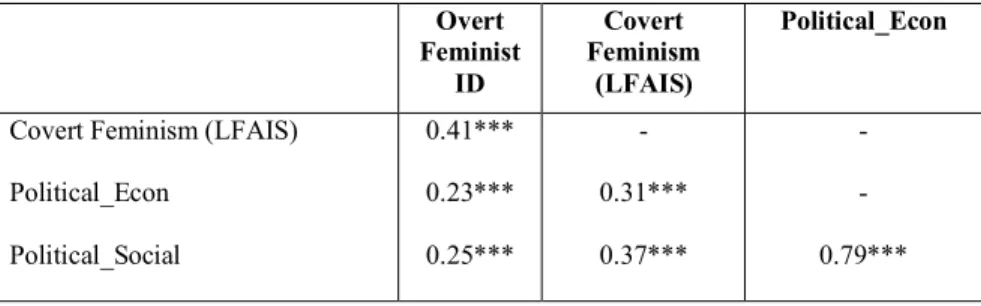
3.44 on an 8-point scale). Table 1 presents the zero-order correlations between participant’s
reported ideological standpoints.
Table 1. Ideological orientation variables correlation coefficients
Overt Feminist
ID
Covert Feminism
(LFAIS)
Political_Econ
Covert Feminism (LFAIS)
Political_Econ
Political_Social
0.41***
0.23***
0.25***
-
0.31***
0.37***
-
-
0.79***
Note. Reported values are Pearson’s r. * p < .05, ** p < .01, *** p < .001
A regression model indicated a significant association between participants’ ideological
social political orientation (B = -0.18, SE B = 0.07, β = -.21) was a significant negative predictor
of collective action (p < .05) and covert feminism (B = 0.31, SE B = 0.14, β = .12) was a
significant positive predictor of collective action (p < .05). Overt feminist identification was the
most significant positive predictor of collective action (B = 0.31, SE B = 0.05, β = .34, p < .001).
Demographic and ideological variables with significant statistical influence on dependent
variables were assessed for confounding effects and controlled for in regression analysis as
advised by Kleinbaum, Kupper, and Nizam (2014).
RQ1: Social Network Characteristic Associations with Collective Action Measure
RQ1 asked whether, among men who have not yet participated in DFA, there was an
association between the independent variables of (a) perceived social support, (b) social and
economic political orientations among those in their closest social network, and, (c) the outward
feminist identity of those in their closest social network and the dependent collective action
variable measuring willingness to engage with DFA in the future. A hierarchical multiple
regression controlling for ideological orientations showed a significant association between
perceived social support (from partners, family members, and friends) and the collective action
measure (F(7,393) = 13.6, p < .001, R2 = 0.20). Perceived social support from friends (p < .05)
and partners (p < .01) were significant individual positive predictors in the model. Perceived
social support from a family member was not a significant individual predictor.
Considering political orientations of those within social networks, hierarchical multiple
regression revealed a significant association between social and economic political orientations
of participants’ closest partner, family member, and friend and the collective action variable
(F(10, 340) = 12.8, p < .001, R2 = 0.27); partners’ social political leaning was a significant
negative predictor in the model (p < .01). Finally, outward feminist identification among social
11.4, p < .001, R2 = 0.19), with family members’ outward feminist identification serving as a
significant individual positive predictor in the model (p < .01). See Table 2 for RQ1 B values.
Table 2. Regression coefficients for social network variables predicting collective action
B SE B β R2
(a) Perceived Social Support
PSS_Partner PSS_Family PSS_Friend 0.14 -0.13 0.19 0.05 0.08 0.08 .15** -.10 .14* 0.20
(b) Social Network Political Orientations
Partner_PoliticalSocial Partner_PoliticalEconomic Family_PoliticalSocial Family_PoliticalEconomic Friend_PoliticalSocial Friend_PoliticalEconomic -0.27 -0.14 -0.02 -0.01 -0.11 0.12 0.08 0.09 0.08 0.07 0.08 0.08 -.33** -.16 -.02 -.01 -.13 .14 0.28
(c) Social Network Feminist Identity
Partner Feminist ID Family Feminist ID Friend Feminist ID
-0.07 0.17 0.08 0.06 0.05 0.05 -.08 .19** .10 0.19
Note. * p < .05, ** p < .01, *** p < .001
RQ2: Situational Motivation Association with Collective Action
Hierarchical multiple regression was used to assess whether situational motivation was
associated with willingness to participate in DFA in the future (collective action measure) for
men with Twitter accounts who do not currently participate in DFA. After controlling for
participants’ ethnicity, education, and ideological orientations, results of the regression (F(9,
391) = 82.1, p < .001, R2 = 0.65) supported situational motivation as a significant positive
predictor of collective action (B = 0.79, SE B = 0.04, β = .72, p < .001, Δ R2 = 0.41). As a
reminder, situational motivation in this study is “the extent to which a person stops to think
about, is curious about, or wants more understanding of” gender inequality, and the collective
RQ3: Masculine and Feminine Identification Associations with Situational Motivation
RQ3 proposed exploration of variables that may influence situational motivation.
Regression analysis was again used to reveal associations between masculine and feminine
identification and the dependent variable of situational motivation. A hierarchical multiple
regression controlling for age and ideological orientations indicated that there was a collective
association between gender identification and situational motivation (F(7, 392) = 30.9, p < .001,
R2 = 0.36). Individually, masculine identification (p < .001) and feminine identification (p <
.001) were each significant positive predictors of situational motivation (See Table 3).
Table 3. Regression coefficients for gender identity predicting situational motivation
B SE B β
Feminine Identification Masculine Identification
0.35 0.41
0.06 0.06
.27*** .34*** Note. * p < .05, ** p < .01, *** p < .001
RQ4: Gender Identity Associations with Feminist Tendencies
The final research question posed a series of queries to investigate whether, for men who
have not yet participated in DFA, there were associations between the strength of their masculine
and feminine gender identities and variables of feminist tendencies. RQ4 first asked whether
there was an association between masculine and feminine identification and covert support for
feminism. The regression model, controlling for political orientation, indicated a significant
positive association between strength of gender identities and covert support for feminism (F(4,
396) = 27.5, p < .001, R2 = 0.23). Feminine (p < .001) and masculine (p < .001) identification
were significant positive and negative predictors in the model, respectively (See Table 4).
Table 4. Regression coefficients for gender identity predicting covert support for feminism
B SE B β
Feminine Identification Masculine Identification
0.18 -0.10
0.03 0.03
Next, a hierarchical multiple regression controlling for political orientation indicated a
significant association between strength of gender identification and overt feminist identification
F(4, 396) = 9.62, p < .001, R2 = .09). Individually, feminine (p < .05) and masculine (p < .05)
identification were significant positive and negative predictors in the model, respectively (See
Table 5).
Table 5. Regression coefficients for gender identity predicting overt feminist identification
B SE B β
Feminine Identification Masculine Identification
0.21 -0.18
0.08 0.08
.14* -.12* Note. * p < .05, ** p < .01, *** p < .001
A final regression model controlling for political orientation and overt feminist
identification indicated a significant association between strength of masculine and feminine
gender identities and the collective action variable (F(5, 395) = 25.3, p < .001, R2 = 0.24).
Masculine identification (p < .001) and feminine identification (p < .001) were each significant
positive predictors in the model. (See Table 6).
Table 6. Regression coefficients for gender identity predicting collective action
B SE B β
Feminine Identification Masculine Identification
0.25 0.30
0.07 0.07
.17*** .21*** Note. * p < .05, ** p < .01, *** p < .001
Discussion
The data provide evidence of men who have not yet participated in DFA despite
awareness of digital feminist activists’ efforts and generally favorable covert support for
feminism, or liberal feminist attitudes and ideologies (Morgan, 1996). Covert support for
feminism was strongly correlated with overt feminist identification, but overt feminist
identification overall fell below identification as a “feminist,” placing most participants’
feminist movement, but tend to be somewhat traditional,” and “I agree with most of the
objectives of the feminist movement, but do not consider myself a feminist.” The collective
action score, representing male non-activists’ willingness to engage with DFA in the future,
hovered around neutral. Additionally, while covert support for feminism was a significant
predictor of collective action, the association between overt feminist identification and collective
action was much stronger. These findings support prior research evidence that feminist
identification may precede and predict collective action (Nelson et al., 2008).
The Influence of Social Networks
The findings of this survey extend network research literature that describes the influence
those in our social networks have on our thoughts and behaviors (Eggens et al., 2008; Tolsdorf,
1976). Specifically, the data suggest that, for men who have yet to participate in DFA, perceived
social support from partners and friends and the outward feminist identification of a close family
member correspond to higher willingness to engage with DFA in the future. Alternatively, a lack
of perceived social support from partners and friends, or a close family member who abstains
from feminist identification may correspond with lower willingness to engage with DFA. The
association between perceived social support and collective action may be attributed to a number
of things, among them (1) the possibility that more social support indicates closer relationships
(Tolsdorf, 1976), and closer relationships may provide more opportunities to discuss sensitive
topics like gender inequality; and (2) that more social support leads to more personal confidence,
and, in turn, more confidence that change is possible through collective action. The association
between a family member’s outward feminist identification and mens’ collective action
tendencies may also be a reflection of previous network research findings that suggest an
Interestingly, among the population of men who had yet to participate in DFA, their
partner’s social political orientation was a significant negative predictor of willingness to engage
with DFA in the future. More specifically, among men who had not yet participated in DFA,
those with more liberal partners were less likely to report future willingness to join collective
action efforts. One potential explanation is that those with more socially liberal partners have
more exposure to liberal activist movements and either feel that they have no place in feminist
movements or feel intimidated by the labor involved in activism. Alternatively, those with more
socially liberal partners may have already been presented with the opportunity to engage with
feminist activism and declined, so were more honest in their reported willingness to engage with
DFA in the future. This possible explanation – that exposure to liberal activism discourages
reported willingness to engage with it in the future for male non-activists – is supported by the
negative association between participants’ own socially liberal political orientations and
collective action. Additional research is called for to better understand the influence of social
networks on male non-activists’ choices to participate in or abstain from DFA.
Masculinity, Femininity, and the Role of Situational Motivation
As a reminder, situational motivation is “the extent to which a person stops to think
about, is curious about, or wants more understanding of a problem,” (Kim & Grunig, 2011). In
accordance with STOPS literature, the data suggest that among men who have not yet
participated in DFA, experiencing situational motivation is a strong positive predictor of
collective action, or future willingness to engage with DFA. Likewise, experiencing less
situational motivation is associated with less future willingness to engage with DFA.
Additionally, the data demonstrate that both masculine and feminine gender identification may
The positive association between masculine identification and situational motivation was
unexpected. Previous literature positions masculine identification as potentially interfering with
support for feminism (Glick et al., 2015). Since the data supports the association between
situational motivation and collective action, based on the literature, masculine identification
might be expected to have a negative association with situational motivation. However,
considering the language of the BSRI items used to measure strength of masculine identification
(i.e., have leadership abilities, assertive, willing to take a stand, ambitious, act like a leader;
Schertzer et al., 2008) it may follow that those who reported higher levels of these characteristics
would also report higher willingness to participate in efforts geared towards change. More
nuanced measures to assess gender identification, particularly those traits that may interfere with
support for feminism, are necessary in order to properly evaluate masculine identification as a
potential barrier to experienced situational motivation (when faced with the problem of gender
inequality). The
The Consequences of Masculine Gender Identification
Much like the association between masculine gender identification and situational
motivation, the data suggest that among men who have yet to participate in DFA, masculine
identification is a positive predictor of reported willingness to engage in collective action in the
future. However, contradictory evidence suggests that the role of masculine identification in
support for DFA is not that simple. Masculine identification was a significant negative predictor
of both covert support for feminism (measured by the LFAIS) and overt feminist identification.
Put differently: for men who have not yet participated in DFA, the stronger their masculine
gender identity, the less likely their covert support for feminism, and the less likely they are to
between masculinity and feminism (Burn et al., 2000, Glick et al., 2015) and suggest this
phenomenon’s persistence in the digital world.
Abstract Activism
The inconsistencies among this study’s findings are curious. Strong masculine
identification was a positive predictor of situational motivation, which in turn was a positive
predictor of collective action; and yet, strong masculine identification significantly interfered
with support for feminism and overt feminist identification. Thinking about the differences
between these concepts as measured in this study, the results might suggest that their tangibility
is a driving force behind the apparent inconsistent influence of masculinity.
For example, the collective action measure asked men to indicate how much they “would
like to do something to help solve inequality,” and the situational motivation measure asked how
much they’d “like to better understand this problem.” Meanwhile, the LFAIS, which measured
covert support for feminism, asked men to respond to statements like “women should be
considered as seriously as men as candidates for the Presidency of the United States,” and
“American should pass the Equal Rights Amendment.” And of course, the outward feminist
identification measure explicitly asked men whether they were feminists.
As demonstrated by the examples above, the measures that were positively predicted by
strength of masculinity are much less concrete. Perhaps when more masculine male non-activists
think abstractly about engaging in feminist activism they feel vaguely supportive of the
movement. On the other hand, when more masculine male non-activists are presented with
concrete, proposed action meant to advance feminism, support for the movement dwindles or
comes with more considerations and reservations. Future research should dig deeper into the idea