Chitosan-MnO
2
nanocomposite for effective removal of Cr (VI) from
aqueous solution
Van-Phuc Dinh
a,b,*, Minh-Doan Nguyen
c, Quang Hung Nguyen
a,b,
Thi-Thanh-Thao Do
a,b, Thi-Thuy Luu
a,b, Anh Tuyen Luu
d, Tran Duy Tap
e,f,
Thien-Hoang Ho
g, Trong Phuc Phan
d, Trinh Duy Nguyen
h, L.V. Tan
caInstitute of Fundamental and Applied Sciences, Duy Tan University, Ho Chi Minh City, 700000, Viet Nam bFaculty of Natural Sciences, Duy Tan University, Da Nang City, 550000, Viet Nam
cIndustrial University of Ho Chi Minh City, 12 Nguyen Van Bao, Go Vap District, Ho Chi Minh City, 700000, Viet Nam dCenter for Nuclear Technology, Vietnam Atomic Energy Institute, Ho Chi Minh City, 700000, Viet Nam
eFaculty of Materials Science and Technology, University of Science, VNUeHCMC, 227 Nguyen Van Cu, District 5, Ho Chi Minh City, 700000, Viet Nam fVietnam National University Ho Chi Minh City, Ho Chi Minh City, 700000, Viet Nam
gDong Nai University, 04 Le Quy Don Street, Bien Hoa City, Dong Nai Province, 810000, Viet Nam
hCenter of Excellence for Green Energy and Environmental Nanomaterials (CE@GrEEN), Nguyen Tat Thanh University, 300A Nguyen Tat Thanh, District 4, Ho Chi Minh City, 700000, Viet Nam
h i g h l i g h t s
g r a p h i c a l a b s t r a c t
MnO2/CS nanocomposite was used as
an adsorbent to remove Cr(VI) from aqueous solution.
The Langmuir monolayer adsorption capacity is 61.56 mg g1.
The primary mechanism of the up-take of Cr(VI) onto MnO2/CS was
proposed.
MnO2/CS was applied to remove total
Cr in effluent with the high removal of 94.21%.
a r t i c l e i n f o
Article history:
Received 31 January 2020 Received in revised form 25 April 2020
Accepted 18 May 2020 Available online 21 May 2020
Handling Editor: Derek Muir
Keywords: MnO2/CS Adsorption
Adsorption mechanisms Total cr
Electrostatic attraction
a b s t r a c t
In this report, the adsorption of Cr(VI) onto MnO2/CS nanocomposite material from aqueous solution is
investigated. All the factors, which affect the adsorption, such as pH, adsorption time, Cr(VI) initial concentration and adsorbent dosage, are also examined. The results obtained show that the Cr(VI) uptake is strongly affected by pH and ion strength. Analysis within the nonlinear isotherm models indicates that the Sips isotherm combining with the Langmuir and Freundlich models offer the bestfit to the exper-imental data due to the obtained highest R2and smallest RMSE andc2values. The calculated Langmuir monolayer adsorption capacity is 61.56 mg g1at pH of 2.0 and adsorption time of 120 min. Moreover, the mechanism studies by combining theoretical models with analytical spectroscopies reveal that the electrostatic attraction plays the important role to the uptake of Cr(VI) onto MnO2/CS nanocomposite.
Therefore, the present nanocomposite material can be applied to remove total Cr from wastewater produced by the galvanized manufacturing factory with a relatively high efficiency.
©2020 Elsevier Ltd. All rights reserved.
*Corresponding author. Institute of Fundamental and Applied Sciences, Duy Tan University, Ho Chi Minh City, 700000, Viet Nam. E-mail address:[email protected](V.-P. Dinh).
Contents lists available atScienceDirect
Chemosphere
j o u r n a l h o m e p a g e :w w w . e l s e v i e r . c o m / l o c a t e / c h e mo sp h e r e
1. Introduction
Chromium is one of heavy metals commonly used for the number of industries such as electroplating, leather-tanning, min-ing, textile dyemin-ing, the galvanized manufacturmin-ing, and etc. (Namasivayam and Yamuna, 1995; Liu et al., 2019), because of which a large amount of chromium-containing wastewater has been released into the environment. Although chromium exists in both hexavalent [Cr(VI)] and trivalent [Cr(III)] states in aqueous solution, Cr(VI) is more toxic and poisonous than Cr(III) due to its physical and biochemical properties (Mishra and Bharagava, 2016). Therefore, a variety of methods have been utilized to remove Cr(VI)
from aquatic environment such as membrane separation (Chen
et al., 2019), photocatalytic reduction (Luo et al., 2017; Wang et al., 2017; Huang et al., 2019), ion-exchange (Terangpi et al., 2018), adsorption (Chen et al., 2014;Liu et al., 2014,2019;Kumar and Jena, 2017; Guan et al., 2019; Pakade et al., 2019), and electro-coagulation (El-Taweel et al., 2015). Among them, adsorp-tion has attracted many scientists owing to its advantages, partic-ularly in low-cost, easy of sampling, and high removal efficiency.
Chitosan, a bio-sorbent, has been widely used to remove heavy toxic metal ions from aqueous solution because it exhibits a good biocompatibility, biodegradability, and multiple functional groups (Kyzas and Bikiaris, 2015). However, it also has poor mechanical properties, low thermal stability, and small surface area, which restrict their applications. In order to adjust its mechanical prop-erties and surface area, which are important for the enhancement of adsorption capacity, various novel composite materials have been investigated including magnetic chitosan composite (Namdeo and Bajpai, 2008; Tran et al., 2010; Li et al., 2017), chitosan/
magnetite-graphene oxide composites (Zhang et al., 2018),
diatomiteechitosan composite (Fu et al., 2017), graphene
oxideechitosan composite (Yang et al., 2017), and manganese oxide-chitosan composite (Dinh et al., 2017,2018). In our previous studies, MnO2/CS composite material has been used as an
adsor-bent to remove Pb(II) and Zn(II) ions (Dinh et al., 2017,2018). The results obtained show that this material is a good adsorbent to remove the above cations from aqueous solution because it has high adsorption capacity and is environmentally friendly. In addi-tion, the adsorption mechanisms of these cations were also studied by combining computer simulation with analytical spectroscopies. However, the uptake of anions, such as CrO42and Cr2O72, onto
MnO2/CS composite material has not yet been investigated. In
particular, the combination of spectroscopic methods with theo-retical models to investigate the Cr(VI) adsorption mechanism of MnO2/CS has not been discussed.
The goal of the present report is to study the uptake of Cr(VI) formed anions as CrO42 or Cr2O27. All the factors affecting the
removal efficiency, such as solution pH, ion strength, contact time, initial heavy metal concentration and adsorbent dosage have been examined. In addition, the Cr(VI) adsorption mechanisms have been studied by using different isotherm and kinetics models combining with the analytical spectroscopies. Furthermore, this material will be applied to remove chromium in the galvanized manufacturing factory’s effluent.
2. Material and methods
2.1. Chemicals
All the chemicals used are of analytical grade and without further purification. Potassium permanganate (KMnO4) and ethyl
alcohol (C2H5OH 98%), standard chromium (1000 mg.L1), nitric
acid (HNO363%), and sodium hydroxide (NaOH 98%) were
pur-chased from Sigma Aldrich. Chitosan (yellow color) with 91.7 kDa of
molecular weight, containing approximately 90% of deacetyl with 12.5% of moisture, was produced from the shrimp shells at Nuclear Research Institute, Dalat city, Lam Dong province, Vietnam.
2.2. Synthesis of MnO2/CS material
MnO2/CS composite material was synthesized following similar
processes with our previous studies (Dinh et al., 2018). Here, 12 g of
potassium permanganate KMnO4 was dissolved in 200 mL of
deionized water (DI water) to obtain the saturated KMnO4solution.
This solution was then gradually added into 300 mL of a mixture of C2H5OH, DI water (2:1 vol) and investigated amounts of chitosan
with different shaking speeds for 8 h at the room temperature. The obtained MnO2/CS material wasfiltered and washed several times
using DI water, prior to be dried at 60C within 12 h in oven.
2.3. Batch adsorption experiment
The batch adsorption experiments were performed by shaking the mixture including 0.1 g of MnO2/CS material and 50 mL of Cr(VI)
solution in 100 mL offlasks. Effects of pH (2e11), adsorption time (10e240 min), adsorbent dosages (0.05e0.25 g), and initial con-centration (50e200 mg.L1) on the adsorption were investigated. After the adsorption time, samples were filtered through filter paper containing pore sizes of 0.45
m
m. Concentrations of Cr(VI) ions before and after the adsorption were determined by usingShimadzu Atomic Absorption Spectrometry AAe6800 Series. The
adsorptive efficiency (H%) and amount of adsorbate in the adsor-bent at the equilibrium (Qe) are calculated as:
H ¼ ðCo CeÞ
Co x 100%; (1)
Qe ¼ ðCo
CeÞx V
m ; (2)
where Ce(mg.L1) and Co(mg.L1) are the equilibrium and
adsor-bate initial concentrations, respectively.
2.4. Characterization of MnO2/CS
The morphology of MnO2/CS was examined by using the
scan-ning electron microscopy (SEM) Se4800 (Hitachi, Japan) and the transmission electron microscopy (TEM) JEM 1010 (Jeol, USA). The thermal properties of the material were analyzed by using TGA/DSC 3þ(Mettler Toledo), whereas the Spectrum GX-FTIR (PerkinElmer,
USA) was used to determine specific bonds in the synthesized
material. In addition, the point of zero charge (pHPZC) of the
ma-terial was recorded via the salt method (Dinh et al., 2019). Herein, the pH values of ten 100 mL plastic beakers consisting of 50.0 mL of
KNO3 0.1 M and 0.1 g of each MnO2/CS were adjusted using a
pHemeter (MARTINI Instruments Mi-150, Romania) from 2 to 11
(±0.1) with HNO30.1 M or NaOH 0.1 M, prior to be shaken within
24 h to reach the equilibrium. The above solutions’pH values were then repeatedly measured. Finally, the line chart of initial pH (pHo) versus the difference between the initial andfinal pH values (
D
pH) is plotted and the pHPZCis chosen at the point of pH¼0.2.5. Recyclability and recoverability
The recyclability and recoverability of MnO2/CS adsorbent were
conducted throughfive cycles, in which the adsorption was per-formed for initial Co¼50 mg.L1of Cr(VI) at 303 K within 120 min
obtain the average values. Furthermore, the maximum errors were controlled to not exceed 5%.
2.6. Procedure of wastewater treatment
The wastewater sample collected from the galvanized
manufacturing factory wasfiltered by usingfilter papers to remove suspended and undissolved solids. The obtained solution was then adjusted to pH¼2 to optimize the adsorption of Cr(VI) onto MnO2/
CS. Next, 1.0 g of this material was placed into aflask containing 50 mL of effluent, prior to the Cr(VI) removal occurred within 120 min. The concentrations of total Cr in the sample before and after the uptake were determined by using the EPA method 200.7, revision 4.4 (ICP-OES) (Martin et al., 1994).
2.7. Data analysis
In the present study, the nonlinear methods have been used to calculate the parameters of the isotherm and kinetic models. To estimate the correlation between experimental data and
theoret-ical models, the RMSE (Root Mean Square Error) and
c
2mathe-matically error functions are employed, namely:
RMSE¼
ffiffiffiffiffiffiffiffiffiffiffiffiffiffiffiffiffiffiffiffiffiffiffiffiffiffiffiffiffiffiffiffiffiffiffiffiffiffiffiffiffiffiffiffiffiffiffiffiffiffiffiffiffiffiffiffiffiffiffiffiffiffiffi 1
ðn1Þ Xn n¼1
ðQe;measQe;calcÞ2
v u u
t ; (3)
c
2¼Xn n¼1ðQe;measQe;calcÞ2
Qe;calc ; (4)
where Qe,meas(mg.g1) and Qe,calc(mg.g1) are experimental and
theoretical adsorption capacities, respectively. These values are determined based on the least-square method via the Solver add-in function of Microsoft Excel. The smaller RMSE and
c
2values are, the better modelfit we obtain. In addition, the smallest RMSE andc
2 values indicate the bestfit of the model to the experimental data.3. Results and discussions
3.1. Characteristics of MnO2/CS nanocomposite material
Fig. 1shows the photographs and SEM images of chitosan before and after loading MnO2nanomaterials.Fig. 1a and c clearly show
that chitosan material is yellow and soft with large size and smooth face, which is not satisfied with the adsorption. In contrast, chitosan coating MnO2nanomaterials as seen inFig. 1b and d is black and
porous with rugged surface, which should be favorable for the adsorption. In addition, the TEM image of MnO2/CS is shown in
Fig. 1e, whereas the EDX analysis of CS and MnO2/CS samples at the
different ratios of KMnO4and CS are presented inFig. 1f andTable 1.
Two specific peaks at 5.899 and 6.491 keV are seen in Fig. 1f
demonstrating that MnO2 nanoparticles have been successfully
coated by the chitosan material. Moreover, the content of Mn loaded on CS is maximum when the rate of KMnO4and CS is 1.29/3
of weight. The effect of shaking speed on the content of Mn loaded onto chitosan presented inTable 1shows thatthe contents of Mn as well as the surface areas are found to increase with increasing the shaking speed and obtain the maximum values at the shaking speed of 1000 rpm. If the shaking speed is higher than 1000 rpm, the content of Mn and surface areas decrease because the
inter-action between MnO2 nanoparticles and chitosan is probably
broken.
Comparing the chitosan’s surface areas before and after loading
MnO2 nanoparticles shows that the surface area of MnO2/CS
(26.52 m2g1) is approximately 115 times larger than that of CS
(0.23 m2g1). In addition, the B.J.H analysis inTable S1suggests that both CS and MnO2/CS are mesoporous materials because their
diameters are within the range of [2, 50] nm (Tsai et al., 2016). These results indicate that these materials can absorb well heavy metal from aqueous solution and the adsorption capacity of MnO2/
CS should be higher than that of CS.
Fig. 2a presents the XRD patterns of MnO2, CS, and MnO2/CS. As
can be seen from thisfigure, some characteristic peaks of
a
eMnO2at the angles 2
q
¼12.6, 37.8, 41.8, and 60.0(JCPDS 44e0141) appear in the curve (a), whereas a specific peak of CS at 2q
¼20.1is observed in the curve (b). After the loading MnO2onto CS, achar-acteristic peak of CS at 2
q
¼20.1appears in the XRD pattern ofMnO2/CS, but its intensity and Full Width at Half Maximum
(FWHM) are significantly reduced. It can be explained that CS [curve (b)] has a concrete crystalline structure, whereas the crys-talline structure of MnO2 [curve (a)] is rather low, resulting in a
significant reduction of XRD peaks in MnO2/CS [curve (c)].
More-over, the peaks at 2
q
¼12.6and 37.8in the MnO2/CS spectrumshould be mainly originated from
a
-MnO2as no peak is seen in theCS spectrum at the same 2
q
value. From the above observation, we are able to conclude that MnO2nanoparticles have beensuccess-fully loaded onto CS.
The FT-IR spectra of MnO2, CS and MnO2/CS are presented in
Fig. 2b. For chitosan, it has a vibration at 3421 cm1, which relates to
the OeH bonding, whereas two specific peaks are seen at
1659 cm1and 1597 cm1corresponding to the amide I stretching
vibration of eNHCOe and NeH bending of eNH2, respectively
(Dinh et al., 2018;Zhang et al., 2018). In addition, the vibrations of eCH3,eCeO andeCeN are recorded, respectively, at 1382 cm1,
1155 cm1and 1084 cm1 (Alhosseini et al., 2012; Yadav et al., 2014;Kumar and Jiang, 2016). Similarly, MnO2nanomaterial
con-sists of three peaks at 3417, 1632 and 1539 cm1associating with the stretching and bending vibrations of water molecules, whereas MneO bonds’vibrations in [MnO6] unit cell of MnO2particles are
related to two peaks at 744 cm1and 528 cm1(Yang et al., 2005; Sun et al., 2016). Comparing the spectra of chitosan before and after coating MnO2shows that the peaks ofeC]O andeNeH groups are
shifted from 1659 cm1to 1634 cm1, while the peak at 1597 cm1 disappears. In addition, their intensities also decrease. Hence, it can be concluded here that MnO2nanoparticles have been successfully
embedded into chitosan and they interact strongly with chitosan at the above specific peaks.
TG-DSC analysis of chitosan before and after loading MnO2
nanoparticles is presented inFig. 2c. From the TG-DSC curves of chitosan (the black dotted line), there appears an endothermic peak at 97.04C, which relates to the dehydration with the weight loss of about 11.54%, whereas two exothermic peaks at nearly 324.6C and
541.1C corresponding to the decomposition and combustion of
chitosan with the weight loss of nearly 42.47% and 40.91%, respectively, are also seen. The TG-DSC curves of MnO2/CS (the red
line) show three similar peaks. However, the dehydration occurs at
a higher temperature (105.1 C) with the weight loss of about
13.47%, while the decomposition and combustion of chitosan happends at about 297.9C and 407.2C with the loss of weigth to be approximately 36.67% and 41.71%. The above TG-DSC results strongly confirm the success of the loading of MnO2nanoparticles
onto chitosan, resulting in the shift of the exothermal peaks. This
finding is similar to those reported by Jian-PingWang et al. (2012) for chitosan and RongLi et al. (2013)for modified chitosan.
The point of zero charge (pHPZC) is a pH value at which the
charge of material’s surface is equal to zero. If the pH values of solution are higher than pHPZC, the surface charge is negative and
the anion uptake is enhanced. By plotting the variation of pH after 48 h with the initial pH, we can easily determine the pHPZCvalue
based on the crossing point between the curve and the x-axis. In this study, the pHPZCvalue of MnO2/CS is found to be 7.2 as seen in
Fig. 2d.
3.2. Factors affecting the adsorption of Cr(VI) on MnO2/CS
Effect of pH.It is well-known that pH of the solution is an important factor directly affecting the material’s surface charge and different formations of Cr(VI) in water. In this study, the effect of pH is investigated within the range from 2 to 11 and the results are shown inFig. 3b. It is seen that the adsorption efficiency decreases Fig. 1.Photographs of chitosan before (a) and after (b) loading MnO2nanoparticles; SEM images of chitosan before (c) and after (d) loading MnO2nanoparticles; TEM image of MnO2/CS (e) and EDX spectra of chitosan before and after coating MnO2nanoparticles (f).
Table 1
Effect of the rate of KMnO4and CS and shaking speed on the content of Mn loaded on CS and surface areas of these materials.
Effects of the rate of KMnO4/CS
%Mn calculated 5 10 15 20 35
%Mn experiment 4.54 4.96 7.48 6.65 5.56
Effects of shaking speed
Shaking speed (rpm) 200 400 600 1000 1500
%Mn 1.78 4.31 5.54 7.65 6.48
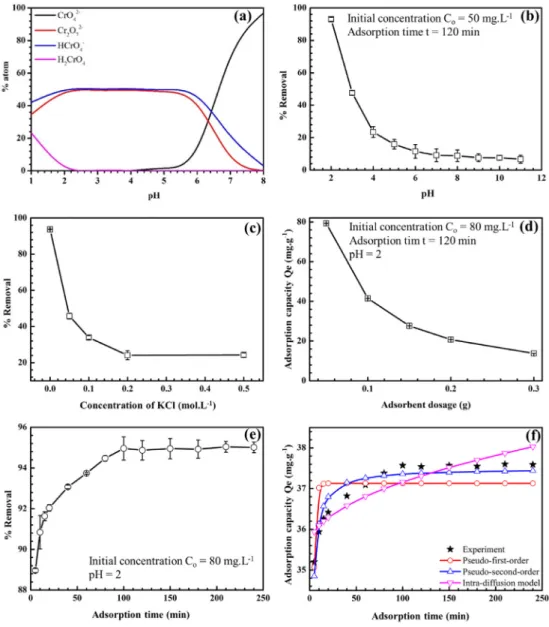
dramatically from 92.98% at pH¼2 to 47.66% at pH¼3 and reaches 6.72% at pH ¼11. This decrease of adsorption efficiency can be explained by the fact that the main species of Cr(VI) at the low pH region consist of HCrO4, Cr2O27, and H2CrO4(Fig. 3a). The later are
suitable for the adsorption of cations due to the electrostatic interaction, leading to the increase of adsorption capacity. In contrast to that, the uptake of Cr(VI) ions decreases with increasing pH owing to the electrostatic repulsion between these ions and negatively charged MnO2/CS surface (Wang et al., 2019).
Effect of ion strength.Fig. 3c presents the effect of ion strength on the removal of Cr(VI) from aqueous solution. The shape of the curve demonstrates that the ion strength forcefully affects the uptake of Cr(VI) when the concentration of KCl is changed. For instance, the Cr(VI) adsorption efficency significantly drops from about 95% to nearly 20% when the KCl concentration increases from 0 M to 0.5 M. This observation can be explained by the formation of screening effect (the so-called electrostatic screening) between the negative surface of MnO2/CS material and Cr(VI) cations (Dinh et al.,
2019).
Effect of adsorbent dosage.Fig. 3d depicts the influence of dosage of MnO2/CS material on the adsorption of Cr(VI). As can be
seen from this figure, the adsorption capacity decreases with
increasing the weight of material because the adsorption capacity Qe (mg.L1) is positively correlated with the (CoeCe) and negatively
related to the weight of material (m) as equation(2). Although both the (CoeCe) and dosage of MnO2/CS increase, the weight of MnO2/
CS is found to decrease more than (CoeCe), resulting in the decrease
of adsorption capacity.
Effect of adsorption time.The uptake of Cr(VI) onto MnO2/CS is
investigated by varying the adsorpiton time from 10 min to 240 min at the low pH¼2 and the result is depicted inFig. 3e. It is observed that the removal follows three stages. First, Cr(VI) is dramatically absorbed by about 92% after 60 min. Next, the
adsorption is slightly increased by rougly 3% from 60 min to
120 min and finally reaches the equilibrium at approximately
95.05% of the removal.
3.3. Kinetic models
Studying adsorption kinetics plays an instrumental role the understanding of the adsorption mechanism. Among the kinetic models, pseudo-first-order, pseudo-second-order and intra diffu-sion models are often used to describe the uptake (Dinh et al., 2019; Khan et al., 2020). In this report, these models have been utilized to
fit the experimental data. The plots of kinetic models and their nonlinear parameters are shown in Fig. 3f and Table S2,
respec-tively. The RMSE and
c
2 values calculated within thepseudo-second-order kinetic model are found to be smallest, thus the adsorption of Cr(VI) onto MnO2should follow this model. However,
both the pseudo-first-order and pseudo-second-order kinetic
models cannot give a detail information about the mass transfer process of Cr(VI) during the adsorption. Instead, the intra diffusion model has been applied. Obviously, the C value evaluated from the intra diffusion model is not equal to zero. Hence one can conclude that the Cr(VI) removal has followed many different mechanisms.
3.4. Isotherm models
In order to understand the adsorption of Cr(VI) onto MnO2/CS in
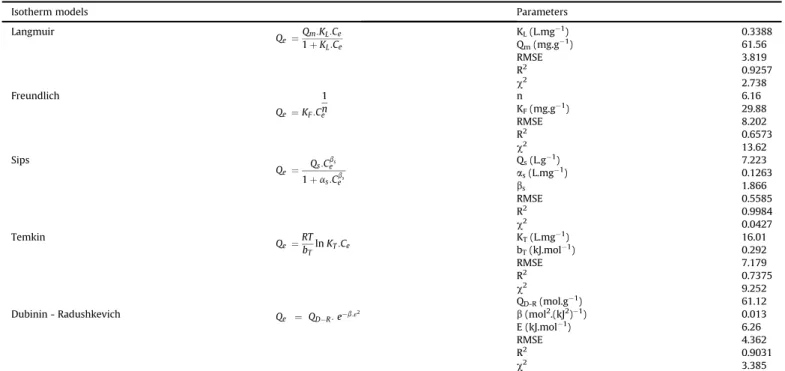
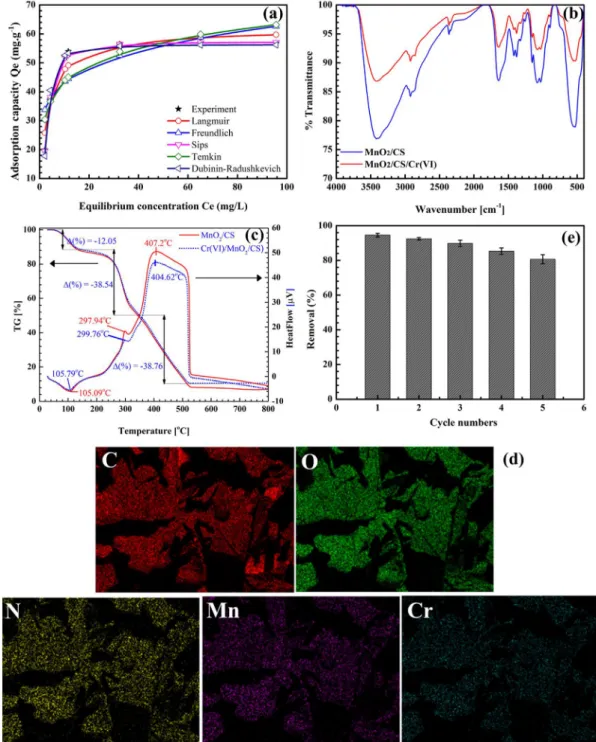
nature, some isotherm models have been employed such as Lang-muir, Freundlich and Sips models, whose equations and calculated nonlinear isotherm parameters are listed inTable 2and their dia-grams are plotted inFig. 4a. According to the statistics from these table andfigure, Sips model offers the best description of the Cr(VI) adsorption onto MnO2/CS material as it gives the smallest RMSE
the fact that Sips model, which is the combination of Langmuir and Freundlich models, is not limited by the concentration of adsor-bates. Hence, the adsorption of Cr(VI) has not only followed a unique process but also complied with both the monolayer and multilayer adsorptions, depending on the initial concentration of heavy metal. To be more precise, Sips model will be reduced to Freundlich isotherm at low adsorbate concentrations, whereas it can anticipate the monolayer adsorption capacity characteristics of the Langmuir isotherm at high concentrations (Foo and Hameed,
2010). Besides, the maximum monolayer adsorption capacity
calculated from Langmuir isotherm model is 61.56 mg g1, which is about 4 times higher than that of the same chitosan (15.70 mg g1) used in the present study and some other chitosan composite materials (Table 3).
3.5. Proposed primary mechanism
To define the mechanism of the removal of Cr(VI) from aqueous
solution using MnO2/CS composite material, both theoretical
models and spectroscopic methods have been employed.
Isotherm models. The Temkin and Dubinin-Radushkevich models are two isotherm approaches that are often used to calcu-late the heat and free energies of the adsorption, respectively. Re-sults presented inFig. 4andTable 2clearly show that the
Dubinin-Radushkevich model fits the experimental data better than the
Temkin one because it offers the smallest RMSE and
c
2values. In addition, the Dubinin-Radushkevich model predicts the free energy of 6.26 kJ mol1, which is smaller than 8 kJ mol1. This resultin-dicates that the adsorption of Cr(VI) onto MnO2/CS should be gone
through a physical process.
Thermodynamic studies.The enthalpy change (
D
H) calculated from adsorption thermodynamic equations is also effectively used to demonstrate whether the adsorption is physical or chemical. The thermodynamic parameters can be calculated from the laws of thermodynamics as:D
Go ¼ RTlnKC; (5)where KC can be calculated from the Langmuir constant KL as
follows:
KC¼ M x KLx 1000; (6)
where M (g.mol1) is the molecular weight of the adsorbate. In addition,
D
G,D
H, andD
Sare related to each other as:D
Go ¼D
Ho TD
So: (7)The well-known van’t Hoff equation is obtained by substituting Eq.(5)into Eq.(7), namely:
LnKC ¼
D
H oR x 1 T þ
D
SoR : (8)
The Gibbs energy change (
D
G) can be directly calculated from Eq.(5), whereas the enthalpy change (D
H) and entropy change (D
S) are, respectively, determined from the slope and intercept of the plot of lnKCversus 1/T (Eq.(8)).The thermodynamic parameters of the Cr(VI) uptake are listed in Table S3. Several noteworthy results are exhibited via the negative
D
G values at all investigated temperatures. This result suggests that the removal of Cr(VI) has occurred favorably and spontaneously, in good agreement with the Freundlich exponentndescribed in Section3.4. However, the
D
Hvalue is found to be less than 40 kJ/mol implying that the uptake of Cr(VI) has also followed the physisorption.SEM mapping.SEM mapping of MnO2/CS after adsorption of
Cr(VI) is illustrated inFig. 4d. It is observed that chromium was uniformly distributed along the surface of MnO2/CS adsorbent. This
result suggests that the removal should follow the adsorption without ion-exchange or coprecipitation and it is controlled by electrostatic attractions only. Thisfinding is similar to the recent reports on the adsorption mechanism of heavy metals (Pb(II), Ni(II) and Cr(VI)) onto diethylenetriamine-grafted Spirodela polyrhiza;L
-Cysteine Functionalized Magnetite (Fe3O4) Nanoparticles and
MnFe2O4@cellulose (Bagbi et al., 2017;Ghanbarian et al., 2017;Qu
et al., 2019).
Fig. 4b shows the FT-IR spectra before and after the Cr(VI) adsorption onto MnO2/CS composite material. It is seen that there is
no shift of specific peaks as well as the formation of new peaks after the adsorption. Notwithstanding, the intensity of all specific peaks is found to decrease due to the electrostatic attraction between Cr(VI) anions and positively charged sites on the surface of MnO2/
CS when pHsolution < pHPZC. Obviously, Cr(VI) anions have been
removed via a physical adsorption.
TG-DSC analysis.TG-DSC diagram of MnO2/CS before and after
the Cr(VI) adsorption is shown inFig. 4c. The peaks of dehydration and the decomposition of chitosan are found to be slightly shifted to the higher temperature. It can be explained by the fact that the weak interactions between Cr(VI) and specific groups in MnO2/CS
material have been formed via the electrostatic attraction, resulting in the increase of dehydration and decomposition temperature. On the other hand, the combustion temperature of MnO2/CS after the
adsorption occurs at the higher temperature with the smaller loss weight of 38.76%. This confirms that specific groups (eNH2,eOH,
eCONHe) in MnO2/CS contribute to Cr(VI) adsorption.
3.6. Reuse of MnO2/CS adsorbent
The regenerative experiments are significant complement for adsorption studies, which are often used to evaluate the regener-ative feasibility of the adsorbents.Fig. 4d shows the removal effi -ciency of Cr(VI) at each cycle after desorption with 50 mL of 0.5 mol.L1 NaOH solution. It can be seen that the removal effi -ciency of Cr(VI) by MnO2/CS has a slight decrease after 5 times of
regeneration, and the associated removal efficiency only decreases from approximately 94% to 80% for 50 mg.L1of Cr(VI) at pH¼2.0. This result indicates a good regenerative property of the MnO2/CS
Table 2
Non-linear isotherm and kinetic models and adsorption thermodynamics’parameters.
Isotherm models Parameters
Langmuir
Qe¼Qm:KL:Ce
1þKL:Ce
KL(L.mg1) 0.3388
Qm(mg.g1) 61.56
RMSE 3.819
R2 0.9257
c2 2.738
Freundlich
Qe¼KF:C
1 n
e
n 6.16
KF(mg.g1) 29.88
RMSE 8.202
R2 0.6573
c2 13.62
Sips
Qe¼ Qs:C
bs
e
1þas:Cebs
Qs(L.g1) 7.223
as(L.mg1) 0.1263
bs 1.866
RMSE 0.5585
R2 0.9984
c2 0.0427
Temkin
Qe¼RT
bT
lnKT:Ce KT(L.mg
1) 16.01
bT(kJ.mol1) 0.292
RMSE 7.179
R2 0.7375
c2 9.252
QD-R(mol.g1) 61.12
Dubinin - Radushkevich Qe ¼ QDR:eb:ε2 b(mol2.(kJ2)1) 0.013
E (kJ.mol1) 6.26
RMSE 4.362
R2 0.9031
c2 3.385
Nomenclature: Qm(mg.g1) is the maximum monolayer adsorption capacity and KLis Langmuir isotherm constant (L.mg1). KFis Freundlich isotherm constant (mg.g1) and n is adsorption intensity. Qsis Sips isotherm model constant (L.g1),b
Fig. 4.Plots of nonlinear isotherm models of the Cr(VI) adsorption onto MnO2/CS material (a); FT-IR spectra (b), TG-DSC (b) of MnO2/CS before and after the Cr(VI) adsorption; SEM mapping of MnO2/CS after the Cr(VI) adsorption (d) and Fifth adsorption - desorption cycles of MnO2/Cs for Cr(VI) removal (e).
Table 3
Comparison between the adsorption capacities of MnO2/CS and other chitosan composite materials.
Chitosan composite materials Qm(mg.g1) References
Chitosan-coatedfly ash 33.27 Wen et al. (2011)
Magnetic chitosan nanoparticles 43.29e55.80 Thinh et al. (2013)
Chitosan 5.25e7.94 Aydın and Aksoy (2009)
Fe2O3-chitosan-cherry kernel shell pyrolytic charcoal composite beads 47.58 Altun and Ecevit (2020)
Chitosan/magnetite-graphene oxide 121e129 Zhang et al. (2018)
GO/PAMAMs 132e211 Liu et al. (2019)
adsorbent in the removal of Cr(VI).
3.7. Application on the wastewater treatment
The MnO2/CS material has been applied to remove total Cr(VI) in
wastewater produced by the galvanized manufacturing factory and the results obtained are presented inTable S4. Herein, two samples denoted as A and B, which are wastewater samples before and after
the uptake onto MnO2/CS material, respectively, have been
selected. The Cr content is determined by using the EPA method 200.7-Revision 4.4 (ICPeOES) with 0.04 of LOD (limit of detection). Results shown inTable S4indicate that the percentage of total Cr removed from wastewater is about 94.21% (reducing from 1016 mg.L1in sample A to 58.8 mg.L1in sample B). This result is
very interesting because it indicates that MnO2/CS material should
become as a promising adsorbent for removing total Cr in the effluent from industrial zones.
4. Conclusion
In this work, Cr(VI) has been significantly removed from
aqueous solution by using MnO2/CS as a novel adsorbent.
In-vestigations on all the factors affecting the adsorption have shown that the pH and ion strength play important roles in the Cr(VI) removal. In addition, the isotherm adsorption model studies demonstrate that the Cr(VI) adsorption should include the mono-layer and multimono-layer adsorptions depending on the adsorbate concentration. Moreover, by combining the theoretical and spec-troscopic methods, we are able to prove that the uptake of Cr (VI) onto MnO2/CS must follow the physical process because of the
electrostatic attraction between Cr(VI) anions and positively charged sites on the surface of MnO2/CS. Finally, this MnO2/CS
material has been used to remove total Cr in the effluent from in-dustrial zones with a relatively high efficiency. Consequently, this material should be considered as a promising adsorbent for removing total Cr in wastewater.
Declaration of competing interest
The authors declare that they have no known competing
financial interests or personal relationships that could have
appeared to influence the work reported in this paper.
CRediT authorship contribution statement
Van-Phuc Dinh: Methodology, Conceptualization, Writing -original draft, Formal analysis, Data curation, Supervision, Valida-tion, VisualizaValida-tion, Writing - review & editing. Minh-Doan Nguyen: Conceptualization, Investigation, Writing - review &
editing. Quang Hung Nguyen: Methodology, Writing - original
draft, Writing - review&editing.Thi-Thanh-Thao Do: Conceptu-alization, Investigation, Writing - review&editing.Thi-Thuy Luu:
Conceptualization, Investigation, Writing - review&editing.Anh Tuyen Luu:Data curation, Formal analysis, Writing - original draft, Writing - review&editing.Tran Duy Tap:Data curation, Formal analysis, Writing - review&editing.Thien-Hoang Ho: Conceptu-alization, Investigation, Writing - review&editing.Trong Phuc Phan:Conceptualization, Data curation, Formal analysis, Writing -review&editing.Trinh Duy Nguyen:Data curation, Formal anal-ysis, Writing - review&editing.L.V. Tan:Methodology, Writing -original draft, Writing - review&editing.
Acknowledgements
This research is funded by Vietnam National Foundation for
Science and Technology Development (NAFOSTED) under grant number 103.02e2018.368.
Appendix A. Supplementary data
Supplementary data to this article can be found online at https://doi.org/10.1016/j.chemosphere.2020.127147.
References
Alhosseini, S.N., Moztarzadeh, F., Mozafari, M., Asgari, S., Dodel, M., Samadikuchaksaraei, A., Kargozar, S., Jalali, N., 2012. Synthesis and character-ization of electrospun polyvinyl alcohol nanofibrous scaffolds modified by blending with chitosan for neural tissue engineering. Int. J. Nanomed. 7, 25e34. Altun, T., Ecevit, H., 2020. Cr(VI) removal using Fe2O3-chitosan-cherry kernel shell
pyrolytic charcoal composite beads. Environ. Eng. Res. 25, 426e438. Aydın, Y.A., Aksoy, N.D., 2009. Adsorption of chromium on chitosan: optimization,
kinetics and thermodynamics. Chem. Eng. J. 151, 188e194.
Bagbi, Y., Sarswat, A., Mohan, D., Pandey, A., Solanki, P.R., 2017. Lead and chromium adsorption from water using L-cysteine functionalized magnetite (Fe3O4)
nanoparticles. Sci. Rep. 7, 7672.
Chen, J.H., Xing, H.T., Guo, H.X., Weng, W., Hu, S.R., Li, S.X., Huang, Y.H., Sun, X., Su, Z.B., 2014. Investigation on the adsorption properties of Cr(VI) ions on a novel graphene oxide (GO) based composite adsorbent. J. Mater. Chem. 2, 12561e12570.
Chen, Y., Xu, S., Han, S., Chu, S., Yang, L., Jiang, C., 2019. Reusable and removable PmPD/PVA membrane for effective Cr(VI) adsorption and reduction. New J. Chem. 43, 5039e5046.
Dinh, V.-P., Huynh, T.-D.-T., Le, H.M., Nguyen, V.-D., Dao, V.-A., Hung, N.Q., Tuyen, L.A., Lee, S., Yi, J., Nguyen, T.D., Tan, L.V., 2019. Insight into the adsorption mechanisms of methylene blue and chromium(III) from aqueous solution onto pomelo fruit peel. RSC Adv. 9, 25847e25860.
Dinh, V.-P., Le, N.-C., Nguyen, V.-D., Nguyen, N.-T., 2017. Adsorption of zinc (II) onto MnO2/CS composite: equilibrium and kinetic studies. Desalin. Water Treat. 58,
427e434.
Dinh, V.-P., Le, N.-C., Tuyen, L.A., Hung, N.Q., Nguyen, V.-D., Nguyen, N.-T., 2018. Insight into adsorption mechanism of lead(II) from aqueous solution by chito-san loaded MnO2nanoparticles. Mater. Chem. Phys. 207, 294e302.
El-Taweel, Y.A., Nassef, E.M., Elkheriany, I., Sayed, D., 2015. Removal of Cr(VI) ions from waste water by electrocoagulation using iron electrode. Egypt. J. Petrol. 24, 183e192.
Foo, K.Y., Hameed, B.H., 2010. Insights into the modeling of adsorption isotherm systems. Chem. Eng. J. 156, 2e10.
Fu, Y., Xu, X., Huang, Y., Hu, J., Chen, Q., Wu, Y., 2017. Preparation of new diatomiteechitosan composite materials and their adsorption properties and mechanism of Hg (II). Royal Soc. Open Sci. 4, 170829.
Ghanbarian, M., Nabizadeh, R., Nasseri, S., Shemirani, F., Mahvi, A.H., Beyki, M.H., Mesdaghinia, A., 2017. Potential of amino-riched nano-structured MnFe2O4@
cellulose for biosorption of toxic Cr (VI): modeling, kinetic, equilibrium and comparing studies. Int. J. Biol. Macromol. 104, 465e480.
Guan, Q., Gao, K., Ning, P., Miao, R., He, L., 2019. Efficient removal of low-concentration Cr(VI) from aqueous solution by 4A/HACC particles. New J. Chem. 43, 17220e17230.
Huang, Z., Dai, X., Huang, Z., Wang, T., Cui, L., Ye, J., Wu, P., 2019. Simultaneous and efficient photocatalytic reduction of Cr(VI) and oxidation of trace sulfameth-oxazole under LED light by rGO@Cu2O/BiVO4p-n heterojunction composite.
Chemosphere 221, 824e833.
Khan, Z.H., Gao, M., Qiu, W., Islam, M.S., Song, Z., 2020. Mechanisms for cadmium adsorption by magnetic biochar composites in an aqueous solution. Chemo-sphere 246, 125701.
Kumar, A., Jena, H.M., 2017. Adsorption of Cr(VI) from aqueous solution by prepared high surface area activated carbon from Fox nutshell by chemical activation with H3PO4. J. Environ. Chem. Eng. 5, 2032e2041.
Kumar, S.K., Jiang, S.-J., 2016. Chitosan-functionalized graphene oxide: a novel adsorbent an efficient adsorption of arsenic from aqueous solution. J. Environ. Chem. Eng. 4, 1698e1713.
Kyzas, G.Z., Bikiaris, D.N., 2015. Recent modifications of chitosan for adsorption applications: a critical and systematic review, 13, 312e337.
Li, J., Jiang, B., Liu, Y., Qiu, C., Hu, J., Qian, G., Guo, W., Ngo, H.H., 2017. Preparation and adsorption properties of magnetic chitosan composite adsorbent for Cu2þ removal. J. Clean. Prod. 158, 51e58.
Li, R., Hu, P., Ren, X., Worley, S.D., Huang, T.S., 2013. Antimicrobial N-halamine modified chitosanfilms. Carbohydr. Polym. 92, 534e539.
Liu, E.-t., Zhao, H., Li, H., Li, G., Liu, Y., Chen, R., 2014. Hydrothermal synthesis of porousa-Fe2O3nanostructures for highly efficient Cr(VI) removal. New J. Chem.
38, 2911e2916.
Liu, H., Zhang, F., Peng, Z., 2019. Adsorption mechanism of Cr(VI) onto GO/PAMAMs composites. Sci. Rep. 9, 3663.
Luo, S., Qin, F., Ming, Y.a., Zhao, H., Liu, Y., Chen, R., 2017. Fabrication uniform hollow Bi2S3nanospheres via Kirkendall effect for photocatalytic reduction of Cr(VI) in
electroplating industry wastewater. J. Hazard Mater. 340, 253e262.
Revision 4.4, pp. 2015-2008.
Mishra, S., Bharagava, R.N., 2016. Toxic and genotoxic effects of hexavalent chro-mium in environment and its bioremediation strategies. J. Environ. Sci. Health, Part C 34, 1e32.
Namasivayam, C., Yamuna, R.T., 1995. Adsorption of chromium (VI) by a low-cost adsorbent: biogas residual slurry. Chemosphere 30, 561e578.
Namdeo, M., Bajpai, S.K., 2008. Chitosanemagnetite nanocomposites (CMNs) as magnetic carrier particles for removal of Fe(III) from aqueous solutions. Colloid. Surface. Physicochem. Eng. Aspect. 320, 161e168.
Pakade, V.E., Tavengwa, N.T., Madikizela, L.M., 2019. Recent advances in hexavalent chromium removal from aqueous solutions by adsorptive methods. RSC Adv. 9, 26142e26164.
Qu, W., He, D., Guo, Y., Tang, Y., Shang, J., Zhou, L., Zhu, R., Song, R.-J., 2019. Adsorption of Ni2þ and Pb2þfrom water using diethylenetriamine-grafted Spirodela polyrhiza: behavior and mechanism studies. Environ. Sci. Pollut. Control Ser. 26, 34562e34574.
Shen-Yang, T., Ke-An, L.I., 1986. The distribution of chromium(VI) species in solution as a function of pH and concentration. Talanta 33, 775e777.
Sun, W., Chen, L., Wang, Y., Zhou, Y., Meng, S., Li, H., Luo, Y., 2016. Synthesis of highly conductive PPy/graphene/MnO2composite using ultrasonic irradiation. Synth.
React. Inorg. Metal-Org. Nano-Metal Chem. 46, 437e444.
Terangpi, P., Chakraborty, S., Ray, M., 2018. Improved removal of hexavalent chro-mium from 10 mg/L solution by new micron sized polymer clusters of aniline formaldehyde condensate. Chem. Eng. J. 350, 599e607.
Thinh, N.N., Hanh, P.T.B., Ha, L.T.T., Anh, L.N., Hoang, T.V., Hoang, V.D., Dang, L.H., Khoi, N.V., Lam, T.D., 2013. Magnetic chitosan nanoparticles for removal of Cr(VI) from aqueous solution. Mater. Sci. Eng. C 33, 1214e1218.
Tran, H.V., Tran, L.D., Nguyen, T.N., 2010. Preparation of chitosan/magnetite com-posite beads and their application for removal of Pb(II) and Ni(II) from aqueous
solution. Mater. Sci. Eng. C 30, 304e310.
Tsai, W.-C., Ibarra-Buscano, S., Kan, C.-C., Futalan, C.M., Dalida, M.L.P., Wan, M.-W., 2016. Removal of copper, nickel, lead, and zinc using chitosan-coated mont-morillonite beads in single- and multi-metal system. Desalin. Water Treat. 57, 9799e9812.
Wang, H., Zhang, M., Lv, Q., 2019. Removal efficiency and mechanism of Cr(VI) from aqueous solution by maize straw biochars derived at different pyrolysis tem-peratures, 11, 781.
Wang, J.-P., Chen, Y.-Z., Wang, Y., Yuan, S.-J., Sheng, G.-P., Yu, H.-Q., 2012. A novel efficient cationicflocculant prepared through grafting two monomers onto chitosan induced by Gamma radiation. RSC Adv. 2, 494e500.
Wang, R., Cheng, G., Dai, Z., Ding, J., Liu, Y., Chen, R., 2017. Ionic liquid-employed synthesis of Bi2E3(E¼S, Se, and Te) hierarchitectures: the case of Bi2S3with
superior visible-light-driven Cr(VI) photoreduction capacity. Chem. Eng. J. 327, 371e386.
Wen, Y., Tang, Z., Chen, Y., Gu, Y., 2011. Adsorption of Cr(VI) from aqueous solutions using chitosan-coated fly ash composite as biosorbent. Chem. Eng. J. 175, 110e116.
Yadav, M., Rhee, K.Y., Park, S.J., Hui, D., 2014. Mechanical properties of Fe3O4/GO/
chitosan composites. Compos. B Eng. 66, 89e96.
Yang, A., Yang, P., Huang, C.P., 2017. Preparation of graphene oxideechitosan com-posite and adsorption performance for uranium. J. Radioanal. Nucl. Chem. 313, 371e378.
Yang, R., Wang, Z., Dai, L., Chen, L., 2005. Synthesis and characterization of single-crystalline nanorods of a-MnO2 and g-MnOOH. Mater. Chem. Phys. 93,
149e153.