Existence of a bending rigidity for a hard-sphere liquid near a curved hard wall:
Validity of the Hadwiger theorem
Edgar M. Blokhuis
Colloid and Interface Science, Leiden Institute of Chemistry, Gorlaeus Laboratories, P.O. Box 9502, 2300 RA Leiden, The Netherlands (Received 22 November 2012; published 4 February 2013)
In the context of Rosenfeld’s fundamental measure theory, we show that the bending rigidity is not equal to zero for a hard-sphere fluid in contact with a curved hard wall. The implication is that the Hadwiger theorem does not hold in this case and the surface free energy is given by the Helfrich expansion instead. The value obtained for the bending rigidity (i) is an order of magnitude smaller than the bending constant associated with Gaussian curvature, (ii) changes sign as a function of the fluid volume fraction, and (iii) is independent of the choice of the location of the hard wall.
DOI:10.1103/PhysRevE.87.022401 PACS number(s): 68.08.−p, 68.03.Cd
I. INTRODUCTION
The Helfrich free energy [1] has proven to be an invaluable starting point in the description of the surface properties of complex surfaces such as membranes or surfactant systems [2,3]. It is the most general form for the surface (or excess) free energy of an isotropic surface expanded to second order in the surface’s curvature:
H=
dA
σ−δσ J +k
2J
2+kK¯ + · · ·
, (1)
whereJ=1/R1+1/R2is the total curvature,K=1/(R1R2) is the Gaussian curvature, and R1,R2 are the principal radii of curvature at a certain point on the surface. The expansion defines four curvature coefficients:σ, the surface tension of the planar interface;δ, the Tolman length [4];k, the bending rigidity; and ¯k, the rigidity constant associated with Gaussian curvature. The original expression proposed by Helfrich [1] features the radius of spontaneous curvatureR0as the linear curvature term (δσ →2k/R0[5,6]), but in honor of Tolman, who was the first to consider curvature corrections to the surface tension [4], we use the notation in Eq.(1).
Recently, an alternative description to replace the Helfrich free energy in certain situations was put forward by K¨onig
et al.[7,8] based on the implications of theHadwiger theorem
[9,10]. The Hadwiger theorem states that any functional of a system that is translationally invariant, additive, and continuous can be written as a linear combination of the four Minkowski functionals: volume, surface area, and the integrated total and Gaussian curvatures [10]. The implication is that, as an alternative to Eq.(1), the surface free energy can be written as
Hadwiger=
dA[σ−δσ J +kK¯ ]. (2)
Comparing the two expressions for the free energy in Eqs.(1)
and(2), we are led to the following two implications of the Hadwiger theorem:
(i) The bending rigidity constant is zero.
(ii) Higher-order curvature terms, represented by the dots in Eq.(1), are absent.
The question now is for which systems are the conditions of the Hadwiger theorem fulfilled so that the bending rigidity and higher-order curvature terms are all strictly zero? It
was suggested that for a hard-sphere fluid in contact with a hard, structureless wall, the Hadwiger theorem should hold and Eq. (2) is a complete expression for its surface free energy [7,8]. The evidence for this suggestion is based on a numerical analysis [7,8,11] of the free energy in spherical and cylindrical geometry using Rosenfeld’s fundamental measure theory (FMT) [12,13], showing that the bending rigidity is zero within numerical accuracy. To understand the basis for this result in more detail, we consider surfaces for which the curvaturesJ andKare constant. The Helfrich free energy per unit area is then given by
H/A≡σ(J,K)=σ−δσ J+
k
2J
2+kK¯ + · · ·. (3)
For a spherically or cylindrically shaped surface with radius
R, this expansion then takes the form
σs(R)=σ− 2δσ
R +
(2k+k¯)
R2 + · · · (sphere), (4)
σc(R)=σ−δσ R +
k
2R2 + · · · (cylinder). (5)
Note that only the combination 2k+k¯appears in the expres-sion for the surface tenexpres-sion of the spherical interface, so that the conclusion whetherkis identically zero or not can be made only from an analysis of thecylindricalsystem. Next to the curvature-dependent surface tension, one may also investigate the curvature dependence of thewall densityρW. According to the wall theorem, the wall density of a fluid in contact with an infinitely hard,planarwall is related to the bulk pressurep
through an ideal gas law [14,15]:
kBT ρW=p. (6)
The wall theorem can be generalized to a spherically shaped hard wall [15–17] or to a more generally shaped hard wall with (constant) curvaturesJ andK[18]:
kBT ρW(J,K)=p+σ J−2δσ K−k
2J
3+2kJ K+ · · ·.
(7)
this expansion takes the form
kBT ρsW(R)=p+ 2σ
R −
2δσ
R2 + · · · (sphere), (8)
kBT ρcW(R)=p+
σ R −
k
2R3 + · · · (cylinder), (9)
where the dots represent terms ofO(1/R4), which indicates that the term proportional to 1/R3is absent in the expansion of the spherical interface. The corresponding term in the expansion of thecylindricalinterface is related to the bending rigidity, thus supplying asecond routeto the determination of its value. Note that these expressions are valid only when the radiusRis defined via the wall densityρW≡ρ(r=R+).
In this article, we revisit the analysis by K¨oniget al.[7,8] for a hard-sphere fluid in contact with a hard wall. Using the exact same theoretical model as in Refs. [7,8,11], i.e., FMT [12,13], we show in Sec.IIthat a detailed numerical analysis yields a bending rigidity that isnot equal to zero, but is an order of magnitude smaller than the rigidity constant associated with Gaussian curvature. Consistent values forkare obtained from the analysis of the radius dependence of the surface tension, Eq.(5), as well as from the analysis of the radius dependence of the wall density, Eq.(9).
As a further consistency test, we perform a systematic expansion of the FMT free energy to second order in the curvature for the spherical and cylindrical interface in Sec.III. This expansion is analogous to a similar expansion for the liquid-vapor interface [20]. It is shown that the resulting expressions forσ,δ, and ¯kare all in terms of the fluid density profile of theplanarinterface,ρ0(z), whereas the expression for the bending rigiditykfeatures the leading-order curvature correction to the density profile, ρ1(z). The values obtained forσ,δσ, and the combination 2k+k¯using these expressions are all consistent with the results of K¨oniget al. [7,8] and those by Bryket al.[11]. The value obtained for thebending rigidity is not zero and is consistent with the two values obtained from the radius-dependent surface tension and wall density. Furthermore, it is inqualitativeagreement with recent molecular-dynamics (MD) simulations by Laird et al. [21], who determined the curvature-dependent surface tension of a fluid near a hard wall by Gibbs-Cahn integration [21,22].
II. FUNDAMENTAL MEASURE THEORY
In this section, we discuss Rosenfeld’s fundamental mea-sure theory [12] as it is applied specifically to a one-component fluid consisting of spherical particles with a diameterd. The free energy is then the following functional of the fluid density
ρ(r) [12,13]:
[ρ]
kBT =
dr
ρln(ρ)−ρ− μ kBTρ+
Vext(r)
kBT ρ+φ
,
(10)
where μ is the chemical potential and where the external fieldVext(r) is used to express the presence of the hard wall. For spherically shaped fluid particles, the free-energy density
φ=φ(n2,n3,nV) is explicitly given by
φ= 1 π d2
−n2ln(1−n3)+
d2n22− |nV|2
2(1−n3)
+d2
n32−3n2|nV|2
24(1−n3)2
. (11)
The three densitiesnα(r) (α=2,3,V) are different convolu-tions of the fluid density
nα(r1)=
dr2ρ(r2)wα(r1− r2), (12)
where the weight functionswα(r) are explicitly given by [13]
w2(r)=δ
d
2 −r
, w3(r)=
d
2 −r
, and
(13)
wV(r)=r
rδ
d
2 −r
.
The Euler-Lagrange equation that minimizes the free energy in Eq.(10)is given by
μ
kBT =ln(ρ)+ Vext(r)
kBT +
α
dr2
∂φ
∂nα(r2)wα(r2− r1). (14)
Note that the Euler-Lagrange equation features wα(r2− r1) and notwα(r1− r2) as in Eq.(12)[13].
For auniformsystem, we have thatn2=6η/d,n3=η, and
nV=0, with the volume fraction defined asη≡(π/6)ρd3. The Euler-Lagrange equation in Eq.(14)then becomes
μ kBT =
ln(ρ)−ln(1−η)+η(14−13η+5η 2)
2(1−η)3 . (15)
Using the expression for the chemical potential above, the bulk pressure is obtained from= −pV giving the Percus-Yevick equation of state:
d3p
kBT =
6η(1+η+η2)
π(1−η)3 . (16)
We mention that a refinement of FMT was recently proposed [23] to yield the more accurate Carnahan-Starling equation of state [24] instead of Eq.(16). It is expected that results do not depend sensitively on this refinement.
Next, we consider the implementation of FMT in three different geometries: the planar, spherical, and cylindrical interface.
A. Planar interface
In planar geometry, we can simplify the expressions for
nα(r)=nα(z), wherezis the coordinate normal to the interface, as
nα(z1)=
where the weight functionsw0
α(z) are explicitly given by
w02(z)=π d
d
2 − |z|
,
w03(z)=π
d2
4 −z 2
d
2 − |z|
, (18)
w0V(z)=2π z
d
2 − |z|
,
and where nV(r)=nV(z)ˆz. The Euler-Lagrange equation in Eq.(14)simplifies in planar geometry to
μ kBT =
ln(ρ)+Vext(z1)
kBT + α
dz2 ∂φ ∂nα(z2)w
0
α(z2−z1). (19)
The external field mimics the presence of a hard wall forz <0, i.e.,Vext(z)= ∞whenz <0 and zero otherwise, so that the densityρ(z)=0 forz <0. The surface tension is the surface free energy per unit area[σ =(+pV)/A[25]]:
σ
kBT
=
∞
−d/2
dz
ρln(ρ)−ρ− μ kBT
ρ+φ+ p kBT
(z)
,
(20)
where the lower integration reflects the fact thatφ and the convoluted densitiesnα(z) are zero only whenz <−d/2.
B. Spherical interface
In spherical geometry, the densitiesnα(r)=nα(r), withr
the radial distance, are
n2(r1)=
dr2 r2 r1
ρ(r2)ws2(r1−r2),
n3(r1)=
dr2 r2 r1
ρ(r2)ws3(r1−r2),
(21)
nV(r1)=
dr2 r2 r1
ρ(r2)wsV(r1−r2)
+ 1 r1 dr2 r2 r1
ρ(r2)ws3(r1−r2),
where the weight functions are equal to those in planar geometry [Eq.(18)]:
w2s(r1−r2)=π d
d
2 − |r1−r2|
,
ws3(r1−r2)=π
d2
4 −(r1−r2) 2
d
2− |r1−r2|
, (22)
wsV(r1−r2)=2π(r1−r2)
d
2 − |r1−r2|
,
and where nV(r)=nV(r)ˆr. The Euler-Lagrange equation in Eq.(14)now reduces to
μ kBT =
ln(ρ)+Vext(r1)
kBT + α
dr2 r2 r1 ∂φ ∂nα(r2)
×wαs(r2−r1)+ 1
r1
dr2
∂φ ∂nV(r2)w
s
3(r2−r1).
(23)
Again, the external field mimics the presence of a hard wall, i.e., Vext(r)= ∞ when r < R, which serves to define the location of the radiusRof the spherically shaped hard wall. The surface tension now becomes
σs(R)
kBT
=
∞
R−d/2
dr r R 2 ×
ρln(ρ)−ρ− μ kBT
ρ+φ+ p kBT
(r−R)
.
(24)
C. Cylindrical interface
In cylindrical geometry, the densitiesnα(r)=nα(r), with
rthe radial distance to the cylinder axis, reduce to
n2(r1)=
dr2 r2 r1 1/2
ρ(r2)w2c(r1,r2),
n3(r1)=
dr2 r2 r1 1/2
ρ(r2)w3c(r1,r2),
(25)
nV(r1)=
dr2 r2 r1 1/2
ρ(r2)wVc(r1,r2)
+ 1
2r1
dr2 r2 r1 1/2
ρ(r2)wc3(r1,r2),
where the weight functions are given by
w2c(r1,r2)=2dK(β)
d
2 − |r2−r1|
,
w3c(r1,r2)=16r1r2[E(β)+(β2−1)K(β)]
×
d
2 − |r2−r1|
, (26)
wc3(r1,r2)=16r1r2[K(β)−E(β)]
d
2 − |r2−r1|
,
wcV(r1,r2)=4(r1−r2)K(β)
d
2 − |r2−r1|
,
wherenV(r)=nV(r)ˆrand whereK(β) andE(β) are complete elliptic integrals of the first and second kind, respectively [26]. The argument of the elliptic functions is defined as β2≡
[d2/4−(r
2−r1)2]/(4r1r2). Note that the weight functions in the cylindrical case are functions of the radial distances
r1 andr2 separately and not only the differencer1−r2. The Euler-Lagrange equation in Eq. (14)in cylindrical geometry reduces to
μ kBT =
ln(ρ)+Vext(r1)
kBT + α
dr2 r2 r1 1/2 ∂φ
∂nα(r2)
×wcα(r2,r1)+ 1 2r1
dr2 r1 r2 1/2 ∂φ
∂nV(r2)w c 3(r2,r1).
(27)
by
σc(R)
kBT =
∞
R−d/2
dr
r R
×
ρln(ρ)−ρ− μ kBT
ρ+φ+ p kBT
(r−R)
.
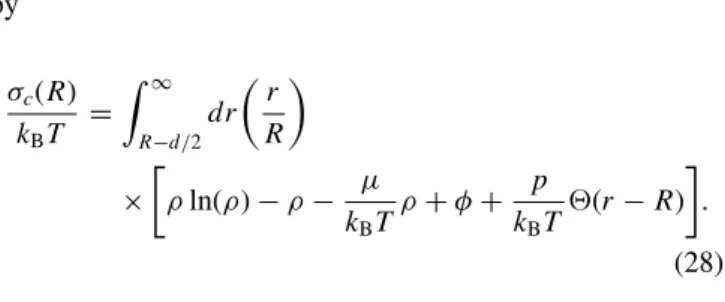
(28)
The procedure to evaluate σs(R) and σc(R) is now as follows. For a certain fixed value of the fluid volume fraction
η, the corresponding chemical potential and pressure are determined from Eqs. (15) and (16). Next, a value for the radiusRis chosen and the Euler-Lagrange equation in Eq.(23)
or Eq.(27)is solved numerically to obtain the density profile
ρ(r) (for details, see the excellent review on FMT by Roth in [13]). The density profile thus obtained then directly provides the wall densityρW≡ρ(r =R+) and the radius-dependent surface tension by evaluating the integral in Eq. (24) or Eq.(28). Finally, the curvature coefficients are obtained from a fit of the surface tension and wall density plotted as a function of 1/Rand comparing with the expansion in Eqs.(4)and(5)
or Eqs. (8) and (9). The fit is carried out by varying the reciprocal radius from 0 to 0.1 in steps of 0.01 in units of 1/d. The resulting 11 data points are then fitted (least-square) to polynomials in 1/R of progressing order starting from a quadratic polynomial to a polynomial of order 7. It is verified that the coefficients in the fit level off with the variation used as an indication of the numerical error.
For the spherical interface, the polynomial fit of σs(R) provides values for the coefficientsσ,δσ, and the combination 2k+k¯. The results are listed for three fluid volume fractions in TableI.
The values forσ andδσ obtained from the polynomial fit of thewall densityare, within error, equal to those listed in the table.
For the cylindrical interface, the polynomial fit of σc(R) again provides values for the coefficientsσandδσ(which are consistent with the results in TableI), but the coefficient of the 1/R2 term now yields values for therigidity constantk. These values arenot equal to zerowithin numerical accuracy and are listed separately in TableII. Also listed are the values obtained from the polynomial fit of thewall density. Already it is noted that these two approaches are consistent and lead to the conclusion that the bending rigidity is not equal to zero for this system. To further corroborate this result, we consider a third approach in the next section.
TABLE II. Numerical values for the bending rigidityk(in units of kBT) for three values of the volume fractionη. The bending rigidity is determined in three different ways: by an analysis of the radius dependence of thesurface tensionof a cylindrical interface, the radius dependence of the fluidwall densityof a cylindrical interface, and by a direct evaluation of the expression in Eq.(39).
Bending rigiditykdetermined via: η σc(R) ρcW(R) Eq.(39) 0.10 0.000 415 172 0.000 415 165 0.000 415 171 0.20 0.000 742 60 0.000 742 51 0.000 742 54 0.30 −0.000 685 −0.000 615 −0.000 619
III. CURVATURE EXPANSION
In this section, we expand the free energy of the spherical and cylindrical surface systematically to second order in 1/R. The analysis is outlined explicitly for the spherical interface—the analysis of the cylindrical interface is more or less analogous, but we indicate where it differs from that of the sphere.
A. Spherical interface
All quantities are expanded to second order in the curvature. In particular, the expansion of the densityρs(r) reads
ρs(r)=ρ0(z)+ρ1(z)
R +
ρ2(z)
R2 + · · ·, (29)
wherez≡r−R. The coefficients in the curvature expansion of the density are determined from the curvature expansion of the Euler-Lagrange equation in Eq.(23). The result is that the (planar) density profileρ0(z) is determined from Eq.(19), and
ρ1(z) follows from solving
0= ρ1(z1)
ρ0(z1) +α,β
dz2 ∂
2φ 0
∂n0
α(z2)∂n0β(z2)
nβ1(z1)wα0(z2−z1)
+
α
dz2
∂φ0
∂nα(z2)z12w 0
α(z2−z1)
+
dz2 ∂φ0 ∂nV(z2)w
0
3(z2−z1), (30)
whereφ0=φ({n0α}) and where we have definedz12 ≡z2−z1. As we show below, it turns out that for the evaluation of the curvature coefficients, it is sufficient to obtain the density profiles ρ0(z) and ρ1(z) only. Using the expanded density profile, we can then determine the coefficients in the expansion
TABLE I. Numerical values for the surface tensionσ (in units ofkBT /d2), Tolman lengthδσ(in units ofkBT /d), and the combination 2k+k¯(in units ofkBT) for three values of the volume fractionη. These values are determined from an analysis of the radius dependence of the surface tension of a spherical interface and by a direct evaluation of the expression in Eqs.(33)–(35).
σ δσ 2k+k¯
η Eq.(33) σs(R) Eq.(34) σs(R) Eq.(35)
0.10 −0.022 097 8 −0.001 309 41 −0.001 309 41 0.000 428 974 0.000 428 971
0.20 −0.139 451 6 −0.014 812 −0.014 811 −0.001 420 5 −0.001 420 7
ofnsα(r):
nsα(r)=n0α(z)+n 1 α(z)
R +
n2 α(z)
R2 + · · ·, (31)
wheren0α(z) is given by Eq.(17)andn1α(z) can be calculated from
n12(z1)=
dz2[ρ1(z2)+z12ρ0(z2)]w20(z1−z2),
n13(z1)=
dz2[ρ1(z2)+z12ρ0(z2)]w30(z1−z2),
n1V(z1)=
dz2
[ρ1(z2)+z12ρ0(z2)]w03(z1−z2)
+ρ0(z2)w30(z1−z2)
. (32)
Again, the evaluation ofn2α(z) turns out not to be necessary. The expansions for ρs(r) and nsα(r) are inserted into the expression for the surface tension in Eq. (24). Making a systematic expansion to second order in 1/R, using the Euler-Lagrange equations in Eqs.(19)and(30), one ultimately obtains expressions for the curvature coefficients by comparing to the curvature expansion in Eq.(4). For the surface tension of the planar interface, the result in Eq.(20)is recovered:
σ kBT =
∞
−d/2
dz
ρ0ln(ρ0)−ρ0−
μ kBT
ρ0+φ0+
p kBT
(z)
. (33)
For the Tolman length, one obtains
δσ kBT
= −
∞
−d/2
dz z
ρ0ln(ρ0)−ρ0− μ kBT
ρ0+φ0+ p kBT
(z)
−1
2 α
∞
−d/2
dz1
∞
0
dz2 ∂φ0 ∂n0
α(z1)
ρ0(z2)z12wα0(z1−z2)
−1
2
∞
−d/2
dz1
∞
0
dz2
∂φ0
∂n0 V(z1)
ρ0(z2)w03(z1−z2). (34)
For the combination 2k+k¯, one finds
2k+k¯ kBT =
∞
−d/2
dz z2
ρ0ln(ρ0)−ρ0−
μ
kBTρ0+φ0+ p kBT (z)
+
α
∞
−d/2
dz1
∞
0
dz2z1
∂φ0 ∂n0
α(z1)
ρ0(z2)z12wα0(z1−z2)
−1
2 α
∞
−d/2
dz1
∞
0
dz2
∂φ0 ∂n0
α(z1)
ρ1(z2)z12w0α(z1−z2)
+1
2 α,β
∞
−d/2
dz1
∞
0
dz2 ∂
2φ 0
∂n0
α(z1)∂n0β(z1)
n1β(z1)ρ0(z2)z12wα0(z1−z2)
+1
2 β
∞
−d/2
dz1
∞
0
dz2 ∂
2φ 0
∂n0V(z1)∂n0β(z1)n 1
β(z1)ρ0(z2)w03(z1−z2)
+1
2
∞
−d/2
dz1
∞
0
dz2
∂φ0
∂n0 V(z1)
ρ1(z2)w03(z1−z2)+
∞
−d/2
dz1
∞
0
dz2
∂φ0
∂n0 V(z1)
ρ0(z2)z2w30(z1−z2). (35)
By solving the density profileρ0(z) from Eq.(19)andρ1(z) from Eq.(30), these coefficients can all be evaluated directly without having to determine the full radius-dependent surface tension as a function of 1/R. It is therefore no surprise that this route to the evaluation of the curvature coefficients is much more convenient. To compare our results to the results by Bryket al.listed in their TableI[11], we need to take care of the fact that in their analysis the location of the radius is defined according to the location of the “actual surface” which accounts for the fact that the molecule’s center of mass is half a diameter away from the surface when it interacts with the hard wall, Ractual=R−d/2. The curvature coefficients are then shifted according to the following transformation:
(σ)R−d/2=σ+
pd
2 , (δσ)R−d/2=δσ−
pd2
8 −
σ d
2 ,
(2k+k¯)R−d/2=2k+k¯+
pd3
24 +
σ d2
4 −δσ d. (36)
The form of these transformations is derived by shifting the location of thez=0 plane by a distanced/2 in the expressions in Eqs.(33)–(35).
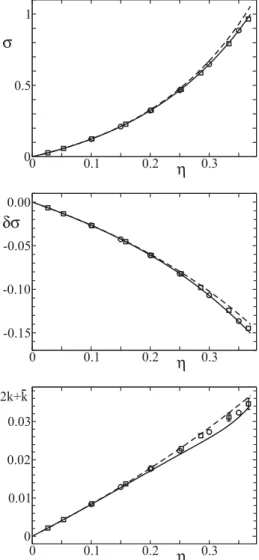
The results for σ, δσ, and the combination 2k+k¯ are plotted in Fig.1as the solid lines. Also shown in Fig.1are the calculations from Bryket al.[11] (circular symbols), computer simulation results by Lairdet al.[21,22] (square symbols), and scaled particle theory (SPT) [27] (dashed lines), for which the expressions read
σ d2
kBT =
3η(2+η) 2π(1−η)2,
δσ d kBT
= − 3η
4π(1−η), (SPT) (37)
2k+k¯ kBT
= − 1
From the results in Fig.1 it is concluded that the curvature coefficients calculated using Eqs.(33)–(35)are consistent with those obtained by Bryket al.[11], although there seems to be some small discrepancy for the combination 2k+k¯at larger volume fractions. We will come back to this point in Sec.IV.
B. Cylindrical interface
The analysis for the cylindrical interface is more or less analogous to that of the spherical interface, with one notable difference being that the weight functionswc
α(r1,r2) in Eq.(26) also need to be expanded in 1/R:
wc2(r1,r2)=w02(z1−z2)
1+d
2/4−z2 12 16R2 + · · ·
, wc3(r1,r2)=w03(z1−z2)
1+d
2/4−z2 12 32R2 + · · ·
,
(38)
wc3(r1,r2)=w03(z1−z2)
1+3
d2/4−z212
32R2 + · · ·
, wVc(r1,r2)=w0V(z1−z2)
1+d
2/4−z2 12 16R2 + · · ·
.
Following the same procedure as for the spherical interface, the expressions forσ andδσ in Eqs.(33)and(34)are recovered, and one obtains as an expression for the bending rigidityk:
k kBT
= −1
4 α ∞ −d/2 dz1 ∞ 0
dz2 ∂φ0 ∂n0
α(z1)
ρ1(z2)z12w0α(z1−z2)
+1 4 α,β ∞ −d/2 dz1 ∞ 0 dz2
∂2φ 0
∂n0
α(z1)∂n0β(z1)
n1β(z1)ρ0(z2)z12w0α(z1−z2)
+1 4 β ∞ −d/2 dz1 ∞ 0 dz2
∂2φ0
∂n0
V(z1)∂n0β(z1)
n1β(z1)ρ0(z2)w30(z1−z2)
+1 8 α ∞ −d/2 dz1 ∞ 0
dz2 ∂φ0 ∂n0
α(z1)
ρ0(z2)
d2
4 −3z 2 12
w0α(z1−z2)
− 1 16 ∞ −d/2 dz1 ∞ 0 dz2 ∂φ0 ∂n0 3(z1)
ρ0(z2)
d2 4 −z
2 12
w03(z1−z2)
+1 4 ∞ −d/2 dz1 ∞ 0
dz2 ∂φ0
∂n0V(z1)ρ1(z2)w 0
3(z1−z2)+ 1 2 ∞ −d/2 dz1 ∞ 0
dz2 ∂φ0
∂n0V(z1)ρ0(z2)z12w 0
3(z1−z2), (39)
whereρ1(z) andn1α(z) are the same as in the spherical analysis. It is noteworthy that since no reference to the location of the
z=0 plane is made in this expression, the bending rigidity isindependentof the choice for the location of the radiusR, i.e., (k)R−d/2=k. In this respect, the bending rigidity is a much more inherent property of the interface in question. The result of the evaluation of the bending rigidity using Eq.(39)is shown as the solid line in Fig.2. The open circles and crosses are the previous results forklisted in TableII. Also shown are very recent computer simulation results by Lairdet al.[21] (solid circles).
Figure2is the main result of this article. It shows that the bending rigidity is definitivelynot equal to zeroin the context of FMT theory for a hard-sphere fluid near a hard wall and the Hadwiger theoremdoes not applyin this case. We have shown this via three more or less independent approaches which agree within numerical accuracy with each other. A further corroboration of this result are the computer simulation results by Lairdet al.[21]; although the agreement is not quantitative, the shape of the volume fraction dependence ofkis strikingly similar.
Finally, we would like to mention that by combining the expressions in Eqs.(35)and(39), an expression for the rigidity constant associated with Gaussian curvature may be obtained:
¯
k kBT =
∞
−d/2
dz z2
ρ0ln(ρ0)−ρ0−
μ
kBTρ0+φ0+ p kBT (z)
+ α ∞ −d/2 dz1 ∞ 0
dz2z1
∂φ0 ∂n0
α(z1)
ρ0(z2)z12w0α(z1−z2)
+ ∞ −d/2 dz1 ∞ 0
dz2z1 ∂φ0
∂n0V(z1)ρ0(z2)w 0
3(z1−z2)− 1 4 α ∞ −d/2 dz1 ∞ 0
dz2 ∂φ0 ∂n0
α(z1)
ρ0(z2)
d2
4 −3z 2 12
w0α(z1−z2)
+1 8 ∞ −d/2 dz1 ∞ 0 dz2 ∂φ0 ∂n0 3(z1)
ρ0(z2)
d2 4 −z
2 12
0 0.1 0.2
η
0.3 00.5 1
σ
0 0.1 0.2
η
0.3-0.15 -0.10 -0.05 0.00
δσ
0 0.1 0.2
η
0.30 0.01 0.02 0.03 2k+k
-FIG. 1. Various curvature coefficients as a function of the fluid volume fraction: (a) surface tensionσ(in units ofkBT /d2), (b) Tolman lengthδσ(in units ofkBT /d), and (c) the combination 2k+k¯(in units ofkBT). The drawn lines are the results calculated using Eqs.(33)– (35), transformed according to Eq.(36)so that the radius is defined as that of the “actual surface.” Circular symbols are results from Bryk et al.[11], square symbols are the computer simulation results by Lairdet al.[21,22], and the dashed line is the SPT result in Eq.(37).
Note that ¯k can be evaluated from the properties of the planar interface only, a result that is consistent with similar expressions for the liquid-vapor interface [20].
IV. DISCUSSION
We have shown that the bending rigidity is not equal to zero in the context of FMT theory for a hard-sphere fluid near a hard wall and that the Hadwiger theorem does not apply in this case. Evidence for this conclusion is shown in Fig.2, where the results of three independent approaches are shown to agree within numerical accuracy. It is noteworthy that the bending rigidity changes sign from positive to negative as a function of increasing fluid volume fraction. It is smaller than the rigidity constant associated with Gaussian rigidity roughly by an order of magnitude.
0 0.1 0.2
η
0.3-0.002 -0.001 0 0.001 0.002
k
FIG. 2. Bending rigidityk(in units ofkBT) as a function of the fluid volume fraction. The drawn line is the result calculated from Eq.(39); open circles and crosses are the previous results listed in TableII; solid circles are the computer simulation results by Laird et al.[21].
The reduced magnitude of k may certainly be partly responsible for the fact that in a previous analysis [7] it was hard to distinguish it from zero. Another possible source for the discrepancy may be due to a different fit procedure used to extract the curvature coefficients from the radius dependence of the surface tension and wall density. A comparison between our analysis and the analysis in Refs. [7,8,11] shows that while numerical results forσs(R) agree to within a high degree of accuracy [28], the difference in fit procedure leads to a fitted value for 2k+k¯ that may differ by as much as 10% [see Fig.1(c)]. One may very well speculate that the difference in fit procedure used may also have consequences for the fitted value obtained fork.
The question now remains, what is the underlying physics of the Hadwiger theorem? The Hadwiger theorem is not merely some abstract notion from mathematics, and one should be able to understand more microscopically when the conditions (i.e., additivity) that lead to it are fulfilled. To address this question, let us consider the general form of the mean-field expressions for the surface tension in spherical [Eq.(24)] and cylindrical geometry [Eq.(28)] [29]:
σs(R)=
dr
r R
2
s(r), σc(R)=
dr
r R
c(r),
(41)
where (r) depends on the distribution of the fluid density
ρ(r) in the interfacial region and may be referred to as the excess free-energy density or (the negative of) the excess lateral pressure [29].
Now, if it is assumed that the lateral pressure isindependent
ofR, i.e.,(r)=0(z), then the only radius dependence in Eq. (41) is due to the geometric factors (r/R)2 and (r/R). Therefore, we immediately conclude from Eq.(41)that
σ =
dz 0(z), δσ = −
dz z0(z),
(42) ¯
k=
dz z20(z),
These results correspondprecisely to the predictions of the Hadwiger theorem so that we may conclude that the Hadwiger theorem corresponds to the following statement:
Hadwiger theorem ⇐⇒ (r)=0(z). (43)
This means that the Hadwiger theorem applies when the fluid molecules do not rearrange themselves when the curvature of the interface is changed. Certainly, theoretical models may be constructed in which such a rearrangement does not occur, but in general this is certainly not the case. To explore this curvature dependence, we expands(r) for a spherical interface in 1/R:
s(r)=0(z)+1(z)
R + · · ·. (44)
Szleifer and co-workers [31] already showed that the bending rigiditykis then expressed as
k= 1
2
dz z1(z), (45)
which explicitly demonstrates the conclusion thatk results from the (possible) rearrangement of molecules when the curvature of the interface is changed. An example of such a rearrangement of molecules as described by the density profile
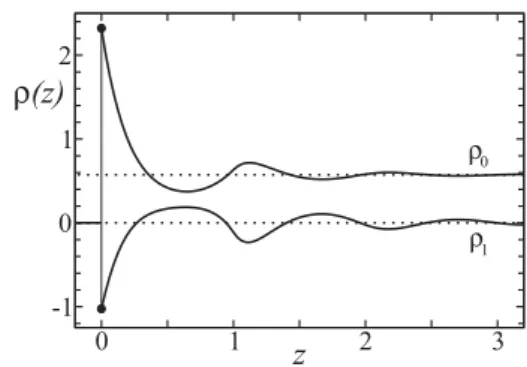
ρ1(z) is shown in Fig.3forη=0.3.
Now, one could argue that the vanishing of the bending rigidity is simply a matter of length scale [7]. The length scale associated with the molecular rearrangement due to curvature is the width of the interfacial regionξ, which is small compared any tomacroscopiclength scale unless the system is critical
0 1
z
2 3-1 0 1 2
ρ
(z)
ρ ρ0
1
FIG. 3. Density profilesρ0(z) (in units of 1/d3) andρ1(z) (in units of 1/d2) as a function ofz(in units ofd) forη=0.3. The values atz=0 correspond to the pressureρ0(0+)=p/kBT and (twice) the surface tensionρ1(0+)=2σ/kBT; cf. Eq.(8).
[25] or when a macroscopic wetting layer is present [32–34]. However, the same argument would apply toallthe curvature coefficients, and in particular to the rigidity constant associated with Gaussian curvature which scales similarly to the bending rigidity.
ACKNOWLEDGMENTS
I am grateful to Roland Roth for bringing this topic to my attention. Further discussions with him and Bob Evans are greatly appreciated. I would also like to thank Brian Laird for communicating his simulation results prior to publication.
[1] W. Helfrich, Z. Naturforsch. C28, 693 (1973).
[2] For reviews, see Micelles, Membranes, Microemulsions, and Monolayers, edited by W. M. Gelbart, A. Ben-Shaul, and D. Roux (Springer, New York, 1994);Statistical Mechanics of Membranes and Surfaces, edited by D. Nelson, T. Piran, and S. Weinberg (World Scientific, Singapore, 1988).
[3] S. A. Safran,Statistical Thermodynamics of Surfaces, Interfaces, and Membranes(Addison-Wesley, Reading, MA, 1994). [4] R. C. Tolman,J. Chem. Phys.17, 333 (1949).
[5] E. M. Blokhuis and D. Bedeaux,J. Chem. Phys.97, 3576 (1992). [6] E. M. Blokhuis and J. Kuipers, J. Chem. Phys. 124, 074701
(2006).
[7] P.-M. K¨onig, R. Roth, and K. R. Mecke,Phys. Rev. Lett.93, 160601 (2004).
[8] P.-M. K¨onig, P. Bryk, K. R. Mecke, and R. Roth,Europhys. Lett.
69, 832 (2005).
[9] H. Hadwiger, Vorlesungen ¨uber Inhalt, Oberfl¨ache und Isoperimetrie(Springer, Berlin, 1957).
[10] K. R. Mecke,Int. J. Mod. Phys. B12, 861 (1998).
[11] P. Bryk, R. Roth, K. R. Mecke, and S. Dietrich,Phys. Rev. E68, 031602 (2003).
[12] Y. Rosenfeld,Phys. Rev. Lett.63, 980 (1989). [13] R. Roth,J. Phys.: Condens. Matter22, 063102 (2010). [14] J. L. Lebowitz,Phys. Fluids3, 64 (1960).
[15] J. R. Henderson,Mol. Phys.50, 741 (1983).
[16] J. R. Henderson, in Fluid Interfacial Phenomena, edited by C. A. Croxton (Wiley, New York, 1986).
[17] E. M. Blokhuis and J. Kuipers, J. Chem. Phys. 126, 054702 (2007).
[18] E. M. Blokhuis (unpublished).
[19] The absence of this term leads to the striking result in Fig.3in Ref. [7]. It is, however, unrelated to the question of whether the bending rigidity vanishes or not.
[20] E. M. Blokhuis and D. Bedeaux,Mol. Phys.80, 705 (1993). [21] B. B. Laird, A. Hunter, and R. L. Davidchack,Phys. Rev. E86,
060602 (2012).
[22] B. B. Laird and R. L. Davidchack,J. Chem. Phys.132, 204101 (2010).
[23] R. Roth, R. Evans, A. Lang, and G. Kahl,J. Phys.: Condens. Matter14, 12063 (2002);Y.-X. Yu and J. Z. Wu,J. Chem. Phys.
117, 10156 (2002).
[24] N. F. Carnahan and K. E. Starling, Phys. Rev. A 1, 1672 (1970).
[25] J. S. Rowlinson and B. Widom,Molecular Theory of Capillarity (Clarendon, Oxford, 1982).
[26] P. F. Byrd and M. D. Friedman,Handbook of Elliptic Integrals for Engineers and Physicists(Springer-Verlag, Berlin, 1954). [27] H. Reiss, H. L. Frisch, E. Helfand, and J. L. Lebowitz,J. Chem.
Phys.32, 119 (1960).
[29] E. M. Blokhuis, H. N. W. Lekkerkerker, and I. Szleifer,J. Chem. Phys.112, 6023 (2000).
[30] W. Helfrich in Physics of Defects, Les Houches, edited by R. Balianet al.(North-Holland, Amsterdam, 1981).
[31] I. Szleifer, D. Kramer, A. Ben-Shaul, W. M. Gelbart, and S. A. Safran,J. Chem. Phys.92, 6800 (1990);I. Szleifer, D. Kramer,
A. Ben-Shaul, D. Roux, and W. M. Gelbart,Phys. Rev. Lett.60, 1966 (1988).
[32] R. Evans, R. Roth, and P. Bryk,Europhys. Lett.62, 815 (2003). [33] R. Evans, J. R. Henderson, and R. Roth,J. Chem. Phys.121,
12074 (2004).