SOCIAL IMPACT
INVESTMENT TASKFORCE
Established under the UK’s
presidency of the G8
September 2014FOR IMPACT
Subject Paper of the Asset
Allocation Working Group
This report has two key audiences. It is for Chief Investment Officers and Investment Managers, who we hope will find it a helpful guide for how to integrate impact
investments across a balanced portfolio. It is also for policymakers and, in particular, those within government who are responsible for designing financial policies that can enable the capital markets to play a powerful role in how we address pressing social and
environmental issues.
Contents
Executive Summary 01
The attraction of impact investment 03 Clarifying the impact investment
universe 05
A portfolio approach to impact
investment 10
Key barriers to greater allocation 16
Policy levers for change 18
Despite increases in aggregate
global wealth, levels of
inequality and environmental
degradation in many countries
continue to rise. To help tackle
this, impact investment
1aligns
the positive power of private
capital with the social and
environmental needs of society
at large. This makes impact
investment a critical tool for
the policymaker, bringing
cost-effective solutions and
incremental capital to some
of our most intractable societal
challenges, from life-saving
vaccines to affordable housing.
It also provides investors with a compelling opportunity: to align their investment strategy with their societal values, to spot areas of rapid growth (supported by a favourable policy environment) and even to identify potentially less correlated investment propositions.
To solve problems on a global scale, we need global capital pools to respond. This means that, alongside the pioneering investors already allocating for impact, we need impact investment to find its formal place within institutional
portfolios.
This will happen when Chief Investment Officers and Investment Managers recognise that a diversified and thoughtful allocation to impact investments can fit with their fiduciary responsibilities, and when governments use well-designed policies to encourage and support such allocations.
This paper presents a series of frameworks to help both investors and policymakers do just that. In Chapter 1, we describe the various features that make impact investment an attractive
proposition, for both governments and investors.
In Chapter 2, we clarify the various terms used in the market and position the investment choices available. This chapter aims to help investors identify the opportunity set that can best meet their societal and financial goals. It also provides policymakers with a view of the impact investment universe, which they can influence and incentivise to meet their development agendas.
In Chapter 3, we propose a framework for
including impact investments across a balanced investment portfolio, without compromising the financial goals and fiduciary responsibilities of Chief Investment Officers and investment managers. This chapter is clearly relevant for investors but it is also aimed at policymakers, since it lays the groundwork for later policy recommendations.
In Chapter 4, we assess the key barriers to
making impact investments for a wide range of
investors and intermediaries. These barriers fall into three main categories, relating to conflict of duty, to the nascent stage of the industry and to increased risk factors.
EXECUTIVE SUMMARY
Impact investment aligns the positive
power of private capital with the social and
environmental needs of society at-large.
It is for this reason that this report has
two key audiences: both investors and
policymakers.
EXECUTIVE SUMMARY
Finally, in Chapter 5, we present a series of actionable policy recommendations that can
address these barriers, illustrated through
examples of equivalent policies already at work around the world. These recommendations call for governments to act in three key ways:
1. MARKET STEWARD
• Clarification of fiduciary duty Use of fiscal incentives
• Requirement for regulated financial institutions and foundation endowments to articulate their contribution to impact investment
• Requirement that impact investment be included as an optional percentage of pension fund offerings
• Requirement that banking institutions lend to priority sectors
2. MARKET PARTICIPANT
• Issuance of Requests for Proposals to encourage development of impact investment products • Stimulation of the intermediary market to
produce more bundled/ multi-asset products at-scale
• Provision of catalytic capital, such as matching investment, first loss protection or guarantees
3. MARKET BUILDER
• Support for placement and distribution platforms • Support for an impact investment rating system Taken together, we hope that the various
frameworks and policy recommendations presented in this report have the potential to unlock the financial power of global portfolio investors, bringing widespread solutions to some of our most pressing societal challenges.
About the authors
This report is the product of a series of discussions by the Asset Allocation Working Group of
the Social Investment Taskforce, established established under the UK’s presidency of the G8 (see Acknowledgements for details).
The Working Group is chaired by Harvey McGrath of Big Society Capital.
The report’s lead authors are Clara Barby of Bridges IMPACT+ and Mads Pedersen of UBS. Please direct any feedback or further enquiries about this report to:
Economic liberalisation and the
evolution of the global capital
markets have hugely increased
wealth and economic efficiency
in many countries around the
world. However, a continued
rise in levels of social inequality
and environmental degradation
underlines that this progress
can come at a high cost to
society. The rise of impact
investment is showing the
power of the capital markets to
finance measurable solutions
to a wide range of social and
environmental challenges, which
governments and aid alone
cannot solve.
A. THE ATTRACTION FOR POLICYMAKERS
Incremental financial and human capital
Many of the issues that public funders and traditional charities seek to address are also the domain of impact investments, such as inadequate housing, hunger and malnutrition, low educational levels, limited access to clean water, sanitation and hygiene, employment challenges, social protection measures, low levels of agricultural productivity, infrastructure, limited availability of financial and professional services and low levels of productivity in the economy. Impact investment’s focus on building financially sustainable and measureable solutions to meet these challenges makes it a compelling proposition for policymakers. It complements public investment by offering incremental financial and human capital to deliver the public agenda, particularly in light of tightening government budgets.2
B. THE ATTRACTION FOR INVESTORS
The case is equally appealing for investors. Impact investments do not just protect and enhance an investment’s value through better day-to-day environmental, social and governance (ESG) practices;3 they are distinct in their focuson defining a societal challenge upfront, setting objectives to deliver an intervention and measuring how well they do. As a result, impact investments make a compelling investment proposition for at least three key reasons:
1. Increased options for
values-driven investors
The old paradigm of ‘two pockets’ (making money with regard only to financial return and giving it away with regard only to impact) is rapidly breaking down. The millennial generation4
want investments that marry profit with purpose and traditional foundations worldwide are
beginning to consider ways that their endowment can further their mission. Impact investment is the strategy of choice for those seeking to align their wealth with their specific social and/or
environmental objectives.
THE ATTRACTION OF
IMPACT INVESTMENT
2 Recent estimates place the total global post-2015 development financing gap at between US$180 and US$500 billion annually, of which well over 50% will be required in Africa and South Asia alone (www.odi.org.uk/sites/odi.org.uk/files/odi-assets/publications-opinion-files/8319.pdf) 3 By assessing and measuring for positive social and environmental impact, impact investments can also unearth potential negative impacts that could hurt financial returns. For example, intense review of supply-chain impacts could highlight unsafe factory conditions or risky locations that could significantly disrupt production
THE ATTRACTION OF IMPACT INVESTMENT
2. Potential for diversification
There may also be purely financial reasons to allocate to impact investment. As impact
investment becomes mainstream, and track records develop, we can envisage impact investments across asset classes. Given the emergent return and correlation profile of some of these categories of impact investment (for example, Social Impact Bonds* and Development Impact Bonds,5 which
will likely sit within absolute return), we see a growing strategic asset allocation logic, based on the potential diversification benefits of including impact investment within a broader portfolio. The combination of improved portfolio risk-adjusted returns, while achieving significant societal impact, could become a powerful driver of asset allocation decisions over time.
3. Potential for growth
Impact investments’ focus on identifying solutions to (often large) unmet societal challenges means that, as an investment strategy, impact investment naturally lends itself to identifying areas of new and rapid growth in otherwise mature markets.
Moreover, in an economic downturn, impact investments’ focus on addressing the real needs of a real economy (such as delivering life-saving healthcare or meeting a shortfall in affordable housing), can result in continued strong demand, even when the rest of the economy is slowing down.
*Social Impact Bonds and Correlation
Social Impact Bonds (SIBs) are a form of contract in which an outcomes-payer (such as a government commissioner) commits to pay for significant improvement in social outcomes (for example, a reduction in offending rates, or in the number of people being admitted to hospital, who might be treated at home) for a defined population. Through a SIB, private investment is used to fund a service provider to deliver the desired societal outcome(s) and the outcomes-payer delivers financial returns to the investor only if the improved social outcomes occur. As an innovative investment product, without a proven track record, SIBs have been kick-started by investors that are willing and able to take apparently disproportionate risk (given the capped level of financial return, which is usually set by the outcomes-payer). Over time, however, it is possible that SIBs prove to be an investment opportunity capable of delivering predictable and competitive risk-adjusted financial returns. If so, given the return drivers of many SIBs (an investor’s financial return is dependant on whether, for example, children achieve better exam results, rather than on the price of oil), they may have a lower correlation profile to the rest of the market. These features could make SIBs particularly attractive to investors seeking less correlated returns.
5 Development Impact Bonds (DIBs) have much in common with the SIB, but with the crucial difference that bilateral aid agencies, foreign aid ministries, multilateral institutions and philanthropists pay for the outcomes delivered, instead of the domestic government 6 As described in the report: Evolution of an Impact Portfolio, October 2013, which profiles the impact allocation approach taken by Sonen Capital on behalf of the K L Felicitas Foundation
In addition to producing positive social or
environmental benefits, an impact investment
strategy may also result in strategic portfolio
advantages, including potentially reducing
overall portfolio volatility, or seizing
opportunities to capture alpha through market
inefficiencies and by capitalizing on long-term
social and environmental trends.
Sonen Capital6
The diversity of opportunities
available is an important merit
of impact investment. It is
also a major challenge. For
investors and policymakers
looking to determine which
impact investment approaches
can best meet their goals (both
impact and financial), a clear
understanding of the relevant
landscape is critical. Below, we
have taken an empirical view
of how the impact investment
market is evolving.
A. THE IMPACT INVESTMENT
VALUE CHAIN
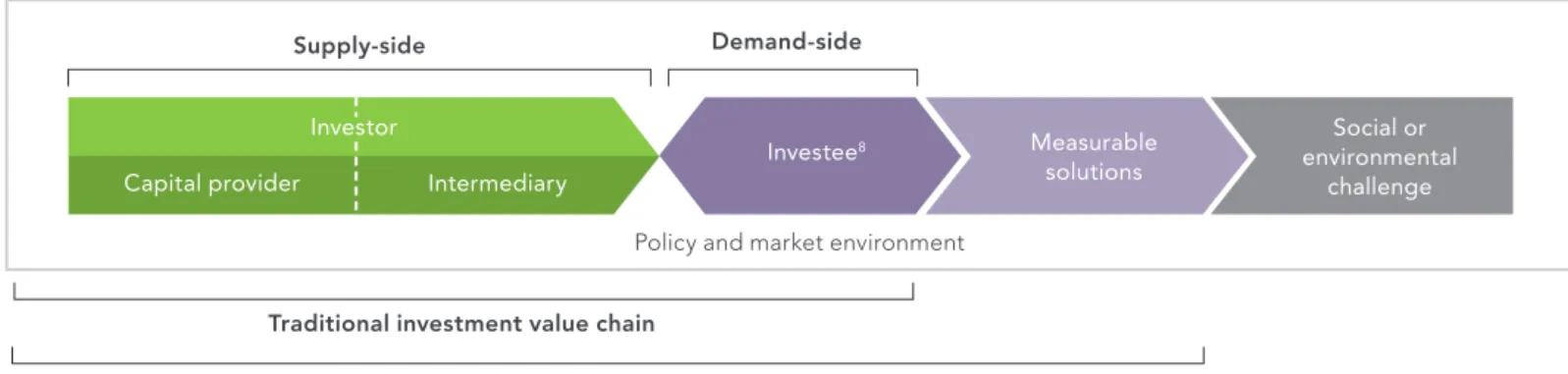
The diagram below shows a simplified version of the traditional investment value chain. This same value chain occurs in impact investment with one distinct difference: while all investments create various impacts (which can be positive or negative), impact investments are distinguished by their deliberate
intention to generate specific positive social impact, by setting outcome objectives and
measuring their achievement.
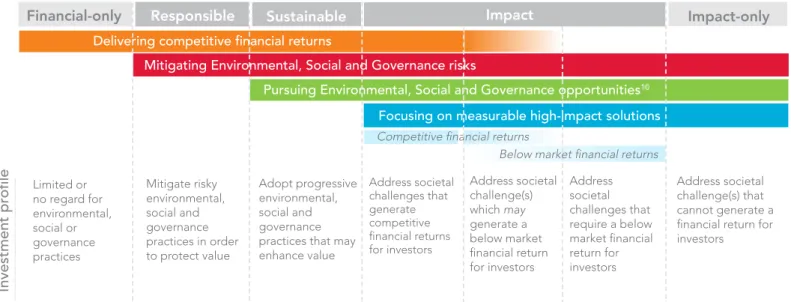
This definition has three important implications. Firstly, impact investments have roots in – but are distinct from – a wider spectrum of investment approaches that integrate societal factors into decision-making. The result is a spectrum of capital, which is explored in more detail in Section B (The supply-side).
Secondly, the investees raising impact investment can take a wide variety of organisational forms, since there is a growing range of approaches to delivering both social and financial returns (ranging from impact-driven businesses to trading non-profits to non-trading charities that engage in SIBs). This variation, and its relationship to financial return for investors, is explored in more detail in Section C (The demand-side).
Thirdly, although impact investments are distinguished by the hallmarks of intention and measurement, these hallmarks may not be shared by every actor in the impact investment value chain: an impact investment can be driven by the investor, by the investee, or by the surrounding
CLARIFYING THE IMPACT
INVESTMENT UNIVERSE
77 The findings presented in this chapter draw significantly on two reports: ‘Investing for Impact: A Strategy of Choice for African Policymakers’ (Bridges IMPACT+, in partnership with the African Private Equity and Venture Capital Association, funded by The Rockefeller Foundation, 2014) and ‘How we define the market’ (Bridges IMPACT+, 2012)
8 We use the term ‘investee’ because, while many impact investment opportunities relate to enterprises, there are also an increasingly number of structured products, including SIBs, DIBs and other bond products.
Capital provider
Supply-side
Traditional investment value chain
Impact investment value chain Demand-side
Policy and market environment Intermediary
Investor
Investee8 Measurable
solutions
Social or environmental
challenge
CLARIFYING THE IMPACT INVESTMENT UNIVERSE
policy environment – or by various combinations of all three. It is for this reason that we refer to impact ‘investments’ in this report, rather than specifically to the investor or investee. Such variations within impact investment are analysed in more detail in section D.
B. THE SUPPLY-SIDE
A spectrum of capital
The notion that investments cannot operate in isolation from society is not new. Socially conscious investments arguably date back centuries, with religions laying down directives on how to invest according to ethical values. More recently, the social climate of the 1960s, followed by the push from investors to eliminate the institutionalized racial discrimination of Apartheid in South Africa, brought socially conscious investments to the fore. By the 1980s, Socially Responsible Investment (SRI) had a dedicated investor base, focused on
systematically ‘screening out’ harmful products and practices (such as tobacco, weapons or oppressive regimes). Back then, this investment
style was driven primarily by ethical motivations, rather than commercial considerations.
Over time, in addition to ethical motivations, many investors have recognised that, by factoring social, environmental and governance risks (ESG) into their investment decisions, they are able to protect value and deliver greater long-term financial returns to shareholders, particularly in a world of
increasing transparency. As a result, the broad category of responsible investors today ranges from those which ‘negatively screen’ harmful products or practices, to those which also address ESG risks through active ownership. The extent to which ESG factors are central to decision-making varies widely within this universe of investors. Taking this further, and building upon “best-in-class” SRI, some investors now deeply integrate social and environmental factors into their analysis and pro-actively screen for ESG
opportunities, favouring approaches which they believe will outperform the market because they operate (or have the potential to operate) in a more sustainable way than their peers over time – be it through their environmental management, stakeholder engagement or governance
practices. This sustainable investing style centres on backing businesses whose ESG practices enable them to flourish in a changing social and environmental landscape, and we distinguish it from responsible investment because it focuses not just on protecting value against risk but also on create additional value, for both shareholders and society.
While sustainable investors focus on progressive ESG practices, impact investors go beyond this to focus on solutions to pressing social or
environmental issues. Impact investments focus deliberately on one or a cluster of issue areas with the intention to make a positive and measurable societal impact, alongside a financial return. For example, an investment might focus on delivering life-saving healthcare to low-income communities, or address water scarcity, or provide high quality jobs to the long-term unemployed.
Impact and financial returns
Investments that intentionally generate
measurable social impact range in their ability to deliver competitive financial returns for investors, giving rise to three broad categories.
First, there are situations where a social challenge creates an opportunity for investors to deliver positive societal change alongside market rate, or even above market rate, financial returns. A clean energy mutual fund generating carbon off-sets or a microfinance structured debt fund are two such examples.
Impact investments focus deliberately on
one or a cluster of issue areas with the
intention to make a positive and measurable
societal impact, alongside a financial return.
For example, an investment might focus on
delivering life-saving healthcare to low-income
communities, or address water scarcity, or
provide high quality jobs to the long-term
unemployed.
Second, there are situations where it may be unclear whether an investment’s delivery of positive social change will require investors to accept a below market financial return. Private equity investments into the growing number of ‘mission-locked’ profit with purpose businesses9
around the world, whose governance requires them to balance shareholder interest with their mission, are one such example.
Thirdly, there are situations where addressing a social issue requires some financial trade-off. This result is a below market investment opportunity to address some of our most pressing social challenges. One such example is a fund providing unsecured loans or quasi equity to social enterprises and trading charities, which have a lock on their disposal of assets and/or distribution of surplus. In summary, we have developed the following map of the market (see Fig. 2) to help clarify the terms and position the choices available to investors. We use only dotted lines to distinguish between types, recognising that many investors will transition across categories, or build a portfolio across the
spectrum. For example, a thoughtful institutional investor could allocate their entire portfolio across impact, sustainable and responsible investment products, in such a way as to optimise impact within the bounds of their financial goals and fiduciary responsibilities.
C. THE DEMAND-SIDE
Any impact-driven organisation can be a recipient of impact investment, provided it can deliver social impact and a financial return. The growing impact investment market is showing that a wide range of impact-driven organistions can be fuelled by impact investment, even including charities that do not trade (if they engage in SIBs or DIBs). Connecting this demand with the supply of capital is an increasingly diverse range of investment products, from those suitable for investors seeking
competitive financial returns alongside impact, to those suitable for investors willing to accomodate below market opportunities within their portfolio for the sake of impact.
Fig. 2 A spectrum of capital
Financial-only Responsible Sustainable Impact Impact-only
Pursuing Environmental, Social and Governance opportunities10
Focusing on measurable high-impact solutions Delivering competitive financial returns
Mitigating Environmental, Social and Governance risks
Competitive financial returns
Investment pr
ofile Mitigate risky environmental, social and governance practices in order to protect value
Adopt progressive environmental, social and governance practices that may enhance value
Address societal challenges that generate competitive financial returns for investors
Address societal challenge(s) which may generate a below market financial return for investors
Address societal challenges that require a below market financial return for investors
Address societal challenge(s) that cannot generate a financial return for investors
Limited or no regard for environmental, social or governance practices
Below market financial returns
9 There are now over 1,000 B Corps seeking to balance shareholders’ interests with a broader stakeholder agenda. Many profit with purpose businesses believe that their commitment to mission creates a competitive advantage due to greater loyalty (from both customers and employees), resulting in market-rate or even market-beating returns for shareholders. For more information, see: http://www.bcorporation.net/ become-a-b-corp/why-become-a-b-corp/protect-your-mission
10 This integration of sustainable practices across an organisation’s core business may also be termed Corporate Social Resonsiblity (CSR), although many organisations have a separate (often philanthropic) CSR ‘carve-out’ that is distinct from their approach to sustainability.
CLARIFYING THE IMPACT INVESTMENT UNIVERSE
Figure 3 below brings this evolving landscape to life by mapping the range of impact-driven organisations seeking investment (horizontal axis) to a range of illustrative impact investment products, categorised according to their financial risk-adjusted return profile (vertical axis, which represents the impact investment section of the capital spectrum, as shown in Fig. 2). The resulting picture shows the powerful role that private capital can play in financing a wide range of impact-driven organisations to address social problems. It also highlights that the organisational form of the underlying investees need not dictate an
investment’s ability to deliver either higher impact or competitive financial returns: for example, there are non-trading charities who will access capital
through financially-attractive SIB or DIB investments; there are Profit with Purpose businesses whose mission will prove so central to their commercial success that they generate competitive returns; and there are a whole range of impact-driven organisations that will generate competitive investment opportunities through use of tax credits, guarantees or first loss positions.
D. VARYING MOTIVATIONS
Recalling the Impact Investing value chain (page 3), the intention to generate positive impact may be shared all participants. For example, an impact-driven housing developer may raise capital from an impact-driven investor.
Impact-driven organisations
Businesses-Seeking-Impact: businesses that set and maintain social outcome objectives for a significant part of their ac-tivities, without locking-in their mission Profit-with-Purpose: businesses that lock in social mission through their gover-nance and/ or embed it in their core busi-ness model Social and solidarity enterprises and other profit-constrained organisations Investee pr ofile Charitiesthat
do not trade but engage in revenue generation through Social Impact Bonds (SIBs) or Devel-opment Impact Bonds (DIBs) Charities and
membership groups that trade but do not distribute profits
Social Sector Organisations Impact-driven businesses
Competitive financial r
eturns Investments that address societal challenge(s) which generate competitive financial returns for investors
Investments that address societal challenge(s) which may generate a below market financial return for investors
Investments that address societal challenge(s) which require a below market financial return for investors
Below market financial r
eturns
• Affordable housing structured debt fund, provid-ing loans to hous-ing associations • Bond fund focused on charities • Social Impact Bonds / Develop-ment Impact bonds
• Fund providing quasi equity to social and solidarity enterprises (e.g. growth capital for community interest companies) • PE/VC fund
providing growth equity to profit with purpose businesses (e.g. a B Corp fo-cused on energy ac-cess for low-income customers, or a ‘buy one, donate one’ business, linking sale of its core product to delivery of impact)
• PE/VC fund focused on businesses seeking impact
(e.g. businesses creating ‘place-based’ impacts in deprived communi-ties, or insurance businesses with a significant focus on ‘base of pyramid’ customers)
• Publicly-listed fund dedicated to renewable energy projects (e.g. a wind farm)
• Microfinance structured debt fund (e.g. loans to microfinance banks) • PE/VC fund dedicated to busi-nesses that improve global public health
Focusing on measurable high-impact solutions
• Fund providing unsecured loans to trading charities and mission-driven co-operatives (e.g. a community hydro project, or supported hous-ing charity, or domiciliary care co-operative)
• Social Impact Bonds / Development Impact bonds, e.g. focused on recidivism, adoption/foster parentage or homelessness
• Social Impact Bonds / Development Impact bonds • Social Impact
Bonds / Development Impact bonds • Bond fund
focused on social enterprises • Social Impact Bonds / Development Impact bonds
• Social Impact Bonds / Development Impact bonds
• Fund providing unsecured loans to non-trading charities
Investment pr
ofile
Fig. 3 Matching supply and demand
However, an impact investment can also occur when the intention to create impact (and measurement of it) is not shared by all participants. In fact, there are many impact investments at work around the world where this is the case. For example, a responsible enterprise may not have an explicit intention to address a societal issue but, due to its location in an underserved community, an impact-driven investor may invest in the enterprise as a solution to the pressing issue of local unemployment. Here, the intent lies primarily at the level of the investor, who also tends to drive the measurement of social outcomes that result. This model has historically been used significantly by Development Finance Institutions seeking to generate job creation, increased tax revenue and economic growth in underserved regions.
Alternatively, an impact-driven healthcare enterprise may be set up with the deliberate intention to create access to affordable maternity care for lower-income populations; yet one of its sources of capital as it grows may be a bank, which is attracted to the enterprise as a
creditworthy commercial investment, rather than for its impact intention.
There are also situations where the impact
intention (and measurement) is catalysed not by an investor or investee but by the surrounding policy environment, which attracts capital and enterprises to deliver societal outcomes that governments can measure. Tax incentives to attract investors and
enterprises to renewable energy projects are one such example, as is the US Low Income Housing Tax Credit, where a combination of policies, the Community Reinvestment Act and the tax code have created a $6-10 billion annual market for private investors.
Even where both the investor and investee do share the intention to address societal challenges, they may differ in their financial motivations. For example, we frequently see impact-only capital (from grantmakers or public funders) being used strategically to support the initial growth of organisations that aim to become financially viable in the long-term but which cannot support capital from financially-motivated investors in the early stages.11
Finally, we also see financial motivations vary among impact co-investors. Many at-scale impact investment opportunities involve layered
structures, where one type of impact-driven investor is willing to ‘flex’ their own financial risk-reward profile (for example, by providing a first loss position or guarantee) just enough to create a market-rate risk-adjusted return proposition, attracting other types of impact, sustainable or even responsible investors, who would not otherwise participate. Through such catalytic behaviour, an impact-driven investor can help attract more capital to impact-driven organisations, significantly furthering their impact.
11 For further discussion of this topic, see: From Blueprint to Scale, Monitor, April 2011 organisation Intention and measurement by the policymaker
The Federal US Community Reinvestment Act (CRA) states that “regulated financial institutions have continuing and affirmative obligations to help meet the credit needs of the local communities in which they are chartered.” The CRA establishes a regulatory regime for monitoring the level of lending, investments and services in low- and moderate-income neighbourhoods typically underserved by lending institutions. Where a regulatory agency finds that a lending institution is not serving these neighbourhoods, it can delay or deny that institution’s merger request or approval to open a branch or expand its services.
Layered capital for leveraged impact
The African Agricultural Capital Fund (AACF) is a private equity fund aiming to boost the productivity and profitability of Africa’s undercapitalized
agriculture sector. Capital in the AACF consists of $17M in equity investments from the foundations, and an $8M commercial loan from J.P. Morgan’s Social Finance unit. The commercial loan has downside protection from the subordinated equity investments and a 50% loan guarantee from USAID’s Development Credit Authority. AACF will also have access to $1.5M in USAID-funded technical assistance grants. This will include
business development services to improve portfolio companies’ operations, competitiveness and access to markets, alongside delivering social impact.
10
A PORTFOLIO APPROACH TO IMPACT INVESTMENT
A portfolio approach to
impact investment requires an
investor to choose what societal
outcomes they wish to deliver,
what aggregate financial return,
volatility and liquidity profile
they wish to achieve and what
percentage of their portfolio
they wish to allocate to impact
investments. These choices are
interrelated and will be driven by
the investor’s particular emphasis
on achieving certain forms of
societal impact relative to overall
financial efficiency or portfolio
trade-offs. Based on these
decisions, an investor can define
the opportunity set that can best
meet their various objectives.
A. A STRATEGY ACROSS ASSET CLASSES
In the previous chapter, we described how an investor can categorise investment opportunities according to their impact profile and their risk-adjusted financial return potential (ranging from competitive to below-market). Taking this further, impact investments can also be categorised according to other standard financial drivers, including: the pattern of expected cash flows, the capital gain or principal payback potential/ probability, the liquidity (lock-up periods), and the correlation to standard markets. As a result, impact investments can be described as part of the asset class whose features they reflect.For instance, an investment with a long lock-up period, potentially high upside (if executed well), and significant risk might be categorized as ‘impact private equity’. An investment with more stable cash flow and limited upside but a high likelihood of principal repayment after a
substantial lock-up period might best be viewed as an ‘impact private debt’ investment. Should a government or a foundation be willing to
guarantee the principal repayment, the instrument might be seen as a substitute for a traditional corporate bond.
Given the above, impact investment should be considered a strategy that can be applied across a variety of asset classes (for example, private debt, private equity or real estate), rather than an asset class itself.
At the same time, however, as a nascent strategy, given the additional skills required to analyse social factors alongside commercial factors (as well as the lack of widespread track record about how social analysis affects investment performance), some asset owners/intermediaries are choosing to treat impact investment as an asset class, often
including it within alternatives.
This treatment of impact investment as an asset class may be useful, since dedicated teams, with an integrated skill set and specific budget to invest, may catalyse greater allocation in the near term. In the longer term, however, our vision is that the strategy of fully factoring social externalities into investment decisions (and the skill-set to do so) will become mainstream across all asset classes. It is also possible, even advisable, to label any treatment of impact investment as an ‘impact
A PORTFOLIO APPROACH
TO IMPACT INVESTMENT
1212 The framework for portfolio construction presented in this chapter has been contributed by Mads Pedersen, Head of Asset Allocation Discretionary at UBS Wealth Management
Impact investment should be considered a
strategy that can be applied across a variety of
asset classes. At the same time, however, as a
nascent strategy, given the additional skills
required to analyse social factors alongside
commercial factors, some asset owners/
intermediaries are choosing to treat impact
investment as an asset class, often including
it within alternatives.
allocation’, equivalent to the proportion of the investor’s total asset allocation that has an impact purpose. This concept would allow an investor to migrate seamlessly from treating impact investment as an asset class to integration across the entire portfolio because it can also capture the intermediate stage when an investor has the expertise to integrate impact investments within certain asset classes, but not others. Retaining the notion of an overall ‘impact allocation’ will enable investors to speak consistently and coherently about how they are approaching impact investing, whilst doing it differently for different asset classes.13
Clearly, the size of this ‘impact allocation’ will be a function of an investor’s overall portfolio and, in particular, its objectives and remit. For many institutional investors, it will be important to understand, in the context of that remit, what the return, risk and liquidity trade-offs resulting from the inclusion of impact investments might be.
In the following section, we therefore re-cap a framework for traditional portfolio construction (to facilitate the evaluation of any trade-offs in the context of a financially efficient portfolio) and suggest specific considerations for those seeking to integrate impact investments. We then offer an alternative illustrative portfolio, which demonstrates that impact investments, if thoughtfully selected, can be included without significantly increased volatility or return dilution but with some increase in illiquidity.
Many individual investors will have a less structured or optimised approach to the size and content of their portfolios and may, for example, place greater emphasis on the societal impact of their investing than on overall portfolio trade-offs or financial efficiency. Nevertheless, we feel that the analytical framework that follows is of value to these non-institutional investors too.
Longer-term:
Fully factoring social externalities into investment decisions will become
mainstream across asset classes
Cash Debt
Public equity Alternative assets
including private equity, venture capital, real estate and absolute return
Fully integrated investment teams within each asset class, using strategies such as: • Impact investment • Sustainable investment • SRI and Responsible
investment
Specialist team with integrated skill-set + dedicated allocation to apply across impact asset classes
Near-term:
Treatment as a specialist allocation will drive more capital in the near term
Cash Debt
Public equity
Impact investment allocation
Alternative assets
including private equity, venture capital, real estate and absolute return
Traditional investment teams, organised by asset classes Fig. 4 Impact investment as a strategy across asset classes
12
Client strategies (Sub) asset classes characteristics
Lower risk Higher risk USD reference currency Income
strategy strategyYield Balanced strategy strategyGrowth
Hedged Expected 5 Yrs
Return p.a. Volatility p.a.Expected
Asset class mix (& sub asset classes)
Money markets 5% 5% 5% 5% 1.7% 0.5%
Bonds 73% 55% 38% 21%
High Grade USD bonds 5-7y 40% 25% 20% 11% 3.1% 2.5% Short-term USD Corporate bonds 1-5yr 10% 8% 2.7% 3.0% USD Corporate bonds 13% 12% 10% 2% 4.3% 5.5% US High Yield bonds 5% 5% 5% 5% 4.8% 9.6% EM sovereign bonds 3% 3% 3% 3% 5.2% 8.7%
EM corporate bonds 2% 2% 5.2% 9.1%
Equities 10% 25% 42% 62%
USA equities 5% 12% 21% 33% 7.6% 15.1%
Emerging Market equities 4% 6% 9% 10.3% 23.9%
EMU equities 4% 5% 7% X 7.6% 19.0%
UK equities 3% 3% 4% 6% X 7.8% 13.5%
Japan equities 4% 5% X 7.2% 19.5%
Switzerland equities 2% 2% 2% 2% X 7.3% 14.8%
Private markets – Absolute Return 12% 15% 15% 12%
Absolute return 12% 15% 15% 12% 4.1% 6.3%
Total 100% 100% 100% 100%
Traditional SAA:
Expected 5 yrs Return p.a. 3.9% 4.7% 5.5% 6.3%
Expected Volatility p.a. 3.6% 5.5% 7.5% 10.1%
A PORTFOLIO APPROACH TO IMPACT INVESTMENT
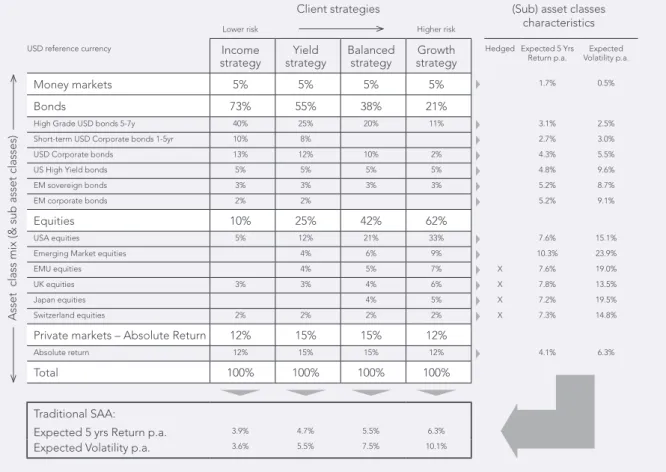
Table 1 – SAAs with traditional investments14
Re-cap: Portfolio
construction and Strategic
Asset Allocation (SAA)
A multi-asset class portfolio approach is based on the principle of diversification of risk and return. The aim is to achieve a long-term investment goal for a reasonable amount of risk and uncertainty (volatility) over a longer period of time (typically five years or more). The most appealing feature is the diversification of risk and return stemming from the fact that, in times of crises and turmoil, different asset classes typically move in different directions: for example, government bonds do well when equities give negative returns. The justification for a well-diversified multi-asset class portfolio comes from the perception that the only free lunch in finance is diversification itself. The building blocks of such a portfolio include the traditional asset classes of public equities,
government bonds, investment grade corporate bonds, high yield bonds, private equity and private debt instruments. In investment language, the Strategic Asset Allocation (SAA), which defines the long-term allocation of the portfolio across asset classes, determines most of the risk and return of the portfolio (subject to any tactical short-term shifts or instrument selection).
General SAA approach
The SAA structures a portfolio at the asset class level to match the specific investment objectives and risk tolerance of investors. If well structured, it offers the best financial risk/return trade-off for a given level of acceptable risk. Constructing an SAA is both an art and a science; good practice requires a robust quantitative framework and seasoned judgment. The quantitative framework supplies a detailed
understanding of the behaviour of financial markets. Qualitative assessments – i.e. the seasoned judgment provided by asset class and asset allocation experts – complement this framework by capturing the subtleties, dynamic nature, structural changes, and likely future developments of various markets. The combination of the quantitative and qualitative inputs results in a set of capital market assumptions (CMAs), representing volatility, correlations, and return expectations for each asset class (equities, high grade bonds, investment grade corporate bonds, etc).
The construction process involves the following steps (see illustration below): • Establish the objectives of the allocation • Defining the investment universe • Estimating the multi-business-cycle
“equilibrium” asset class covariance matrix
• Estimating forward–looking, single-business-cycle (five to seven years) asset class returns
• Consolidating asset class estimates for expected risk and return, the so-called capital market assumptions in a consistent way
• Constructing portfolios or SAAs based on optimal risk and return trade-off, including testing portfolios across history and possible future market stress scenarios To assure reasonable assumptions, SAAs and CMAs should be reviewed on an ongoing basis, say every 18 to 36 months, to assure that portfolios and expected returns are anchored on long-term views and also account for structural market adjustments over time (for example the “new” interest rate environment post the global financial crisis).
An illustration of such a set of portfolios or SAAs is given in table 1, where one sees a set of portfolios split into risk levels from left to right and across asset class from top to bottom, spanning from high grade bonds to equities and then to alternative investments. The columns to the right present what could be realistic return and risk expectations for the individual asset classes in a world where yields are expected to normalize as central banks start to move interest rates up over the coming five years.
14 The return forecast should not be seen as exact numbers but rather as centre point of a distribution of likely returns. Monte Carlo simulations are used for this illustration.
B. HOW TO INTEGRATE IMPACT
INVESTMENTS INTO A PORTFOLIO
Since impact investment is a strategy across asset classes, the impact investment universe can be aligned to standard investment practice, which we have categorized as follows: fixed income, equities and private markets (including absolute return, private equity, venture capital, private debt, and private real estate). This can be further broken down to give investors access to such sub-asset classes as impact venture capital or impact absolute return.Capital market assumptions
(CMAs) for impact
As is the case for the standard asset classes, in order to incorporate impact asset classes in a Strategic Asset Allocation/portfolio context, we need to develop capital market assumptions for each impact investment asset and sub-asset classes. The individual or institutional investor can use the expected characteristics of traditional asset classes as a benchmark and decide, asset class by asset class, what constitutes a reasonable financial return, volatility and liquidity profile for both the individual impact investment (relative to a traditional investment in that asset class) and the aggregate portfolio (relative to a traditional SAA). Some impact investments will have the same characteristics as traditional investments in their related (sub) asset class. However, recalling our earlier framing of the attractions of impact
investment, as well as the variations within it, there are often additional considerations for an investor to take into account.
Financial return considerations
Recalling the spectrum of capital shown earlier (p9), investors can consider impact investments’ financial return potential relative to standard instruments with the relevant (sub) asset class. There are at least three categories to consider: 1. Investments addressing societal challenges
that generate a competitive financial return for investors
2. Investments addressing societal challenges that may generate a competitive financial return for investors
3. Investments addressing societal challenges that require a below market financial return for investors. Although they may not therefore
become standard commercial instruments, they are nonetheless of interest to impact investors.
The extent to which an investor includes more or less of these various categories within a portfolio will depend on their particular emphasis on achieving certain forms of societal impact relative to overall portfolio trade-offs or financial
efficiency. For example, one investor may seek a competitive risk-adjusted financial return of, say, 10-15% and only target impact investments with the potential to deliver this. Another investor may view 10-15% as the norm but be willing to accept a financial return of 8%, if the underlying
investment employs a cap on distributions in order to cross-subsidise delivery of education to particularly disadvantaged communities.
Risk and diversification considerations
As with financial return potential, some impact investments fall obviously into traditional sub-asset classes and may therefore be viewed as having a similar risk profile to traditional investments. However, many impact investments’ revenue streams may actually prove to have a lower correlation to traditional business-cycle driven investments. For example, impact investments’ focus on addressing critical societal needs can result in continued strong demand in an economic downturn; or, as is the case with Social Impact Bonds,15 an opportunity’s financial return streams
may be linked solely to the delivery of a pre-agreed set of societal outcomes – outcomes not necessarily correlated with traditional investment benchmarks. Investors may therefore wish to categorise impact investments according to their diversification contribution to the overall portfolio. Finally, it is important to note that some impact investments are novel and somewhat unproven, and may incorporate non-market related risks. Investors can therefore further categorise impact investments according to their development stage. For example, proven instruments versus newer models, which may need “early adopters” before they can become standard instruments.
Liquidity considerations
At this stage in the development of impact investing, many opportunities are found in less liquid form within the private markets of the alternative investment (AI) space. Broadly, alternative investments can be said to comprise four sub-categories under private markets:
14
A PORTFOLIO APPROACH TO IMPACT INVESTMENT
absolute return, private equity/venture capital, private debt and real assets/estate. The AI
investment universe is illustrated in figure 5 below. At the current level of development, the absolute return space is where we would allocate Social Impact Bonds (SIBs) and Development Impact bonds (DIBs).
Over time, we envisage that this focus on alternatives will lessen, as impact investment opportunities become widespread across
traditional asset classes like corporate bonds and listed equity (for example, those companies listing on the Social Stock Exchange). At the moment, however, it may be sensible for an investor to focus on including impact investments in traditional non-liquid asset classes like private equity and venture capital, private debt and absolute return. In summary, the traditional framework for portfolio construction can be used as the guide rails for making what an investor considers to be a reasonable allocation to impact investments.
However, given the variation among opportunities, as well as the limited evidence base, we advise considering both top-down (macroeconomic, market-specific characteristics and asset class proxy modeling) and bottom-up (security or deal-specific) considerations when creating impact CMAs. As a further caution, we emphasize that portfolio implementation needs to be done deal-by-deal to ensure alignment of security-specific risk/return expectations versus those developed within the CMA framework. Finally, from a top-down perspective, we emphasize diversification across a number of deals or funds even within each sub-asset class (a well-known
phenomenon from traditional investing, for example, a number of different funds or holdings of US equities).
C. EXAMPLE OF A PORTFOLIO THAT
INCLUDES IMPACT INVESTMENTS
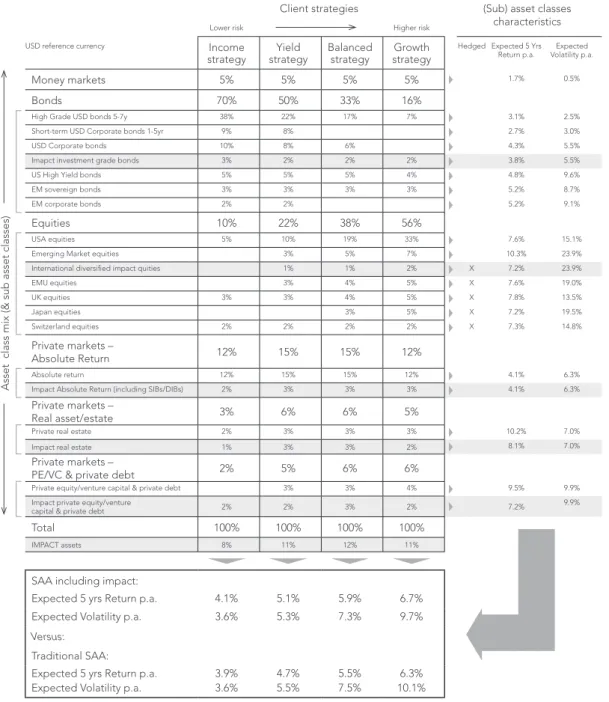
In the Re-cap section above, we recommended a starting point for well-diversified portfolios across different risk levels, ranging from an income-focused strategy to one income-focused on equities. In order to understand the effect that an ‘impact allocation’ may have on the characteristics of a portfolio, Table 2 on the opposite page shows a similar set of portfolios with a recomended allocation to impact investments across different asset classes.Given the short track records, nascent nature of the market, and limited evidence base, we caution that this portfolio is illustrative only. However, we have endeavoured to use conservative assumptions for the return and volatility of impact investments for modelling purposes, assuming that, within absolute return, opportunities will be able to deliver a return of approximately 4% with a volatility of a little more than 6%. We have also assumed an initial 20% cut on the return
expectations of impact investments in other asset classes, which would represent an investor’s desire to include not just impact investments that deliver competitive financial returns but also those that may deliver a below market financial return (and/or even some investments that require one). Finally, we have assumed that an impact executive, looking to allocate across asset classes, will find Fig. 5 A focus Alternative investments diagram alternative investments
Equities
Real assets/
estates Private equity andventure capital Private debt Absolute return
Bonds
Alternative investments
Private markets
IMPACT IMPACT IMPACT IMPACTe.g. SIBs
& DIBs Equities
opportunities available in fixed income, equities, real estate, absolute return, private equity, venture capital and private debt but that less liquid asset classes may form a significant percentage (two thirds) of the total allocation to impact investment in the near term.16
Based on all of these assumptions, we estimate that an investor with an 8–12% impact investment allocation17 should be able to achieve the same financial return as an investor with no impact allocation, assuming that the dedicated investor is willing to accept a larger share of the portfolio
in illiquid investments. Indeed, by including an impact allocation, such an investor may even see improved diversification and a slightly better expected financial return.
The key is to maintain a diversified and cautious approach to these new investment opportunities and to accept that they involve an increase in illiquidity in the portfolio, which may decrease over time as impact investment opportunities increase in more liquid asset classes, such as public equities.18
Table 2 – SAAs including Impact Investments
16 The portfolios presented in this paper have allocation to alternative asset classes of 12-24 percent. This is probably a reasonable allocation for most private and institutional investors, but for many endowments and Ultra High Net Worth individuals an allocation of 30-40% or more to alternatives will be natural. Assuming that this allocation comes with a tolerance for less liquid assets, we would recommend gradually increasing the impact allocation in line with the overall allocation to alternative investments as impact investment opportunities increase.
17 Depending on the strategy being employed, ranging from income- to equity-focused.
18 We have made only very limited allocations to traditional equities, since this area is in development and any single line holdings of several percentage points would represent a concentration risk, which we try to avoid in both traditional and impact asset classes.
Client strategies (Sub) asset classes characteristics
Lower risk Higher risk USD reference currency Income
strategy strategyYield Balanced strategy strategyGrowth
Hedged Expected 5 Yrs Return p.a. Volatility p.a.Expected
Asset class mix (& sub asset classes)
Money markets 5% 5% 5% 5% 1.7% 0.5%
Bonds 70% 50% 33% 16%
High Grade USD bonds 5-7y 38% 22% 17% 7% 3.1% 2.5% Short-term USD Corporate bonds 1-5yr 9% 8% 2.7% 3.0% USD Corporate bonds 10% 8% 6% 4.3% 5.5% Imapct investment grade bonds 3% 2% 2% 2% 3.8% 5.5% US High Yield bonds 5% 5% 5% 4% 4.8% 9.6% EM sovereign bonds 3% 3% 3% 3% 5.2% 8.7% EM corporate bonds 2% 2% 5.2% 9.1%
Equities 10% 22% 38% 56%
USA equities 5% 10% 19% 33% 7.6% 15.1% Emerging Market equities 3% 5% 7% 10.3% 23.9% International diversifi ed impact quities 1% 1% 2% X 7.2% 23.9% EMU equities 3% 4% 5% X 7.6% 19.0% UK equities 3% 3% 4% 5% X 7.8% 13.5% Japan equities 3% 5% X 7.2% 19.5% Switzerland equities 2% 2% 2% 2% X 7.3% 14.8%
Private markets –
Absolute Return 12% 15% 15% 12%
Absolute return 12% 15% 15% 12% 4.1% 6.3% Impact Absolute Return (including SIBs/DIBs) 2% 3% 3% 3% 4.1% 6.3%
Private markets –
Real asset/estate 3% 6% 6% 5%
Private real estate 2% 3% 3% 3% 10.2% 7.0% Impact real estate 1% 3% 3% 2% 8.1% 7.0%
Private markets –
PE/VC & private debt 2% 5% 6% 6%
Private equity/venture capital & private debt 3% 3% 4% 9.5% 9.9% Impact private equity/venture
capital & private debt 2% 2% 3% 2% 7.2% 9.9%
Total 100% 100% 100% 100%
IMPACT assets 8% 11% 12% 11%
SAA including impact:
Expected 5 yrs Return p.a. 4.1% 5.1% 5.9% 6.7% Expected Volatility p.a. 3.6% 5.3% 7.3% 9.7%
Versus:
Traditional SAA:
Expected 5 yrs Return p.a. 3.9% 4.7% 5.5% 6.3% Expected Volatility p.a. 3.6% 5.5% 7.5% 10.1%
16
BARRIERS TO GREATER ALLOCATION
While there is a compelling
case to support the growth of
impact investment – and many
case studies show ‘success
stories’ already at work – the
total allocation to impact
investment remains small,
relative to the scale of pressing
societal challenges that it has the
potential to address. Why is this
the case and how might policy
play a powerful enabling role for
greater allocation?
Our analysis has taken a bottom-up approach. First, we analysed which significant ‘pools’ of capital are not (sufficiently) participating in the market today because of a variety of barriers. Second, recognising that barriers to allocation will vary by pool, we analysed existing barriers for each pool. Third, we created a matrix, on which we could highlight the greatest barriers for each pool. This matrix is shown overleaf, followed by a set of corresponding policy recommendations.
A. ‘POOLS’ OF CAPITAL
The ‘pools’ of capital that our Working Group considered most relevant included mass retail, foundations, High Net Worth Individuals (HNWIs), single and multi-family offices, pension funds, banks and insurance companies. We also included the intermediaries who act as ‘gatekeepers’ to large pools of capital, including retail advisors, HNWI advisors and institutional advisors. Our analysis recognises that foundations can make various allocations: either through grants (taking the form of catalytic philanthropy to support impact investment), through programme-related investment (carve-outs from their
grantmaking) or through their endowment (in the form of mission-related investment). Likewise, banks can behave as asset owners (investing their own balance sheet) or as intermediaries, investing on behalf of their clients.
B. KEY BARRIERS
The following key barriers were identified by the Working Group, with support from additional market research.* Barriers were assumed to be ‘key’ when they were considered significant for a range of capital pools. They fall into three main categories:
Conflict of Duty
• Fiduciary duty
Perception that impact investing cannot deliver appropriate risk-adjusted financial returns • Compliance
Perceived conflict with internal/external rules and regulations
BARRIERS TO
GREATER ALLOCATION
1919 The findings and quotations presented in this chapter draw significantly on a report by Bridges IMPACT+: ‘Shifting the Lens: A De-risking Toolkit for Impact Investment’, published January 2014, which was commissioned by the Bridges Charitable Trust and funded by Bank of America Merrill Lynch
It’s a struggle to see more institutional
investors entering this space, when the ticket
size is so small.
Nascent sector
• Lack of specialism
Traditional asset allocation frameworks, team structures and skill sets not designed to incorporate impact investment strategies • Lack of appropriate opportunities
Lack of suitable investment options in terms of sector (target outcome/beneficiary), geography, size or asset class, as well as lack of
intermediaries to support origination • Disproportionate transaction costs
Transaction costs out of proportion with potential financial returns
RIsk factors
• Capital risk
Loss of some or all of the original investment amount
• Unquantifiable risk
Lack of track record: While all investments carry risk, unquantifiable risk applies to situations in which the investment profile is not well-known. Since impact investment is not yet a mainstream strategy – in terms of its investment products and investment teams – asset owners can find quantifying the level and type of risk involved particularly challenging.
• Exit risk
Investments not sufficiently liquid to meet uncertain cash flow demands
• Impact risk
Impact evidence not sufficiently robust to justify diversion of funds from other impact-creating opportunities
A note on our approach
We recognise that this is not a comprehensive list of barriers to allocation. For example, we have not included a discussion of important barriers such as market risk, operational risk or currency risk. This is because, while these barriers are relevant to impact investments, the addition of an impact lens was not cited as significantly increasing the importance of these barriers.
Without liquidity, or the perception of
liquidity, huge sections of the investing
community will not be able to participate
in the impact investment market.
Investment bank
Impact risk is particularly real for those
whose existence depends on achieving
targeted societal outcomes.
18
INTRODUCTION: THE NEW PARADIGM
C. Key Barrier Matrix
Asset ownersMass retail Foundations and Endowments Single family offices & HNWIs
Programme-Related
Investment (PRI) Mission-Related Investment (MRI)
Conflict of duty
Fiduciary duty See Advisors N/A Trustees continue to be concerned as to whether mission-related investment falls within charitable regulation and tax code
See Advisors
Compliance See Advisors Concern that the use of grant funds for investment may result in private gain that is in conflict with public benefit duty
See above See Advisors
Nascent sector
Lack of specialism
See Advisors The typical separation of the grantmaking team and investment team can make assessment of opportunities that require the skills of both a challenge
See Advisors
Lack of appropriate opportunities
Lack of suitable investment options in terms of sector (target outcome/beneficiary), geography, size or asset class, as well as lack of intermediaries to support
Disproportionate transaction costs
Require transaction costs to be sufficiently low so as to be in proportion to smaller investment
Willing to tolerate higher transactions costs, providing the social impact is sufficiently high
Require sufficiently large capital outlay to justify expenditure on due diligence, structuring and management of impact investments
Willing to tolerate higher transaction costs, providing the social impact is sufficiently high
Risk factors
Capital risk Generally wealth is for retirement purposes or for the next generation, making capital preservation, at a minimum, a priority
Intention to re-cycle funds for leveraged impact can make (some level of) capital preservation a priority
Concern about erosion of capital base (ability to generate income for grantmaking) makes capital preservation, at minimum, a priority
Demonstrated willingness to forgo some financial return for the sake of impact but typically not prepared to absorb capital losses
Unquantifiable risk See Advisors Willingness to venture into uncharted territory depends on potential for impact ‘upside’
Unfamiliar products require trustees to play a more active role in decision making, since ability to calculate risk is viewed as core to fiduciary duty
For those HNWIs investing directly, willingness to venture into uncharted territory depends on potential for impact ‘upside’* Exit risk Requirements vary
within this group, although uncertain cash flow demands can make
liquidity a top priority
Short-term liquidity not a priority but goal of re-cycling capital for leveraged impact does require a defined exit strategy within a reasonable timeframe
Liquidity not a priority (buy-to-hold investments have a place in these portfolios)
Buy-to-hold investments have a place in these portfolios. However, see Advisors
Impact risk Impact performance must be sufficiently transparent and easy to understand to justify opportunity cost of capital (diverting funds from either grantmaking or traditional investment)
Critical that impact performance is sufficiently cost-effective to justify opportunity cost of capital, i.e. to justify diverting funds from grantmaking
Critical that impact performance is sufficiently cost-effective to justify diverting funds from existing ‘tried and tested’ investments that optimise surpluses for grantmaking
Impact performance must be sufficiently compelling to justify transaction costs
Asset owners Intermediaries
Multi family
offices Pension funds Insurance CosBanks and Advisors
Own balance sheet Retail
advisors HNWI advisors Institutional advisors
Conflict of duty
Fiduciary duty Advisors typically do not ask family members whether they wish to invest in line with their values (See Advisors)
Societal duty to maximise people’s future pensions creates a fear of any additional investment criteria that may inhibit maximising financial value
N/A Very few advisors have asked their clients whether they wish to invest in line with their values. Consequently, advisors typically see their duty as solely to maximise financial risk-adjusted returns and fear that the addition of an impact lens may inhibit this
Compliance See Advisors See above Capital requirements (e.g. Insolvency II) can include investment liquidity considerations, which conflict with many less liquid impact investments
See above
Nascent sector
Lack of specialism
See Advisors Where someone/a team may be leading on impact investments, they tend not to have any specific budget for allocation
Little incentive (from a fee or liability perspective) to develop impact investment expertise
Lack of appropriate opportunities
Lack of suitable investment options in terms of sector (target outcome/beneficiary), geography, size or asset class, as well as lack of intermediaries to support
Disproportionate transaction costs
Require sufficiently large capital outlay to justify expenditure on due diligence, structuring and management of impact investments
Can have strict rules about investment size, % holding and management fees
Require sufficiently large capital outlay to justify expenditure on due diligence, structuring and management of impact investments
Typical fee structures do not cover additional due diligence of impact factors
Risk factors
Capital risk Demonstrated willingness to forgo some financial return for the sake of impact but typically not prepared to absorb capital losses
Role as conscientious ‘steward’ of people’s pensions makes protection against losses a priority
Lack of clarity about whether competitive risk-adjusted financial returns are widely achievable has led to a focus on limiting downside
See relevant asset owners
Unquantifiable risk See Advisors Many pension funds rely on external advisors (See Advisors)
‘A ‘testing the water’ attitude can mean a willingness to venture into uncharted territory, providing capital risk is reduced (see above). However, see Compliance
Unfamiliar products are a challenge for Independent Financial
Advisors (from a liability and fee perspective), who want to show clients a product with track record and to benchmark that product within conventional portfolios Exit risk Buy-to-hold
investments have a place in these portfolios. However, see Advisors
Liquidity not a top priority, although exit path must be clearly defined
Financial institutions lending for fixed terms are less concerned about liquidity. However, see Compliance
Flexibility to sell a security can be a key requirement for advisors considering whether to invest a client’s money
Impact risk Impact performance must be sufficiently compelling to justify transaction costs
Protecting against (the reputational risk of) poor
impact performance often viewed as priority
Impact performance has to be sufficiently compelling to justify transaction costs (see Transaction cost risk above).
Advisors will consider credible impact performance as key to product offering for clients (impact risk therefore linked to reputational risk)