W
ho is like me and who is not? What kind of relationship do I have to those who are different? These are questions about bound-aries, the symbolic distinctions that we make along multiple dimensions between ourselves and others. Such distinctions have social impli-cations when they are widely recognized and accepted as legitimate dimensions of differ-ence, and when they organize access to resources and opportunities (Lamont and Molnár 2002). Symbolic boundaries both include and exclude—by separating out those who do not belong, they draw together those who do (Alexander 1992; Taylor 2002).Symbolic distinctions drawn along lines of race, gender, sexuality, or social class are often
studied because they lead to social exclusion for those in marginalized groups, and these dis-tinctions form the basis for social inequality (Epstein 1988; Lamont and Fournier 1992). By contrast, religious boundaries are often seen by sociologists as a basis for inclusion, forming meaningful subcultures and motivating politi-cal mobilization of the marginalized (Warner 1993). Moreover, increasing religious plural-ism in postwar America has coincided with an ecumenical movement and a decline in the salience of the boundaries between particular religious groups (Hout and Fischer 2001).
Yet what about the boundary between the religious and the nonreligious? Do Americans make invidious distinctions (c.f. Epstein 1988) between believers and nonbelievers? If so, what are the bases for these symbolic distinctions? More broadly, what can that tell us about the sources of solidarity in American society and the limits of religious acceptance?
In this article, we situate Americans’ atti-tudes toward atheists within the literature on religion in America. The reaction to atheists has long been used as an index of political and social tolerance. While important, this literature does not tell us why there is so strong a reaction to such a small, hard to identify, and
disorgan-A
Atth
heeiissttss A
Ass ““O
Otth
heerr””:: M
Mo
orraall B
Bo
ou
un
nd
daarriieess aan
nd
d
C
Cu
ullttu
urraall M
Meem
mb
beerrssh
hiip
p iin
n A
Am
meerriiccaan
n S
So
occiieettyy
Penny Edgell Joseph Gerteis
University of Minnesota University of Minnesota
Douglas Hartmann University of Minnesota
Despite the declining salience of divisions among religious groups, the boundary between believers and nonbelievers in America remains strong. This article examines the limits of Americans’ acceptance of atheists. Using new national survey data, it shows atheists are less likely to be accepted, publicly and privately, than any others from a long list of ethnic, religious, and other minority groups. This distrust of atheists is driven by religious predictors, social location, and broader value orientations. It is rooted in moral and symbolic, rather than ethnic or material, grounds. We demonstrate that increasing acceptance of religious diversity does not extend to the nonreligious, and present a theoretical framework for understanding the role of religious belief in providing a moral basis for cultural membership and solidarity in an otherwise highly diverse society.
A
AMMEERRIICCAANNSSOOCCIIOOLLOOGGIICCAALLRREEVVIIEEWW,, 22000066,, VVOOLL.. 7711 ((AApprriill::221111––223344))
Direct cor respondence to Penny Edgell, Department of Sociology, University of Minnesota, 909 Social Sciences, 267 19th Avenue South, Minneapolis, MN 55455 ([email protected]). Research supported by the Edelstein Family Foundation as part of the American Mosaic Project at the University of Minnesota. The authors thank Eric Tranby for his help with statistical analysis and other research support.
ized category of persons. The broader litera-ture on the historical connection between reli-gion and civic life in America sheds more light on the cultural bases for this symbolic exclusion, particularly on assumptions about what Americans think they have (or should have) in common. Americans’ views of atheists tell us lit-tle about atheists themselves—who they are, where they live, or what they are like. We believe, however, that these views reveal a great deal about dominant conceptions of national unity as well as fears of moral decline.
Using data from a new national survey (2003, N = 2081), we show that Americans draw sym-bolic boundaries that clearly and sharply exclude atheists in both private and public life. From a list of groups that also includes Muslims, recent immigrants, and homosexuals, Americans name atheists as those least likely to share their vision of American society. They are also more likely to disapprove of their children marrying athe-ists. Using logistic regression models, we show that these attitudes are driven by religious affil-iation and involvement as well as by social con-text and broader moral outlook.
We show not only that atheists are less accept-ed than other marginalizaccept-ed groups but also that attitudes toward them have not exhibited the marked increase in acceptance that has charac-terized views of other racial and religious minorities over the past forty years. Rather than treating atheists as akin to other out-groups, we reveal the unique social and cultural bases underlying attitudes toward this group, leading us to rethink some core assumptions about Americans’ increasing acceptance of religious diversity and to consider how the weakening of internal boundaries between religious groups may heighten awareness of the external bound-ary between the religious and the nonreligious. We argue that attitudes toward atheists clarify why and how religion forms a basis for solidarity and collective identity in American life through its historical association with morality and cit-izenship.
R
REELLIIGGIIOOUUSS BBOOUUNNDDAARRIIEESS AANNDD B
BEELLIIEEFFSS IINN AAMMEERRIICCAA
In the context of the modern United States, social scientists have generally concentrated on the inclusive aspect of religious boundaries, placing at the forefront what Parsons (1951)
would have called the functional or integrative aspects of religious belief and practice. In pri-vate life, scholars concentrate on how religion provides values and a sense of meaning, fosters supportive and caring relationships (Sherkat and Ellison 1999), and gives “a framework for seeing oneself as a good person and one’s life as basically good, independent of the success that one has in acquiring money, fame, or power” (Hart 1986:52). In public life, religious institutions have been studied for their role in preserving ethnic and subcultural identities (Eck 2001; Smith 1998), providing the material resources and social connections that foster social capital and civic participation (Herberg 1960; Putnam 2000; Verba, Schlozman, and Brady 1995; Wuthnow 1998) and supporting organized demands for political change or social justice (Gusfield 1986; Lincoln and Mamiya 1990; Morris 1984; Warner 1993). In this con-text, religion is framed as both pluralistic and empowering (Warner 1993:1059), and aspects of religion that may be contested or foster inequality receive relatively less attention.
One can, of course, find references to the exclusionary consequences of religious bound-aries in scholarship on American religion—for example, work on the history of anti-Semitism, on the anti-Catholic movements of the nine-teenth century (Dolan 1985; Gleason 1980; Higham 2002; Lipset and Raab 1978), and on anti-Muslim violence post 9/11 (Wellman and Tokuno 2004; Wuthnow 2004). However, in a society in which religion is voluntary, pluralis-tic, and separate from the state, scholars have tended to understand religion as “a fundamen-tal category of identity and association” that is “capable of grounding both solidarities and identities” (Warner 1993:1059), a boundary that fosters belonging.
The meta-narrative of scholarship on reli-gion in American life is woven together from three strands. First, America has historically been a religious nation. Since the mid-nine-teenth century there have been consistently high levels of religious belief, affiliation, and involve-ment (c.f. Warner 1993), and over our history observers have noted a close connection between religion and democracy. Alexis de Tocqueville was moved by the Christian piety of Jacksonian America. “It is religion that gave birth to the Anglo-American societies.|.|.|. Christianity .|.|. reigns not only as a philosophy
that is adopted after examination, but as a reli-gion that is believed without discussion,” he wrote. “In the United States, Christian sects vary infinitely . . . but Christianity itself is an established and irresistible fact” (Tocqueville [1992] 2000:405–6). Tocqueville thought that Christianity (or at least the dominant Protestantism of the era) provided the “habits of the heart” necessary for good citizenship, draw-ing people out of the private realm of family life into vital civic association (Tocqueville [1992] 2000:275ff.; see Weber 1946 for a different interpretation).
Others have concluded that a more ecu-menical version of Tocqueville’s thesis still holds true in post–World War II America. According to Herberg’s classic Protestant, Catholic, Jew (1960), each of these historic faiths has provided a way of being, and becom-ing, a good American. Similarly, in Habits of the Heart (1985) and The Good Society (1991), Bellah and his coauthors observed that the Biblical (Judeo-Christian) religions have pro-vided a cultural repertoire of citizenship and sol-idarity. This scholarly tradition argues that religion gives a sense of personal identity and meaning leading to public engagement and effective citizenship (see also Glock and Stark 1965; W. L. Warner 1961; R. S. Warner 1993). The second strand of the meta-narrative is the claim that a religious convergence has occurred during the twentieth century, which may be the basis for the trust that Americans have in those who are religious. When Caplow and his coau-thors revisited Muncie, Indiana, in the 1970s to replicate the Lynds’ earlier Middletown study, they found a set of religious ideas and actions shared across religious groups that they called “the common creed” (Caplow, Bahr, and Chadwick 1983). More recent quantitative work suggests that Muncie is, in this regard, unex-ceptional. Using General Social Survey (GSS) data, Hout and Fischer (2001) found faith in God and the regular practice of prayer to be widely shared across religious groups in America, along with the belief that there is a strong connection between religious faith and personal morality.
This convergence suggests that religion in general—if no longer Christianity in particu-lar—is one basis for private and public trust in American society. In the 1998 GSS, only 15 per-cent of respondents agreed that the United States “would be a better country if religion had less
influence.” A recent report by Public Agenda summed up its own survey findings this way: “If more Americans were more religious, people believe that crime would go down, families would do a better job raising their children, and people would be more likely to help each other. Indeed, most Americans fear that the country would decline if people lost their religious faith” (Farkas et al. 2001:10). In the Public Agenda poll, 74 percent agreed that “[i]t is a bad idea for families to raise children without any reli-gion.” When asked to identify the most impor-tant meaning of being religious, 53 percent of respondent said “making sure that one’s behav-ior and day-to-day actions match one’s faith.” The authors conclude that for many Americans “[t]o be religious .|.|. means to be a moral human being” (Farkas et al. 2001:10–11).
The third strand of the meta-narrative is the argument that increasing religious pluralism has coincided with increasing tolerance of reli-gious difference, declines in relireli-giously based prejudice, and processes of assimilation to erode many of the long-standing divisions among Protestants, Catholics, and Jews (Alwin 1986; Glock and Stark 1965; Herberg 1960). Declines in anti-Semitism and anti-Catholic sentiment mirror the scholarly claim that piety and plu-rality increasingly go hand in hand in American life (Gleason 1980; Smith 1993). Indeed, the idea of a unified “Judeo-Christian” tradition— once considered a radical myth—is now wide-ly accepted by conservatives and liberals alike as a core aspect of American culture (Hartmann, Zhang, and Windschadt, 2005). Taken togeth-er, these three strands of the scholarly literature weave a story of religion’s declining signifi-cance as an exclusionary boundary in American life.
New divisions became salient at the same time that traditional forms of religious prejudice were waning, including a division between lib-erals and conservatives. Most sociologists, how-ever, argue that America as a whole is not well characterized by the image of a monolithic Christian conservative camp or an ongoing “war” between liberals and conservatives (see DiMaggio, Evans, and Bryson 1996). The reli-gious pluralism stemming from immigration and globalization is another source of new boundaries. Hout and Fischer (2001), however, argue that this diversity poses no threat of seri-ous social conflict, inequality, or intolerance
because of the convergence around a common set of religious beliefs and practices (or “the common creed”), and because America’s diverse and voluntaristic religious institutions are well equipped to absorb diversity without being torn apart by it (c.f. Warner 1993). Also, a “rapidly rising tolerance for (and maybe even prefer-ence for) religious differprefer-ence .|.|. facilitates reli-gious coalitions on some issues and respect for [the] fellow religious on all issues” (Hout and Fischer 2001:4). Similarly, Diana Eck (2001; c.f. Smith 2002) argues that the expansion of reli-gious pluralism associated with post-1965 immigration will continue to follow the pattern that Will Herberg (1960) documented, summa-rized by the phrase e pluribus unum—from many, one (c.f. Wolfe 1999).
More tolerance of religious diversity, how-ever, does not necessarily mean that the salience of religious identity itself is declining. To the contrary, if acceptance of religious diversity in the United States is indeed based upon increas-ing convergence around a core set of religious beliefs and practices, then this may reinforce intolerance of those who reject religion. In such an environment, religious acceptance may be driven largely by assumptions that religious people, of whatever faith, are “like me” in two ways. In private life, they are understood to be moral people, worthy of the trust that is the basis for close personal relationships. In public life, the boundaries that separate religious iden-tities (for example, evangelical versus main-line Protestant versus Catholic or Jew) are understood to be encompassed by and to con-stitute a broader identity—being a good American. In such a setting, how do Americans view those who reject religion, and what does that tell us about how Americans view their nation and themselves?
A
ATTHHEEIISSTTSS AASS OOTTHHEERR
By any measure, there are not many atheists in America. While about 14 percent of Americans name no religious preference (Hout and Fischer 2002; Kosmin, Mayer, and Keysar 2001), most of these religious “nones” also say that they believe in God and pray regularly (Hout and Fischer 2002). In the 2000 GSS, only about 3 percent of Americans affirm that “I don’t believe in God,” perhaps the best direct indicator of being an atheist, while another 4.1 percent agree
with the statement “I don’t know whether there is a God and I don’t believe there is any way to find out.” Taken together, these “skeptics,” as Hout and Fischer (2002) call them, make up only 7 percent of the population. In fact, only about 1 percent of Americans self-identify as “atheist” or “agnostic,” according to Kosmin et al. (2001). This gap may indicate that many skeptics do hold some form of religious belief, or it may signal the stigma attached to the athe-ist label.
We argue that it is important to understand Americans’ attitudes toward atheists even though they are few in number—and not an organized and self-conscious group—and even though individual atheists are not easily identi-fied. Our focus is not on mistreatment of athe-ists, but on attitudes that mark them as outsiders in public and private life, that may even desig-nate them as unworthy of full civic inclusion (c.f. Alexander 1992).1For our analysis what is important is that other Americans respond to “atheist” as a meaningful category. Such a dis-tinction is symbolic, but that is not to say it is not “real.” In fact, the contrast between “real” and symbolic is not all that helpful in this case, because symbolic boundaries are deeply mean-ingful and because symbolic categories motivate behavior and organize resources (Sewell 1992). This understanding draws on a tradition of work on the relational nature of social identities, including civic and national identity (e.g., Alexander 1992; Anderson 1991; Taylor 1989). We assess the degree to which atheists rep-resent a symbolic “other” against which some Americans define themselves as good people and worthy citizens. This allows us to explore what attitudes about atheists reveal regarding the nature of cultural membership and moral soli-darity in American society. Do Americans feel that atheists are “like me”? Do they see them as moral people and good citizens?
1Mistreatment of atheists and atheists’ own
per-ceptions of their place in American society are beyond the scope of this article. These important topics have perhaps received too little attention from scholars, though they receive occasional attention in the pop-ular media (see Blumer 2004). Scholarly treatment of atheists is largely historical (see Jacoby 2004; Turner 1985; McGrath 2004; and Feldman 2005).
To date, empirical work on how Americans view nonbelievers (and particularly atheists) has focused on issues of prejudice and political tolerance, rather than cultural membership (Stouffer 1955). In the Public Agenda report cited earlier, 54 percent of respondents said that they would be unlikely to vote for a political can-didate who is “open about not believing in God.” In a 1999 Gallup poll, only 49 percent of Americans say that they would be willing to vote for a presidential candidate who is an atheist— compared to 59 percent willing to vote for a homosexual candidate and over 90 percent pro-fessing willingness to vote for a female, Jewish, or black candidate. Farkas et al. (2001:100) conclude that widespread political rejection of atheists and others who profess no religion pro-vides a “glaring exception” to the general rule of increasing social tolerance over the last thir-ty years of the twentieth century. Citing the same Gallup data but reviewing changes from 1937 to 2000, Hout and Fischer (2001) come to a startlingly different conclusion. Because
tol-erance increased for all groups, they report that the overall pattern of tolerance of atheists is not an exception to the general rule.
Figure 1, drawn from the same Gallup data on willingness to vote for various presidential candidates, shows that both claims are true. Using this measure, political tolerance toward atheists has indeed moved in the same direction as has tolerance for other groups. Yet Farkas et al. (2001) are also right—the gap in willingness to vote for atheists versus other religious minori-ties (Catholic or Jewish) is large and persistent. What this literature does not address ade-quately is why atheists continue to be the least accepted group, despite their small numbers. It is worth pointing out that the only group meas-ured that was less accepted was homosexuals, and yet by 1999 this group was also more tol-erated than were atheists. As Loftus (2001) argues, political tolerance for a minority group is distinct from and varies independently of atti-tudes about the morality of members of that group and from feelings toward members of
Figure 1. Gallup Data, Willingness to Vote for Presidential Candidates
Source:Report based on answers to Gallup question, “If your party nominated a generally well-qualified person for president who happened to be (INSERT HERE), would you vote for that person?” Response categories: yes, no, no opinion (data retrieved July 1, 2005 at http://gallup.com/poll/content/print.aspx?
the group. While understanding political toler-ance is quite important, it is not clear whether that research can help us to answer the questions about boundaries and cultural membership posed at the beginning of this article.
In contrast to the political tolerance literature, we examine Americans’ willingness to recognize and accept atheists in both public and private life. We asked people to say whether members of particular minority groups “Share your vision of American society,” a question about public acceptance designed to shed light on the ques-tion of cultural membership that we posed ear-lier. We also asked about willingness to accept one’s own child marrying someone from a par-ticular religious, ethnic, or other minority group—a private matter. These questions go beyond tolerance to capture the importance and nature of symbolic boundaries and the distinc-tions that people use to define their own iden-tity and worth.
We find that out of a long list of ethnic and cultural minorities, Americans are less willing to accept intermarriage with atheists than with any other group, and less likely to imagine that atheists share their vision of American society. We find that Americans’ willingness to draw a boundary that excludes atheists is influenced by certain demographic factors that are more gen-erally associated with levels of tolerance, but it is also influenced by religious identity and prac-tice, by social context and exposure to diversi-ty, and by broader value orientations. We argue that atheists provide an important limiting case to the general narrative of increasing tolerance of religious pluralism in the United States, and that this exception is a useful lens through which to understand Americans’ assumptions about the appropriate role of religion in both public and private life. We find that in private life, many Americans associate religiosity with morality and trustworthiness; religion forms a basis for private solidarity and identity (c.f. Warner 1993). In public life, many Americans believe now, as in Herberg’s (1960) time, that affirming a religious identity is an important way of “being American,” a basis for citizenship and a source of a common American identity. D
DAATTAA AANNDD DDEESSIIGGNN
Our data come from the American Mosaic Project, a multi-year, multi-method study of
diversity and solidarity in American life with particular emphasis on race and religion (University of Minnesota, Minneapolis, princi-pal investigators Hartmann, Gerteis, and Edgell). The research includes a nationally rep-resentative random-digit dial (RDD) telephone survey (N = 2081) conducted during the sum-mer of 2003. In addition, in-depth interviews and fieldwork were conducted in four U.S. cities (Los Angeles, Minneapolis-St. Paul, Atlanta, and Boston) by a team of graduate students in the summer of 2004. For this article, we also review contemporary public discourse on athe-ists in American society.
The core data for this article are drawn from the telephone survey we designed and fielded through the Wisconsin Sur vey Center. Households were randomly selected, then respondents were randomly chosen within households. The survey, on average, took slight-ly more than 30 minutes to complete. Additionally, African Americans and Hispanics were over-sampled to provide complete data on these populations; to facilitate this over-sam-pling, the survey could also be conducted in Spanish if the respondent preferred. Our response rate, using a calculation that includes only known households, is 36 percent.2This response rate compares well to other recent RDD samples. The Council on Market and Opinion Research (CMOR) maintains an ongo-ing study of response rates; this study demon-strates that in 2003, the year our survey was conducted, the mean response rate for RDD telephone surveys was 10.16 percent, although carefully conducted social science surveys, such as ours, typically have somewhat better rates (AAPOR 2004). A good point of comparison here is the 2002 American National Election Study (ANES), which included a fresh RDD sample with a response rate of 35.24 percent, using a calculation that included only known households. The comparison with the ANES is even more favorable when we consider that they
2This calculation includes only known
house-holds and corrects for the stratified sample to ensure the closest comparison to other RDD surveys, such as the American National Election Study (for full doc-umentation, see http://www.soc.umn.edu/amp/ ampindex.htm).
compensated their respondents, while we did not.
Response rate is not the only or even the most important indicator of data quality. The more important issue is the potential for non-response bias. The few available systematic treatments of this issue reveal few differences between RDD surveys with higher and lower response rates on key measures when standard sampling and survey techniques are employed (Keeter et al. 2000; Pew Research Center for People and the Press 2004). To investigate non-response bias in our sample, we checked many of our variables against the same measures in two surveys known to be of high quality, the General Social Surveys (GSS) and the much larger Current Population Survey (CPS). Our data are quite closely aligned with both. In the few instances where our data differ notably from the GSS figures, they tend to align more closely with the CPS figures (see Table S1, Online Supplement on ASRWeb site). Two items from our survey capture one’s willingness to draw boundaries separating oneself from others in both public and private life. The first ques-tion is akin to the “thermometer” quesques-tions familiar to survey researchers, where respon-dents are asked about various groups and asked to rate them on a scale of feelings, from 100 (very warm) to 0 (very cold). Rather than ask about feelings in general, the question we con-structed and fielded asked about the degree to which members of particular groups share one’s “vision of America”—the response categories were “almost completely agree,” “mostly,” “somewhat,” and “not at all.”3This question was asked of all respondents. While based on standard measures we designed this item to capture what Lamont and Molnár (2002:187–88) call “cultural membership.” Someone who does not share your vision of American society may not value the same things
about America or understand what it means to be an American citizen in the same way. A pos-itive answer is thus an indicator of moral soli-darity. In the negative answers, symbolic boundaries become visible.
The second question asked whether the respondent would approve or disapprove if his or her child wished to marry a member of each of a list of groups.4 This item is a standard measure of group prejudice, with reluctance to accept intermarriages typically interpreted as an indicator of underlying intolerance. It was part of a series of questions given in a split-half for-mat to investigate views of a wider range of groups within survey time constraints; the item on intermarriage with atheists was asked of half of our respondents. We interpret it here as a measure of personal trust and acceptance, an evaluation of who is thought to be capable of being caring and moral, able to make one’s child happy, and to treat other family members well. D
DEESSCCRRIIPPTTIIVVEE AANNAALLYYSSIISS——AATTTTIITTUUDDEESS T
TOOWWAARRDD AATTHHEEIISSTTSS IINN PPUUBBLLIICC AANNDD P
PRRIIVVAATTEE LLIIFFEE
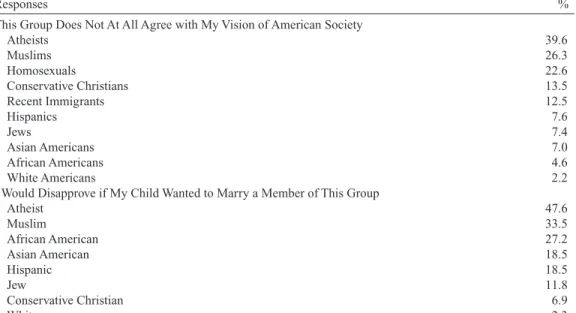
We asked about a number of racial, ethnic, and religious groups on both questions. Regarding public boundaries we also asked about two addi-tional groups that have been central to recent, controversial public debates—immigrants and homosexuals. Table 1 shows the responses to these questions, in rank order from the least accepted group to the most accepted. For both of our measures, atheists are at the very top of the list of problematic groups. Americans are less accepting of atheists than of any of the other groups we asked about, and by a wide mar-gin.
The next-closest category on both measures is Muslims. We expected Muslims to be a light-ning-rod group, and they clearly were. This makes the response to atheists all the more strik-ing. For many, Muslims represent a large and mostly external threat, dramatized by the loss of
4Wording was as follows: “People can feel differently
about their children marrying people from various back-grounds. Suppose your son or daughter wanted to marry [a person in given category]. Would you approve of this choice, disapprove of it, or wouldn’t it make any difference at all one way or the other?”
3Wording was as follows: “Now I want to read you
a list of different groups of people who live in this country. For each one, please tell me how much you think people in this group agree with YOUR vision of American society—almost completely, mostly, somewhat, or not at all?” Note that these groups were posed separately and the order was randomized, so that theoretically each group could have received equally high or low levels of acceptance.
life in the World Trade Center attacks and the war in Iraq. By contrast, atheists are a small and largely silent internal minority. When the “some-what” and “not at all” responses are combined for the public acceptance measure, atheists (78.6 percent) and Muslims (77.6 percent) appear nearly equally problematic—the vast majority of Americans reject both groups.
One’s own religious identity and involvement shape attitudes toward atheists. Church atten-ders, conservative Protestants, and those report-ing high religious saliency are less likely to approve of intermarriage with an atheist and more likely to say that atheists do not share their vision of American society. It should sur-prise no one that the lowest level of rejection of atheists comes from the nonreligious, meas-ured here as those who do not go to church, do not claim a religious identity, and report that reli-gion is “not at all” salient to them. A notable pro-portion of even this group, however, does not accept atheists. About 17 percent of the nonre-ligious say that atheists do not at all share their vision of America, while about one in ten indi-cate that they would not approve of their child marrying an atheist.
Attitudes toward atheists also are related to social location. White Americans, males, and those with a college degree are somewhat more
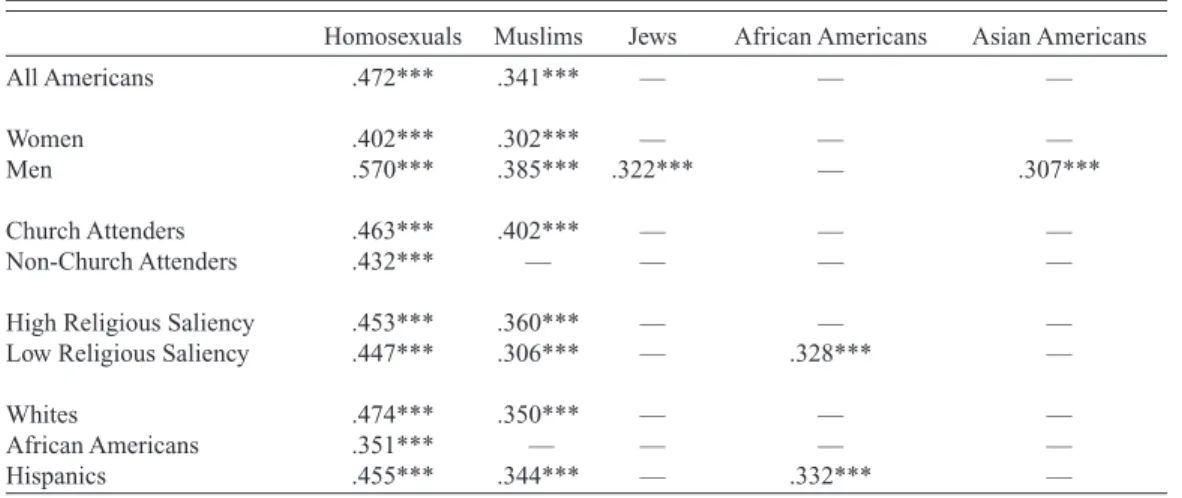
accepting of atheists than are nonwhite Americans, females, or those with less formal education. Party affiliation matters, especially on our intermarriage item. Those in the South and Midwest are also less accepting of atheists in both public and private life than are those in the East or West (results not shown). Across all of these categories, however, rates of non-acceptance of atheists range from about one in three (34 percent) to three in five (60 percent). Are attitudes toward atheists meaningfully patterned vis-à-vis other out-groups? Using our public acceptance measure—the degree to which respondents said that members of a social group are in agreement with their own “vision of American society”—we calculated the cor-relations between responses about atheists and other social groups.
Table 3 reports these correlations, showing only those that are above .3 and are statistical-ly significant. Across all of the groups we exam-ined, negative attitudes toward atheists are correlated with negative views of homosexuals and, for most, Muslims; none of these correla-tions is large. We believe this indicates that the boundary being drawn vis-à-vis atheists is sym-bolic, a way of defining cultural membership in American life, and not the result of a simple, Table 1. Public and Private Acceptance, Ranked Groups
Responses 0%
This Group Does Not At All Agree with My Vision of American Society
—Atheists 39.6
—Muslims 26.3
—Homosexuals 22.6
—Conservative Christians 13.5
—Recent Immigrants 12.5
—Hispanics 7.6
—Jews 7.4
—Asian Americans 7.0
—African Americans 4.6
—White Americans 2.2
I Would Disapprove if My Child Wanted to Marry a Member of This Group
—Atheist 47.6
—Muslim 33.5
—African American 27.2
—Asian American 18.5
—Hispanic 18.5
—Jew 11.8
—Conservative Christian 6.9
—White 2.3
T a b le 2a. — Pub
lic and Pri
v ate Acceptance of Atheists b y Religious Characteristics Non-Church Church Non-Conser v ati v e Non-Lo w High Attenders Attenders, Conser v ati v e Protestants, religious, Religious, Religious Religious Question % % Protestants, % % % % Salience, % Salience, % Ag ree with V ision of America? —
Almost complete ag
ree 12.7 0 4.4 0 8.8 0 3.8 18.6 0 6.0 11.4 0 4.4 — Mostl y ag ree 16.8 12.6 16.1 10.0 19.2 13.9 19.3 10.3 — Some w hat ag ree 45.7 35.3 43.0 27.9 45.3 37.6 48.2 32.1 —
Not at all ag
ree 24.8 47.7 32.1 58.3 16.9 42.5 21.1 53.2 Appro v
e of Inter
mar riage? — Appro v e 18.6 0 9.2 15.1 0 6.6 30.8 10.8 19.1 0 7.5 — No dif ference 58.8 29.6 46.7 22.9 58.7 37.0 59.9 24.1 — Disappro v e 22.6 61.1 38.1 70.5 10.6 52.1 21.0 68.4 Sour ce:
American Mosaic Project Sur
v
ey
, 2003.
Note:
All relationships are
p
≤
.001 le
v
el. Church
Attender = attending church monthl
y or more; Nonreligious = all those w
ho are not church attenders, repor
t l
o
w
religious
salien-cy
, and claim no religious identity
. T a b le 2b . — Pub
lic and Pri
v ate Acceptance of Atheists b y Social Location Nonw hites, Whites, Male, F emale, Less than Colle ge De g ree Repub licans, Democrats, Question % % a %% b Colle ge De g ree, %
or More, %
c %% d Ag ree with V ision of America? —
Almost complete ag
ree 0 8.6 0 7.0 0 8.5 0 6.8 0 6.9 0 8.4 0 5.0 0 6.7 — Mostl y ag ree 12.0 14.8 14.3 11.7 10.9 16.1 11.2 12.8 — Some w hat ag ree 36.2 39.7 39.5 36.3 30.4 41.3 31.1 32.6 —
Not at all ag
ree 43.3 38.5 37.8 45.2 51.4 34.2 42.5 36.4 Appro v
e of Inter
mar riage? — Appro v e 14.2 12.1 11.7 0 9.5 14.3 10.2 11.9 10.2 — No dif ference 35.4 41.3 43.8 35.2 36.7 43.1 26.5 39.9 — Disappro v e 50.4 46.6 42.5 54.9 50.1 45.8 60.9 48.2 Sour ce:
American Mosaic Project Sur
v ey , 2003. ap ≤ .01 for W orldvie w question; p ≤ .05 le v
el for inter
mar riage question. bp ≤ .05 for W orldvie w question; p ≤ .001 le v
el for inter
mar riage question. cp ≤ .001 for W orldvie
w question; not signif
icant for inter
mar
riage question.
dNot signif
icant for w
orldvie w question; p ≤ .001 le v
el for inter
mar
irrational unwillingness to tolerate small out-groups.
Again, it is important to note that by calling this rejection “symbolic” we do not mean that it is “not serious” or “not real.” Cultural mem-bership is so passionately contested because symbolic categories are so dearly held. The par-allel with homosexuality is instructive. For example, many Americans believe that homo-sexuals pose a threat to the family and to mar-riage, a threat that has increased with the same-sex marriage movement. This is a sym-bolic threat—gay and lesbian activists are not lobbying to abolish heterosexual marriage, and no existing heterosexual marriage would be legally invalidated were the same-sex couple next door to wed. Nonetheless, it is experienced by many as a real threat because to them the cul-tural meaning of marriage would change if same-sex marriage were permitted (c.f. Hull 2006). This is true whether one knows any actu-al same-sex couples or not, and regardless of the behavior and morality of actual same-sex cou-ples.
M
MUULLTTIIVVAARRIIAATTEE AANNAALLYYSSIISS—— M
MOODDEELLIINNGG PPUUBBLLIICC AANNDD PPRRIIVVAATTEE A
ACCCCEEPPTTAANNCCEE
To explore the effects of different kinds of fac-tors on people’s willingness to draw a strong boundary around atheists, we perform logistic
regression analyses on both of our measures. We use binary logistic regression instead of ordered logistic regression because we believe that this better captures the conceptual distinction we want to make, allowing us to identify those who draw a definite boundary (not at all agree/does not approve).5We include a table with stan-dardized beta coefficients to examine the rela-tive size of the effects of different independent variables on attitudes toward atheists. In these analyses we used weighted data to adjust for our strategy of over-sampling African Americans and Hispanics. We impute values for missing cases to the sample mean on all independent variables except for income, for which we used an imputation method (hot-deck) accounting for gender, employment status, age, and edu-cation. In the discussion, we also draw on in-depth interview data from our fieldwork to help us interpret respondents’ attitudes toward athe-ists.
We include four blocks of variables in our models: demographics, personal religiosity, social context, and political and social values Table 3. Correlations between Attitudes Towards the Worldview of Atheists and the Worldview of Other
Groups, by Gender, Religiosity, and Race
Homosexuals Muslims Jews African Americans Asian Americans All Americans .472*** .341*** — — —
Women .402*** .302*** — — —
Men .570*** .385*** .322*** — .307*** Church Attenders .463*** .402*** — — — Non-Church Attenders .432*** — — — — High Religious Saliency .453*** .360*** — — — Low Religious Saliency .447*** .306*** — .328*** —
Whites .474*** .350*** — — —
African Americans .351*** .— — — — Hispanics .455*** .344*** — .332*** — Source:American Mosaic Project Survey, 2003.
Note:Correlations are included if they are >.3 and statistically significant. * p< .05; ** p< .01; *** p< .001 (Kendall test).
5Supplemental analyses using ordered logit
els show similar results; coefficients in these mod-els display generally the same directions and patterns of significance (see Table S2, Online Supplement on
ASRWeb site: http://www2.asanet.org/journals/asr/ 2006/toc050.htm.
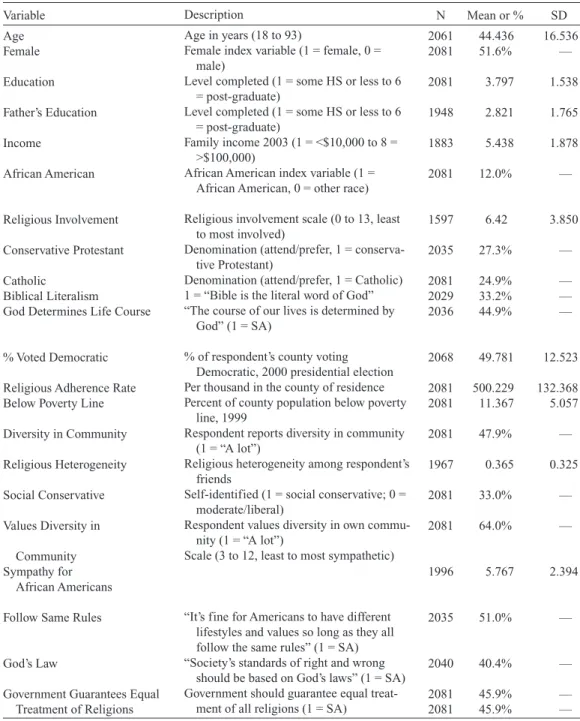
(Table 4). We argue that attitudes toward athe-ists serve as an index for how one thinks about the importance of personal morality in both pri-vate and public life. If so, then social context should affect attitudes toward atheists by shap-ing one’s experience with religion as a basis
for association and civic life. Political and social values should also matter if attitudes toward atheists are embedded within larger worldviews that differently privilege the role of religiously based morality in American life.
Table 4. Description of Independent Variables
Variable N Mean or % SD
Age 2061 44.436 16.536
Female 2081 51.6% .—
Education 2081 3.797 1.538
Father’s Education 1948 2.821 1.765
Income 1883 5.438 1.878
African American 2081 12.0% .—
Religious Involvement 1597 6.42 3.850
Conservative Protestant 2035 27.3% .—
Catholic 2081 24.9% .—
Biblical Literalism 2029 33.2% .—
God Determines Life Course 2036 44.9% .—
% Voted Democratic 2068 49.781 12.523
Religious Adherence Rate 2081 500.229 132.368
Below Poverty Line 2081 11.367 5.057
Diversity in Community 2081 47.9% .—
Religious Heterogeneity 1967 0.365 0.325
Social Conservative 2081 33.0% .—
Values Diversity in 2081 64.0% .—
—Community
Sympathy for 1996 5.767 2.394
—African Americans
Follow Same Rules 2035 51.0% .—
God’s Law 2040 40.4% .—
Government Guarantees Equal 2081 45.9% .—
—Treatment of Religions 2081 45.9% .— Source:American Mosaic Project Survey, 2003.
Note:N = number; SD = standard deviation; HS = high school; SA = strongly agree. Description
Age in years (18 to 93)
Female index variable (1 = female, 0 = male)
Level completed (1 = some HS or less to 6 = post-graduate)
Level completed (1 = some HS or less to 6 = post-graduate)
Family income 2003 (1 = <$10,000 to 8 = >$100,000)
African American index variable (1 = African American, 0 = other race) Religious involvement scale (0 to 13, least
to most involved)
Denomination (attend/prefer, 1 = conserva-tive Protestant)
Denomination (attend/prefer, 1 = Catholic) 1 = “Bible is the literal word of God” “The course of our lives is determined by
God” (1 = SA)
% of respondent’s county voting Democratic, 2000 presidential election Per thousand in the county of residence Percent of county population below poverty
line, 1999
Respondent reports diversity in community (1 = “A lot”)
Religious heterogeneity among respondent’s friends
Self-identified (1 = social conservative; 0 = moderate/liberal)
Respondent values diversity in own commu-nity (1 = “A lot”)
Scale (3 to 12, least to most sympathetic)
“It’s fine for Americans to have different lifestyles and values so long as they all follow the same rules” (1 = SA) “Society’s standards of right and wrong
should be based on God’s laws” (1 = SA) Government should guarantee equal
IINNDDEEPPEENNDDEENNTTVVAARRIIAABBLLEESS
DEMOGRAPHICS. The demographic variables
include age, gender, and race, as well as meas-ures for economic capital (income) and cultur-al capitcultur-al (education, father’s education). Studies of prejudice and tolerance suggest that age, gender, and race may all relate to negative atti-tudes toward minority groups, including athe-ists (Golebiowska 1999). Economic and cultural capital may influence the drawing of moral boundaries through their shaping of class-based “habitus” (Bourdieu 1984; c.f. Lamont 1992). We treat these demographic variables as con-trols.
RELIGIOSITY. Religious involvement,
reli-gious identity, and relireli-gious beliefs may also shape reactions to atheists (Wilcox and Jelen 1990). We include a scale measure for religious involvement, a 14-point scale that combines church attendance, religious salience, and par-ticipation in other religious activities (alpha = .79). This measure goes beyond the standard use of church attendance to measure religious involvement, which has been critiqued by some scholars as an inadequate index of involvement (Hinojosa and Park 2004). We also include vari-ables for religious identity (conservative Protestant and Catholic), based on the REL-TRAD scheme (Steensland et al. 2000). We constr ucted our variable “conser vative Protestant” by including all those denominations that Steensland et al. (2000) identify as “evan-gelical.” We also classify some black Protestant denominations as “conservative” Protestant. While we agree with Steensland et al. that black Protestants are a distinctive religious tradition, we also agree with Smith (1987) that some black church traditions share with the evangel-ical subculture important elements of history, culture, and belief. 6We use the label “conser-vative Protestant” rather than “evangelical” to connote what we believe to be a broader range of religious belief and tradition among those in
this category (e.g. Assemblies of God, which is a Pentecostal denomination; see Woodberry and Smith 1998). Our items labeled “Biblical Literalism” and “God Determines Life Course” are commonly used measures of attitudes toward religious authority and religious determinism, respectively.
SOCIAL CONTEXT AND ASSOCIATIONS. Our
con-text measures do not capture exposure to athe-ists per se,but instead allow us to examine the effect of general experience with those who are different than one’s self (c.f. Allport 1954). We include measures for distinctive aspects of diver-sity in one’s environment, including exposure to poverty and religious diversity as measured by both the rate of religious adherence in the sur-rounding area and the presence of religious diversity among one’s own network of friends. We also explore the effects of one’s self-report-ed perception that one “lives in a diverse com-munity.” Finally, we include a measure of county-level Democratic voters, since political and religious identities are intertwined (Hout and Fischer 2002).
VALUES. If feelings about atheists indicate a
more general sense of who can be a good citi-zen, a good neighbor, and a worthy member of one’s family, then we expect them to be con-nected to broad social and political value com-mitments. We include a measure of self-reported social conservatism and of the value one places upon diversity as indicators of willingness to respect different values and moral claims. Drawing from the research using atheism as an index of tolerance and prejudice generally, we expect those who express sympathy for African Americans also to be less willing to exclude atheists, and so we include a measure of this.
Finally, we believe that feelings about athe-ists may be shaped by beliefs about what draws our nation together, including beliefs about the appropriate role of religion in society. We include a measure of having a procedural view of democracy (a belief that diversity is not a problem as long as everybody follows the same rules). To capture views of religion’s appropri-ate role in society, we include a measure of how strongly one believes in the equal treatment of religious groups under the law and a question about whether society’s standards of right and 6In our initial models, we included an interaction
term for black*conservative Protestant, which proved not to be significant, and so was dropped from our final models.
wrong should be based on God’s laws. These three measures, taken together, capture the degree to which one understands procedural norms or substantive morality to be founda-tional for the good society.
M
MOODDEELLIINNGGPPUUBBLLIICCAACCCCEEPPTTAANNCCEE
The analysis of public acceptance of atheists is provided in Table 5. We include the variables dis-cussed earlier in successive blocks in a logistic regression model of our item on whether athe-ists share the respondent’s vision of American society (1 = “not at all,” 0 = other responses). As noted previously, we believe that this cap-tures a strong sense of atheists as “other”; responding “not at all” means identifying athe-ists as not sharing in the common cultural mem-bership of American society.
Our initial model shows that women, African Americans, and older people are more likely to reject atheists, while those with more education, and whose fathers had more education, are more accepting of them. Several of these demographic factors are no longer significant once our other blocks of variables are included, but the effects for African Americans and the more educated continue to be significant, while those with higher income emerge as less accepting of athe-ists. In initial models we included an interaction term to investigate whether conservative Protestants who are African American are espe-cially likely to reject atheists; this term was not significant and was dropped from final models. In Model 2, four of our measures of reli-giosity are associated with attitudes toward athe-ists. Religious involvement, being conservative Protestant, biblical literalism, and a belief that God determines the course of our lives all pre-dict a lack of public acceptance of atheists. In our final model, three of these effects remain significant—religious involvement, religious determinism, and conservative Protestant, all three of which are reduced by including our cultural values items. Religious identity (con-servative Protestant) and religious determinism influence attitudes toward atheists largely because they foster beliefs about the appropri-ate role of religion in society. When these items are included, much of the direct effect of one’s own religious belief and practice disappears, which helps us to understand how religious
identity and involvement shape attitudes toward the nonreligious.
Models 3 and 4 show that our social-context measures are related to public rejection of athe-ists, although they work in different ways. Those living in more Democratic-leaning counties are less likely to reject atheists as not sharing their vision of America, as are those who reported more religious diversity in their own social net-works. Unexpectedly, so are those who live in places with more religious adherents; this rela-tionship is quite small, but it is stable. Those liv-ing in poorer and more diverse communities are more likely to reject atheists; this may be because in such contexts trust and acceptance are more problematic in general. In our fol-lowing discussion, we draw upon in-depth inter-views to explore this possibility.
Finally, our measures of social and cultural values clearly shape the public rejection of athe-ists, controlling for demographic variables, reli-gious belief and involvement, and social context. Those who say that they valuediversity in their community (as opposed to merely perceiving such diversity) and those who hold sympathet-ic views of Afrsympathet-ican Amersympathet-icans are less likely to reject atheists, which may indicate a more gen-eral unwillingness to perpetuate any form of group prejudice or rejection. Similarly, those who hold a procedural understanding of democ-racy (America is strong as long as we all “fol-low the same rules”) are less likely to reject atheists, as are those who believe that the gov-ernment should guarantee equal treatment of all religions. Those who have a more substantive vision of a nation based on common religious belief (society’s laws should be based on God’s laws) are more likely to reject atheists. M
MOODDEELLIINNGGPPRRIIVVAATTEEAACCCCEEPPTTAANNCCEE
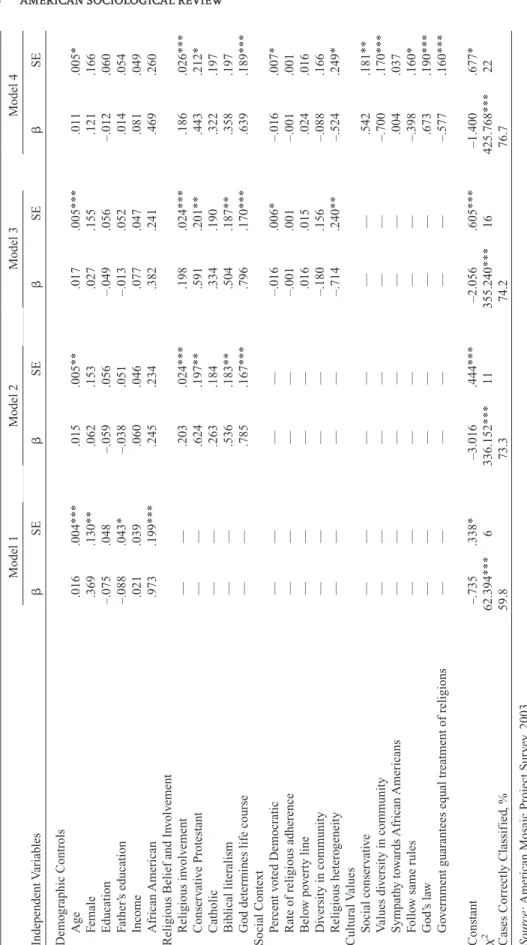
We also regressed the same blocks of predictive variables on our measure of private acceptance, the respondent’s approval of a child marrying an atheist. Many of the relationships mirror those found in our previous analysis of public accept-ance, but a few stand out as different. A marked difference is the generally weaker power and sig-nificance of our demographic factors. In Model 5, women, older people, and blacks are more likely to disapprove of their child marrying an atheist, while those whose fathers had more education are less likely to disapprove. In Model
T a b le 5. Lo gistic Re g
ressions of Responses to
“Atheists Do Not
At
All Share My
V ision of America ” Model 1 Model 2 Model 3 Model 4 Independent V ariab les  SE  SE  SE  SE Demo g raphic Controls —— Age .013 .003*** .011 .004** .013 .004*** .007 .004 — F emale .236 .100* .066 .109 .061 .111 .073 .119 — Education – .185 .037*** – .164 .040*** – .160 .041*** – .126 .043** — F ather ’s education – .078 .032* – .036 .035 – .019 .036 .022 .038 — Income .024 .029 .067 .032* .087 .032** .068 .034* — African American .606 .148*** .080 .164 .138 .170 .506 .185**
Religious Belief and Practice —
Religious in v olv ement . — . — .107 .017*** .098 .098*** .079 .019*** — Conser v ati v e Protestant . — . — .447 .137*** .425 .140** .348 .146* — Catholic . — . — .062 .135 .152 .139 .187 .145 — Bib lical literalism . — . — .471 .128*** .401 .130** .252 .138 — God deter
mines life course
. — . — .757 .119*** .785 .121*** .591 .134*** Social Conte xt — P ercent v oted Democratic . — . — . — . —– .021 .005*** – .018 .005*** —
Rate of religious adherence
. — . — . — . —– .001 .000*** – .001 .000** — Belo w po v er ty line . — . — . — . — .027 .011* .032 .011** — Di v
ersity in community
. — . — . — . — .375 .110*** .449 .117*** — Religious hetero geneity . — . — . — . —– .670 .176*** – .587 .182*** Cultural V alues — Social conser v ati v e . — . — . — . — . — . — .157 .128 — V alues di v
ersity in community
. — . — . — . — . — . —– .543 .120*** — Sympath y to w
ards African Americans
. — . — . — . — . — . —– .155 .027*** — F ollo
w same r
ules . — . — . — . — . — . —– .247 .113* — God ’s la w . — . — . — . — . — . — .672 .140*** — Go v er
nment guarantees equal treatment of religions
. — . — . — . — . — . —– .398 .007*** Constant – .388 .242 – 2.014 .297*** – .752 .436 .491 .478 2 92.912*** .0 6 352.361*** . 11 405.546*** . 16 535.000*** . 22 Cases Cor rectl y Classif ied , % 6 0 68.3 70.0 71.3 Sour ce:
American Mosaic Project Sur
v
ey
, 2003.
Note:
N = 1,844.

= Beta v
alue; SE = standard er
ror
.
*
p
< .05; **
p
< .01; ***
p
< .001 (tw
8, however, the only effect that remains signif-icant is that for age, and it is quite small.
One’s own religious belief and involvement affect attitudes toward intermarriage with athe-ists; in the final model, those who are the most religiously involved, conservative Protestants, and those who believe that the course of life is determined by God all disapprove of their child marrying an atheist. Social context also matters less for attitudes toward intermarriage, with a small effect for those living in a Democratic county and a large effect for those with reli-giously diverse friendship networks; both are less likely to disapprove. Cultural values also matter, with social conservatives and those who believe that society’s standards of right and wrong should be based on God’s laws being more likely to disapprove of having an atheist for a son- or daughter-in-law. Those who believe that the government should guarantee equal treatment for all religions, who value diversity in their community, and who believe in proce-dural norms of democracy (follow the same rules) are less likely to disapprove of their child marrying an atheist.
S
SUUPPPPLLEEMMEENNTTAALL AANNAALLYYSSEESS AANNDD IINNTTEERRPPRREETTAATTIIOONNSS
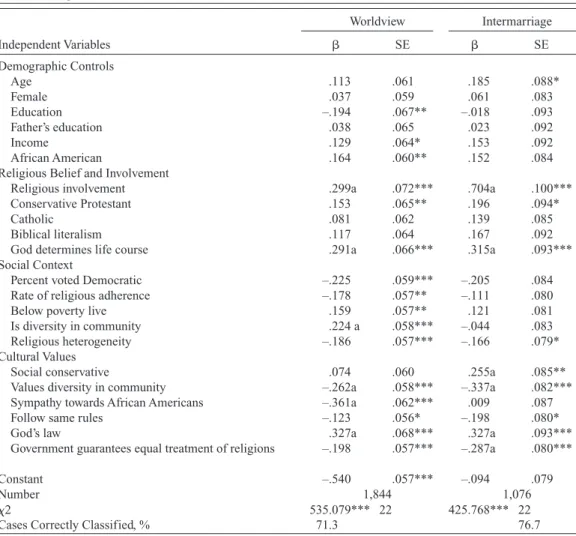
These analyses allow us to begin to identify the factors that predict the symbolic and cultural exclusion of atheists from both public and pri-vate life. To help us interpret the relative strength of these factors in shaping acceptance or rejec-tion of atheists, we recalculated the final mod-els for public and private rejection with standardized independent variables, which allows us to compare directly the size of the effects. Table 7 shows these results. For both models, the largest effects are denoted with footnotes.
The comparison shows that somewhat dif-ferent factors drive the two types of boundaries. For our measure of public acceptance, the strongest effects are divided between one’s own religious belief and involvement, living in a diverse community, and three of our cultural values variables. For intermarriage, religious involvement is by far the strongest predictor of attitudes, and cultural values also have large effects. It makes sense that one’s own religious involvement would have the most effect on the measure of private acceptance. It also, though,
affects public acceptance, highlighting the importance of the social and communal aspects of religion for attitudes toward the nonreligious. It is notable that having a conservative Protestant identity does not emerge as one of the stronger predictors of attitudes toward atheists in our final models, which include specific items that measure attitudes toward religion’s role in public life. While much research has pointed to the strength of the conservative Protestant subculture, few studies have con-tained measures that allow one to specify the mechanisms that link individual participation in this subculture with broader views of public issues. What matters for public acceptance of atheists—and figures strongly into private acceptance, as well—are beliefs about the appropriate relationship between church and state and about religion’s role in underpinning society’s moral order, as measured by our item on whether society’s standards of right and wrong should be based on God’s laws. In under-standing how other Americans view atheists, being conservative Protestant matters because of beliefs that reject the possibility of a secular basis for the good society.
It is worth exploring who our respondents were thinking of when they reacted to ques-tions about atheists. Where they thinking of the 14 percent of Americans who claim no reli-gious identity or the 7 percent who tell the General Social Survey that they either do not believe in God or are not sure? Or were they thinking of the 1 percent who explicitly describe themselves as atheist or agnostic?
Our in-depth interviews shed some light on this. These interviews did not contain any direct questions about atheists because they were designed to gather information on how respon-dents experience diversity in local contexts, including neighborhoods and community organ-izations, ecumenical groups, and cultural festi-vals. Discussion of atheists, however, emerged in some of the interviews in the context of answers to other questions; the richest of these discussions occurred in the Los Angeles field-site, and those are the discussions we draw upon here (see also Wolf-Meyer 2005).
Respondents had various interpretations of what atheists are like and what that label means. Those whom we interviewed view atheists in two different ways. Some people view atheists as problematic because they associate them
T a b le 6. Lo gistic Re g
ressions of Disappro
v
al of One
’s Child Mar
ry ing an Atheist Model 1 Model 2 Model 3 Model 4 Independent V ariab les  SE  SE  SE  SE Demo g raphic Controls — Age .016 .004*** .015 .005** .017 .005*** .011 .005* — F emale .369 .130** .062 .153 .027 .155 .121 .166 — Education – .075 .048 – .059 .056 – .049 .056 – .012 .060 — F ather ’s education – .088 .043* – .038 .051 – .013 .052 .014 .054 — Income .021 .039 .060 .046 .077 .047 .081 .049 — African American .973 .199*** .245 .234 .382 .241 .469 .260
Religious Belief and In
v olv ement — Religious in v olv ement . — . — .203 .024*** .198 .024*** .186 .026*** — Conser v ati v e Protestant . — . — .624 .197** .591 .201** .443 .212* — Catholic . — . — .263 .184 .334 .190 .322 .197 — Bib lical literalism . — . — .536 .183** .504 .187** .358 .197 — God deter
mines life course
. — . — .785 .167*** .796 .170*** .639 .189*** Social Conte xt — P ercent v oted Democratic . — . — . — . —– .016 .006* – .016 .007* —
Rate of religious adherence
. — . — . — . —– .001 .001 – .001 .001 — Belo w po v er ty line . — . — . — . — .016 .015 .024 .016 — Di v
ersity in community
. — . — . — . —– .180 .156 – .088 .166 — Religious hetero geneity . — . — . — . —– .714 .240** – .524 .249* Cultural V alues — Social conser v ati v e . — . — . — . — . — . — .542 .181** — V alues di v
ersity in community
. — . — . — . — . — . —– .700 .170*** — Sympath y to w
ards African Americans
. — . — . — . — . — . — .004 .037 — F ollo
w same r
ules . — . — . — . — . — . —– .398 .160* — God ’s la w . — . — . — . — . — . — .673 .190*** — Go v er
nment guarantees equal treatment of religions
. — . — . — . — . — . —– .577 .160*** Constant – .735 .338* – 3.016 .444*** – 2.056 .605*** – 1.400 .677* 2 62.394*** .0 6 336.152*** . 11 355.240*** . 16 425.768*** . 22 Cases Cor rectl y Classif ied , % 59.8 73.3 74.2 76.7 Sour ce:
American Mosaic Project Sur
v
ey
, 2003.
Note:
N = 1,076.

= Beta v
alue; SE = standard er
ror
.
*
p
< .05; **
p
< .01; ***
p
< .001 (tw
with illegality, such as drug use and prostitu-tion—that is, with immoral people who threat-en respectable community from the lower threat-end of the status hierarchy. Others saw atheists as rampant materialists and cultural elitists that threaten common values from above—the osten-tatiously wealthy who make a lifestyle out of consumption or the cultural elites who think they know better than everyone else. Both of these themes rest on a view of atheists as self-interested individualists who are not concerned with the common good.
One woman, KW, a Republican in her mid-60s, told our interviewer that belief in something
transcendent is necessary to move beyond “the me,” the narrowly self-interested consumerism that she sees as rampant. This interview excerpt shows how she linked together the ideas of con-sumerism, arrogance, atheism, and American identity:
It’s that same arrogance again. I’m an American, I can do anything I want, and to heck with the rest of the world. [Interviewer: Do you see religion fitting into it very well?] These people aren’t very religious, you’ll notice that. There’s a real, “I’m an atheist” attitude among people with major money. You don’t see this nice balance .|.|. I’ll say it again, some religious belief, I don’t care who or what you worship, just something to give you that stability. Table 7. Standardized Logistic Regression Coefficients of Final Model of Worldview and Intermarriage
Regressions
Worldview Intermarriage Independent Variables . .SE . .SE Demographic Controls
—Age .113 .061 .185 .088*
—Female .037 .059 .061 .083
—Education –.194 .067** –.018 .093
—Father’s education .038 .065 .023 .092
—Income .129 .064* .153 .092
—African American .164 .060** .152 .084 Religious Belief and Involvement
—Religious involvement .299a .072*** .704a .100***
—Conservative Protestant .153 .065** .196 .094*
—Catholic .081 .062 .139 .085
—Biblical literalism .117 .064 .167 .092
—God determines life course .291a .066*** .315a .093*** Social Context
—Percent voted Democratic –.225 .059*** –.205 .084
—Rate of religious adherence –.178 .057** –.111 .080
—Below poverty live .159 .057** .121 .081
—Is diversity in community .224 a .058*** –.044 .083
—Religious heterogeneity –.186 .057*** –.166 .079* Cultural Values
—Social conservative .074 .060 .255a .085**
—Values diversity in community –.262a .058*** –.337a .082***
—Sympathy towards African Americans –.361a .062*** .009 .087
—Follow same rules –.123 .056* –.198 .080*
—God’s law .327a .068*** .327a .093***
—Government guarantees equal treatment of religions –.198 .057*** –.287a .080***
Constant –.540 .057*** –.094 .079
Number 1,844 1,076
2 535.079*** 22 425.768*** 22
Cases Correctly Classified, % 71.3 76.7 Source:American Mosaic Project Survey, 2003.
Note:= Beta weight; SE = standard error.
aThe largest effects seen for both models.
If you’re going all through life, “I’m an atheist, I don’t believe in anything except the almighty dol-lar,” this is definitely a destructive attitude and the rest of the world sees it.
Other respondents were also very specific to make the link between atheism and those who had no larger concept of the common good. One man, DD, a Democrat who is also a pastor involved in social justice outreach, told our interviewer,
You know, anybody can effect change but it has, most non-faith-based organizations do it much more from the perspective of what’s in it for me, and it’s more [a] possible takeover situation, “I’m gonna force you to do whatever I want to do” .|.|. [I]t’s a healthy faith-based tradition that I always recognize as being fixed in community, and work-ing together, and lookwork-ing out for the well-bework-ing of the other person just as much as myself. Another respondent, an interior designer very involved in his neighborhood association, brought up the issue in a portion of the interview not focused explicitly on religion or the lack thereof. Our interviewer asked this man, one of the few Republicans in his community group, if he was concerned that the visibility of the Christian Right might dismay those who other-wise would identify with Republican values. He responded,
Only by perception because you know, being a Republican, it doesn’t bother me in the least. Yeah, because I would say .|.|.|the prisons aren’t filled with conservative Republican Christians. The pris-ons are probably filled with people who don’t have any kind of a spiritual or religious core. So I don’t have to worry about .|.|., a conservative Christian, you know, committing a crime against me, chances are.
In these interviews, the atheist emerges as a culturally powerful “other” in part because the category is multivalent (Turner 1974), loaded with multiple meanings. For all these respon-dents, atheists represent a general lack of moral-ity, but for some, this lack was associated with criminality and its dangers to safety and public order, while for others the absence of morality was that of people whose resources or posi-tions place them above the common standards of mainstream American life. To put it somewhat differently, atheists can be symbolically placed at either end of the American status hierarchy. What holds these seemingly contradictory views together is that the problem of the atheist was
perceived to be a problem of self-interest, an excessive individualism that undermines trust and the public good. In this, our respondents draw the same link between religion and the taming of self-interest that Tocqueville wrote about over a century ago (Tocqueville [1992] 2000, see especially volume 2, parts I and II). It is important to note that our respondents did not refer to particular atheists whom they had encountered. Rather they used the atheist as a symbolic figure to represent their fears about those trends in American life—increasing crim-inality, rampant self-interest, an unaccountable elite—that they believe undermine trust and a common sense of purpose.
In recent public discourse, atheists take on a similar symbolic role. We found that the figure of the atheist is invoked rhetorically to discuss the links—or tensions—among religion, moral-ity, civic responsibilmoral-ity, and patriotism. In par-ticular, the association of the atheist with a kind of unaccountable elitism has surfaced in recent public debates. The civically engaged atheists’ awareness of the negative stereotypes of athe-ists has led to the coining of a new term, “Brights,” around which to identify and organ-ize and thus, according to one prominent Bright, to challenge the association between atheism, immorality, and lack of civic commitment. One of those advocates has gone so far as to claim the following:7
Many of the nation’s clergy members are closet brights, I suspect. We are, in fact, the moral back-bone of the nation: brights take their civic duties seriously precisely because they don’t trust God to save humanity from its follies (Dennett 2003).
In a review of the book The Twilight of
Atheism,Charlotte Allen (2004) not only
asso-ciates atheism with totalitarianism but also sees this notion of the “Brights” as particularly trou-bling because of the intersection of science with big money and the ability to influence public policy. She worries if atheism, “may yet be experiencing a new dawn: a terrifying new alliance with money and power, of a kind even Marx could not have foreseen” (Allen
7Intellectual and philosophical treatments of
athe-ism often start with the assertion that morality is possible without belief in God, knowing that this is something that is often called into question (Martin 2002; see also Dawkins 2003).
2004:51ff). Moreover, it is not only political conservatives who are uncomfortable with athe-ists. Commentators like Alan Wolfe—himself a professed nonbeliever—have claimed that athe-ism’s close cousin secularism is a position almost exclusively held by a small, white, pro-fessional elite and that the Democratic Party must distance itself from secularists if they want to have any hope of regaining leadership of a country that is deeply religious, and if they want to be authentically responsive to the moral con-cerns that drive the majority of American vot-ers (see Wolfe 2004, 2005).
Nonbelief has come to be not only a lively subject for cultural commentary but also a mat-ter of political rhetoric and debate. In the wake of the terrorist attacks of 9/11, former Attorney General John Ashcroft gave a speech to the National Religious Broadcaster’s Annual Convention on February 19, 2002, in Nashville. Peter Beinart (2002) reported on it in The New
Republic.In that speech, Ashcroft says the
fol-lowing:
Civilized individuals, Christians, Jews, and Muslims, all understand that the source of freedom and human dignity is the Creator. Governments may guard freedom. Governments don’t grant free-dom. All people are called to the defense of the Grantor of freedom, and the framework of freedom He created.
Ostensibly intended to unify the nation, Ashcroft’s comments caused controversy because of their apparent disavowal of nonbe-lieving Americans. It was an approach many critics held to be endemic for an administration that had come to power in no small part on the basis of its moral claims and emphasis on faith-based policy initiatives. The centrality of values-talk in the 2004 campaign did nothing to lessen such concerns, to such an extent that in the year following his reelection the president found it necessary to reach out to nonbelievers even at the risk of offending his core constituents. On, April 28, 2005, for example, President Bush put it like this: “The great thing about America... is that you should be allowed to worship any way you want. And if you choose not to worship, you’re equally as patriotic as somebody who does worship.”8This comment makes no sense
unless the patriotism of the nonbeliever has effectively been called into question, revealing the tension between the belief that religion pro-vides the basis for morality in American life and the belief in pluralism and freedom of con-science.
No matter how we read the President’s remarks, the contrast between those who cele-brate “the Brights” and those, like Ashcroft, who emphasize the centrality of faith is stark, and sheds light on why atheism becomes, in the American context, something that is under-stood and discussed as more than simply a pri-vate choice. Williams (1995) has distinguished two competing cultural models of the public good in American society. One is a covenant model that sees society’s welfare as dependent upon individuals having a “right relationship” with God and social institutions that reflect God’s laws. The other is a contract understand-ing, in which the locus of morality, trust, and accountability are in our relationships to one another and not referential to a higher being or power. Contracts and covenants not only oper-ate according to different norms and proce-dures, but they also imply different ontologies that specify different relationships between indi-viduals and the state and different bases for belonging and trust.
Williams argues that bothof these models of the public good are deeply moral and that his-torically, in the United States, religious traditions have provided the cultural resources that con-struct both the contract and the covenant under-standing. Originally this religious basis was largely Protestant; then it was expanded to the Judeo-Christian core, and now it is, perhaps, more inclusive still, as Hout and Fischer (2001; c.f. Eck 2001) have pointed out. The basis is still religious, however, if not strictly Christian; and while liberal democratic social theory has con-ventionally argued that American democracy is exceptional because of its religious vitality and the central role of religion in public life, recent developments in Africa, Asia, and Latin America suggest that a covenantal model— rather than the secular vision of state-society
“There’s nothing more powerful than this country saying you can worship any way you want, or not wor-ship at all” (http://www.christianitytoday.com/ct/ 2004/121/51.0.html).
8President Bush reiterated this point in an