
The effects of attractive but unattainable alternatives on the
attractiveness of near and distant future menus
Leah Borovoi,
∗Tel Aviv University
Nira Liberman
Tel Aviv University
Yaacov Trope
New York University
Abstract
We examine how adding an Attractive but Unattainable Alternative (AUA) to a set of available but less attractive alternatives influences evaluations of near vs. distant future sets of alternatives. According to Construal Level Theory (Liberman & Trope, 2008) including an AUA would decrease the attractiveness of near future sets, but may increase the attractiveness of distant future sets. In four studies participants imagined a choice situation with three alternatives. For some participants a fourth alternatives was added, which was attractive but unattainable. Half of the participants in each condition imagined making a decision in the near future whereas others imagined making the decision in the distant future. Participants then evaluated the attractiveness of the entire set of alternatives, as well as of each alternative separately. We examined choices between jobs, computers and roommates. The last study examined negotiations with the landlord about an apartment. Consistent with our hypothesis, an AUA increased the evaluation of the distant set and decreased the evaluation of the near set.
Keywords: construal level theory, intertemporal choice, contrast effect, temporal distance.
1 Introduction
Imagine considering a vacation in the Caribbean and browsing through offers of different vacation packages. All the packages seem equally attractive, but one of them stands out as being especially attractive — a brand new five star hotel offers attractive tours that are all included in the quite moderate price. A closer look discloses that this most attractive package is offered exclusively to members of the Hilton Club, which you are not. How would the existence of this very Attractive but Unattainable Alter-native (AUA) affect your evaluation of thesetof vacation plans the travel agency offers? Would you stay with this agency or look for other agencies?
Some decision makers may find the situation annoying. Compared to the AUA, the other vacation plans would seem mediocre, and the entire menu that the agency of-fers would lose attractiveness. Other people, however, could think that the fact that in principle the agency has such attractive vacation packages speaks in its favor, and increase their ratings of the agency and the menu it offers. Other cases of including an AUA in a set of alternatives may involve offering especially valuable products and in-dicating that they are out of stock, or including attractive dishes in a restaurant’s menu and indicting that they are
∗We thank Mali Madyuni and Assi Schupak for help in running
the experiments. We thank Shiri Nusbaum, Tal Eyal, Elena Stephan, Rotem Aloni, Tali Nissan, Ayelet Shpizaizen, Oren Shapira, Elinor Amit and anonymous reviewers for many helpful ideas. E-mail: [email protected].
not served that day. Obviously, including an AUA is cost-less. Is it a good strategy? Can it promote sales? Would it reduce or increase the attractiveness of the entire set?
Related to this question, research on the Phantom Decoy effect found that, when choosing between two equally desirable alternatives, adding a phantom decoy — namely, an alternative that is worse than both initial alternatives and is dominated by one of them — increases choice of the alternative that dominates the decoy (Huber, Payne, & Puto, 1982). For example, a decision maker may feel indifferent between a five-star restaurant that is 25 minutes drive away and three-star restaurant that is 5 minutes drive away. Offering a third alternative – a four-star restaurant that is 35 minutes drive away, may cause the decision maker to prefer the five-star restaurant that is 25 minutes drive away (Choplin, & Hummel, 2005; Colman, Pulford, & Bolger, 2007). Both phantom de-coys and AUAs are irrelevant. Unlike a phantom decoy, however, an AUA is more attractive than the other alter-natives.
We investigate the impact of an attractive but irrelevant alternative on the evaluation of the entire set of alterna-tives. We suggest that temporal distance from making the choice is one factor that may determine the influence of Attractive but Unattainable Alternatives (AUAs) on eval-uation of the entire set. Specifically, based on Construal Level Theory (CLT, Liberman & Trope, 2008; Liberman, Trope & Stephan, 2007; Trope & Liberman, 2003; Liber-man, Trope, & Wakslak, 2007), we propose that when alternatives are considered for the proximal future, AUAs 102
decrease the attractiveness of near future sets, but do not decrease and even increase the attractiveness of distant future sets, leading to an interaction between AUAs and temporal distance. In what follows, we explicate how this prediction derives from CLT and test it in four studies.
Construal Level Theory (CLT, Liberman & Trope, 1998; Liberman, Trope & Stephan, 2007; Trope & Liber-man, 2003) proposes that psychological distance from a decision influences individuals’ evaluations of the alter-natives by systematically changing the way they construe these alternatives. People tend to construe more psycho-logically distant alternatives on a higher level, namely, using more abstract, generalized representations. High-level construals abstract the essential qualities of events and, therefore, consist of more central and essential fea-tures. In contrast, low-level construals may include more peripheral and less essential features of events. Thus, whereas representations of near future events are rich with details, representations of distant future events omit secondary and incidental features of events. High level features are those that when altered or removed cause more change to the situation. For example, in an aca-demic lecture, changing the topic of the lecture is typi-cally perceived as a more substantial change that chang-ing the room in which the lecture takes place, and there-fore the topic is a higher level feature of the talk than its location.
There are two non-exclusive ways in which CLT might predict that distance would increase the beneficial impact (or decrease the detrimental impact) of AUAs on sets of alternatives. First, desirability considerations (i.e., the value of an action’s end state) constitute a high-level con-strual of the alternative and should receive more weight in a more distant future decision. In contrast, feasibility considerations (i.e., the ease or difficulty of reaching that end-state) constitute a low-level construal of the alterna-tive and should receive less weight in a more distant fu-ture decision (Liberman & Trope, 1998). Because AUAs are, by definition, highly desirable but not feasible, they would be more attractive in more distant future sets.
Second, temporal distance may affect the likelihood of assimilation versus contrast. Förster, Liberman, and Kutchel (2008) recently showed that psychological dis-tance enhances assimilation (as opposed to contrast) of a target to a category. For example, in one of their experi-ments, participants compared their athletic skills to either a moderately high standard or a moderately low standard and then rated their expected athletic performance in an athletic competition that would take place either the next day or a year later. Compared to a control condition, in which time was not specified, a distant time perspective enhanced assimilation (i.e., produced a high self-rating after comparison to a high standard and a low self-rating after comparison to a low standard) whereas a proximal
time perspective enhanced contrast (i.e., produced a low self-rating after comparison to a high standard and a high self-rating after comparison to a low standard).
Possibly, temporal proximity would make participants more likely to contrast the AUA from the set, and cause the set to be evaluated more negatively than without an AUA. Temporal distance, on the other hand, would re-duce contrast (or prore-duce assimilation) of the set from the AUA. As a result, the entire set of alternatives will not look worse (and may even look better) in the presence of an AUA than without it.
We report four studies that examine the prediction that AUAs decrease the attractiveness of near future sets, but do not decrease and even increase the attractiveness of distant future sets. In addition to this predicted interac-tion between time and adding an AUA, there might be also main effects of both factors. Specifically, adding an AUA might produce either an overall assimilation effect or an overall contrast effect (Sherif, & Hovland, 1961). Temporal distance, too, might decrease or increase the attractiveness of a set of alternatives, due to temporal dis-counting (Lowenstein, & Prelec, 1992; Raineri and Rach-lin, 1993) or savoring (Loewenstein, & Prelec, 1993), re-spectively. These possible main effects, which may also vary from study to study, are not the main focus of this research.
2 Method
2.1 2.1. Participants
Tel Aviv University students were approached on cam-pus and offered an opportunity to participate in an ex-periment. Those who volunteered were handed a ques-tionnaire, and were asked to imagine one of the situa-tions described below. We tried to match the time of the study to its content. For example, we asked about choosing a roommate at the beginning of the academic year, when participants were more likely to be consid-ering such choice. 110 students (45 women) completed Study 1 about choosing an RA job position, 114 students (52 women) completed Study 2 about choosing a com-puter, 116 students (55 women) completed Study 3 about choosing a roommate and 97 students (27 women) com-pleted Study 4 about negotiation.
2.2 Materials and procedure
In each study, participants considered three or four choice alternatives, depending on the experimental condition. Each alternative was described in a table along several di-mensions. Participants were randomly assigned to one of four conditions created by crossing presence vs. absence
Table 1: Descriptions of job positions, Study 1.
Job A Job B Job C Job D
Interest Boring technical job Average Interesting, requires
skill and thinking
Interesting, requires skill and thinking Opportunity for
promotion High Medium Low High
Variety Medium Low High High
Working hours Convenient Convenient Inconvenient Convenient
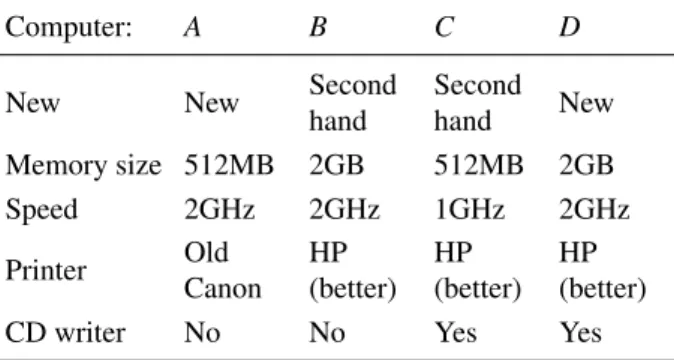
Table 2: Descriptions of computers, Study 2. This study was done in 2003, therefore, computers are “outdated”.
Computer: A B C D
New New Second
hand
Second
hand New
Memory size 512MB 2GB 512MB 2GB
Speed 2GHz 2GHz 1GHz 2GHz
Printer Old
Canon HP (better)
HP (better)
HP (better)
CD writer No No Yes Yes
of an AUA and near vs. distant future temporal perspec-tive. In the no-AUA condition participants read a descrip-tion of three available alternatives, whereas in the AUA condition a fourth alternative was presented, which was better than the other alternatives on each dimension, but it was also indicated that this alternative was unattain-able. In the near future condition participants imagined making a decision for the near future whereas in the dis-tant future condition they imagined making a decision for a year later.
In each decision situation, participants indicated how attractive the set of alternatives (or proposals in the fourth study) seemed to them, how satisfying, rich, interesting, and varied it was, and how motivated they were to choose from the set, all on scales that ranged from 1 (not at all) to 9 (very much). These evaluations were positively corre-lated (Cronbach’s alpha ranges from .87 to .93) and were averaged into a set evaluation index. We predicted that AUAs decrease the attractiveness of near future sets, but do not decrease and even increase the attractiveness of distant future sets. In addition, participants indicated how attractive they considered each alternative (including the AUA in the AUA conditions) on scales that ranged from 1 (not at all attractive) to 8 (very attractive). These ratings were averaged across the 3 alternatives, not including the
AUA. We predicted that time would enhance the attrac-tiveness of the AUA. We also predicted that time would attenuate contrast between AUAs and other alternatives. We therefore expected that, in the near future condition more than in the distant future condition, the presence of an AUA would detract from the attractiveness of the other alternatives.
As mentioned earlier, in addition to the predicted inter-action between adding an AUA and time, both time and adding an AUA might have a main effect on the evalua-tion of both the entire set and on other alternatives. These main effects are not the main focus of our study. The ma-terials, translated from Hebrew, of the near future (distant future) conditions are presented below.
2.2.1 Study 1. Choosing a Research Assistant (RA) position
Imagine that you are looking for an RA posi-tion to start working immediately (a year from now). Three [four] job positions are similar in salary but differ in the following dimensions: interest (technical job vs. a job that requires skill and thinking), opportunity for promotion (high, medium, low), variety (high, medium, low) and working hours (convenient versus in-convenient).1
The positions are described in Table 1. Job D is the AUA — it is dominant over other alternatives, but is open only to 3rd year students with an GPA of 97 and above. This alternative was included only in the “AUA present” conditions.
2.2.2 Study 2. Choosing a computer
Imagine that you are looking for a computer to buy immediately (a year from now). Your credit card company offers a special deal. They 1These attributes were taken from Gati and Kibary (1998), who
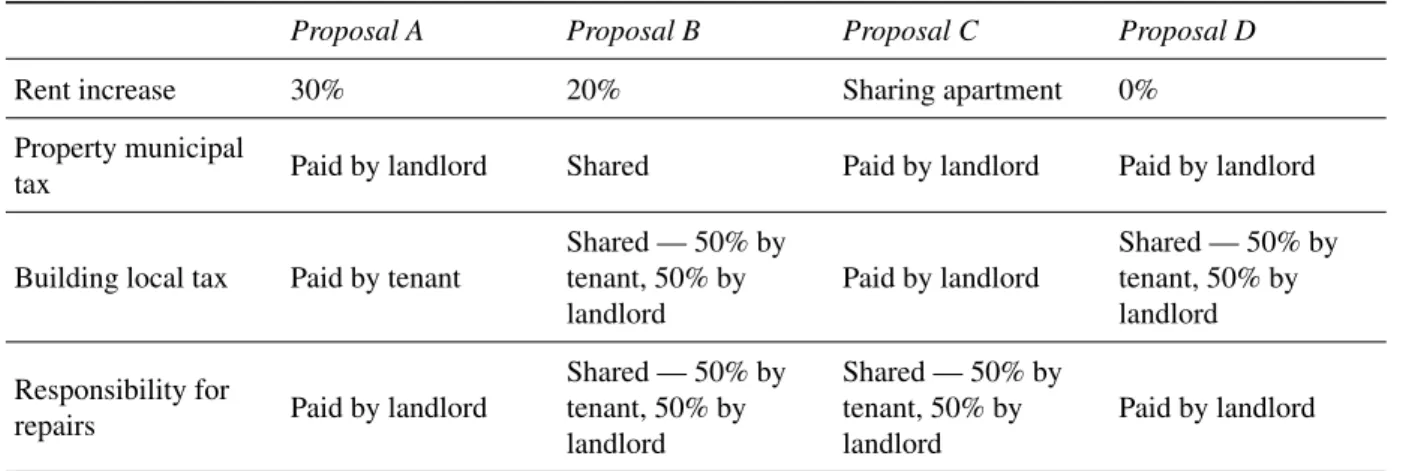
Table 4: Descriptions of landlord proposals, Study 4.
Proposal A Proposal B Proposal C Proposal D
Rent increase 30% 20% Sharing apartment 0%
Property municipal
tax Paid by landlord Shared Paid by landlord Paid by landlord
Building local tax Paid by tenant
Shared — 50% by tenant, 50% by landlord
Paid by landlord
Shared — 50% by tenant, 50% by landlord Responsibility for
repairs Paid by landlord
Shared — 50% by tenant, 50% by landlord
Shared — 50% by tenant, 50% by landlord
Paid by landlord Property tax is paid by the landlord/tenant or shared 50/50.
Table 3: Descriptions of roommates, Study 3.
Candidate: A B C D
Age 20 23 50 23
Occupation Solder Student Foreign
worker Student
Speaks
Hebrew Yes Yes No Yes
Smoking status
Not at all
Not at
all Yes Not
Orderliness Yes, slightly
Yes, a lot
Not at
all Yes
offer a choice between three [four] computers for an attractive price. The computers vary in the following dimensions: Newness (new, sec-ond hand), Memory size (large, small), speed of processor (high, low), CD writer (available, Unattainable) and printer (HP, old Canon).
Computer D was the AUA — it was dominant over other alternatives, but was indicated as being “out of stock”. It was included only in the “AUA present” condi-tions. See Table 2.
2.2.3 Study 3. Choosing a roommate
Imagine that you are looking for a roommate to share an apartment in the upcoming semester (a year from now). Three [four] people ap-ply. They vary in the following attributes: Age (25, 50), knowledge of Hebrew (native language, doesn’t speak Hebrew), orderliness (orderly, disorderly), profession (student,
for-eign worker) and smoking status (smoking, non smoking).
Candidate D was the AUA — this candidate was domi-nant on all the others but it was indicated that he declined the opportunity to join the apartment. This alternative was included only in the “AUA present” conditions. See Table 3.
2.2.4 Study 4. Negotiation with landlord
Imagine that you have been living in a rented apartment for a long time. You are very happy with the apartment. One day, the apartment owner informs you that because the USD rate has dropped, he wants to raise the rent start-ing next month (a year from now). You do not like this and say that you are going to leave the apartment. However, you find out that there are virtually no apartments for rent in the neighbor-hood. You therefore start negotiating with your landlord and he makes you a few offers, which are summarized in the Table 4.
Proposal D is the AUA — it dominates other alterna-tives, but it was indicated that the landlord could not get his wife to approve it, and he had to withdraw it. It was included only in the “AUA present” conditions. See Table 4.
3 Results
3.1 Manipulation check
As intended, in all four studies the AUAs were rated higher than the rest of the alternatives in the set, all ts > 12.21, p < .001.
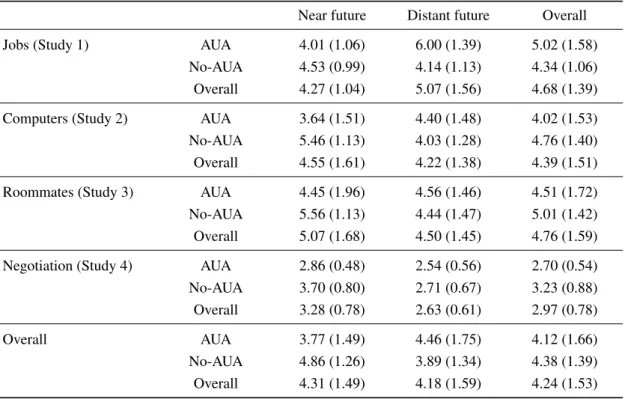
Table 5: Means and standard deviations (in parentheses) for evaluations of a set of alternatives by AUA, time and study.
Near future Distant future Overall
Jobs (Study 1) AUA 4.01 (1.06) 6.00 (1.39) 5.02 (1.58)
No-AUA 4.53 (0.99) 4.14 (1.13) 4.34 (1.06)
Overall 4.27 (1.04) 5.07 (1.56) 4.68 (1.39)
Computers (Study 2) AUA 3.64 (1.51) 4.40 (1.48) 4.02 (1.53)
No-AUA 5.46 (1.13) 4.03 (1.28) 4.76 (1.40)
Overall 4.55 (1.61) 4.22 (1.38) 4.39 (1.51)
Roommates (Study 3) AUA 4.45 (1.96) 4.56 (1.46) 4.51 (1.72)
No-AUA 5.56 (1.13) 4.44 (1.47) 5.01 (1.42)
Overall 5.07 (1.68) 4.50 (1.45) 4.76 (1.59)
Negotiation (Study 4) AUA 2.86 (0.48) 2.54 (0.56) 2.70 (0.54)
No-AUA 3.70 (0.80) 2.71 (0.67) 3.23 (0.88)
Overall 3.28 (0.78) 2.63 (0.61) 2.97 (0.78)
Overall AUA 3.77 (1.49) 4.46 (1.75) 4.12 (1.66)
No-AUA 4.86 (1.26) 3.89 (1.34) 4.38 (1.39)
Overall 4.31 (1.49) 4.18 (1.59) 4.24 (1.53)
3.2 Evaluations of the set of alternatives
Our main hypothesis concerned the evaluation of the en-tire set of alternatives. We predicted that AUAs decrease the attractiveness of near future sets, but do not decrease and even increase the attractiveness of distant future sets. We conducted a three-way ANOVA on the set evalua-tion index, with time, AUA, and Study (1–4) as between-participants factors. Table 5 presents the mean and stan-dard deviations of the individual studies.
There was no main effect of time, F(1, 420) = 2.05, p = .15. A significant main effect of AUA, F(1, 420) = 4.83, p < .03, indicated that inclusion of an AUA de-creased the attractiveness of the set, (MAUA= 4.16, SD = 1.66; Mno AUA= 4.38, SD = 1.38). This main effect was qualified by the predicted interaction between time and AUA, F(3, 420) = 45.69, p < .001. Including an AUA decreased the attractiveness of near future sets of alterna-tives (Mproximal, AUA= 3.77, SD = 1.50; Mproximal, no AUA= 4.86, SD = 1.26, t(218) = 5.82, p < .01) but increased the attractiveness of distant future sets (Mdistant, AUA = 4.47, SD = 1.76; Mdistant, no AUA = 3.86, SD = 1.34, t(214) = –2.70, p < .01). There was no three-way interaction be-tween time, AUA and study; thus the interaction of time and AUA did not depend on study.
There were significant interactions between time and study, F(1, 420) = 7.54, p < .01, and between AUA and study, F(1, 420) = 7.09, p < .01. These interactions
sug-gest that the main effects of time and of AUA differed between studies. Since the main effects of time and AUA are not the focus of the present research, we will not at-tempt to explain these differences.
Our results thus demonstrate, consistent with our pre-dictions, that when people consider alternatives for the proximal future, inclusion of AUAs makes the set less at-tractive. When the same set is considered for the distant future, however, inclusion of AUAs makes it more attrac-tive.
3.3 Evaluations of the AUA
We expected the AUA to be more valued in the distant future than in the near future, because time increases the weight of desirability, on which AUAs are high, and de-creases the weight of feasibility, on which AUAs are low. We conducted a two-way ANOVA on the evaluations of the AUA, with time and study as between-participants factors (see Table 6). A significant main effect of time, F(1, 209) = 8.47, p < .01, indicated that, as predicted, the attractiveness of AUAs increased over time, (Mnear future= 5.96, SD = 2.08; Mdistant future= 6.58, SD = 1.65). There was no interaction between study and time, F(3, 209) = 1.22, ns, indicating that this effect was uniform across studies. A main effect of study, F(3, 209) = 49.64, p < .01, indicated that the attractiveness of AUA dependent
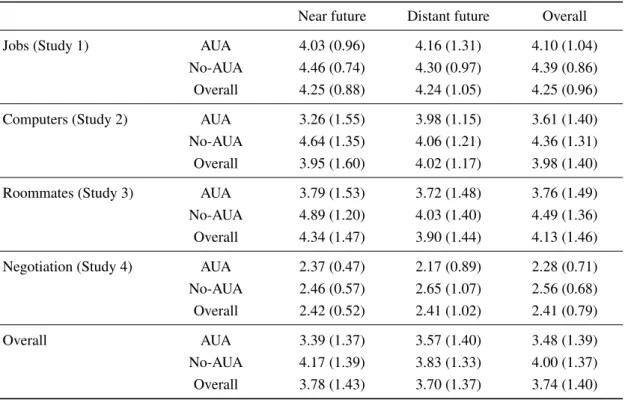
Table 7: Means and standard deviations (in parentheses) for evaluations of available alternatives by time, AUA and study.
Near future Distant future Overall
Jobs (Study 1) AUA 4.03 (0.96) 4.16 (1.31) 4.10 (1.04)
No-AUA 4.46 (0.74) 4.30 (0.97) 4.39 (0.86)
Overall 4.25 (0.88) 4.24 (1.05) 4.25 (0.96)
Computers (Study 2) AUA 3.26 (1.55) 3.98 (1.15) 3.61 (1.40)
No-AUA 4.64 (1.35) 4.06 (1.21) 4.36 (1.31)
Overall 3.95 (1.60) 4.02 (1.17) 3.98 (1.40)
Roommates (Study 3) AUA 3.79 (1.53) 3.72 (1.48) 3.76 (1.49)
No-AUA 4.89 (1.20) 4.03 (1.40) 4.49 (1.36)
Overall 4.34 (1.47) 3.90 (1.44) 4.13 (1.46)
Negotiation (Study 4) AUA 2.37 (0.47) 2.17 (0.89) 2.28 (0.71)
No-AUA 2.46 (0.57) 2.65 (1.07) 2.56 (0.68)
Overall 2.42 (0.52) 2.41 (1.02) 2.41 (0.79)
Overall AUA 3.39 (1.37) 3.57 (1.40) 3.48 (1.39)
No-AUA 4.17 (1.39) 3.83 (1.33) 4.00 (1.37)
Overall 3.78 (1.43) 3.70 (1.37) 3.74 (1.40)
Table 6: Means and standard deviations (in parentheses) for evaluation of AUAs by time and study.
Near future Distant future Overall
Jobs
(Study 1) 7.14 (1.13) 7.70 (0.67) 7.42 (0.96) Computers
(Study 2) 5.75 (2.34) 6.89 (1.66) 6.31 (2.09) Roommates
(Study 3) 6.86 (1.76) 6.97 (1.18) 6.91 (1.49) Negotiations
(Study 4) 3.88 (1.13) 4.39 (0.72) 4.12 (0.98)
Overall 5.96 (2.08) 6.58 (1.64) 6.27 (1.91)
on study, an effect that is of no interest, since we did not attempt to equate AUA’s in attractiveness.
Did the effect of time on the AUA account for its effect on the entire set of alternatives of which the AUA was part? To explore this possibility, we conducted a media-tion analysis, in which we included only sets with AUAs, and in which time was the independent variable, evalua-tion of the AUA was the mediator, and evaluaevalua-tion of the set was the dependent variable.
When only sets with AUAs were considered, time had a significant effect on evaluations of the set,β = .22, t =
3.15, p = .002, and on the evaluation of the AUA,β = .16, t = 2.41, p = .017. Evaluations of the AUA predicted, in turn, the evaluation of the set,β = .49, t = 8.20, p < .0001. When both time and evaluations of the AUA were entered together in a regression to predict evaluation of the set, both time,β = .13, t = 2.18, p = .03, and AUA remained significant predictors, β = .47, t = 7.80, p < .0001. The mediation path was significant according to a Sobel Test, Z = 2.31, p < .02. This pattern suggests that evaluations of the AUA partially mediated the effect of time on evaluations of the set.
3.4 Evaluations of the available
alterna-tives
We conducted a two-way ANOVA on the evaluations of the available alternatives, with time, AUA and study as between-participants factors (see Table 7 for means and standard deviations). There was no main effect of tempo-ral distance, F < 1. A main effect of AUA, F(1, 420) = 20.45, p < .01, indicated that inclusion of AUA decreased the attractiveness of available alternatives, (MAUA= 3.48, SD = 1.39; Mno AUA= 4.00, SD = 1.36). In other words, the other alternatives in the set were contrasted away from the AUA. More importantly and as predicted, the contrast effect (i.e., the effect of including an AUA) was quali-fied by an interaction with temporal distance, F(3, 420)
= 4.67, p < .03, which indicated that it was stronger in near future decisions (Mproximal, AUA = 3.39, SD = 1.37; Mproximal, no AUA= 4.17, SD = 1.39, t(218) = 4.19, p < .01), than in distant future decisions (Mdistant, AUA= 3.57, SD = 1.40; Mdistant, no AUA = 3.83, SD = 1.33, t(213) = 1.37, ns.). There were no interaction effects involving study, all F’s < 1.30, ns, indicating that none of the effects reported above depended on study.
Did the evaluation of the available alternatives medi-ate the effect of time by AUA interaction on evaluation of the entire set? In other words, did including an AUA af-fect in a different way the evaluation of near future versus distant future sets because its effect on other alternatives similarly depended on time? Such mediation, if found, would support the assimilation versus contrast explana-tion, by suggesting that including an AUA makes near future sets look worse and distant future sets to look bet-ter because other albet-ternatives are assimilated to an AUA more (or are contrasted from it less) in the distant future compared to the near future.
The results reported so far establish the effect of the in-teraction of AUA by time (the independent variable) both on the evaluation of the set (the dependent variable),β= .27, t = 5.87, p < .001, and on the evaluations of other alternatives (the mediator),β = .09, t = 2.00, p < 0.04. Evaluations of available alternatives were positively re-lated to the evaluation of the set, β = .68, t = 19.45, p < 0.01. When the evaluation of the set was regressed si-multaneously on time, AUA, their interaction, and evalu-ations of available alternatives, the effect of time x AUA remained significant,β =.21, t = 6.12, p < .001, as did the effect of available alternatives,β=.66, t = 19.57, p < .001. This pattern establishes the evaluation of available alternatives as a partial mediator of the effect of the time x AUA interaction on evaluation of the set, Sobel test for significance of mediation, Z = 1.99, p < .05.
4 General discussion
The present studies demonstrate across a variety of choice situations that including a highly attractive but unattain-able alternative (AUA) reduces the attractiveness of the set of alternatives when the choice is envisioned in the near future but not when it is envisioned in the distant future. When a distant choice is considered, an AUA increases the attractiveness of the set of alternatives to which it belongs.
On the applied side, our results point to a costless and potentially effective strategy of marketing. For example, a real estate agency may exhibit attractive apartments and label them as “sold out”, a university may propose a study program that includes an attractive course and note that it is not offered in the current academic year, or raffle
or-ganizers may offer an especially attractive prize and note that it is out of stock. Would that increase the attractive-ness of the real estate agency, of the study program, or of the raffle? Our results suggest that this is more likely to be the case if choice is considered for the distant future. When the set of alternatives is proximal, adding such an AUA might backfire.
On the theoretical side, these results point to another way in which irrelevant information may affect choice and extend CLT in a potentially interesting way. We ex-amined two mechanisms (both within the framework of CLT) that could account for the obtained pattern of re-sults. First is the notion that AUAs, being high on desir-ability and low on feasibility, seem more attractive in the distant future than in the near future (Liberman & Trope, 1998). This was indeed the case on our studies, and this pattern partly accounted for the enhanced attractiveness of sets with AUAs in the more distant future. The sec-ond explanation is that temporal distance reduces contrast between AUAs and the rest of the alternatives in the set (Förster et al., 2008). This explanation, too, was sup-ported by our results, and appeared to partly mediate the effect of AUA on near versus distant sets.
Although our finding are consistent with these two planations, there is another way in which CLT could ex-plain these results, namely, that distant future sets of al-ternatives may be perceived in a more global and less dif-ferentiated way, without taking note of which feature be-longs to which alternative. To the extent that a decision maker does not note to which alternative unattainability is attached, adding an AUA would have a more beneficial effect on set evaluation. This latter theoretical possibility points to a number of interesting predictions. For exam-ple, regarding information search one could predict that, if more distant sets are presented in a less differentiated way, then they would be searched by attributes and not by alternatives. We could also predict that when examin-ing sets of alternatives for the more distant future, partici-pants would not pay much attention to what attributes be-long to which alternative. Initial data in our lab supports these predictions. For example, participants read descrip-tions of two job candidates and chose between them for a job that had to start in the near future or in the distant fu-ture. On a later memory test, they were asked whether a certain feature (e.g., “easily discouraged”) was associated with the first candidate, the second candidate or neither. Participants in the distant future condition confused the candidates more often, but did not make more of other memory mistakes.
In future research it would be interesting to exam-ine the case of undesirable but very improbable alterna-tives. For example, in presenting the health risks involved in sunbathing, reminding people of the unlikely but ex-tremely unpleasant outcome of skin cancer might cause
the set of milder but more probable negative outcomes (e.g., wrinkles, moles) appear less negative in the near future, but more negative in the distant future. Adding information on negative but improbable outcomes would make the entire set of outcomes seem more threatening in the distant future more than in the near future.
Future research should also examine real life situations in which an AUA is included in a menu. It would be in-teresting, for example, to append to a department’s course list an attractive course, indicate that it is not offered dur-ing the current academic year, and assess the effects of doing so on the attractiveness of the courses in the de-partment, both a long time before enrollment and on the day of enrollment. Based on our current results, we could advise departments against using such strategies close to enrollment.
In CLT, temporal distance is one of four psychological distances that are predicted to have similar effects. There-fore, the other three distances — social distance, spatial distance, and hypotheticality may have similar effects on evaluations of sets with and without AUAs. For example, menus with AUAs would seem more attractive when con-sidered for somebody else rather than for oneself, when the choice situation is geographically distance, or if the prospect of making the choice is less likely. These pre-dictions, too, await empirical examination in future stud-ies.
References
Colman, A.M., Pulford, B. D. and Bolger, F. (2007). Asymmetric dominance effects in games with and without dominant strategies. Organizational Behavior and Human Decision Processes, 104,193–206. Choplin, J. M. & Hummel, J. E. (2002). Magnitude
com-parisons distort mental representations of magnitude.
Journal of Experimental Psychology: General, 131,
270–286.
Förster, J., Liberman, N., & Kuschel, S. (2008). The ef-fect of global versus local processing styles on assim-ilation versus contrast in social judgment. Journal of Personality and Social Psychology, 94, 579–599. Huber, J., Payne, J.W., & Puto, C. (1982). Adding
asym-metrically dominated alternatives: Violations of regu-larity and the simiregu-larity hypothesis. Journal of Con-sumer Research, 9, 90–98.
Liberman, N., & Trope, Y. (1998). The role of feasibil-ity and desirabilfeasibil-ity considerations in near and distant future decisions: A test of temporal construal theory.
Journal of Personality and Social Psychology,75, 5– 18.
Liberman, N. & Trope, Y. (2008). The psychology of transcending the here and now. Science, 322, 1201– 1205.
Liberman, N., Trope, Y., & Stephan, E. (2007). Psycho-logical distance. In A. W. Kruglanski & E. T. Higgins (Eds.), Social psychology: Handbook of basic princi-ples ( Vol. 2, pp. 353–383). New York: Guilford Press. Liberman, N., Trope, Y., & Wakslak, C. (2007). Con-strual level theory and consumer behavior. Journal of Consumer Psychology, 17, 113–117.
Loewenstein, G., & Prelec, D. (1992). Choices Over Time.New York, Russell Sage Foundation
Lowenstein, G., & Prelec, D. (1993). Preferences for Se-quences of Outcomes.Psychological Review, 100,91– 107.
Raineri, A., & Rachlin, H. (1993). The effect of tempo-ral constraints on the value of money and other com-modities. Journal of Behavioral Decision-Making, 6,
77–94.
Sherif, M. & Hovland, C. I. (1961).Social judgment: As-similation and contrast effects in communication and attitude change.New Haven: Yale University Press. Thagard, P. (1989). Explanatory coherence. Behavioral
and Brain Sciences, 12,435–502.
Trope, Y., & Liberman, N. (2003). Temporal Construal.
![EHB_-AP.1B[1].pdf](data:image/gif;base64,R0lGODlhAQABAIAAAP///wAAACH5BAEAAAAALAAAAAABAAEAAAICRAEAOw==)