T
HE
E
XPERT
W
ORKING
G
ROUP ON
W
ELFARE
i
FOREWORD
I am delighted to present to Scottish Ministers the report of the Expert Working Group on Welfare.
At the beginning of this year, Nicola Sturgeon MSP, Deputy First Minister and Cabinet Secretary for Infrastructure, Investment and Cities, invited us to scrutinise and challenge the Scottish Government’s work on assessing the cost of benefit payments in an independent Scotland and the delivery of those payments in an independent Scotland. We were also asked to offer views on immediate priorities for change in the event of independence.
We were asked to operate independently and, in the time we had, published a range of material on our website in an effort to be as transparent as possible. We do not express a view in this Report on the matter of Scottish independence, though clearly it is that possibility which formed the context to much of our work.
This Report may mark the end of the work against our remit, but we believe it marks the beginning of a longer journey towards a welfare system for an independent Scotland in the event of a “Yes” vote in the forthcoming Referendum. Our focus has been on delivery, transition and early priorities for change, matters we have
considered through the eyes of those who claim benefits. It is clear to us, however, that there is a strong appetite across Scotland for a wider conversation about the principles and policies, opportunities and choices, which Governments in an independent Scotland might wish to pursue.
I am grateful to my fellow members of the Group – Mike Brewer, Martyn Evans, Douglas Griffin and Lynn Williams – for the considerable effort and expertise that they have brought to our discussions. I would like to thank UK Government
Departments and COSLA for responding to our Requests for Information which we have published alongside this report. Finally, I would also like to acknowledge the considerable support we received from the Secretariat and officials from the Scottish Government, and to recognise their impartiality, professionalism, and integrity
ii Most importantly, on behalf of the Group, I would like to thank all those who shared their stories with us. Many of these were deeply personal; and while some were difficult to hear and others were uplifting, all were shared openly and honestly. Thank you to everyone who took the time to talk to us.
Darra Singh OBE Chair, Expert Working Group on Welfare May 2013
iii
CONTENTS
FOREWORD
i
CONTENTS
iii
EXECUTIVE SUMMARY
1
1
INTRODUCTION AND BACKGROUND
4
2
WELFARE REFORM OVERVIEW
7
3
COST OF BENEFITS
25
4
DELIVERY AND TRANSITION
44
5
A FUTURE WELFARE STATE FOR SCOTLAND
70
ANNEX: A MEMBER BIOGRAPHIES
85
ANNEX: B NOTE OF THIRD SECTOR EVENT SESSION
88
ANNEX: C NOTE OF POVERTY ALLIANCE SESSION
96
ANNEX: D NOTE OF BUSINESS SESSION
101
ANNEX: E EXPERT WORKING GROUP ON WELFARE: KEY DATES 104
GLOSSARY
105
LIST OF ABBREVIATIONS
110
1
EXECUTIVE SUMMARY
1. The Expert Working Group on Welfare was established to review the Scottish Government’s work on the cost of the current benefits system1
, their plans for delivery of benefit payments in an independent Scotland, and provide views on transitional issues that would be relevant to the continued delivery of benefit payments in the event of independence.
2. The Group was also asked to offer views on what aspects of the UK Government’s current reforms to working-age benefits should be an immediate priority for change if Scotland should choose to become an independent country. 3. This Report presents a preliminary forecast of benefit spending in Scotland through to 2017-18 that covers the actual costs of the payments to individuals, and the costs to Government of administering these payments.
4. The current UK fiscal framework does not produce detailed intra-country or inter-regional fiscal accounts or projections. Therefore the forecast has been produced mainly by combining UK-wide or GB-wide forecasts of spending on individual benefits with historical data on the ratio of benefit spending in Scotland to the rest of the UK.
5. Given the information available to it, we believe the methodology used by the Scottish Government to produce this initial forecast is reasonable.
6. In the event of a “Yes” vote, we recommend that the Scottish Government builds its capacity to forecast benefit spending and to assess the impact of changes in the benefit system on individuals and households in Scotland.
7. We also recommend that the Scottish and UK Governments begin
discussions immediately about sharing historical DWP and HMRC administrative data for Scotland, and DWP and HMRC’s modelling tools. We believe that there
1
2 would be an advantage to both the UK Government and the Scottish Government if accurate forecasts of benefit spending in Scotland were regularly prepared and published irrespective of the result of the Referendum.
8. In the event of a “Yes” vote, we believe that the Scottish and United Kingdom Governments have a strong common interest in working together, as envisaged by Article 30 of the Edinburgh Agreement2, to support each other in maintaining the delivery of benefit payments during an agreed period of transition.
9. We believe that this common interest is underpinned by an obligation to ensure continuity of service to benefit claimants across the nations of the United Kingdom. We also believe that formalising the current arrangements into an agreed set of ‘shared services’ would safeguard delivery, as well as being the most efficient and cost effective arrangement for both Governments in a period of transition. 10. Given the important role that Scotland currently plays in delivering benefits to claimants in the rest of the UK, we believe it is the interests of both the Scottish and UK Governments to introduce a programme of information sharing and begin
discussions about how benefits would continue to be delivered for all claimants in the UK in the event of Scottish independence.
11. The matter of welfare and welfare reform is always controversial and we acknowledge that many aspects of the UK Government’s current reforms are hotly contested. It is important to remember, however, the economic context in which the changes are taking place, the principles that underpin the UK Government changes and the range of factors that have to be balanced when reforms to welfare are being introduced.
12. In reflecting the views we received under our Call for Evidence, we have presented a number of possibilities for change to the benefits system which we believe should be considered by the Scottish Government in the event of independence.
2
3 13. It is clear to us, however, that there is a very strong appetite across Scotland for a wider conversation about the principles and policies, opportunities and choices, which Governments in an independent Scotland might wish to pursue. We would encourage the Scottish Government to give this piece of work the time it needs to have its conclusions discussed with the broadest possible audience.
4
1
INTRODUCTION AND BACKGROUND
Expert Working Group on Welfare
1.1 The Expert Working Group on Welfare was established on 6 January 2013. Its Members were asked by Nicola Sturgeon MSP, Deputy First Minister and Cabinet Secretary for Infrastructure, Investment and Cities, to:
Review the Scottish Government’s current assessment of the cost of the benefit system at the point of independence (including the change to Universal Credit) in the period to 2017-18.
Consider how that assessment might be improved or developed.
Assess the Scottish Government’s developing plans for delivering benefit payments in an independent Scotland upon independence.
Provide our views on the main transitional issues (including costs) and the Scottish Government’s developing approach to these matters.
Consider what alternative delivery options should be considered in the longer term.
Offer views on what aspects of the UK Government’s current reforms to working-age benefits should be an immediate priority for change in an independent Scotland.
1.2 The Scottish Government is committed to holding a referendum on
independence in 2014. As part of the process, the Scottish Government will publish a White Paper in Autumn 2013. This Report is provided to assist the development of the Scottish Government’s thinking prior to the White Paper.
1.3 The Group met four times in the course of the first five months of 2013 and issued a Call for Evidence. We also held sessions facilitated by the Scottish Council for Voluntary Organisations (SCVO), the Poverty Alliance, and Ernst and Young. We
5 published minutes and supporting evidence on a dedicated website3 to ensure our work was as transparent as possible even while our discussions were ongoing. And though this report represents the views of the Group’s members, we have also highlighted where the views of stakeholders have helped us in framing our conclusions, particularly in the area of priorities for immediate change.
Report Structure and Overview
1.4 Chapter 2 contains an overview of the UK Government’s welfare reform programme and describes the new powers for welfare which the Scottish
Government has gained as a result of changes introduced by the UK Government in the Welfare Reform Act 2012.
1.5 In Chapter 3 we consider the Scottish Government’s initial assessment of the cost of the current benefit system at the point of Scottish independence (including the change to Universal Credit) in the period to 2017-18 and how that assessment might be improved or developed.
1.6 In Chapter 4 we look at how benefits are delivered across the UK and the role which Scotland plays in that. We consider how the Scottish Government and the UK Government would continue to deliver benefit payments in the event of Scottish independence, and provide our views on the main transitional issues.
1.7 In Chapter 5 we outline the evidence we received on priorities for change. We believe this provides a good basis for the Scottish Government to develop a range of policy positions, in particular on how Universal Credit could be adapted to better suit the needs of the people of Scotland in the event of independence.
Requests for information from UK Government
1.8 We agreed that in order to obtain as much evidence as possible, an approach should be made to the UK Government for the information that it held relating to Scotland. The advice we received, and their replies to our various follow up
3
6 enquiries, was used to inform the writing of this Report. The letters we received from the UK Government are published alongside it. Any errors in accurately incorporating this material are genuine and ours.
Call for Evidence
1.9 On 8 February 2013 we launched a Call for Evidence which ran until 8 March 2013. It sought views from all interested parties on:
the prospective cost of welfare in an independent Scotland at the point of Scotland becoming independent in March 2016 (as set out in Scotland's Future: from the Referendum to Independence and a Written Constitution4); arrangements for delivery of benefit payments in an independent Scotland;
and
the immediate priorities for change.
1.10 We received 26 responses to the Call for Evidence. The full report analysing the responses is also published alongside this Report, and aspects of it feature throughout, particularly Chapter 5.
1.11 To supplement the Call for Evidence, three evidence-gathering sessions were organised with third sector representatives, representatives from the business
community and people with experience of claiming benefits. These sessions are referred to in more detail in Chapter 5 and the output from, and issues raised during these sessions are also contained as Annexes.
4
7
2
WELFARE REFORM OVERVIEW
Chapter Summary
In this Chapter we provide an overview of the UK Government’s programme of welfare reform and new responsibilities being devolved to the Scottish Parliament, including:
The range of benefits which form part of the current system; Some background to the reforms underway and still to come;
Information on policies which support the benefits system in Scotland, such as the Council Tax Reduction Scheme and the Scottish Welfare Fund.
Introduction
2.1 The current UK welfare system is being reformed, a process which Secretary of State for Work and Pensions, Iain Duncan Smith, has described as “the biggest change since Beveridge introduced the welfare system”5
.
2.2 Many of the existing laws are being repealed and replaced by the Welfare Reform Act 20126. The UK Government believes that the existing welfare system is complex, having developed iteratively over many years. Their reforms are intended to remove these complexities and provide better incentives for people to enter and remain in work. Welfare is a reserved matter and, as such, the reforms are being implemented by the UK rather than the Scottish Government.
2.3 In 2012-13 the UK Government is forecast to spend just under £18 billion on benefits in Scotland7. Local government also provides welfare in a wider sense
5
http://www.telegraph.co.uk/news/politics/conservative/8114432/Iain-Duncan-Smith-My-welfare-reforms-are-Beveridge-for-today-with-a-hint-of-Tebbit.html
6
http://www.legislation.gov.uk/ukpga/2012/5/contents/enacted 7
8 through its social work and social care services at an additional cost of
approximately £5 billion.
2.4 Benefit and tax administration is mostly undertaken by the Department for Work and Pensions (DWP) and Her Majesty’s Revenue and Customs (HMRC), integrated departments which combine policy and delivery functions, doing business from centralised offices and increasingly using the telephone or internet-based services as a preferred method of communication.
2.5 The following pages set out key welfare reform dates. This information is based on a DWP guideline presentation published in March 20138. We have supplemented this with additional information.
8
14
Benefit Categories
2.6 Benefits can (broadly speaking) be categorised as follows: Benefits for out of
work people
Benefits for elderly people
Benefits for people who are ill or
disabled
Benefits for families with
children
Benefits for people on low incomes
Other
Income Support In Work Credit &
Return to Work Credit Job Grant Jobseekers Allowance State Pension Pension Credit TV Licences Winter Fuel Payments Attendance Allowance Carer’s Allowance Disability Living Allowance Employment & Support Allowance Incapacity Benefit Industrial Injuries Personal Independence Payment Severe Disablement Allowance Statutory Sick Pay
Child Benefit Child Tax Credit Maternity Allowance
Statutory Maternity Pay
Council Tax Benefit/ Council Tax Reduction
Discretionary Housing Payments Scottish Welfare Fund
Social Fund (regulated) Working Tax Credit
Housing Benefit
Bereavement benefits Christmas bonus
Universal Credit Other small benefits such as cold weather
payments, child trust fund etc.
15
Universal Credit
2.7 At the heart of the UK Government’s current programme of welfare reform is the introduction of Universal Credit (UC)9. This is the new single payment for
working-age adults who are looking for work, or are in work but on a low income. UC will replace six means-tested or income-related benefits or tax credits:
Income-related JSA Income-related ESA
Income Support (including support for mortgage interest) Working Tax Credit
Child Tax Credit Housing Benefit
2.8 The UK Government’s aim for Universal Credit is to improve work incentives, simplify the system and reduce fraud and error. On 29 April 2013, Ashton-under-Lyne became the first Jobcentre to take claims for Universal Credit, with Wigan, Warrington and Oldham Jobcentres taking claims for Universal Credit from July. This ‘Pathfinder’ will run through to the start of a progressive national roll out from
October 2013. DWP say that this early testing of the new benefit will inform planning for that roll out, but that full migration onto will be completed by 201710. At the time of writing, DWP had not yet published its plans for implementation of UC in Scotland. 2.9 To help prepare Local Authorities for the transition to UC, DWP established and funded a GB-wide series of pilots11 which will “explore how local expertise can support residents under Universal Credit, setting examples for other local authorities across the country”, beginning from the end of 2012. In Scotland, the LAs involved are Dumfries & Galloway, North Lanarkshire and West Dunbartonshire. The Scottish Government has also funded three further pilots using the same model, in
Aberdeenshire, Dundee and South Lanarkshire.
9
https://www.gov.uk/government/policies/simplifying-the-welfare-system-and-making-sure-work-pays/supporting-pages/introducing-universal-credit
10
https://www.gov.uk/government/news/universal-credit-launches-in-manchester 11
16 2.10 The work-related requirements for UC form the ‘conditionality framework’. This sets out the requirements for every claimant. Each UC claimant will fall into one of four possible conditionality groups:
No work-related requirements;
Work-focussed interview requirements only; Work preparation requirements;
All work-related requirements.
2.11 UC will be calculated on a household basis and will comprise basic personal amounts payable for single adults and couples (with lower rates, as now, for
claimants under 25), plus additional amounts for disability, housing costs and children. Actual net earnings from employment will automatically be taken into account by using the HMRC’s ‘real time information’ (PAYE) system. UC also includes specific rules for the self-employed12.
2.12 DWP expects 50 per cent of UC transactions to be online in the first year, rising to 80 per cent by the end of 2017. UC is underpinned by an expectation that the service will be ‘digital by default’ described by DWP as “high quality digital services, focused on users, and clear support for those who are not yet online”13
.
Personal Independence Payment
2.13 The second major reform being implemented by the UK Government is the change from Disability Living Allowance (DLA) to Personal Independence Payment (PIP) for people aged 16 to 64.
2.14 Individuals who are already getting DLA will be progressively reassessed for PIP. Entitlement to PIP will depend on the individual’s ability to carry out daily living and/or mobility activities as affected by their condition or disability. It will not depend on what type of health condition or disability the individual has.
12
https://www.gov.uk/government/uploads/system/uploads/attachment_data/file/192667/universal-credit-toolkit-quick-guide-self-employment.pdf
13
17 2.15 The UK Government published its response to the latest consultations on PIP after the 2012 Autumn Statement providing more information on the rates of benefit, the assessment criteria and the thresholds for the new benefit14.
2.16 PIP awards will be based upon the circumstances of the individual and will look at the impact of the disability or health condition, and the extent to which
someone is able to live independently. It will not be related to the current DLA award. Some individuals currently receiving DLA will not be awarded PIP, because it uses different criteria for the award.
2.17 DLA currently has two components, care and mobility, which are paid at different rates depending on the level of need. The care component has three rates (lower, middle and higher) while the mobility component has two rates (lower and higher). PIP will have two components, linked to a range of activities that will be considered in a new assessment: one will be awarded on the basis of the individual’s ability to ‘get around’ (the mobility component); the other on their ability to carry out the other key activities necessary to be able to participate in daily life (the daily living component). Each component will be paid at two rates – standard and enhanced. There will be no equivalent to the lower care rate which is provided under the current DLA rules.
2.18 One of the key changes from DLA to PIP is the move from the current self-assessment to a points-based assessment which will involve a face-to-face meeting with an independent healthcare professional working under contract to DWP. The new assessment will follow a similar process to the Work Capability
Assessment currently used for claims to Employment and Support Allowance (ESA).
14
https://www.gov.uk/government/uploads/system/uploads/attachment_data/file/184961/pip-detailed-design-response.pdf
18
Changes to Housing Benefit
2.19 Changes are also being made to Housing Benefit (HB) and Local Housing Allowance (LHA), which is the name given to support for housing costs for those who rent from private sector landlords.
2.20 In general, a household’s LHA rate depends on their family composition and the area of the country in which they live. Prior to the changes set out below, LHA was calculated as follows: first, each family was deemed to require a property with a certain number of bedrooms depending on the family composition; second, LHA rates were set so that a family could, in principle, afford to rent a property which was amongst the cheapest 50 per cent of those in the local area of the relevant size. The amount of LHA paid to a family would then be reduced to reflect the family income and the presence of non-dependents.
2.21 The first set of changes related to claims for LHA, and took effect from April 2011. They include the following:
The removal of the five bedroom LHA (Local Housing Allowance) rate so that the maximum level is for a four bedroom property only.
The introduction of absolute caps so that LHA weekly rates cannot exceed £250 for a one bedroom property, up to £400 for a four bedroom property.
The withdrawal of the £15 weekly housing benefit excess that some claimants could receive under the LHA arrangements.
Staged increases in the rates of non-dependent deductions in relation to income-related benefits (including housing benefit).
LHA rates being set at the 30th percentile of rents in each Broad Rental Market Area, rather than the median.
19 2.22 The second set of changes began to be implemented from April 2013. They cover changes to LHA and HB and include the following:
Introduction of limits for HB for working age tenants in the social rented sector where a property is deemed to be under-occupied. HB will be reduced by 14 per cent of eligible rent if under-occupying by one bedroom, or 25 per cent for two or more bedrooms.
Introduction of the overall benefit cap, which caps the total amount of benefit a household can receive at the national average income (approximately
£26,000). The benefit cap will be administered via a reduction to housing benefit payments until Universal Credit is rolled out.
LHA will be uprated using the Consumer Price Index rather than rents, ending the link between housing benefit and actual costs.
2.23 HB will gradually phase out as UC is introduced, as support for both eligible rent and mortgage interest payments for those of working-age will be made as part of the UC entitlement, and HB for pensioners is merged with Pension Credit. Under Universal Credit, tenants in the social rented sector will have their housing support paid direct to claimant households, rather than the landlord.
The Uprating of Welfare Benefits
2.24 The largest single saving to spending on benefits announced by the UK Government is the change to the way in which benefits are uprated with changes in the cost of living. In its June 2010 Budget the UK Government announced that it would use the Consumer Prices Index (CPI) to uprate benefits, and state pensions, including public service pensions, rather than the Retail Prices Index (RPI) or the Rossi index. The increase in the RPI has typically exceeded that in the CPI by around 0.7 per cent points in the past, although the gap between the CPI and RPI may be up to 1 per cent point in the future15.
15
20 2.25 In addition to the above change, as part of the 2012 Autumn Statement the UK Government announced that certain working age benefits will be uprated by 1 per cent rather than CPI for the tax years 2013-14, 14-15 and 15-16. The benefits affected are:
Jobseeker's allowance
Employment and support allowance Income support
Elements of housing benefit Maternity allowance
Sick pay, maternity pay, paternity pay, adoption pay Any corresponding elements of Universal Credit
2.26 Decisions for 2013-14 will take effect through the Uprating Order provided for by sections 150 and 150A of the Social Security Administration Act 1992. The UK Government also decided that certain tax credits – the couple element and lone parent element of Working Tax Credit, and the child element of Child Tax Credit – would be up-rated by 1 per cent in April 2013. The changes due to apply in
April 2014 and April 2015 were legislated for in the Welfare Benefits Uprating Act 2013, which received Royal Assent on 26 March 201316.
The Scottish Welfare Fund
2.27 Though most welfare is reserved to the UK Government, the UK Welfare Reform Act 2012 indirectly provided Scotland with additional responsibilities. The Act abolished the discretionary Social Fund, Community Care Grants and Crisis Loans for living expenses from 1 April 2013, previously administered by the DWP, and transferred the associated funding to Local Authorities in England and to the Scottish and Welsh Governments.
16
21 2.28 Scottish Ministers have decided to use this funding to support local welfare provision under a new scheme called the Scottish Welfare Fund (SWF)17. It is a national scheme, based on guidance from Scottish Ministers, delivered through Local Authorities. The guidance takes previous Social Fund rules as the starting point but has important differences.
2.29 The objectives of the SWF are to:
provide a safety net in a disaster or emergency, when there is an immediate threat to health or safety;
enable independent living or continued independent living, preventing the need for institutional care.
2.30 There are two types of grants in the SWF – Crisis Grants and Community Care Grants. A Crisis Grant aims to help people, typically on benefits, who are in crisis because of a disaster or an emergency. A Community Care Grant aims to help people on benefits who may have to go into care unless they get some support to stay at home, or if they are leaving any form of care and need help to set up their own home. A Community Care Grant can also help families facing exceptional pressures, with one-off items (e.g. some white goods).
2.31 The SWF is a discretionary scheme that prioritises applications according to need. It aims to take advantage of the opportunity to strengthen links to other local services and provide a better service to vulnerable members of the local community. It provides non-recurring grants that do not have to be repaid, and grants can be made in kind as well as in cash. Local Authorities have the discretion to provide vouchers, a fuel card, or furniture if they think that is the best way to meet the need. They have discretion to determine how applicants can access the Fund (by post, face-to-face, online and/or by telephone).
17
22
Passported Benefits
2.32 On 22 December 2011 the Scottish Parliament approved a partial Legislative Consent Motion in respect of the Welfare Reform Act 2012 (then the Welfare Reform Bill). It has since passed its own piece of primary legislation in the form of the
Welfare Reform (Further Provision) Scotland Act 201218. Scottish Ministers are using the powers it provides to ensure the continuation of Scottish Government funded ‘passported’ benefits – such as free school lunches and blue badge parking – once Universal Credit and Personal Independence Payment are brought in by the UK Government.
2.33 Passported benefits19 are benefits for which people are eligible if they receive one or more UK welfare benefits. There are eight Scottish Government passported benefits linked to Universal Credit:
Free School Lunches; Legal Aid;
Education Maintenance Allowance; Individual Learning Accounts; NHS dentistry exemptions; Optical vouchers;
NHS patient travel costs; Court exemption fees.
2.34 There also are three Scottish Government passported benefits linked to Personal Independence Payment:
Blue Badge parking permits;
Concessionary bus travel (working age);
Student loans (HE) – exemption from repayment.
18
http://www.legislation.gov.uk/asp/2012/10/enacted?view=interweave 19
23
Council Tax Reduction
2.35 Council Tax Benefit (CTB) was payable to families with low incomes that are liable to pay council tax on a property in which they are resident. Many of the
conditions for claiming were the same as those for Housing Benefit, including those on capital thresholds, income, applicable amounts and premiums. There was also an alternative benefit, known as the Second Adult Rebate, which was payable instead of so-called ‘main’ CTB to people who had a low-income adult living with them who was not liable for council tax and who did not pay rent.
2.36 Council Tax Reduction (CTR)20 was introduced from 1 April 2013 to replace CTB, which was abolished by the UK Government as part of their welfare reform programme. Responsibility for assisting those who need help to pay their council tax in Scotland now sits with the Scottish Government and Scottish Local Authorities. In line with this transfer of responsibility, and to fund the new arrangements, the UK Government has added 90 per cent of the amount of CTB payments in Scotland to the Scottish budget.
2.37 CTR works by comparing the amount of income a person has with the amount that a person needs to live on (their 'applicable amount'). If their income is less than the applicable amount, they may be entitled to a reduction of up to 100 per cent of their Council Tax.
Universal Services
2.38 The Scottish Government is responsible for a range of policies with direct connections to the welfare system. There are a wide range of universal, or
near-universal, services currently supported by public expenditure in Scotland such as concessionary travel, free personal and nursing care, prescription charges and eye examinations.
20
24 2.39 There are also significant interactions between reserved welfare functions and devolved responsibilities. For example, employment policy is reserved, while
employability and skills are devolved. Housing benefit is reserved, but administered by local authorities under contract to DWP, while housing policy is devolved. Benefits for sick and disabled people are reserved, but changes to these can increase
pressure on the devolved health and social care services.
Conclusions
2.40 Our work takes place against a backdrop of significant change to the welfare state, through the UK Government’s current welfare reform programme, but also with new responsibilities being given to Scotland.
2.41 Our remit asks us to look at the costs associated with the system we have described above, and we turn to that matter now. It should be noted that our remit does not extend to considering the impacts of these welfare reforms on the Scottish Government’s budget (whether positive or negative) or on Scottish public services.
25
3
COST OF BENEFITS
Chapter Summary
This Report presents a preliminary forecast of benefit spending in Scotland through to 2017-18 that covers the actual costs of the payments to individuals, and the costs to Government of administering these payments.
The current UK fiscal framework does not produce detailed intra-country or inter-regional fiscal accounts or projections. Therefore the forecast has been produced mainly by combining UK-wide or GB-wide forecasts of spending on individual benefits with historical data on the ratio of benefit spending in Scotland to the rest of the UK. Given the information available to it, we believe the methodology used by the Scottish Government to produce this forecast is reasonable.
In the event of a “Yes” vote, we recommend that the Scottish Government builds its capacity to forecast benefit spending and to assess the impact of changes in the benefit system on individuals and households in Scotland.
We also recommend that the Scottish and UK Governments begin discussions immediately about sharing historical DWP and HMRC administrative data for
Scotland and DWP and HMRC’s modelling tools. We believe that there would be an advantage to both the UK Government and the Scottish Government if accurate forecasts of benefit spending in Scotland were regularly prepared and published irrespective of the result of the Referendum.
Introduction
3.1 The Expert Group was asked to examine forecasts prepared by the Scottish Government of the costs of benefit expenditure in Scotland for the period to 2017-18. These costs include the actual costs of the payments to individuals, and the costs to Government of administering these payments. Administration costs associated with
26 the wider work of DWP, including Work Programme and Jobcentre Plus, are also included as it was not possible to separate these out. Costs associated with the payment and administration of Tax Credits and Child Benefit, administered by HMRC, are also included.
3.2 The forecasts prepared by the Scottish Government presented in this Chapter are consistent with stated UK Government welfare policy and growth assumptions at the time of writing, and do not reflect any options available to future independent Scottish Governments.
Current UK Fiscal Framework
3.3 The current UK fiscal framework does not provide separate detailed intra-country or inter-regional fiscal accounts. However, the Scottish Government each year produces the Government Expenditure and Revenue Scotland (GERS) publication which aims to estimate a set of public sector accounts for Scotland using official UK and Scottish Government finance statistics.
3.4 The most recent GERS publication21 shows that in 2011-12 social protection in Scotland was £21,656 million. Scotland’s Balance Sheet, a recent report based on GERS, indicates that “expenditure on social protection as a share of GDP is
estimated to have been lower in Scotland than in the UK in each of the past five years”, accounting for 14.4 per cent of GDP in Scotland and 15.9 per cent in the UK in 2011-12 (the most recent year for which figures are available)22. However, the structure of GERS does not allow us to identify spending solely on the benefits system, and so the Scottish Government forecasts presented in this Report use an alternative methodology, described below.
3.5 The current UK fiscal framework splits public expenditure into two elements: Annually Managed Expenditure (AME); and Departmental Expenditure Limits (DEL)
21
http://www.scotland.gov.uk/Topics/Statistics/Browse/Economy/GERS 22
27 (which taken together are known as Total Managed Expenditure (TME)).
HM Treasury describe these two elements as follows23:
DEL spending is expenditure, split into revenue and capital, that is planned by each UK Government Department. Limits on DEL expenditure are usually set by HM Treasury at Spending Reviews;
AME is more volatile, demand-led expenditure not subject to multi-year limits in the same way as DEL. In the 2013 Budget, the UK Government announced an intention to introduce a firm limit on a significant proportion of AME. Further details of how these limits will operate are to be presented by the UK
Government in their forthcoming Spending Review24.
3.6 Nearly 95 per cent of expenditure relating to the benefits system is recorded under AME. This spending is demand-led, in that spending in any given year depends not only on Government decisions on how entitlements should be calculated, but also on how many claimants there are in the year, something not within the direct control of Government. This means that such spending can change from year to year in a way that is not always predictable. DEL spending covers the day-to-day operational costs of DWP and HMRC, and can generally be budgeted more accurately.
3.7 The Scottish Parliament does not have responsibility for benefits. As such, the Scottish Government does not have access to the data and tools used by DWP and HMRC to produce forecasts of benefits expenditure and estimates of the costs and impact of changes in policy. Such tools include forecasting models, mostly based on historical administrative data, and microsimulation models, mostly based on
large-scale household surveys. As a result, the forecasts of benefit expenditure in Scotland prepared by the Scottish Government have been estimated using the following publicly available resources:
23
http://www.hm-treasury.gov.uk/psr_spend_plancontrol.htm 24
https://www.gov.uk/government/uploads/system/uploads/attachment_data/file/188357/budget2013_complete.p df.pdf
28 DWP and Office of Budget Responsibility (OBR) benefit expenditure
forecasts;
DWP and HMRC accounts;
HM Treasury forecast of DEL expenditure to 2014-15;
DWP historical information on benefit expenditure, split by countries and regions of Great Britain;
the Government Expenditure and Revenue Scotland (GERS) publication. 3.8 The next section of this Chapter describes the approach we have adopted using these sources.
Forecasting benefit expenditure to 2017-18
3.9 As UK public expenditure is classified as either DEL or AME spend, the
Scottish Government has also split benefit spending into DEL and AME components, and has used different methods for forecasting each. The Expert Group provided advice and guidance during this exercise which is incorporated in the analysis below.
Forecasting AME expenditure
3.10 The UK Government publishes medium-term forecasts of benefit expenditure as part of each Budget and Autumn Statement. In the 2013 UK Budget, outturn data for 2011-12 and forecasts for benefit expenditure to 2017-18 were published. DWP provides benefit-by-benefit forecasts for spending on the benefits for which they have responsibility25. Forecasts for spending on Tax Credits and Child Benefit, administered by HMRC, are published by the OBR at the time of their Economic and Fiscal Outlook26. These forecasts represent a central estimate of future levels of benefit expenditure.
3.11 It should also be noted that the OBR and DWP have included Universal Credit in their forecasts “…as an additional cost on top of what would be spent on the
existing social security benefits and tax credit system if that system was left in
25
http://research.dwp.gov.uk/asd/asd4/budget_2013_260313.xls
26
29 place”27. However, the OBR remark that significant uncertainties relating to Universal Credit remain. These include the possibility of future changes to the policy design and implementation, uncertainty over how benefit recipients will respond to the changes, and the scale of savings to error and fraud28. Like the DWP forecasts, Scottish Government forecasts do not account for these uncertainties.
3.12 DWP also publish outturn data for their benefits split by countries and regions of Great Britain, and Chart 3.1 below shows how spending on DWP benefits in Scotland compares Wales and the regions of England on a per capita basis.
27
http://budgetresponsibility.independent.gov.uk/economic-and-fiscal-outlook-march-2013/ 28
30 Chart 3.1: DWP benefit expenditure by region on a per capita basis, 2011-12
Source: DWP benefit expenditure by Local Authority data (updated: 23-04-13), ONS 2011 Mid Year population estimates and Scottish Government calculation
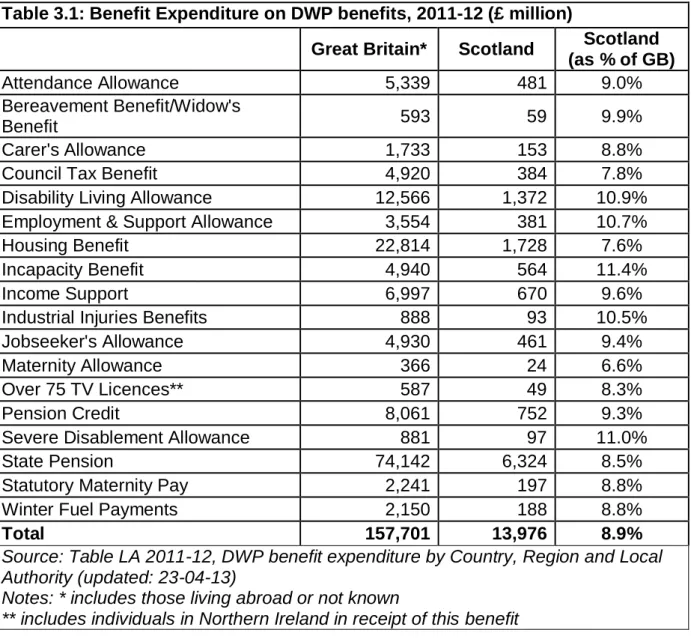
31 3.13 Table 3.1 below shows spending on individual DWP benefits in Scotland as a share of spending in Great Britain. It focuses on the main benefits administered by DWP, and so excludes some smaller benefit lines, and Tax Credits and Child Benefit which are administered by HMRC - a full list of all benefits included can be found in Chapter 2. On average, in 2011-12, 8.9 per cent of spending on DWP benefits in Great Britain went to recipients in Scotland, with this fraction varying between
benefits, ranging from 11.4 per cent for Incapacity Benefit to 7.6 per cent for Housing Benefit.
Table 3.1: Benefit Expenditure on DWP benefits, 2011-12 (£ million)
Great Britain* Scotland Scotland
(as % of GB)
Attendance Allowance 5,339 481 9.0%
Bereavement Benefit/Widow's
Benefit 593 59 9.9%
Carer's Allowance 1,733 153 8.8%
Council Tax Benefit 4,920 384 7.8%
Disability Living Allowance 12,566 1,372 10.9%
Employment & Support Allowance 3,554 381 10.7%
Housing Benefit 22,814 1,728 7.6%
Incapacity Benefit 4,940 564 11.4%
Income Support 6,997 670 9.6%
Industrial Injuries Benefits 888 93 10.5%
Jobseeker's Allowance 4,930 461 9.4%
Maternity Allowance 366 24 6.6%
Over 75 TV Licences** 587 49 8.3%
Pension Credit 8,061 752 9.3%
Severe Disablement Allowance 881 97 11.0%
State Pension 74,142 6,324 8.5%
Statutory Maternity Pay 2,241 197 8.8%
Winter Fuel Payments 2,150 188 8.8%
Total 157,701 13,976 8.9%
Source: Table LA 2011-12, DWP benefit expenditure by Country, Region and Local Authority (updated: 23-04-13)
Notes: * includes those living abroad or not known
** includes individuals in Northern Ireland in receipt of this benefit
3.14 The basis for our forecast of benefit spending in Scotland was to take this information on the historical share of benefit spending in Great Britain that is paid to people in Scotland, and apply these to the benefit-by-benefit forecasts of spending made at the Great Britain level. In other words, we have combined DWP’s forecast , of spending on each benefit (made at the time of the 2013 UK Budget) with historical
32 data on Scotland’s share of benefit spending, all at the level of the individual benefit, to produce a forecast of benefit expenditure in Scotland to 2017-18.
3.15 In some cases, historical information on the ratio of Scotland to Great Britain spending (or UK spending, for HMRC benefits) is not available. In these situations, the Scottish Government used a proxy. For example, Scotland’s share of Disability Living Allowance spending was used as a proxy for Scotland’s share of future Personal Independence Payment spending, and Housing Benefit was used for Discretionary Housing Payments. Alternatively where there was no suitable benefit to use as a proxy, the average share of 8.9 per cent was applied (this was used for the Christmas bonus, for example). Estimates based on current expenditure have been used for those benefits currently administered by the Scottish Government such as the Scottish Welfare Fund and the Council Tax Replacement scheme. 3.16 The implicit assumption behind this methodology is that the ratio of spending in Scotland to Great Britain, at the level of individual benefits, will remain at their 2011-12 levels through to 2017-18. We say more about this assumption later in the Chapter.
3.17 As well as omitting a number of smaller benefits29, Table 3.1 also omits Tax Credits and Child Benefit, both administered by HMRC. The ratio of Scotland to UK expenditure on these benefits is taken from Scottish Government estimates,
consistent with figures published by HM Treasury as part of the Country and
Regional Analysis of the Public Expenditure Statistical Analyses (PESA) publication. 3.18 Our resulting forecasts of AME benefit spending in Scotland using this
methodology are shown in Table 3.2, with how benefit expenditure is distributed across different recipient groups illustrated in Chart 3.2.
29
33 Chart 3.2 Forecast Benefit Expenditure in Scotland 2011-12 to 2017-18, nominal terms (£ billion)
34 3.19 Table 3.3 shows the forecasts of benefit expenditure produced by the UK Government (which do not include data relating to the localisation of council tax support and discretionary elements of the Social Fund). The tables show that benefit expenditure in Scotland is forecast to rise, in line with the trend at the UK level: AME expenditure on benefits in Scotland is forecast to rise by 9 per cent in nominal terms and 1 per cent in real terms between 2013-14 (the current year) and 2017-18 (the final year covered in the remit of the Group); for the UK, the projected growth is 10 per cent in nominal terms and 2 per cent in real terms. This growth is primarily driven by the economic climate and demographic changes.
35 Table 3.2: Forecast AME costs associated with welfare in Scotland 2011-12 to 2017-18 (£ billion)
2011-12 2012-13 2013-14 2014-15 2015-16 2016-17 2017-18
Nominal terms 17.1 17.9 18.1 18.4 18.8 19.2 19.7
Real terms
(2011-12 prices) 17.1 17.6 17.5 17.4 17.5 17.6 17.7
Source: Scottish Government calculation based on methodology highlighted in this report To convert figures from nominal to real terms the GDP deflator from Budget 2013 was applied.
Table 3.3: Forecast AME costs associated with welfare in GB/UK 2011-12 to 2017-18 (£ billion)
2011-12 2012-13 2013-14 2014-15 2015-16 2016-17 2017-18 outturn forecast forecast forecast forecast forecast forecast
Nominal terms 196.1 205.1 202.8 206.8 212.0 216.8 222.1
Real terms
(2011-12 prices) 196.1 202.5 195.7 195.9 197.2 198.3 199.8
Sources: OBR, Economic and Fiscal Outlook – March 2013 supplementary fiscal tables and DWP medium-term benefit forecasts as at Budget 2013, and Scottish Government calculation
Note: Figures are presented for GB/UK as expenditure for Tax Credits and Child Benefit administered by HMRC along with Over 75 TV licences includes Northern Ireland while expenditure on other benefits relates to Great Britain only. Localisation of council tax support and discretionary elements of the Social fund are not included within the UK Government’s forecasts
36
Forecasting DEL expenditure
3.20 As we discuss in Chapter 4, understanding the operating costs for benefit administration for Scotland is not straightforward, as distinct costs relating to Scotland cannot easily be disaggregated from the rest of Great Britain.
3.21 As benefits administration costs cannot be identified within GERS, we have used DWP and HMRC accounts as the basis for our forecast of benefits
administration costs in Scotland.
3.22 For administration costs relating to DWP, the 2011-12 annual report and accounts provides figures on total DEL expenditure for 2011-12 (this includes administration costs plus programme expenditure, and therefore includes
expenditure on the Work Programme and Jobcentre Plus), and the 2013 UK Budget provided data on total DEL limits to 2014-15 (i.e. for the remainder of the Spending review period)30. Beyond 2014-15, we assumed that DWP’s administration costs would grow in line with the OBR’s current forecast of how Resource DEL (RDEL) will change across all UK Government Departments, and this implies falls in real-terms of 2.7 per cent in 2015-16, 3.8 per cent in 2016-17 and 4.3 per cent in 2017-1831. We then assumed that the Scotland’s share of these future administrative costs was equal to Scotland’s share of the spending on the actual DWP benefits in 2011-12 (or 8.9 per cent).
3.23 The same methodology was used to forecast HMRC’s total DEL budget. Within HMRC’s 2011-12 annual report and accounts administration costs are estimated to be 1.55 pence per pound of Tax Credit, and 0.58 pence per pound of Child Benefit32. Using these figures, we have estimated the proportion of HMRC DEL spend on administering these two benefits across the UK. This proportion was
assumed to remain constant over the period and an estimate of the Scottish share was applied to the forecast for HMRC total DEL spend.
30
Capital DEL was excluded from these calculations. As DEL is set at each Spending Review figures for 2015-16 to 2017-18 are not yet available.
31
http://budgetresponsibility.independent.gov.uk/economic-and-fiscal-outlook-march-2013/
32
37 3.24 Taking DWP and HMRC administration costs together, the total DEL costs for administering benefits in Scotland are forecast to remain broadly constant at
£0.7 billion each year to 2017-18. The implicit assumption behind this way of producing a forecast is that the cost of administering benefits in Scotland is no higher, per pound of benefits paid to claimants, than it is across Great Britain at present.
Total costs
3.25 Tables 3.4 to 3.7 show the overall forecast of benefit spending in Scotland, including both DEL and AME. It shows that, by 2017-18, expenditure on the welfare system in Scotland, including the additional costs of Universal Credit, will amount to £20.3 billion. Table 3.6 and 3.7 show the equivalent forecasts for GB/UK.
38 Table 3.4: Forecast costs associated with welfare in Scotland 2011-12 to 2017-18 (£ billion), nominal
terms
2011-12 2012-13 2013-14 2014-15 2015-16 2016-17 2017-18 Based on current costs
AME expenditure 17.1 17.9 18.1 18.4 18.8 19.2 19.7
DEL expenditure 0.7 0.7 0.7 0.7 0.7 0.7 0.6
Total current costs 17.8 18.5 18.8 19.1 19.5 19.9 20.3
Additional costs of Universal Credit
OBR forecasts - - 0.0 0.0 0.0 0.0 0.0
Total 17.8 18.5 18.8 19.1 19.5 19.9 20.3
Sources: Scottish Government Calculations based on methodology highlighted in this report and OBR Economic and Fiscal Outlook March 2013
Notes: Numbers have been rounded to nearest £0.1 billion; numbers may not sum due to rounding; “-“ indicates that there is no data available while ‘0.0’ indicates that there is a value but that it rounds to less than £0.1 billion.
Table 3.5: Forecast costs associated with welfare in Scotland 2011-12 to 2017-18 (£ billion), real terms - 2011-12 prices
2011-12 2012-13 2013-14 2014-15 2015-16 2016-17 2017-18 Based on current costs
AME expenditure 17.1 17.6 17.5 17.4 17.5 17.6 17.7
DEL expenditure 0.7 0.7 0.7 0.7 0.6 0.6 0.6
Total current costs 17.8 18.3 18.1 18.1 18.2 18.2 18.3
Additional costs of Universal Credit
OBR forecasts - - 0.0 0.0 0.0 0.0 0.0
Total 17.8 18.3 18.1 18.1 18.2 18.2 18.3
Sources: Scottish Government Calculations based on methodology highlighted in this report and OBR Economic and Fiscal Outlook March 2013
Notes: Numbers have been rounded to nearest £0.1 billion; numbers may not sum due to rounding; “-“ indicates that there is no data available while ‘0.0’ indicates that there is a value but that it rounds to less than £0.1 billion. To convert figures from nominal to real terms the GDP deflator from Budget 2013 was applied.
39 Table 3.6: Forecast costs associated with welfare in GB/UK 2011-12 to 2017-18 (£ billion), nominal
terms
2011-12 2012-13 2013-14 2014-15 2015-16 2016-17 2017-18 outturn forecast forecast forecast forecast forecast forecast Based on current costs
AME expenditure 196.1 205.1 202.8 206.8 212.0 216.8 222.1
DEL expenditure 8.1 7.5 8.0 7.8 7.7 7.6 7.4
Total current costs 204.2 212.7 210.8 214.7 219.8 224.4 229.5
Additional costs of Universal Credit
OBR forecasts - - 0.0 0.0 0.1 0.3 0.3
Total 204.2 212.7 210.8 214.7 219.9 224.6 229.8
Sources: OBR, Economic and Fiscal Outlook – March 2013 supplementary fiscal tables and DWP medium-term benefit forecasts as at Budget 2013, and Scottish Government calculation
Note: Numbers have been rounded to nearest £0.1 billion; numbers may not sum due to rounding; “-“ indicates that there is no data available while ‘0.0’ indicates that there is a value but that it rounds to less than £0.1
billion.
Note: Figures are presented for GB/UK as expenditure for Tax Credits and Child Benefit administered by HMRC along with Over 75 TV licences includes Northern Ireland while expenditure on other benefits relates to Great Britain only.
Localisation of council tax support and discretionary elements of the Social Fund are not included within the UK Government’s forecasts
40 Table 3.7: Forecast costs associated with welfare in GB/UK 2011-12 to 2017-18 (£ billion), real terms -
2011-12 prices
2011-12 2012-13 2013-14 2014-15 2015-16 2016-17 2017-18 outturn forecast forecast forecast forecast forecast forecast Based on current costs
AME expenditure 196.1 202.5 195.7 195.9 197.2 198.3 199.8
DEL expenditure 8.1 7.4 7.8 7.4 7.2 6.9 6.6
Total current costs 204.2 210.0 203.4 203.3 204.4 205.2 206.4
Additional costs of Universal Credit
OBR forecasts - - 0.0 0.0 0.1 0.3 0.3
Total 204.2 210.0 203.4 203.3 204.5 205.5 206.7
Sources: OBR, Economic and Fiscal Outlook – March 2013 supplementary fiscal tables and DWP medium-term benefit forecasts as at Budget 2013, and Scottish Government calculation
Note: Numbers have been rounded to nearest £0.1 billion; numbers may not sum due to rounding; “-“ indicates that there is no data available while ‘0.0’ indicates that there is a value but that it rounds to less than £0.1
billion.
Note: Figures are presented for GB/UK as expenditure for Tax Credits and Child Benefit administered by HMRC along with Over 75 TV licences includes Northern Ireland while expenditure on other benefits relates to Great Britain only.
Localisation of council tax support and discretionary elements of the Social Fund are not included within the UK Government’s forecasts
41
Assumptions and uncertainties
3.26 As with any piece of financial forecasting, the forecasts in this Report are based on assumptions. The main assumptions relate to economic growth and demographic change that underpin the UK Government’s forecasts of benefit expenditure for the UK. However, in order to produce our forecast of benefit spending in Scotland, we have had to make additional assumptions.
3.27 Our first main assumption is that the ratio of spending on benefits in Scotland to that in Great Britain remains constant. In the event of divergences in the economic conditions or the demographic structure between Scotland and the rest of the UK, then forecasts would need to be revisited33.
3.28 Table 3.8 shows the ratio of spending on DWP benefits in Scotland to that in Great Britain, based on available data for the past five years. This has been used to produce average benefit ratios for (a) the past five years and (b) the past three years.
3.29 If the five year average ratios of spending on DWP benefits in Scotland to that in Great Britain were used to forecast benefit spending for Scotland, this would produce a slightly higher forecast of benefit spending in Scotland than our main forecast. However, the ratio of spending on DWP benefits in Scotland to that in Great Britain has in actual fact gradually fallen very slightly since peaking at 9.7 per cent in 2002-03. If we had assumed that such a trend were to continue, then that would have produced a forecast of benefit spending in Scotland that is slightly lower than the figure identified in this report.
3.30 This illustrates the dependency of forecasting on the use of assumptions and how changing the assumptions can produce slightly different results. For example, if the ratio of spending on DWP benefits in Scotland to that in Great Britain were to change by 0.2 percentage points (i.e. to fall to 8.7 per cent or rise to 9.1 per cent),
33 We note that the economic forecasts underpinning the UK Government’s forecasts are made at the UK level, and ignore any variation between the nations of the UK.
42 then this would change our forecast of benefit spending in Scotland by no more than 2 per cent.
Table 3.8: Ratio of Scottish Benefit Expenditure as a proportion of Great Britain for DWP benefits, base year 2011-12
5 year average (2007-08 to 2011-12) 3 year average (2009-10 to 2011-12) 1 year (2011-12)
Attendance Allowance 9.3% 9.2% 9.0%
Bereavement Benefit/Widow's
Benefit 10.0% 9.9% 9.9%
Carer's Allowance 9.1% 8.9% 8.8%
Council Tax Benefit 8.3% 7.9% 7.8%
Disability Living Allowance 11.1% 11.0% 10.9%
Employment & Support Allowance** 10.5% 10.3% 10.7%
Housing Benefit 7.9% 7.7% 7.6%
Incapacity Benefit 11.6% 11.5% 11.4%
Income Support 9.8% 9.7% 9.6%
Industrial Injuries Benefits 10.4% 10.5% 10.5%
Jobseeker's Allowance 9.1% 9.2% 9.4%
Maternity Allowance 7.6% 7.3% 6.6%
Over 75 TV Licences*** 8.5% 8.5% 8.3%
Pension Credit 9.7% 9.5% 9.3%
Severe Disablement Allowance 11.0% 11.0% 11.0%
State Pension 8.6% 8.6% 8.5%
Statutory Maternity Pay 8.8% 8.8% 8.8%
Winter Fuel Payments 8.8% 8.7% 8.8%
Total 9.0% 8.9% 8.9%
Source: Table LA 2011-12, DWP benefit expenditure by Country, Region and Local Authority - updated 23-04-13, Scottish Government Calculation
Notes: * Data for Great Britain includes those living abroad or not known
** Employment Support Allowance introduced in 2008/09, so a four year average is represented
*** Great Britain figure includes individuals in Northern Ireland in receipt of this benefit
3.31 Our second main assumption is that, beyond 2014-15, the costs of
administering benefits will grow at the same rate as all areas of DEL spending, and that the costs of administering benefits in Scotland are identical, per pound of benefit spending, to the costs at the Great Britain level. As the costs of administering the benefits system are a small fraction of the total forecast costs of benefits spending in Scotland small changes in our forecasting assumptions will not have any significant impact on overall costs.
43 3.32 Finally, we also note that forecasts of benefit spending at the UK level are particularly uncertain at the moment given the pace and scope of reforms to the benefit system, and that little is known about whether these reforms will have greater or lesser impact in Scotland from the rest of the UK.
Conclusions
3.33 This Chapter presents a preliminary forecast for Scotland of the costs of paying benefits, and the costs to government of administering these benefits and other administrative costs associated with wider DWP services, such as Jobcentre Plus.
3.34 We believe that these preliminary forecasts are a reasonable estimate of the costs of benefit spending and related administrative costs, given the information currently available to the Scottish Government. These forecasts could be improved if the Office for Budget Responsibility produced economic forecasts for each of the nations of the UK; if the Scottish Government had access to data and models owned by DWP; or if DWP and HMRC would undertake a bespoke forecast of benefit and tax credit spending in Scotland.
3.35 In the event of independence, we recommend that the Scottish Government builds its capacity to forecast benefit spending and to assess the impact of changes in the benefit system on individuals and households in Scotland. It could do this by building its own models, acquiring copies of existing models, or buying services from another organisation.
3.36 We also recommend that the Scottish Government and UK Government begin discussions immediately about sharing historical DWP and HMRC administrative data for Scotland and DWP’s and HMRC’s modelling tools. This will provide the Scottish Government with a rich source of historical information on trends in benefit spending in Scotland which could be used to produce more detailed forecasts. We believe that there would be an advantage to both the UK Government and the Scottish Government if accurate forecasts of benefit spending in Scotland were regularly prepared and published irrespective of the result of the Referendum.
44
4
DELIVERY AND TRANSITION
Chapter Summary
In this Chapter we set out our understanding, based on the evidence available to us, of the role Scotland plays in the delivery of the current UK benefits system. We conclude that, in the event of a “Yes” vote, the Scottish and United Kingdom Governments have a strong common interest in working together, as envisaged by Article 30 of the Edinburgh Agreement, to support each other in maintaining the delivery of benefit payments during an agreed period of transition.
We believe that this common interest is underpinned by an obligation to ensure continuity of service to benefit claimants across the nations of the United Kingdom. We also believe that formalising the current arrangements into an agreed set of ‘shared services’ would safeguard delivery, as well as being the most efficient and cost effective arrangement for both Governments in a period of transition.
Finally, given the important role that Scotland currently plays in delivering benefits to claimants in the rest of the UK (as illustrated at paragraph 4.27), we believe it is the interests of both the Scottish and UK Governments to introduce a programme of information sharing and begin discussions about how benefits would continue to be delivered for all claimants in the UK in the event of Scottish independence.
Introduction
4.1 The Department for Work and Pensions (DWP) carries out the majority of the functions necessary to deliver benefit payments to people living in Scotland.
HM Revenue and Customs is responsible for the administration of Child Benefit and Tax Credits.
45 4.2 With effect from 3 October 201134, DWP dissolved its two executive agencies (Jobcentre Plus and The Pension, Disability and Carers Service) and returned their functions back to the Department. The DWP also took over responsibility for child maintenance from 1 August 2012, a system previously administered by the Child Maintenance and Enforcement Commission which was abolished on 31 July 201235. 4.3 In this Chapter we look at how benefits are delivered across Scotland and the role of DWP operations in Scotland. We consider how the Scottish Government would deliver benefits payments in the event of a “Yes” vote for independence, and provide our views on the main transitional issues.
4.4 The information presented in this Chapter is based on the evidence we have been able to gather in the time available to us. Through Requests for Information and follow-up queries, we also invited DWP, HMRC and COSLA to provide more detailed information to support the evidence we gathered. We took due account of this information in our discussions and it is reflected in this Chapter.
The administration of working age benefits in and from Scotland
4.5 The administration of working age benefits – in other words, where claims are assessed and decisions made on how much benefit is awarded – is allocated to DWP centres across the UK on a combination of geographical and benefit category basis. For smaller items of work, there are centres of expertise in certain offices which service the whole of the UK.
4.6 In response to our Request for Information, the DWP confirmed that Scotland does not ‘export’ any of its work for Jobseekers Allowance, Employment and Support Allowance, Income Support and Incapacity Benefit. In other words, all claims for these benefits made by people living in Scotland are processed in Scotland.
4.7 DWP’s response confirmed that just over 40 per cent of all claims processed in Scotland are claims made by people living in England. DWP also indicated that on
34
https://www.gov.uk/government/uploads/system/uploads/attachment_data/file/183222/cmec-report-and-accounts-to-july-2012.pdf.pdf
35
46 a permanent basis Scotland processes the following claims for people living outside Scotland:
Parts of Yorkshire - Jobseekers Allowance, Employment and Support Allowance, Income Support and Incapacity Benefit.
Parts of the North West of England - Jobseekers Allowance, Employment and Support Allowance, Income Support and Incapacity Benefit.
London - Jobseekers Allowance, and Employment and Support Allowance.
4.8 Scotland is also home to the largest working-age benefit centre in the UK, Northgate Benefit Centre in Glasgow. We understand that Northgate currently employs in excess of 1,000 full time equivalent (FTE) members of staff and undertakes much of the English processing activity mentioned above. We also understand that Northgate may process a range of other claims for people living outside Scotland. This could be on a temporary basis, however DWP was unable to provide temporary caseload data or indicate what benefits/volumes such temporary processing activity covered.
4.9 In addition, Northgate carries out certain GB-wide functions: the DWP’s national team for decision making and appeals under the Mandatory Work Activity Programme is based there36; and since April Northgate has been supporting the Universal Credit Pathfinder37.
4.10 DWP confirmed that the remaining benefit processing centres located in Scotland are based in: Aberdeen; Bathgate; Clydebank; Coatbridge; Inverness; Kirkcaldy; Kilmarnock; Saltcoats; Springburn; and Stornoway.
4.11 There are also 94 Jobcentre Plus (JCP) offices servicing Scotland38,39. Jobcentre Plus provides resources to enable people of working age find work and helps employers find new staff. In terms specifically of benefit administration,
36
http://www.dwp.gov.uk/docs/mwa-memo-lr10.pdf 37
http://www.cywp.org.uk/wp-content/uploads/2013/03/Department-for-Work-and-Pensions-Our-Reform-Story.ppt 38
http://www.publications.parliament.uk/pa/cm201213/cmhansrd/cm130416/text/130416w0001.htm 39
47 unemployed individuals can be supported in making a new claim for benefits in a JCP office and find out about the progress of an existing claim.
4.12 DWP Contact Centres provide a wide range of services via the telephone, which include helping claimants find work, claim a wide range of benefits and
pensions, as well as enabling employers to place vacancies. In response to a follow-up enquiry DWP confirmed that there are three Customer Contact Centres in
Scotland: Dundee, Paisley and Springburn.
The administration of non-working age benefits in and from
Scotland
4.13 There are nine Regional Pension Centres across Great Britain40 and one National Centre in Newcastle. The National Centre provides two UK-wide services: the Futures Pensions Service, providing state pension statements and information, and the International Pensions Centre which provides advice and information about claiming pensions and benefits to those people living abroad or who have lived abroad41.
4.14 There are two Pensions Centres in Scotland: Motherwell and Dundee. In response to our Request for Information, DWP has confirmed that there 849 FTEs employed in Scotland processing claims for State Pension and Pension Credit. The number of employees working in the Scottish Pension Centres could be greater, however, given that other services are delivered from these sites (such as the Bereavement Service).
4.15 There are 12.8 million people in receipt of State Pension across Great Britain, including 1.1 million overseas state pensioners. In Scotland just over one million people are in receipt of a State Pension42. There are 2.5 million people in receipt of Pension Credit across Great Britain, around 250,000 of whom live in Scotland43.
40
https://www.gov.uk/government/uploads/system/uploads/attachment_data/file/175084/eia-virtuality-pension-service-telephony.pdf.pdf
41
https://www.gov.uk/state-pension-if-you-retire-abroad/how-to-claim
42
http://83.244.183.180/100pc/sp/ccgor/cat/a_carate_r_ccgor_c_cat_nov12.html 43