Close the Gap
Campaign
Progress and
priorities report
Acknowledgements
This report is a collaborative effort of the Close the Gap Campaign Steering Committee. Funding for, and project management of, the report was provided by Oxfam Australia.
Author: Christopher Holland.
Editors: Andrew Gargett, Senior Policy Officer, Australian Human Rights Commission and Executive Officer, Close the Gap Campaign Steering Committee Secretariat and National Health Leadership Forum Secretariat; Dr Peter Lewis, Aboriginal and Torres Strait Islander Peoples Rights Advocacy Lead, Oxfam Australia.
Editorial assistance:
Roxanne Moore, Research and Project Officer, Australian Human Rights Commission.
Design and layout:
Lisa Thompson, JAG Designs.
Printing:
Paragon Australasia Group.
Published by:
The Close the Gap Campaign Steering Committee, February 2015.
© Close the Gap Campaign Steering Committee for Indigenous Health Equality, 2015.
This work is licensed under the Creative Commons Attribution – NonCommercial – ShareAlike 2.5 Australia License. To view a copy of this license, visit:
http://creativecommons.org/licenses/ by-nc-sa/2.5/au or send a letter to Creative Commons, 171 Second Street, Suite 300, San Francisco, California, 94105, USA.
Copies of this report and more information are available to download at: www.humanrights.gov.au/social_ justice/health/index.html and www.oxfam.org.au/closethegap Cover photograph:
Peter Djandjomerr at Ubir Rock art site in Kakdu National Park, NT. Peter runs the Morle Boys program for Children’s Ground in Jabiru, NT. Photograph: Jason Malouin/OxfamAUS.
Contents
Executive summary 1
Introduction 4
The Close the Gap Statement of Intent 5
Chapter 1:
Progress in the national effort to close the gap –
health outcomes
6
1.1 Progress towards achieving the life expectancy target 7 1.2 New insights into chronic disease and the high rates
of undetected and untreated conditions 9
1.3 Risk factors for chronic disease 11
1.4 Progress towards achieving the child (under-five)
mortality target 16
Chapter 2:
Developments in policy
20
2.1 Proposed changes in Commonwealth-State relations
and their impact on the Closing the Gap Strategy 21 2.2 The Indigenous Advancement Strategy and the
Closing the Gap Strategy 25
2.3 Potential negative impact of proposed Budget measures 27
Chapter 3:
Establishing effective pathways for positive change –
an analysis by the Campaign Steering Committee
30
3.1 Staying to the path 31
3.2 The role of culture 32
3.3 Including access to services as a measure of success 33 3.4 Building on the strengths of Aboriginal Community
Controlled Health Services 35
3.5 Building an Aboriginal and Torres Strait Islander health
workforce 37 3.6 Addressing mental health and suicide prevention as a
new priority focus 38
3.7 A target to reduce imprisonment rates 40 3.8 Health in all Aboriginal and Torres Strait Islander policy
approach 41 3.9 The implementation of the National Aboriginal and Torres
Strait Islander Health Plan 42
Conclusion 43
Who we are 44
Aboriginal and Torres Strait Islander people should be aware that this document may contain images or names of people who have since passed away.
Executive summary
The Campaign Steering Committee welcomes the absolute gains in Aboriginal and Torres Strait Islander life expectancy from 2005–2007 to 2010–2012. Over that five-year period, life expectancy is estimated to have increased by 1.6 years for males and by 0.6 of a year for females. But a life expectancy gap of around ten years remains for Aboriginal and Torres Strait Islander people when compared with non-Indigenous people.
Both the modesty of the gains, and the magnitude of the remaining life expectancy gap remind us why the Council of Australian Governments’ (COAG) Closing the Gap Strategy and the target to close the life expectancy gap was needed. It remains necessary today. But we must also keep in mind that closing the life expectancy gap requires time. The Closing the Gap Strategy was operationalised in July 2009 and the latest data we have is from 2012–2013. This is too short a time to adequately assess the progress of this Strategy in achieving outcomes.
Instead, the Campaign Steering Committee look to reductions in smoking rates, improvements to maternal and child health outcomes and demonstrated inroads into the impact of chronic diseases as evidence that the Closing the Gap Strategy is working.
The findings of the National Aboriginal and Torres Strait Islander Health Measures Survey (NATSIHMS), the largest biomedical survey ever conducted among Aboriginal and Torres Strait Islander people, are critical. The survey identified high levels of Aboriginal and Torres Strait Islander people with undetected treatable and preventable chronic conditions that impact significantly on life expectancy. Armed with this data, the Campaign Steering Committee believes the nation now has an enhanced ability to make relatively large health and life expectancy gains in relatively short periods of time.
To do this, there needs to be a much greater focus on access to appropriate primary health care services to detect, treat and manage these conditions. And the evidence is that Aboriginal Community Controlled Health Services (ACCHS) provide the best returns on investment in terms of providing both access to health services and the quality of those services.
As such, this report affirms the need to keep on track with the Closing the Gap Strategy and, with patience, many indicators suggest improvements to life expectancy will be seen in time. Any reduction in effort or momentum will squander the investment we have made as a nation up until now.
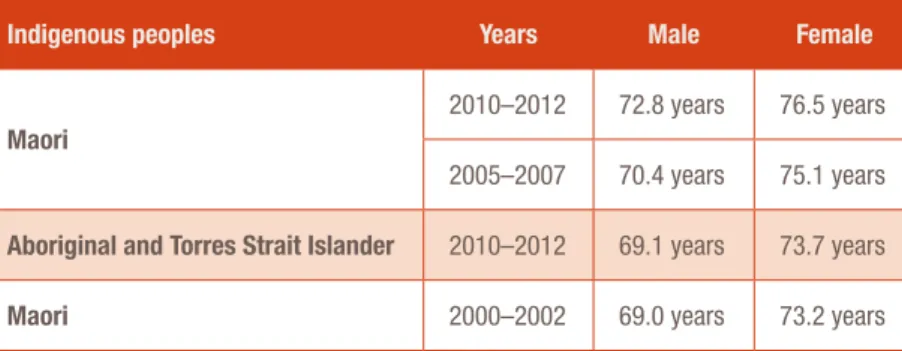
The comparison between the life expectancy of Maori peoples and Aboriginal and Torres Strait Islander peoples is illustrative. In 2010–12 an increase of approximately four years has been reported for the Maori life expectancy over the previous decade. But this occurred after two decades of effort in New Zealand. This demonstrates that substantial change is possible but it takes sustained and continuous effort.
The Campaign Steering Committee emphasises the need to ensure that potential changes in Commonwealth-State relations do not have the unintended effect of undermining the Closing the Gap Strategy. While recognising that all jurisdictions have a responsibility to contribute, the Campaign Steering Committee firmly supports the Australian Government’s continuing leadership role in an overall national approach.
The Campaign Steering Committee recognises the value in the new Indigenous Affairs priorities of the Australian Government: education, employment and community safety. But there are concerns. In particular, a clearer connection between the Indigenous Advancement Strategy and the Closing the Gap Strategy will enhance both policies. Employment, education and community safety are drivers of improved health and wellbeing. However, good health is equally important to employment, education and community safety. Further, the health sector is the biggest employer of Aboriginal and Torres Strait Islander people and increased investment in health services will result in increased employment.
The Campaign Steering Committee is also concerned that hard won Aboriginal and Torres Strait Islander health gains could be negatively impacted by proposed measures contained in the 2014–15 Budget. Potential cuts to the Tackling Indigenous Smoking programme are of particular concern and could hinder the significant progress made in reducing Aboriginal and Torres Strait Islander smoking rates in recent years. Investment in early prevention activities saves on the provision of complex care into the future. These programmes also address and have started to make inroads into primary prevention, particularly in healthy eating, nutrition and physical activity. The development of the Implementation Plan for the National Aboriginal and Torres Strait Islander Health Plan (Health Plan) will be pivotal in our shared efforts to close the gap. It provides an opportunity to increase the quality and efficiency of services, address service gaps by building on the existing capacity of ACCHS, and to expand the Aboriginal and Torres Strait Islander health workforce.
The Campaign Steering Committee remains steadfast in its belief that the road to closing the health gap is embodied in the Close the Gap Statement of Intent signed by the Australian Government and most state and territory governments. The Close the Gap Statement of Intent commits parties to genuine partnerships with Aboriginal and Torres Strait Islander peoples, ensuring appropriate evidence based health services, strengthening the ACCHS sector, effective planning and the use of targets, and addressing the social determinants of health.
The Close the Gap Campaign Steering Committee recommends:
1. That the findings of the National Aboriginal and Torres Strait Islander Health Measures Survey (NATSIHMS) are used to better target chronic conditions that are undetected in the Aboriginal and Torres Strait Islander population. In particular, access to appropriate primary health care services to detect, treat and manage these conditions should be increased. Aboriginal Community Controlled Health Services should be the preferred services for this enhanced, targeted response.
2. That the Australian Government should continue to lead the COAG Closing the Gap Strategy.
3. That the Australian Government revisit its decision to discontinue the National Indigenous Drug and Alcohol Committee.
4. That connections between the Indigenous Advancement Strategy and the Closing the Gap Strategy are clearly articulated and developed in recognition of their capacity to mutually support the other’s priorities, including closing the health and life expectancy gap.
5. That the Tackling Indigenous Smoking programme is retained and funding is increased above current levels to enable consolidation, improvement and expansion of activities until the gap in the rates of smoking between Aboriginal and Torres Strait Islander and non-Indigenous people closes.
6. That proxy indicators are developed to provide insights into the use and availability of health services on Aboriginal and Torres Strait Islander health and life expectancy outcomes.
7. The National Strategic Framework for Aboriginal and Torres Strait Islander Peoples’ Mental Health and Social and Emotional Wellbeing provides the basis for a dedicated Aboriginal and Torres Strait Islander mental health and social and emotional wellbeing plan. This is developed and implemented with the National Aboriginal and Torres Strait Islander Health Plan, the National Aboriginal and Torres Strait Islander Suicide Prevention Strategy 2013 and the National Aboriginal and Torres Strait Islander Peoples’ Drug Strategy implementation processes in order to avoid duplication, be more efficient, and maximise opportunities in this critical field.
8. That Closing the Gap Targets to reduce imprisonment and violence rates are developed, and activity towards reaching the Targets is funded through justice reinvestment measures.
9. That the Implementation Plan for the National Aboriginal and Torres Strait Islander Health Plan include the essential elements:
• Set targets to measure progress and outcomes;
• Develop a model of comprehensive core services across a person’s whole of life;
• Develop workforce, infrastructure, information management and funding strategies based on the core services model;
• A mapping of regions with relatively poor health outcomes and inadequate services. This will enable the identification of services gaps and the development of capacity building plans;
• Identify and eradicate systemic racism within the health system and improve access to and outcomes across primary, secondary and tertiary health care;
• Ensure that culture is reflected in practical ways throughout Implementation Plan actions as it is central to the health and wellbeing of Aboriginal and Torres Strait Islander people;
• Include a comprehensive address of the social and cultural determinants of health; and
• Establish partnership arrangements between the Australian Government and state and territory governments and between ACCHS and mainstream services providers at the regional level for the delivery of appropriate health services.
Introduction
In March 2008, the then Australian Government and Opposition signed the Close the Gap Statement of Intent, committing to closing the health and life expectancy gap between Aboriginal and Torres Strait Islander people and non-Indigenous Australians by 2030. All Australian
governments ratified this commitment when the Council of Australian Governments (COAG) set the Closing the Gap Targets found in the National Indigenous Reform Agreement and the Closing the Gap Strategy.
In April 2008, the then Australian Government (subsequently supported by the then Opposition) further committed to the Prime Minister providing an annual report to Parliament on progress towards closing the gap. This report would focus on the progress made in reaching the COAG Closing the Gap Targets. The report, by tradition, occurs in the first sitting week of Parliament, symbolically reminding the parliament and the nation of the importance of our collective efforts to close the gap.
In the spirit of an open and constructive dialogue between government, the wider community, and Aboriginal and Torres Strait Islander peoples, the Close the Gap Campaign annually produces this progress and priorities report alongside the Prime Minister’s report.
The
Close the Gap Statement of Intent
The Close the Gap Statement of Intent was signed on 20 March 2008 by Hon. Kevin Rudd MP (then Prime Minister); Hon. Nicola Roxon MP (then Minister for Health and Ageing); Hon. Jenny Macklin MP (then Minister for Families, Housing, Community Services and Indigenous Affairs); and Dr Brendan Nelson MP (then Opposition Leader).
Most state and territory governments and oppositions have also signed the Close the Gap Statement of Intent, including Victoria in March 2008; Queensland in April 2008; Western Australia in April 2009; the Australian Capital Territory in April 2010; New South Wales in June 2010; and South Australia in November 2010. A variety of non-government organisations including Campaign Steering Committee members, health bodies, human rights groups and community development organisations have also signed the Close the Gap Statement of Intent at both a national and state/ territory level demonstrating broad community support for these principles.
The report comprises three chapters:
Chapter 1: Progress in the national effort to close the gap examines health outcomes as revealed by data in the last twelve months. It demonstrates that gradual improvements are beginning to be evidenced in key Aboriginal and Torres Strait Islander health outcomes. Chapter 2: Developments in policy assesses proposals for federal relations reform, changes to the Closing the Gap Strategy, the Indigenous Advancement Strategy and other developments.
Chapter 3: Establishing effective pathways for positive change – an analysis by the Campaign Steering Committee sets out the Campaign’s ideas for enhancing the Closing the Gap Strategy and improving Aboriginal and Torres Strait Islander health outcomes over the next few years.
Progress in the national effort to
close the gap – health outcomes
National Close the Gap Day celebrations at Royal Prince Alfred Hospital, Sydney, NSW. Photograph: Michael Myers/OxfamAUS.
1
This chapter considers Australian governments’ progress towards meeting the COAG Closing the Gap health targets: that is, to achieve life expectancy equality between Aboriginal and Torres Strait Islander people and non-Indigenous Australians by 2030; and to halve Aboriginal and Torres Strait Islander deaths among children ages 0-4 years by 2018.2
Primary references include the COAG Reform Council’s final report,
Indigenous Reform 2012–13: Five years of Performance,3 and the Productivity
Commission’s report, Overcoming Indigenous Disadvantage 2014 (OID 2014 Report).4 Both reports measure progress against the above targets, the latter
in the context of many other indicators.
Also considered are the results of the 2012–2013 Australian Bureau of Statistics (ABS) NATSIHMS5 – the first national biomedical survey for
Aboriginal and Torres Strait Islander people, and some challenging research into closing the diabetes gap.6
1.1 Progress towards achieving the life expectancy
target
(a) Absolute gains
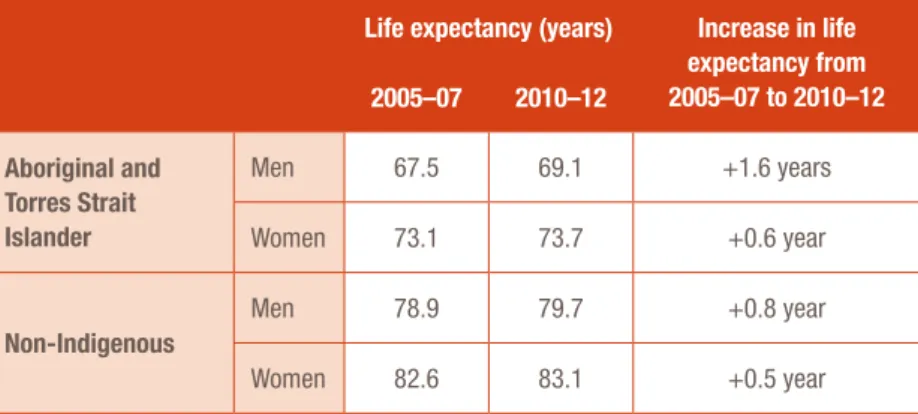
The ABS 2010–2012 life expectancy estimates for Aboriginal and Torres Strait Islander people are still current: 69.1 years for men and 73.7 years for women.7 Table 1 summarises the absolute gains in life expectancy from
2005–07 and 2010–12 for both Aboriginal and Torres Strait Islander people and non-Indigenous people, disaggregated by gender.
Table 1: Changes in Aboriginal and Torres Strait Islander and non-Indigenous
life expectancy over 2005–07 and 2010–12, disaggregated by gender
8Life expectancy (years) Increase in life expectancy from 2005–07 to 2010–12 2005–07 2010–12
Aboriginal and Torres Strait Islander
Men 67.5 69.1 +1.6 years
Women 73.1 73.7 +0.6 year
Non-Indigenous
Men 78.9 79.7 +0.8 year
Women 82.6 83.1 +0.5 year
The Campaign Steering Committee welcomes the absolute gains in
estimated Aboriginal and Torres Strait Islander life expectancy. These are ‘on-the ground’ improvements to ‘on-the lives of Aboriginal and Torres Strait Islander peoples and should not be underestimated. Another year a father can spend with his son, or a grandmother with her grandchildren, or a trusted Elder guiding the life of their community, is to be treasured.
In Chapter 3 of this report, an illustrative comparison between the life expectancy of the Maori peoples and Aboriginal and Torres Strait Islander peoples is provided. A four-year rise in Maori life expectancy was achieved between 2000–02 and 2010–12.
Closing the Gap has always been a bipartisan goal and, as such, our successes and failures are always shared.1
Prime Minister Abbott, Prime Minister’s Report on Closing the Gap 2014
This positive outcome was the result of two decades of sustained national effort.9 The Campaign
Steering Committee believes that Aboriginal and Torres Strait Islander peoples could make similar absolute gains before the early 2020s if the effort to close the gap in this country is maintained. Large absolute gains will be particularly possible with a much greater focus on increasing access to appropriate health services. This need will be addressed throughout this report.
However, as important and welcome as absolute gains are, the focus of the Closing the Gap Strategy must remain on achieving relative gains. Closing the gap is a priority health, social justice and human rights issue in Australia.
(b) Relative gains
Over 2005–2007 and 2010–2012 the life expectancy gap for Aboriginal and Torres Strait Islander men closed by 0.8 years, and for women by only 0.1 years.10 The small relative gain was a result of
the gains in life expectancy made by non-Indigenous people. Indeed, such small relative gains are within the margin for error and could in fact be non-existent.11
In its final report, the COAG Reform Council concluded that the nation is not on track to meet the 2030 COAG life expectancy equality target and that larger absolute and relative gains are needed in future years.12 They highlight particular concerns nationally for Aboriginal and Torres Strait Islander
women’s life expectancy, and for Northern Territory Aboriginal and Torres Strait Islander residents.13
(c) Being realistic about big picture change
The 2010–2012 life expectancy estimate is akin to a baseline – against which progress can be measured until 2030. This is because the 2010–2012 data is better understood as reflecting life expectancy prior to the Closing the Gap Strategy: in such a short period of time (since the strategy became operational in July 2009), no significant changes or ‘instant results’ should be expected.
Cardiovascular disease and the time required to yield results
Cardiovascular disease, the single biggest killer of Aboriginal and Torres Strait Islander people, is illustrative of the need for time to yield results. The COAG Reform Council reports that, in the five states where data is reliable, 26.1 percent of Aboriginal and Torres Strait Islander deaths were caused by cardiovascular disease in 2007–11.14 In 2009–2011,
the age-adjusted cardiovascular disease death rate for Aboriginal and Torres Strait Islander people was 1.3 times as high as that for non-Indigenous people.15
Over the twentieth century, cardiovascular disease mortality in Australia reached a peak in the late 1960s. Rates began to decline steadily in both sexes from 1970.16 Between 1981 and
2011, the cardiovascular disease death rate for males fell by 71 percent – a 4.2 percent average annual decline. The female rate fell by 67 percent – a 3.8 percent average annual decline.17
The Australian Institute of Health and Welfare (AIHW) estimates that if cardiovascular disease death rates had remained at their 1968 peak, there would have been 190,223 deaths for cardiovascular disease in 2011 – more, in fact, than the number of deaths from all causes in that year.18 The actual number of cardiovascular disease deaths that occurred
in 2011 was 45,622.19
The AIHW attributes the decline in about equal measure to improved diagnosis and treatment of cardiovascular disease, as well as lowering of the rates of smoking and hypertension among the general population over that 50-year period.20 As such, a relatively
long ‘lag period’ can be expected until that change is reflected in available data. For example, studies suggest that it takes from between two and six years after quitting for a smoker’s risk of cardiovascular disease returning to a level similar to that of a non-smoker.21
Cardiovascular disease is one area where targeted improvements could result in significant health benefits. In particular, when presenting to hospitals with acute coronary syndrome, Aboriginal and Torres Strait Islander peoples do not receive equivalent care as other Australians. A landmark study by the AIHW showed there were twice as many in-hospital death rates, a 40 percent lower rate of angiography, a 40 percent lower rate of coronary angioplasty or stent procedures and 20 percent lower rate of coronary artery bypass surgery.22 Addressing this access to service
differential is a critical task at hand.
A study by Hoy and colleagues further demonstrates this point. The study found that non-violent Aboriginal and Torres Strait Islander deaths with chronic disease can be halved in just over three years, through systematic application of currently available therapies.23 Programmes like these
can be enormously effective, save lives and reduce health costs over the long-term as well as providing benefits from individual, family and community perspectives. But there are no shortcuts. These results depend on well-run and adequately resourced health services being accessible to Aboriginal and Torres Strait Islander people.
1.2 New insights into chronic disease and the high rates of
undetected and untreated conditions
The results of the NATSIHMS, the largest biomedical survey ever conducted among Aboriginal and Torres Strait Islander people (with around 3,300 participants), was released in September 2014.24
The results are sobering. However, they provide a strong indication that gains to health and life expectancy are possible through targeted and enhanced primary health services that are able to prevent, detect, treat and support the management of chronic diseases.
(a) High levels of treatable and preventable conditions
The NATSIHMS reported that Aboriginal and Torres Strait Islander people were, when compared to non-Indigenous people:
• More than three times as likely to have diabetes (rate ratio of 3.3);25
• Twice as likely to have signs of chronic kidney disease (rate ratio of 2.1),26 and more than
four times as likely to be in the advanced stages of chronic kidney disease (Stages 4-5);27
and
• Nearly twice as likely to have a high amount of triglycerides in their blood – a risk factor for cardiovascular disease (rate ratio 1.9).28
The survey also found significant differences across remoteness areas. In particular, when compared with those living in urban areas, Aboriginal and Torres Strait Islander participants in remote areas were two and a half times as likely to have signs of chronic kidney disease (33.6 percent compared with 13.1 percent).29
(b) Compounding nature of chronic disease and high rates of comorbidities
The NATSIHMS also highlighted the compounding nature of chronic disease and risk factors among the Aboriginal and Torres Strait Islander population. It demonstrates that diabetes, cardiovascular disease and chronic kidney disease are all risk factors for each other and that co-morbidity between these conditions is more common for Aboriginal and Torres Strait Islander people than for non-Indigenous people.30 For example:
• Over half (53.1 percent) of all participants with diabetes also have signs of kidney disease. This was higher than the corresponding rate for non-Indigenous people with diabetes (32.5 percent);31 and
• Participants with diabetes were also more likely than non-Indigenous people with diabetes to have indicators of cardiovascular disease, including high triglycerides (45.1 percent compared with 31.8 percent) and lower than normal levels of HDL ‘good’ cholesterol (60.5 percent compared with 48.8 percent).32
The NATSIHMS participants also demonstrated the associations between (1) smoking and low levels of ‘good’ HDL cholesterol; and (2) obesity and high total cholesterol, low ‘good’ HDL cholesterol, and high rates of ‘bad’ LDL cholesterol and triglycerides. This suggests there are complex inter-relationships between the various risk factors and chronic diseases, and a corresponding need for a multi-pronged effort that tackles risk factors and chronic disease simultaneously.
(c) High levels of chronic conditions at comparatively young ages
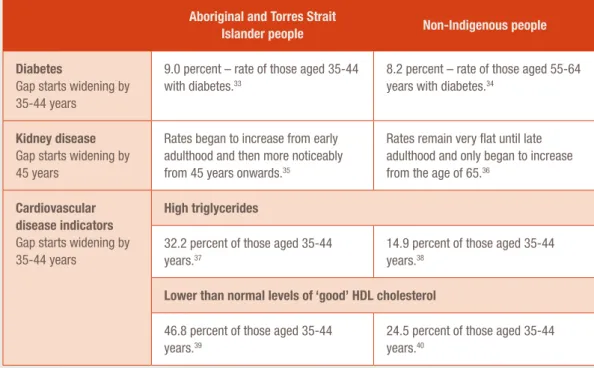
The NATSIHMS also confirms that Aboriginal and Torres Strait Islander people tend to develop chronic diseases at younger ages – as set out in Table 2 below.
Table 2: The age gap for the development of chronic disease between Aboriginal and Torres Strait
Islander people and non-Indigenous people
Aboriginal and Torres Strait
Islander people Non-Indigenous people
Diabetes
Gap starts widening by 35-44 years
9.0 percent – rate of those aged 35-44 with diabetes.33
8.2 percent – rate of those aged 55-64 years with diabetes.34
Kidney disease
Gap starts widening by 45 years
Rates began to increase from early adulthood and then more noticeably from 45 years onwards.35
Rates remain very flat until late adulthood and only began to increase from the age of 65.36
Cardiovascular disease indicators
Gap starts widening by 35-44 years
High triglycerides
32.2 percent of those aged 35-44 years.37
14.9 percent of those aged 35-44 years.38
Lower than normal levels of ‘good’ HDL cholesterol
46.8 percent of those aged 35-44 years.39
24.5 percent of those aged 35-44 years.40
(d) High levels of undetected and untreated chronic conditions
Perhaps the most disturbing results of the NATSIHMS were the high levels of undetected chronic conditions. These findings demonstrate the need to increase Aboriginal and Torres Strait Islander access to appropriate health services to prevent, detect and treat these chronic conditions.
• One in five (20.4 percent) participants had high blood pressure (systolic or diastolic blood pressure equal to or greater than 140/90 mmHg). Of these, four in five (79.4 percent) did not report high blood pressure as a long-term health condition;41
• Nearly one in five (17.9%) had signs of chronic kidney disease, but of these, nine in ten didn’t know they had these signs;42
• One in four adults (25 percent) had abnormal or high total cholesterol levels according to their blood test results. Yet of these, only one in ten people (9.1 percent) from this group self-reported having high cholesterol as a current long-term health condition. While this was similar to the rate found in the non-Indigenous population (10.1 percent), it nonetheless suggests that the majority of Aboriginal and Torres Strait Islander people with high total cholesterol results are either unaware that they have the condition or did not consider it to be a long-term or current problem;43 and
• Overall, 11 percent of all participants were detected with diabetes.44 While 9.6 percent had
a diagnosis, 1.5 percent had not.45 Almost five percent of additional participants were found
to be at high risk of diabetes.46
The NATSIHMS also reported that of those who were diagnosed with diabetes, only two in five (38.9 percent) were effectively managing their condition (having a HbA1c test result of seven percent or less).
These results also highlight the very real opportunities for sizeable and rapid health gains through targeted improvements to primary and other health services to prevent, detect and treat these conditions. In particular, and discussed later, these results underscore the big difference that improved and enhanced ACCHS could make in this area. The ACCHS are already out-performing other services in reducing the impact of chronic disease among Aboriginal and Torres Strait Islander people,47 and that existing strength should be built upon.
1.3 Risk factors for chronic disease
In this section, the Campaign Steering Committee considers the following chronic disease risk factors: mental health conditions; smoking; excess body weight and obesity; and harmful alcohol consumption.
(a) Mental health conditions
Research over the past decade suggests a chain of causation may be present between mental health conditions (in particular, serious psychological distress) and chronic disease. A 2014 study by Reeve and colleagues correlated data from the 2004–2005 ABS National Aboriginal and Torres Strait Islander Health Survey and the 2008 ABS National Aboriginal and Torres Strait Islander Social Survey (NATSISS),48 to make significant findings as to what was required to close the diabetes gap.
Among other findings discussed below, it found an association between people who self-reported diabetes and those who reported the forced removal of relatives. It described the finding as ‘consistent with emerging evidence that serious psychological stress contributes to a range of health problems and may be involved in the development of risk factors for metabolic syndrome, including raised blood glucose’.49
Recommendation 1
That the findings of the National Aboriginal and Torres Strait Islander Health Measures Survey (NATSIHMS) are used to better target chronic conditions that are undetected in the Aboriginal and Torres Strait Islander population. In particular, access to appropriate primary health care services to detect, treat and manage these conditions should be increased. Aboriginal Community Controlled Health Services should be the preferred services for this enhanced, targeted response.
Such emerging evidence includes that from a 2006 international review of evidence on the association between stress and chronic disease for Indigenous populations and African
Americans by Yin Paradies.50 While the review found the strongest associations between serious
psychological distress resulting from racism and mental health conditions,51 it also identified
studies that associated such psychological distress with high blood pressure, hypertension, impaired immune function, heart disease, pre-term births, increased heart rate and the thickening of arterial walls.52 There is now a well-established link between racism and poor mental and
physical health outcomes, including anxiety, depression, overweight and obesity, smoking, substance misuse and alcohol misuse.53
The Campaign Steering Committee is of the view that there is a clear correlation between mental health and chronic disease. The artificial divide that exists between the consideration of these conditions is unhelpful. Aboriginal and Torres Strait Islander mental health must be addressed not only as a priority in its own right, but also as an important part of addressing chronic disease.
(b) Rates of current daily smokers
Tobacco smoking is estimated to be the leading cause of burden of disease for Aboriginal and Torres Strait Islander people: responsible for around 12 percent of the total burden of disease and injury.54
Smoking is a major preventable contributor to the Aboriginal and Torres Strait Islander life expectancy gap due to the high rates of cardiovascular and respiratory diseases associated with it.55 It also impacts on low birth rate and infant child mortality. As noted, over 2007–2011
cardiovascular disease was the most common cause of Aboriginal and Torres Strait Islander deaths (responsible for 26.1 percent of deaths). Respiratory diseases were the fifth most common cause of deaths accounting for 7.7 percent of the total deaths.56
Comparing the results of the 2002 and 2008 NATSISS results with those of the 2012–2013 ABS Australian Aboriginal and Torres Strait Islander Health Survey (AATSIHS) enables the rates of smoking among Aboriginal and Torres Strait Islander people to be tracked over time. Similar surveys in the general population enable further comparisons.
The surveys show a progressive decrease in daily smoking rates for Aboriginal and Torres Strait Islander people: declining from 51 percent in 2002, to 45 percent in 2008, and then to 41 percent in 2012–13.57 While the daily smoking rate remains high, such gains are welcome.
However, there have been only small relative gains when compared to the rates of smoking among non-Indigenous people over the past 15 years. From 2008 – to 2012–2013, the fall in the Aboriginal and Torres Strait Islander smoking rate was 3.6 percent. However, among non-Indigenous people the rate of smoking fell by 2.9 percent – and from a much lower baseline.58 As a result the gap
in the rates of smoking has remained unchanged at the 2008 level of 25.2 percent,59 and has
decreased by only two percent since 2001 when the gap was 27 percentage points.60 The largest
gaps are in major cities (22.4 percent gap between the two population groups) and inner regional areas (23.1 percent gap).61
The evidence of the impact of anti-smoking campaigns among the non-Indigenous population highlights the need for a sustained and properly resourced anti-smoking focus over decades to make significant and consistent population health gains.
In 1945, more than three out of every four men and one in every four women in Australia were regular smokers.62 In fact, smoking rates remained high until the Quit campaigns became
established in each state from 1983 onwards.63 These used social marketing to ‘sell’ the message
that smoking was harmful.64 Health education in schools remained a major theme, but this was
complemented with more vigorous efforts to stop retailers from selling cigarettes to children.65
Since the 1980s, a relatively steady decline in smoking rates has been evident with the exception of a period in the mid-1990s. This is believed to correspond with reduced expenditure on public campaigns, highlighting the need for a sustained and properly resourced anti-smoking focus over decades to make significant and consistent population health gains.66
This is why more time must be allowed for the Tackling Indigenous Smoking programme, operational only since 2010, to build on the impressive results already apparent in the data. The Campaign Steering Committee believes that it is reasonable to expect further significant reductions in smoking rates over the next decade if investment in the Tackling Indigenous Smoking programme is sustained. As such it is critical that funding and other support for the programme continues in order for the wider promise of the programme to be realised. As in so many other areas, the Campaign Steering Committee counsels a long-term perspective will be rewarded in this area.
(c) Excess body weight and obesity
In Recommendation 1 of its final report, the COAG Reform Council identifies the ‘higher rates of obesity among Aboriginal and Torres Strait Islander people as an area that requires further attention from COAG as part of its efforts to achieve life expectancy equality’.67 The Campaign
Steering Committee supports this recommendation. Excess body weight, especially obesity, is a risk factor for chronic disease including diabetes, cardiovascular disease and cancer. Risks increase with greater weight.68
Among Aboriginal and Torres Strait Islander people in 2011–13, 41.7 percent were obese compared with 27.2 percent of non-Indigenous people.69 Even more concerning is that while
the non-Indigenous rate of overweight and obesity was almost twice that of normal weight, the Indigenous rate of overweight and obesity was almost three times the normal weight rate.70
Nationally in 2011–13, there was a significant gap of 8.8 percent between the proportion of Aboriginal and Torres Strait Islander and non-Indigenous people with excess body weight.71 That
is, 71.4 percent of the former were overweight or obese, compared with 62.6 percent of the latter.72
Only the Northern Territory had a significantly lower proportion of Aboriginal and Torres Strait Islander people with excess body weight (59.8 percent) than the national non-Indigenous rate.73
The Campaign Steering Committee recognises the efforts and positive outcomes achieved by the Tackling Smoking and Healthy Lifestyle Workers. These workers raise awareness in Aboriginal and Torres Strait Islander communities of the health benefits of keeping active, making informed decisions on food and carbonated drink intake, and stopping smoking. Consequently, we recommend that the Tackling Indigenous Smoking Programme and funding for Tackling Smoking and Healthy Lifestyle Workers be at minimum maintained and, in the immediate future, increased.
(d) Alcohol consumption and at-risk drinking
Nationally in 2011–13, Aboriginal and Torres Strait Islander people abstained from drinking alcohol at almost twice the rate of non-Indigenous people (26.1 percent and 16.3 percent respectively).74
Yet high alcohol consumption and at-risk drinking remain challenges to closing the life expectancy and health gap.
High alcohol consumption can have harmful short and long term effects on a person’s physical, social and mental health and safety. Ongoing harmful use of alcohol is associated with several diseases that may cause disability or death including cancer, diabetes and cardiovascular disease.75
The COAG Reform Council refers to the following as harmful patterns of alcohol consumption: • Lifetime risky drinking – consuming an average of two standard drinks or more per day, on
average, in a week.76 In 2011–2013, approximately 19 percent of both Aboriginal and Torres
Strait Islander and non-Indigenous people drank at levels that put them at lifetime risk of harm from alcohol.77 Both population groups also report small but significant declines since
2004–2005: the former from 20.3 to 19.2 percent; and the latter from 21.9 to 19.5 percent.78
• Binge drinking – consuming more than four standard drinks in a single session.79 In 2011–
2013, Aboriginal and Torres Strait Islander people reported binge drinking in the previous year at higher rates than non-Indigenous people (51.8 percent compared to 45.3 percent of respondents respectively),80 but reported binge drinking less often (13.1 per cent, compared
to 33 percent of non-Indigenous people reported binge drinking on a weekly basis).81
• Among people who drank at least once in the past 12 months, a significantly higher proportion of Aboriginal and Torres Strait Islander people drank higher volumes in a single session than non-Indigenous people. Among Aboriginal and Torres Strait Islander men, 42 percent reported drinking 11 or more standard drinks on a single occasion compared with 32.7 percent of non-Indigenous men; and 29.7 percent of Aboriginal and Torres Strait Islander women reported drinking seven or more standard drinks on a single occasion, compared with 20.4 percent of non-Indigenous women.82
Perhaps what is of greatest concern is what could be referred to as ‘daily binge drinking’. The COAG Reform Council report approximately 14 percent of Aboriginal and Torres Strait Islander men and 12.7 percent of non-Indigenous men aged 15 and over were drinking an average of over five standard drinks per day.83 A significantly larger proportion of Aboriginal and Torres Strait
Islander men (8.1 percent) than non-Indigenous men (6.1 percent) were drinking more than seven standard drinks per day.84 Similarly more Aboriginal and Torres Strait Islander women (4 percent)
than non-Indigenous women (2.8 percent) were drinking more than five standard drinks per day.85
The OID 2014 Report finds that in 2012–13, Aboriginal and Torres Strait Islander people were admitted to hospital for acute intoxication at around 12.1 times the rate for non-Indigenous people – the rate in remote and very remote areas was double the rate in major cities.86 The gap increased
from 5.7 to 12.1 times the rate of admission from 2004–05 to 2012–13.87
At-risk drinking is also linked with injury, disability and death through accidents, violence and suicide:88
• From 2003–2007 to 2008–2012, the alcohol induced death rate for Aboriginal and Torres Strait Islander people in jurisdictions where data is deemed reliable was around five times the rate for non-Indigenous people;89
• The majority of Aboriginal and Torres Strait Islander homicides each year involved alcohol consumption;90
• It is estimated that the prevalence of Fetal Alcohol Spectrum Disorders (FASD) for Aboriginal and Torres Strait Islander people is between 2.76 and 4.7 per 1,000 births compared to between 0.06 and 0.68 per 1,000 births for all Australians;91 and
• Evidence demonstrates that high levels of alcohol misuse is associated with family violence in Aboriginal and Torres Strait Islander communities.92
Tackling harmful drinking among Aboriginal and Torres Strait Islander people is an important part of closing the health and life expectancy gap. As such, the Campaign Steering Committee welcomes the ongoing development of a dedicated National Aboriginal and Torres Strait Islander Peoples’ Drug Strategy (Drug Strategy). The Drug Strategy will address problem alcohol and other drug consumption and replace the National Drug Strategy Aboriginal and Torres Strait Islander Peoples Complementary Action Plan 2003–2009.93
Implementing the Drug Strategy in a coordinated way with the implementation of the Health Plan, the National Strategic Framework for Aboriginal and Torres Strait Islander Peoples’ Mental Health and Social and Emotional Wellbeing (in development at the time of writing)94 and the 2013 National
Aboriginal and Torres Strait Islander Suicide Prevention Strategy95 remains a key challenge for
2015 as discussed later. The Drug Strategy is discussed further in the text box below.
National Aboriginal and Torres Strait Islander Peoples’ Drug Strategy
The National Drug Strategy 2010–2015 committed to the development of seven sub-strategies to be developed, one of which is the National Aboriginal and Torres Strait Islander Peoples’ Drug Strategy (Drug Strategy).96 In 2013, the Working Group for the Drug
Strategy released a background paper that provides insight into the purpose and some of the main areas for consideration to be discussed in the final document.97
The Drug Strategy is intended to act as a guide for governments, Aboriginal and Torres Strait Islander communities, service providers and individuals by identifying some of the key issues and areas for action relating to the harmful use of tobacco, alcohol and other drugs. It should consider the types of actions that could help to reduce the impact of these things on Aboriginal and Torres Strait Islander peoples and communities, and contribute to improved health and social outcomes.98
In delivering on this purpose, it is expected the Drug Strategy will consider the three pillars that underpin the National Drug Strategy: demand reduction; supply reduction and harm reduction.99
The Drug Strategy should recognise that problem tobacco, alcohol or other drug use in any context should not be considered in isolation, as there are many contributing factors that can underpin problem usage. It should also recognise that Aboriginal and Torres Strait Islander peoples draw strength from social and emotional wellbeing: this includes connectedness to family, culture and identity.100
The Drug Strategy should acknowledge that ‘Aboriginal and Torres Strait Islander populations are diverse, as are their experiences of health and social problems and in acknowledgement of this diversity seek to promote a shared responsibility and ownership of the issues and solutions that are identified by working in active partnership with Aboriginal and Torres Strait Islander peoples’.101
In October 2014, the Australian Medical Association’s National Alcohol Summit issued a Communique calling for Australian Government leadership in developing and implementing a dedicated national alcohol strategy, independently from the National Drug Strategy. A National Alcohol Strategy would include a specific focus on the needs of Aboriginal and Torres Strait Islander peoples, but connect these to general population alcohol policy to enable coordinated responses to both Aboriginal and Torres Strait Islander and non-Indigenous problem drinking at regional and national levels. The strategy would address pricing, availability, promotion and treatment for alcohol problems.102
1.4 Progress towards achieving the child (under-five) mortality
target
The COAG Reform Council reports that Australian governments are on track to meet COAG’s target to halve the gap in child death rates by 2018. However, the death rate for Aboriginal and Torres Strait Islander children is still more than double the rate for non-Indigenous children.103
There are five jurisdictions with good quality data for this indicator: New South Wales, Queensland, Western Australia, South Australia, and the Northern Territory.104 Even across these jurisdictions,
however, the numbers of child deaths are relatively small and five years’ data (i.e. data that includes years in which the COAG Closing the Gap reform agenda was operating – effectively from July 2009 on) are not enough to reliably show change.105 Because of this, the Council adopts a
1998 baseline to allow for up to fifteen years of data to be assessed and better identify trends.106
This shows that deaths of both Aboriginal and Torres Strait Islander and non-Indigenous children fell significantly from 1998 to 2012:
• The death rate for Aboriginal and Torres Strait Islander children decreased by an average of 6.5 deaths per 100,000 per year;107 and
• The death rate for non-Indigenous children decreased by 2.0 deaths per 100,000 per year.108
This reduced the Aboriginal and Torres Strait Islander child death gap from 139.0 deaths per 100,000 in 1998 to 87.6 per 100,000 in 2012 and has been interpreted to mean that the nation is on track to meet the COAG target and halve the gap by 2018.109 However, as noted by the COAG
Reform Council, child mortality for the non-Indigenous population is also improving and the ratio of the Aboriginal and Torres Strait Islander child mortality rate to the non-Indigenous rate has not changed over the last 10 years and remains almost twice as high (1.9 times). The gap cannot close until this ratio declines.
The child (under-five) rate for Aboriginal and Torres Strait Islander children is 165 deaths per 100,00 while the rate for non-indigenous children is 77 deaths per 100,000.110 This is still
unacceptable.
The COAG Reform Council is critical of the continuing use of the trajectory that Australian governments agreed for closing the child death gap in 2009, found in the National Indigenous Reform Agreement.111 This is because it is based on a projected non-Indigenous rate based on
the 1998 to 2008 rate of decline and yet the rate of decline has significantly increased since that time.112 As such, what it means to achieve equality has also significantly changed.
(a) Low birth weight babies
Birth weight is a key indicator of infant health and a major determinant of a baby’s chance of survival and good health. Low birth weight is of particular concern.113 AIHW defines a low birth
weight baby as one with a weight of less than 2,500 grams. Research that indicates that babies weighing less than 2,500 grams at birth are at least 20 times as likely to die within their first year of life than those who weighed at least that amount.114
In 2011, babies born to Aboriginal and Torres Strait Islander mothers were twice as likely as those born to non-Indigenous mothers to be of low birth weight: 12.6 percent of babies born to Aboriginal and Torres Strait Islander mothers weighed less than 2,500 grams compared with 6 percent of babies born to non-Indigenous mothers.115
Between 2000 and 2011, AIHW reported a statistically significant decrease in the low birth weight rate among live born singleton babies of Aboriginal and Torres Strait Islander mothers, with the rate declining by 9 percent over the period. In contrast, there was no significant change in the corresponding rate for non-Indigenous mothers.116
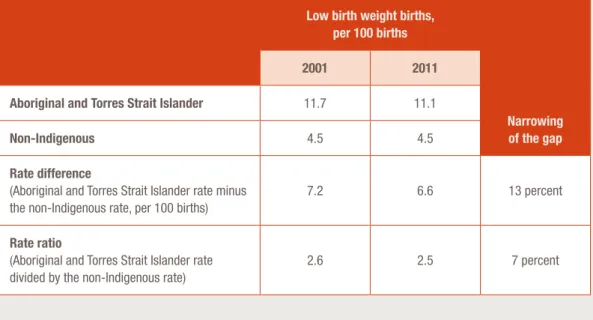
As such, over the period 2000 to 2011, there was a small but statistically significant narrowing of the birth weight gap in this period as set out in Table 3.
Table 3: Narrowing of the gap in Aboriginal and Torres Strait Islander and non-Indigenous low birth
weight births, 2001–2011
117Low birth weight births, per 100 births
Narrowing of the gap
2001 2011
Aboriginal and Torres Strait Islander 11.7 11.1
Non-Indigenous 4.5 4.5
Rate difference
(Aboriginal and Torres Strait Islander rate minus the non-Indigenous rate, per 100 births)
7.2 6.6 13 percent
Rate ratio
(Aboriginal and Torres Strait Islander rate divided by the non-Indigenous rate)
2.6 2.5 7 percent
Some of the key determinants for low birth weight babies are:
• Access to antenatal care – such care can reduce the chance of low birth weight due to early diagnosis and treatment of pregnancy complications, with the World Health Organization recommending that women receive antenatal care at least four times during pregnancy; • Smoking – babies born to mothers who smoke are more likely to be of low birth weight than
other babies. Passive exposure to smoke is also associated with lower birth weight;
• Pre-term births (defined as before 37 weeks of gestation) – factors associated with pre-term births include chronic conditions like diabetes and high blood pressure;
• The mother’s diet and nutritional status at conception and during the pregnancy; • Drug and alcohol consumption during pregnancy – particularly alcohol consumption that
leads to FASD; and
• The age of mothers – low birth weight is more common among younger mothers (aged less than 20) and older mothers (aged 35 and over).118
These determinants are often underpinned by social determinants. Mothers living in relative poverty are more likely to have low birth weight babies (with this potentially related to factors such as nutrition, maternal health and behavioural characteristics such as smoking).119
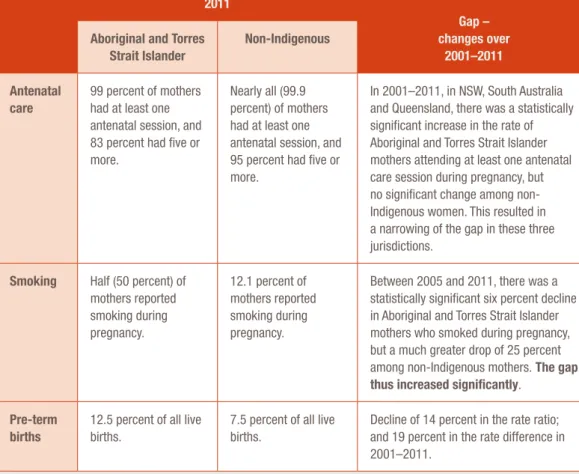
In Table 4 below, the gaps between Aboriginal and Torres Strait Islander people and non-Indigenous people for three of the above determinants for low birth weight are considered.
Table 4: Selected determinants of low birth weight babies 2011, with changes in the gap between
Aboriginal and Torres Strait Islander people and non-Indigenous people for these determinants
1202011
Gap – changes over
2001–2011
Aboriginal and Torres Strait Islander
Non-Indigenous
Antenatal care
99 percent of mothers had at least one antenatal session, and 83 percent had five or more.
Nearly all (99.9 percent) of mothers had at least one antenatal session, and 95 percent had five or more.
In 2001–2011, in NSW, South Australia and Queensland, there was a statistically significant increase in the rate of Aboriginal and Torres Strait Islander mothers attending at least one antenatal care session during pregnancy, but no significant change among non-Indigenous women. This resulted in a narrowing of the gap in these three jurisdictions.
Smoking Half (50 percent) of mothers reported smoking during pregnancy.
12.1 percent of mothers reported smoking during pregnancy.
Between 2005 and 2011, there was a statistically significant six percent decline in Aboriginal and Torres Strait Islander mothers who smoked during pregnancy, but a much greater drop of 25 percent among non-Indigenous mothers. The gap thus increased significantly.
Pre-term births
12.5 percent of all live births.
7.5 percent of all live births.
Decline of 14 percent in the rate ratio; and 19 percent in the rate difference in 2001–2011.
Looking forward, the Campaign Steering Committee believe that increased focus must be
maintained in relation to reducing smoking during pregnancy and to increasing access to antenatal care. Once again, the demonstrated strengths of ACCHS in providing maternal and infant care already demonstrated by the ACCHS should be utilised.
ACCHS’ ‘mums and bubs’ programmes have long been established and have a track record in improving mother and child health outcomes. For example, the Baby Basket programme developed in 2009 by the Apunipima Cape York Health Council. This encourages expecting Aboriginal and Torres Strait Islander mothers to have earlier and more frequent engagement with antenatal and postnatal health services. The programme also provides Baby Baskets, with practical gifts for mum and baby, health education material and food vouchers to purchase fruit and vegetables at the first trimester, immediately prior to birth and six months post birth. The programme also provides Health Workers or clinicians with opportunities to engage with mothers, their partners and families about issues affecting their growing baby – such as healthy choices around smoking, alcohol and diet. A 2014 evaluation of the programme noted that at a relatively small cost of $874 per participant, the programme was resulting in a higher proportion of women making antenatal visits, that the women involved were less likely to be iron deficient, and they were more likely to be making healthy choices such as eating fruit and vegetables and quitting smoking.121
Developments in policy
Carly Zandstra, teacher at Nowra High School. Photograph: Peter Izzard/OxfamAUS.
2
2.1 Proposed changes in Commonwealth-State
relations and their impact on the Closing the Gap
Strategy
The Closing the Gap Strategy aims to address Aboriginal and Torres Strait Islander disadvantage by achieving outcomes and equality across seven ‘building blocks’ or areas of life (early childhood, schooling, health, economic participation, healthy homes, safe communities, governance and leadership).123 This coherent and integrated approach is aligned with the
holistic idea of health supported by Aboriginal and Torres Strait Islander peoples,124 and with social determinants of health theory.125
The Closing the Gap Strategy is led by the Australian Government and involves the commitment of all the states and territories. As such, it also provides a national and consistent approach to closing the gap that can be sustained over the long term – until 2030. As the Department of Finance’s 2009 Strategic Review of Indigenous Expenditure noted, with these strong foundations in place the ‘key challenge from this point lies not so much in further policy development as in effective implementation and delivery’.126
However, the Campaign Steering Committee is concerned that despite continued Australian Government commitment to closing the gap, broader structural reform to the federal system of the type that is currently being discussed could potentially have an adverse impact on the Closing the Gap Strategy.
(a) Reforms to the federal system
The Australian Government’s National Commission of Audit flagged structural reform to the federal system in its March 2014 report. It recommended clear delineation of respective roles and responsibilities and reform of the Commonwealth’s financial relations with the states and territories. The Australian Government supports ensuring ‘that, as far as possible, the states are sovereign in their own sphere’.127 To that end, the Terms
of Reference for the development of a White Paper on the Reform of the Federation (White Paper) were released on 28 June 2014.128
This is intended to set out the Australian Government’s position on the practical application of what ‘the states being sovereign in their own spheres’ might mean for programme and service delivery, including in Indigenous Affairs.129
Issues Paper 1 A Federation for Our Future was released in September 2014.130 This states that:
A major part of the [current] problem [with the federation] is that over time, the Commonwealth has become, for various reasons, increasingly involved in matters which have traditionally been the responsibility of the States and Territories.131
This, of course, could include aspects of Indigenous Affairs. Reform along these lines then could potentially signal a break with the spirit of the 1967 referendum. In this, over 90 percent of Australians supported the potential for Australian Government involvement (and the Campaign Steering Committee believes leadership) in Indigenous Affairs. This was, at least in part, because of the failure of the states and territories to effectively address Aboriginal and Torres Strait Islander disadvantage and protect basic human rights since at least federation.132
If there is one message I want Governments to hear from this report it is: Do not press the reset button! … If we continue to start over again the foundations previously laid will be pulled up time and again, never allowing enough time or energy to build the structure required to close the gap on Indigenous disadvantage.122
Brian Gleeson, the Coordinator General for Remote Indigenous Services
In relation to the Closing the Gap Strategy, the Issues Paper suggests:
In Australia, we should be particularly mindful of the difference in life chances that exist as a result of socio-economic disadvantage, especially in respect of Aboriginal and Torres Strait Islander peoples, and make it a priority to achieve governments’ commitment to Close the Gap in Indigenous life expectancy, child mortality, education and employment.133
Later the Issues Paper acknowledges that ‘sometimes a national approach is more appropriate than pursuing different approaches across the States and Territories’ and cites addressing Aboriginal and Torres Strait Islander disadvantage as an example of such a national objective.134
However, other than this reference it does not significantly address the issue of what ‘clear delineation of responsibilities for different levels of government’ will mean for Aboriginal and Torres Strait Islander Affairs.135 Critically for the Campaign Steering Committee, all governments must
ensure that actions are taken with clearly articulated responsibilities to address disadvantage. Issues Paper 3 Roles and Responsibilities in Health, discusses Aboriginal and Torres Strait Islander health and health services at some length. It notes that there is a high degree of overlap between the Commonwealth and state and territory-level involvement in Indigenous health ‘but that the effect of this overlap on Indigenous health is unclear’.136
Further, it discusses the role of the Australian Government in addressing health inequities:
Commonwealth involvement in a policy area is sometimes argued on equity grounds. While the Commonwealth may be best placed to address equity concerns in some circumstances, the States and Territories also work to improve and ensure equity for their communities. The States and Territories are closer to where services are being delivered and are often best placed to know how equity concerns can be addressed.137
Community member Marlene Nabulwad teaching kids in Kunwinjku, the traditional local Aboriginal language. Jabiru, NT. Photograph: Jason Malouin/Oxfam AUS.
The Campaign Steering Committee supports the need for the clarification of roles and responsibilities among Australian governments to ensure the best health outcomes can be achieved for Aboriginal and Torres Strait Islander peoples.
The Campaign Steering Committee firmly believes that the Australian Government has the responsibility to lead the national approach to the Closing the Gap Strategy. Reform to the federal system should not adversely affect this.
(b) Continued national leadership of the Closing the Gap Strategy
In December 2013, COAG decided not to renew the National Partnership Agreement on Closing the Gap in Indigenous Health Outcomes.138 The Campaign Steering Committee is not wedded to
a national partnership agreement to further the Closing the Gap Strategy as it pertains to health. It is, however, concerned to ensure that the substitution of a national partnership agreement with tri-lateral Australian Government agreements with the states and territories and jurisdictional representatives of the Aboriginal and Torres Strait Islander health services, does not weaken or fragment the Closing the Gap Strategy. The tri-lateral agreements are being developed through AHMAC and existing Indigenous Health Partnership Forums.139
As highlighted in the Campaign Steering Committee’s two previous reports,140 there have been
significant cuts to mainstream health expenditure in Queensland,141 New South Wales142 and South
Australia in recent years – particularly to preventative health programmes.143
While not aimed at Aboriginal and Torres Strait Islander people, services or programmes, these cuts are likely to have disproportionate and detrimental impacts on preventative health efforts in these jurisdictions among Aboriginal and Torres Strait Islander peoples.144 One critic has
highlighted the likelihood for increases in cardiovascular diseases, diabetes and mental health conditions over time.145
As argued in last year’s report, the Campaign Steering Committee believe such jurisdictional health cuts demonstrate the need for greater Australian Government leadership to ensure a consistent national approach in the implementation of the Closing the Gap Strategy. They demonstrate the need for stronger and nationally consistent agreements (whether struck nationally or otherwise) to continue the Closing the Gap Strategy.
Maintaining a national and consistent effort under Australian Government leadership could, to some degree, help immunise the effort to close the health gap from the ever-turning wheels of state and territory-level political fortune.
Recommendation 2
Elements of the Closing the Gap Strategy that have been discontinued in the
past year
The Campaign Steering Committee is also concerned about the de-commissioning of the COAG Reform Council in the Budget measures for 2014–2015.146 This independent body
has provided an authoritative annual report across many areas of COAG activity and, in particular, the Closing the Gap Strategy.
In relation to the Closing the Gap Strategy, the COAG Reform Council was the only body that provided an independent and national assessment of progress against the Closing the Gap Targets – it independently monitored the performance of the Australian and the state and territory governments. In this way it complemented – not duplicated – the Prime Minister’s annual progress report. The Department of the Prime Minister and Cabinet’s Portfolio Budget Statement indicated, that with the abolition of the COAG Reform Council, it would continue to monitor state and territory performance.147 The Campaign Steering
Committee is concerned that this does not clarify how independent and national-level annual public reporting on progress against the Closing the Gap Targets will occur. Given the importance of strengthening efforts to close the Aboriginal and Torres Strait Islander health gap and disadvantage more broadly, the lack of clarity around who will report in future on the Closing the Gap Strategy is of great concern. The ongoing need for this important monitoring role should be addressed by the Australian Government as a priority.
Further, the Campaign Steering Committee also emphasises its concern that the Australian Government will provide no further funds to the Closing the Gap Clearinghouse. Since its establishment in 2007 the Clearinghouse has played an important role in establishing and setting out the evidence base for the Closing the Gap Strategy.148
The Australian Government has also discontinued the National Indigenous Drug and Alcohol Committee, with its functions to be absorbed within the Australian National Council on Drugs.149 This will further limit the Government’s access to Aboriginal and Torres Strait
Islander specialist advice and leadership. Regrettably the decision means there is now no national voice or committee on alcohol and other drugs for Aboriginal and Torres Strait Islander peoples.
Recommendation 3
That the Australian Government revisit its decision to discontinue the National Indigenous Drug and Alcohol Committee.
2.2 The Indigenous Advancement Strategy and the
Closing the Gap Strategy
The Indigenous Affairs priorities of the Australian Government are: • Getting children to school;
• Getting adults to work; and
• Building safer Indigenous communities.151
The Indigenous Advancement Strategy (IAS) is the vehicle for delivering these three priority objectives. The IAS commenced on 1 July 2014 and consolidated more than 150 individual programmes and activities into five broad-based programme streams that are being coordinated from the Department of the Prime Minister and Cabinet (PM&C). It does not include the bulk of health and mental health programmes that remain located in the Department of Health. The primary exception is the ‘Social and Emotional Wellbeing Programme’ which was transferred to PM&C.152
The 2014–15 Budget, delivered in May 2014, detailed that the IAS consolidation will save the Australian Government $534.4 million over five years through programme rationalisation.153 The Campaign Steering
Committee supports the reduction of red tape and duplication. However, the lack of detail on how these savings or cuts will apply and their impact on services and health outcomes is an ongoing concern.
The Campaign Steering Committee also notes that the IAS has been developed with minimal input from Aboriginal and Torres Strait Islander peoples and their representative organisations, apart from the Indigenous Advisory Council. This is despite the Australian Government seeking greater levels of engagement with Aboriginal and Torres Strait Islander peoples within the IAS itself. As noted by the Aboriginal and Torres Strait Islander Social Justice Commissioner:
The Federal Government has outlined its intention for a new engagement with Aboriginal and Torres Strait Islander people. To achieve this goal, surely it must at least have a discussion with us before proceeding with a radical re-shaping of government policy that so profoundly affects us? The Aboriginal and Torres Strait Islander leadership stands ready for this conversation with Government. All it takes is an assurance that we will be heard.154
Without such engagement, these sweeping changes to programme funding have and continue to cause anxiety within Aboriginal and Torres Strait Islander organisations across the country. As further noted by the Aboriginal and Torres Strait Islander Social Justice Commissioner:
To give some idea of the magnitude of the changes confronting the Department of the Prime Minister and Cabinet is the rationalisation of approximately 150 programs and activities down to five. This affects about 1,440 organisations with just over 3,000 funding contracts. On top of this, the Department will have to manage a budget cut in the vicinity of $400 million over the next four years.155
In November 2014, the Australian Government stated it would delay announcing the assessment of IAS applications until March 2015.156 This
delay underlines the difficulties of the process and is a further cause of anxiety for Aboriginal and Torres Strait Islander organisations.
The new policy framework developed by COAG (as reflected in the National Indigenous Reform Agreement and the Closing the Gap strategy) represents a comprehensive, coherent and ambitious agenda for reform. The key challenge from this point lies not so much in further policy development as in effective implementation and delivery.150
Strategic Review of Indigenous Expenditure