Which CEO Characteristics and Abilities Matter?
Steven N. Kaplan,* Mark M. Klebanov,** and Morten Sorensen***
Abstract
We exploit a unique dataset to study individual characteristics of CEO candidates for companies involved in buyout and venture capital transactions and relate these characteristics to subsequent corporate performance. CEO candidates vary along two primary dimensions: one that captures general ability and another that contrasts communication and interpersonal skills with execution skills. Subsequent performance is positively related to general ability and to execution skills. The findings expand our view of CEO characteristics and types relative to previous studies.
* University of Chicago Booth School of Business and NBER, ** Ziff Brothers Investments, *** Columbia Business School and NBER. We thank Geoff Smart and Randy Street of ghSMART for providing the data and for helpful discussions and comments. We thank David Altman, Malcolm Baker, Carola Frydman, Cam Harvey, John Graham, Mike Jensen, Leslie Pratch, David Robinson, David Yermack, two anonymous referees, and seminar participants at the 2008 AFA Meetings, Duke, Harvard Business School and Economics Department, Kellogg, LSE, NBER Corporate Finance, NBER Private Equity Conference, NBER Summer Institute, SIFR Conference 2007, and Wharton for helpful comments. We also thank Xu Da, Sol Garger, Cristina Iftimie, Ingrid Tang, Phoebe Tse, and Jaclyn Yamada for research assistance. This research has been supported by the Lynde and Harry Bradley
Foundation and the Olin Foundation through grants to the Stigler Center for the Study of the Economy and the State, the Center for Research in Security Prices, the Kauffman Foundation, the Booth Initiative on Global Markets, and Kathryn Gould. Address correspondence to Steve Kaplan, University of Chicago Booth School of Business, 5807 South Woodlawn Avenue, Chicago, IL 60637 or e-mail at [email protected].
Theorists have long assumed that CEOs have heterogeneous talents and abilities that map into firm performance. For example, Rosen (1981), Murphy and Zabojnik (2004), and Gabaix and Landier (2007) all model CEOs with different qualities. Empirical studies confirm that managerial heterogeneity is important for corporate actions and performance. For example, Bertrand and Schoar (2003), Adams et al. (2005), and Bennedsen et al. (2008) find evidence that specific CEOs matter. However, neither the theoretical nor empirical studies have provided much guidance concerning which particular characteristics and abilities are important for corporate governance and performance.
A few theories have identified specific managerial characteristics. In particular, Bolton et al. (2009) develop a theory of leadership that contrasts managerial resoluteness against
communication skills. Resoluteness is a form of overconfidence that arises when CEOs are unresponsive to outside information and precludes communication skills. Their theory presents a trade-off between adapting to new information and coordinating employees, implying that more resolute and overconfident CEOs perform better than CEOs who are better listeners and
communicators in situations requiring greater coordination. They predict that measures of characteristics that reflect resoluteness and overconfidence should be positively correlated with performance.1
Other studies have focused more narrowly on managerial overconfidence. Heaton (2002) argues that overconfidence in the form of managerial optimism is unambiguously bad, causing either over- or underinvestment. In contrast, Gervais, Heaton, and Odean (2009) present a model where overconfidence can increase value by mitigating moral hazard and aligning incentives.
1 Rotemberg and Saloner (1993) make a similar distinction, although their economic mechanism is different. They explore the difference between empathetic and selfish CEOs. Selfish CEOs are narrowly focused on profit
Empirically, Malmendier and Tate (2005, 2009) find that overconfident CEOs have higher investment-cash flow sensitivities and are more likely to engage in value-destroying mergers. Graham et al. (2008) provide additional empirical evidence that CEO behavior is related to measures of overconfidence, optimism, and risk-aversion. However, it remains an open question how overconfidence relates to subsequent performance.
To summarize, building on Bolton et al. (2009)’s idea that resoluteness is a form of overconfidence, the previous literature assumes that overconfidence and resoluteness on one hand and empathy and team-related skills on the other hand are primary and defining distinctions of managerial characteristics. The papers make different predictions about the effects of those characteristics on performance, and they use different indirect empirical measures of the
characteristics, particularly overconfidence, with the notable exception of Graham et al. (2009). Open questions remain, however, concerning how managerial characteristics vary across CEOs, how CEO types vary, and which characteristics or types are more important for corporate performance.
In this paper, we make two contributions. First, we identify the primary variation in the characteristics of a sample of CEO candidates, and investigate whether the theoretical and empirical focus on resoluteness and overconfidence versus empathy and communication is a first-order distinction for actual CEOs. Second, we consider the relationship between CEO characteristics and performance, paying special attention to the variables stressed in the
theoretical papers that are related to resoluteness, overconfidence, empathy, communication, and team skills.
To do this, we use detailed assessments of 316 candidates considered for CEO positions in firms involved in private equity (PE) transactions from 2000 to 2006. The PE investors in
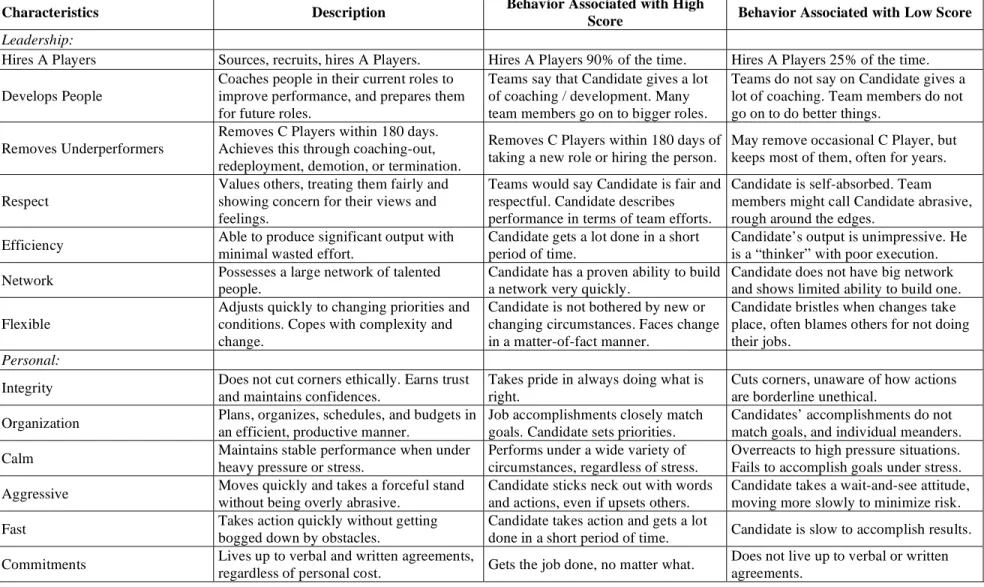
those transactions requested the assessments at the time of investment or at the time candidates were considered for hiring. The assessments were performed by ghSMART, a firm specialized in assessing top executives, and are based on four-hour structured interviews. Each interview resulted in a report with a detailed description of the candidate’s background and characteristics. The reports include ratings of 30 specific characteristics and abilities, described in Table I.
The assessments are roughly equally divided between buyout and venture capital (VC) deals. We look at these two groups separately in many of our analyses, particularly of
performance. We complement the individual assessments with information about the subsequent hiring of the candidates, investment decisions by the PE firms, and the performance of the
companies. We obtain this information directly from the PE firms and a range of public sources. To identify the main dimensions of variation in managerial characteristics, we use factor analysis — the traditional empirical approach in studies of personality traits (see Fabrigar et al. (1999) and Borghans et al. (2008)). We find two dominant factors with intuitive interpretations: the first factor loads positively2 on all characteristics and appears to represent a measure of a candidate’s overall talent. This factor can be interpreted as analogous to the general measure of managerial talent and ability assumed by theorists like Rosen (1981).
The second factor loads positively on the characteristics: Respect, Open to Criticism, Listening Skills, and Teamwork, which reflect communication and interpersonal abilities. It loads negatively on Fast, Efficiency, Aggressive, Persistence, and Proactive, characteristics describing capabilities that appear related to resoluteness and execution skills. The importance
2 Note that the sign and magnitude of factor loadings are unidentified and cannot be interpreted. Formally, a factor is a vector that is only identified up to scale and sign. It classifies characteristics that tend to vary together and defines a scale that measures this covariation, but the scale is arbitrary. If one were to, say, reverse the signs and double the
of the second factor suggests that the distinction between these two CEO types emphasized by theorists is, in fact, important in practice.
We then consider the relationship between characteristics and performance. For buyout candidates, we find that that success is positively and significantly related to Efficiency,
Organization, Aggressive, Commitments, Persistence, Proactive, High Standards, and Holds People Accountable. These characteristics appear to reflect execution and resoluteness. The magnitudes of the performance differences are large.
In multivariate analyses of buyout CEOs using the factors, success is positively related to the first factor, suggesting that general talent or ability is important. Success is negatively related to the second factor, suggesting that execution and resoluteness contribute positively to performance. When we decompose the second factor into a separate execution-resoluteness factor and an interpersonal-team factor, the execution-resoluteness factor is positively related to performance.
Overall, CEOs with greater overall talent appear to be associated with better
performance, consistent with theories like Rosen (1981) and Gabaix and Landier (2007). The relationship between greater resoluteness and execution skills and performance is consistent with Bolton et al. (2009) and Gervais et al. (2008).
For VC CEOs, the empirical patterns are weaker. This is consistent with VC-backed companies being younger, having greater idiosyncratic volatility [see Adams et al. (2005)], and with greater needs for specific knowledge than general managerial talent. Still, for VC backed firms, Proactive is positively related to performance, while Teamwork is consistently negative. In multivariate analyses using the factors, the interpersonal-team factor is generally negatively related to performance. This also is consistent with Bolton et al. (2009) where coordination- and
communication-related abilities should be less important for VC transactions, because VC-funded companies tend to be smaller, requiring less coordination.
Our study also relates to the broader management leadership literature, which has developed a plethora of theories and classifications. Prominent examples are Drucker (1967), Collins (2001), and Goleman et al. (2002). Yammarino et al. (2005) survey 348 publications with 17 additional leadership theories, ranging from the Ohio State Model to Charismatic Leadership and Romance of Leadership. This range of theories, often based on smaller samples and anecdotal evidence, has led to a vague characterization of effective leadership. Ulrich, Smallwood, and Sweetman (2009) summarize the current recommendations as “leaders need to have innovative strategies […], forge long-term relationships with customers, innovate, execute, build high-performing teams, ensure accountability, manage people, communicate, engage others, create workforce plans, exercise judgment, have emotional intelligence, and possess an honorable character.” While these traits seem desirable, they are unlikely to be equally valuable. The questions addressed here are ultimately empirical: which CEO attributes effectively
characterize CEO abilities and which of those are more important for corporate performance? In the management literature, our results are generally consistent with ideas in Drucker (1967), who based his work on personal observation of a broad range of executives, particularly public company CEOs. According to Drucker, effective executives “differ widely in their personalities, strengths, weaknesses, values and beliefs. All they have in common is they get the right things done.” Those “right things,” as described by Drucker, correspond to our notion of resoluteness and execution.
An important caveat is that different types of CEOs may endogenously match with different types of companies.3 In this case, the resulting performance may reflect company differences rather than a causal impact of CEO types. Like the previous literature, we cannot rule out this concern formally – we have no instrument or natural experiment – but our results suggest that this is probably not a main effect. Still the results relating characteristics and performance are more tentative. Another remaining concern (and topic for future research) is whether our results generalize from CEO candidates for PE–related companies to companies more generally.
The paper proceeds as follows. Section I describes the data on CEO assessments, along with the performance measures. Section II explores the main dimensions of variation in the directly measured CEO characteristics and abilities. Section III studies the relationship between CEO characteristics and performance. Section IV presents our robustness analysis. Section V concludes.
I. Data A. Assessments
We rely on a proprietary dataset with detailed assessments of 316 CEO candidates considered for positions in 224 companies funded by private equity (PE) investors. The
assessments were performed from 2000 to 2006 by ghSMART, a consulting firm that focuses on assessing top management candidates for the private equity industry. Typically, a PE investor
3 Graham, Harvey, and Puri (2009) present evidence suggesting that impatient and optimistic CEOs are more likely to be employed at companies with high expected future growth. It is difficult to distinguish whether this relationship
hires ghSMART to assess the incumbent CEO or other potential CEO candidates when the investor is considering a portfolio company investment.
It is important to understand the process in some detail. ghSMART is not a recruiting firm. It does not suggest which candidate(s) to interview, but, rather, assesses candidate(s) under consideration by the PE firms. It does not receive a fee contingent on whether a candidate is hired or not, and it has no apparent incentives to deliver biased assessments. According to ghSMART, the main objective is to provide accurate reports, as they generate more repeat business with the PE investors.
ghSMART reports that no candidate has ever refused to participate in an interview or suggested that it presented an unreasonable time burden or intrusion into the candidate’s privacy. Three PE firms explicitly told us that they use ghSMART for all their investments, and we obtain qualitatively and statistically identical results when we restrict our analyses to the ten PE firms that had more than ten CEO candidates assessed by ghSMART.
The reports are based on four-hour interviews with similar specified structures, resulting in twenty- to forty-page documents. The interviewer4 asks for specific examples of actions and behavior at every job and life stage, starting with the candidate’s childhood and progressing through the education and subsequent career path. The interviewers then extract a range of qualitative and quantitative information from this reported behavior. In particular, they score the candidates on thirty specific characteristics in five general areas, defined by ghSMART as Leadership, Personal, Intellectual, Motivational, and Interpersonal. Table I presents an excerpt from ghSMART’s internal guidelines describing each of the thirty characteristics along with the
4 The ghSMART interviewers generally hold doctoral degrees or degrees from top MBA programs, and have worked at consulting firms (such as McKinsey & Co., Bain, and Boston Consulting Group). ghSMART reports a
reported behaviors that determine the rating.5
Some reports also include assessments of other abilities specific to the particular company. Because these abilities are not consistently assessed across candidates, we do not include them in our analyses. However, in our limited attempts to include them, we find no evidence that they affect our results.
We also note whether the candidate is the incumbent CEO or is an outside candidate. In a few cases, the candidate works for the company but not as CEO. We include these candidates with outsiders, although due to their small number our results are unchanged if we code them as incumbents. Finally, we note whether the PE firm has already invested in the company at the time of the assessment.
For each of the thirty characteristics, the candidate is scored with a letter grade from D (lowest) to A+ (highest), reflecting the extent to which the candidate possesses the particular characteristic, not whether it is desirable or not. We code grades of B or below as 1. We
combine these grades because there are relatively few of them. We code grades of A and A+ as 4. Again, we combine them because there are relatively few A+’s. We code grades of B+ as 2 and grades of A- as 3. We obtain qualitatively similar results without combining grades.
An important concern is whether it is possible for the candidates to “game” or “fake” the interviews by providing answers they believe will help them be hired. In this case, higher scores may reflect a candidate who is better at creating the perception of being an attractive CEO. This problem has been extensively studied in the psychology literature, which concludes that faking has surprisingly small effects on the validity of predictors of job performance.6 Similarly,
5 Smart and Street (2008) provide additional information and detail about ghSMART’s interviewing methodology. 6
McClelland (1998) finds that interviews similar to those conducted by ghSMART successfully classify top performers.7
Moreover, it is difficult to reconcile our results with significant faking. If faking caused the assessments to be uninformative, we should find no relationship between the assessments and subsequent performance. In fact, we find such a relationship.8
A more subtle effect might arise if candidates who are better managers are also better at faking the assessments. In this case, characteristics that are more positively related to the hiring decision should also be more positively related to performance. In fact, we find that some characteristics that are related to hiring are unrelated to performance.9
Overall, while our sample and measures of managerial characteristics are by no means perfect, they probably constitute the best systematic, large sample evidence of CEO
characteristics available.
B. Measuring Performance
In addition to the assessments, we code three post-assessment measures: (1) whether the CEO candidate was hired, (2) whether the PE firm invested in the company, and (3) whether the CEO who was hired was successful.
Borghans et al. (2008) conclude that “effects of faking on predictive validity have been well-studied by
psychologists, who conclude that distortions have surprisingly minimal effects on prediction of job performance” and Ones and Viswesvaran (1998) conclude that “[concerns about faking are] not supported by the available data. Large-scale meta-analyses have shown that faking does not destroy predictive validity in the personality domain in general […] and integrity tests in particular.”
7 McClelland (1998) studies managers in one large food and beverage company and classifies top performers based on their subsequent bonus awards.
8 Additionally, albeit anecdotally, several PE firms told us that they do not make any investments without a CEO assessment of the type ghSMART provides. While economic theory suggests that it may be rational for candidates to attempt to misrepresent their types, economic theory also prescribes that it would be irrational for investors to rely on such assessments if they were uninformative. Assessments also are costly: they require at least four hours of a candidate’s time and a monetary payment by the investor that exceeds ten thousand dollars.
We construct these measures from two sources of information. First, either ghSMART or we approached each PE firm and asked whether the PE firm invested; if it invested, we asked whether the candidate was hired; and if the candidate was hired, we asked whether the CEO was successful. We also asked if the investment overall was successful, as well as for any
quantitative success measures. We obtained PE firm appraisals of success for 81 of the 224 hired CEOs. This number may seem low, but PE firms are notoriously reluctant to share information about portfolio companies, particularly financial figures. Hence, we code a
successful CEO as an outcome of 1; a mediocre or mixed CEO as 0.5; and an unsuccessful CEO as 0. Below, this is called the PE measure.
Second, we supplement the PE appraisals with public information, including CapitalIQ, Zoominfo.com, VentureOne, Lexis-Nexis, company websites, and the PE firms’ websites. Based on this information, we create two additional success measures: the public measure and the broad measure. The relationship between the three success measures is detailed in Table II. For both, we start with the 81 PE firms’ responses. For the public measure, we also classify a CEO as successful if the CEO led the company or another company to a clearly favorable exit such as an IPO or sale to another company. We classify a CEO as unsuccessful if the company went bankrupt, the company was sold to another firm under distress or at a substantial loss, or the CEO was removed before an exit occurred. In a few cases, we classify a CEO as having a mixed result. One example would be cases where we are able to find return information and can see that investors only earned a modest return.
For the broad measure, we start from the public measure and additionally classify a CEO as successful if the company received positive press regarding its operations or additional financing at higher valuations. We classify a CEO as unsuccessful if the company had
unfavorable press regarding its operations or subsequent financing. We also classify the CEO as having a mixed result if the company had not exited in any form (IPO, sale, liquidation, etc.) or the company had not received any informative press.
Comparing the three measures of success, we view the PE measure as being the most precise but also the least available. The broad measure is the most widely available but also the least precise, with the public measure falling in between.
We recognize that our success measures, particularly the two broader measures, are coarse. This is unavoidable as many of our companies are privately held with limited disclosures and we are unable to collect more systematic performance or financial data. That said, our broader measures are comparable to measures typically used in studies of PE and VC
performance, where success is typically classified based on companies going public or being acquired [e.g., Gompers et al. (2006) and Hochberg et al. (2007)]. On the other hand, one might view our narrower PE measure that evaluates the CEO directly as more precise than the measure used in other studies.
We consider, but do not report, two additional measures of financial success. We used direct appraisals of financial success obtained for 68 investments by the PE firms. The PE firms classify the deals as not successful (the firm lost money), mixed, successful (the investment returned up to two times the investment), and very successful (the investment returned more than two times the investment). Second, we supplemented the PE firms’ answers with information obtained from publicly available sources. The financial success measures are highly correlated with the other measures and lead to coefficients of similar magnitude but lower statistical significance due the smaller sample. In the full sample, the positive effect of the first factor
remains significant, but the significance declines as the subsample is further divided into PE and VC deals.
C. Sample Descriptive Statistics
Table II describes the distribution of candidates in the sample. Panel A presents the number of incumbent and outside candidates that were hired. Of the 316 candidates, 224 were hired. There is a large difference in hiring rates for incumbents and outsiders: of the 171
incumbents, 159 (93%) were hired and continued as CEOs. Of the 145 outsiders, only 65 (45%) were hired.
Panels B and C summarize the success measures for the 224 CEO candidates who were hired. We have the PE firms’ performance assessments for 81 candidates. Of these, 37 (46%) were considered successful; 30 (37%) unsuccessful; and 14 (17%) had mixed or uncertain outcomes. With our public measure, we rate 126 candidates and find that 54 (43%) were successful, 67 (53%) were unsuccessful, and 5 (4%) had mixed outcomes. Finally, using the broad measure, we rate 208 candidates and find that 92 (44%) were successful, 84 (40%) were unsuccessful, and 32 (16%) had mixed results. These measures indicate that it is not trivial to identify a successful CEO.
Panel D describes the number of candidates that were assessed per company. Only one candidate was assessed for 219 (85%) of the 258 companies in the sample. The remaining 39 (15%) companies assessed multiple candidates.
II. Distribution of Managerial Characteristics A. Ratings
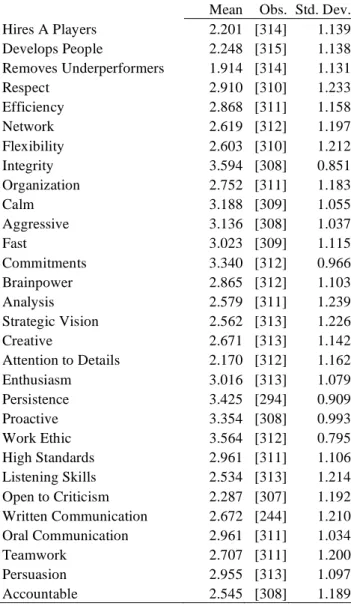
Panel A of Table III presents the means and standard deviations for the 30 characteristics in the data. Panel A indicates a fair amount of variation in the ratings of CEO candidates, with most standard deviations exceeding one. The two characteristics with the highest means and lowest standard deviations are Work Ethic and Integrity, suggesting that candidates considered for CEO positions are perceived to have high integrity and a strong work ethic.
Panel B of Table III compares buyout to VC candidates, and incumbents to outsiders. Buyout candidates generally have higher ratings than VC candidates. The ratings are higher for 20 of the 30 characteristics, significantly so for seven. Those seven are a mix of execution and interpersonal skills: Respect, Flexibility, Commitments, Attention to Details, Persistence, Listening Skills, and Open to Criticism. VC candidates are rated significantly higher on only two characteristics: Brainpower and Strategic Vision.
Because of the large number of characteristics, we are cautious when interpreting a few characteristics as having statistically significantly differences. Even with random data, random variation would lead to some significant differences.
To address this concern, we use a Wilcoxon Signed Rank Test. This non-parametric test compares the average scores for the characteristics for buyout and VC candidates, taking into account the signs and magnitudes of the differences. On average, if the scores had the same distributions, about half the differences would be positive, half would be negative, and they would have similar magnitudes. We reject this null hypothesis, supporting the finding that buyout company candidates score higher, on average, than VC company candidates.
The patterns are suggestive. Buyout candidates tend to score higher on characteristics related to a broader range of managerial and executive functions while VC candidates score higher on characteristics related to intelligence and vision. To the extent that entrepreneurs are
overrepresented relative to professional managers as candidates for VC-funded firms, our results suggest that entrepreneurs have less general management ability and more specific knowledge-related skills than the candidates considered for buyout transactions.
Panel B of Table III also compares incumbent CEOs to outside candidates. Outsiders score higher than incumbents on 19 of the 30 characteristics. In eight cases, the differences are significant: Hires A Players, Develops People, Efficiency, Network, Organization, Analysis, Oral Communication, and Accountable. For only one characteristic, Creativity, and only at the 10% level, do incumbents score higher than outsiders. A Wilcoxon Signed Rank Test confirms that these differences are not due to random variation. The higher scores of outsiders relative to incumbents are intriguing, given that outsiders are hired less often. The differences, however, are difficult to interpret given the large number of companies that assess only a single candidate.
B. Factor Analysis
As mentioned earlier, many of the theoretical papers in this literature assume that managers and CEOs have some general talent or ability that maps into performance. A number of the more recent theoretical and empirical papers in this literature also contrast resoluteness and overconfidence with flexibility, empathy, teamwork, and coordination. To investigate whether that distinction is important in our data, we use factor analysis to extract the main dimensions of variation in the characteristics of the candidates in our sample.
Panel A in Table IV reports the loadings on the four first factors. The first two factors have intuitive interpretations. The first factor, capturing 53.0% of the variation, has positive loadings on all the individual characteristics, ranging from a loading of 0.33 on Integrity to a loading of 0.68 on Efficiency. We can interpret this factor as measuring general talent or
ability.10 This structure of the first factor is commonly encountered in factor analysis, and it reflects the empirical fact that all the characteristics tend to move together.
The second factor, capturing 20.4% of the variation, has two distinct sets of loadings. The positive loadings, in decreasing order, are on the characteristics Respect,Open to Criticism, Listening Skills, Teamwork, Integrity, and Develops People. These characteristics appear to capture a candidate’s interpersonal skills. In contrast, the negative loadings are on the characteristics Fast, Aggressive, Persistent, Proactive, Work Ethic, High Standards, and Accountable, characteristics that arguably reflect execution ability.
The second factor sorts candidates along a spectrum, assigning higher positive scores to those with greater interpersonal abilities and lower negative scores to candidates with greater resoluteness and execution abilities. The importance of this factor is consistent with Bolton et al. (2009) who contrast resoluteness and overconfidence with teamwork and interpersonal skills. Hence, we interpret negative loadings on the second factor (corresponding to higher scores on Fast, Aggressive, Persistent, Proactive, Work Ethic, High Standards, and Accountable) as indicative of greater resoluteness and overconfidence.
The third and fourth factors are difficult to interpret, a typical problem with factor analysis. The third factor explains 11.4% of the variation. A positive loading on this factor corresponds to higher scores on Analysis, Organization, Attention to Details, and Written Communication. Candidates with negative loadings score higher on Enthusiasm, Persuasion, Persistence, and Proactive. The first set of characteristics may evoke a sense of deliberate analytic ability and organizational talent, whereas the second set of characteristics may reflect a more energetic and engaging nature. The fourth factor explains only 8% of the variation, with
positive loadings reflecting higher scores on Strategic, Brainpower, Creative, and Written
Communication, and negative loadings reflecting higher scores on Accountable, High Standards, Removes Underperformers, and Attention to Details.11
Overall, our results suggest that the characteristics of CEO candidates vary along two main dimensions: in their general level of ability and in their tilt towards either interpersonal or execution-related characteristics.
Before examining the relationship between the characteristics and performance, we also construct a second, more focused, factor decomposition to isolate the differences between the teamwork / interpersonal-related and resoluteness / execution-related characteristics. The focused analysis includes the six characteristics with the highest (most positive) loadings on the second factor (Respect, Open to Criticism, Listening Skills, Teamwork, Integrity, and Develops People) and the six characteristics with the lowest (most negative) loadings (Fast, Aggressive, Persistent, Proactive, Work Ethic, and High Standards). Not surprisingly, using those 12 characteristics, the factor analysis isolates two strong factors: an execution factor and an interpersonal factor.
Panel B of Table IV presents the loadings on the two focused factors that are rotated to isolate the interpersonal- and execution-related characteristics.12 The execution factor loads positively on the execution-related characteristics, and the interpersonal factor loads positively on the interpersonal characteristics. The pair-wise correlations of the characteristics in each of the two factors are all positive and highly significant while the pair-wise correlations between characteristics in the two different factors are much less significant and occasionally negative. This supports the idea that the scores on Fast, Aggressive, Persistent, Proactive, Work Ethic, and
11 In our factor regressions below, we include only the two primary factors. The results are largely unchanged when we include factors three and four in the regressions.
12 A number of rotations are commonly used to clarify the interpretation of the factors. We use the standard oblique quartimin rotation to isolate the execution and interpersonal characteristics in the two focused factors, although other
High Standards can be viewed as different measures of an underlying execution / resoluteness characteristic or ability. Similarly, the scores on Respect, Open to Criticism, Listening Skills, Teamwork, Integrity, and Develops People can be interpreted as different measures of an underlying interpersonal characteristic or ability.
As a more formal test, we calculate Cronbach’s alpha, which measures the variance of the combined scores relative to the variances of the individual scores, finding alphas of 0.85 for the execution-related characteristics and 0.82 for the interpersonal ones. These alphas are high,13 confirming the interpretation of the characteristics in each factor as different measures of the execution- and interpersonal-related characteristics or ability. Consequently, we use the two focused factors directly as indices of resoluteness and execution-related versus interpersonal skills.
As a robustness check, we also perform the analyses (but do not report in the tables) using other indices of execution and interpersonal abilities. We construct two indices by simply averaging the scores of the six most positive and negative characteristics. Alternatively, we construct indices using only the four most positive and negative characteristics, using both factor analysis and simple averages. In all cases, the results are consistent with the reported results.
III. Managerial Characteristics and Performance
We compare the candidates’ characteristics to the subsequent performance of the companies, restricting the analysis to the 224 candidates who were CEOs after the assessments — either because they remained as CEOs or were hired. As described earlier, we use three measures of success, with increasing coverage but decreasing precision: the PE measure, the public measure, and the broad measure.
A. Individual Characteristics and Performance
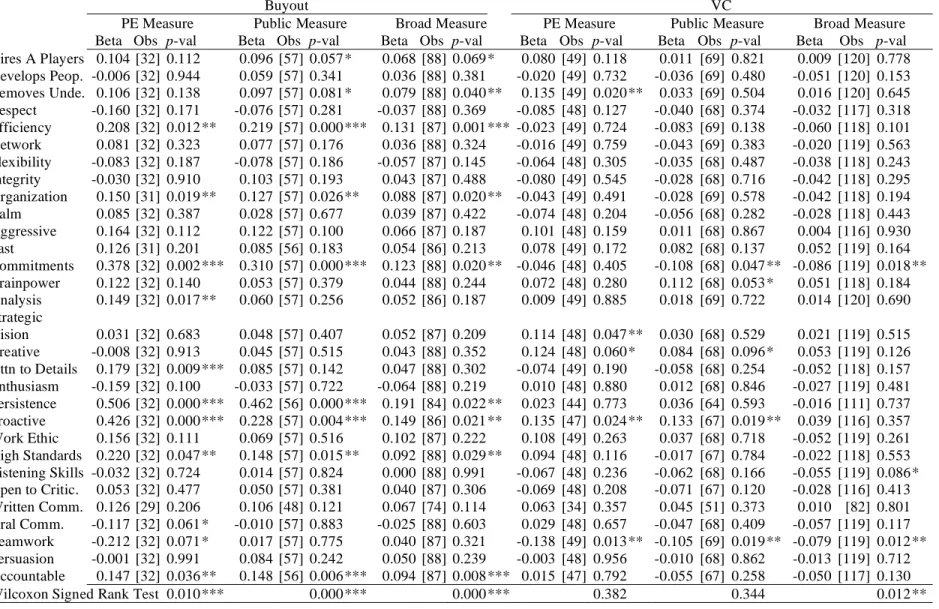
In this section, we consider the relationship between the individual characteristics and subsequent CEO success. Because our sample covers the seven-year period from 2000 to 2006, a period with large changes in both the buyout and VC markets, we include year fixed effects to control for time variation in the outcomes and treat buyout and VC deals separately. Table V presents regressions of each of the three outcome or success measures on the individual characteristics and time fixed effects.
For buyouts, we find positive coefficients for between 20 and 24 of the 30 characteristics, depending on the outcome measure, with roughly half of these statistically significant. We use the Wilcoxon Signed Rank Test to test the hypothesis that all the beta coefficients equal zero and the observed effects are due to random variation. We reject this hypothesis and conclude that, on average, CEOs with higher ratings perform better.
In Table V, we see that the larger and more significant effects are for resoluteness and execution-related characteristics. For buyout deals, the outcomes are positively and significantly related to Efficiency, Organization, Commitments, Persistence, Proactive, High Standards, and Accountable. None of the more interpersonal characteristics seem to have a strong relation to performance, and there is even weak evidence that Teamwork is negativelyrelated to
performance, particularly for VC deals.
The magnitudes are economically meaningful. Interpreting the magnitudes of the coefficients as a linear probability model,14 considering the first column in Table V, we see that increasing the CEO’s Efficiency score from 3 to 4 (i.e., from A- to A) is associated with a 20.8%
14
increase in the probability of a successful deal. Indeed, the empirical success rate for CEOs with an Efficiency score of 4 is 93% (using the PE measure), but it drops to 50% for CEOs scoring 3 and below. Similarly, an increase in the CEO’s score on Proactive from 3 to 4 is associated with a 42.6% increase in success probability. Needless to say, these magnitudes are substantial.15
Figure 1A presents success rates (using the PE and the public measures) as a function of CEO ratings for the six characteristics that comprise the focused execution and interpersonal factors. Consistent with the regressions, higher scores on the execution-related characteristics tend to be associated with higher success rates. In contrast, higher scores on the interpersonal-related characteristics do not show such a tendency.
Overall, these results are consistent with the theoretical predictions. First, talent, generally, does appear to be measurable and to predict performance, as assumed in models like Rosen (1981). Second, as predicted by Bolton et al. (2009), resoluteness and execution skills appear to be more important for performance than interpersonal skills.
Note that these results are univariate effects and the effects of different characteristics are unlikely to be independent. For example, CEOs with higher scores on Efficiency tend to score higher on Proactive, and we cannot double-count the increases in success probability. To sort out these effects and obtain more accurate estimates of the total economic magnitudes, we present a multivariate factor analysis below.
Turning to the estimates for VC firms, Table V shows mixed results. The magnitudes of the coefficients are smaller and only about half of them are positive. The Wilcoxon Signed Rank
15 The R-squared of these regressions generally declines from the PE measure to the public measure and the broad measure. For the regressions using the PE measure, for buyout candidates, the R-squared ranges from 8.2% for
Test does not find strong evidence that CEOs with higher scores perform better. Note that the weaker VC findings are not due to a smaller sample size.
Figure 1B presents the results graphically, plotting success rates (using the PE and the public measures) as a function of CEO ratings for the six characteristics that comprise the focused execution and interpersonal factors.
As with the buyout sample, there is no evidence that interpersonal- or communication-related skills are positively communication-related to performance. In fact, teamwork tends to be negatively related to performance. The effects of the remaining execution skills are mixed, with Proactive being positive and Commitments being negative.
There are several potential explanations for the weaker findings for VC-backed companies. First, the results are consistent with VC-funded companies having much greater business risk than the buyout-funded companies. This greater business risk potentially generates sufficiently volatile performance or outcomes that cannot be statistically reliably related to managerial ability. This result complements the results in Kaplan, Sensoy, and Stromberg (2009), who find that the success of VC-backed businesses is highly dependent on choosing the right business model, possibly reducing the effects of the individual managers. Also consistent with this interpretation, Adams et al. (2005) find that smaller public companies tend to have more volatile performance than larger companies, possibly leading to noisier results.
Second, VC-backed companies may have different CEO needs from more mature companies, not reflected by current theories. To speculate, CEOs of smaller companies may oversee a broader set of tasks and may have to avoid being bogged down by any single one of them. Hence, Persistence (defined as “sticks with assignments until they are done”) and
Commitments (“gets the job done, no matter what”) may be less valuable for such CEOs, consistent with Table V.
B. Factors and Performance
In Table VI, we present multivariate regressions that estimate the relation between performance and CEO factor scores. We report separate specifications for each of our three performance measures as well as different combinations of year-, industry-, and interviewer-fixed effects, finding results that are fairly consistent across specifications. The specifications also include an indicator for whether the candidate is the incumbent CEO at the time of the assessment.
Panel A in Table VI reports the performance of the buyout CEOs hired by PE investors using the two broad factors, which contain all the characteristics. Performance is significantly positively related to the first “general talent” factor in all specifications. Again, this is strongly consistent with the assumptions that managerial ability can be measured and is related to subsequent performance.
Performance is negatively related to the second factor in all specifications, but significantly so only for the PE measure. Candidates with stronger execution-related
characteristics relative to interpersonal characteristics have negative scores on the second factor, and these results suggest that better execution-related skills relative to interpersonal skills are positively related to performance.
The R2 declines as we move from the more precise PE measure to the less precise broad measure, and it increases, obviously, as more fixed effects are included.
in the sample of the two factors are 0.97 for the general talent factor and 0.93 for the second factor. Interpreting the regressions as a linear probability model, the coefficients in the first specifications in Table VI suggest that a one-standard deviation increase in general talent is associated with roughly a 28% (percentage-point) increase in success probability (= 0.29 x 0.97). Using the regressions with the PE measure, a one-standard deviation increase in the second factor is associated with a roughly 18% (percentage-point) decline in success probability (= 0.19 x 0.93).
To separate the effects of execution-related and interpersonal characteristics for the buyout sample, Panel B in Table VI reports estimates using the focused execution and interpersonal factors. As mentioned, these factors contain only the six most positive and six most negative characteristics in the second of the broad factors. Across the specifications, we find that the coefficients on the execution factor are positive and statistically significant,
confirming that performance is related to those abilities. The magnitudes are substantial. A one-standard deviation16 increase in the focused execution factor is associated with increases in success probabilities of 13% to 36% (percentage points).
In contrast, the coefficients on the interpersonal factor are never significant, are smaller in magnitude, and occasionally negative.
The insignificance of the incumbency variable in Table VI is also noteworthy. Incumbent CEOs are generally thought to have greater firm-specific knowledge than outside candidates, but the value of such firm-specific knowledge is an open empirical question.17 After controlling for other CEO characteristics, we find no evidence that incumbency and, arguably, firm-specific knowledge are related to success in our sample.
16
This result is somewhat surprising considering the construction of the sample. We do not observe firm-specific abilities, but we might expect incumbent CEOs with weaker abilities to be more likely to be replaced by outside CEOs. Hence, the remaining incumbents should be those who are perceived to be relatively strong CEOs. Yet, controlling for individual characteristics through the factors, we find no evidence that incumbents perform better than outside CEOs.
For VC CEOs, the multivariate results, like the univariate results, show somewhat different patterns. In Panel C of Table VI, the “general talent” factor (Factor 1) is not
significantly positively related to performance. In fact, the last specification reports a significant negative relationship. However, the “team player versus execution” factor (Factor 2) is negative across all specifications, and significantly so for several of the specifications. As with the univariate results, the absence of a strong positive influence of general talent may be consistent either with greater business volatility for VC-backed companies or with different needs for such firms.
Using the focused execution and interpersonal factors, Panel D of Table VI indicates that performance is not related to the execution-related factors, but is consistently negatively related to the interpersonal factor.
The VC regressions also fail to reveal any consistent or significant relationship between incumbency and performance, holding CEO characteristics constant. Again, this seems more consistent with Murphy and Zabojnik (2004) than Khurana (2002).
Overall, the results using both factor structures and both the VC and buyout samples are broadly consistent with the predictions in Bolton et al. (2009). Their model suggests that for more mature companies, the coordination benefit of resoluteness is more valuable, consistent with our findings of a positive value of the execution factor for buyout companies. VC-backed
are smaller with lesser coordination needs, broadly consistent with our finding of the negative effects of the interpersonal factor.
IV. Robustness and Endogeneity A. Endogeneity
It is possible that certain types of firms require certain CEO characteristics, which would lead to endogenous matching of candidates and firms [see Graham, Harvey, Puri (2009)]. For example, if more promising firms hire fast and aggressive CEOs, then we will find that fast and aggressive CEOs perform better. This concern is not unique to our paper, and it also arises in previous work on CEO characteristics, such as Bertrand and Schoar (2003) and Malmendier and Tate (2005).
We think that this type of selection is unlikely to be a primary driver of our results. First, we find it unlikely, albeit not impossible, that the more promising firms would hire execution-oriented CEOs while struggling firms would hire team- and interpersonally-execution-oriented managers. If anything, the opposite selection – where struggling firms need more decisive action – appears more reasonable, in which case our results may underestimate the true effects.
Second, for companies for which we have more than one CEO assessment, we consider the relation of the non-hired CEO candidate(s) characteristics to company performance. If there were significant selection of certain candidates for certain companies, we would expect the characteristics of candidates who are considered but not hired to be similar to those who are hired and, therefore, to help explain performance. However, we find no evidence of a
Another concern is that the sample contains only companies considered by buyout and VC investors, usually at the time of the investment decision. These two groups of companies may differ from each other as well as from public, family-owned, and other kinds of companies. While we do not have the data to formally address this issue below, we discuss the likelihood that our results generalize in the summary and conclusions.
B. Directly Observable Characteristics
It is possible that the assessed characteristics simply measure or proxy for directly observable characteristics that have been considered in previous studies, such as education, tenure, and functional background. As noted earlier, our data contain some such biographical information about the CEO candidates, including years of work experience,18 years of
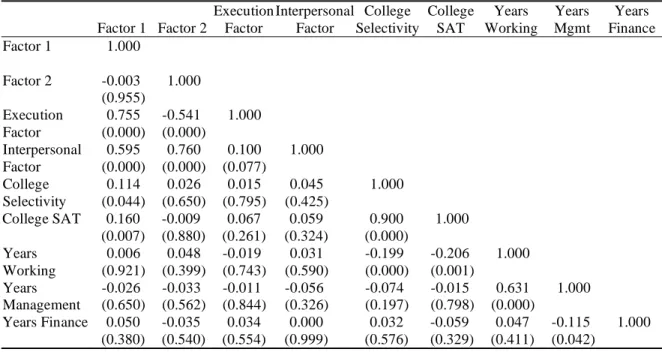
management experience, years of experience in a finance role, and college selectivity. We coded college selectivity using the ratings in Peterson’s College Planner,19 and the correlations are presented in Panel A of Table VII. The college selectivity and college SAT scores are highly correlated with each other, and they are also positively and significantly
correlated with the general talent factor (Factor 1). Although the distinction is not reported in the table, both correlations are significant for buyout CEOs, while only the college SAT scores are significantly correlated (at the 10% level) with the general talent factor (Factor 1) for VC CEOs.
College selectivity and college SAT are not significantly correlated with Factor 2 or either of the focused factors. Moreover, none of the experience variables is correlated with any
18
This measure effectively measures age. In the U.S., it is illegal to ask prospective employees about their age as part of an interview process, so age is not in our data.
19 Selectivity is coded as 4 if the school was rated most selective and admitted fewer than 20% of its applicants; 3 if the school was rated most selective; 2 if the school was rated very selective; 1 if the school was rated moderately selective; 0 if the school was rated minimally or not selective; and -1 if the candidate did not attend or graduate from college. We also coded the average of the interquartile range of SAT scores for each school. If a score was not
of the factors. This lack of correlation suggests that the characteristics captured by our second factor and our focused factors are not proxies for more easily observable characteristics.
We rerun the multivariate regressions for success from Table VI with the observable characteristics in addition to the previous regressors. We do not include college SAT scores, because they are highly correlated with college selectivity. The results are virtually identical, if we use college SAT scores instead of college selectivity. The results are presented in Panel B of Table VII.
For buyout CEOs, the results for the factors are qualitatively and statistically identical to the results in Table VI. The only observable variable with any significance is years of finance experience, which is significantly positive when using the public success measure (and positive, but not significant, for the other success measures). Note that years of finance experience is not significant by itself in any regression when the factors are not included.
For CEOs of VC-backed firms, the results are also qualitatively and statistically similar to those reported in Table VI. College selectivity is significantly positively related to success using the broad measure (although it is unrelated to success using the other two measures). One interpretation is that for VC CEOs, college selectivity may be a marginally better measure of general talent than the characteristics assessed by ghSMART and captured by Factor 1. Chevalier and Ellison (1999) obtain a similar result (that college selectivity predicts performance) for mutual fund managers.
Overall, we interpret these results using observables as having two implications. First, using college selectivity or SAT scores to capture part of the general talent variable seems valid. Second, the CEO distinctions and characteristics captured by the ghSMART assessments, and reflected in our second factor and the focused factors, cannot be proxied by more readily
observable characteristics. Those factors appear to capture managerial characteristics that are largely orthogonal to and provide more consistent performance-relevant information than the observable characteristics.
V. Summary and Conclusion
Using a novel dataset of assessments of CEO candidates of companies involved in private equity transactions, we study CEO characteristics and abilities and how those abilities relate to subsequent performance. The candidates are assessed on thirty individual characteristics. To our knowledge, these assessments provide a greater level of detail on CEOs’ specific characteristics than any previous study.
A factor analysis of the assessed characteristics suggests that there are two primary factors, with intuitive interpretations, that explain the majority of the variation in managerial characteristics: Factor 1 captures general ability, and Factor 2 contrasts communication and interpersonal skills with execution and interpersonal-related skills.
We relate the CEO characteristics to subsequent performance. For buyout CEOs, subsequent success is clearly related to the CEO’s general ability. For both buyout and VC CEOs, success is more strongly related to execution, resoluteness, overconfidence-related skills than to interpersonal-related skills. Consistent with differences in business uncertainty, the relations are stronger for buyout than for VC CEOs. Finally, success does not appear to be related to incumbency after controlling for talent and ability.
The results have several implications. First, consistent with the assumptions in theories like Rosen (1981), there appears to be substantial variation in general managerial talent that is measurable and different from the usual observable characteristics like age, industry, and SAT
scores. Second, consistent with these theories, we find that performance is strongly related to the general talent factor for the buyout CEOs. The more mixed results for the VC CEOs are not entirely surprising, but suggest a need for further research. Third, the structure of the second factor may support recent theoretical and empirical studies like Malmendier and Tate (2005), Gervais et al. (2008), and Graham et al. (2009), that focus on managerial overconfidence and optimism as characteristics of first-order importance for CEOs. Fourth, the results that
performance is more strongly correlated with resoluteness and execution-related skills than with interpersonal and team-related skills are particularly consistent with Bolton et al. (2009) who find that more “resolute, steadfast CEOs who stick to their guns tend to be better leaders than ‘good listeners’.” The results are also consistent with Gervais et al. (2009), who derive
conditions where overconfident CEOs perform better. Finally, our finding that incumbent CEOs are no more successful than outside candidates, holding talent constant, is suggestive. It is consistent with the predictions of Murphy and Zabonjik (2004) and others, and less consistent with the admonition in Khurana (2002) to focus on insiders and avoid outsiders. This presents an interesting topic for future research.
While this is likely the most detailed study of individual CEO characteristics at present, we recognize that it has limitations. Our outcome measures are coarse, and the PE measures may be subjective. We cannot formally address concerns about endogenous matching of companies and candidates, although we consider it unlikely to be a primary driver of our results, as
discussed. Finally, the results reflect buyout and VC-funded companies that may differ from other types of companies. While the generality of our results, therefore, remains an open empirical question, the similarities between our results and the ideas expressed by Drucker (1967) for a larger set of companies – public, private, and non-profit, small and large – suggest
References
Adams, Renee, Heitor Almeida, and Daniel Ferreira, 2005, Powerful CEOs and their impact on corporate performance, Review of Financial Studies, 1403-1432.
Barrick, Murray, Michael Mount, and Timothy Judge, 2001, Personality and Performance at the Beginning of the New Millennium: What do We Know and Where Do We Go Next?
International Journal of Selection and Assessment, 9-30.
Barsade, S., A. Ward, J. Turner and J. Sonnenfeld, 2001, To your heart’s content: A model of affective diversity in top management teams, Administrative Science Quarterly, December, 802-836.
Ben-David, I., J. Graham, and C. Harvey, 2008, Managerial Overconfidence and Corporate Policies, working paper, Duke University.
Bennedsen, Morten, Francisco Pérez-González, and Daniel Wolfenzon, 2008, Do CEOs Matter? working paper, Columbia University.
Bertrand, Marianne and Antoinette Schoar, 2003, Managing with style: The effect of managers on firm policies, Quarterly Journal of Economics, 118 (4), 1169-1208.
Bloom, Nick and John Van Reenen, 2007, Measuring and Explaining Management Practices Across Firms and Nations, Quarterly Journal of Economics, 1351-1408.
Borghams, L., A. L. Duckworth, J. J. Heckman, and B. ter Weel, 2008, The Economics And Psychology Of Personality Traits, NBER Working Paper 13810.
Bolton, Patrick, Markus Brunnermeier and Laura Veldkamp, 2008, Leadership, Coordination and Mission-Driven Management, working paper Columbia University.
Chevalier, J. and G. Ellison, 1999, Are Some Mutual Fund Managers Better than Others? Cross-Sectional Patterns in Behavior and Performance, Journal of Finance, 875-899.
Collins, Jim, 2001, Good to Great: Why Some Companies Make the Leap and Others Don’t
(Harper Business, New York).
Drucker, Peter, 1967, The Effective Executive (Harper Collins, New York).
Fabrigar, L. R., Wegener, D. T., MacCallum, R. C., and Strahan, E. J., 1999, Evaluating the use of exploratory factor analysis in psychological research, Psychological Methods, 4, 272-299. Frank, Murray and Vidhan Goyal, 2007, How Much Do Managers Really Matter? working paper.
Frydman, Carola, 2006, Rising through the ranks: The evolution of the market for corporate executives, 1936-2003, working paper, MIT.
Gabaix, Xavier and Augustin Landier, 2008, Why Has CEO Pay Increased So Much? Quarterly Journal of Economics, 49-100.
Gervais, S. and I. Goldstein, 2007, The Positive Effects of Biased Self-Perceptions in Firms,
Review of Finance 11(3), 453-496.
Gervais, S., J.B. Heaton, and T. Odean, 2009, Overconfidence, Compensation Contracts, and Labor Markets, working paper, Duke University.
Goleman, Daniel, Richard Boyatzis, and Annie McKee, 2002, Primal Leadership: Realizing the Power of Emotional Intelligence (Harvard Business School Press: Boston).
Gompers, P., A. Kovner, J Lerner, and D. Scharfstein, 2006, Skill vs. Luck in Entrepreneurship and Venture Capital: Evidence from Serial Entrepreneurs, working paper, Harvard Business School.
Graham, J., C. Harvey, and M. Puri, 2009, Managerial Attitudes and Corporate Actions, working paper, Duke University.
Graham, J. and K. Narasimhan, 2004, Corporate Survival and Managerial Experiences During the Great Depression, working paper, Duke University.
Guthrie, James, and Deepak Datta, 1997, Contextual Influences on Executive Selection: Firm Characteristics and CEO Experience, Journal of Management Studies, 34, 537-560.
Hambrick, Donald C. and Phyllis A. Mason, 1984, Upper Echelons: The Organization as a Reflection of Its Top Managers, Academy of Management Review, 9, 2, 193-206.
Heaton, J. B. 2002, Managerial Optimism and Corporate Finance, Financial Management, ?? Hellmann, Thomas and Manju Puri, 2002, Venture capital and the professionalization of start-up firms: Empirical evidence, Journal of Finance, 169-197.
Hochberg, Y., A. Ljungqvist, and Y. Lu, 2007, Venture Capital Networks and Investment Performance, Journal of Finance, 62, 251-301.
John, O. P., and S. Srivastava, 1999, The Big Five Trait Taxonomy: History, measurement, and theoretical perspectives, In L. A. Pervin & O. P. John (Eds.), Handbook of Personality: Theory and Research (2nd ed., pp. 102-138) (Guilford: New York).
Kaplan, Steven, Berk Sensoy and Per Stromberg, 2009, What are Firms? Evolution from Early Business Plans to Public Companies, Journal of Finance, 75-115.
Kaplan, Steven and Per Stromberg, 2004, Characteristics, Contracts, and Actions: Evidence From Venture Capitalist Analyses, Journal of Finance, 59, 2177-2210.
Khurana, Rakesh, 2002, Searching for a Corporate Savior: The Irrational Quest for Charismatic CEOs (Princeton University Press: Princeton, NJ).
Lazear, Edward P. and Sherwin Rosen, 1981, Rank-Order Tournaments as Optimum Labor Contracts, Journal of Political Economy, 89, 5, 841-864.
Malmendier, Ulrike and G. Tate, 2005, CEO Overconfidence and Corporate Investment, Journal of Finance 60 (6), 2661-2700.
Malmendier, Ulrike and G. Tate, 2009, Superstar CEOs, Quarterly Journal of Economics, 1593-1638.
Manso, Gustavo, 2010, Motivating Innovation, MIT working paper.
McClelland, D.C., 1998, Identifying competencies with behavioral event interviews,
Psychological Science 9, No. 5, 331-339.
Morgeson, F., M. Campion, R. Dipboye, J. Hollenbeck, K. Murphy, and N. Schmitt, 2007, Are We Getting Fooled Again? Coming to Terms with Limitations in the Use of Personality Tests for Personnel Selection, Personnel Psychology, 1029-1049.
Murphy, Kevin J., and Jan Zabojnik, 2004, CEO Pay and Turnover: A Market Based
Explanation for Recent Trends, American Economic Review Papers and Proceedings 94, 192-196.
Ones, Deniz, and Chockalingam Viswesvaran, 1998, The Effects of Social Desirability and Faking on Personality and Integrity Assessment for Personnel Selection, Human Performance
11, 245-269
Rosen, Sherwin, 1981, The Economics of Superstars, American Economic Review, 71, 5, 845-858.
Rotermberg J. and G. Saloner, 1993, Leadership Style and Incentives, Management Science, 39, 1299-1318.
Schoar, Antoinette, 2008, CEO Careers and Styles, working paper, MIT.
Smart, Bradford, 1999, Topgrading: How Leading Companies Win by Hiring, Coaching, and Keeping the Best People (Penguin Group: New York).
Sorensen, Morten, 2007, How Smart is Smart Money: A Two-Sided Matching Model of Venture Capital, Journal of Finance, 62, 2725-2762.
Ulrich, Dave, Norm Smallwood, and Kate Sweetman, 2009, Leadership Code: Five Rules to Lead By (Harvard Business School Press: Boston).
Van Den Steen, E., 2005, Organizational Beliefs and Managerial Vision, Journal of Law, Economics, and Organization, 21(1), 256-283.
Yammarino, F.J., Dionne, S.D., Chun, J.U., & Dansereau, F., 2005, Leadership and levels of analysis: A state-of-the-science review, Leadership Quarterly 16, 879-919.
Zarutskie, Rebecca, 2007, Do Venture Capitalists Affect Investment Performance? Evidence from First-Time Funds, working paper, Duke University.
Figure 1 Individual Characteristics and Performance: The histograms plot the relationships between scores in selected individual characteristics and
performance. The vertical axis contains the success rate, measured as the fraction of the candidates that are successful according to the performance measure. The horizontal scale indicates the score on the characteristic, coded from 1 (lowest) to 4 (highest), as defined in the text. Panel A contains buyout candidates, and Panel B contains VC candidates. The left plots contain the six characteristics associated with the execution factor, and the right plots contain the six
characteristics associated with the interpersonal factor. The top plots use the PE measure as the performance measure, and the bottom plots use the public measure. When a score is reported but there is no bar (e.g., a score of 2 for persistence for buyout candidates), the score was given to some candidates, but they were all unsuccessful (a success rate of zero). When the score is unreported (e.g., a score of 1 for persistence for buyout candidates), the score was not given to any candidate in the sample.
TABLE I: Descriptions of individual characteristics: From ghSMART internal guidelines.
Characteristics Description Behavior Associated with High
Score Behavior Associated with Low Score
Leadership:
Hires A Players Sources, recruits, hires A Players. Hires A Players 90% of the time. Hires A Players 25% of the time. Develops People
Coaches people in their current roles to improve performance, and prepares them for future roles.
Teams say that Candidate gives a lot of coaching / development. Many team members go on to bigger roles.
Teams do not say on Candidate gives a lot of coaching. Team members do not go on to do better things.
Removes Underperformers
Removes C Players within 180 days. Achieves this through coaching-out, redeployment, demotion, or termination.
Removes C Players within 180 days of taking a new role or hiring the person.
May remove occasional C Player, but keeps most of them, often for years.
Respect
Values others, treating them fairly and showing concern for their views and feelings.
Teams would say Candidate is fair and respectful. Candidate describes performance in terms of team efforts.
Candidate is self-absorbed. Team members might call Candidate abrasive, rough around the edges.
Efficiency Able to produce significant output with minimal wasted effort.
Candidate gets a lot done in a short period of time.
Candidate’s output is unimpressive. He is a “thinker” with poor execution. Network Possesses a large network of talented
people.
Candidate has a proven ability to build a network very quickly.
Candidate does not have big network and shows limited ability to build one. Flexible
Adjusts quickly to changing priorities and conditions. Copes with complexity and change.
Candidate is not bothered by new or changing circumstances. Faces change in a matter-of-fact manner.
Candidate bristles when changes take place, often blames others for not doing their jobs.
Personal:
Integrity Does not cut corners ethically. Earns trust and maintains confidences.
Takes pride in always doing what is right.
Cuts corners, unaware of how actions are borderline unethical.
Organization Plans, organizes, schedules, and budgets in an efficient, productive manner.
Job accomplishments closely match goals. Candidate sets priorities.
Candidates’ accomplishments do not match goals, and individual meanders.
Calm Maintains stable performance when under
heavy pressure or stress.
Performs under a wide variety of circumstances, regardless of stress.
Overreacts to high pressure situations. Fails to accomplish goals under stress. Aggressive Moves quickly and takes a forceful stand
without being overly abrasive.
Candidate sticks neck out with words and actions, even if upsets others.
Candidate takes a wait-and-see attitude, moving more slowly to minimize risk.
Fast Takes action quickly without getting
bogged down by obstacles.
Candidate takes action and gets a lot
done in a short period of time. Candidate is slow to accomplish results. Commitments Lives up to verbal and written agreements,
regardless of personal cost. Gets the job done, no matter what.
Does not live up to verbal or written agreements.
Intellectual:
Brainpower Learns quickly. Demonstrates ability to quickly understand and absorb new info.
High GPA and SAT scores, ability to pick-up new job details quickly.
Low GPA and SAT scores. May remain in same role for a long time.
Analytical Skills Structures and processes qualitative or quantitative data and draws conclusions.
Cites multiple examples of problem solving skills.
Rarely solves problems through analysis. Heavy reliance on gut.
Strategic Vision Able to see and communicate the big picture in an inspiring way.
Holds a big vision for current and future roles. Inspires others vision.
Does not have a vision for current or future roles. Does not value planning.
Creative Generates new and innovative approaches to problems.
Offers new and innovative solutions to
intractable problems many times. Rarely offers creative solutions. Attention to Detail Does not let important details slip through
the cracks or derail a project.
Makes time to review the details. Asks penetrating questions.
Makes many mistakes because of ignoring small, but important details.
Motivational:
Enthusiasm Exhibits passion and excitement over work. Has a “can do” attitude.
Displays high energy and a passion for the work..
Displays low energy and limited passion for the work.
Persistence Demonstrates tenacity and willingness to go the distance to get something done.
Never gives up. Sticks with assignments
until they are done. Has a track record of giving up. Proactive Acts without being told what to do. Brings
new ideas to company.
Regularly brings new ideas into an organization. Self directed.
Never brings in new ideas. Takes direction / does not act until being told.
Work Ethic Possesses a strong willingness to work hard and long hours to get the job done.
Works long, hard hours to get the job
done. Does just enough to get the job done.
High Standards Expects personal performance and team performance to be the best.
Expects top performance from himself and from others around him.
Allows himself to do 80% of the job / lets poor performance from others slide.
Interpersonal:
Listening Skills Lets others speak and seeks to understand their viewpoints.
Displays ability to listen to others to understand meaning.
Cuts people off, does not address questions, misunderstands. Open to Criticism Often solicits feedback and reacts calmly to
receiving criticism.
Responds to criticism by finding ways to grow and become better.
Reacts to criticism by blaming others and becoming bitter.
Written Communication Writes clearly and articulately using correct grammar.
Demonstrates ability to write clearly in all forms of communication.
Does not offer any evidence of being a strong writer.
Oral Communication Speaks clearly and articulately without being overly verbose or talkative.
Speaks clearly, articulately, and succinctly.
Speaks too quickly or too slowly, mumbles, uses a lot of jargon, etc. Teamwork Reaches out to peers and cooperates with
supervisors to establish relationship.
Recognizes the power of a strong team, and works collaboratively.
Prefers to operate in isolation. May not work harmoniously with others. Persuasion Able to convince others to pursue a course of
action
Convinces others to take a course of action, even if initially in opposition.
Fails to or never tries to convince others to take a course of action.
Holds People Accountable Sets goals for team and follows-up to ensure progress toward completion.
Sets goals, follows-up, and holds people accountable for shortfalls.
Does not set goals, follow-up, or hold people accountable.