Dexterity for Channel Capacity Enhancement in
MU-MIMO by Abrogating Interference
Dr. Dalveer Kaur, Neeraj Kumar
I. K. Gujral Punjab Technical University, Jalandhar
Abstract: The looming field of Multi user Multiple-input
Multiple-output (MU-MIMO) communication system has faced a challenge with precoding techniques for achieving increased channel capacity of their less inhaling of signals, imperfect knowing of channel state information, loss of signals by noise, time complexity etc. in downlink systems which results in interference to the users. Hence straight forwarding from the issues, the paper newly introduce2LB-FR precoding technique which holds Linde-Lyold’s (LL)algorithm to increase data transmission by consuming large amount of signals with space and the Bernoulli distribution with Bayes decision (BB) to allot the perfect channel state; l information during transmission that eliminates co-interference. Holding Floyd Rasta (FR) algorithm expels the noise if added and takes the shortest required path by acquiring all the possible routes available in single execution which decreases delay. By the overall implementation, the proposed work pomped that in short time, the capacity of the channel get enhanced with interference cancellation.
Keywords: MU-MIMO, Linde–Lyold’s, Bernoulli distribution,
channel capacity, interference, Bayes decision, Floyd Warshell, RASTA mean subtraction.
1. Introduction
Multi user Multiple-input Multiple-output (MU-MIMO) communication techniques have been an important area of focus for next-generation wireless systems because of their potential for high capacity, increased diversity, and interference suppression [1].By the massive number of cell phones and the rise of various applications, for example, video spilling and informal communities, together outcome in expansive interest for remote system data transmission [2]. So the IEEE indicates 802.11n/ac as of late to abuse MIMO advances with multiple users to give a higher transmission rate to remote systems.
In a MIMO framework, every gadget, i.e., Access point (AP) or customers, can be outfitted with multiple receiving wires, which can be utilized to convey the spatial multiplexing pick up or the assorted variety pick up, or both [3]. MIMO advancements can henceforth considerably support the system throughput by empowering concurrent transmissions as well as decreasing the effect of signal fading [4].The throughput for the MU-MIMO framework can be expanded by the linear and nonlinear precoding techniques.
In linear precoding techniques, the Concurrent transmissions [5] of MU-MIMO can be realized by using a signal processing technique, called zero-forcing beam forming (ZFBF).ZFBF eliminates the interference among simultaneous transmissions [6] with the goal that every customer only gets its focused on signal. In any case, such precoding may influence the getting SNR at every customer, and in this way makes the achievable rate be unpredictable. In order to reduce the above said issues, the capacity for the MIMO multiple-user channel has been analyzed using
nonlinear precoding techniques [7] alluded to as "writing on dirty paper." This strategy was produced [8] in view of interference cancellation. It is demonstrated that the limit of a channel where the transmitter knows the meddling sign was the same as though there were no obstruction. The dirty paper relationship originates from looking at the obstruction in a communications channel to earth that was available on a bit of paper. Anyway this procedure works for known channel state information conditions.
In Channel State Information, a transmit cluster can send multiple messages, at the same time and specifically, to autonomous terminals [9]. By and large, the users appreciate the linear total rate additions of traditional point-to-point multiple radio wires. A pragmatic way to deal with multiple informing [10], yields an aggregate rate inside 4 dB of the hypothetical achievable rate for a ten-reception apparatus base station and ten single-receiving wire terminals. Conversely, without forward channel learning at the base station, the aggregate rate for the users was no more noteworthy than the rate for a solitary user [11].
To distinguish the CSI, the Time-division duplex (TDD) [12] frameworks offer a direct route for the transmitter to obtain the CSI. Since the forward and turn around connect in a TDD framework share a similar frequency, reciprocity implies that the base station can take in the forward connection from known pilot motions on the invert link [13]. However, there might abrogate considerations that direct the decision of a Frequency division duplex (FDD) framework, in spite of the more noteworthy complication of FDD in CSI transfer [14].
The problem of getting and utilizing imperfect CSI at the transmitter has received hefty attention as exemplified by [15]. These numerous approaches cross-check the standard of the channel obtained at the bottom station required for beam forming, space–time communication, increasing capability and precoding. However, they are doing indirectly address the question of the relative potency of TDD and FDD in CSI transfer [16], particularly in a very multiuser setting. additionally for the downlink of a line (Digital Subscriber Line) [17] system with interference between the wires for every user is one state of affairs wherever the transmitter terminals will get together, however the so much finish of the MIMO channel cannot[18].
additional degrees of diversity when using appropriately designed signal processing at the transmitter and receiver. In the downlink design of precoding techniques in MU-MIMO, the capacity of holding large number of signals is difficult because of the multi users and also collides with each other because of limited space. When traveling through the channel, the signal has to know their channel state information since another path travel results in interference, cross talk, etc. Along with this, the noise present in the channel gets added and makes loss of signals which results in attenuation and degradation in channel capacity. Confering with the issues, maximize the signal level and providing the proper route along their shortest path avoids the interference, attenuation, time complexity. So the paper designs a newly precoding technique which can interestingly solve the listed problem to cancel the interference and time complexity and thereby improve capacity.
The outline of this paper is summarized as follows. Section 2 deals with related research problems. Section 3 discussed about the proposed methodology. Section 4 discussed about the result and performance evaluation of this research and concluded in section 5.
2. Related Works
ChristophStudeet.al [21] processed new algorithms for amount greatest a-posteriori (MAP) channel estimation and knowledge detection, and targeted the connected execution/quantization exchange offs. the use of four-piece ADCs was capable accomplish shut ideal execution in large MU-MIMO-OFDM systems having a BS-reception equipment to-user proportion of eight or higher. The advancement of corresponding methods was of principal significance to empower the pragmatic organization of amount large MU-MIMO-OFDM frameworks.
Sven Jacobson et.al [22] delineated the problem of downlink precoding for a narrowband large MU-MIMO framework with digital to analog converters (DACs) at the bottom station (BS). For the instance of 1-bit DACs, a unique nonlinear precoding algorithmic rule was provided that altogether outflank linear precoders at the value of associate expanded procedure quality. Also, a generalization of investigation to the instance of oversampled DACs, that work on associate examined repetition larger than the image rate, was of all the way down to earth interest.
Aki Hakkarainenet.al [23] processed ideal redoubled linear RX as way as restricted the mean square error. The novel approach incorporates the I/Q skewness mitigation, outside interference suppression and knowledge stream separation of multiple UEs into a solitary ready stage, afterwards evaded isolate phone standardization. By and enormous the outcomes demonstrate that solid and elite spatial making ready qualities are often gotten by the processed enlarged combiner rule, no matter tested levels of the outer interference, phone I/Q awkward nature and high variety of spatially multiplexed users, within the thought-about OFDMA MU-MIMO frameworks.
ZhongqiangLuoet.al [24] delineated the visually impaired separation technique against channel confound in multiple-input multiple-output (MIMO) frameworks. the problem of visually impaired signal separation/extraction with channel
confound was planned as a value perform of blind supply separation (BSS) subject to the second-arrange cone constraint, which may be referred to as second-arrange cone programing optimization issue. The processed dazzle locater will offer power against channel confound to accomplish desirable execution over the existed daze identifiers.
Zhen gaoet.al [25] processed the digitally controlled phase shifter network (DPSN)- primarily based crossover precoding/combining set up for mm Wave large MIMO, whereby the low-rank property of the mm Wave large MIMO channel lattice was utilized to decrease the desired price associated quality of a phone with an immaterial execution misfortune. One key element of the explained plot was that the macro cell bachelor's degree will at an equivalent time bolster multiple little} cell bachelor's degrees with multiple streams for each little cell BS, that was frequently strained to single-user MIMO with multiple streams or multi-user MIMO with single stream for each user R. Krishnan et.al [26] clarified the impact of stage clamor on the downlink execution of a multi-user multiple-input multiple-output framework, wherever the bottom station (BS) utilized an intensive variety of transmit antennas. They take into account a setup wherever the bachelor's degree utilizes free running oscillators, and receiving wires are connected to each generator. For all thought-about precoders, when β is little, the execution of the setup wherever all bachelor's degree radio wires are connected to a solitary generator is healthier than that of the setup wherever each bachelor's degree receiving wire has its own generator. Be that because it could, the inverse is valid.
Neerajkumar and Dalveerkaur [28] clarified a Multiuser multiple-input multiple-output (MIMO) nonlinear pre coding techniques face the issue of poor computational scalability of the size of the network. But by this nonlinear pre coding technique the interference is pre-cancelled automatically and also provides better capacity. So in order to reduce the computational burden in this paper, a definitive issue of MU-MIMO scalability is tackled through a non-linear adaptive optimum vector perturbation technique. Unlike the conventional (Vector Perturbation) VP methods, here a novel anterograde tracing is utilized which is usually recognized in the nervous system thus reducing complexity.
By the above works substantially challenging problems are identified for the enhancement of channel capacity. The chore ofChristophStudeet.al [21] on quantized maximum a-posteriori channel estimation finds difficult to estimate the channel parameter. In view of precoding the data streams, Sven Jacobsson et.al[22] theorem makes high rate and complexity inthe closed form approximation. Aki Hakkarainenet.al [23] work fails to analyze the MSQ value accurately.
through channel determination, noise reduction, less time consumption which results the channel capacity enhancement.
3. Emergence of Channel Enhancement in
Mu-MIMO by Interference Cancellation with
2lb-Fr Pre coding Techniques
The addition of multiple antennas in a wireless network opens up many problems to the users by making interference, attenuation, time complexity due to improper knowing of CSI. Concerning the channel, the space utilization is higher when a large number of data streams are transmitted by the multiusers at the same time with the problem of collision. Many linear and non-linear precoding techniques such as dirty paper, zero forcing, MMSE involves seriously canceling the interference problem by means of holding large amount of data streams. But these techniques find difficulty to solve the different modes of interference by knowing the exact CSI.
Thence to mitigate that, anew precoding technique called 2LB-FR is proposed that holds Linde -Lyold’s (LL) algorithm to divide and group the data streams into fragments according to the receiver station information. This algorithm makes use of spacing specialty of Lyold’s algorithm thereby solves the inter symbol interference and maintain the in-phase quality of the signal by preserving the necessary signal data. While allocating the space and making the large number of data streams into groups they have to select the match channel path for destination. Because mismatching of channel path leads to the co-channel interference. The diagrammatic representation is given in figure 1.
Linde Lyolds Algorithm
Base station
Shortest path allotment by Floyd Warshell-RASTA mean
subtraction User 5 User 4 User 3 User 2 User 1 User 6 User 7 User 8 User 9 User n
Network of MU-MIMO
Figure 1: An MU-MIMO System with 2LB-FR Techniques Hence to select their matched channel path for transmission, the Bernoulli Bayes decision (BB)is proposed which finds the channel probability of path and distributes the grouped data streams by exactly pointing the CSI. This is done by the calculation of probability of CSI. Now it is important to make sure that the signal has to make a short travel by eliminating BER because addition of noise can increase the weight of the system resulting in degradation of channel capacity.
Also long travel can cause a severe problem of attenuation of signal. This problem is solved by the Floyd Rasta algorithm (FR) which expels the noise of even slow variations in the signal if added while taking the shortest required path by
acquiring all the possible routes available in single execution. Thus by eliminating the interference problem with accurate identification of CSI, selecting the shortest path distance and noise reduction techniques the capacity of the channel gets enhanced.
Let us consider the MU-MIMO system with the transmitting signals to the user from the base station by the matrix model equation given by
z
HX
y
=
+
(1) Where y is the receiving signal, H is the channel gain, X is the transmitting antenna and the z is the noise added while transmission.
A MIMO channel holding na transmitters and nb receivers is represented as a matrix H of dimension na × nb, where each of the quantities [H]i,j represents the transfer function from the jth transmitter to the ith receiver. We denote the signal transmitted from the jth transmitter xj, and collect all such signals into anna-dimensional vector x. The model of the MU-MIMO channel in form of matrix is represented as in (2).
n n n
u H X z
n n n y n z z z X X X H H H y y y + + = * 2 1 2 1 2 1 2 1 . . . . . . * . . . . . . (2)
The design of enhanced capacity channel in MU-MIMO is given below in the following sections.
3.1. Capacity Enhancement with Sniffing Information in MU-MIMO
Channel capacity can be evaluated as the maximum amount of signal that can move over a particular infrastructure channel. The MU-MIMO communication system can have the capability of holding more information from the users but, because of the more space utilization of these information in the channel, the transmission rate is a smaller amount than the utilized information that causes the inter symbol interference. Hence to reduce that the paper designs the spatial spacing and grouping algorithm to enhance the channel capacity by transmitting more information which can be explained below.
3.1.1. Inter symbol cancellation with spacing by Linde-Lyolds algorithm
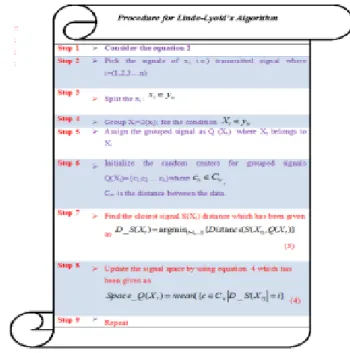
To enhance the channel capacity by increasing the more signal transmission rate with the spatial spacing, the paper presents the Linde-Lyolds algorithm. In that the Linde algorithm which is the part of the Lindebuzo grey algorithm receives the large number of signals in the base station and grouped them according to the receiver station information. Together with, the Lyold’s algorithm allots the spatial space as a precoding for each grouped signals to cancel the inter symbol interference. The mathematical evaluation for the proposed scheme is given below,
wise procedure from step 1 to step 9 which is given in figure 2.
Figure 2: Procedure for Line- Lyolds Algorithm The closest signal S(Xt) distance which has been given as in equation 3,
( )
(
) ( )
t t
t t
t Dis ce S X Q X
X S
D_ ( )=argmin(−1...) tan ,
(3) The signal space is updated by using the equation 4
( )
X mean(
c C D S( )
X i
)
QSpace_ t = w _ t
(4) By splitting the signals in step 3 and grouped them according to the receiver station in step 4 followed by proper coding assignment in step 5 makes the multi signals as single which can makes the channel to hold large of data’s and allotting the space utilizing the shortest distance between centers of the data in equation (3), and (4) there by cancels the inter symbol interference caused due to the collision of the signals. Thus the complexity in taking large amount signals get reduced completely by allocating the proper spatial space.
After precoded the signals with the proper spacing, it is essential to know the channel state information exactly and make their travel in the shortest path without the addition of noise. So that it is impossible for attaining the co-interference and loss of signals in the channel. For that purpose, the paper newly designs the channel allotment technique that can be explained in the following sections.
3.2. A Majesty in Precoding Techniques with Channel Allotment
While sending the signals for transmission, the signal has to know the channel state information(CSI) for transmission thus improper CSI of channel leads to the cross talk problem i.e) co-channel interference. Much of the researches on mutually linear processing and dirty paper coding approaches to multi-user MIMO channels has assumed that the transmitter and receivers all know the channel accurately. Precise CSI might be anything but difficult to get when the channel is evolving gradually, yet it is considerably more troublesome in situations where the channel is evolving quickly. So it requires additional algorithms for the channel estimation to eliminate the co interference. For that, the
channel state estimation has done with the BB theorem which is explained below.
3.2.1. Co-Interference cancellation by Bernoulli’s distribution with Bayer’s Decision:
After allotting the space for the grouped signal in equation4, considering toward one side of the connection there is an n-component radio wire exhibit (base station), and at the opposite end of the connection are multi-reception apparatus terminals (users).
It needs the base station to require within the propagation lattice from its reception apparatuses to the users. It likewise needs each user to require within the line of that corresponds to the propagation channel from the bottom station receiving antennas to its single antenna. thus curious about getting correct CSI as quickly as attainable and assume that the channel is more or less constant throughout the required coaching intervals, the paper designs the Bernoulli distribution with Bayes decision. The formulation for the Bernoulli distribution with Bayes decision is given below. The spaced signals from the equation4 can be used for finding n number of antennas with their CSI can be written as,
= = n t t X Q space B 1 ) ( _ (5) Utilizing the information in the propagation matrix with the gain Hn, the channel state information can be utilized by the distributed value of p. The distribution plot can be plotted as followsB 0 1 2 …………... t-1 t P(B)
1-p p
p-1
……….. p-(t-2) p- (t-1)
(6) Where B is the grouped signal from the antenna, P(B) is the probable distribution to know the CSI. Then the possible known CSI for concern signal with their antenna can be calculated utilizing the equation 7 can be evaluated as
p
=
p)
*
(1
+
p)
-(1
*
0
=
(B)
E
(7)
Then expected CSI for the consecuting signals in the next antenna is
p
=
p)
*
(1
+
p)
-(1
*
0
=
)
(B
E
2 2 2 2 (8)
The difference between the CSI state by the distribution plot of equation (6) for two antenna medium can be evaluated as
p2
-p
=
(B)
Diff
(9)By taking the difference of the consecutive signals in their antennas, the probability of CSI are calculated for the concern signal. Then to allocate the accurate CSI, the Bayes decision function can be implemented by
diff(B) B2) + E(B * E(B) = ) BD(Xc (10) Where BD(Xc) is the matched CSI for signal.
and their differences in equation (8) and (9). By calculating all the features quickly, the signals are distributed with the probable CSI. Then to allow them in the concern path, Bernoulli finds the probability of the matched channel and then the Bayes calculate the accurate CSI for signals taking less time for computation and distribution. Henceforth the problem of Co-Channel interference (mismatching of channel) due to the inaccurate CSI can completely eliminated.
After travelling into their matched channel Path with known CSI, noise can be added if it travels for a long time results in loss of signal strength(attenuation) and makes degradation channel capacity. So there is a need for the design of picking short path travel with noise reduction to get the enhanced system of channel capacity in MU-MIMO.
3.2.2. Attenuation cancellation by Floyd Rasta Algorithm:
As the signals travel further, they will lose strength by the addition of noise thus, reliability of the transmission will be reduced and eventually fail which affects the channel capacity. Hence to reduce that, the shortest path for the travel can be calculated using Flyods- Rasta there by addition of noise can be eliminated which can be explained below. Let the number of channel path can be selected as k and the shortest path can be taken as K(s).By using the Floyd Warshell algorithm the shortest path for the signal BD(yc) can be calculated as below
Figure 3: Procedure for Floyd Rasta Algorithm In the Floyd Rasta algorithm, the Floyd Warshell picks all acquiring possible routes by its single calculation using the step 1 to step 3 and finally finds the shortest path using the equation (11) which is given in figure 3,
( )
( )
1(
1)
(
1)
, min
S
K = Kij k− Kik K− +Kkj K−
(11) Thus by finding the shortest path, the transmission time becomes lower and reaches the station fastly. Also by taking the shortest path the possibilities of adding noise become get reduced. But to get the well enhanced system, the Rasta mean subtraction technique is added to the signals as given
in equation (12) which expels the noise if added while transmission.
( )
( )
( )
(
)
− − −
=
* − 1
2 1 *
S
K z K S t t z n
(12) Thus the entire channel capacity get enhanced by the proposed techniques which can be evaluated using the equation (3),(9) and (12) as
K(s)z ) BD(X * ) Space_Q(X =
y' t t +
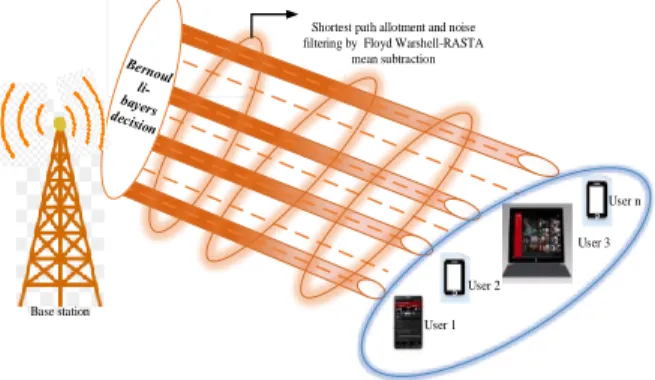
(13) The overall diagram for channel allocation and the noise reduction is given below
User 1 User 2
User 3 User n Shortest path allotment and noise
filtering by Floyd Warshell-RASTA mean subtraction
Base station
Figure4: Representation of precoding technique with channel allotment
The above designed precoding technique of 2LB-FR transmit large number of data streams into groups by allotting the proper space that eliminates the inter-symbol interference using the Linde-Lyold’s algorithm. To transmit these data streams by knowing accurate CSI and make to travelling in their concern path, the BB theorem plays a part thus the elimination of the co-interference is carried out in the channel. Then for shortest path travel, the Floyd Rasta algorithm is utilized that eliminates the unwanted noise if added while transmission. By transmitting the signals in the shortest path, the strength of the signal get increased with decreased BER meanwhile attenuation get eliminated. Exploiting the high data transmission rate, interference cancellation and the decreased BER, the total channel capacity gets enhanced in the MU-MIMO channel which can be proven in the section 4.
4. Results and Discussion
The proposed technique is delineated in previous section 3 and during this section the detail rationalization on the implementation result and its performance is analyzed. The proposed precoding methodology of 2LB-FR is implemented within the operating platform of MATLAB with the subsequent system specification.
Platform MATLAB 2015a
OS Windows 8
Processor Intel core i5
The process is executed on considering certain parameters which are tabulated below in table1,
Table 1: Processing parameter
Parameter Description
Channel Type Downink
Number of Transmitting station
4
Number of Receiving station
4
Number of users 10
Number of bits transmitted 80 bits/packets
Bit rate 1.6kb/sec
Modulation scheme 4-QPSK
Noise Considered Zero-Mean Circular Symmetric Complex Gaussian random vector
(ZMCSCG) noise The proposed model executes with 4*4 MU-MIMO channels with 80 bits in single packet size. This process is carried by 4-QPSK modulation scheme evaluating with 10 users, considering 4 users at a time .The performance evaluation results are described below.
4.1 Performance Evaluation for the proposed 2LB-FR precoding Techniques
Figure 5.Input bits
Figure 6.QPSK modulation
The figure5 displays the input bits at the transmission side for the proposed 2LB-FR precoding techniques and figure 6 shows the input bits after QPSK modulation/mapping
Figure 7: Using Linde-Lyolds Algorithm
In figure 7, the Linde-Lyolds algorithm grouped the bits based on the receiver station, thus the space occupies in the channel becomes reduced and also the inter symbol interference would eventually get reduced.
Figure 8: Input bits after Lende-Lyolds-Flyod-Rasta Figure 8 tells about Flyod warshall- Rasta Mean subtraction for the noisy removal and the shortest path selection is allocated. The figure 8 says shows the precoded bits by the proposed method of 2LB-FR, these bits are ready for transmission through the MU-MIMO channel
Figure 9.Transmission of bits in noisy channel The above figure shows the noise (zero-mean circular symmetric complex Gaussian random vector as noise).
.
Figure 11: Received QPSK decoded bits
Proving the proposed 2LB-FR precoding technique, the figure 5 is compared with the figure 9 shows that the transmitted bits by the precoded technique received with minimal interference in the channel. Hence the proposed method work outs well with enhancing the channel capacity by interference cancellation.
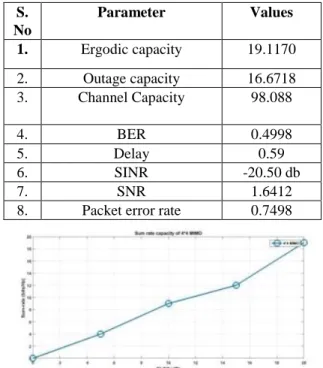
Table 2: Performance Evaluation for the proposed 2LB-FR
S. No
Parameter Values
1. Ergodic capacity 19.1170
2. Outage capacity 16.6718
3. Channel Capacity 98.088
4. BER 0.4998
5. Delay 0.59
6. SINR -20.50 db
7. SNR 1.6412
8. Packet error rate 0.7498
Figure12: Ergodic Capacity of the 4*4 MU-MIMO The evaluation of the proposed methodology with their concern parameters of Throughput, BER, SINR, SNR, Delay capacity in terms of ergodic, outage (Both with no CSI) ,channel(AWGN) ,shows the ability to withstand in the current field. The outcomes of capacity values such as ergodic, outage, channel with the value of 19.117, 16.6718, 98.088 reflects that the source distortion for ergodic and outage values are within the limit due to the proposed 2LB-FR precoding system thus the overall channel capacity get increased with higher value. Considering the BER, SNR and SINR the values evaluated are 0.4998,1.6412,-20.50db which has been within their rage as per researches.
Because the use of Linde-Lyold’s algorithm makes the large number of data’s into group and allocate the space which automatically eliminates the inter-symbol interference thereby producing the low BER value. The proper allocation CSI by the BB theorem makes the co-channel interference cancellation in the channels by eradicating the interference noise that tends to get the optimum SINR value of -20.05db.By introducing the shortest path selection and noise
reduction by the Floyd Rasta algorithm, the obtainable noise becomes low thus increases the SNR value as 1.6414. By the overall innovative methods, a new precoding technique of 2LB-FR increases the throughput which is tough enough to show the channel enhancement by interference cancellation with the proposed method.
4.2 Comparison Results
To evaluate the consistency of the proposed method, parameters such as BER, complexity, throughput, capacity and SNR is compared with the other precoding techniques such as the Minimum Mean Square Error (MMSE) [27], Dirty Paper Coding (DPC)[27], Zero Forcing (ZP) [27]. Block Diagonalization (BD) [27] and Tomilson-Harashmina precoding (THP) technique [27] The definition and the comparison for the various parameters are given below,
4.2.1 Bit error rate (BER)
It is outlined as during transmission, range of bit errors is that the number of received bits of an information stream over a channel that are altered because of noise, interference, distortion
BER= (14)
Table 3: Comparison Table for BER
Methodology BER
DPC 0.5152
ZF 0.5648
THP 0.5214
BD 0.5333
MMSE 0.5410
Proposed 2LB-FR 0.4998
Above table 3 shows the comparison of BER for proposed methodology with the existing methods
Figure 13.Comparison graph for BER
By using Linde-Lyolds algorithm, number of bits holds for transmission is large using the grouping mechanism. When calculating the BER rate by altered receiving bits with the other techniques, the proposed obtained the low value of 0.4998 while the other methods DPC, ZF, THP, BD and MMSE are 0.5152, 0.5648, 0.5214, 0.5333, and 0.5410 respectively. Because due to the shortest path selection and noise filtering by the Flyod-warshall with Rasta mean subtraction does not allows the chance to alter the data or signals while transmission. Hence the possibilities of altering the signals which named as BER is low and that have been proved in figure 13.
sent
bits
of
Number
4.2.2 Delay
Delay is defined as the part of number of bits to the rate of transmission .the formulation for calculating the delay is given by,
Delay=
ion
transmiss
of
Rate
bits
of
Number
(15)
Table 4: Comparison Table for Delay
Methodology Delay Value
DPC 0.060
ZF 0.078
THP 0.061
BD 0.06
MMSE 0.067
Proposed 2LB-FR 0.059
Above table 4 shows the comparison of delay for proposed methodology with the existing methods
Figure 14: Comparison graph for Delay
The proposed scheme eliminates the delay problem by making the group mechanism using Linde-Lyolds and makes to select the channel correctly by means of fast decision with BB theorem along with finding a shortest path travel by the Flyod-warshel with Rasta mean subtraction method in a single execution. The figure 14 shows out that the proposed method possess the lower delay value of 0.059 by obtaining the 2LB-FR mechanism while comparing the other techniques such as DPC, ZF, THP, BD and MMSE obtained the higher delay values of 0.060, 0.078, 0.061, 0.06 and 0.067 respectively.
4.2.3 SNR (Signal Noise Ratio)
It is defined as a signal to noise ratio between the input and output signals.
SNR=
(16)
Table 5: Comparison Table for SNR
Methodology SNR
DPC 1.19
ZF 0.9
THP 1.13
BD 0.4758
MMSE 0.8
Proposed 2LB-FR 1.6142
Above table 5 shows the comparison of SNR for the proposed methodology with the existing methods
The values obtained from the figure 15 for the proposed methodology is 1.6142 while comparing with the other methods of DPC,ZF, THP, BD and MMSE techniques whose
values are 1.19,0.9,1.13 0.47 and 0.8 respectively. This is concludes as the value of the proposed methodology attains higher because usage of new precoded2LB-FR techniques reduces the noise level by the usage of Flyod-warshall with Rasta mean subtraction. By obtaining low noise, the value of the SNR get increases which has been proved in the above graph.
Figure 15: Comparison graph for SNR 4.2.4 Channel Capacity
Channel capacity C = B*log2 (1+SNR)
Where, C is the channel capacity; B is the bandwidth; SNR is the signal to noise ratio.
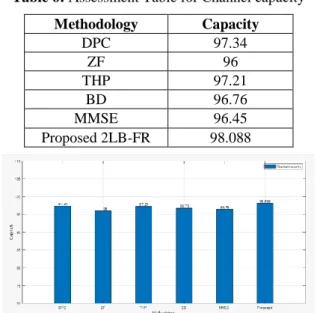
The capacity of the MU-MIMO system is also considered to verify the effectiveness of the system. The total capacity value is compared to the other existing parameters are given below in table 6.
Table 6: Assessment Table for Channel capacity
Methodology Capacity
DPC 97.34
ZF 96
THP 97.21
BD 96.76
MMSE 96.45
Proposed 2LB-FR 98.088
Figure 16: Comparison graph for Channel Capacity From figure 16, it assures that the capacity of the channel get enhanced for the proposed methodology as 98.088 comparing to the other techniques of DPC, ZF, THP, BD and MMSE whose values are 97.34,96,97.21,96.76 and 96.45 respectively. The cancellation of interference such as co-channel, inter-symbol, attenuation and unwanted noise strengthen the signal there by increase the channel capacity.
4.2.5 Throughput
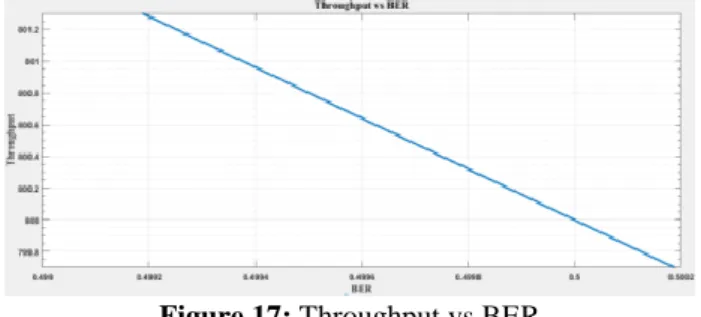
Throughput strictly depends on the source. If source doesn't fill all channel capacity you've not the maximum efficiency of the link. If you want to evaluate the throughput of correct received bits, under BER constraint,
The comparison of the proposed method in terms of BER and SNR are given below
Noise
receiver
in
Figure 17: Throughput vs BER
The increase in throughput value depends on the decrease in the BER. The BER value obtained for the proposed method is low compared to the other existing methods which there by increases the throughput that has been plotted in the figure17.
Figure 18.Throughput vs SNR
The increase in throughput value depends on the increase in the SNR. When the noise gets reduced the value of SNR get increase. The SNR value obtained for the proposed method is high compared to the other existing methods and thereby the throughput has increased which has been plotted in the figure 18.
By the overall performance and the comparison results, the designed precoded technique of2LB-FR in MU-MIMO channel work outs very well by obtaining the desirable weighted values in their capacity and other parameters such as throughput, BER, SNR, delay compared to the other techniques of DPC, ZF, BD, THP and MMSE.
5. Conclusion
The MU-MIMO problem of enhancing the channel capacity with interference cancellation was challengingly solved by the newly proposed 2LB-FR precoding techniques which increases the data transmission rate, cancels the interference and prevents the signals from unwanted noise. The evaluation and comparison results paraded that the proposed precoding achieves a channel capacity with enhanced value of 98.088%over the DPC, ZF, MMSE, BD and THP precoding techniques respectively.
6. References
[1] J. Kumar, A. Patel, S. Patel. “Multiuser-MIMO Broadcast Channel techniques,” International Research Journal of Engineering and Technology, Vol.3, No.2, pp.1587-90, 2016.
[2] P. Pattanayak, P. Kumar. “SINR based limited feedback scheduling for MIMO-OFDM heterogeneous broadcast networks,” In Communication (NCC), 2016 Twenty Second National Conference on IEEE, pp. 1-6, 2016. [3] H.G. Bafghi, B. Seyfe, M. Mirmohseni, M.R. Aref.
“Capacity of the State-Dependent Wiretap Channel:
Secure Writing on Dirty Paper,” arXiv preprint arXiv:1605.05693, 2016.
[4]. L. Dolecek, F. Sala, “Channel coding methods for non-volatile memories,” Foundations and Trends® in Communications and Information Theory, Vol.13, No.1, pp.1-28, 2016.
[5]. S.H. Lee, L. Wang, A. Khisti, G.W. Wornell, “Covert communication with channel-state information at the transmitter,” IEEE Transactions on Information Forensics and Security, Vol.13, No.9, pp. 2310-2319, 2018.
[6]. E. Telatar. “Capacity of multi‐antenna Gaussian channels,” European transactions on telecommunications, Vol.10, No.6, pp. 585-95, 1999. [7]. G. Caire, S. Shamai. “On the achievable throughput of a
multiantenna Gaussian broadcast channel,” IEEE Transactions on Information Theory, Vol.49, No.7, pp.1691-706, 2003.
[8]. W. Rhee, J.M. Cioffi. “On the capacity of multiuser wireless channels with multiple antennas,” IEEE Transactions on Information Theory, Vol.49, No.10, pp.2580-95, 2003.
[9]. P. Viswanath, D.N. Tse. “Sum capacity of the vector Gaussian broadcast channel and uplink-downlink duality,” IEEE Transactions on Information Theory, Vol.49, No.8, pp.1912-21, 2003.
[10]. S. Vishwanath, N. Jindal, A.Goldsmith, “Duality, achievable rates, and sum-rate capacity of Gaussian MIMO broadcast channels,” IEEE Transactions on Information Theory, Vol.49, No.10, pp. 2658-68, 2003. [11]. C. Peel, Q. Spencer, A.L. Swindlehurst, B. Hochwald,
“Downlink transmit beamforming in multi-user MIMO systems,” InSensor Array and Multichannel Signal Processing Workshop Proceedings, pp. 43-51, 2004. [12]. S. Zhou, Z. Wang, G.B. Giannakis, “Quantifying the
power loss when transmit beamforming relies on finite-rate feedback,” IEEE Transactions on Wireless Communications, Vol.4, No.4, pp. 1948-57, 2005. [13]. R. Venkataramani, T.L. Marzetta, “Reciprocal training
and scheduling protocol for MIMO systems,” In Proceedings Of The Annual Allerton Conference On Communication Control And Computing, Vol.41, No.1, pp. 334-343, 1998.
[14]. L. Zheng, D.N. Tse, “Diversity and multiplexing: A fundamental tradeoff in multiple-antenna channels,” IEEE Transactions on information theory, Vol.49, No.5, pp. 1073-96, 2003.
[15]. M. Schubert, H. Boche, “Solution of the multiuser downlink beamforming problem with individual SINR constraints,” IEEE Transactions on Vehicular Technology, Vol.53, No.1, pp.18-28, 2004.
[16]. Q.H. Spencer, A.L. Swindlehurst, M. Haardt, “Zero-forcing methods for downlink spatial multiplexing in multiuser MIMO channels,” IEEE transactions on signal processing, Vol.52, No.2, pp. 461-71, 2004.
[18]. U. Erez, S. Shamai, R. Zamir, “Capacity and lattice strategies for canceling known interference,” IEEE Transactions on Information Theory, Vol.51, No.11, pp.3820-33, 2005.
[19]. C. Windpassinger, R.F. Fischer, J.B. Huber, “Lattice-reduction-aided broadcast precoding,” IEEE Transactions on Communications, Vol.52, No.12, pp. 2057-60, 2004.
[20]. Q.H. Spencer, A.L. Swindlehurst. “Channel allocation in multi-user MIMO wireless communications systems,” InCommunications, 2004 IEEE International Conference on IEEE, Vol.5, pp. 3035-3039, 2004.
[21]. C. Studer, G. Durisi, “Quantized massive mu-mimo-ofdm uplink,” IEEE Transactions on Communications, Vol.64, No.6, pp. 2387-99, 2016.
[22]. S. Jacobsson, G. Durisi, M. Coldrey, T. Goldstein, C. Studer, “Quantized precoding for massive MU-MIMO,” IEEE Transactions on Communications, Vol.65, No.11, pp. 4670-84, 2017.
[23]. A. Hakkarainen, J. Werner, K.R. Dandekar, M. Valkama, “Analysis and augmented spatial processing for uplink OFDMA MU-MIMO receiver with transceiver I/Q imbalance and external interference,” IEEE Transactions on Wireless Communications, Vol.15, No.5, pp.3422-39, 2016.
[24]. Z. Luo, C. Li, L. Zhu, “Robust blind separation for MIMO systems against channel mismatch using second-order cone programming,” China Communications, Vol.14, No.6, pp. 168-78, 2017.
[25]. H. Zhang, S. Huang, C. Jiang, K. Long, V.C. Leung, H.V. Poor, “Energy efficient user association and power allocation in millimeter-wave-based ultra-dense networks with energy harvesting base stations,” IEEE Journal on Selected Areas in Communications, Vol.35, No.9, pp.1936-47, 2017.
[26]. R. Krishnan, M.R. Khanzadi, N. Krishnan, Y. Wu, A.G. Amat, T. Eriksson, R. Schober, “Linear massive MIMO precoders in the presence of phase noise—A large-scale analysis,” IEEE Transactions on Vehicular Technology, Vol.65, No.5, pp.3057-71, 2016.
[27]. A. Agnihotri, B. Gupta, “Performance evaluation of linear/non-linear precoding schemes for downlink multi-user MIMO systems,” In Industrial Instrumentation and Control (ICIC), 2015 International Conference on IEEE, pp. 484-489, 2015.