R E V I E W
Open Access
Learner Modeling Using Educational Games: A
Review of the Literature
Mohamed Ali Khenissi
1*, Fathi Essalmi
1, Mohamed Jemni
1and Kinshuk
2* Correspondence:
1
Research Laboratory LaTICE, ENSIT, University of TUNIS, 5, Avenue Taha Hussein, B.P. 56, 1008 Tunis, Tunisia Full list of author information is available at the end of the article
Abstract
Recently, there has been growing interest in the use of games in education. Educational games have been found to stimulate learners by increasing their motivation and engagement. In addition, educational games could be used for creating the learner model. In fact, these games provide ample opportunities for learner’s interactions with the computer which can be exploited for creating a reliable learner model. This paperapresents a survey of the field of learner modeling using educational games, describing the main methods and proposing taxonomy to better organize them. The paper also enumerates several educational games that are suitable for experimentation. This synthesis is expected to not only help the
researchers and developers working in this field but also pedagogues and teachers who plan to integrate these approaches in educational context.
Keywords:Educational games; Learner model; Adaptation; Learners' characteristics; Taxonomy of methods; Learner-computer interactions traces; Learners tracking; Indicators
Introduction
A learner model is a key component of any adaptive e-learning system as it maintains information about learners in order to provide them adaptation according to their
current learning needs. Bull (2004) defined the learner model as follows “the learner
model is a model of the knowledge, difficulties and misconceptions of the individual. As a student learns the target material, the data in the learner model about their
un-derstanding is updated to reflect their current beliefs” (Bull, p 47). Bull et al. (2001)
also added that various information types could be stored in the learner model such as knowledge; interests; cognitive style; eagerness; helpfulness; interaction preferences; opinions of peers; and, user actions. The process of creating learner model, so-called learner modeling, requires numerous if not continuous observations of interactions be-tween the learner and the computer. Learner interaction with the computer is rather restricted in traditional e-learning systems (limited to clicks, time that the learner invested in visiting a page, etc.) (Moreno-Ger et al. 2009; Stathacopoulou et al. 2007). This information does not accurately inform us how the learners have interacted with particular content. Did they actually read the content? Did they examine it? Or, did they simply leave the page without actually gaining anything (Moreno-Ger et al. 2009)? The lack of a variety of interactions between the learner and the traditional e-learning systems affects the certainty of the interpretations that could result in a misconstruc-tion and therefore affect the accuracy of learner modeling process. In this context, edu-cational games are not only considered as interactive didactic support that is able to
increase the learner motivation and engagement, but also as the means to provide
ample opportunities for learner’s interaction with the computer, which can be used to
create reliable learner models. Therefore, using educational games (that represent a highly interactive content) to model the learner is a promising trend.
This paper presents a survey of the field, describing the main methods and proposing taxonomy to better organize them. This paper also lists several educational game plat-forms that are suitable for experimentation. The main content of the paper (Sections 2 and 3) is a review of existing methods that have already been used to model the learner using educational games. To make the scope of the review more clear, we define the concepts of modeling methods as a set of ideas and approaches that can be presented at the conceptual level and used to achieve the specific objective of creation of learner model.
In this review, we will observe those methods that model learners explicitly and the ones that model them implicitly. The difference between explicit and implicit methods of learner modeling is related to the ways of extracting information about learners. An implicit method aims to extract information about learners in a hidden and unobtrusive way, without endangering the high level of engagement provided by educational games. On the other hand, an explicit method aims to use a direct and obvious way of extract-ing information and makextract-ing it overt to learners. The next section of the paper presents identified methods that have already been used to model the learner explicitly. Section 3 presents methods used to generate learner models implicitly. Section 4 introduces the taxonomy of learner modeling methods which use educational games. Sections 5 and 6 describe and discuss several educational games used to model the learners. Lastly, con-clusions are drawn and directions for future work are presented.
Review
Review of explicit methods
In this section, we present identified methods that have already been used to model the learner explicitly, along with examples.
Evaluation of questionnaire
Learner modeling can be performed through evaluating the learner's answers to a ques-tionnaire at the beginning, during or at the end of the educational game. It can also be done by redirecting learners to an online survey and asking them to answer questions (Moreno-Ger et al. 2007; Huang 2011; Fu et al. 2009; Pourabdollahian et al. 2012).
For example, Moreno-Ger et al. (2007) evaluated the learner’s level of knowledge as
part of learner modelling through a questionnaire and some basic tests to capture the
learner’s initial level of knowledge. The learners were then provided with an
educa-tional game, which also included an in-game exam. The results of that exam were used
to grade the learners. Finally, the final in-game exam was used to assess the learners’
proficiency. In another example (Huang 2011), after completing the educational game, learners were asked to self-report the mental effort investment level and the difficulty level associated with the learning task on a 9-point Likert scale.
A scale named EGameFlow was used by Fu et al. (2009) to measure learners’
with the items. Similarly, in Pourabdollahian et al. (2012), learners were requested to answer a questionnaire in order to evaluate their level of engagement. The question-naire contained 21 questions based on 5-point Likert scale and categorized according to five classifications (challenge, immersion, interest, purpose and control). The data collected from the survey was analyzed by both descriptive and inferential statistics for evaluating the engagement of learners.
Interpreting body posture and physiological signals
Various hardware and software equipment have also been used for modeling the learners. The behavior of the learners can be recognized through identifying gestures, body posture and physiological signals. It is done by identifying and labeling different reactions to game events and then looking for common features of body expressions (Peters et al. 2009; Amershi et al. 2006; Conati 2002; Conati and Maclaren 2009; Conati and Maclaren 2009a; Rebolledo-Mendez and de Freitas 2008; Jimenez et al. 2011).
Rebolledo-Mendez and de Freitas (2008) and Jimenez et al. (2011) used Electro En-cephalogram readings using Brain Computer Interface (BCI) for psychometric input to measure attention. BCI offered the possibility of reading electric signals generated by
neural activity in the brain, which could be used to assess the learners’attention levels.
In another example (Peters et al. 2009), learner's level of attention was evaluated using
two components. The first component detected user’s gaze behavior based on input
from a web camera. This component used the direction of eye or head to establish the screen-space coordinates of where the user was looking. The second component mea-sured attention levels using a neurophysiological recording device.
Electromyography sensors have also been used to detect several types of bodily ex-pressions Conati (2002); Conati and Maclaren 2009; Conati and Maclaren 2009a) to recognize rapidly changing emotions. Likewise, Amershi et al. (2006) collected data on
game events and learners’biometric expressions to form a picture of the most common
biometric expressions of emotion towards events within the educational game.
Learners’ biometric expressions were recorded using 4 sets of sensors. Each biometric
recording was synchronized with logs of the game events that could stimulate an emo-tional reaction.
Review of implicit and unobtrusive methods
Several methods have been used to generate learner models implicitly. In this section, we will identify and discuss methods that have been used in literature.
Translating learner's actions
In this method, the set of actions made by the learner during the game can be inter-preted and translated into descriptive information useful to model the learner. In addition, experts or automated systems define an appropriate description for each set of actions. These descriptions are then used to model the learner (Lessard 2012; Conati and Zhao 2004; Manske and Conati 2005; Stathacopoulou et al. 2004; Virvou et al. 2003; Katsionis and Virvou 2004; Conlan et al. 2009).
For example, the learner model in Lessard (2012) aimed at creating a representation
of learner’s cognitive traits. To do that, the study established connections between the
of traits that the learner may exhibit during game-play were identified. This could
pro-vide epro-vidence of the learner’s cognitive abilities.
The learner model’s goals in Conati and Zhao (2004) and Manske and Conati (2005)
were to generate assessment of learner’s knowledge on number factorization.
Know-ledge assessment was done by representing the probabilistic relations between learner’s
actions and the corresponding learner’s knowledge.
Learner's motivational state was assessed in Stathacopoulou et al. (2004). For that, the learning environment stored in a log file all the available information about what a learner was doing, recording each learner action with a time stamp. Typical examples of learner actions included selection of objects for experimentation, selection of avail-able tools, mouse moves, mouse drags or clicks on tools or objects, mouse drags when the learner was trying to draw a vector, as well as the time when the action was per-formed. After that, expert teachers defined actions related to each type of evidence of
learner’s motivational state.
In another example (Virvou et al. 2003), inferences were drawn about the learners’feelings
and reactions depending on the time they spent before and after they made some actions in the educational game. For example, the time that a learner took to answer a question was
used to measure the degree of speed of the learner. The pausing time after a system’s
re-sponse was used to measure the degree of surprise that the rere-sponse might have caused to
the learner. The number of times a learner pressed the“backspace”and“delete”button while
forming an answer was used to measure the degree of certainty of the learner concerning a particular answer. Similarly, mouse movements without any obvious intent were used to measure the degree of concentration or frustration on the part of the learner.
Learner’s emotional state was assessed in Katsionis and Virvou (2004). For that,
com-puter logging was used to record learners’actions while they interacted with the
educa-tional game. The collected data was analyzed by five human experts who also observed
learners’actions while the learners played the game and noted down what the learners
were likely to have felt.
The learner model’s goal in Conlan et al. (2009) was to generate a real-time
evalu-ation of a learner’s skills. The skill assessment engine component was responsible for
translating each learner’s actions within the game into a list of probabilities that showed
the likelihood of each relevant skill having been acquired by the learner. The learner model determined which skill states had increased or decreased in probability.
Interpreting interaction traces
In this method, the game engine monitors and records interactions between the learner and the game, generating a trace of actions performed by the learner during the play sessions and tracking a lot of different parameters in the game (start game, end game, quit game, phase changes, significant variables, time, performance, tasks completed, etc.). At the end of the game play, these traces can be delivered to a group of experts or automated systems in order to identify what information can be extracted from these traces and infer a lot of useful information for modeling purposes (Moreno-Ger et al. 2009; Stathacopoulou et al. 2007; Hou 2012; Choi et al. 2005; Serrano-Laguna et al. 2012; Bouvier et al. 2013a; Bouvier et al. 2013b).
For example, learner’s learning style was modeled in Stathacopoulou et al. (2007) by
mouse move or drag was timed and recorded. The learning environment stored in a log file all available information about what a learner was doing, recording each learner
action with a time stamp. Furthermore, this work used teachers’expertise in order to
select the appropriate measures of learner’s observable behavior to serve as indicators
of the learner’s learning style.
Learner’s learning experiences were assessed in Moreno-Ger et al. (2009) by
monitor-ing and recordmonitor-ing interaction between the learner and the educational game, generatmonitor-ing a trace of the actions performed by the learner during the play sessions, tracking a lot of different parameters in the game and assigning points to the most relevant actions. These traces were then delivered to the instructors in order to inform them how the learner interacted with the educational game and infer a lot of information from these traces for assessment purposes.
The educational game in Hou (2012) recorded every complete motion and event that
took place during the game in order to model learner’s behavior. In this work, a total of
82 unique items were recorded, including various motions (e.g., pressing a certain but-ton) and events (e.g., completing a certain task) in the game (e.g., players talking with others, entering a new task, starting a new battle and changing costumes for the role). These 82 items were divided into 10 behavior categories. Each category had a name, label, and description.
The learner model in Choi et al. (2005) generated assessment of learners’knowledge
by keeping track of the learner’s behaviors during the game. The learner model had
ac-cess to information such as learner moves and tools acac-cessed by the learner. The
col-lected data was then interpreted to determine the state of learner’s knowledge.
In another example Serrano-Laguna et al. (2012), high-level assessment report of the learners was generated by selecting types of traces that must be logged to facilitate as-sessment. The system then identified what information could be extracted from the
traces. Finally, the system analyzed learner’s traces and produced reports for teachers.
Learners’ engagement was identified in Bouvier et al. (2013a) and Bouvier et al.
(2013b) by relying on their traces of interactions performed in the learning game. Stud-ies of Bouvier et al. (2013a) and Bouvier et al. (2013b) proposed an approach that con-sists of three stages. The first stage aims to determine the high-level engaged-behaviors. The second stage aims to characterize these engaged-behaviors by identifying the underlying chains of actions. The last stage aims to detect these chains of actions among all the actions recorded.
Interpreting conversation
In this method, information about the learner is extracted from his/her communication with a Non Player Character (NPC). The NPC poses questions and records learner's choices during these conversations and questions answered during game dialogues (Moreno-Ger et al. 2007; Muñoz et al. 2010; Muñoz et al. 2011a; Muñoz et al. 2011b; Rebolledo-Mendez et al. 2008).
For example, learner’s learning style and learner’s preferences were modelled in
Learner’s emotions were assessed in Muñoz et al. (2010), Muñoz et al. (2011) and Muñoz et al. (2011a) by analyzing the answers of the learner during the educational game dialogues.
A NPC in Rebolledo-Mendez et al. (2008) perpetually monitored the learner and re-quested her/him to answer questions. The system collected and processed the learner responses. After that, it calculated learner's level of motivation. Then it selected one rule from a set of rules taken from theory and reacted with aim to sustain or enhance the current level of motivation.
Interpreting learner’s errors
The goal of this method is to retain the information of what the learner has learnt, and
what the learner has learnt incorrectly. In addition, this method records learners’
mis-conceptions, errors, number and types of mistakes made by the learner, learner failure and success, and time taken to complete the game (Virvou et al. 2003; Champagnat et al. 2010; Virvou et al. 2002; Rebolledo-Mendez et al. 2008; Cheng et al. 2009; Fareed et al. 2010; Khenissi et al. 2013a).
For example, the learner model in Virvou et al. (2003) generated assessment of the
learner’s level of knowledge by keeping track of right and wrong answers that the
learner had given and the time he/she had spent to give a correct one.
In another example Fareed et al. (2010), an evaluation of recall improvement of learner memory was generated by defining recall accuracy as the ratio of the number of questions attempted correctly to the total number of questions.
Learner’s failure and success were pursued in Champagnat et al. (2010). In the case
of failure, the game had to be tolerant with the learner. This means that the game allowed the learners to continue and did not stop them from playing or reiterating the stage, but with penalties (e.g. giving them less points or worse results).
The learner model in Virvou et al. (2002) examined the correctness of the learners’
answers in terms of the learners’ factual knowledge and reasoning they used. In
addition, the learner modeling component performed error diagnosis based on a cogni-tive theory of Human Plausible Reasoning Collins and Michalski (1989). In particular, when a learner was asked a question from a domain, HPR was used to perform error diagnosis in case of an error and to find out how close the erroneous answer had been to the correct one.
The learner model in Cheng et al. (2009) assessed the learner's degree of mastery by monitoring his/her performance and comparing it with information stored in a table called Conditional Probability Table (CPT). The CPT stored the probability of having a wrong answer even when concepts were seen to be mastered. Taking into account the CPT, the learner model detected evidence of mastering the subject and also detected evidence of deficiency at a skill or concept level.
An NPC in Rebolledo-Mendez et al. (2008) requested the learner to answer ques-tions. After that, the system processed the learner's responses as either correct or incor-rect and collected contextual information such as number of corincor-rect/incorincor-rect answers and time taken to answer such questions. Based on this information, the system took decision about the appropriate help.
The learner model in Khenissi et al. (2013a) detected learner's deficiency in
she arranged a set of unordered instructions in order to form a program. In particular, when the learner moved an instruction in an inappropriate place, the learner model re-corded the incorrect answer and provided the learner with the appropriate help.
Path follow
The goal of this method is to follow the path of the learner during the game play,
rec-ord the learner’s trajectory towards a goal and then interpret and infer information
about the learner. In fact, each path has a specific meaning and leads to specific infor-mation about the learner (Moreno-Ger et al. 2008; Noguez et al. 2009; Rebolledo-Mendez et al. 2009; Kopeinik et al. 2012).
For example, Moreno-Ger et al. (2008) described the game as state transition systems
in order to assess the learner’s activity inside the game. During the game play, actions
of the learner triggered state transitions and the sequences of actions led to one or more end states. The game engine kept track of transitions, checked the states that the game went through and generated reports describing them.
A NPC within the educational game in Rebolledo-Mendez et al. (2009) monitored the learner and identified his/her learning trajectory. The identified learning trajectory was compared to different predefined learning trajectories. This comparison assisted the learner model in taking a decision on how to proceed.
In Noguez et al. (2009) and Kopeinik et al. (2012), a given domain was represented in terms of its entities, properties, and relationships. The entities and their relationships
provided a general scheme. This scheme facilitated tracking of the learner’s path during
the game play and then inferred useful information about her/him.
Taxonomy of learner modeling methods
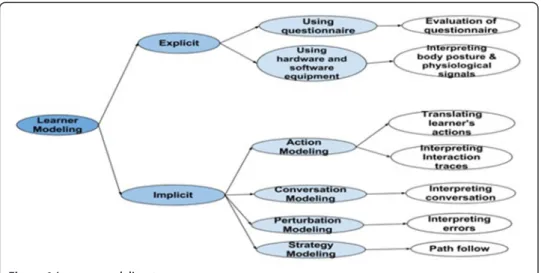
In this section, taxonomy of learner modeling methods which use educational games will be described. This taxonomy was created based on the literature review discussed in previous sections. Figure 1 presents the organization of the key terms of our tax-onomy from the most general to the most specific.
From the literature, we observe that learner modeling using educational games can be achieved explicitly or implicitly. The explicit way can be accomplished using a questionnaire
(Moreno-Ger et al. 2007; Huang 2011; Fu et al. 2009; Pourabdollahian et al. 2012). Ques-tionnaires can solicit direct and precise answers, but this would endanger the high level motivation provided by educational games because such use would require stopping the learner from playing and requesting her/him to answer questions. Alternatively, the use of hardware and software equipment provides an explicit way to model the learner while using educational games (Peters et al. 2009; Amershi et al. 2006; Conati 2002; Conati and Maclaren 2009; Conati et al. 2009a; Rebolledo-Mendez and de Freitas 2008; Jimenez et al. 2011). This method can provide additional information for modeling the learner. How-ever, it obviously requires the use of additional hardware and software equipment. Fur-thermore, observations collected using these equipment can be interpreted in different ways and this can endanger the reliability of the learner models.
Learner modelling can also be achieved implicitly. This is done by recording actions of the learners while they are using educational games (Action Modelling) (Hou 2012; Serrano-Laguna et al. 2012; Lessard 2012; Moreno-Ger et al. 2009). The set of actions made by the learners during the game play can be interpreted and translated into de-scriptive information useful for modeling the learners.
Conversation Modeling is an implicit way to extract information about the learners (Muñoz et al. 2010; Muñoz et al. 2011; Muñoz et al. 2011a; Rebolledo-Mendez et al. 2008). It essentially models the communication between the learner and the non-player character. It records the learner's choices during these conversations and questions an-swered during game dialogues. It also records conversations with fellow players.
Moreover,Perturbation Modelingis used to extract information about the learners in
an unobtrusive way (Champagnat et al. 2010; Rebolledo-Mendez et al. 2008; Cheng et al. 2009; Fareed et al. 2010). It interprets information of what the learner has learnt,
and what the learner has learnt incorrectly. It also records learners’misconceptions or
errors, and the learner’s failure and success.
Finally, Strategy Modeling is also used to implicitly elicit information about the
learners (Moreno-Ger et al. 2008; Noguez et al. 2009; Rebolledo-Mendez et al. 2009; Kopeinik et al. 2012). It concerns long-term learner behavior during the use of an edu-cational game as composed of a series of learner actions. Learner strategy can be moni-tored by following learner paths inside the game.
Educational games used to model learner
This section describes educational games that have been used to model the learner. Most of these educational games include mechanism to extract specific information about the learners. These educational games are classified according to their relation to the taxonomy described in Section 4.
Learner modeling using questionnaire
Trade Ruler:Trade Ruler was designed to teach general public about the importance of trade
between countries. The player in this game plays the role of the“trade ruler”of island. The
ruler is responsible for managing the island’s production on its labor-intensive (jeans) and
is to maximize the islanders’welfare (Huang 2011). This educational game is accessible on-line (Trade 2015).
Hands-on OS game:Hands-on OS game was designed to introduce learners the com-mon problems associated with the operating system of a computer. The main goal of this game is to enhance the proficiency of the learner in certain skills related to the
computer’s operating system (Fu et al. 2009).
Set Based Concurrent Engineering game:The main goal of this game is to help practi-tioners in designing a simplified airplane by following a simplified approach. The game is divided into two stages. In the first stage, players are requested to design an airplane for a given list of customer requirements without following a specified process. In the second stage, players are provided with the necessary instruments to execute a specified process. Once players complete the design, a comparison of performances is presented to the players to compare the two stages in terms of total development cost, time and quality (Pourabdollahian et al. 2012).
Learning version of Pacman game (LPG):The LPG aims to motivate learners to cor-rectly answer the questions of the programming languages. In the traditional version of the Pacman game, players control the Pacman through a maze, eating pac-dots. When all dots are eaten, the Pacman is taken to the next stage. In addition, there are four en-emies who roam the maze, trying to catch the Pacman. If an enemy touches the Pacman, a life-chance is lost. Near the corners of the maze are four dots known as power pellets that provide the Pacman with the temporary ability to eat the enemies. When all life-chances have been lost, the game ends. In the Learning version of the Pacman Game, when the Pacman eats a power star, the learner has to respond to a question (about the programming language) in order to continue the game having a 're-verse' role (the Pacman can move freely and eat the enemy for a short period) (Khenissi et al. 2013b). This educational game is accessible online (LPG 2015).
Learning modeling using hardware and software equipment
Prime Climb:Prime Climb is an educational game designed to help 6th and 7th grade stu-dents practice number factorization. Prime Climb consists of series of mountains. Each mountain is divided into hexes labelled with numbers. Two players must collaborate to climb these mountains. Each player can only move to a number that does not share any
common factor with the partner’s number. If a wrong number is chosen, the climber falls
and swings from the rope until the player selects a correct number. During the game, each student has a pedagogical agent which provides support. This educational game was cited in many works for different purposes (Conati and Maclaren 2009; Conati et al. 2009a).
Learning version of Second Life:Second Life is an open-ended virtual world which offers users opportunities to define virtual experiences with other users. In the learning version, an artificial intelligence NPC poses questions to the learners. In addition, this NPC uses a predefined set of reactions and has limited conversation with the learners. The NPC asks questions in a multiple choice question format (Rebolledo-Mendez and de Freitas 2008).
Action modeling
MMORPG (e.g. team-work, battles, pets, and role-playing situations). The learner can practice the pronunciation through the voice-recognition module included in this game. IThis module diagnoses the correctness of the pronunciation and determines whether the learner reaches a new level or passes a quest. In addition, this game allows players to team up, communicate via voice or texts, and solve quests jointly (Hou 2012). This educational game is accessible online (Talking 2015).
Virtual Reality Game for English: It is an educational game that was designed to teach English orthography and grammatical rules. Learners navigate through the vir-tual world and answer questions concerning English spelling. In this virvir-tual world, there are three types of animated agents: the advisor, the guard (who acts as a virtual
enemy) of a passage and the learner’s companion. The advisor agent appears in
situa-tions where the learner has to read new parts of the theory or has to repeat parts that s/he appears not to know well. The virtual enemy agent is responsible for asking questions to the learners. Finally, the virtual companion appears to make some remarks in a casual way as if a friend was talking to the learner (Katsionis and Virvou 2004).
Vectors in Physics and Mathematics: It is a discovery learning environment. It was designed to help students in constructing the concepts of vectors in physics and math-ematics in secondary schools taking into account the conceptual difficulties that the students faced. The thematic units of the learning environment are: Position and Dis-placement; Motion; Forces and Equilibrium; Forces and Motion; and, Forces and Mo-mentum. Each of these units contains several scenarios, which refer to real life situations (Stathacopoulou et al. 2007; Stathacopoulou et al. 2004).
Balance game: The balance game was developed with the purpose of guiding stu-dents to understand the concept of moment. Moment is a quantity representing the magnitude of a force influencing the rotation of an object. The object repre-sented in the game is a bar lying on a wheel that acts as the pivot for the system. Two boxes at the sides of the bar represent two forces acting on the beam. The learner has to balance and control the movement of the bar by changing the force acting on one side of the beam. This is made by catching balls of different weights (Cheng et al. 2009).
ELEKTRA: It is a narrative-driven adventure game. In this game, the learner has to solve several physics-oriented puzzles. A virtual character (representing the ghost of Galileo) guides, advises and encourages the learner during the game (Conlan et al. 2009). The ELEKTRA project is accessible online (ELEKTRA 2015).
Conversation modeling
PlayPhysics:It is a role playing game in which the learner plays the role of an astronaut on a mission. The main goal is to save the mentor (Captain Richard Foster), who has been trapped on a space station, and reestablish control over the space station Athena. To achieve the main goals, the learner has to overcome challenges by applying the principles and the concepts of physics (Muñoz et al. 2010; Muñoz et al. 2011; Muñoz et al. 2011a).
<e-Adventure > educational game engine: <e-Adventure > is a game engine designed to facilitate the creation of educational games. Games delivered by the e-Adventure en-gine are point and click adventure games. During the game, the learner can learn by interacting with the objects, consultation of in-game books and conversations with other characters. The < e-Adventure > engine includes mechanisms that monitors the
learner’s activities and then provides adaptation and assessment (Moreno-Ger et al.
2007a; Moreno-Ger et al. 2007b). The < e-Adventure > platform is accessible online (E-Adventure 2015).
Perturbation modeling
VR-ENGAGE: It is a virtual world in which the learner navigates through with the goal of finding the book of wisdom, which is hidden. Several obstacles challenge the learner while navigating through the virtual world. A dragon guard (who acts as a virtual enemy that closes doors) poses a question to the learner from the domain of geography.
Depending on the correctness of the learner’s answers, the dragon allows her/him to
continue his/her way through the door, which leads her/him closer to the“book of
wis-dom”(Virvou et al. 2002).
Instruction Right Place Game: This game allows learners to benefit from the drag and drop technology to construct a program (from any programming language) in an amus-ing way. This educational game breaks down complex programmamus-ing tasks and guides learners through a series of small steps to form a program interactively (Khenissi et al. 2013a). This educational game is accessible online (IRPG, 2015).
Strategy modeling
80Days: 80Days is an adventure game used to teach geography for a target audience of 12 to 14 years old and follows European curricula in geography. The game story is about an alien scout called Feon who kidnaps a Boy (play character) and travels with him around the world in a spaceship to collect relevant geographical information. The player assists the alien in exploring the planet and creating a report about the Earth
and its geographical features. In the course of the game, the player discloses the aliens’
real intention which is to prepare for the conquest with the earth. The player has to save the planet and the only way to do it is to draw the right conclusion from the trai-torous Earth report (Kopeinik et al. 2012; Kickmeier-Rust et al. 2011). The 80Days pro-ject is accessible online (The 80Days 2015).
Discussion
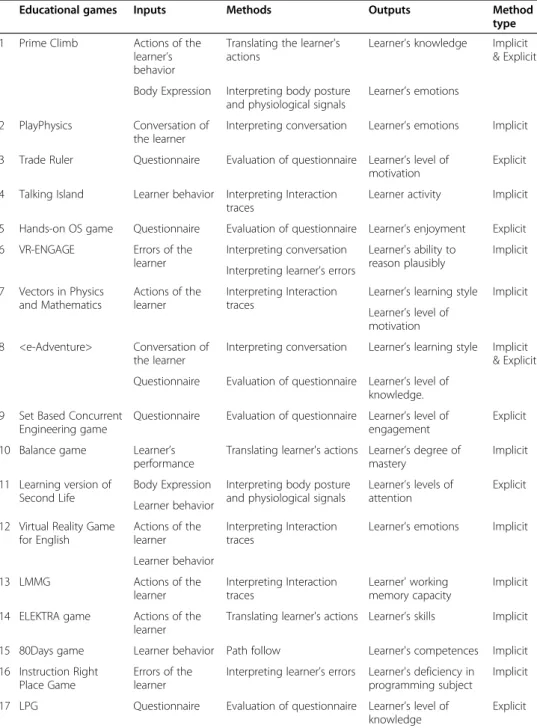
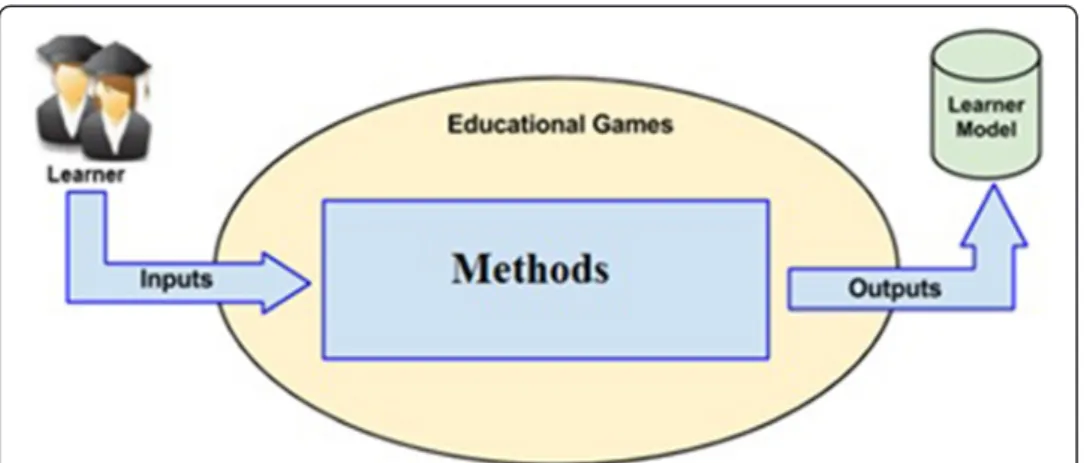
As shown in Table 1, the process of creating a learner model requires several
obser-vations (inputs) collected from the learner’s interaction with the educational game.
Methods described in this paper use these inputs in order to extract specific informa-tion about the learner (outputs). This informainforma-tion is then stored in the Learner Model. Figure 2 illustrates an architecture to build a learner model using educational games. This architecture consists essentially of four main components which are: inputs, methods, output and the educational game.
Table 1 shows that many educational games have used explicit methods for extracting information about learners. For example, the educational games < e-Adventure>, Trade
Table 1 Educational games and methods of learner modelling
Educational games Inputs Methods Outputs Method
type
1 Prime Climb Actions of the learner’s behavior
Translating the learner's actions
Learner’s knowledge Implicit & Explicit
Body Expression Interpreting body posture and physiological signals
Learner’s emotions
2 PlayPhysics Conversation of the learner
Interpreting conversation Learner’s emotions Implicit
3 Trade Ruler Questionnaire Evaluation of questionnaire Learner’s level of motivation
Explicit
4 Talking Island Learner behavior Interpreting Interaction traces
Learner activity Implicit
5 Hands-on OS game Questionnaire Evaluation of questionnaire Learner’s enjoyment Explicit
6 VR-ENGAGE Errors of the learner
Interpreting conversation Learner's ability to reason plausibly
Implicit
Interpreting learner’s errors
7 Vectors in Physics and Mathematics
Actions of the learner
Interpreting Interaction traces
Learner’s learning style Implicit
Learner’s level of motivation
8 <e-Adventure> Conversation of the learner
Interpreting conversation Learner’s learning style Implicit & Explicit
Questionnaire Evaluation of questionnaire Learner’s level of knowledge.
9 Set Based Concurrent Engineering game
Questionnaire Evaluation of questionnaire Learner’s level of engagement
Explicit
10 Balance game Learner’s performance
Translating learner's actions Learner’s degree of mastery
Implicit
11 Learning version of Second Life
Body Expression Interpreting body posture and physiological signals
Learner’s levels of attention
Explicit
Learner behavior
12 Virtual Reality Game for English
Actions of the learner
Interpreting Interaction traces
Learner’s emotions Implicit
Learner behavior
13 LMMG Actions of the learner
Interpreting Interaction traces
Learner’working memory capacity
Implicit
14 ELEKTRA game Actions of the learner
Translating learner's actions Learner’s skills Implicit
15 80Days game Learner behavior Path follow Learner's competences Implicit
16 Instruction Right Place Game
Errors of the learner
Interpreting learner’s errors Learner's deficiency in programming subject
Implicit
17 LPG Questionnaire Evaluation of questionnaire Learner’s level of knowledge
Ruler, Set Based Concurrent Engineering game and Hands-on OS game evaluate lear-ner's answers to questionnaire in order to obtain information about them.
On the other hand, the educational games Prime Climb and Learning version of Sec-ond Life interpret body posture and physiological signals of learners using hardware
and software equipment in order to assess learners’emotions.
Table 1 also shows that a number of educational games have used implicit methods to obtain information about learners. For example, the educational games Talking Is-land, Vectors in Physics and Mathematics, Balance game, Prime Climb, Virtual Reality Game for English and ELEKTRA record actions of learner (Action Modeling). The set of learners' actions are then interpreted or translated into descriptive information.
Other examples of educational games that have used implicit methods for modeling
learners include < e-Adventure > and PlayPhysics that interpret learners’ conversation
during the game play. In addition, VR-ENGAGE interprets the learner’s errors. Finally,
80Days follows learners' path in order to extract specific information about them. The analysis shows that the most used explicit method is Evaluation of questionnaire (used by four games, namely Trade Ruler, Hands-on OS game, <e-Adventure>, and Set Based Concurrent Engineering game). However, use of questionnaires has inherent risk of endangering the high level motivation provided by educational games, since this ap-proach requires stopping the gameplay for answering the questionnaire. Therefore, cau-tion needs to be exercised while adopting the use of quescau-tionnaire.
Furthermore, the findings show that the most used implicit methods are interpreting interaction traces and translating learner's actions (used by six games, namely Prime Climb, Talking Island, Vectors in Physics and Mathematics, Balance game and ELEK-TRA). These traces of learners are then available during the game play and at the end of the game. These traces are interpreted to infer further information about the learners. In addition, these methods could be considered as the promising methods for the future and the most recommended to researchers for creating a reliable learner model. This selection is based on two fundamental reasons: First, these methods belong to implicit category that extracts learners' characteristics in unobtrusive way without disturbing learners (such as by asking them to answer a long questionnaire) or endan-ger their motivation. The second reason is the availability of modern technologies that efficiently store, explore and process large quantities of data (Big data technologies). In
fact, with these modern technologies, the large amounts of traces obtained from
learners’ interactions with the educational games could be stored, and well explored
and interpreted for creating a reliable learner model.
Furthermore, the findings reveal that when there are conversations between the learner and an educational game, interpreting conversation method has been used fre-quently (by three games, namely PlayPhysics, VR-ENGAGE and < e-Adventure>). In fact, conversations of learners provide useful inputs that can help in inferring a lot of useful information for modeling purposes.
Equally important, the analysis shows that the majority of studies that model learner’s
attitude towards the educational games (learner’s emotions and learner’s levels of
atten-tion) have used hardware and software equipment alongside interpreting body posture and physiological signals method (used by two games, namely Prime Climb and Learn-ing version of Second Life) (Amershi et al. 2006; Conati 2002; Conati and Maclaren 2009; Conati et al. 2009a). Indeed, manifestations of emotion and attention are expressed immediately through the body. Hence, the best way to extract these manifes-tations is to interpret body posture and physiological signals of the learners using hard-ware and softhard-ware equipment.
Conclusion
This research focused on the learner modeling using educational games. In particular, this study gathered information from various works in the field and generated tax-onomy in order to organize the most important methods. Furthermore, several educa-tional games used in the literature to model the learner were presented and discussed.
This synthesis can help researchers and developers working in this field by making the main methods of learner modeling using educational games clear to them. In addition, this synthesis may help researchers and developers in the selection of the ap-propriate methods for their objectives. From the findings, researchers and developers can know which indicators should be implemented in the educational games for extracting specific learner's characteristics. The findings can also help pedagogues and teachers who plan to integrate these approaches in educational context.
Despite the comprehensiveness of this survey, this work does not claim that it in-cludes all methods of learner modeling using educational games. However, it does en-compass major themes identified in the literature, and provides a classification where future games can be easily integrated.
An important research direction emerging from this research is the development of standard services that implement learner modeling methods described in this paper. Es-pecially, these services will be easily integrated in each educational game. These ser-vices help the interested in this field by the reduction of programming effort. In fact, researchers, teachers or game creators can simply integrate one of these services inside an educational game for extracting useful information about the learner.
Endnote a
Competing interest
The authors declare that they have no competing interests.
Authors’contribution
All authors read, discussed, improved and approved the manuscript.
Author details
1Research Laboratory LaTICE, ENSIT, University of TUNIS, 5, Avenue Taha Hussein, B.P. 56, 1008 Tunis, Tunisia.2School of Computing and Information Systems, Athabasca University, Athabasca, Canada.
Received: 19 August 2014 Accepted: 10 February 2015
References
S Amershi, C Conati, H Maclaren, Using Feature Selection and Unsupervised Clustering to Identify Affective Expressions in Educational Games. In Workshop in Motivational and Affective Issues in ITS, 8th International Conference on Intelligent Tutoring Systems, Jhongli, Taiwan, 2006. Available online at: http://research.microsoft.com/en-us/um/ people/samershi/papers/ITS2006_affective.pdf Accessed 17 Feb 2015.
P Bouvier, E Lavoué, K Sehaba, S George, Identifying Learner’s Engagement in Learning Games: a Qualitative Approach based on Learner’s Traces of Interaction. Proceedings of 5th International Conference on Computer Supported Education (CSEDU 2013), Aachen, Germany, 6–8 May 2013a.
P Bouvier, K Sehaba, E Lavoue, S George,Using Traces to Qualify Learner’s Engagement in Game-Based Learning. Proceedings of 13th International Conference onAdvanced Learning Technologies, 2013b, pp. 432–436 S Bull, J Greer, G McCalla, L Kettel, J Bowes, User modelling in i-help: What, why, when and how, inUser Modeling
(Springer Berlin, Heidelberg, 2001), pp. 117–126
S Bull, Supporting learning with open learner models. Proceedings of fourth Hellenic Conference on Information and Communication Technologies in Education, Athens, Greece, pages 47–61, 2004
R Champagnat, G Delmas, M Augeraud, A storytelling model for educational games: Hero's interactive journey. Journal International Journal of Technology Enhanced Learning archive2(1/2), 4–20 (2010)
I Cheng, S Rodriguez, A Basu,Multimedia and Games incorporating Student Modeling for Education. Proceedings of the International Workshop on Technology for Education, 2009, pp. 91–94
Y Choi, M Choo, S Chin, Prototyping a Student Model for Educational Games. International Journal of Information Processing Systems1(1), 107–111 (2005)
A Collins, R Michalski, The logic of plausible reasoning: A core theory. Cognitive Science13, 1–49 (1989)
C Conati, Probabilistic assessment of user’s emotions in educational games. Journal of Applied Artificial Intelligence, Special Issue on Merging Cognition and Affect in HCI16(7–8), 555–575 (2002)
C Conati, H Maclaren, Empirically building and evaluating a probabilistic model of user affect. User Modeling and User-Adapted Interaction19(3), 267–303 (2009)
C Conati, X Zhao,Building and evaluating an intelligent pedagogical agent to improve the effectiveness of an educational game. Proceedings of the 9th international conference on Intelligent user interfaces, 2004, pp. 6–13
C Conati, H Maclaren, Modeling User Affect from Causes and Effects. Proceedings of the 17th International Conference on User Modeling, Adaptation, and Personalization, Pages 4–15, 2009a.
O Conlan, C Hampson, N Peirce, M Kickmeier-Rust,Realtime Knowledge Space Skill Assessment for Personalized Digital Educational Games. Proceedings of the Ninth IEEE International Conference on Advanced Learning Technologies, 2009, pp. 538–542
E-adventure (2015), http://e-adventure.e-ucm.es/. Accessed 10 Jan 2015 ELEKTRA (2015), http://www.elektra-project.org/. Accessed 10 Jan 2015
U Fareed, BT Zhang, MMG,A Learning Game Platform for Understanding and Predicting Human Recall Memory. Proceedings of the 11th international conference on Knowledge management and acquisition for smart systems and services, 2010, pp. 300–309
FL Fu, RC Su, SC Yu, EGameFlow: A scale to measure learners’enjoyment of e-learning games. Computers & Education
52, 101–112 (2009)
HT Hou, Exploring the behavioral patterns of learners in an educational massively multiple online role-playing game (MMORPG). Computers & Education58, 1225–1233 (2012)
WH Huang, Evaluating learners’motivational and cognitive processing in an online game-based learning environment. Computers in Human Behavior27(2), 694–704 (2011)
IRPG (2015), http://www.egresearch.info/edugame/IRPG/index.html. Accessed 10 Jan 2015
COS Jimenez, H G A Mesa, G Rebolledo-Mendez, S de Freitas, Classification of cognitive states of attention and relaxation using supervised learning algorithms. Proceedings of the IEEE International Games Innovation Conference IGIC, Pages: 31–34, 2011.
G Katsionis, M Virvou,A cognitive theory for affective user modelling in a virtual reality educational game. Proceedings of the IEEE International Conference on Systems, Man and Cybernetics, 2004, pp. 1209–1213
MA Khenissi, F Essalmi, M Jemni,A Learning version of Pacman Game. Proceedings of the Fourth IEEE International Conference On Information and Communication Technology and Accessibility (ICTA)(IEEE, Hammamet, Tunisia, 2013a), pp. 1–3 MA Khenissi, F Essalmi, M Jemni, Presentation of a Learning Game for Programming Languages Education. Proceedings
of 13th International Conference on Advanced Learning Technologies, IEEE, 324–326, 2013a
MA Khenissi, F Essalmi, M Jemni, Kinshuk,A Learning Version of Memory Match Game, Proceedings of the 14th IEEE International Conference on Advanced Learning Technologies (ICALT2014), July 7–9, 2014(IEEE, Athens, Greece, 2014b), pp. 209–210
MA Khenissi, F Essalmi, M Jemni, Kinshuk,Review of Learner Modeling using Educational Games. Proceedings of the 6th International Conference on Computer Supported Education. 01–03 April(SCITEPRESS, Barcelona, Spain, 2014c), pp. 147–152
MD Kickmeier-Rust, E Hillemann, D Albert,Tracking the UFO’s Paths: Using Eye-Tracking for the Evaluation of Serious Games. Proceedings of the International Conference on Virtual and Mixed Reality, 2011, pp. 315–324
S Kopeinik, A Nussbaumer, M Bedek, D Albert,Using CbKST for Learning Path Recommendation in Game-based Learning. Proceedings of the 20th International Conference on Computers in Education, 2012
M Lessard, Identification OF Cognitive Traits Through Game Method. Master of Science In Information Systems. Athabasca University, 2012.
LMMG (2015), http://www.egresearch.info/edugame/LVMMG/index.html. Accessed 10 Jan 2015 LPG (2015), http://www.egresearch.info/edugame/LPG/index.html. Accessed 10 Jan 2015
M Manske, C Conati, Modelling Learning in an Educational Game, in12th Conference on Artificial Intelligence in Education(Ios Press, Amsterdam, the Netherlands, 2005)
P Moreno-Ger, P Sancho Thomas, I Martínez Ortiz, JL Sierra, B Fernández Manjón, Adaptive units of learning and educational videogames. Journal of Interactive Media in Education5(1), 1–15 (2007a)
P Moreno-Ger, D Burgos, JL Sierra, BF Manjón,A Game-Based Adaptive Unit of Learning with IMS Learning Design and < e-Adventure>(Lecture Notes in Computer Science 4753 (Springer), Crete, Greece, 2007b)
P Moreno-Ger, D Burgos, I Martínez-Ortiz, JL Sierra, B Fernández-Manjón, Educational game design for online education. Computers in Human Behavior24, 2530–2540 (2008)
P Moreno-Ger, D Burgos, J Torrente, Digital games in e-Learning environments: current uses and emerging trends. Simulation & Gaming40(5), 669–687 (2009)
K Muñoz, PM Kevitt, T Lunney, J Noguez, L Neri,PlayPhysics : Emotional Games Learning Environment for Teaching Physics. Knowledge Science Engineering and Management, vol. 6291 (Springer Berlin, Heidelberg, 2010), pp. 400–411 K Muñoz, PM Kevitt, T Lunney, J Noguez, L Neri, An emotional student model for game-play adaptation. Entertainment
Computing2, 133–141 (2011a)
K Muñoz, P M Kevitt, T Lunney, J Noguez, L Neri, Designing and Evaluating Emotional Game-based Learning Environments. Serious Games and Edutainment Applications, Pages 245–271, 2011.
J Noguez, L Neri, V Robledo-Rella, K Muñoz, Inferring Knowledge from Active Learning Simulators for Physics. Simulators for Physics, inMICAI 2009: Advances in Artificial Intelligence(Springer, Berlin Heidelberg, 2009), pp. 533–544 C Peters, S Asteriadis, G Rebolledo-Mendez,Modelling user attention for human-agent interaction. Proceedings of the
10th Workshop on Image Analysis for Multimedia Interactive Services, 2009, pp. 266–269
B Pourabdollahian, M Taisch, E Kerga, Serious Games in Manufacturing Education: Evaluation of Learners’Engagement, Proceedings of the 4th International Conference on Games and Virtual Worlds for Serious Applications. ProcediaComputer Science15, 256–265 (2012)
G Rebolledo-Mendez, S de Freitas,Attention modeling using inputs from a Brain Computer Interface and user-generated data in Second Life(Proceedings of the Tenth International Conference on Multimodal Interfaces, Crete, Greece, 2008). Available online at: https://curve.coventry.ac.uk/open/file/066c9b7f-ba65-3017-0825-cbaabacfe7d0/1/Atten-tion%20modeling.pdf Accessed 17 Feb 2015
G Rebolledo-Mendez, D Burden, S de Freitas,A Model of Motivation for Virtual-Worlds Avatars. Proceedings of the 8th international conference on Intelligent Virtual Agents, 2008, pp. 535–536
G Rebolledo-Mendez, S de Freitas, ARG Gaona,A Model of Motivation Based on Empathy for AI- Driven Avatars in Virtual Worlds. Proceedings of the 2009 Conference in Games and Virtual Worlds for Serious Applications, 2009, pp. 5–11 Á Serrano-Laguna, J Torrente, P Moreno-Ger, B Fernández-Manjón, Tracing a little for big Improvements: Application of
Learning Analytics and Videogames for Student Assessment. Procedia Computer Science (Elsevier)15, 203–209 (2012)
R Stathacopoulou, M Samarakou, M Grigoriadou, GA Magoulas,A Neuro-Fuzzy Approach to Detect Student's Motivation. International Conference on Advanced Learning Technologies–ICALT, 2004
R Stathacopoulou, M Grigoriadou, M Samarakou, D Mitropoulos, Monitoring students' actions and using teachers' expertise in implementing and evaluating the neural network-based fuzzy diagnostic model. Expert Systems with Applications32(4), 955–975 (2007)
Talking Island (2015), http://www.talking-island.com/. Accessed 10 Jan 2015 The 80Days (2015), http://www.eightydays.eu/. Accessed 10 Jan 2015
Trade Ruler (2015), http://nobelprize.org/educational_games/economics/trade/. Accessed 10 Jan 2015 M Virvou, C Manos, G Katsionis, K Tourtoglou,VR-ENGAGE: A Virtual Reality Educational Game that Incorporates
Intelligence. Proceedings of IEEE International Conference on Advanced Learning Technologies, 2002, pp. 425–430 M Virvou, K Manos, G Katsionis,Proceedings of the IEEE International Conference on Systems, Man and Cybernetics, 2003,