Internal marketing, Organizational commitment, Job
satisfaction and Market orientation
Mehrdad Orouei
Department of Management, Semnan Branch, Islamic Azad University, Semnan, Iran
E-mail: [email protected]
Abstract
this research provides insight of antecedents of market orientation by presenting a conceptual
model stem from relevant literature. The empirical results indicated that internal marketing is
an antecedent for market orientation, job satisfaction and organizational commitment.
Moreover, both job satisfaction and organizational commitment has direct positive impact on
market orientation. Managerial implications and theoretical applications have been explored
for both managers and scholars.
Keywords: internal marketing, market orientation, organizational commitment,
1. Introduction
Market orientation as a culture or as a plan, cannot take place without organizational
commitment. Moreover, organizational commitment is a through concept that done not only
by top managers, but also by all the employees in any organizational level. Therefore, the
prosperity of service organizations in their commercial activities has to assured by the
commitment of employees that could be done through internal marketing. Although internal
marketing has crucial role in financial performance of companies, by reviewing the
marketing literature, it found that the most relevant studies have focused on concepts like
employee motivation and loyalty. Moreover, there is paucity of researches in investigating
the role of internal marketing on other factors like organizational commitment or market
orientation warranting more research in this field. Therefore, this study focuses on
investigating the effect of internal marketing on rare studied variables namely organizational
commitment, employees’ satisfaction and organizational commitment. According to recent
statistics, services accounts for about one-quarter of the world trade volume (Keegan, 1995).
This figure is even higher in western countries (e.g. United States and many European
surprise to see a dozen of studies and different scholars who closely investigate different
aspects of service organizations issues. In recent years, issues have become more specialized,
concepts like market orientation, and internal marketing has become more popular among
scholars. Internal marketing is a prevailing concept in marketing literature in last two
decades, which first introduced as a solution for employee-related problems such as quality of
work or lack of satisfaction and loyalty toward the organization. Nowadays, studies show that
internal marketing programs have direct positive effect on employees’ commitment and the
performance of the organization due to increase of employees’ motivation (Ahmed and Rafiq,
2002). Market orientation, which is another closely relevant concept to internal marketing, is
a leading variable in boosting organizational commitment through increasing commitment of
employees. Conducting internal marketing programs is a mean for fulfilling this goal
(Caruana and Calleya, 1998). The concept of market orientation is a vital issue for prosperity
of any service organization due to several reasons. Firstly, market orientation is responsible
for information gathering of customers that makes their potential need known to the
organization. Consequently, this process may lead to creation of the highest possible value
for customers (Awwad and Agti, 2011). Secondly, by considering the main role of human
resource, which makes the core of service organizations, designing and conducting a
comprehensive and integral market orientation program, could be crucial in increasing the
level of commitment and loyalty in organization.
The study starts with a section presenting the literature review. Because of this review,
hypothesis will developed and Methodology and results will followed. Findings will
summarized and managerial implications presented in the last section.
2.
Literature review
2.1.Market orientation
Market orientation is defined as creating a competitive advantage through a customer-focused
enterprise, in which customer values are created (Hou, 2008). Due to abundant number of
studies in this area, different definitions are available in relevant literature. Some scholars
have discussed market orientation as a firm capability (Day, 1994), others (e.g. Teece et al.,)
emphasized more on the dynamic capabilities feature of market orientation in firms which is
rapidly changing environments. In this perspective, firms will gain ability to both make the
best use of the existing resources and at the same time, develop their organizational
capabilities (Teece et al., 1997).
Concerning the definition of market orientation, some researchers have defined this term
from behavioral perspective as including both customers and competitors’ orientation.
Particularly in the study of Mullins et al. (2005) market orientation is defined as those
organizations which are customer and competitor focused and simultaneously have integrate
marketing with other activities. By reviewing the literature,there are two identifiable
approaches through conceptualizing market orientation, namely behavioral and cultural
(Homburg and Pflesser, 2000). The main emphasis of behavioral perspective is on
organizational activities related to the generation and dissemination of information while in
cultural perspective, the main concentration remains on influential organizational values
which are effective on market orientation (Kirca et al., 2005; Narver and Slater, 1990).
2.2.Internal marketing and market orientation
Internal marketing has been defined as considering employees as customers and jobs as
internal products which would lead to fulfillment of needs of employees through the path to
reaching organizational goals (Achfeldt and Coote, 2005). For instance, Studies shows that
development of internal marketing in financial institutions have direct positive effect on the
commitment of employees(Kyriazopoulos et al., 2007). Moreover, some studies have
proposed that perception of employees of internal marketing concept in management systems
has direct positive effect on the commitment of employees in industries such as hotel industry
(Hung and Lin, 2008).
Nowadays, internal marketing is considered as a strategy for market orientation. Hogg and
Carter have defined internal marketing as integral part of every service organization which
needs marketing techniques for empowering it to be able to create values for customers
(Hogg and Carter, 2000). Some scholars considered internal marketing as an influential factor
for performing market orientation in organization (e.g. Gummesson (1991)), others like
Bouranta et al.have indicated that internal marketing has direct positive effect on market
orientation of the firm and dimensions of internal marketing has positive effect on customer
orientation and other variables of market orientation (Bouranata et al., 2005). Another study
will prevail market orientation. Therefore, by studying the relevant literature it is proposed
that:
H1: Internal marketing has a positive effect on market orientation.
2.3.Organizational commitment and market orientation
There are different definitions of organizational commitment in literature which most of them
have discussed one common feature of organizational commitment which is the link between
organization and individuals. (Sivaramakrishan et al., 2008). Regarding this link, the most
relevant definition of organizational commitment is relative strength of employees
involvement in organization which lead to identification of employees with their organization
(Mowday et al., 1982).
By reviewing the relevant literature, different dimensions of organizational commitment
could be found. For instance, Meyer and Allen (1991) identified different dimensions of
organizational commitment, namely affective, continuance and normative. Affective
commitment is emotional bond between employee and the organization. Continuance
commitment is about costs and benefits of quitting the job and leaving the organization and
normative commitment is the feeling of obligation about not leaving the company.
Although organization commitment has been discussed thoroughly in relevant literature and
its antecedents and consequences has been prevalently investigated by scholars, there is still
no definite agreement for the role of organizational commitment as an antecedent of market
orientation of organizations (Conduit and Marondo, 2001). In the other hand, few studies
have investigated the consequent role of organizational commitment for market orientation,
in which results show that by inclination of organizations toward market orientation,
organization commitment will improve (Kohli et al., 1993).
Therefore, review of the relevant literature led us to the following hypothesis:
H2: Organizational commitment has direct influence on market orientation
2.4.Job satisfaction and market orientation
Job satisfaction is defined as the actual satisfaction of employee about its job which is caused
by both intrinsic and extrinsic sources (Weiss et al., 1967). Therefore, job satisfaction is
considered as a comparison of employee’s expectations and the actual outcome of the job
(Locke, 1969). In some cases, more emphasis has been put on affective component of job
facets of job (MacCormick & Ilgen, 1985). Moreover, other scholars have investigated the
feeling of employees toward their job and have found many influential factors of job
dimensions affecting employees’ job satisfaction (Schultz and Schultz, 1994).
There are several studies attempting to identify the relationship of job satisfaction with other
kind of organizational factors (e.g. Kline and Boyd (1994); Kerego and Mthupha, 1997). In
the study of Kline and Boyd (1994) the relationship of organizational context and job
satisfaction has been examined in which results support the relationship of job satisfaction
with different aspects of market environment. In the study of Azizi et al., (2012) the
relationship between job satisfaction and market orientation has been studied and results
shows that job satisfaction has direct positive effect on brand orientation. Despite supporting
relevant literature, the relationship of job satisfaction and market orientation has not yet been
investigated; therefore, it is proposed that:
H3: Job satisfaction has a positive effect on market orientation
2.5.Internal marketing on organizational commitment and job satisfaction
Previous researches have indicated the effective role of internal marketing on job related
variables, namely job involvement and organizational commitment (Tansuhaj et al., 1991).
For instance, in the study of Berry (1981) the correlation between internal marketing and
organizational commitment has been investigated in which results shows that internal
marketing has a direct positive effect on employees’ job satisfaction. Other studies also show
for employees to be satisfied be committed to their organization, managers must promote
services to internal employees first and after assurance of satisfied internal employees they
can concentrate on their external customers (Ting, 2010).
Different studies have investigated the relation of internal marketing and job satisfaction (e.g.
Conduit and Mavaondo, 2001) in which the results shows that by implementing internal
marketing the job satisfaction of employees will increase in turn and the final outcome will
be enhanced organization performance (Tansuhaj et al., 1991). Another research shows
different factors and dimensions of internal marketing could have different effects on
employees’ job motivation and job satisfaction (Rajyallakshmi and Kameswari, 2012). In the
study of Al-Hawary et al., (2013) the effect of internal marketing on employees’ job
satisfaction has been explored and results support the positive effect of aspects of internal
H4: Internal marketing has a positive effect onorganizational commitment
H5: Internal marketing has a positive effect on job satisfactio
Figur1. Conceptual model
3. Methodology
3.1.Measures
The questionnaires were mainly adapted from relevant prior studies and carefully modified to
reflect the characteristics of Iran’s market. The first set of items for internal marketing were
derived from Caruana and Calleya (1998) and Tsai (2008). The items for job satisfaction
were derived from the existing measurement scales developed by Hachman and Oldham’s
(1974). The itmes for organizational commitment were derived from the scale developed by
Porter et al., (1974). The scale used to measure market orientation was developed by Narver
and Slater (1990). To assess the content and face validity, the questionnaire was submitted to
three marketing professionals who assessed each item for representativeness, specificity, and
clarity. The final questionnaire was divided into two parts. The first part contained questions
regarding respondents’ demographics, and the second part focused on measurement scales.
All variables in the second part of the questionnaire were closed-ended five-point scales, with
1 indicating ‘‘strongly disagree’’ and 5 indicating ‘‘strongly agree’’.
3.2.Sample
The sample for this organization was employees of food companies which have more than
100 employees and have central office in Tehran. A convenience sampling technique was
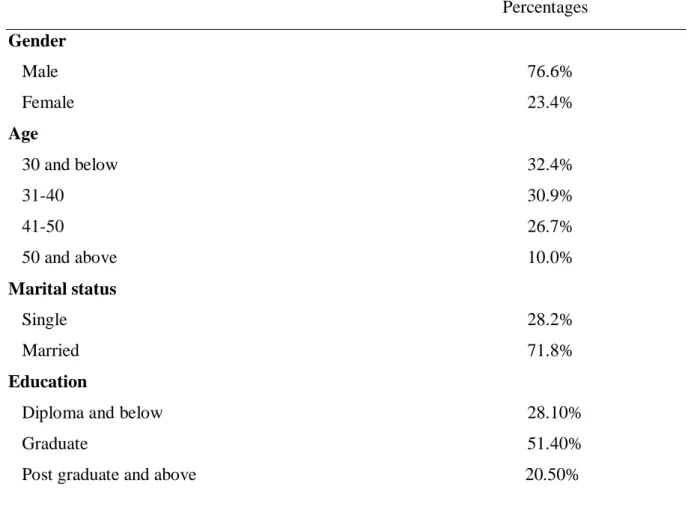
used and total number of 292 employees were selected from 8 companies. In total, 23.4 Internal
marketing
Market oraientation
Job satisfaction Organizational
percent of the respondents were female, and 32.4 percent were below 30 years old. Moreover,
71.8 percent were married and half of the respondents were graduates. Table 1 lists the
demographic statistics of all respondents.
Table 1. Respondents profile
Percentages
Gender
Male 76.6%
Female 23.4%
Age
30 and below 32.4%
31-40 30.9%
41-50 26.7%
50 and above 10.0%
Marital status
Single 28.2%
Married 71.8%
Education
Diploma and below 28.10%
Graduate 51.40%
Post graduate and above 20.50%
4. Analysis and Results
4.1.Measure Validity and Reliability
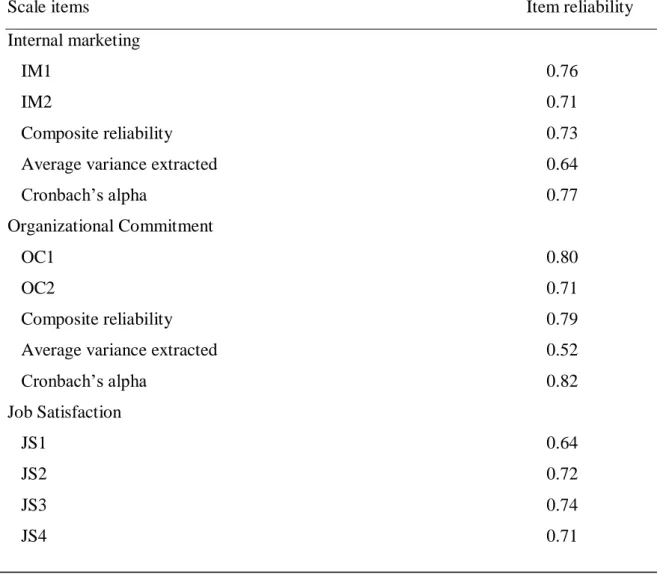
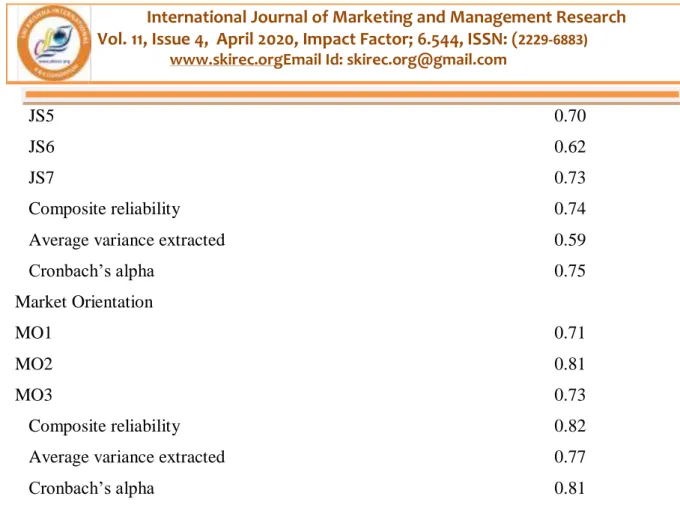
For identifying the poorly fitting items exploratory factor analysis (EFA) has been used
following confirmatory factor analysis (CFA) for further measure purification as shown in
table 2. One item within the internal marketing scale has been removed due to
unidimensionality requirements. Scales’ coefficient alphas are indicated in table 2. In all the
(Nunnally, 1978). Scales’ average variance has been more than .5 which is the recommended
level of Dillon and Goldstein (Dillon and Goldstein, 1984).
Discriminant validity of scales was measured using the test suggested by Fornell and Larcker
(Fornell and Larcker, 1981). According to this test, for scale to have discriminant validity, the
extracted average variance of latent variable must be greater than the shared variance of a
latent variable with other latent variable. As shown in table 3, no correlation exceeds the
square root of the average variance extracted, which is in compliance of needed criterion.
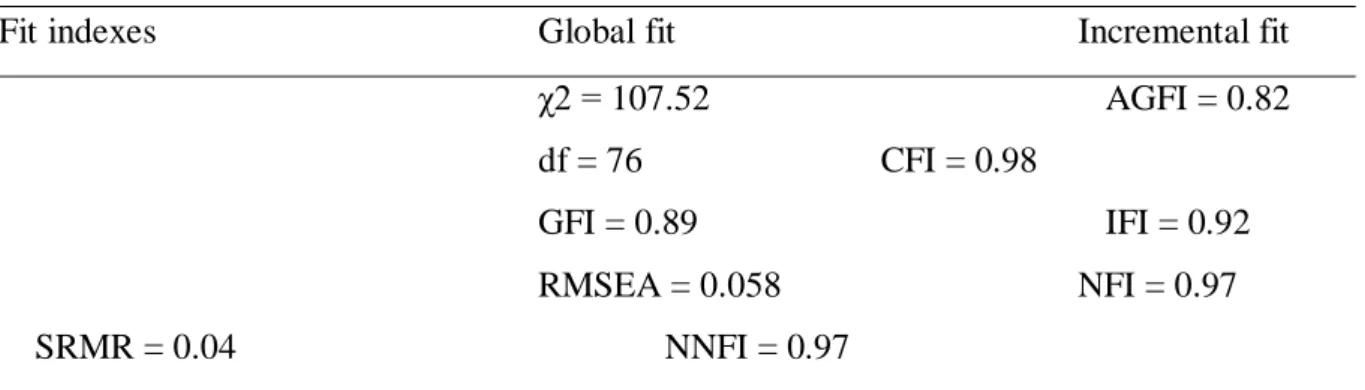
For examining fit between the data and the proposed structural model, the casual structure of
the proposed model has been tested. The estimation of the structural model yields a
chi-square of 107.52 with 76 d.f. the x2/df value was 1.41. The GFI provides evidence of a
reasonably fitting model (GFI = 0.89); so, all other indices are within the recommended range
of acceptability. As a result, the structural model demonstrated good fit to the date. The
various goodness-of-fit statistics are also presented in table 2.
Table 2. Measurement scale items
Scale items Item reliability
Internal marketing
IM1 0.76
IM2 0.71
Composite reliability 0.73
Average variance extracted 0.64
Cronbach’s alpha 0.77
Organizational Commitment
OC1 0.80
OC2 0.71
Composite reliability 0.79
Average variance extracted 0.52
Cronbach’s alpha 0.82
Job Satisfaction
JS1 0.64
JS2 0.72
JS3 0.74
JS5 0.70
JS6 0.62
JS7 0.73
Composite reliability 0.74
Average variance extracted 0.59
Cronbach’s alpha 0.75
Market Orientation
MO1 0.71
MO2 0.81
MO3 0.73
Composite reliability 0.82
Average variance extracted 0.77
Cronbach’s alpha 0.81
Notes: χ2 = 107.52; df = 76; RMSEA = 0.058; CFI = 0.93; NFI = 0.91; GFI = 0.89; IFI =
0.92
Table 3. Correlation Matrix of latent constructs
Variable Mean SD IM OC JS MO
Internal Marketing (IM) 3.300.59 0.94 -
Organizational Commitment (OC) 2.73 0.63 0.41*0.07 -
Job Satisfaction (JS) 2.56 0.710.27* 0.29 0.37* -
Market Orientation (MO) 3.51 0.941.12 0.760.49* 0.71*
Note: * Significant at the p < 0.05
4.2.Testing Research Hypotheses
The standardized path coefficients (β) indicate that internal marketing is an antecedent of
organizational commitment (β=0.32, t=6.41). The results of the analysis support the
antecedent role ofinternal marketingforjob satisfaction (β=0.41, t=4.23). The argument that
internal marketing is an antecedent and positively relate market orientation is supported by
antecedentrole for market orientation is supported in the findings (β=0.27, t=3.28) and the
effect of job satisfaction on market orientation also has supported (β=0.32, t=2.89).
Table 4. Summary of results
Hypotheses Estimate t-Value Hypotheses validation
H1: IMOC 0.326.41** Yes
H2: IM JS0.414.23** Yes
H3: IM MO 0.644.12** Yes
H4: OC MO0.27 3.28* Yes
H5: JS MO 0.32 2.89* Yes
* Significant at p<0.05; ** Significant at p<0.01
4.3. Test of the Structural Model
Table 5 shows the common model-fit indices, recommended values and results of the test of
structural model fitness. The estimation of the structural model indicates a chi-square of
107.52 with 76 d.f. the x2/df value was 1.41. As shown in Table 5, with comparison of all fit
indices with their corresponding recommended values (Hair et al., 1998), the evidence of a
good model fit was revealed.
Table 5. Overall fit of the model
Fit indexes Global fit Incremental fit
χ2 = 107.52 AGFI = 0.82
df = 76 CFI = 0.98
GFI = 0.89 IFI = 0.92
RMSEA = 0.058 NFI = 0.97
SRMR = 0.04 NNFI = 0.97
5. Conclusion and managerial implications
The effect of internal marketing, organizational commitment and job satisfaction on market
orientation were investigated in this research. By presenting a conceptual model based on the
their own internal relationships become known which many of them have never been
investigated in previous studies. Due to evidence of good model fit, the model and the
relationships it presents, could be consider as highly reliable and applicable to different
purposes either academic or practical.
In previous researches the role of internal marketing on market orientation has been
investigated. For instance, Bouranta et al., have indicated that internal marketing has direct
positive effect on market orientation of the firm and dimensions of internal marketing has
positive effect on customer orientation and other variables of market orientation. In this
research, this effect has been investigated for Iranian food companies and showed that in
Iranian food companies internal marketing has direct positive effect for prevailing market
orientation.
The relation of market orientation on organizational commitment has been examined in the
work of Berry (1981) in which the correlation between internal marketing and organizational
commitment has been investigated. Results shows that internal marketing has a direct
positive effect on employees’ job satisfaction. In this research this relation has been
confirmed for Iranian food companies. Therefore, it is now known for managers and
marketers that for reaching organizational commitment the first step is concentration on
development of internal marketing.
In previous researches in literature the relation of job satisfaction and internal marketing has
been investigated thoroughly. For instance, in the study of Conduit and Mavaondo (2001)
results shows that by implementing internal marketing the job satisfaction of employees will
increase in turn and the final outcome is enhanced organization performance. Likewise, in
this study by investigating and supporting the effect of internal marketing on job satisfaction
for food companies in Iran, managers have easier task for improving job satisfaction of their
employees due to identified antecedents of that variable.
Although organizational commitment is a popular concept in recent studies, there is still no
agreement for the role of organizational commitment as an antecedent of market orientation
(Conduit and Marondo, 2001). Therefore, in this study this rarely studied relation has been
investigated and results shows that organizational commitment has a direct positive effect on
market orientation.
Finally, the effect of job satisfaction on market orientation has not been investigated directly.
been supported (Azizi et al., 2012) or in another relevant study the effect of organizational
context on job satisfaction has been investigated and supported by results. In this study the
effect of job satisfaction and market orientation has been studied in Iranians food companies
and results support the direct positive effect of job satisfaction on market orientation.
References
1) Ackfeldt, A. L., and Coote, L. V. (2005), A study of organizational citizenship behaviors
in a retail setting. Journal of Business Research, 58(2), 151-159, 58(2), 151-159.
2) Ahmed, P. K., and Rafiq, M. (2002), Internal marketing: the tools and concepts for
change: Butterworth-Heinemann.
3) Al-Hawary, S. I. S., Al-Quadah, K. A. M., Abutayeh, P. M., Al-Zyadat, D. Y., The
impact of internal marketing on employee’s job satisfaction of commercial banks in
Jordan, Interdisciplinary Journal of Contemporary Research in Business, 4(9), 811-823.
4) Awwad, M. S., and Agti, D. A. M. (2011), The impact of internal marketing on
commercial banks’ market orientation. International Journal of Bank Marketing, 29(4),
308-332.
5) Berry, L. (1981), The employees as customer, Journal of Retail Banking, 3, 25-28.
6) Bouranta, N., Mavridoglou, G., and Kyriazopoulos, P. (2005), The impact of internal
marketing to market orientation concept and their effects to bank performance. Journal of
Operational Research, 5(2), 349-362.
7) Caruana, A., and Calleya, P. (1998), The effect of internal marketing on organizational
commitment among retail bank managers. International Journal of Bank Marketing,
16(3), 108-116.
8) Conduit, J. and Mavando, F. T. (2001), How critical is internal customer orientation to
market orientation?, Journal of Business Research, 51(1), 11-24.
9) Day, G. (1994), The capability of market-driven organization, Journal of Marketing, 58,
37-52.
10)Gummesson, E. (1991). Marketing-orientation revisited: the crucial role of the part-time
marketer. European Journal of Marketing, 25(2), 50-75.
11)Hogg, G., and Carter, S. (2000), Employee attitudes and responses to internal marketing.
12)Homburg, C. and Pflesser, C, C. (2000), a multiple-layer model of marke-orientation
organizational culture: measurement issues and performance outcome, Journal of
Marketing Research, 37, 449-462.
13)Hou, J. J. (2008), Toward a research model of market orientation and dynamic
capabilities, Social Behavior and Personality, 36(9), 1251-1268.
14)Hugn, J. and Lin, T. (2008), The investigation on the internal marketing practices of the
international tourism hotel chains, Journal of International Management Studies, 170-176.
15)Kirca, A. H., Jayachandaran, S. and Bearden, W.O. (2005), Market orientation: a
meta-analytic review and assessment of its antecedents and impact on performance, Journal of
Marketing, 69, 24-41.
16)Kyriazopoulos, P., Yannacopoulos, D., Spyridakos, A., Siskos, Y., and Grigoroudi, E.
(2007), Implementing internal marketing through employee’s motivation.
17)Locke, E. A. (1969), What is job satisfaction? Organizational Behavior and Human
Performance, 4, 309-336.
18)McCormick, E. J. and Ilgen, D. (1985), Industrial and Organizational Psychology,
London: Allen and Unwin.
19)Narver, J. C. and Slater, S. (1990), The effect of a market orientation on business
profitability, Journal of marketing, 54(4), 20-25.
20)Porter, Lyman W., Richard M. Steers, Richard T. Mowday, and P. V. Boulian (1974),
Organizational commitment, job satisfaction and turnover among psychiatric technicians,
Journal of Applied Psychlogy, 59(5), 603-609.
21)Rajyalakshmi, Nittala and Kameswari, A. Vijaya (2009), Internal Marketing for Customer
Satisfaction in Retail Sector, 3(3), 207-220.
22)Schultz, D.P. and Schultz, S.E., (1994), Psychology and Work Today: An Introduction to
Industral and Organizational Psychology. New York: Mc Millan.
23)Sivaramakrishnan, S., Zhang, D., Delbaere, M., and Bruning, E. (2008), The relationship
between organizational commitment and market orientation. Journal of Strategic
Marketing, 16(1), 55-73.
24)Tansuhaj, P., Randall, D., and McCullough, J. (1991). Applying the internal marketing
concept within large organizations: as applied to a credit union. Journal of Professional
25)Ting, S. C. (2010), The effect of internal marketing on organizational commitment: job
involvement and job satisfaction as mediators. Educational Administration Quarterly. 5.
1-30.
26)Wiess, D. J., Dawis, R. V., England, G. P. and Lofquist, L. H. (1967). Manual for the
Minnesota Satisfaction Questionnaire. St. Paul: University of Minnesota, Industrial