Improved Sensing Accuracy using Enhanced
Energy Detection Algorithm with Secondary User
Cooperation in Cognitive Radios
Muthumeenakshi. K, Radha.S
ECE Department, SSN College of Engineering, Kalavakkam, India [email protected], [email protected]
Abstract: Spectrum sensing is indispensable for cognitive radio to identify the available white spaces. Energy detection is considered as a preferred technique for spectrum sensing in cognitive radio networks. It is because of its simplicity, applicability and low computational complexity, energy detection is employed widely for spectrum sensing. This paper proposes an enhanced energy detection based spectrum sensing algorithm which incorporates the features of traditional energy detection and cooperative detection. The false alarm and detection probabilities of the proposed algorithm are derived theoretically under AWGN channel conditions. The performance of the proposed algorithm is evaluated analytically for various decision thresholds. The performance evaluations indicate that the proposed enhanced energy detection algorithm outshines the traditional energy detection algorithm and greatly improves the spectrum sensing accuracy under varying SNR conditions.
Keywords: Cognitive Radio, Spectrum Sensing, Energy Detection, Cooperative Sensing, Sensing Accuracy, Spectrum Access.
1.
Introduction
Radio spectrum is a limited and scarce resource and is completely regulated by authorized bodies such as the Federal Communication Commission [1]. The demand for the radio spectrum is increasing with both the competing wireless applications and the number of users. The current static spectrum assignment approach could not increase spectrum utilization. To improve the spectrum utilization Cognitive Radio Technology is proposed [2]. This technology could be made use of in the future to make flexible, opportunistic use of the licensed spectra by unlicensed users. That is, unlicensed users equipped with cognitive radio may in future be able to sense and opportunistically utilize a licensed spectrum when the corresponding licensed user is not making use of it. In the existing cognitive radio terminology, licensed users are called the primary users and unlicensed users are called the secondary users [2]. Secondary users are allowed to share the licensed spectrum when it is found idle, which requires the knowledge about the primary user access patterns. Thus the main challenge of cognitive radio is to reliably identify the presence or absence of the primary users and not to cause harmful interference to the primary users. There are number of such primary user detection algorithms called spectrum sensing algorithms reported in the literature. Few existing spectrum sensing algorithms include energy detection,
matched filtering and cyclostationary feature detection, eigen-value based detection, covariance based detection, radio mode identification approach and filter bank spectrum estimation techniques [2]-[7]. The existing spectrum sensing algorithm provides various trade-offs between the sensing accuracy, sensing time, computational complexity, practical applicability, etc., Energy detection based spectrum sensing algorithms can be used when no information about the primary signal is known. Energy detectors are well known for their low computational complexity, low implementation cost, simplicity and applicability. The main drawback of energy detection is its performance degradation under low Signal to Noise Ratio (SNR) conditions. It could not reliably detect the primary user signal under varying noise conditions, signal fading and shadowing. Cooperative spectrum sensing schemes [8], [9] are proposed to improve the detection performance under these conditions. Performance improvements are achievable with cooperative spectrum sensing but at the expense of increased sensing time and complexity. Apart from the cooperative sensing, there are many hybrid sensing schemes [10] reported in the literature. Hybrid schemes are sequential or parallel combinations of existing single stage algorithms like combined energy and feature detection, combined energy and eigen-value detection, etc., The studies on the hybrid schemes have also reported considerable performance improvements.
In this paper, an enhanced energy detection based spectrum sensing algorithm is proposed. The main objective of the proposed algorithm is to combine the features of the traditional energy detection algorithm [11], improved energy detection algorithm [12] and cooperative schemes and to intelligently detect whether the primary user is operating in the spectrum. This enhanced energy detection algorithm considerably improves the detection performance under low SNR regime.
2.
Related Works
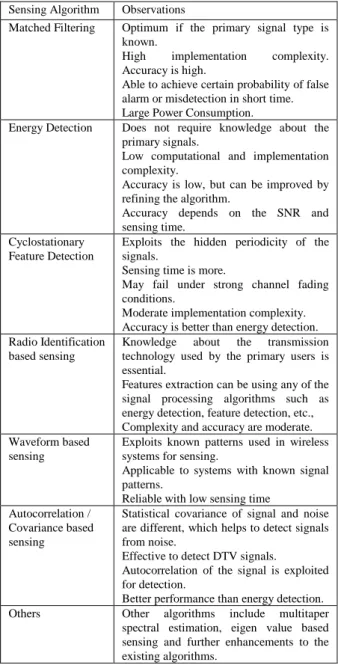
Spectrum sensing is the key function of cognitive radio networks. There are many existing methodologies reported in the literature which improves the performance of spectrum sensing. A comprehensive summary of the existing spectrum sensing algorithms with their merits and demerits are listed in the Table 1.
Table 1. Summary of existing sensing algorithms Sensing Algorithm Observations
Matched Filtering Optimum if the primary signal type is known.
High implementation complexity. Accuracy is high.
Able to achieve certain probability of false alarm or misdetection in short time. Large Power Consumption.
Energy Detection Does not require knowledge about the primary signals.
Low computational and implementation complexity.
Accuracy is low, but can be improved by refining the algorithm.
Accuracy depends on the SNR and sensing time.
Cyclostationary Feature Detection
Exploits the hidden periodicity of the signals.
Sensing time is more.
May fail under strong channel fading conditions.
Moderate implementation complexity. Accuracy is better than energy detection. Radio Identification
based sensing
Knowledge about the transmission technology used by the primary users is essential.
Features extraction can be using any of the signal processing algorithms such as energy detection, feature detection, etc., Complexity and accuracy are moderate. Waveform based
sensing
Exploits known patterns used in wireless systems for sensing.
Applicable to systems with known signal patterns.
Reliable with low sensing time Autocorrelation /
Covariance based sensing
Statistical covariance of signal and noise are different, which helps to detect signals from noise.
Effective to detect DTV signals.
Autocorrelation of the signal is exploited for detection.
Better performance than energy detection. Others Other algorithms include multitaper
spectral estimation, eigen value based sensing and further enhancements to the existing algorithms.
Improvements in spectrum sensing are focused both in local sensing and cooperative sensing. In local sensing, the secondary user individually performs sensing algorithms and arrives at a decision on its own. In [13], the traditional energy detection algorithm is examined for complex Gaussian signal and the effect of various sensing parameters on the error probability is evaluated. The performance analysis of traditional energy detection algorithm is analyzed for signals under both AWGN and Rayleigh fading in [14]. A sequential hybrid detector using both the energy detection algorithm and cyclostationary feature detection is proposed in [15]. In [16], a fuzzy logic based spectrum sensing scheme is proposed.
In stage one, the sensing is performed using the common techniques like energy detection, feature detection and matched filtering. The result of the first stage is combined with a fuzzy logic algorithm to decide about the presence or absence of the primary user. SNR based adaptive sensing scheme is proposed in [17]. This scheme is two staged, where in stage one the SNR is estimated. In the second stage, the secondary user performs either energy detection or cyclostationary detection based on the estimated SNR. Many other techniques which uses wavelet transforms, SVD, covariance measures, eigen values are also proposed in the literature [18, 19]. The performance degradation due to unreliable spectrum sensing directly affects the throughput of the secondary users. The impact of unreliable sensing for an opportunistic sharing system is studied in [20]. So it is necessary to further improve the sensing performance. Alternatively, techniques to improve the performance of the traditional energy detection algorithm are well studied in the literature. In [12], an improved energy detection algorithm is proposed for spectrum sensing. The improved energy detection scheme initially employs the traditional energy detection algorithm and additionally confirms the threshold with the average of past M energy values along with the previous energy value. This algorithm is able to avoid any missed detection due to instantaneous energy drops and improves the detection performance. The computational complexity of the improved energy detection algorithm is analyzed and is found to be similar to that of the traditional energy detection algorithm. Another approach to improve the traditional energy detection algorithm is proposed in [21]. The algorithm computes an arbitrary positive power operation on the received signal instead of squaring operation and shows better performance.
Apart from the local sensing techniques, cooperative sensing techniques are proposed to improve the detection performance. A collaborative spectrum hole detection scheme and optimization of decision threshold using energy detection is proposed in [22]. Sensing throughput tradeoff using energy detection is formulated and the optimal sensing time which maximizes the secondary user throughput is obtained for cooperative schemes in [23]. Cooperative sensing scheme with imperfect feedback channel is analyzed in [24]. A detailed focus on the performance analysis and comparison on the hard decision and soft decision based fusion schemes is accomplished in [25].
3.
The Spectrum Sensing Problem and the
System Model
The spectrum sensing problem is formulated as a binary hypothesis testing model defined by the two hypotheses, defined as
0
1
if
if
v( n )
H
y( n )
s( n ) v( n )
H
(1)where y(n) is the signal received over the primary band by the cognitive radio, s(n) is the transmitted primary user signal and v(n) is the AGWN and n = 1,2,3….N. Hypothesis H0
indicates that the channel is unoccupied and contains only noise. Hypothesis H1 indicates the presence of the primary
user signal. N refers to the finite number of samples collected over the observation period based on which the sensing decision is made. Under ideal conditions, the spectrum sensing decision has to be hypothesis H1 if the primary user
is operating on the spectrum and hypothesis H0 if the
spectrum is free. Practically, spectrum sensing algorithms are prone to errors which lead to erroneous decisions. The two common errors are false alarms and missed detections. False alarms occur when the spectrum sensing algorithm decides hypothesis H1 and the sensed spectrum is free. A false alarm
results in low spectrum utilization due to missed transmission opportunities for the secondary users. Alternatively, missed detection occurs when the spectrum sensing algorithm decides hypothesis H0 and the sensed spectrum is actually
occupied by the licensed user. A missed detection may result in harmful interference to the primary user which is undesirable. Thus the performance of any spectrum sensing algorithm is evaluated by means of the two probabilities: the probability of false alarm, denoted by Pf = Prob(H1/H0) and
the probability of detection, denoted by Pd = Prob(H1/H1).
The probability of missed detection is the complementary Pd
given by Pmd = 1 – Pd. Any spectrum sensing algorithm
should result in low Pf and high Pd. However, there is always
a trade-off between the two probabilities. To explore the relationship between the two probabilities of a spectrum sensing algorithm, Receiver Operating Characteristic (ROC) curves are helpful. ROC curves are generally obtained by plotting the probability of detection with respect to the probability of false alarm against various parameters of the algorithm.
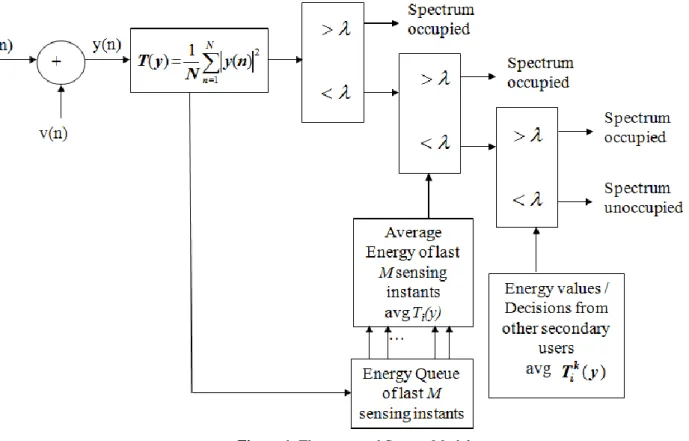
The system model for the proposed enhanced energy detection based spectrum sensing is shown in Figure 1. The main objective of the proposed algorithm is to improve the probability of detection without much increase in algorithm complexity. The enhanced spectrum sensing scheme primarily begins with the traditional energy detection and combines the feature of cooperative detection with the other secondary users in the cognitive radio network to maximize the probability of detection. The traditional energy detector compares the received signal energy on a primary channel over an observation period with a properly set threshold and declares the state of the channel as occupied or unoccupied. The procedure for threshold setting is explained in section 4. If the spectrum is reported unoccupied, the concept of improved energy detection [12] is employed. The improved energy detection makes an additional check by comparing the
average energy value of the past M sensing instants with the decision threshold. For this purpose, the energy value of the past M sensing instants is stored. This step is incorporated to avoid any misdetection due to instantaneous energy drops. If the average energy value of M sensing instants is greater than the threshold, the decision threshold is again compared with the energy value of the immediate past sensing instant. This step is essential to avoid any false alarm when the primary user has just vacated the channel. Sometimes, the algorithm may fail to detect the presence of primary user because to noise uncertainty. Thus in the proposed algorithm, to further improve the performance of the detector, the decision is corroborated with cooperative sensing. Cooperation among the other secondary users is required only if the algorithm is unable to obtain a stable decision in the first two stages. Thus the computational complexity of the algorithm is not as high as cooperative detection and it is comparable with that of the traditional energy detection.
4.
Operating Principle of the Proposed
Enhanced Energy Detection Algorithm
The operating principle of the proposed spectrum sensing algorithm is described as follows: First, the traditional energy detection is explained thoroughly. Its theoretical performance is analyzed comprehensively in terms of the false alarm and missed detection probabilities for varying number of samples. Then the algorithm design of the enhanced energy detection is explained and its theoretical performance is evaluated. Finally, the results of the proposed spectrum sensing are compared with the improved energy detector and traditional energy detector.
4.1 The Traditional Energy Detector
The traditional energy detector [10] uses the measured signal energy over an observation interval as the test statistic and compares it with a predefined threshold , given by,
2
1
1
Ni
n
T ( y )
y( n )
N
(2) Ti(y) is the decision statistic computed at the ith sensinginstant. The spectrum sensing algorithm decision is hypothesis H1 if Ti(y)>. Otherwise, the decision is H0. The
procedure to select the decision threshold is explained below.
The analytical expressions for Pd and Pf can be derived
based on the test statistic which follows a central chi-square distribution under H0 and non central chi-square distribution
under H1 with 2N degrees of freedom. If N is sufficiently
large (required to achieve a certain performance), central limit theorem approximates the test statistic as Normal distribution as given by,
2
0 0 0
2
1 1 1
if
if
iNormal( μ ,σ )
H
T ( y )
Normal( μ ,σ )
H
(3)
where
μ ,μ ,σ ,σ
0 1 02 12are the mean and variance of the distribution under H0 and H1 respectively. They are evaluated(i) Both s(n) and v(n) are real and Gaussian. (ii) s(n) and v(n) are independent of each other.
(iii) The primary user SNR under H1 is given by
2 2
s vσ
γ
σ
The mean and variance of the test statistic under H0 is ,
20 1 2 1 2 1 2 1 2
1
1
=
1
=
1
=
=
N i n N n N v n N v n vμ
E T ( y )
E
y( n )
N
E
v( n )
N
E
σ
N
σ
N
σ
2 22
0 0 0
1
4 4 4 4
4
1
1 1
= = 3
2 =
N i nv v v
v
σ E T ( y ) μ E y( n ) μ
N
E v( n ) σ σ σ
N N
σ N
Similarly the mean and variance of the test statistic under H1 is ,
21
1 2 1
2 2 2 2
1 1
2 2 2
1
1
=
1
1
=
=
=
1
N i n N n N Ns v s v
n n
s v v
μ
E T ( y )
E
y( n )
N
E
s( n ) v( n )
N
E
σ
σ
σ
σ
N
N
σ
σ
( γ
)σ
2 2 21 1 1
1
2
4 4 2 2 2 2
2
4 4 2 2 2 2
2 2
2 2 4
1
1
=
2
1
=
2
2
2
=
1
N i ns v s v
s v s v s v
s v v
σ
E T ( y ) μ
E
y( n ) μ
N
E s( n )
E v( n )
σ
σ
σ σ
N
σ
σ
σ
σ
σ σ
N
σ
σ
γ
σ
N
N
Thus the probability of false alarm and detection of the traditional energy detector can be obtained using the distribution of the test statistic as,
2 0 2 0 2 2 2 2
0 0 2
0 2 1 2
1
2
1
=
2
v( x μ ) σ f λ λ t λ N σ
P
N( μ ,σ )dx
e
dx
πσ
e
dt
π
=
21
2
f vλ
N
P
Q
σ
(4)where Q(.) is the tail probability function of the normal distribution and defined as
2 2
1
2
t αQ( α )
e dt
π
2 1 2 1 2 2 2 21 1 2
1 2 2 1 1
1
2
1
=
2
v( x μ ) σ d
λ λ
t
λ γ N /
( γ ) σ
P
N( μ ,σ )dx
e
dx
πσ
e
dt
π
=
21
2
1
d vλ
N /
P
Q
γ
σ
( γ
)
(5)4.2 Determination of Decision Threshold
The decision threshold setting procedure is very crucial as it directly affects the performance of the detector. The threshold should be chosen such that the probability of detection is maximized and the probability of false alarm is minimized. Achieving both these criteria cannot be realized in practice. Also, this requires the knowledge of signal and noise powers. The estimation of signal power is difficult whereas the noise power can be estimated. Thus the threshold is normally selected to satisfy a fixed Pf, which depends only
on noise power. The decision threshold for a target Pf,
denoted as ^
f
P can be solved from equation (4) as,
2
2
1
1
^
v f
λ σ
Q
P
N
(6) The corresponding probability of detection is obtained as,2 1 2 2 1 2 1 1 ^ v f d v
σ Q P
N N /
P Q γ
σ ( γ )
4.3 The Proposed Enhanced Energy Detection Algorithm
The traditional energy detector has well-known detection performance drawbacks. Its performance depends on factors like SNR, number of samples N and hidden user problem. Missed detections should be avoided as it is harmful to the primary user. The missed detections due to instantaneous signal energy drops could be avoided using an improved energy detector as in [12]. To further improve the accuracy of the energy detector and to avoid missed detections due to shadowing and fading, the proposed enhanced spectrum sensing algorithm additionally verifies with the decisions from the other secondary users present in the cognitive radio network. This requires the exchange of sensing decisions between the secondary users using a common control channel. The additional check using the cooperative decision (using soft combining scheme or hard combining scheme with AND/OR/MAJORITY fusion rules) will be useful in avoiding missed detection due to hidden users. The algorithm for the enhanced energy detector is explained in Algorithm 1. The traditional energy detection algorithm is also explained in Algorithm 2 for comparison.
The proposed enhanced energy detection algorithm is explained as follows: At every ith sensing instant, the signal energy value is calculated using N samples and compared with the decision threshold. If the signal energy is falls below the threshold, the average signal energy values of the past M
sensing instants and the signal energy value of its pervious instant (i-1) are compared with the threshold. The average signal energy of the past M sensing instants is computed as,
1
avg mean
1 =
( ) ( ), ( ), .... ( ) ( )
j i i i M
i j j i M
T y T y T y T y
T y
M
The test statistic values of the past instants j = i, i-1, …i-M
can be assumed to be normally distributed and their average value is also normally distributed,
avg
T
j(
y
) ~
Normal μ
(
avg,
σ
avg)
The average mean and variance of avg Tj(y) can be evaluated
as [12],
1 0
2 2
=
1
avg
v v
L
M
L
μ
μ
μ
M
M
L
M
L
γ
σ
σ
M
M
2 2 2
1 0
2 4 4
2 2
2
2
=
1
avg
v v
L
M
L
σ
σ
σ
M
M
L
M
L
γ
σ
σ
M
N
M
N
where L is the number of times, the decision is H1 out of M.
Additionally, one more check is performed to avoid any missed detections due to hidden user problem. This is achieved with the help of the other cooperating secondary users in the network. The other secondary users share their respected signal energy values calculated at the ith instant with each other through a common control channel (soft combining). Now the average energy value of the other secondary users is given by,
1 2
1
avg
mean
1
=
(
)
(
),
(
), ....
(
)
(
)
k K
i i i i
K k i i
T
y
T
y T
y
T
y
T
y
K
The mean and variance of avg
T
ik is given by,
0
1
c k k
avg
L
K
L
μ
μ
μ
K
K
1
2 2 2
0
2 2
k
c k
avg
L
K
L
σ
σ
σ
K
K
If the signal energy value is still less than the decision threshold, the state of the channel is declared as unoccupied. Instead of sharing the signal energy values, the other secondary users can also share their decisions as a 1 bit value between them (hard combining). In such case, the probability of detection and false alarm is given by,
1
1
K
l K l
c
d d d
l X
K l K l
c
f f f
l X
K
P
P
P
l
K
P
P
P
l
where X=1 indicates OR fusion rule, X=K indicates AND fusion rule and X=K/2 denotes the MAJORITY rule.
Hence, the probability of detection
P
den for the enhanced energy detection algorithm is derived as,
1 1 1 1 1 1 11
avg
( ) ( ) . ( ) .
( ) ( ) . ( )
en
d i H i H j H
k
i H i H i H
P P T y λ P T y λ P T y λ
P T y λ P T y λ P T y λ
(1 ) .
(1 )
avg
en c
d d d d d d
avg
λ μ
P P P Q P P P
σ
(8)
The corresponding false alarm probability
P
fen is given by, (1 ) .
(1 )
avg
en c
f f f f f f
avg
λ μ
P P P Q P P P
σ
(9)
Algorithm 1. The proposed algorithm Input: x(n), , N
Output: H0, H1
for every sensing instant i do
Compute Ti(y)
Compute avgTj(y), j = i, i-1,…i-M
if Ti(y) > then
decide H1
else
if avgTi(y) > then
if Ti-1(y) > then
decide H1
else
Compute avg k( )
i
T y , k = 1,2,..K
if avg k( ) i
T y > then
decide H1
else
decide H0
end if
end if
else
decide H0
end if
end if
end for
Algorithm 2 The traditional energy detection algorithm Input: x(n), , N, K,
Output: H0, H1
for every sensing instant i do
Compute Ti(y)
if Ti(y) > then
decide H1
else
decide H0
end if
end for
4.4 Determination of Decision Threshold for the Proposed Enhanced Energy Detection Algorithm The determination of the decision threshold is very important for any signal detection scheme. The determination of the decision threshold for the traditional energy detection is explained in section 4.2. If the similar threshold as given in equation (6) is used for the proposed detection algorithm the lower and upper bound for the detection and the false alarm probabilities can be approximated as follows. From equation (9),
1 1
( ) avg . ( )
en c
d d d d d d
avg
λ μ
P P P Q P P P
σ
We analyze the upper and lower bounds of the probabilities of detection and false alarm. The probability of the enhanced energy detection algorithm depends on the Q function. The value of Q(.) lies between 0 and 1. Hence, if Q(.) = 0,
en
d d
P
P
and if Q(.) = 1 and
P
dc1
,
1 1
= 1 1
1
( ) ( )
( ) ( )
en c
d d d d d d
d d d d
P P P P P P
P P P P
Otherwise if Q(.) = 1 and
P
dcP
d,
2 3
1 1
= 1 1
3 3 1
en c
d d d d d d
d d d d d
d d d
P P P P P P
P P P P P
P P P
( ) ( )
( ) ( )
Thus the probability of detection is bounded by
P
d
P
de
1
. At the same time the probability of false alarm also increases from its target value as given by,If Q(.) = 0,
en
f f
P
P
and if Q(.) = 1 and
P
fc0
,2
2
en
f f f
P
P
P
which indicate that the probability of false alarm increases by approximately two times.
If Q(.) = 1 and
P
fcP
f ,2 3
3
3
en
f f f f
P
P
P
P
which indicate that the probability of false alarm increases approximately by three times. Thus the performance improvement of the proposed algorithm is achieved at the expense of slight degradation in the false alarm. However it can be verified from the ROC curves presented in the following section that the performance degradation due to false alarm is less intense for the proposed algorithm. To compensate for the increase in false alarm (maximum three times target Pf), the threshold can also be chosen as,
2
2
11
3
^ f v
P
λ σ
Q
N
(10)improvement. If the target Pf is denoted as arg t et f
P
, the probability of detection forP
ftarget is given by,
2 1
1
2
1
1
arg
(
).
.
(
)
en
d d d
t et
v f avg
c
d d d
avg
P
P
P
σ
Q
P
μ
N
Q
P
P P
σ
Now the proposed algorithm is analyzed for three different situations which are obtained when
^
arg
t et
f f
P
P
,2
^
arg
ft et f
P
P
and3
^
arg
ft et f
P
P
which leads to three different threshold values.Situation (i) – Maximum primary user protection: To highly protect the primary users from harmful interference, it is desirable to use the threshold in which
^
arg
t et
f f
P
P
. Thedetection performance is guaranteed in this case at the expense of loss in spectrum opportunities for the secondary users.
Situation (ii) – Maximum secondary user utilization: To create more opportunities for the secondary users the
threshold in which
3
^
arg
ft et f
P
P
could be employed. This slightly reduces the detection performance than the first situation, but guarantees the false alarm probability.Situation (iii) – As a compromise between the primary user protection and secondary user spectrum utilization, the
threshold in which
2
^
arg
ft et f
P
P
could be employed. This gives a better detection performance than the second situation, with a slight degradation in the false alarm probability.The performance of the enhanced energy detector obtained for each of the above discussed threshold values is better than the traditional energy detector.
5.
Simulation Results and Discussions
To verify the accuracy of the proposed enhanced energy detection algorithm, the ROC curves are plotted and compared with the traditional energy detection algorithm. The primary signal should be sensed at a very low SNR to protect them from interference. According to IEEE 802.22 spectrum sensing specifications, a cognitive radio should be able to detect a digital TV signal at an SNR of -3dB to -21dB [20].
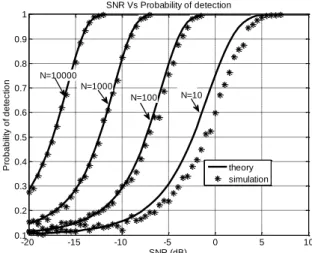
Thus, the proposed algorithm is evaluated for low SNR values. The number of other cooperating secondary users (K) is set to 10. Figure 2 shows the detection performance of the traditional energy detection algorithm with respect to SNR for varying number of samples N. To achieve the simulated results, the primary signal is assumed to be real Gaussian. It is observed that the detection performance improves with increasing number of samples. It is also observed that for short sensing times (say N = 10), the signal variance is large and hence the simulated performance does not follow the theoretical performance and exhibits performance degradation. Table 2 shows the achieved probability of detection and the corresponding SNR values for N = 1000.
-20 -15 -10 -5 0 5 10
0.1 0.2 0.3 0.4 0.5 0.6 0.7 0.8 0.9 1
SNR (dB)
P
ro
b
a
b
ili
ty
o
f
d
e
te
c
ti
o
n
SNR Vs Probability of detection
theory simulation N=1000
N=10000
N=10 N=100
Figure 2. Performance of the traditional energy detection algorithm
Table 2. Achieved probability of detection using traditional energy detection
Target Pf = 0.1
Pd SNR (dB)
0.9 -9.27
0.8 -10.14
0.7 -10.87
0.6 -11.61
To evaluate the performance of the proposed algorithm, the SNR values for which the Pdis 0.6 to 0.9 are considered. The
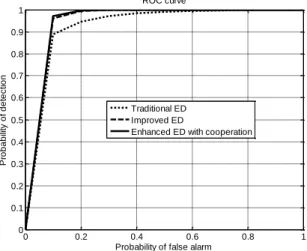
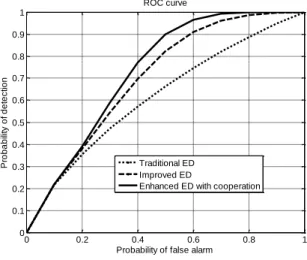
ROC curve for the proposed algorithm, improved energy detection algorithm and the traditional energy detection are obtained as shown in Figure 3 to Figure 6. To obtain the improved energy detection performance, the value of L and
M are assumed to be 5. It is observed that when the SNR is -10.14 and Pf = 0.1, the probability of detection of the
traditional energy detection algorithm is 0.8 whereas for the proposed algorithm Pd is 0.9. This corresponds to 10%
0 0.2 0.4 0.6 0.8 1 0
0.1 0.2 0.3 0.4 0.5 0.6 0.7 0.8 0.9 1
Probability of false alarm
P
ro
b
a
b
ili
ty
o
f
d
e
te
c
ti
o
n
ROC curve
Traditional ED Improved ED
Enhanced ED with cooperation
Figure 3. ROC curves for SNR = -9.27 dB
0 0.2 0.4 0.6 0.8 1
0 0.1 0.2 0.3 0.4 0.5 0.6 0.7 0.8 0.9 1
Probability of false alarm
P
ro
b
a
b
ili
ty
o
f
d
e
te
c
ti
o
n
ROC curve
Traditional ED Improved ED
Enhanced ED with cooperation
Figure 4. ROC curves for SNR = -10.14 dB
0 0.2 0.4 0.6 0.8 1
0 0.1 0.2 0.3 0.4 0.5 0.6 0.7 0.8 0.9 1
Probability of false alarm
P
ro
b
a
b
ili
ty
o
f
d
e
te
c
ti
o
n
ROC curve
Traditional ED Improved ED
Enhanced ED with cooperation
Figure 5. ROC curves for SNR = -10.87 dB
0 0.2 0.4 0.6 0.8 1
0 0.1 0.2 0.3 0.4 0.5 0.6 0.7 0.8 0.9 1
Probability of false alarm
P
ro
b
a
b
ili
ty
o
f
d
e
te
c
ti
o
n
ROC curve
Traditional ED Improved ED
Enhanced ED with cooperation
Figure 6. ROC curves for SNR = -11.61 dB
Then the performance of the proposed algorithm is also analyzed for different number of samples N = 5000, 1000, 100 and 10 and shown in Figure 7 to Figure 10. It is observed that as N increases the detection performance also increases. For low values of N the proposed algorithm achieves better results which ensure that it is able to detect the primary user signal with short sensing durations.
0 0.2 0.4 0.6 0.8 1
0 0.1 0.2 0.3 0.4 0.5 0.6 0.7 0.8 0.9 1
Probability of false alarm
P
ro
b
a
b
ili
ty
o
f
d
e
te
c
ti
o
n
ROC curve
Traditional ED Improved ED
Enhanced ED with cooperation
Figure 7. ROC curves for N = 5000
0 0.2 0.4 0.6 0.8 1
0 0.1 0.2 0.3 0.4 0.5 0.6 0.7 0.8 0.9 1
Probability of false alarm
P
ro
b
a
b
ili
ty
o
f
d
e
te
c
ti
o
n
ROC curve
Traditional ED Improved ED
Enhanced ED with cooperation
0 0.2 0.4 0.6 0.8 1 0
0.1 0.2 0.3 0.4 0.5 0.6 0.7 0.8 0.9 1
Probability of false alarm
P
ro
b
a
b
ili
ty
o
f
d
e
te
c
ti
o
n
ROC curve
Traditional ED Improved ED
Enhanced ED with cooperation
Figure 9. ROC curves for N = 100
0 0.2 0.4 0.6 0.8 1
0 0.1 0.2 0.3 0.4 0.5 0.6 0.7 0.8 0.9 1
Probability of false alarm
P
ro
b
a
b
ili
ty
o
f
d
e
te
c
ti
o
n
ROC curve
Traditional ED Improved ED
Enhanced ED with cooperation
Figure 10. ROC curves for N = 10
-20 -15 -10 -5 0 5
0.1 0.2 0.3 0.4 0.5 0.6 0.7 0.8 0.9 1
SNR (dB)
P
ro
b
a
b
ili
ty
o
f
d
e
te
c
ti
o
n
Pd Vs SNR
Traditional ED Improved ED
Enhanced ED with cooperation
Figure 11. Performance comparison of the algorithms with respect to SNR
The previous observations are well confirmed in Figure 11. in which the probability of detection is plotted against SNR. The improvement in the probability of detection is well observed for the proposed algorithm. The SNR values for which the achieved probability of detection is 0.6 to 0.9 is shown in Table 3.
The detection probability of 0.9 is achieved at an SNR of -10.81 for the proposed algorithm whereas it is approximately 0.7 for the traditional energy detection algorithm. Thus it can be concluded that similar detection performance is achieved at low SNR for the enhanced energy detection algorithm.
Table 3. SNR at target probability of detection
Pd
SNR (dB)
Traditional ED
Improved ED
Enhanced ED with cooperation
0.9 -9.27 -10.1 -10.81
0.8 -10.14 -10.85 -11.6
0.7 -10.87 -11.52 -12.23
0.6 -11.61 -12.2 -12.81
Figure 12 shows the ROC curves obtained for various decision threshold values as discussed in section 4.4. Threshold 1 corresponds to
^ arg
t et
f f
P P , threshold 2 corresponds to
2
^ arg f
t et
f
P
P and threshold 3 corresponds
to
3
^ arg f
t et
f
P
P . The target probability of false alarm
^
f
P is set
to 0.1 and the number of samples N is set to 1000. The detection performance obtained for all the three cases is better than the performance obtained for traditional energy detection.
0 0.2 0.4 0.6 0.8 1
0 0.1 0.2 0.3 0.4 0.5 0.6 0.7 0.8 0.9 1
Probability of false alarm
P
ro
b
a
b
ili
ty
o
f
d
e
te
c
ti
o
n
ROC curve
Traditional ED
Enhanced ED (Threshold 1) Enhanced ED (Threshold 2) Enhanced ED (Threshold 3)
1000 2000 3000 4000 5000 6000 7000 8000 9000 10000 0.2
0.3 0.4 0.5 0.6 0.7 0.8 0.9
No of samples
P
ro
b
a
b
ili
ty
o
f
d
e
te
c
ti
o
n
Pd Vs N
Traditional ED Improved ED
Enhanced ED with cooperation
Figure 13. Performance comparison of the algorithms with respect to the number of samples
Table. 4 No of samples required for a target probability of detection (SNR = -14dB)
Pd
No. of samples (N)
Traditional ED
Improved ED
Enhanced ED with cooperation
0.9 8620 5820 4150
0.8 5870 4175 2935
0.7 4210 3120 2250
0.6 3010 2310 1740
Finally, the computational complexity of the proposed algorithm is analyzed and compared with the existing algorithms. The computational complexity is analyzed using number of samples required to achieve a target Pd and Pf.
The number of samples required for the traditional energy detection algorithm can be computed using (7) and given by
2
1 1
1
2
1
f dN
Q
P
Q
P
(11)which shows that the required number of samples for a target performance varies as O(1/SNR2). Figure 14 shows the sample complexity against SNR obtained using (11). Similar closed form expression for N is difficult to obtain for the proposed algorithm. Hence the complexity in terms of the number of samples is obtained numerically and compared with the existing algorithms. The curves corresponding to the proposed algorithm tend to follow the curve using (11) with a lesser slope. Hence it can be concluded that the complexity in terms of number of samples is same as that of the existing algorithms. The processing time taken for the proposed algorithm is also found to be comparable to that of the traditional energy detection algorithm as the algorithm requires only additional verifications. However, the need for storage requirements increases with increase in M and K
values.
-150 -10 -5 0
2000 4000 6000 8000 10000 12000 14000
SNR (dB)
N
u
m
b
e
r
o
f
S
a
m
p
le
s
SNR Vs N
Traditional ED Improved ED
Enhanced ED with cooperation
Figure 14. Complexity analysis in terms of number of samples
6.
Conclusion
Energy detection is a simple and very popular spectrum sensing algorithm and is widely used in cognitive radio networks. It has a very low computational and implementation complexity. In spite of the advantages, the performance of the energy detection is limited than other alternative techniques. To overcome the performance degradation of the traditional energy detector, this paper proposes an enhanced energy detection algorithm to improve the spectrum sensing accuracy. The proposed algorithm combines the features of both the traditional energy detection and cooperative detection. The expressions for the detection and false alarm probability are derived and the selection of decision threshold is discussed. Results confirm that enhanced energy detection algorithm performs well than the existing energy detection algorithms. Under low SNR, its detection performance is better and requires less number of samples to achieve the same level of performance than other energy detection algorithms.
References
[1] J. Mitola, “Cognitive Radio: An integrated architecture for software defined radio”, PhD thesis, KTH Royal Institute of Technology, Stockholm, Sweden, 2000. [2] F.Akyildiz, W.Y.Lee, S.Mohanty, “Next generation /
dynamic spectrum access / cognitive radio wireless networks: A survey,” Computer Network Journal (Elsevier), Vol. 50, No.13, pp. 2127 – 2159, Sep 2006. [3] T.Arslan, “A survey of spectrum sensing algorithms for
cognitive radio applications," IEEE Communications Surveys & Tutorials, Vol.11, No.1, pp.116-130, 2009. [4] Y.Zeng, Y.C.Liang, “Eigen value based spectrum
sensing algorithms for cognitive radio”, IEEE transactions on Communications, Vol.57, No.6, pp. 1784 – 1793, June 2009.
[5] Y.Zeng, Y.C.Liang, “Spectrum sensing algorithms for cognitive radio based on statistical covariances”, IEEE transactions on Vehicular Technology, Vol.58, No.4, pp 1804-1815, 2009.
Communication Networks and Information Security, Vol.4, No.2, pp. 86 – 90, August 2012.
[7] K.G.Smitha, A.P.Vinod, “Low Power DFT Filter bank based two stage spectrum sensing”, International Conference on Innovations in Information Technology, Abu Dhabi, pp. 173-177, March 2012.
[8] A.Ghasemi, E.S. Sousa, “Collaborative spectrum sensing for opportunistic access in fading environment”, IEEE International Symposium on Dynamic Spectrum Access Networks, Baltimore, MD, USA, pp. 131–136, November 2005.
[9] D.Chen, J.Li, J.Ma, “Cooperative Spectrum Sensing under Noise Uncertainty in Cognitive Radio,” 4th International Conference on Wireless Communication, Networking and Mobile Computing WiCom’08, Dalian, pp. 1- 4, Oct. 2008.
[10]Z.Ejaz, N.U.Hasan., S.Lee, H.S.Kim, “I3S: Intelligent Spectrum Sensing Scheme for Cognitive Radio Networks”, Eurasip Journal on Wireless Communication and Networking, Vol. 2013, pp. 1 – 10, 2013.
[11]H.Urkowitz, “Energy detection of unknown deterministic signals,” in Proceedings of the IEEE, Vol. 55, No. 4, pp. 523 - 531, April 1967.
[12]M.L pez- en tez, F.Casadevall, "Improved energy detection spectrum sensing for cognitive radio," IET Communications, Vol.6, No.8, pp.785-796, May 2012. [13]A.K.Dey, A. anerjee, “On Primary User Detection
using energy detection technique for cognitive radio”, National Conference on Communications, IIT Guwahati, pp. 99 – 102, 2009.
[14]F.Digham, M.S. Alouini, M. K. Simon, “On the energy detection of unknown signals over fading channels," IEEE International Conference on Communications (ICC’03), Anchorage, AK, USA, pp. 3575-3579, May 2003.
[15]B.Alexander, R.D.Koilpillai, “Cognitive Radio Techniques for GSM and” National Conference on Communications, IIT Bombay, pp. 1 – 5, 2008.
[16]Z.Ejaz, N.U.Hasan, M.A.Azam, H.S.Kim, “Improved local spectrum sensing for cognitive radio networks”, Eurasip Journal of Advanced Signal Processing, Vol. 2012, pp. 1 – 12, 2012.
[17]Z.Ejaz, N.U. Hasan, H.S.Kim, “SNR ased adaptive spectrum sensing for cognitive radio networks”, International Journal of Innovative Computing Information and Control, Vol.8, No.9, pp. 6095-6106 2012.
[18]Z.Tian G.B.Giannakis, “A wavelet approach to wideband spectrum sensing in cognitive radios”, International Conference on Cognitive Radio Oriented Wireless Networks and Communications (CROWNCOM), Mykonos Island, pp. 1-5, June 2006. [19]D.Li, W.Zou, Z.Zhou, Y.Ye, “Sensor Selection for
collaborative spectrum sensing using SVD-QR”, International Conference on Communications and Networking, China, pp. 25-27, Aug 2010.
[20]S.Tang, Y.Xie, “Performance Analysis of Unreliable Sensing for an Opportunistic Spectrum Sharing System”, International Journal of Communication Networks and Information Security, Vol.3, No.3, pp. 240 – 246, August 2011.
[21]J.Song, Z.Feng, P.Zhang, Z.Liu, "Spectrum sensing in cognitive radios based on enhanced energy detector," IET Communications, Vol.6, No.8, pp.805-809, May 2012.
[22]W.Zhang, R.K.Mallik, K.B.Letaief, “Optimization of Cooperative Spectrum Sensing with Energy Detection in Cognitive Radio Networks, IEEE Transactions in Wireless Communications, Vol.8, No.12, pp. 5761 – 5766, December 2009.
[23]Y.Chang Liang, Y.Zeng, E.C.Y. Peh, A.T.Hoang, "Sensing-Throughput Tradeoff for Cognitive Radio Networks," IEEE Transactions on Wireless Communications, Vol.7, No.4, pp.1326-1337, April 2008.
[24]J.Liza, K.Muthumeenakshi, S.Radha, “Cooperative Spectrum Sensing in a Realistic Cognitive Radio Environment”, IEEE International Conference on Recent Trends in Information Technology, Chennai, pp 375 – 379, June 2011.