Address for correspondence Dr. Neerja Puri
Consultant Dermatologist,
Punjab Health Systems Corporation, Punjab, (India)
Email: [email protected]
Review Article
Anesthesia for dermatologic procedures and
their complications
Neerja Puri*, Ashutosh Talwar**
Consultant Dermatologist* and Surgeon**, Punjab Health Systems Corporation, Punjab, India
Abstract Local anesthesia (anesthesia) is the reversible loss of sensation in a defined area of the body and is achieved by the topical application or injection of agents that block the generation and/or journey of nerve impulses in tissue. No dermatological procedure is possible without a local anesthetic. Local anesthesia is used in many dermatological procedures and surgical operations. The aim is to minimize pain and suffering and maximize patient comfort. This article provides an insight into the various types of anesthesia for dermatologic procedures and their complications.
Key words
Anesthesia, sensation, local, complications, dermatological procedures.
Introduction
Local anesthetics provide a reversible regional loss of sensation.1 Local anesthetics reduce pain,
thereby facilitating surgical procedures. Local anesthesia is required for most of the dermatologic procedures. A dermatologist has to be well-versed with all types of anesthesia, whether topical anesthesia or infiltrative anesthesia. Delivery techniques broaden the clinical applicability of local anesthetics.2 These
techniques include topical anesthesia, infiltrative anesthesia, ring blocks, and peripheral nerve blocks. Regional anesthesia or field block is essentially local anesthesia but covering a larger area of subcutaneous tissue or larger peripheral nerves.3Tumescent anesthesia is carried out by
injecting large amounts of fluids containing diluted local anesthetic and adrenaline (epinephrine). It is used for liposuction and other plastic, cosmetic and dermatological procedures
involving large areas of skin surgery.4 Local
anesthetics are relatively easy to administer and readily available.
Discussion
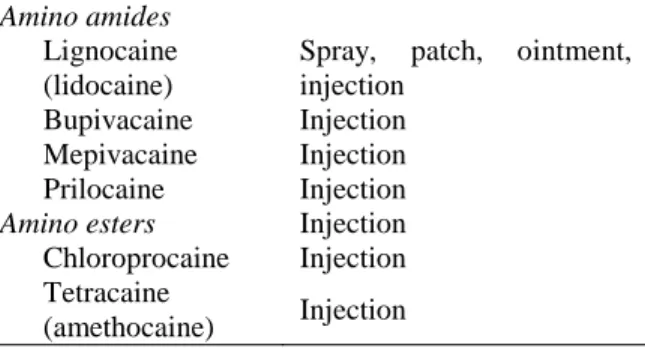
There are basically 2 classes of local anesthetics
[Table 1], the amino amides (amide ethers) and
amino esters (amine esters).5 Some of these are
available in many different formulations including topical sprays, patches, ointments and injections. Duration of action depends on the agent and formulation chosen.
Lignocaine (lidocaine) is the local anesthetic most frequently used as it is effective, acts
Table 1 Different anesthetics agents and their routes of administration.
Amino amides Lignocaine (lidocaine)
Spray, patch, ointment, injection
Bupivacaine Injection Mepivacaine Injection Prilocaine Injection Amino esters Injection Chloroprocaine Injection Tetracaine
rapidly and is relatively free from toxicity and sensitivity. It is the gold standard local anesthetic by which all other anesthetics are compared. It is also the only local anesthetic available in many different formulations. Painless dermal local anesthesia can be achieved with the topical anesthetic, eutectic mixture of local anesthetics (EMLA).6 This is a
combination of lignocaine (lidocaine) and prilocaine and comes in the form of cream or patches.7 It is particularly useful for numbing
areas that require injection, especially in children. EMLA is also used in many dermatological procedures, including curettage, split-skin grafts, and different laser techniques.8
Adrenaline (epinephrine) is sometimes added to local anesthetic formulations. It is used to:
prolong duration of anesthesia
reduce systemic absorption
reduce surgical bleeding
increase the intensity of blockade.
The following types of anesthesia are used for dermatological procedures:
I. Topical Anesthesia
Topical anesthesia refers to the modification of pain sensation or the loss of sensation caused by an agent that is applied topically to the skin. Topical anesthesia includes the administration of cryoanesthesia and the application of local anesthetic compounds, which must penetrate the epidermis to have a physiologic effect.9,10
Because the stratum corneum is an effective barrier, the delivery of anesthetics can be challenging. Recent advances in laser technology and the subsequent increase in the use of laser treatments have fueled the need for improved topical anesthetic agents and the development of such agents.
Cryoanesthesia
Cryoanesthesia refers to the external application of cold to the skin to produce numbness. Ice, refrigerant sprays, and liquid nitrogen have been used for this purpose. Ice applied directly to the site for 30-60 seconds provides superficial short-duration anesthesia that may be acceptable for quick, shave biopsy. This application is particularly useful in children or adults who have a fear of needles. Refrigerant sprays, such as ethyl chloride and dichlorotetrafluoroethane, are useful for anesthetizing superficial lesions prior to their removal. These sprays are particularly helpful for anesthetizing tumors related to molluscum prior to their curettage and cysts or furuncles prior to their incision and drainage. After a frost is produced on the skin, a 10- to 12-second period of anesthesia occurs before the skin temperature and sensation return to normal. As a result of this limited time frame, an assistant often has to spray the area while the surgeon performs the procedure.11
Topical anesthetics
Tetracaine is a long-acting ester anesthetic that can be combined with epinephrine (adrenaline) and cocaine or with epinephrine and lidocaine to form mixtures known as TAC and LET, respectively.12 TAC and LET are topical
anesthetics used widely to anesthetize lacerations before repair. They do not induce anesthesia in intact skin; therefore, their usefulness is limited. Topical lidocaine is available in a 2% or 5% concentration in a viscous or jelly formulation.13 These
anesthesia and a longer duration of action. Several studies have shown that the efficacy of these lidocaine preparations is equivalent to that of EMLA. The recommended application time for Topicaine and LMX is 30 minutes, and occlusion is not required. The maximum area of application should not exceed 100 cm2 in children and 600 cm2 in children weighing greater than 10 kg and in adults. Lidocaine iontophoresis, which delivers lidocaine into the skin under the influence of an electric current, has been shown to provide adequate anesthesia for venous cannulation and shave biopsies.14
EMLA cream (Astra USA, Westborough, Mass) is a eutectic mixture of 2.5% lidocaine and 2.5% prilocaine in an oil-in-water emulsion. This topical anesthetic cream provides adequate anesthesia for superficial curettage, dermabrasion, several laser procedures, epilation, and cryosurgery. However, EMLA does not seem to be helpful in reducing the pain associated with topical photodynamic treatment of actinic keratoses. EMLA is the most widely used topical agent and has proven efficacy based on results from several clinical trials.15 EMLA
cream must be applied directly to the surgical site and placed under occlusion for 1-3 hours. The anesthetic effects of EMLA may persist for as long as 2 hours. EMLA cream, although safe, is reported to cause systemic toxicity in children.16 In fact, both CNS manifestations and
methemoglobinemia are reported with the use of EMLA cream.17Clinicians should closely adhere
to the dosing guidelines listed in the Physicians' Desk Reference. They are as follows:
For infants aged 3 months or younger or those weighing less than 5 kg, a maximum dose of 1 g can be applied over a maximal surface area of 10 cm2.
For children aged 3-12 months and weighing more than 5 kg, a maximum
dose of 2 g can be applied over a maximal surface area of 20 cm2.
For children aged 1-6 years and weighing more than 10 kg, a maximum dose of 10 g can be applied over a maximal surface area of 100 cm2.
For children aged 7-12 years, a maximum dose of 20 g can be applied over a maximal surface area of 200 cm2.
The S-Caine Peel is a 1:1 eutectic mixture of lidocaine 7% base and tetracaine 7% base in a cream vehicle that dries to form a flexible membrane that can be easily removed. The S-Caine Peel has been shown to provide adequate anesthesia for different types of laser therapies, including laser treatment of leg veins and tattoo removal. The application time is 30-60 minutes.
II. Infiltrative anesthesia
patient discomfort. The anesthetic diffuses through the dermis with the infiltration; fortunately, this effect limits the number of needle penetrations needed to anesthetize a particular site. If additional needle sticks are needed, they should be placed in an already anesthetized area.
III. Ring block or field block
A specific type of infiltration anesthesia is the ring block or field block. To perform a ring block, the anesthetic agent is circumferentially injected around the surgical site without injecting the area to be excised. This infiltration prevents the nerve impulses from entering the area. A ring block is useful when the distortion of a surgical site due to the infiltration of anesthesia is not desired. Ring blocks allow a decreased volume of anesthetic to be used to anesthetize a larger area. When ring blocks are used, the anesthetic should be injected into both the superficial and deep planes to be maximally effective. Ring blocks are usually given for nail avulsions.
IV. Tumescent anesthesia
This is a high volume, low concentration lidocaine/epinephrine solution used by dermatologic surgeons for liposuction, ambulatory phlebectomy, hair transplantation, laser resurfacing, flaps and grafts etc.19 The
solution provides anesthesia safely, is practically painless to inject, and markedly decreases bleeding. In 1987, Jeffery Klein, a dermatologist, first created the technique of tumescent anesthesia in liposuction procedures.20
Tumescent anesthesia is based on the use of dilute solutions of lidocaine (0.05-0.1%) in large volumes to provide superior anesthesia. Epinephrine (1:1,000,000) is added for hemostasis, and the solution is buffered with
sodium bicarbonate to decrease injection discomfort. Concentrations as high as 55 mg/kg have been used safely with the tumescent technique. The use of such high total doses of anesthetic without systemic toxicity is understood. The absorption kinetics of lidocaine change when high-volume, low-concentration solutions are used. Decreased concentrations of lidocaine also result in slower plasma absorption with decreased peak plasma levels. The development of this anesthetic delivery system has revolutionized the surgical technique of liposuction.
and epinephrine (1:1,000,000) in physiologic saline, the tumescent technique produces swelling and firmness, or tumescence, of targeted fatty areas.
Recent clinical studies of the absorption pharmacokinetics of lidocaine with the tumescent technique have shown that peak plasma lidocaine levels occur approximately 12 to 15 hours after beginning the infiltration.21
This remarkably delayed absorption permits a much higher lidocaine dosage than was previously believed possible. Any reduction in a drug’s rate of systemic absorption will reduce magnitude of the drug’s peak plasma levels. The safe upper limit for lidocaine dosage using the tumescent technique has been estimated to be 35 mg/kg. This is approximately five times greater than standard lidocaine dosage limitations.22,23
Clinical local anesthesia persists for up to 18 hours, obviating the need for postoperative analgesia. The prolonged and profound anesthesia of skin and subcutaneous tissues that is provided by the tumescent technique is probably a result of exposing sufficient lengths of sensory axons to marginal blocking concentrations of lidocaine. The infiltration of a large volume of dilute epinephrine assures diffusion throughout the entire targeted area while avoiding tachycardia and hypertension. The associated vasoconstriction is so complete that there is virtually no blood loss with liposuction.24 The mechanical and
pharmacologic properties of the fluid is injected subcutaneously prevent the massive shifts of intravascular fluids which are usually seen when liposuction is done by general anesthesia. With the tumescent technique there is no longer any need to replace significant volumes of IV fluids.
Advantages of the tumescent technique
Minimal blood loss
Blood loss with liposuction is minimized by the tumescent technique. The extensive vasoconstriction produced by large volumes of dilute epinephrine 1:1,000,000 produces less than12 ml of whole blood for each liter of pure fat removed by liposuction.
Prolonged local anesthesia
Complications of local anesthetics
Although local anesthetics are relatively safe when administered properly, they have the potential to cause both regional and systemic reactions.
Local effects
Local effects are usually a result of the injection technique. These effects include pain, ecchymosis, hematoma formation, infection, and nerve laceration. Pain is always felt when a local anesthetic is injected; however, associated discomfort can be minimized by using good technique. Several factors, including needle puncture of the skin, tissue irritation resulting from the anesthetic, and distention of tissues caused by infiltration, are responsible for the discomfort associated with the use of local anesthetics. The addition of epinephrine to an anesthetic solution decreases the pH of the solution, making it more acidic (pH 3.5-4.5) and leading to a more painful injection. The solution can be neutralized by the addition of sodium bicarbonate 8.4% to minimize discomfort. For example, sodium bicarbonate 8.4% can be added to lidocaine with epinephrine in a 1:10 ratio to achieve a solution pH similar to that of tissue fluid (pH 7.3-7.4). Discomfort associated with distension of the tissues during the injection of local anesthetics is caused by the rate of injection and the volume of fluid injected. To limit the pain, the anesthetic should be slowly administered to allow the stretch receptors time to accommodate the new volume of fluid.25 In
addition, the volume of solution injected should be the smallest volume needed to achieve a loss of sensation at the surgical site. The formation of ecchymosis or a local hematoma is a result of the perforation of cutaneous blood vessels. These complications are encountered more commonly in areas of high vascularity, including the mucous membranes, head, and genitalia.
Ecchymosis and hematoma are even more pronounced when the patient has a bleeding diathesis or when the patient has been taking aspirin or other anticoagulants. If ecchymosis occurs, the patient should simply be reassured. If hematoma formation occurs, the patient should be evaluated. The hematoma may require drainage with an 18-gauge needle, followed by the application of a pressure dressing. Infection is an additional local complication of anesthetic use that usually occurs when proper sterile technique is not used. Cleansing the skin surface with alcohol is adequate in otherwise clean or noninfected areas.
Systemic effects
resulting from excessive blood levels of anesthetics is clinically manifested as adverse reactions in the CNS and cardiovascular system.26 The CNS is affected in a predictable
and dose-dependent fashion. As serum levels of lidocaine increase, effects on the CNS become more severe. Any physician who uses local anesthetics must be aware of the signs and symptoms of systemic toxicity.27 At serum
lidocaine levels in the range of 1-5 mcg/mL, patients may complain of tinnitus, lightheadedness, circumoral numbness, diplopia, or a metallic taste in the mouth. In addition, they may complain of nausea and/or vomiting, or they may become more talkative. As serum levels increase to 5-8 mcg/mL, nystagmus, slurred speech, localized muscle twitching, or fine tremors may be noticed. Patients also have been noted to have hallucinations at these levels. If blood lidocaine levels reach 8-12 mcg/mL, focal seizure activity occurs; this can progress to generalized tonic-clonic seizures. Respiratory depression occurs at extremely high blood levels (20-25 mcg/mL) and can progress to coma. If signs of CNS toxicity are noted, steps must be taken to reduce hypoxia and acidosis, because these states increase the toxicity of local anesthetics. The patient's airway should be maintained, and supplemental oxygen provided. If blood levels of carbon dioxide increase, protein binding of lidocaine decreases and results in higher levels of free lidocaine in the blood. Increased respiration and respiratory alkalosis increase the seizure threshold and decrease the uptake of the local anesthetic into the CNS. If convulsions occur, the patient's airway should be maintained, and supplemental oxygen administered.28,29 If seizure activity is
sustained, 5-10 mg of diazepam should be administered slowly (1-2 mg/min) until the seizures cease. Compared with the CNS, the cardiovascular system is less susceptible to the
effects of local anesthetics. Most adverse effects of the cardiovascular system that occur with the administration of local anesthetics are a result of the addition of epinephrine rather than direct effects of the anesthetic. However, high blood levels of local anesthetics directly reduce cardiac contractility. In addition to the direct vasodilatory effects of most local anesthetics, the decrease in cardiac function can cause hypotension. Atrioventricular blocks, bradycardia, and ventricular arrhythmias also are reported; these are more common in patients with known conduction disturbances and requiring antiarrhythmic medications.
Allergic reactions
Allergic reactions to local anesthetics are extremely rare, especially with amide local anesthetics, and account for less than 1% of the reactions caused by local anesthetics. Reactions can be type I (i.e. anaphylactic) or type IV (i.e. delayed-type hypersensitivity) reactions. These reactions are not dose related, but, rather, they are idiosyncratic. Skin prick and intradermal test results are negative in the vast majority of patients, but some authors recommend testing with the most commonly used amide local anesthetic (lidocaine).
occur with anesthetics of the amide and ester subtypes. Clinical manifestations are similar to those of allergic contact dermatitis and include erythema, plaques, and pruritus. Patients with a history of type IV reactions are not at an increased risk of type I reactions due to amide-type anesthetics. Contact dermatitis caused by topical anesthetics should be treated with topical steroid preparations.
Conclusion
Local anesthetics are vital to cutaneous surgery. They are effective, inexpensive, easily accessible, and relatively safe. Any surgeon using these agents should be aware of the proper technique for their use and the potential adverse effects.
References
1. Covino BG, Vassallo HG, eds. Local Anesthetics: Mechanisms of Action and Clinical Use. New York: Grune and Stratton; 1976. pp105-106.
2. De Jong RH. Toxic effects of local anesthetics. JAMA. 1978;239:1166-8. 3. Braid DP, Scott DB. The systemic
absorption of local analgesic drugs. Br J Anaesth. 1965;37:394-404.
4. Amin SP, Goldberg DJ. Topical anesthetics for cosmetic and laser dermatology. J Drugs Dermatol. 2005;4:455-61.
5. Railan D, Alster TS. Use of topical lidocaine for cosmetic dermatologic procedures. J Drugs Dermatol. 2007;6:1104-8.
6. Maunuksela EL, Korpela R. Double-blind evaluation of a lignocaine-prilocaine cream (EMLA) in children. Effect on the pain associated with venous cannulation. Br J Anaesth. 1986;58:1242-5.
7. Bucalo BD, Mirikitani EJ, Mov RL. Comparison of skin anesthetic effect of liposomal lidocaine, nonliposomal lidocaine, and EMLA using 30-minute application time. Dermatol Surg. 1998;24:537-41. 8. Arendt-Nielsen L, Bjerring P. Laser-induced
pain for evaluation of local analgesia: a comparison of topical application (EMLA)
and local injection (lidocaine). Anesth Analg. 1988;67:115-23.
9. Huang W, Vidimos A. Topical anesthetics in dermatology. J Am Acad Dermatol. 2000;43:286-98.
10. Adriani J, Dalili H. Penetration of local anesthetics through epithelial barriers. Anesth Analg. 1971;50:834-41.
11. Kundu S, Achar S. Principles of office anesthesia: part II.Topical anesthesia. Am Fam Physician. 2002;66:99-102.
12. Covino BG. Pharmacology of local anaesthetic agents. Br J Anaesth. 1986;58:701-16.
13. Benowitz NL, Meister W. Clinical pharmacokinetics of lidocaine. Clin Pharmacokinet. 1978;3:177-201.
14. Boyes RN, Scott DB, Jebson PJ. Pharmacokinetics of lidocaine in man. Clin Pharmacol Ther. 1971;12:105-16.
15. Hernandez E, Gonzalez S, Gonzalez E. Evaluation of topical anesthetics by laser-induced sensation: comparison of EMLA 5% cream and 40% lidocaine in an acid mantle ointment. Lasers Surg Med. 1998;23:167-71.
16. Kaweski S. Topical anesthetic creams. Plast Reconstr Surg. 2008;121:2161-5.
17. Hahn IH, Hoffman RS, Nelson LS. EMLA-induced methemoglobinemia and systemic topical anesthetic toxicity. J Emerg Med. 2004;26:85-8.
18. Goodwin DP, McMeekin TO. A case of lidocaine absorption from topical administration of 40% lidocaine cream. J Am Acad Dermatol. 1999;41:280-1.
19. Klein JA. Anesthesia for liposuction in dermatologic surgery. J Dermatol Surg Oncol. 1988;14:1124-32.
20. Klein JA. The tumescent technique for lipo-suction surgery. Am J Cosmet Surg. 1987;4:263-7.
21. Lillis PJ: Liposuction surgery under local anesthesia: Limited blood loss and lidocaine absorption. J Derm Surg Oncol. 1988;14:1145-8.
22. Klein JA. Tumescent technique for regional anesthesia permits lidocaine doses of 35 mg/kg for liposuction: Peak plasma lidocaine levels are diminished and delayed 12 hours. J Dermatol Surg Oncol. 1990;16:248-63.
24. Mehra P, Caiazzo A, Maloney P. Lidocaine toxicity. Anesth Prog. 1998;45:38-41. 25. De Jong RH, Ronfield RA, DeRose RA.
Cardiovascular effects of convulsant and supraconvulsant doses of amide local anesthetics. Anesth Analg. 1982;61:3-9. 26. De Jong RH, editor. Local Anesthetics, 2nd
ed. Springfield: IL Charles, C Thomas; 1977. pp 187-188.
27. Friedman PM, Mafong EA, Friedman ES, Geronemus RG. Topical anesthetics update: EMLA and beyond. Dermatol Surg. 2001;27:1019-26.
28. Jackson T, McLure HA. Pharmacology of local anesthetics. Ophthalmol Clin N Am. 2006;19:155-61.
29. Kaweski S. Topical anesthetic creams. Plast Reconstr Surg. 2008;121:2161–5.