Address for correspondence Dr. S C Murthy
Department of Dermatology, Venereology & Leprosy, Government Medical College (VIMS), Bellary, Karnataka, India.
Email: [email protected]
Original Article
Genital Herpes: A clinical and seroepidemiological
study of patients attending a sexually transmitted
diseases clinic in South India
Introduction
Genital herpes (GH) is one of the world’s most prevalent sexually transmitted infections (STI).
GH typically occurs due to herpes simplex virus (HSV)-2 although HSV-1 is recently emerging as a potential cause for GH. It is commonly present in adolescents. Despite increased awareness of HSV-l & 2 as sexually transmitted
pathogens, GH infections are often
misdiagnosed / underdiagnosed. In over half of horizontal transmission events and 70% of vertical transmission events, the source contact
DR Shivanand, SC Murthy*, TY Raghu*
Department of Dermatology,Venereology & Leprosy. SIMS & RH, Tumkur, Karnataka. * Department of Dermatology,Venereology & Leprosy, VIMS, Bellary, Karnataka.
Abstract
Background Genital herpes has been emerging as one of the leading cause of sexually transmitted infections. Serology has an important role in the diagnosis of genital herpes. Our objective was to know the hospital based prevalence, other epidemiological parameters, co-infections and serological utility in genital herpes.Methods This was a cross-sectional, descriptive study of patients attending sexually transmitted diseases clinic of our hospital. A total of 820 consecutive patients of both the sexes attending the clinic over a period of 18 months, were screened for the features of genital ulcer disease. Among 128 patients with genital ulcer disease, 76 clinically suspected with genital herpes were subjected to serology.
Results The hospital based prevalence of genital herpes among sexually transmitted diseases patients and genital ulcer disease was 9.3% and 59.4% respectively. Males were predominantly affected. Maximum prevalence, 30 (39.5%) patients was seen in the age group of 30-39 years. Sixty (78.9%) were married, 58 (76.3%) belonged to lower class. Among women, majority of them were housewives. Among patients with genital herpes, 22 (28.9%) had primary disease, while 54 (71.1%) had recurrent disease. Common clinical features were only erosions in 24 (31.6%), erosions with crusting, 24 (31.6 percent). Herpes simplex virus (HSV) 1 and 2 coexistence was seen in 34 (44.7%), followed by HSV 2 alone 26 (34.2%) and HSV 1 in 10 (13.2%) of patients. Serological reactivity for HIV I and II in 24 (31.6%), syphilis in 10 (13.2%) and HbsAg in 4 (5.3%) were seen. Polymerase chain reaction for HSV was positive in 38 (50%), of patients.
Conclusion The hospital based prevalence of genital herpes among STD patients was 9.3 percent. Lower socioeconomic status, illiteracy and number of sexual partners may contribute to the higher incidence of genital herpes. Serology can be used in adjunct to clinical examination and the diagnosis can be confirmed by specific polymerase chain reaction.
Key words
is unaware of being infected. Only limited data on the seroprevalence of HSV-2 are available.1,2 Previous epidemiological studies of HSV-2
infection have been hampered by the
nonspecificity of serologic assays, which do not
clearly differentiate HSV-1 and HSV-2
infections because of common antigen
reactivity. Recently, HSV-2 type-specific
serologic assays have been developed. Detection of type-specific HSV-2 antibodies almost exclusively indicates a genital infection because HSV-2 oral infection is rarely seen in the absence of genital infection, and HSV-2 seropositivity in adults from neonatal or
nosocomial HSV-2 infections are rare.
Therefore, HSV-2 seroprevalence can be used as a marker of genital herpes. The magnitude of the
problem of GH in adolescents is
underappreciated and silently spreads the disease. We conducted this study to find the prevalence of HSV-2 infection in a group of sexually transmitted diseases (STD) clinic
attendees using a reliable type-specific
immunoassay.
Methods
A cross-sectional, descriptive study of patients attending STD clinic in our hospital was conducted. Sexually active male and female patients presenting with complaints of genital ulcer/ lesions suggesting GH with high risk behavior were included. A total of 820 patients were screened over a period of 18 months, among whom 128 had Genital Ulcer disease (GUD). Seventy six clinically suspected with GH were subjected to serology.
Detailed history, clinical examination, routine hematological, urine, biochemical tests, Rapid Plasma Reagin (RPR) were done. Tzanck smear, Blood Venereal Disease Research Laboratory
test (VDRL), Treponema pallidum
hemagglutination assay (TPHA), serology for
HSV 1 and 2, IgM and IgG (Noatec,
Immundiagnostic, GMBH), human
immunodeficiency virus (HIV) I & II (Tridot, Capillus, HIV comb), HbsAg (ERBA LISA Hepatitis B from Transasia Bio Medical Ltd. Damn) and antibodies to hepatitis C virus
(HCV) using SPN ANBASE – C-90, 30.6, 3rd
generation EIA kit were also done. Polymerase chain reaction (PCR) was done to all GUD patients. The data was entered into a proforma and tabulated for various parameters like age distribution, sex ratio and others. Statistical analysis was done using Chi-square test wherever applicable.
Results
Among 820 patients screened, 538 (65.6%) were males and 282 (34.4%) were females with a male to female ratio of 1.9:1. The overall prevalence of genital herpes among the STD patients was 9.3%. Among patients with GUD, GH contributed 59.4% with males 52 (68.4%) and females 24 (31.6%) of cases. Majority of the patients, 30 (39.5%) belonged to the age group of 30-39 years. Most i.e. 40 patients (52.6%) attained sexarche between 15-19 years. The mean age of sexarche for males was 20.4 years and for females was 16.8 years. Most 60(78.9%) were married. Widows and unmarried patients constituted 16 (10.53%) each. Illiterates, 52 (68.4%) were more common compared to literate 24 (31.6%) patients. Majority were housewives 26 (34.2%), followed by drivers, 22
(28.9%), farmers, 10 (13.2%), coolie,
Figure 1 Grouped vesicles over shaft of the penis
Figure 2 Erosions, vesicles and crusted lesions over penis
Figure 3 Grouped erosion over glans penis
14 (18.4%) and middle class 04 (5.3%), based on Prasad classification. The Mean age of onset of GH was 28 years for males and 38.1 years for females. Patients had different stages of GH at
presentation (Figures 1-3). Pattern of clinical
lesions is shown in Table 1.
Majority of the patients had heterosexual preference. Only two male patients had homosexual practice i.e. active participant (penetrative). They had recurrent GH with serological positivity for IgM HSV 1, IgG HSV 1 and 2. Thirty two patients had regular partner and were also symptomatic.
The proportion of primary cases among the total cases was more in males than females.
The proportion of recurrent GH among the total cases was more in females than males.
However difference was statistically not significant, the primary and recurrent genital herpes among males and females are depitected in Table 2.
Among patients with recurrent GH, 44 patients (81.5%) had 1 to 5 recurrences/ year. However only 10 (18.5%) had more than 5 recurrent episodes/year. Among 76 patients, 22 (28.9%) presented as primary episode. Most of the men, 50 (96.2%) were uncircumcised and had more recurrences. Out of 24 female patients 6 (25%) had vaginal discharge syndrome.
Table1 Pattern of clinical lesions Type of lesions No of
patients
Percentage
Vesicular 4 5.3
Only Erosions 24 31.6
Only Crusting 12 15.8
Vesicular with erosions 10 13.2 Erosions with crusting 24 31.6 Crusting with
re-epithelization
2 2.6
Table 2 Sex distribution of primary and recurrent genital herpes
Sex Primary cases Recurrence cases
Male 14 38
Female 08 16
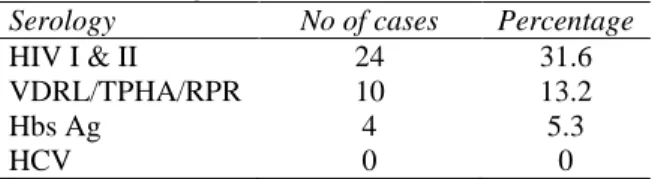
Table 3 Serological tests for other STI
Serology No of cases Percentage
HIV I & II 24 31.6
VDRL/TPHA/RPR 10 13.2
Hbs Ag 4 5.3
HCV 0 0
Cervical erosions were seen in them.
Lymphadenopathy was seen in 18 (23.7%) patients, with recurrent attacks. None of the patients with primary GH had lymphadenopathy.
Tzanck smear was done in all 128 patients with GUD. Among the 76 patients clinically suspected with GH, 8 (10.5%) showed multinucleated giant cells.
Among the primary cases, highest number of cases were seropositive for HSV 2 in 8 (36.4%) and 8 (36.4%) were also positive for both HSV 1 and 2. HSV 1 positivity was seen in 18.2%. Among the recurrent cases, highest number were found to be seropositive for both HSV 1 and 2 (48.2%) while HSV 2 alone in 33.3% and HSV 1 in 11.1%. Overall, highest infections were caused by co-infections with both HSV 1 & 2 (44.7%) followed by HSV-2 (34.2%), HSV 1 alone in 13.2%. The remaining cases (7.9%)
were serologically negative infections.
Serological tests for other STI’s are shown in Table 3.
Discussion
Genital Herpes (GH) is the commonest and emerging cause of GUD in STD clinics. We found a prevalence of 59.4% of GH among GUD patients. In western countries, GH accounts for 20%-50% of cases of GUD.1,2 Prevalence of GH among overall STD patients in our study was 9.3%. In previous Indian studies3 the reported prevalence range in between 4.9% to 17.3%, which is in accordance with our study. However, studies have shown steady increase in the incidence of genital herpes.
Majority of our patients belonged to the age group 20-49 years similar to studies which have shown the highest rate of acquisition of GH in between 15-40 years.4 This may be due to the high sexual activity in this age group.
Males were presently affected in contrast to earlier studies that showed females to have higher seroprevalence4. This could be due to
symptomatic presentation in males,
asymptomatic shedding in females5 and lack of awareness. The mean age for males in our study was 35.4 years and females 32.5 years. This is in concordance with the fact that the highest age of presentation is in between 15-40 years. Maximum prevalence was seen in reproductive age group in concordance with earlier studies.4
The highest prevalence of GH (52.6%) was seen among the patients who had their sexual debut in early age between 15-19 years. Majority of them were found to be associated with HSV-2. However, similar study showed no association
between married females and HSV-2
prevalence. This distribution discrepancy could
possibly be related to the changing
epidemiological trends in STI. Majority of the patients (78.9%), with GH were married, while widowed and unmarried were found to be 10.5% each. We found high risk behavior among the married than unmarried. This may be due to the extramarital high risk behavior, lack of fear among the married. Obasi et al.6 and found HSV-2 prevalence to be higher in married women and men than unmarried. In our study, male patients had multiple partners. Polygamy has been found to be one of the risk factors associated with increased seroprevalence of
HSV-26, while another study found no
association between polygamy and HSV-2 prevalence in women.7
to be inversely related to the level of education in both sexes. However, age adjustment removed this in women and reversed in men although they were statistically insignificant. This may be due to lack of awareness and ignorance of consequences. We found majority of patients with GH to be housewives followed by drivers, farmer and others. Obasi et al. 6 found seroprevalence to be highest in female
farmers followed by students, manual
workers/office/ business. They also found that occupation was not significantly associated with HSV-2 prevalence in both sexes.
We found higher seroprevalence among men with history of exposure to CSW similar to earlier studies.8 Van de Laar et al. also found higher prevalence of HSV 2 antibodies among CSW compared to non CSW although it was not significant.
Majority of our patients belonged to lower socioeconomic status followed by lower middle class and middle class similar to study done by Stavrakv et al.9 This may be due to the fact that people belonging to lower socioeconomic status have got less recreation facilities and are more prone to seek other reachable recreations, resulting in high risk sexual behavior.
We found higher prevalence of HSV 2 in heterosexuals, in contrast to western countries where homosexuals are commonly affected.8 This is probably due to sexual preference trends prevalent in our country. Mean number of sexual partners for males were, 7-27 and females 1.1 and was statistically significant. An association between HSV-2 infection and reported sexual behavior has been noted. HSV-2 infected persons are more likely to have multiple sex partners and trend for increased presence of infections with increase in number of life-time partners were statistically significant for both sexes. We found an early age of onset in males
possibly due to their premarital high risk behavior while women had late onset acquisition after marriage, from their partners.
In our study, proportion of primary cases were more for males, however in recurrent cases it was more for females. Recurrent episodes are more common in males but painful in females.2 Role of circumcision in the acquisition of STDs is controversial. There are both supportive6 and lack of protection10 for circumcision in the acquisition of HSV and other STDs. Similar to Obasi et al;6 our sample size was small and there were only two patients who had undergone circumcision. Hence, it is difficult to comment regarding the protective role of circumcision.
Although in recurrent episodes, inguinal lymphadenopathy is usually absent, we found a
few recurrent cases associated with
lymphadenopathy. This may be possibly due to the associated conditions like HIV, secondary infections, walking bare footed and other unrelated causes.
The sensitivity of Tzanck smear is about 50%-60%2 and is highest in early lesions. The Tzanck test is not reliable for providing a conclusive diagnosis of herpes infection and is not recommended by the centers for disease control and prevention. In our study, Tzanck smear positivity was low, probably due to the late presentation. Cervical ulcerative lesions are common and are almost always associated with first episodes disease. It can also be associated with vaginal discharge. In our study we found
cervical erosions and vaginal discharge
syndrome in 25% of patients. Two of them had primary GH, while four had recurrent GH.
women and 1% men who were TPHA and RPR positive. Seropositivity for syphilis i.e. (RPR/TPHA) and HSV 2 has been found to be associated with the number of lifetime partners,
prevalent HIV infection and HIV
seroconversion. This difference may be due to the smaller sample size in our study. The discrepancies in the serological findings could be due to the false positive VDRL and RPR test.
We found co-existent HIV I and II infection in 31.6% of patients. Ahmed et al.13 in a study conducted in two different places found the co-infection in 71% and 46% respectively. GH has been reported to be a significant cofactor in the transmission of HIV. The relative risk for HIV seroconversion among GH varies from 1.2 to 8.5. A higher risk of recent herpes (relative risk 8.3) in HIV seropositive women is found. Our study had similar findings. The association is significant as various atypical presentations of GH, prolonged course and drug resistance can occur.14 HbsAg seroprevalence was found in a few patients and HCV in none. HIV and HCV are thought to be transmitted with subclinical genital erosion. Transmission of HbsAg in our patients might have occurred by similar route, although other modes of transmission cannot be ruled out.
Ahmed et al.13 found 27.1% of persons more than 12 years of age to be HSV seropositive. 51% were positive for HSV 1 only, 5.3% for HSV-2 and 16.6% with co-infection. We found half of the patients with co-infection by both HSV 1 & 2 similar to Xu et al.15 We found the changing trends in GH with predominate co-infection with HSV 1 and 2. Co-co-infection with both the types may have partial protective effect against each other as suggested earlier.13,15
Limitations in our study were, our sample size was small and we could not do case control study.
In conclusion, the hospital based prevalence of GH was 9.3% with male predominance. Factors influencing acquisition and recurrences include multiple sexual partners, sexarche at younger age, illiteracy and lower socio-economic status. GH may act as a cofactor in the transmission of HIV. Since majority of the patients had antibodies to both serotypes, serology alone cannot be taken as a diagnostic method. It can be used as an adjunct to clinical examination, for the diagnosis and confirm the diagnosis by specific PCR. Awareness, education and counseling to the risk population helps in controlling the rapidly spreading viral sexually transmitted infections.
References
1. Corey L, Holmes KK. Genital herpes simplex virus infections: current concepts in diagnosis, therapy and prevention. Ann Intern Med 1983; 98: 973-83.
2. Karn D, Amatya A, Aryal ER et al. Prevalence of sexually transmitted infections in tertiary care centre. Kathmandu Univ Med J 2011; 34: 44-8.
3. Kumar B, Gupta S, Sahoo BL. Epidemiology of genital herpes: Current concepts. Indian J Sex Transm Dis 2001; 22: 2-4.
4. Gilson RJ, Mindel A. Recent advances: sexually transmitted infections. BMJ 2001; 322: 1160-4.
5. Brock BV, Selke S, Benedetti J, et al. Frequency of asymptomatic shedding of herpes simplex virus in women with genital herpes. JAMA 1990; 263: 418-20.
6. Obasi A, Mosha F, Quigley M, et al. Antibody to herpes simplex virus type 2 as a marker of sexual risk behavior in rural Tanzania. J Infect Dis 1999; 179: 16-24. 7. Shaw M, van der Sande M, West B, et al.
Prevalence of herpes simplex type 2 and syphilis serology among young adults in a rural Gambian community. Sex Transm Inf 2001; 77: 358-65.
9. Stavraky KM, Rawals WE, Chiavetta J, et al. Sexual and socialeconomic factors affecting the risk of past infections with herpes simplex virus type 2. Am J Epidemiol 1983; 118: 109-21.
10. Bassett I, Donovan B, Bodsworth NJ, et al. Herpes simplex virus type2 infection of heterosexual men attending a sexual health centre. Med J Aust 1994; 160: 697-700. 11. Scoular A, Gillespie G, Carman WF.
Polymerase chain reaction for genital herpes in a genitourinary medicine clinic. Sex Transm Infect 2002; 78: 21-25.
12. Safrin S, Shaw H, Bolan G, et al. Comparison of virus culture and the polymerase chain reaction for diagnosis of
mucocutaneous herpes simplex virus infection. Sex Transm Dis 1997; 24: 176-80. 13. Ahmed HJ, Mbwana J, Gunnarsson E, et al. Etiology of genital ulcer disease and association with human immunodeficiency virus infection in two Tanzanian cities. Sex Transm Dis 2003; 30: 114-9.
14. Sardana K, Sehgal VN. Genital ulcer disease and human immunodeficiency virus: a focus. Int J Dermatol 2005; 44: 391-405. 15. Xu F, Schillinger JA, Sternberg MR, et al.