Address for correspondence Dr. Selviana
Health Science Faculty, Universitas, Muhammadiyah Pontianak, Indonesia. Email: [email protected]
Original Article
Trichophyton concentricum as a cause of tinea
imbricata
Introduction
Tinea imbricata is a recurrent chronic dermatophytosis caused by Trichophyton concentricum.1 Clinical features include papulosquamous lesions, with the stratum corneum arranged like a tile.2,3 This disease was found in isolated area in the Pacific, Oceania, East Asia, Central Asia, Mexico, Central and South America. It was first reported on Philippine island of Mindanao in 1789. Tinea
imbricata is endemic in certain areas, including Papua, Sulawesi, Sumatra and the central islands of Eastern Indonesia.1,4 In West Kalimantan, it is endemic in Teluk Pongkal Village, Melawi Regency, the number of cases is 40-90 cases per year.5
In West Kalimantan, Gold mining workers are generally illegal who are vulnerable to T. concentricum infection. They have low level of education, poor socio-economics, and less knowledge regarding occupational health and safety.6 There could be a potential transmission of Tinea imbricata that is commonly found in land contact workers. T. concentricum is an anthropophilic fungus that causes chronic non-Selviana, Indah Budastutik, Mirto, Linda Suwarni
Health Science Faculty, Universitas Muhammadiyah Pontianak, Indonesia.
Abstract
Background Tinea imbricata is a recurrent chronic dermatophytosis caused by Trichophyton concentricum. In West Kalimantan, Indonesia, this disease is endemic and only occurs in Teluk Pongkal Village, Melawi Regency. There is no known presence of T. concentricum as the trigger factor for the occurrence of Tinea imbricata yet. This study aims to analyze the presence of T. concentricum fungi in the environment around the house and the relationship of employment with a history of transmission of Tinea imbricata in Teluk Pongkal Village, Sokan District, Melawi Regency.Methods This research was observational with cross sectional approach. A sample of 31 incidences of Tinea imbricata in August 2016. Macroscopic and microscopic methods were used for identification of T. concentricum. Data analysis used the Fisher's Exact Test (α = 0.05).
Results The study showed that T. concentricum fungi were found on towels (45.2%), bed sheets (41.9%), and indoor air (38.7%). The presence of the T. concentricum on the towel (p = 0.031; PR = 3.238), bed sheets (p = 0.021; PR = 3.692) and indoor air (p = 0,007; PR = 4.222 95%) were significantly associated with a history of transmission of Tinea imbricata. Illegal gold miners are at risk for the occurrence of Tinea imbricata.
Conclusion T. concentricum was found on towels, bed sheets, and indoor air. It was greater in patients with a history of transmission of Tinea imbricata .
Key words
inflammatory T. corporis. It is characterized by a concentric ring7 and originate from sufferers of Tinea imbricata and is transmitted by contact for 2-5 years repeatedly.3
T. concentricum is easily transmitted to equipment used together, such as towels, spray, shoes, clothing, etc.8 However, this research is still limited. Thus, the aim of this study was to analyze the presence of T. concentricum fungi in the environment around the house (including towels, bed sheets, and indoor air) and the relationship of employment with a history of transmission of Tinea imbricata in Teluk Pongkal Village, Sokan District, Indonesia
Methods
Subject The subjects of this study were incidences of Tinea imbricata who were recorded at the Sokan Community Health Center in August 2016, comprising 31 patients.
Measured Parameter The measured variables were the presence of T. concentricum on towels, bed sheets, and respondent's employment. Meanwhile, the dependent variable is a history of transmission of Tinea imbricata.
Laboratory examination A microscope, glass object, glass cover, petri dish, round needle, desiccator, sterile swab, 100 ml glass beaker, hot plate, stirring rod, pH meter, autoclave, dropper pipette, test tube, cotton, and newspaper were used to examine the fungi. While the materials used included the medium SDA (Sabouraound Dextrose Agar), aqudest sterile, 10% KOH, HCl, and NaOH.
The fungi samples on towels and bed sheets was taken by a sterile swab and indoor air by placing the media in the house for 15 minutes. Furthermore, macroscopic and microscopic methods were used.
Ethics This research has been approved by research ethics committee Faculty of Health Science, Universitas Muhammadiyah Ponianak, Indonesia
Statistial analysis Fisher’s Exact Test was used with α=5%.
Results
The characteristics of respondents can be seen in Table 1 which showed that Tinea imbricata in Teluk Pongkal Village occurs at all ages, from children to adults, with the largest proportion at the age of 16-45 years, male sex, and low educated. Tinea imbricata generally involves 60% of the body surface area and is more dominant on the legs, arms, and body (Figure 1).
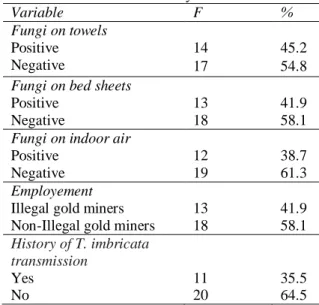
Table 2 shows that T. concentricum fungi is found in towels, on the bed and indoor air. Most of patients were illegal gold miners, and history of Tinea imbricata.
Based on Table 3, the proportion of positive T. concentricum found on towels, bed sheets, and indoor air tends to be greater in patients with a history of transmission of Tinea imbricata than with no history of transmission. The Fisher's Exact Test showed a relationship between T. concentricum on towels, bed sheets and indoor air with a history of Tinea Imbricata in Teluk Pongkal Village, Sokan District, Melawi Regency.
Table 1 The characteristics of respondents
Variable F %
Age
9-15 years old 16-45 years old 46-65 years old
5 22 4
16.1 71.0 12.9 Gender
Male 24 77.4
Female 7 22.6
Level of education
Elementary school 11 35.5
Junior high school 8 25.8
Senior high school 12 38.7
Table 2 Existence of T. concentricum and Tinea imbricata Transmission History
Variable F %
Fungi on towels
Positive 14 45.2
Negative 17 54.8
Fungi on bed sheets
Positive 13 41.9
Negative 18 58.1
Fungi on indoor air
Positive 12 38.7
Negative 19 61.3
Employement Illegal gold miners Non-Illegal gold miners
13 18
41.9 58.1 History of T. imbricata
transmission
Yes 11 35.5
No 20 64.5
Table 3 Relationship between The Presence of T. concentricum, Employment, and Tinea imbricata Transmission History
Variable
Transmission History of Tinea imbricata
Total
PR
95% CI p value
Ada Tidak ada N %
n % n %
Fungi on towels
Positive 8 57.1 6 42.9 14 100 3.238 (1.054-9.950) 0.031
Negative 3 17.6 14 82.4 17 100
Fungi on bed sheets
Positive 8 61.5 5 38.5 13 100 3.692 (1.206-11.303) 0.021
Negative 3 16.7 15 83.3 18 100
Fungi on indoor air
Positive 8 66.7 4 33.3 12 100 4.222 (1.388-12.848) 0.007
Negative 3 15.8 16 84.2 19 100
Employment Illegal gold miners Legal gold miners
6 5
46.2 27.8
7 13
53.8 72.2
13 18
100 100
1.662 (0.644-4.290) 0.449
Discussion
Tinea imbricata occurs mostly at the age of 16-45 years (productive age) and more in male gender and low level education. In line with previous research our study showed that Tinea imbricata occurs mostly in males of productive age.6 In general, Tinea imbricata sufferers come from low socioeconomic, low education, and poor hygiene.9
T. concentricum proliferation as a disease agent for tinea imbricata can be transmitted due to direct contact such as shaking hands and sleeping together in one bed. Indirect transmission occurs through objects such as clothing, towels, bed sheets, pillows, mats and others. Displacement from underwear and bed sheets occurs when the objects are contaminated by untreated patients.10 In this study, T. concentricum was found in towels, bed sheets, and indoor air which became the medium for the spread of T. concentricum fungi from patients to others. Direct contact with the patient's skin can cause the movement of fungi to the intermediary medium. When contact occurs with media contaminated with fungi, it has the potential to infect other people's skin. This indicates that people had a low personal hygiene, such as not washing towels regularly, not drying towels after use and sharing towels. In addition, people also rarely wash the bed sheets and use the same bed as Tinea imbricata sufferers. This is what causes the fungus T. concentricum to easily breed on the bed and infect other family members. The findings of this study reinforce previous research which stated that transmission of T. concentricum and the incidence of skin diseases are closely related to poor personal hygiene.
4,11-14
The home environment is very influential on the spread of skin diseases, especially those caused by fungi.15
Another finding from this study is presence of T.
concentricum in indoor air. This reinforces previous research. Fungi in the air pose a serious threat to public health.16 The environment around home has the potential for fungi breeding, such as high humidity, lack of lighting and ventilation in the house. Efforts that can prevent the proliferation of fungi in the air e.g. sufficient sunlight. Sunlight has a deadly microbial activity (or disinfection). The nature of heating and drying from sunlight also has the effect of affecting microbial growth and metabolism.17 Thus, the community is expected to maintain the air quality of the house by making adequate ventilation for air circulation, opening the window in the morning so that the humidity and lighting in the house can be optimal.
In this study, it was found that illegal gold miner tended to have a greater history of transmission of Tinea imbricata. Gold miners are at risk because they carry out activities from morning to evening on the river to search for and sort out golden seeds, contact with soil and water, and are always exposed to sunlight to make it easier for workers to sweat, and facilitate fungi to multiply. This finding broadens previous research that skin conditions that are hot, high humidity, trauma, excessive sweating, maceration, and poor hygiene are important factors in the clinical development of dermatophytosis.4,11,14,18.
Conclusion
Tinea imbricata is more commonly found in illegal gold miners. The presence of the T. concentricum was found to be greater in patients with a history of transmission of Tinea imbricata, which was found in towels, bed sheets, and indoor air.
funded this research in the Research grant in 2016.
References
1. Djuanda, A, Hamzah M, Aisah S, Editor Ilmu penyakit Kulit dan Kelamin Edisi Kelima. Jakarta : Balai penerbit FKUI, 2007; 89-105.
2. Burns, Carrick., Valentine, Johannah. 2016. Tinea Imbricata. NEJM 2016; 375.
3. Bonifaz, Alexandro MB; Archer-Dubon, Carla MD; Saul, Amado MD. Tinea imbricate or Tokelau. Int J Dermatol 2004; 43(7): 506-10.
4. Budimulja U. TineaImbricata. Dalam: Budimulja U, Kuswadji, Brahmono K, dkk. Editor Dermatomikosis superficialis : Pedoman untuk dokter dan Mahasiswa Kedokteran. Jakarta: Balai Penerbit FKUI, 2004 ; hal. 36-9.
5. Puskesmas Sokan, 2016. Profil Puskesmas Sokan Tahun 2016.
6. Gerry. 2013. Distribution Of Imbrikata Tinea Disease Patients Based On Sociodemography And Clinical Conditions In The Sokan Sub-District Village, Melawi District, West Kalimantan Province, 2010. Jurnal Mahasiswa PSPD FK Universitas Tanjungpura.
7. Marc Pihet, Hugues Bourgeois, Jean-Yves Mazière, Alain Berlioz-Arthaud, Jean-Philippe Bouchara, Dominique Chabasse. 2018. Isolation of Trichophyton concentricum from chronic cutaneous lesions in patients from the Solomon Islands. The Journal of Pediatric. Vol 102 No 4 Hal 389-393.
8. Blanka Havlickova Viktor A. Czaika Markus Friedrich. 2008. Epidemiological trends in skin mycoses worldwide. Mycoses Journal. Volume 51, Issue s4. Page 2-15. 9. Bramono K. Chronic recurrent
dermatophytosis in the tropics: Studies on
tinea imbricate in Indonesia. Korean J Med Mycol. 2012; 17: 1-7.
10. Hasanah, Uswatun. 2017. Mengenal Aspergillosis, Infeksi Jamur Genusaspergillus. Jurnal Keluarga Sehat Sejahtera Vol. 15 No 30 Desember 2017 11. Johan, Reyshiani. 2016. Tinea Imbricata.
Laporan Kasus CDK 245 Vol 243 No. 10 Tahun 2016.
12. Parman., Hamdani., Rachman, Irwandi., Pratama, Angga. 2017. Faktor Risiko Perorangan Santri Terhadap Kejadian Penyakit Kulit Skabies di Pesantren Baqiyatushalihat Tanjung Jabung Barat Tahun 2017. Jurnal Ilmiah Universitas Batanghari Jambi Vol.17 No.3 Tahun 2017. 13. Yahya, Husein. 2017. Knowledge,
perception, and practice of patients about pityriasis versicolor in Kaduna, North Central Nigeria. International Journal Of Dematology. Vol 56 No 11 Tahun 2017. 14. Schieke SM, Garg A. Superficial fungal
infection. In: Wolff K, Goldsmith LA, Katz SI, Gilchrest BA, Paller AS, Leffel DJ, editors. Fitzpatrick’s dermatology in general medicine. 8th ed. New York: McGraw-Hill Companies Inc; 2012. p. 2277-97.
15. Ayanbimpe GM, Taghir H, Diya A, Wapwera S. 2008. Tinea capitis among primary school children in some parts of central Nigeria. Mycoses Journal. Vol 51 No 4.
16. Khan A.A.H., Karuppayil. S.M,2012. Fungal Pollution of indoor environments and its management. The Saudi Journal of Biological Sciences Vol.19 : 405-426. 17. Irianto, C.H., 2006, Studi Optimasi Sistem