Two Models of Teaching Content Methods Courses for
Prospective Elementary Teachers in one Texas Regional University
Karen E. McIntush
Texas A&M University, [email protected]
Sylvia Taube
Sam Houston State University, [email protected]
Abstract
This study compared two different models of teaching pre-service elementary teachers during their content methods semester focusing on best teaching practices in mathematics, science and social studies. One involved one instructor teaching three content courses in an integrated manner; the other involved multiple instructors teaching their areas of “expertise”. Two years
of data were collected and analysed using multiple variables including performance on standardized teacher certification examinations and formal observations from teacher-mentors and student teaching supervisors. Comparing group weighted mean values on student teaching evaluations and passing rates on the state teacher certification examinations indicated the “content-expert” group and the “integrated” group did not differ on these quantitative measures. Responses to an online survey using a focus group of 38 teacher candidates revealed distinct difference in responses to the open-ended questions. Implications suggest the importance of developing pedagogical content knowledge as well as meeting the social, emotional, and “safety” needs of prospective teachers while they are still in training.
Specific actions taken to restructure the teacher preparation program are discussed. Insights from this action research may prove beneficial to those engaged in designing or restructuring teacher-preparation programs.
Introduction
What knowledge base should elementary teachers possess and how should they learn this in the teacher preparation programs? This question addressed decades ago, continues to elude teacher educators. One of the areas in teacher preparation that needs further exploration involves systems to deliver the content methods in the elementary education program. Should the content methods courses (mathematics, science, social studies, etc.) be taught in a block and by whom? Facing teacher educator shortage in STEM areas and challenges in scheduling classes at the undergraduate level, academic departments are resolved to find efficient and effective ways of preparing future teachers to teach the content areas, especially those included in the state standardized examinations for students in third through fifth grade.
Two models have been used at a regional Texas university from a content-focused approach, allowing teacher candidates more specialization in their teaching to a more integrated approach similar to those seen in a self-contained classroom, where one teacher teaches all subjects to their students. In an effort to determine which of the two models more effectively prepared prospective teachers for their student teaching experience and beyond, this research study was conducted in order to ensure candidates experience research-based pedagogy as well as pedagogical content knowledge (PCK) that are much needed in the public-school classroom.
Review of Literature
While the literature on preparing teachers seems robust, little consensus has been reached. The Committee on the Study of Teacher Preparation Programs in the United States (2010) noted the lack of clarity about what works in teacher education curriculum. According to Darling-Hammond (2016) we must try to understand the complexity of teaching. Ball and Forzani (2010, p. 8) strongly assert that teacher preparation programs should not rely on “untested approaches” or rely on experience and common sense which can be detrimental.
We must ensure that new teachers have the required professional skills, dispositions, and competencies that allow them to feel confident and competent in their job.
Teacher educators (Lonning & DeFranco, 1994; Stuessy, 1993; Wright, Sorrels, & Granby, 1996) researched the process and impact of teaching an “integrated curriculum” to pre-service teachers. Wright and associates (1996) reported a longitudinal study of their institution’s attempt to integrate teacher education methods courses and to assess its impact
mathematics and language arts as supporting knowledge and tools to learn the major core subjects (science and social studies). They found “improved teacher quality” using the
integrated approach based on mentors’ feedback on student teachers’ skills in developing and implementing integrated learning units.
The literature on teacher development has not fully addressed who and how we should be preparing or training future elementary teachers. Should a single instructor be teaching the content pedagogy courses (i.e., teaching mathematics, science, social studies)? With higher expectations placed on elementary teachers regarding the content knowledge they need to teach young children, can we reasonably expect one methodology instructor to do an effective job engaging future teachers in teaching all three content areas? This single-instructor model might run counter to the research on pedagogical content knowledge (Ball & Forzani, 2010) which argues that learning how to teach each content area requires specific skills such as, anticipating student responses and confronting the “nuances” of teaching and learning a
specific concept (e.g., fractions, systems, capitalism). Additionally, researchers (e.g., Bieda, 2016) assert teachers need full support to understand and develop teaching practices which are, in turn, informed by various factors (school culture, content, learning theories, student learning opportunities).
Proponents of STEM (science, technology, engineering, mathematics) curriculum support honing 21st century skills for the millennial students. Implementing STEM curriculum requires teachers with strong content as well as pedagogical content knowledge in mathematics, science, technology, etc. to be able to integrate different disciplines and cognitive processes (problem solving, inquiry) needed to engage learners in real-world problems. Preparing teachers who can confidently process and implement interdisciplinary teaching practice along with a strong content knowledge should be a primary goal.
different models of teaching content methods (pedagogy) courses in a block. The main purpose was to collect and analyse meaningful data that can inform and guide our efforts in redesigning our teacher preparation program (Pre-Kindergarten-Grade 6).
Overview of Two Models and Implementation
Over the course of five years, the teacher preparation program for elementary teachers (Pre-Kindergarten-grade 6) at one regional university located in Texas, USA has implemented two different models for teaching the content methodology courses in a block. This particular senior-level block includes four courses (mathematics, science, social studies, classroom management) and at least 120 hours of field experience in public elementary schools. It is offered immediately following the literacy semester (focusing on reading and literacy assessment and strategies) and before the student teaching semester. A methods block application process is in place and with 130 teacher candidates (six sections) admitted every semester.
Content-expert model
This model involves three different “content expert” professors each teaching a content
methods course (mathematics, science, social studies) in the block. Instructors in this model have terminal degrees in their respective disciplines and presumed “experts” in both the content and pedagogical content knowledge unique to the discipline. Individual instructors design their syllabus according to their area of expertise (mathematics, science, social studies), and address the state-level standards for teaching mathematics, science, and social studies. In their respective courses, these three content-specific instructors facilitate and guide the teacher candidates in familiarizing the state curriculum and use innovative pedagogies that are learner-centered and engaging for future teachers. During this semester, the teacher candidates spend four full weeks in the real classroom for intense clinical experience. The content-expert instructors meet regularly to plan and implement all program requirements (e.g., lesson plans, unit plans, field experience) in the block. These instructors each supervise a small group (12-15) of teacher candidates during field experience.
Integrated-single instructor model
an integrated pumpkin unit where students learn the history and geography of pumpkins. Additionally, students use scientific investigation skills to analyse the pumpkin qualitatively and quantitatively. Students use mathematics to create charts and graphs to compare pumpkins by different attributes (e.g., weight, size, number of creases) and look for correlations to the number of seeds in a pumpkin. They also design a “crate” or box with
appropriate size and volume to pack the pumpkins for shipping. A literacy connection is intentionally infused that includes turning pumpkins into literary characters like those in the book, Rainbow Fish and writing a biography.
Two practical arguments supporting the integrated curriculum in teacher development include: (a) most elementary teachers are in self-contained classrooms teaching all content areas all day, and (b) science and social studies receive little coverage in the lower grades due to the state testing in mathematics and reading/language arts.
Similarities and differences
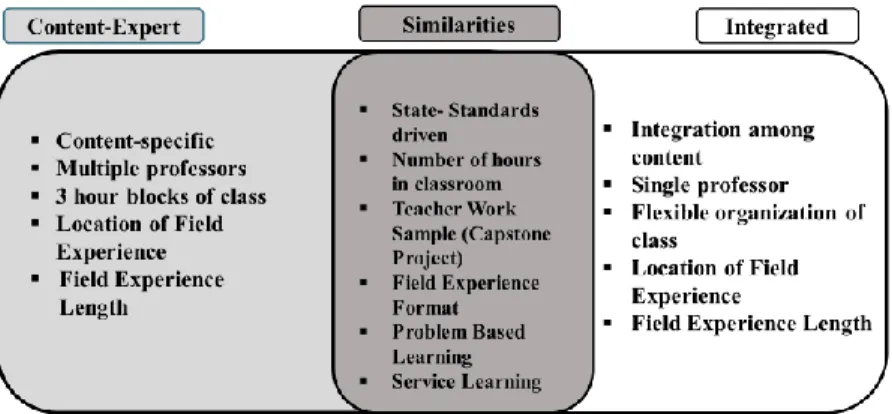
Both models have similarities and differences, some of which were outlined above. For instance, both models require the same programmatic requirements established by the university. These include the Dispositions and Diversity Proficiency (DDPs), completion of three formally written lesson plans, and a capstone project, the Teacher Work Sample (TWS). Additionally, all Methods classes receive training in the state-mandated curriculum, the Texas Essential Knowledge and Skills (TEKS). Teacher candidates in both models complete the same field-based assignments (whole-class teaching of mathematics, science, and social studies lessons) as well as complete a Service Learning project. Finally, both models complete similar major projects for each of the content areas.
outlines similarities and differences between the two models of delivering the required content methods courses.
Figure 1. Two content pedagogy models for teaching content methods courses
Purpose of Study
The purpose of this study was twofold: to 1) assess whether one model more adequately prepared students for student teaching, and 2) assess the benefits, strengths, and drawbacks of each of these models from the teacher candidates’ perspectives. The findings should help in restructuring the teacher preparation program at this university to meet new standards advocated by the national accreditation system for teacher development. The following questions were addressed in this study:
1. Is there a significant difference between the two models of delivering instruction during the content methods semester based on the following measures?
a) Results on two standardized teacher certification examinations b) Evaluation of student teaching by both field supervisor and mentor
c) Capstone assessment (Teacher Work Sample) in student teaching semester
2. How do prospective elementary teachers perceive each of these models in terms of benefits, drawbacks, and teaching competencies gained?
Methodology
This study included 1,084 undergraduates (academic years 2013-2016) who were in their senior year and enrolled in the teacher preparation program in the College of Education at a regional state university in Texas, USA. The sample was mostly female, with age range 20-45 years. The participants were a combination of traditional and non-traditional students.
Data collection
Quantitative data were collected through a college-wide data management system (TK20). Dependent measures included formal evaluations from mentors and student teaching supervisors during student teaching semester and the Teacher Work Sample (TWS) submitted during the middle part of student teaching semester.
In addition, test results from two standardized Texas Teacher Certification Examinations were provided by the Texas State Board of Educator Certification office. Passing the Core Subjects EC-6 and the Pedagogy and Professional Responsibilities (PPR) examinations is critical in getting a teaching certificate in the state of Texas.
Finally, a ten-item questionnaire was designed to collect self-reported data from a cohort of content methods students during the spring 2016 semester. Students were asked to complete a short online survey (see Appendix A) in the spring 2016 focus group (n=38; one class from each model) to collect qualitative data on participants’ experience and perceptions
of the two models.
Brief descriptions of dependent measures
Texas Teacher Certification Examination (Core Subjects: EC-6th). All students wishing to obtain a certification in Early Childhood through 6th Grade are required to take and pass this examination in order to teach in Texas. The candidates schedule their preferred time, and testing site at locations around the state. The examination includes five parts including language arts and reading, math, science, social studies, and fine arts, health, and physical fitness (http://cms.texes-ets.org/texes/core-subjectsgeneralist-tests/). In addition to showing content mastery, they must also show mastery of pedagogy for the content areas.
access (http://cms.texesets.org/files/9414/8716/9969/160_ppr_ec_12_prep_manual.pdf) to information and support on this particular standardized test.
The Teacher Work Sample (TWS). This teacher preparation program requirement was a capstone project completed by all student teachers. It consisted of seven components requiring students to evaluate the effectiveness of a unit designed and taught during the first student teaching placement. Each TWS is evaluated by two “blind” scorers (faculty) and each candidate received an overall rating of 1 (indicator not met), 2 (partially met indicator), or 3 (met indicator). Students should receive a minimum overall score of “2” in order to pass student teaching and be recommended for teacher certification.
Formal Evaluations by the student teaching supervisors and campus mentors. These are written evaluations based on the state and national teaching standards. The state of Texas adopted the Professional Development and Appraisal System (PDAS) as the format for teacher evaluations of teacher performance in the public schools. The form used by mentors for the student teachers reflected this appraisal system. Other evaluation instruments used in this study addressed competencies in technology integration and dispositions. The observation data were entered into TK20 by the student teaching supervisor.
Results
This first section will present findings that will provide answers to our first research question: Is there a significant difference between the two models of delivering instruction during the content methods semester based on the following measures?
a) Results on two standardized teacher certification examinations b) Evaluation of student teaching by both field supervisor and mentor
c) Capstone assessment (Teacher Work Sample) in student teaching semester
Results from state teacher certification examinations. On the PPR examination, the
failing (value=0) only, we were not able use t-test statistics as the standard deviation values were not known. Both groups demonstrated high passing rates on the PPR but needed more support on the EC-6 Content examination.
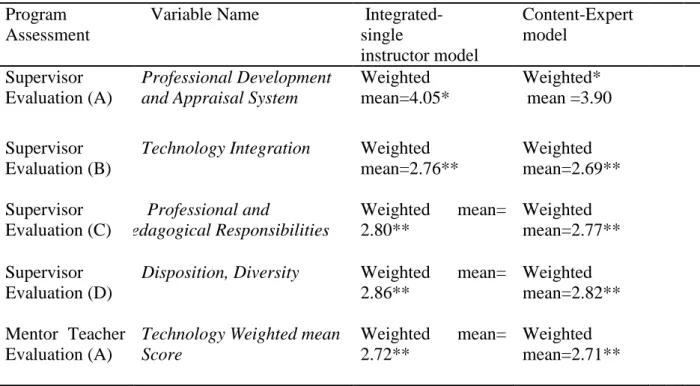
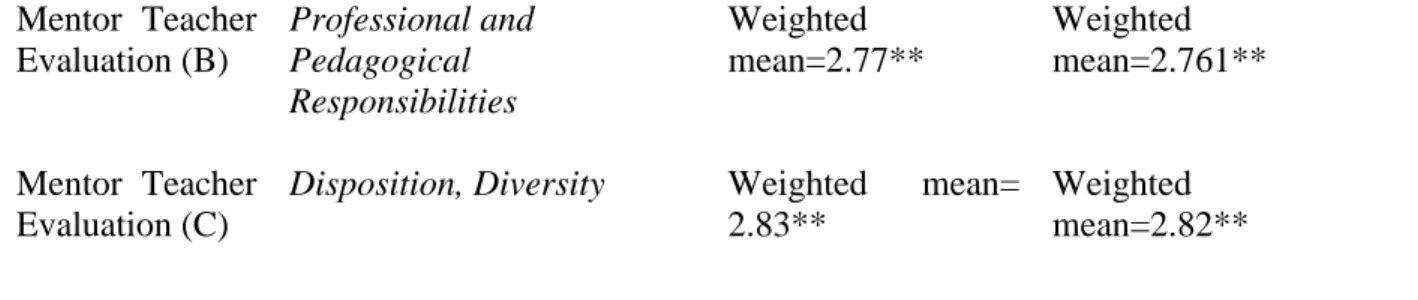
Evaluation from student teaching supervisors and mentors. Table 1 outlines the results on
various evaluative instruments used by student teaching supervisors as well as classroom mentors. The instruments assess various areas of teaching proficiencies required by both the state and national standards. The students were rated using a Likert scale 1 through 5. While the Integrated Model measured slightly higher, the results indicate no significant difference between the two models regarding performance in the indicated domains.
Teacher Work Sample
Data stored in TK20 were accessed in order to analyze sample performance on the capstone assessment called the Teacher Work Sample (TWS). Analysis of 476 TWS overall scores (single instructor-integrated group) and 1,962 TWS (content-expert group) by two blind scorers were conducted by calculating weighted means (values: 1=not met indicator; 2= partially met indicator; 3=met indicator). Overall, the single instructor-integrated group had an overall weighted mean of 2.623 while the content-expert group showed a weighted mean of 2.614. Since the mean difference is quite negligible, there was no strong evidence that the two groups were different based on their performance on the TWS.
Table 1. Student teaching evaluation of samples using weighted means
Program Assessment
Variable Name Integrated-single instructor model Content-Expert model Supervisor Evaluation (A) Professional Development and Appraisal System
Weighted mean=4.05* Weighted* mean =3.90 Supervisor Evaluation (B)
Technology Integration Weighted mean=2.76** Weighted mean=2.69** Supervisor Evaluation (C) Professional and Pedagogical Responsibilities
Weighted mean= 2.80** Weighted mean=2.77** Supervisor Evaluation (D)
Disposition, Diversity Weighted mean= 2.86**
Weighted mean=2.82**
Mentor Teacher Evaluation (A)
Technology Weighted mean Score
Weighted mean= 2.72**
Weighted mean=2.71**
Mentor Teacher Evaluation (B) Professional and Pedagogical Responsibilities Weighted mean=2.77** Weighted mean=2.761**
Mentor Teacher Evaluation (C)
Disposition, Diversity Weighted mean= 2.83**
Weighted mean=2.82**
*1= Not acceptable; 2= Acceptable; 3=Met expectation **1=Basic; 3= Proficient; 5 =Exceeds expectation
The following section will present findings that will provide answers to our second research question: How do prospective elementary teachers perceive each of these models in terms of benefits, drawbacks, and teaching competencies gained?
Responses from the survey were analysed for the Spring 2016 focus group. We had an 85% response rate from a sub-sample of 38 teacher candidates in the content methods block. Among the respondents, 25 participated in the single instructor-integrated class and 13 from the content expert class. Tables 2 and 3 summarize the general themes extrapolated from the responses on the online survey (Appendix A) administered to both groups of teacher candidates. Those teacher candidates in the integrated-single instructor model preferred this setup for reasons other than pedagogy and PCK. For example, a resounding theme seems to support motivational theories of learning when respondents alluded to “feelings of security”, “support and guidance from instructor” and “positive relationships”. Meanwhile, teacher
candidates in the content-expert model saw the value of seeing “multiple perspectives” and “different teaching styles”. They have also recognized how “passionate each instructor was about their content” and appreciated instructors’ feedback.
Table 2. Typical responses to “Given your current set up, what do you think is the best part?” Integrated-single instructor model Content-expert model
“I think integrating all the core
subjects has helped me learn all the material and how teaching will really be.”
“I like that our teachers were
passionate about the content area they were teaching.”
“...Makes the semester a lot less
stressful and more uniform and organized!”
“Having an instructor with a
“The consistency in grading and instruction”
insight and advice. I don't think one instructor could have provided as much information.” “Having one professor that knows
your strengths and weaknesses in all areas. They are able to give you the maximum amount of guidance and support.”
“I think it's great that the
teachers for each class are passionate about the specific subject.”
“It was very easy to communicate
when you needed help or reassurance of something. . .”
“Getting to see different points of view from different fields.”
Responses to questions 4, 5, and 6 on the survey, although speculative, still provided invaluable information for program restructuring. For instance, on one survey question, would you recommend a new methods student to sign up for your current set-up, frequent responses included the following:
Integrated-single instructor model:
“I feel like I learned a lot and was able to build a better relationship with my professor.”
“I love working with one instructor because we really got to know her and she got to know us as well.”
Content-expert model:
“I think having a different set of professors was beneficial because it allowed me to learn from professors who had strengths in their particular content area.”
Table 3
Responses to “Given your current set up, what do you think is the least desirable part?” Integrated-single instructor model Content-expert model
“Too big of a class, smaller class
size for one professor teaching all 4 courses is much more beneficial for
“The teachers weren't always on
the students and teacher! “
“Going two days in a row, all day.” “Inconsistencies in expectations and communication”
“All the up-front assignments.” “That we don’t see as much
integration and that not all professors are working together.”
Discussion
In this study, we compared two different configurations of teaching content methods block using a mixed methodology. We found no significant difference between the two models based on all quantitative measures collected during the student teaching semester. Both models seemed to have a positive impact on the teacher certification examinations (core content, pedagogy and professional responsibilities) with high passing rates, student teaching performance and successful completion of the capstone requirement (Teacher Work Sample).
Responses to the open-ended questions on the online survey administered to a focus group gave invaluable information on the benefits and drawbacks of each of the content methods configurations from the candidates’ self-reports and experience. Having one
instructor teaching all three content (mathematics, science, social studies) methods courses in an integrated format seemed to have met teacher candidates’ basic and immediate needs (e.g.,
better relationship with peers and instructor) consistent with theorists like Abraham Maslow and his ideas on motivation theory and the “hierarchy of needs”. Teacher candidates viewed
the single-instructor model as a “safety net” which keeps them from feeling “overwhelmed” with course expectations during the semester.
There are several limitations to this study which will not support any general conclusion. First, content methods students may take their content examination (Texas Teacher Certification Examination Generalist-K- 6th) during the methods semester or prior to this semester. Therefore, the data from this state-mandated examination did not necessarily tell us whether one model is more or less successful in preparing them for student teaching. The PPR test result would be an appropriate measure to compare both groups since this test is taken after completion of the content methods semester.
certification examinations. The data on each sample showed only “Pass” or “Fail”. Hence t-test statistics were not appropriate without knowing the variance (e.g., standard deviations).
Conclusion
Recognizing the limitations in our study, no definite conclusion can be derived from this study. However, for program revision and improvement, findings from this action research provided invaluable data for improving our own teacher education program, especially during the content methods semester. At least three tangible actions and outcomes resulted from this study, and they are currently being implemented.
First, at the beginning of each semester, instructors teaching in the content methods (pedagogy) block jointly review teaching assignments and course emphases to meet teacher candidates’ need for building strong relationship, clarity in communication, feeling of
security, and self-efficacy. For example, to improve teacher-student communication and to keep students on track with pending assignments, instructors in the same team collaboratively create common calendars (using Google Docs) for assignments, due dates and other events occurring during the semester. Additionally, instructors intentionally model a spirit of “teamwork” among themselves, which can alleviate students’ feeling of insecurity during a
very intense and demanding semester. Each class uses Facebook, GroupMe, or other applications to communicate with peers and instructors about assignments and events, in addition to utilizing a course management system (Blackboard).
Secondly, the teacher preparation program has recently adopted teacher education standards espoused by the Interstate Teacher Assessment and Support Consortium (InTASC) that articulates four domains: Learner and learning, Content knowledge, Instructional practice, and Professional responsibility. Note, the second domain weighs more on strong content knowledge in mathematics, science, social studies, and reading/language arts for elementary teachers; Implying strong emphasis on both content knowledge, PCK, and pedagogy. Moreover, instructors teaching in the content methods block are making explicit connections with sample test questions on the teacher certification examination that assess not only content knowledge in mathematics, science, and social studies but also knowledge of children’s misconceptions, errors, and thinking processes unique to a specific content.
replaced the Teacher Work Sample) that will measure the teaching competencies supported by the newly adopted national educator standards (InTASC).
References
Ball, D. & Forzani, F. (2010). What does it take to make a teacher? Kappan, 92 (2), 8-12. Ball, D., Thames, M., & Phelps, G. (2008). Content knowledge for teaching: What makes it
special? Journal of Teacher Education, 59 (5), 389-407.
Bieda, K. (2016). Taking stocks: MTE’s contribution to building a knowledge base for the
practice of mathematics teacher education. Mathematics Teacher Educator, 5(1), 3-7. Committee on the Study of Teacher Preparation Programs in the United States. (2010). Preparing teachers: Building evidence for sound practice. Washington, DC: National Research Council.
Darling-Hammond, L (2006). Assessing teacher education. Journal of Teacher Education. 57 (2). 120-138.
Hiebert, J. & Morris, A. (2009). Building a knowledge base for teacher education: An
experience in K-8 mathematics teacher preparation. The Elementary School Journal, 109 (5), 475-490.
Konecki, L., Sturdivant, R., King, C., Melin, J., & Lancaster, P. (2012). Including multiple voices in collaboratively designing a teacher education program. Action in Teacher Education, 34, 526-540.
Lonning, R. & DeFranco, T. (1994). Development and implementation of an integrated mathematics/science preservice elementary methods course. School Science and Mathematics, 94(1), 18-25.
Stuessy, C. L. (1993). Concepts to application: Development of an integrated
mathematics/science methods course for preservice elementary teachers. School Science and Mathematics, 93(2), 55-62.
APPENDIX A On-line Survey
Content Methods Configuration Feedback Form
Introduction: For several years now, the content methods block has been redesigned to meet teacher candidates’ need as well as instructor’s passion. Specifically, some sections in the
block are being taught by a single instructor (teaching math, science, social studies, & classroom management) while the other sections are taught by multiple professors based on their specialized field (math, science, social studies).
Typically, the single-instructor integrates 2 or 3 subject areas without necessarily following the meeting time assigned for each course. Additionally, classroom management is “woven” throughout the 3 content areas. Major assignments are similar in both set-ups as well as field experience expectations.
Purpose: Since you are in ONE of these set-ups this semester, we need your feedback about the benefits and drawbacks of being placed in a single-instructor set-up and multiple-instructor setting.
Please answer each question as best as you can. Your insights will help us implement the new EC-6 Program (starting Fall 2017).
1.Identify what type of Methods section you attend. a. Single Instructor teaching all 4 courses
b. Multiple instructors (different instructor teaching math, science, social studies)
2.Given your current section set-up, what do you think is the best part?
3.Given your current section set-up, what do you think is the least desirable part?
4.Would you recommend a new methods student to sign up for your current set-up? a. Yes
b. No c. Not sure
6.If you had to do Content Methods block again, would you choose a section with: a. Single instructor
b. Multiple Instructors c. Not sure
7.Did you take the TEXES EC-6 Core examination during the content methods semester? a. Yes
b. No
8.If your answer to question # 7 above is YES, did you pass it all in your first attempt? a. Yes
b. No
9.If you took the TEXES EC-6 Core examination during the content methods semester, do you think your CONTENT courses (math, science, social studies classes you took at SHSU prior to Methods) helped you pass the test?
a. Most Definitely b. Somewhat c. Not sure d. Not at all e. Not applicable
10. If you took the TEXES EC-6 Core examination during the content methods semester, what was the most difficult domain(s) you have experienced?
a. Math b. Science c. Social Studies d. Other