Australian Journal of Basic and Applied Sciences
ISSN:1991-8178Journal home page: www.ajbasweb.com
Corresponding Author: Noorliza Karia, Universiti Sains Malaysia, School of Management, USM 11800, Penang, Malaysia.
Tel: +604-653 2528; Fax: +604-657 7448, E-mail: [email protected]
Exploring the comprehensive framework of third-party logistics providers competitive
advantage: a resource-based view approach
1
Noorliza Karia, 2Muhammad Hasmi Abu Hassan Asaari, 3Chee Yew Wong 1Universiti Sains Malaysia, 11800 USM, Penang, Malaysia
2Universiti Sains Malaysia, 11800 USM, Penang, Malaysia 3Leeds University Business School, University of Leeds, Leeds, UK
A R T I C L E I N F O A B S T R A C T Article history:
Received 30 September 2014 Received in revised form 17 November 2014
Accepted 25 November 2014 Available online 6 December 2014
Keywords:
third-party logistics; resource-based; competitive advantage; customer service innovation; cost leadership
Background: The globalization and speedy expanding knowledge and technology have brought new competitive landscape for third-party logistics providers (3PLs). Yet, some 3PLs are still operating with inappropriate resources such as low-end technology at high cost. They are also facing problems with hiring skilled and knowledgeable workers with formal logistics education and training. Objective: This paper attempts to explore what are the aggregate resources acquired and accessed by 3PLs; and enlighten the strategic resources for 3PLs' competitiveness. Results: The findings unearth that physical, technology, knowledge, relational and organizational resources have been acquired and accessed by 3PL firms. The results also verified that technology and organizational resources are explanatory factors of customer service innovation for 3PL firms. In contrast knowledge and organizational resources are explanatory factors of cost leadership for 3PL firms. Conclusion: This research is a novel attempt to initiate a comprehensive framework of 3PLs' competitive advantage. This research identified strategic resources which can be bundled for 3PLs' competitive advantage. It highlights the needs for 3PL's managers to advance and bundle their strategic resources to enhance competitive advantage.
© 2014 AENSI Publisher All rights reserved. To Cite This Article: Noorliza Karia, Muhammad Hasmi Abu Hassan Asaari, Chee Yew Wong., Exploring the comprehensive framework of third-party logistics providers competitive advantage: a resource-based view approach. Aust. J. Basic and Appl. Sci., 8(23): 345-351, 2014
INTRODUCTION
Third-party logistics providers (3PLs) are providers of industrial logistics services that perform logistics functions on behalf of customers or as companies that specialize in providing various types of logistics services such as transportation, warehousing and freight forwarding. 3PL is a term used to describe different forms of logistics service providers, often interchangeable with terms such as “integrated logistics providers” (full and integrated logistics services) (Africk and Calkins, 1994) or in general “full service providers” (FSP) (Lai, 2004). Lai et al. (2004) suggest that logistics service providers, often referred to as third party 3PLs (3PLs), carry out the logistics activities for one or more companies within a supply chain (functioning as an intermediary).
Exactly how 3PL firms can effectively manage different resources and capabilities remains an intriguing question. Attempting to answer this crucial question, there are some clues suggesting that physical resources and equipment (Mentzer et al., 2004; Brah and Lim, 2006; Karia and Razak, 2007), human resources (Lin, 2007; Ellinger et al., 2008) and corporate image (Yang et al., 2009) could enhance 3PLs' performance. Others suggest that 3PL firms need capabilities such as information technology (IT) capability (Lai et al., 2008; Yang et al., 2009), and relational orientation (Panayides and So, 2005; Panayides, 2007), knowledge and managerial competences (Wong and Karia, 2010). However, it is still unclear what resources are acquired and accessed by 3PLs and what mechanisms and orders to which different resources and capabilities can be bundled together to enhance 3PL firms’ competitive performance.
Literature Review:
The logistics literature recognizes that the emergence of logistics outsourcing and global supply chain has presented 3PLs with challenges and demands for smarter ways to leverage productive resources and capabilities. In the competitive industry it is essential for 3PLs to gain access to and transform the right logistics resources into superior logistics performance and to sustain competitive advantage. The logistics resources studies have been concentrated on IT capability, relationship and logistics outsourcing. It has been predominately looked at from the user perspective but 3PL's perspective has received little attention. Previous logistics studies have suggested that logistics resources such as technology, relationships, transport vehicles, and people are the determinants of logistics performance and firm competitive advantage. However the logistics literature has not considered the potential of aggregate logistics resources. Also, some of the constructs and measurement scales for such logistics resources have not been established and empirically tested. Other problems are that the empirical study of the performance impacts of 3PL resource-based logistics (RBL) is scarce and recent; and the theoretical development and application in logistics resources studies receive little consideration.
Recognizing the lack of theoretical development and application in logistics research, several logistics scholars have called for a shift to a more theory-driven research (Stock, 1997; Mentzer and Kahn, 1995). Earlier studies of the impacts of logistics resources on 3PL performance did not use any specific theory (e.g. Lai et al., 2006; Panayides, 2006; Brah and Lim, 2006). To search for a theory which explains the performance implications or competitive advantage of logistics resources, this research refers to the resource-based theory of the firm from the strategy literature (Penrose, 1959; Wernerfelt, 1984; Rumelt, 1984; Barney, 1991). Thus this research attempts to explore what are the aggregate logistics resources acquired and accessed by 3PLs; and examine what are the strategic resources bundled to achieve competitive advantage of customer service innovation (CSI) and cost leadership (CL).
This is a novel research because it considers bundling of various resources and capabilities, unlike most previous research which examined the relationship between individual resources and 3PL performance separately (e.g., Panayides, 2007; Lin, 2007; Lai et al., 2008; Yang et al., 2009). In addition, this research builds a novel resource bundling model by advancing the resource-based view (RBV) theory, which argues that resources have no real value to a firm when they act in isolation (Eisenhardt and Martin, 2000). Furthermore, this research distinguishes diverse resources (Mentzer et al., 2004) and identifies which resources and capabilities can be bundled together (Teece, 1986) to enhance 3PLs’ performance.
Theoretical Model And Hypotheses:
Furthermore, this research argues that 3PLs' performance metrics measure mainly operational capabilities but do not always represent the overall competitive performance of 3PLs. In today’s competitive environment, delivering customer orders alone is insufficient to compete; they need to innovate in service provisions and constantly provide and remain cost competitive such that they can retain customers as well as attracting new customers (Mentzer et al., 2004). Thus, this research considers cost leadership (CL) and customer service innovation (CSI) as the competitive performance metrics for 3PLs. In CSI this research includes delivery reliability (Stainer, 1997), delivery quality (Stainer, 1997), flexibility (Myers et al., 1996; Stainer, 1997), and value-added service (Lai et al., 2008). CSI is required to achieve service variety advantage (Mentzer et al., 2004; Lai et al., 2008). Meanwhile, CL means 3PLs are able to reduce costs of transportation, inventory and warehousing (Daugherty and Pittman, 1995) and achieve cost advantage which is reflected in lower service cost and charge relative to competitors (Lai, 2004; Mentzer et al., 2004).
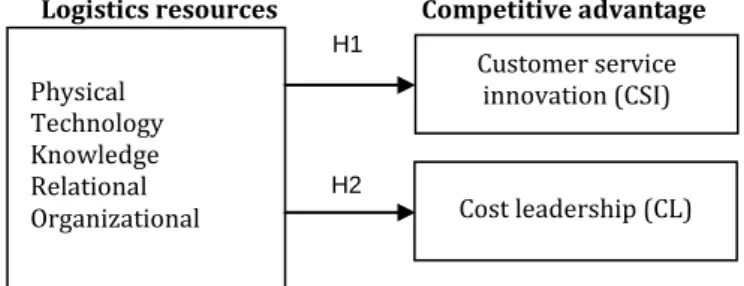
Meanwhile the 3PLs' logistics resources comprise of physical and equipment; technology, knowledge, relational and organizational resources. Physical resources are defined as the basic logistics infrastructure (e.g., transports, warehouses, containers, cranes) and equipment such as logistics and IT equipments (e.g., telephone, fax, computers,) which commonly available to 3PLs in order to perform logistics tasks (Stefansson, 2006; Karia and Razak, 2007). Advanced technology resources are defined as such web-based systems, GPS, GIS, track and trace systems, automatic warehousing systems, routing optimisation software, and advanced loading and unloading systems which are relatively costly and difficult to develop (Lai, 2004; Chapman et al., 2003; Lai et al., 2008; Brah and Lim, 2006). Knowledge resources are defined as the recruitment and development of skilled people and integrated teams with technical ability, knowledge and experience. Experienced professionals are required to effectively manage a supply chain (Murphy and Poist, 2000). Firms exhibit higher performance when they recruit and acquire competent employees (Wright et al., 1995). Relational resources are defined as strong relationships with customers and suppliers characterised by a high level of trust and long-term relationship. Stronger relationships allow 3PLs to coordinate its networks and share information (Skjoett-Larsen, 2000), and interact and communicate (Panayides and So, 2005; Panayides, 2007) with customers and suppliers more effectively. Organizational resources are defined as 3PLs’ competence in managing organizational routines, practices and strategy processes which interface with customers to meet customer demand requirements. This research argues that these five logistics resources are acquired and accessed to meet customer needs and more relevant for 3PLs to achieve customer service innovation and cost leadership as presented at Figure 1.
Fig. 1: Theoretical model of 3PLs’ competitive advantage
The strategic literature highlights the importance of bundling resources to generate superior firm’s performance (Penrose, 1959). According to the RBV theorists, resources, especially those tangible ones, have no real value to the firm when they act in isolation (Eisenhardt and Martin, 2000). Intangible resources and capabilities are often bundled with other tangible resources that may be quite commonly available, as suggested by the RBV literature (Teece, 1986). Based on these theoretical arguments, we expect 3PLs to bundle or combine specific resources and capabilities to enhance performance. The research model argues that some resources and capabilities will together and directly enhance 3PLs’ performance, and their performance impacts are enhanced by some supporting resources. There is previous studies argued that tangible resources especially technology and physical and equipment resources are insufficient to have a direct impact on firms’ performance and they need other intangible resources or so-called dynamic capabilities to jointly affect firm performance (Nelson and Winter, 1982; Makadok, 2001).
This research argue that physical, technology, knowledge, relational and organizational resources are bundled together to deliver customer service innovation (CSI). Physical resources such as logistics infrastructures, vehicles and hubs are acquired and accessed by most of 3PLs mainly for every logistics operations and activities. Advanced technology and equipment such web-based systems, GPS, GIS, and track and trace systems allows 3PLs to innovatively trace shipment and provide quick response to customers (Sander and Premus, 2005; Brah and Lim, 2006). A study of Lai et al. (2006) revealed that 3PLs with a higher level of IT application could offer faster and more reliable delivery. A positive significant relationship between IT
Logistics resources Competitive advantage
Physical Technology Knowledge Relational
Organizational Cost leadership (CL)
Customer service innovation (CSI)
capability and service variety and service quality has been reported by another study of 3PLs (Lai et al., 2008). Such advanced technologies can be purchased from technology providers or developed in house. However, they can only become useful and inimitable when 3PLs have the right knowledge resources and organizational resources which transform them into innovative customer service. Organizational resource is the key dynamic capability here because it is the ability to understand customer needs and manage customer service delivery processes that truly draw the right technology and knowledge together to innovate. Similarly relational resources (good rapport with customers) are acquired to facilitate a better understanding of customer needs. Relational resources support effective and interactive participation and management of contracts. Thus the bundles of resource are required for achieving customer service innovation (CSI). This research proposed:
Hypothesis H1: bundles of physical, technology, knowledge, relational and organizational resource positively affect customer service innovation (CSI).
Meanwhile this research also argues physical, technology, knowledge, relational and organizational resources play imperative roles in achieving CL. Every 3PLs has to acquire advanced technology and physical and equipment resources for effective communication, transmission and processing information to support delivery and logistics operations and facilitate innovation capabilities in logistics. Previous studies ascertain that basic technology and equipment such as logistics infrastructure and IT infrastructure, basic IT facilities for hardware and software are required to support logistics operations, administration processes, demand management processes and customer service processes (Bowersox et al., 2007; Stefansson, 2006; Karia and Razak; 2007). Basic IT communication tools and facilities support the communication and interaction between 3PLs and customers and in turn help to speed up transaction process and achieve paperless operations. Similarly relational resources (good rapport with customers) are acquired to facilitate a better understanding of customer needs of cost leadership. While it is possible to deploy skills and knowledge workers to perform multi-tasking jobs to generate cost saving and reduce the number of process, document and staff, such efforts need supports from technology and equipment resources. While it is possible to achieve cost saving by adopting advanced technology, there is also a need to put in a heavy initial investment. Every 3PL owns and access to certain technology resources and equipment, but to achieve economy of scale and scope, a firm needs to develop organizational resources to translate customer needs into effective use of these resources. Organizational resources consolidate orders from different customers and geographical areas, which then allow optimization of transport routing and warehouse utilization. Furthermore, organizational resources can deliver cost efficiency with the help of knowledge about the efficient use of resources. Knowledge and organizational resources are crucial to sustain cost-saving efforts. Thus the bundles of resource are required for achieving cost leadership (CL). This research proposed:
Hypothesis H2: bundles of physical, technology, knowledge, relational and organizational resource positively affect cost leadership (CL).
Research Methodology:
This research is randomly drawn a sample of 400 3PL firms from established Logistics Directory (www.msialogistics.com). The survey was conducted and ultimately 123 firms completed the survey, stand for thirty percent response rate. The profile of respondents comprises of almost equal fully 3PLs Malaysian-owned and non Malaysian-owned; equal representations in firm size; slightly more than half (53 percent) of the them have been in the industry for more than 15 years, with an average of 20 years and a standard deviation of 15 years, indicating the firmness of logistics industry in Malaysia.
Results:
The Pearson correlation was performed to examine the relationship between resources and performance metric in terms of customer service innovation and cost leadership. Table 1 summarizes the Pearson’s correlations. As indicated, the correlations between all variables are positive and above 0.3 (at p < 0.01), suggesting the existence of some correlations. Since the correlations among independent variables are less 0.75 (Pallant, 2007; Hair et al., 2010), multi co-linearity is no expected to be a problem. The results reveal that physical, technology, knowledge, relational and organizational resources are acquired and accessed by 3PLs.
Table 1: Results of Pearson Correlation
Variables 1 2 3 4 5 6
1. Physical resources 1
2. Relational resources 0.563** 1
3. Technology resources 0.612** 0.412** 1
4. Organizational resources 0.625** 0.485** 0.560** 1
5. Knowledge resources 0.629** 0.538** 0.750 0.470** 1
6. Customer service innovation 0.382** 0.320** 0.506** 0.537** 0.451** 1
7. Cost leadership 0.297** 0.316** 0.323** 0.449** 0.370** 0.533**
In order to examine bundles of resource enhance performance in term of CSI and CL, stepwise regression analyses are performed. The preliminary analyses are conducted to ensure that there are no violations of normality, linearity and homoscedasticity assumptions. Table 2 shows the results of stepwise regression for customer service innovation (CSI) and cost leadership (CL). In model 1, organizational resource (=0.63) explained 29% of variance in CSI. In model 2, both organizational and technology resources together explained 35% of variance in CSI. Three other logistics resources: knowledge resources, relational and physical and equipment resources were not affecting CSI directly. The results partially support hypothesis H1. In model 3, organizational (=0.67) explained 20% of variance (R2) in CL. In model 4, organizational and knowledge resources together explained 23% of variance in CL. The other three logistics resources: relational, physical and equipment resources were not affecting CL directly. The results support hypothesis H2. Organizational resources provided the strongest contribution to CSI and CL.
Table 2: Results of stepwise regression analyses Dependent
variable Model Intercept
Beta coefficient ()
R2 F d.f. ∆R2
Organizational resource
Technology resource
Knowledge resource
CSI Model 1 1.38*** 0.63**** - - 0.29 48.67 1, 120 -
Model 2 1.03*** 0.43**** 0.29*** - 0.35 32.01 2, 119 0.06
CL Model 3 0.77 0.67**** - - 0.20 30.31 1, 120 -
Model 4 0.39 0.53**** - 0.26** 0.23 18.22 2, 119 0.03
****Significant at 0.000;***Significant at 0.001; **Significant at 0.01
Discussion And Recommendation:
This research advances logistics literatures and management theories in the number of aspects. First, it contributes to initiate a comprehensive model of 3PL's competitive advantage by advancing theoretical model and resource-based theory. To our knowledge, this research provides the empirical justifications that physical, technology, knowledge, relational and organizational resources are acquired and accessed by 3PL firms, signifying the emerging importance of strategic resources for 3PLs' competitive advantage of customer service innovation and cost leadership. Second, this research unearth the 'black box' on the bundles of resource for 3PLs' competitiveness. Thus supports the strategic management literature to reveal such a black box that explains the exact orders and mechanisms of bundles of resource. Third, the findings of this research provide a crucial clue for explaining why 3PL firms are able to achieve competitive advantages. It extends previous studies by developing a novel theoretical model to explain the orders in which certain strategic resources can be bundled to achieve customer service innovation and cost leadership. In particular this research reveals that organizational resource is the key strategic resource to success, and it has to be bundled together with technology resources in order to offer customer service innovation; and with knowledge resources in order to execute logistics operations at lowest cost. With regards to the role of other resources such as physical and relational resources, the findings suggest that they are equally important even though they are not directly impacting cost and service performance.
Conclusion:
Overall this research advances the theoretical model of 3PL's competitive advantage. The findings of this research imply that 3PL firms acquire and access bundles of resources to become competitive. Logistics managers of 3PL firms need to align organizational resources with technology resources to meet customer's demand and requirements. Instead of developing organizational resources, 3PL firms should concurrently advance and bundle with knowledge resource in order to execute lower operations costs and increase productivity. It is significant to ponder that other resources are crucial and associate with strategic resources; and indirectly to affect 3PLs' competitiveness. However, how they are associated together to affect competitiveness remains an intriguing inquiry. Future research is suggested to examine the bundling effects of various resources and capabilities on 3PL firms’ competitive performance using other samples, guided by this theoretical model. This will help to provide more insights into the “black box” of 3PLs’ resources and competitiveness as well as to advance the theoretical model. Using this theoretical framework, future research should consider partial least square (PLS) to verify the bundles of resource model on competitive advantage.
ACKNOWLEDGEMENT
Authors would like to acknowledge to the Higher Education Department, Ministry of Malaysia Education for the grant awarding of this research. Ref no: 203/PMGT/6730088.
REFERENCES
Distribution, 35(5): 49-61.
Amit, R and P.J. Schoemaker., 1993. Strategic assets and organizational rent, Strategic Management Journal, 14: 33-46.
Barney, J., 1991. Firm resources and sustained competitive advantage. Journal of Management, 17(1): 99-120.
Bowersox, D. J., D.J. Closs and M.B. Cooper., 2007. Supply Chain Logistics Management (2nd ed.), New York: McGraw Hill.
Brah, S.A and H.Y. Lim., 2006. The effect of technology and TQM on the performance of logistics companies. , International Journal of Physical Distribution and Logistics Management, 36(3): 192-209.
Chapman, R.L., S, Claudine and J. Kandampully., 2003. Innovation in logistics services and the new business model: A conceptual framework. International Journal of Physical Distribution and Logistics Management, 33(7): 630-650.
Daugherty, P.J and P.H. Pittman., 1995. Utilization of time-based startegies: creating distribution flexibility/responsivenss. International Journal of Operations and Production Management, 15(2): 54-60.
Eisenhardt, K.M and J.A. Martin., 2000. Dynamic capability: What are they? Strategic Management Journal, 21: 1105-1121.
Ellinger, A.E., D.J. Ketchen, G.T. Hult, A.B. Elmadag and R.G. Richey., 2008. Market orientation, employee development practices, and performance in logistics service provider firms. Indusrtrial Marketing Management, 37: 353-366.
Fabbe-Costes, N., M. Jahre and C. Roussat, 2009. Supply chain integration: the role of logistics service providers. International Journal of Productivity and Performance Management, 58(1): 71-91.
Hair, J.F., W.C. Black, B.J. Babin and R.E. Anderson, 2010. Multivariate Data Analysis (seventh ed.). New Jersey: Pearson Prentice Hall.
Karia, N and R.C. Razak., 2007. Logistics Assets That Payoff Competitive Advantage, In K. S. Soliman, Information Management in the Networked Economy: Issues and Solutions (pp. 33-39). New York: International Business Information Mangement Association.
Karia, N and C.Y. Wong., 2013. The impact of logistics resources on the performance of Malaysian logistics service providers. Production and Planning and Control: The Management of Operations, 24(7): 589-606.
Lai, F., D. Li, Q. Wang and X. Zhao, 2008. The information technology capability of third-party logistics providers: A resource-based view and empirical evidence from China. Journal of Supply Chain Management, 44(3): 22-38.
Lai, F., X. Zhao and Q. Wang, 2006. The impact of information technology on the competitve advantage of logisitcs firms in China. Industrial Management and Data System, 106(9): 1249-1271.
Lai, K.H., 2004. Service capability and performance of logistics service providers. Transporation Research Part E, (40): 385-399.
Lin, C.Y., 2007. Factors affecting innovation in logistics technologies for logistics service providers in China. Journal of Technology Management in China, 2(1): 22-37.
Makadok, R., 2001. Toward a synthesis of the resource-based and dynamic-capability views of rent creation. Strategic Management Journal, 22: 387-401.
Mentzer, J.T., S, Min and L.M. Bobbitt., 2004. Toward a unified theory of logistics. International Journal of Physical Distribution and Logistics Management, 34(8): 606-627.
Mentzer, J.T and K.B. Kahn., 1995. A framework of logistics research. Journal of Business Logistics , 16(1): 231-250.
Murphy, P.R and R.F. Poist., 2000. Third-party logistics: some user versus provider perspectives. Journal of Business Logsitcs, 21(1): 121-133.
Myers, M.B., S.E. Fawcett and S.R. Smith, 1996. Operating in the Caribbean: a logistics perspective. International Journal of Physical Distribution and Logistics Management, 26(9): 20-35.
Nelson, R.R and S.G. Winter., 1982. An evolutionary theory of economic change. Cambridge MA: Harvard University Press.
Olavarrieta, S and A.E. Ellinger., 1997. Resource-based theory and strategic logistics research. International Journal of Physical Distribution and Logistics Management, 27(9/10): 559-587.
Pallant, J., 2007. Survival Manual. A step by step guide to data analysis using SPSS for windows (3rd ed.). New York: McGraw Hill.
Panayides, P.M., 2007. Effects of organizational learning in third-party logistics. Journal of Business Logistics, 28(2): 133-158.
Panayides, P.M and M. So., 2005. The impact of integrated logistics relationships on third-party logistics serive quality and performance. Maritime Economics and Logistics, 7: 36-55.
Penrose, E.T., 1959. The Theory of the Growth of the Firm. New York: John Wiley.
Ray, G., J.B. Barney and W.A. Muhanna., 2004. Capabilities, business processes, and competitive advantage: Choosing the dependent variable in empirical tests of resource-based view. Strategic Management Journal, 25: 23-37.
Rumelt, R.P., 1984. Toward a strategic theory of the firm. In Competitive Strategic Management (Lamb RB ed.). Englewood Cliffs, NJ: Prentice-Hall.
Sanders, N.R and R. Premus, 2005. Modeling the relationship between firm IT capability, collaboration and performance. Journal of Business Logistics, 26(1): 1-23.
Skjoett-Larsen, T.S., 1999. Supply chain management: a new challenge for reseachers and managers in logisitcs. The international Journal of Logistics Management, 10(2): 41-53.
Skjoett-Larsen, T.S., 2000. Third party logistics - from an interorganizational point of view. International Journal of Physical Distribution and Logistics Management, 30(2): 112-127.
Stainer, A., 1997. Logistics - a productivity and performance perspective. Supply Chain Management: An International Journal, 2(2): 53-62.
Stefansson, G., 2006. Collaborative logistics management and the role of third-party service providers. International Journal of Physical Distribution and Logistics Management, 36(2): 76-92.
Stock, J.R., 1997. Applying theories from other disciplines to logistics. International Journal of Physical Distribution and Logistics, 27(9/10): 515-539.
Teece, D.J., 1986. Profiting from technological innovation: implications for integration, collaboration, licensing and public policy. Research Policy, 15: 285-305.
Teece, D.J., G. Pisano and A, Shuen, 1997. Dyanmic capabilities and strategies management”, Strategic Management Journal, 18(7): 509-533.
Wernerfelt, B., 1984. A resource-based view of the firm. Strategic Management Journal, 5(2): 171-180. Wong, C.Y and N, Karia., 2010. Explaining the competitve advantage of logistics providers: A resource-based view approach. International Journal of Production Economics, 128(1): 51-67.
Wright, P.M., D. Smart and G.C. McMahan, 1995. Matches between human resources and strategy among NCAA basket ball teams. Academy of Management Journal, 38: 1052-1074.