S O F T W A R E
Open Access
Efficient ring perception for the Chemistry
Development Kit
John W May
*and Christoph Steinbeck
Abstract
Background: The Chemistry Development Kit (CDK) is an open source Java library for manipulating and processing chemical information. A key aspect in handling chemical structures is the determination of the chemical rings. The rings of a structure are used areas including descriptors, stereochemistry, similarity, screening and atom typing. The CDK includes multiple algorithms for determining the rings of a structure on demand. Non-unique descriptions of rings were often used due to the slower performance of the unique alternatives.
Results: Efficient algorithms for handling chemical ring perception have been implemented and optimised in the CDK. The algorithms provide much faster computation of new and existing types of rings. Several optimisation and implementation considerations are discussed which improve real case usage. The performance is measured on several publicly available data sets and in several cases the new implementations were found to be more than an order of magnitude faster.
Conclusions: Algorithmic improvements allow handling of much larger datasets in reasonable time. Faster
computation allows more appropriate rings to be utilised in procedures such as aromaticity. Several areas that require ring perception have also seen a noticeable improvement. The time taken to compute the unique rings is now comparable allowing a correct usage throughout the toolkit. All source code is open source and freely available.
Keywords: Rings, Cycles, CDK
Background
The Chemistry Development Kit (CDK) [1,2] is an open source Java library for manipulating chemical informa-tion. A key aspect of manipulating and querying chemi-cal information is the ability to define and reason about attributes of chemical structures. Describing the rings in a structure is fundamental and a prerequisite of other attributes.
There is often a disconnect between how chemical rings are numbered and what is useful for computation. Conflicting definitions of rings contribute towards dis-crepancies between chemistry toolkits such as assigning aromaticity. The CDK does not provide a single strict definition of what rings are present in a structure. The ring information is considered auxiliary with different
*Correspondence: [email protected]
Cheminformatics and Metabolism, European Molecular Biology Laboratory-European Bioinformatics Institute (EMBL-EBI), Wellcome Trust Genome Campus, Hinxton, Cambridge, UK
algorithms utilised for a specific use-case. Some consid-erations of the differences will be touched upon but a thorough review is provided by [3,4] and [5].
There are several key properties we wish to know: is an atom or bond in a ring, what size is the ring and what are the other atoms and bonds in the ring? This infor-mation can be stored as an attribute of each atom or bond, as a collection of rings on the structure or computed on demand. With the provision of multiple algorithms it is undesirable to store all the information but invariant properties including membership and smallest ring size could be stored as an attribute of an atom or bond.
The ring properties can be used in many procedures throughout the library. In similarity searching and screen-ing the creation of chemical fscreen-ingerprints [6] may include ring size or membership to reduce the number of false positives. When matching atoms and bonds between structures the ring properties can be used in early elimi-nation of infeasible matches or to disfavour ring opening and closing. Ring properties are also utilised in structure
patterns (SMARTS [7]) where ring membership, size and number of rings can be queried.
It is essential that different structure resonance forms are treated as equivalent, one approach is to treat bonds in aromatic ring systems as delocalised. Conversely a delo-calised structure may have been provided without spec-ified bond orders. The ring properties can be used to localise and delocalise the bonds between aromatic and Kekulé representations.
Geometric isomers (double-bond stereochemistry) should not be encoded when the bond is involved in a rigid ring. Rigidity is approximated by only allowing stere-oconfigurations in rings with more than seven atoms. Groups of interdependent stereocenters can be identified by recursively checking the rings in a structure [8].
Improving the core ring perception algorithms can influence many areas and it is important that efficient algorithms are used.
Graph theory preliminaries
Although more comprehensive and accurate methods exist, chemical structures can be represented and effi-ciently modelled as graphs [9]. The algorithms used for ring perception are not specific to chemical structures and require several formal definitions. The basic concepts for these are briefly introduced here. A graph is composed of a set of verticesVand a set of edgesE. Each vertex or edge may belabelledwith a value. Two vertices areadjacentif an edge exists which contains the two vertices. The ver-tices of an edge are known as the endpoints, each endpoint is said to beincidentto the edge. Adegreeof a vertex is the number of incident edges. If the endpoints are unordered, an edge is said to beundirected. Simple graphs have no edges connecting the same vertex (loops) and no edges which share the same endpoints (multiedges). We model a chemical structure as simple undirected labelled graph where the atoms and bonds are labels on the vertices and edges. Although the edges have a numeric value (bond order) they are not treated as weighted.
A walk is a sequence of vertices and edges connect-ing two vertices. If the start and end of the walk are the same, the walk is closed. Otherwise the walk isopen. A
walk issimple if it contains no repeated edges and ele-mentaryif there are no repeated vertices. Asimplewalk that is alsoopenit is referred to as apath. Two vertices are connectedif there is a pathbetween them. A graph is connected if each vertex can be reached from every other vertex. Aconnected component (ConnComp(G))in an undirected graph is a subgraph in which every vertex is
connected.
Acycleis a closedwalk. Graphs containing acycleare said to becyclicoracyclicif no cycle is present. Acyclic simple graphs are referred to as atree. A ring in a chemi-cal structure is best described as anelementarycycle. The
cycle has no repeating vertices or edges and each vertex has adegreeof 2 (in the cycle). This definition includes envelope rings of structures like napthalene and azulene. As we are primarily concerned with chemical structures herein we use the termcycleto refer toelementary cycle.
A cycle basis is a set of cycles which can be used to generate all other cycles (cycle space) of the graph. Repre-senting a cycle as a set of edges, a new cycle can be gener-ated using the symmetric difference (XOR,⊕-summing) of the edge sets of two cycles whose edge sets intersect. A
minimum cycle basisis a cycle basis of minimum weight, in an unweighted graph the weight is simply the number of edges. When there is more than one basis with the same weight the choice between them is arbitrary as either can be used to generate the cycle space.
Cycle membership
The first step in cycle processing for a chemical struc-ture is to efficiently determine which vertices and edges of the graph belong to a cycle. In PubChem-Compound [10] (Aug 2013) 97.3% of structures (47,745,887) contained a cycle. Although the proportion of structures containing a cycle is high only 59.3% of the heavy atoms and 57.3% of bonds were cyclic. Eliminating these acyclic vertices and edges from further processing reduces the size of the computation.
The SpanningTree was introduced in the CDK to
eliminate acyclic vertices and edges, reducing the run-time of existing algorithms [11]. A graphHis a subgraph of a graph G if the vertices V and edges E of H are a subset ofG. A subgraphGis said to be aspanning sub-graphofHif every vertex ofHis present inG. The edges in chemical structures are unweighted and so the mini-mum spanning tree is a tree with the smallest number of edges. Given an input structure a spanning tree is created which contains a subset of the edges that span the ver-tices but contains no cycles. The SpanningTreeclass uses a greedy algorithm [12] to sequentially build up this tree. Cyclic vertices and edges are determined by find-ing a path in the tree between the two endpoints of an edge which was not included. Any edge that is not in the spanning tree is cyclic and any path in the tree which con-nects the two endpoints contains vertices and edges that are also cyclic. The number of paths to find depends on the number of edges not included in the spanning tree. Structures containing a large number of rings will have more edges removed and more paths to find. Discovery of a path in the tree is implemented as depth-first-search and the entire tree may be traversed for each removed edge.
Cycle sets
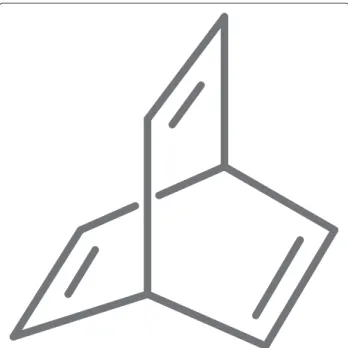
Figure 1The structure of barrelene.Barrelene is thought of having two rings and mirrors what is found in the MCB and reflected in its systematic name (bicyclo[2.2.2]octa-2,5,7-triene). The choice of which two rings is arbitrary. Barrelene has three relevant cycles and no essential cycles. In this simple example the choice of which two cycles is irrelevant as they are symmetric. This would no longer be the case if the structure was hetereocyclic or had exocyclic group added.
There is an exponential number of elementary cycles in a graph and smaller subsets of this have subsequently been defined and used in various aspects of chemical information processing.
Smallest set of smallest rings/minimum cycle basis
A well known set of cycles is the Smallest Set of Smallest Rings (SSSR). The SSSR was originally defined as a mini-mum length Kirchhoff-fundamental basis but has evolved to refer to a minimum cycle basis (MCB). The original def-inition of SSSR does not always contain the shortest cycles and was computationally intractable [3]. To avoid confu-sion the term SSSR will now only be used in reference to CDK implementation names. As introduced previously
the MCB is a polynomial set of cycles which can be used to generate the cycle space. As the MCB may not be unique it has little direct use in similarity, aromaticity, depiction or other descriptive features. It is also not required to find the shortest cycle through each edge or vertex which can be accomplished without checking the cycles form a basis. Although the MCB is not unique, the number of cycles it contains is. This value is the circuit rankaand is the number of edges that would need to be removed to make the graph acyclic (a spanning tree). For these rea-sons the size of the MCB agrees with de-facto standards and chemical nomenclature (Figure 1). The formula|E| − |V| + |ConnComp(G)|provides the circuit rank without computation of the cycle walks [5].
The original algorithm [13] utilised in the CDK was shown to be incorrect and can not guarantee completion on all graphs [3]. Although one may consider such cases rare in four of the five tested chemical data sets (Table 1) at least one structure was found which caused the CDK implementation to halt indefinitely. The algorithm is still partially used in other cheminformatics libraries [14]. The implementation was replaced with a correct algorithm [3] (SSSRFinder) which also provides uniquely defined cycle sets as alternatives to the MCB.
In general the CDK library has been relying less on MCB as it has little use beyond counting the number of rings and generating the cycle space. Both of these tasks can be achieved more efficiently with other procedures. The implementations provided in the CDK are primarily for reference and their use in computing other uniquely defined cycle sets.
Essential and relevant cycles
The essential and relevant cycles are a uniquely defined set of cycles. The MCB is non-unique when there are multiple minimum cycle bases and an arbitrary choice of a single basis can generate the cycle space. The essential cycles is the intersect of these minimum cycle bases whilst the relevant cycles is the union. When a graph has a single unique MCB it is equal to both the essential and relevant cycles. As a subset of the MCB the essential cycles do
Table 1 Chemical structure sets used to measure performance
Identifier nstructures Description Available
chebi_108 26,790 ChEBI Release 108 [15] www.ebi.ac.uk/chebi
nci_aug00 250,172 NCI Aug 2000 [16] cactus.nci.nih.gov/download/nci
zinc_frag 504,074 Zinc Clean Fragments zinc.docking.org/subsets/clean-fragments
Ph7 2013-04-12 [17]
chembl_17 1,318,180 ChEMBL Release 17 [18] www.ebi.ac.uk/chembl
zinc_leads 5,135,179 Zinc Clean Leads Ph7 2013-05-31 [17] zinc.docking.org/subsets/clean-leads
not form a basis and cannot be used to generate the cycle space. Like the MCB the essential cycles are always poly-nomial in number. Counter-intuitively, structures such as barrelene (Figure 1) contain no essential cycles. The rel-evant cycles do form a basis but may be exponential in number.
The uniqueness of these cycle sets make them desir-able for describing chemical entities. The essential cycles have been utilised in the CDK for similarity searching techniques including generation of fingerprints and for the structure query patterns. Unfortunately the computa-tion of the unique essential and relevant cycles (using the SSSRFinder) takes much longer than the non-unique MCB. The increased computation runtime has generally meant the MCB has been favoured.
All elementary cycles
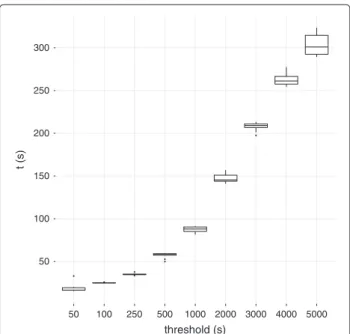
When considering all cycles, the number of cycles can be very large and infeasible to compute for fullerene-like and cyclophane-like structures. The set of all cycles can be generated using a cycle basis or computed directly [20]. Direct computation is more efficient and is pro-vided in the CDK as theAllRingsFinder. One major drawback of the existing implementation is the depen-dence on a time measure to determine feasibility. The time was measured from when the algorithm started and aborted if the elapsed time exceeded a set thresh-old. Whether the algorithm completes then depends on the machine specification and also the current load on the processor. The timeout was also generally left at a value too high (5 seconds) for larger datasets. To demon-strate this, the timeout threshold was varied and tested on a small dataset. The number of structures that the algorithm successfully completed was measured. Increas-ing the threshold to longer than a second provides only a small gain in coverage (Figure 2). A timeout of just 50 ms allowed 99.4% of the structures to complete in 32 seconds. Leaving the timeout at the default value of 5000 ms allowed 99.8% of structures to complete but took nearly 10 times longer (291 seconds) (Figure 3). This could be an artefact of hardware improvements but high-lights the difficulties in choosing an appropriate value when using a timeout. The set of all cycles was used throughout the library in fingerprint generation, similarity searching [21], descriptors, kekulisation and fragmenta-tion. The cycles were also partially utilised in aromaticity perception.
Implementations
The processing of cycles in the CDK has been stream-lined and optimised. Improved algorithms for determin-ing cycle membership and the uniquely defined essential and relevant cycles have been implemented in the CDK library. The algorithms are split across several classes
99.5 99.6 99.7 99.8
50 100 250 500 1000 2000 3000 4000 5000
threshold (s)
% completed (str
uctures)
Figure 2Coverage of different timeout thresholds when finding all elementary cycles.The percentage of structures in ChEBI 108 [15] that theAllRingsFindersuccessfully finished was measured for different timeout thresholds. Increasing the threshold larger to more than a second has minimal impact.
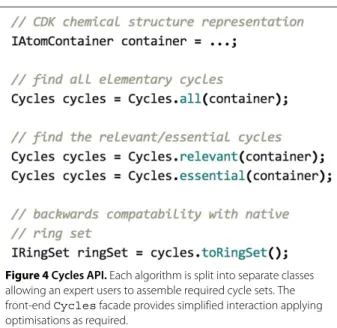
allowing an expert user to pick and choose. For simplicity a facade, Cycles(Figure 4), provides generation of the cycle sets described and applies preprocessing optimisa-tions. Specific implementation details are discussed and measured in the results.
50 100 150 200 250 300
50 100 250 500 1000 2000 3000 4000 5000
threshold (s)
t (s)
Figure 4Cycles API.Each algorithm is split into separate classes allowing an expert users to assemble required cycle sets. The front-endCyclesfacade provides simplified interaction applying optimisations as required.
Graph representations
A graph can be represented and stored using several data structures [22] (Figure 5). The choice of data struc-ture can dramatically affect performance. A coordinate or edge-list representation stores the vertices and edges as separate lists. The edge list is memory efficient but inefficient to determining adjacency where every edge must be checked. An adjacency matrix is a square
matrix with a boolean value indicating whether two ver-tices are adjacent. Matrix representations offer constant time adjacency checking but require every vertex to be checked in order to obtain a list of neighbours or degree. The matrix representation is less memory effi-cient and requires quadratic space to store. In an adja-cency/incidence list each vertex stores adjacent vertices or incident edges. Testing adjacency is bounded by the num-ber of adjacent vertices, thedegree[22]. Thedegreeand the set of adjacent vertices can be obtained in constant time.
The choice of data structure depends on properties being modelled, and which algorithms will be used. Chemical structures are generally small (|V| < 100) and each vertex is only adjacent to a few other ver-tices (sparse). Although more costly in memory and for modifications the attributes of chemical structures make the adjacency (or incidence) list representation preferable.
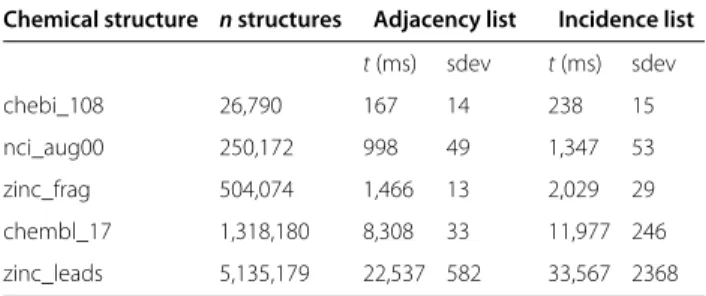
The CDK currently uses an edge list representation to store chemical structures. Conversion of the CDK native data type to an adjacency list is relatively quick but can become significant if carried out multiple times. Many of the existing algorithms used an optimised rep-resentation but benefit was seen by avoiding the slower CDK native objects and minimising reconversion. The overhead introduced for converting the CDK objects (Table 2) could be minimised by loading directly into
an more optimal data structure. When comparing to existing methods the conversion time is included in comparisons.
Results and discussion
Here we describe the optimisations and measure the per-formance on several chemical datasets (Table 1). All mea-surements were performed on a 2.66 GHz Intel Core i7 processor using Java version 1.7.0_21. The unprocessed benchmark results are provided as Additional files 1, 2 and 3.
Cycle membership
The existing algorithm used in SpanningTree was
for graphs with weighted edges [12]. In an unweighted graph any spanning tree is the minimum spanning tree. A spanning tree in an undirected, unweighted graph can be constructed with a depth- or breath-first-search [23]. Although efficient in construction, the spanning tree still requires additional operations to determined the cyclic vertices and edge. A more efficient approach is to com-pute the biconnected (2-connected) components of the graph. The biconnected components can be found using a single depth-first search [24]. A vertex is biconnected if removing it from the graph does not increase the num-ber components. Abiconnected componentis a maximal connected subgraph where every vertex is biconnected. In addition to detecting the cyclic vertices and edges the procedure also partitions the graph in to separate com-ponents which correspond to a separate ring systems in the chemical structure. If the number of edges is equal to the number of vertices, |E| = |V|, then the circuit rank is 1 and the component is an elementary cycle. Such components correspond to the isolated and spiro ring sys-tems in a chemical structure whilst the other biconnected components are the fused and bridged ring systems. The simple elementary cycles need no further processing and can be skipped from the more computationally intensive algorithms.
To measure the impact by utilising the biconnected components the time taken to compute the MCB was
Table 2 Average (n= 15) time taken to convert CDK structure representations to adjacency and incidence list data structures
Chemical structure nstructures Adjacency list Incidence list
t(ms) sdev t(ms) sdev
chebi_108 26,790 167 14 238 15
nci_aug00 250,172 998 49 1,347 53
zinc_frag 504,074 1,466 13 2,029 29
chembl_17 1,318,180 8,308 33 11,977 246
zinc_leads 5,135,179 22,537 582 33,567 2368
measured on the chemical structure sets. Although processing only the cyclic vertices and edges improves performance an even larger gain can be seen by pro-cessing only the non-simple biconnected separately (Figure 6). The largest performance improvement was seen for the zinc data sets that contain fewer fused ring systems.
The biconnected components were already used inter-nally for other cycle computations (SSSRFinder). A
new RingSearch utility was written with an
algo-rithm optimised for small graphs using binary sets. The implementation provides logical testing of cycle mem-bership for vertices and edges as well as partitioning the components and creating fragments of the input structure.
The time taken on several chemical datasets showed the new implementation performs well compared to the
SpanningTree(Figure 7). The new algorithm can
pro-cess between 100,000 and 300,000 structures per second where the majority of time (Table 3) was spent in the conversion (Table 2). Thezinc_leadsdata has almost five times the number of structures than chembl_17 but the SpanningTree actually finished in less time (Table 3). This is because chembl_17 contains more fused-ring systems that cause a bottle neck in processing. The difference is emphasised by measuring the perfor-mance on single structures containing large fused ring systems (Table 4).
ChEBI 108 NCI Aug 2000 Zinc (clean frag) ChEMBL 17 Zinc (clean leads)
0.0e+00 5.0e+04 1.0e+05 1.5e+05 2.0e+05 2.5e+05 3.0e+05 3.5e+05 Structures s−1
method
biconnected cyclic none
ChEBI 108 NCI Aug 2000 Zinc (clean frag) ChEMBL 17 Zinc (clean leads)
0.0e+00 5.0e+04 1.0e+05 1.5e+05 2.0e+05 2.5e+05 Structures s−1
Implementation
RingSearch SpanningTree
Figure 7Improved cycle membership perception.The performance (structures per second) when using theRingSearch compared to the pre-existingSpanningTree. Times measured for theRingSearchinclude the conversion from the CDK objects to anadjacencylist representation (Table 2).
Minimum cycle basis
The new implementation MinimumCycleBasis
com-putes the MCB as by-product of the relevant cycles [26]. Although this algorithm has a higher computational com-plexity than the existing (SSSRFinder) in practice it was found to be several factors faster (Figure 8). Although the existing implementation scales better, processing small graphs and an optimised implementation with fewer over-heads can run faster.
The absolute time taken for processing structures from
zinc_fraghas dropped from∼47 to∼2 seconds whilst
processing chembl_17went from ∼4 minutes to ∼15 seconds (Table 5). The algorithm to compute the MCB and relevant cycles [26] first computes an initial set of cycles in a compact representation that is then reduced to either a MCB or the relevant cycles. Determining the
Table 3 Average and median (n= 15) time taken to determine ring membership
Chemical structure SpanningTree RingSearch mean median sdev mean median sdev
t(ms) t(ms) t(ms) t(ms)
chebi_108 2,969 2,826 246 236 212 90
nci_aug00 8,440 8,451 59 1,396 1,372 88
zinc_frag 5,338 5,353 77 1,833 1,818 60
chembl_17 122,357 122,493 616 10,325 10,303 98
zinc_leads 114,710 115,067 837 27,496 27,502 215
Times exclude IO but include conversion. It should be noted that the majority of the time spent inRingSearchwas for the conversion (adjacency). Unprocessed measurements are provided in Additional file 1: Cycle membership benchmark.
Table 4 Average (n= 50) time taken to determine ring membership in several complex structures from ChEBI and FULLERENE [25]
Chemical structure
SpanningTree RingSearch
t(ms) sdev t(ms) sdev
cubane(CHEBI:33014) 1.18 1.24 0.21 0.66
dodecaboride(CHEBI:51706) 1.11 0.80 0.05 0.01
octacontaboron(CHEBI:50252)100.18 52.87 0.44 0.18
C60fullerene(CHEBI:33128) 11.15 2.92 0.30 0.03
C70fullerene(CHEBI:33195) 10.44 4.25 0.88 0.23
C320fullerene(FULLERENE) 423.06 166.30 0.61 0.32
C720fullerene(FULLERENE) 3100.71 1171.62 1.65 0.66
initial set of cycles uses a shortest paths procedure where an ordering is imposed on vertices [27]. With the vertices ordered by degree if the biconnected component is known to be a non-simple component (i.e. fused or bridged) then only shortest path searches from vertices with deg> 2 will yield new cycles to add to the initial cycles. In prac-tice this reduces the number of shortest path searches, for example in the common naphthalene and anthracene substructures from 10 and 14 to 2 and 4 respectively.
The cycle basis is formed by incrementally adding can-didate cycles of increasing size. In this case the cancan-didates are the initial set of cycles [26]. A candidate is added to the
ChEBI 108 NCI Aug 2000 Zinc (clean frag) ChEMBL 17
0.0e+00 5.0e+04 1.0e+05 1.5e+05 2.0e+05 Structures s−1
Implementation
new old
Table 5 Average and median (n= 15) time taken to compute the minimum cycle basis (MCB) using the existing and improved implementations
Chemical structure MCB (old) MCB (new) mean median sdev mean median sdev
t(ms) t(ms) t(ms) t(ms)
chebi_108 4,200 4,020 695 396 353 160
nci_aug00 34,762 34,330 1,685 2,193 2,125 211
zinc_frag 47,752 47,844 1,982 2,376 2,330 153
chembl_17 245,620 245,592 990 15,341 15,257 311
zinc_leads - - -
-The time taken by the new implementation includesadjacencyconversion (Table 2). Unprocessed measurements are provided in Additional file 2: Short cycles.
basis if it is linearly independent from the current mem-bers of basis [27]. This check for linear independence is expensiveb and can be avoided under some conditions. With the union of all edges in the basis (EB) a new cycle is linearly independent if any edges of the candidate (Ecand) are not present in basis. That is, when |EB∩Ecand| <
|Ecand|, the cycle must independent. Additionally we know the basis is complete when the number of cycles is equal to the circuit rank. As the biconnected components are processed separately, the circuit rank of the component is
|E| − |V| +1.
Essential and relevant cycles
The new implementation computes the relevant cycles directly [26]. The MCB and essential cycles are then
ChEBI 108 NCI Aug 2000 Zinc (clean frag) ChEMBL 17
0e+00 5e+04 1e+05 Structures s−1
Implementation
new old
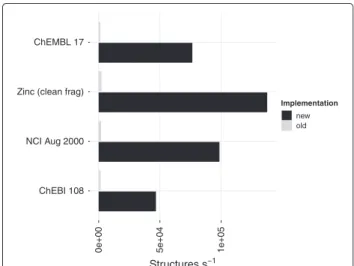
Figure 9Performance of computing relevant cycle basis.A comparison of computing the relevant cycle basis using the old implementation (SSSRFinder) compared to the new implementation. The performance of the old implementation on zinc_leadsdata set was not stable. The performance includes conversion to anadjacencylist representation for the new method (Table 2).
ChEBI 108 NCI Aug 2000 Zinc (clean frag) ChEMBL 17
0.0e+00 5.0e+04 1.0e+05 1.5e+05 Structures s−1
Implementation
new old
Figure 10Performance of computing essential cycles.A comparison of computing the essential cycles using the old implementation (SSSRFinder) compared to the new implementation. The performance of the old implementation on zinc_leadsdata set was not stable. The performance includes conversion to anadjacencylist representation for the new method (Table 2).
derived as a by-product. The computation of relevant and essential cycles showed a larger improvement over the existing implementations than for the MCB com-putation (Figures 9, 10). The old implementation could process around 2,000 structures per second whilst the newer implementations can process between 50,000 and 200,000. The time taken to find all the relevant cycles
in chembl_17 has dropped from ∼16 minutes to
only ∼16 seconds (including 8 seconds spent in conver-sion) (Table 6). Similarly the time taken to find the essen-tial cycles in the nci_aug00 dataset went from ∼2.5 minutes to∼2 seconds (Table 7).
Previously the time taken to find the uniquely defined cycle sets was much longer than the non-unique MCB (Figure 11). The new implementation now finds the
Table 6 Average and median (n= 15) time taken to compute the relevant cycles using the existing and improved implementations
Chemical structure Relevant cycles (old) Relevant cycles (new) mean median sdev mean median sdev
t(ms) t(ms) t(ms) t(ms)
chebi_108 17,013 16,897 576 445 388 171
nci_aug00 149,210 148,231 12,190 2,250 2,187 195
zinc_frag 183,587 184,720 18,219 2,610 2,519 237
chembl_17 972,493 972,605 1,197 16,003 15,991 201
zinc_leads - - -
Table 7 Average and median (n=15) time taken to compute the essential cycles using the existing and improved implementations
Chemical structure Essential cycles (old) Essential cycles (new) mean median sdev mean median sdev
t(ms) t(ms) t(ms) t(ms)
chebi_108 16,561 16,395 615 572 424 451
nci_aug00 128,963 128,663 2,325 2,536 2,459 362
zinc_frag 217,312 217,016 940 3,662 3,574 336
chembl_17 954,954 952,437 20,698 17,235 17,171 293
zinc_leads - - -
-The time taken by the new implementation includesadjacencyconversion (Table 2). Unprocessed measurements are provided in Additional file 2: Short cycles.
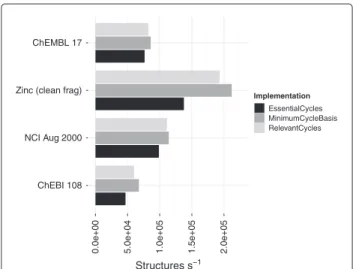
unique cycle sets in time comparable to the non-unique MCB (Figure 12).
The number of cycles found by each set was also mea-sured on the data sets (Table 8). On average the number of cycles found in the unique sets was within 1% of the non-unique MCB. This means in practice the unique sets can readily be used as a replacement for the non-unique MCB. It is however inevitable that some structures will have an infeasible number of relevant cycles. During test-ing, a structure in PubChem-Compound (CID 53389303) was found to contain over 1 million relevant cycles. As the number of relevant cycles can be determined without generating the walks, such structures can be filtered out if desired.
All elementary cycles
The data structures of AllRingsFinder were opti-mised and the timeout replaced with a threshold specific
ChEBI 108 NCI Aug 2000 Zinc (clean frag) ChEMBL 17
0e+00 5e+03 1e+04
Structures s−1
Implementation
EssentialCycles MinimumCycleBasis RelevantCycles
Figure 11Performance comparison of the old MCB, Essential and Relevant cycles.Previously the computation of the MCB is much faster than the essential and relevant cycles. This led to the MCB being favoured for use in other procedures.
ChEBI 108 NCI Aug 2000 Zinc (clean frag) ChEMBL 17
0.0e+00 5.0e+04 1.0e+05 1.5e+05 2.0e+05 Structures s−1
Implementation
EssentialCycles MinimumCycleBasis RelevantCycles
Figure 12Performance comparison of the new MCB, Essential and Relevant cycles.The computation of the unique sets is now comparable to the minimum cycle basis. The performance includes conversion to anadjacencylist representation (Table 2).
to the algorithm [20]. The improvements to the data structures involved representing the path-graph as an incidence-list and using binary sets to test intersec-tion. The algorithm progresses by iteratively reducing (removing) vertices – the order of removal can be prede-termined or dynamic. Using a predeprede-termined order the edges need only be indexed by the next endpoint (i.e. directed). This reduces the number of modifications to the path-graph. Edges are only removed when a vertex is being reduced and all edges can be removed at once from this vertex. As each vertex is reduced the degree on the adjacent vertices may increased. Limiting the maximum degree the algorithm is allowed to reach provides a better threshold to determine feasibility.
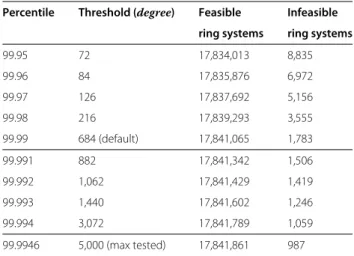
To determine an appropriate threshold the algorithm was run on all fused ring systems found in PubChem Compound (Dec 2012). The maximum degree required to perceive the ring systems was measured for each system. An arbitrarily high value of (deg= 5000) was chosen as an absolute maximum value. It was found that 987 (0.005%) systems would require a threshold larger than maximum
Table 8 The number of cycles in each set
Chemical nstructures MCB Essential Relevant All structure
chebi_108 26,790 56,572 55,687 57,401 ∼126,713
nci_aug00 250,172 599,876 591,144 606,045 ∼1,007,643
zinc_frag 504,074 880,296 875,801 882,393 ∼1,022,498
chembl_17 1,318,180 4,505,285 4,455,907 4,563,027 ∼6,599,942
zinc_leads 5,135,179 - - - ∼14,816,752
Table 9 Ring systems (PubChem-Compound) that were feasibly handled by the improved AllRingsFinder at different thresholds
Percentile Threshold (degree) Feasible Infeasible
ring systems ring systems
99.95 72 17,834,013 8,835
99.96 84 17,835,876 6,972
99.97 126 17,837,692 5,156
99.98 216 17,839,293 3,555
99.99 684 (default) 17,841,065 1,783
99.991 882 17,841,342 1,506
99.992 1,062 17,841,429 1,419
99.993 1,440 17,841,602 1,246
99.994 3,072 17,841,789 1,059
99.9946 5,000 (max tested) 17,841,861 987
5000 to finish. Retrospectively calculating the threshold required for a given percentile showed only a small gain for higher values (Table 9). Even using a small threshold of only 9 allows perception of 99% of the ring systems (Figure 13). The default value (used in benchmarks) was chosen as 684 which from this test would allow the algo-rithm to feasibly complete on ∼99.99% of the systems present in PubChem Compound (Dec 2012).
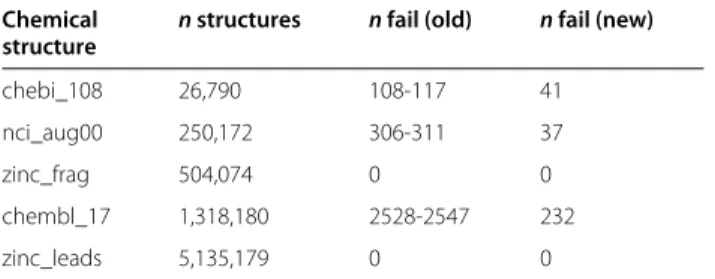
The new threshold still encounters infeasible structures but number found is fewer and does not vary between runs (Table 10). The performance of the new implemen-tation was compared against the old algorithm using a time out of 5 ms (much lower than default). With the small timeout 2,500 structures inchembl_17were con-sidered infeasible by the old implementation whilst using the new implementation with the default threshold only
232 are infeasible. The new algorithm was able to com-pute more cycles (Table 11) in less time (Figure 14). The time taken to find all cycles in chembl_17 pre-viously took ∼9 minutes (with a small threshold) but now takes only∼25 seconds (Table 12). Disregarding the conversion we found that when the computation was fea-sible, determining all cycles was as fast as the smaller subsets.
Additional cycles sets
The shortest cycle through each vertex and edge is also provided as a unique but potentially exponential cycle set. The edge-short cycles has also been termed the Largest Set of Smallest Rings (LSSR) and is utilised within Open Babel [28]. Computation of the sets does not check if the cycles form a basis. This could improve performance but no noticeable change was observed in measurements. The implementations are provided for compatibility.
A TripletCycles utility was also implemented to
improve generation of CACTVS [29] Substructure Keys (PubChemFingerprint). These cycles are the shortest through a vertex triple{u,v,w}and allows generation of cycles for envelope rings such as naphthalene or azulene whilst avoiding larger fused rings. The implementation allows a unique or non-unique set to be generated.
Conclusion
The improved performance in cycle perception means it is now feasible to analyse much larger chemical data sets. This is particularly true of the unique short cycle sets (essential and relevant) which saw an order of magnitude improvement. It is now no longer favourable to utilise the non-unique MCB due to runtime performance. Any pro-cedures incorrectly relying on the MCB to be unique can
0 20 40 60 80 100
5 10 15 20 25 30
D (maximum degree)
T (%)
T = 99%,D = 9
Table 10 Average (n= 15) number of structures
considered infeasible by the old and new implementations
Chemical nstructures nfail (old) nfail (new) structure
chebi_108 26,790 108-117 41
nci_aug00 250,172 306-311 37
zinc_frag 504,074 0 0
chembl_17 1,318,180 2528-2547 232
zinc_leads 5,135,179 0 0
Based on a timeout procedure the number of cycles found in the old procedure varied between repeats, given the same structures the new feasibility threshold does not.
be easily adapted to use the new algorithms. The effi-cient implementation of the relevant cycles could also be adapted to compute a recent descriptor known as Unique Ring Families [30].
Improvements were seen throughout the toolkit with cycle perception being required for core functionality. The new algorithm for cycle membership has been used to improve performance of atom typing and the set of all cycles utilised in aromaticity perception. To avoid a per-formance hit from the old implementation the aromaticity of non-shortest cycles was only perceived for small fused rings systems. The new aromaticity has no restrictions and attempts to perceive aromaticity on all cycles. If com-putation is not feasible the aromaticity perception falls back to a smaller more feasible cycle set. Alternatively the smaller set of cycles could be tested first with the larger set only utilised if potentially aromatic atoms were remaining. Using the optimised representations the set of all cycles is generally faster to compute than the smaller sets and it is preferable to try all and fail fast.
A large portion of the time is spent in converting the CDK objects to optimised representations. Despite this without the conversion the runtime performance is much slower. Further gains could be made by optimising the native data structures and removing the need for conver-sion. The changes required would be large but could be introduced in future releases.
Table 11 Average (n= 15) number of all cycles found in each datasets
Chemical structure nstructures Old New Cycles sdev Cycles sdev
chebi_108 26,790 98,597 199 126,713 0
nci_aug00 250,172 936,625 409 1,007,643 0
zinc_frag 504,074 1,022,498 0 1,022,498 0
chembl_17 1,318,180 6,176,585 378 6,599,942 0
zinc_leads 5,135,179 14,816,752 0 14,816,752 0
Due to the time out the old implementation sometimes provided different counts for each repeat.
ChEBI 108 NCI Aug 2000 Zinc (clean frag) ChEMBL 17 Zinc (clean leads)
0.0e+00 4.0e+04 8.0e+04 1.2e+05 Structures s−1
method
new old
Figure 14Performance comparison when finding all elementary cycles.The performance difference between the old and new implementations for finding all elementary cycles. The performance includes conversion to anincidencelist representation (Table 2).
Availability and requirements
Project Name:The Chemistry Development Kit
Project Home Page:sourceforge.net/projects/cdk/
(ver-sion CDK (development)) or github.com/cdk/cdk (ver(ver-sion 1.5.4 onwards)
Operating System:Platform Independent
Programming Language:Java
Requirements:Java 1.6+
License:Lesser General Public License 2.1
Endnotes
aalternatively known as cyclomatic number, nullity (μ),
frère jacque number, first Betti’s number or bond closures [5].
blinear independence is check with row reduction of a
matrix (Gaussian elimination).
Table 12 Average and median (n= 15) time taken to find all rings using existing and improved implementations of AllRingsFinder
Chemical structure Old New
t(ms) median sdev t(ms) median sdev
t(ms) t(ms)
chebi_108 16,293 16,179 540 599 574 105
nci_aug00 80,417 80,339 319 3,478 3,449 143
zinc_frag 41,854 41,747 458 3,786 3,778 60
chembl_17 568,984 568,809 829 25,200 25,181 99
zinc_leads 661,028 661,368 1133 54,490 54,471 101
Additional files
Additional files 1: Cycle membership benchmark.Performance measurements of determining cycle membership usingSpanningTree andRingSearch.
Additional files 2: Short cycles.Performance measurements of determining short cycles (MCB, essential and relevant) using the old and new implementations.
Additional files 3: All cycles.Performance measurements of determining all cycles using the old and new implementations.
Abbreviations
The following abbreviations have been used in reference to implementation class names in the CDK library. Here we detail the full package name used in library.AllRingsFinder:org.openscience.cdk.ringsearch.AllRingsFinder;
Cycles:org.openscience.cdk.graph.Cycles;MinimumCycleBasis:org. openscience.cdk.graph.MinimumCycleBasis;PubChemFingerprint:org. openscience.cdk.fingerprint.PubChemFingerprint;RingSearch:org. openscience.cdk.ringsearch.RingSearch;SSSRFinder:org.openscience. cdk.ringsearch.SSSRFinder;SpanningTree:org.openscience.cdk.graph. SpanningTree;TripletCycles:org.openscience.cdk.graph.TripletCycles.
Competing interests
The authors declare that they have no competing interests.
Authors’ contributions
JM implemented, benchmarked the ring perception algorithms and wrote the manuscript. CS designed the core library and provides continuous support. Both authors read and approved the final manuscript.
Acknowledgements
This work was supported by Biotechnology and Biological Sciences Research Council CASE studentship [BB/I532153/1]. The authors would like to thank the following persons for their valuable discussions (names are alphabetically ordered): Felicity Allen, Stephan Beisken, Gordon James, Luis de Figueiredo, Pablo Moreno and Kalai Vannai. Additionally we would like to specifically thank Egon Willighagen for his thorough review of CDK additions.
Received: 17 December 2013 Accepted: 27 January 2014 Published: 30 January 2014
References
1. Steinbeck C, Han Y, Kuhn S, Horlacher O, Luttmann E, Willighagen E:The Chemistry Development Kit (CDK): an open-source java library for chemo- and bioinformatics.J Chem Inf Comput Sci2003,43(2):493–500. 2. Steinbeck C, Hoppe C, Kuhn S, Floris M, Guha R, Willighagen E:Recent
developments of the Chemistry Development Kit (CDK) - an open-source java library for chemo- and bioinformatics.CPD2006, 12:2111–2120.
3. Berger F, Flamm C, Gleiss PM, Leydold J, Stadler PF:Counterexamples in chemical ring perception.J Chem Inf Comput Sci2004,44(2):323–331. 4. Downs G, Gillet V, Holliday J, Lynch M:Review of ring perception
algorithms for chemical graphs.J Chem Inf Comput Sci1989, 29(3):172–187.
5. Downs G:Ring Perception, Handbook of Cheminformatics, vol 1. Weinheim: Wiley-VCH; 2003.
6. Willett P:Similarity-based virtual screening using 2D fingerprints. Drug Discovery Today2006,11(23):1046–1053.
7. Daylight:SMARTS - A Language for describing molecular patterns. http://www.daylight.com/dayhtml/doc/theory/theory.smarts.html. 8. Razinger M, Balasubramanian K, Perdih M, Munk M:Stereoisomer
generation in computer-enhanced structure elucidation.J Chem Inf Comput Sci1993,33(6):812–825.
9. Balaban AT:Applications of graph theory in chemistry.J Chem Inf Comput Sci1985,25:334–343.
10. Bolton E, Wang Y, Thiessen P, Bryant S:PubChem: Integrated platform of small molecules and biological activities.InChapter 12 in Annual Reports in Computational Chemistry, Volume 4. Washington: American Chemical Society; 2008.
11. Nikolova-Jeliazkova N:Slow fingerprints?CDK News2005,2(2):34–40. 12. Kruskal JB:On the shortest spanning subtree of a graph and the
traveling salesman problem.Proc Am Math Soc1956,7(1):48–50. 13. Figueras J:Ring perception using breadth-first search.J Chem Inf
Comput Sci1996,36:986–991.
14. RDKit:Cheminformatics and machine learning software 2014.http:// www.rdkit.org.
15. Hastings J, Matos PD, Dekker A, Ennis M, Harsha B, Kale N, Muthukrishnan V, Owen G, Turner S, Williams M, Steinbeck C:The ChEBI reference database and ontology for biologically relevant chemistry: enhancements for 2013.Nucleic Acids Res2013,41(D1):456–463. 16. National Cancer Institute (NCI) Database Download.http://cactus.nci.
nih.gov/download/nci/.
17. Irwin J, Sterling T, Mysinger M, Bolstad E, Coleman R:ZINC: A free tool to discover chemistry for biology.J Chem Inf Model2012,52(7):1757–1768. 18. Gaulton A, Bellis LJ, Bento AP, Chambers J, Davies M, Hersey A, Light Y,
Mcglinchey S, Michalovich D, Al-Lazikani B, Overington JP:ChEMBL: a large-scale bioactivity database for drug discovery.Nucleic Acids Res 2012,40(D1):1100–1107.
19. Weininger D:SMILES, A chemical language and information system. 1. Introduction to methodology and encoding rules.J Chem Inf Comput Sci1988,28(1):31–36.
20. Hanser T, Jauffret P, Kaufmann G:A new algorithm for exhaustive ring perception in a molecular graph.J Chem Inf Comput Sci1996, 36(6):1146–1152.
21. Rahman S, Bashton M, Holliday GL, Schrader R, Thornton JM:Small Molecule Subgraph Detector (SMSD) toolkit.J Cheminformatics2009, 1(1):12.
22. Sedgewick R, Wayne K:Graphs, Algorithms, 4th edn. Boston: Addison Wesley; 2011.
23. Skiena SS:Minimum spanning tree, Graphs, The Algorithm Design Manual. New York: Springer; 1997.
24. Hopcroft J, Tarjan R:Efficient algorithms for graph manipulation. Commun ACM1973,16(6):372–378.
25. Schwerdtfeger P, Wirz L, Avery J:Program FULLERENE: a software package for constructing and analyzing structures of regular fullerenes.J Comput Chem2013,34(17):1508–1526.
26. Vismara P:Union of all the minimum cycle bases of a graph.Electr J Comb1997,4:73–879.
27. Horton JD:A polynomial-time algorithm to find the shortest cycle basis of a graph.SIAM J Comput1987,16(2):358–366.
28. O’Boyle NM, Banck M, James CA, Morley C, Vandermeersch T, Hutchison GR:Open Babel: an open chemical toolbox.J Cheminformatics2001, 3(1):33.
29. Ihlenfeldt W, Takahashi Y, Abe H, Sasaki S:Computation and management of chemical properties in CACTVS: an extensible networked approach toward modularity and compatibility.J Chem Inf Comput Sci1994,34(1):109–116.
30. Kolodzik A, Urbaczek S, Rarey M:Unique ring families: a chemically meaningful description of molecular ring topologies.J Chem Inf Model2012,52(8):2013–2021.
doi:10.1186/1758-2946-6-3
![Table 4 Average (n = 50) time taken to determine ring membership in several complex structures from ChEBI and FULLERENE [25] Chemical structure SpanningTree RingSearch t (ms) sdev t (ms) sdev cubane (CHEBI:33014) 1.18 1.24 0.21 0.66 dodecaboride (CHEBI:517](https://thumb-us.123doks.com/thumbv2/123dok_us/7883492.2101068/7.892.457.810.708.976/determine-membership-structures-fullerene-structure-spanningtree-ringsearch-dodecaboride.webp)