CAAL 5/2/2013 Agenda Item 3n
Trident Technical College, A.A.S., Homeland Security Management, Program Proposal, CAAL 5/2/2013
New Program Proposal
Associate in Applied Science, Homeland Security Management
Trident Technical College
Summary
Trident Technical College requests approval to offer a program leading to the Associate
in Applied Science degree with a major in Homeland Security Management
to be implemented
in Fall 2013. The proposed program is to be offered through traditional instruction on campus.
Trident Technical College currently offers an Associate in Applied Science degree with a major
in Criminal Justice and certificates in Law Enforcement, Corrections, Crime Scene
Investigation, and Emergency Management and Protection. The following chart outlines the
stages for approval of the proposal; the Advisory Committee on Academic Programs (ACAP)
voted to recommend approval of the proposal to the Committee on Academic Affairs and
Licensing (CAAL). The full program proposal
is attached.
Stages of Consideration
Date
Comments
Program Planning Summary
received and posted for
comment
11/1/2012
Program Planning Summary was accepted
without comments or questions.
Program Planning Summary
considered at ACAP
12/15/2012
Planning Summary was accepted without
comments.
Program Proposal Received
1/15/2013
Program Proposal posted to
ACAP members for review
2/28/2013
Program Proposal accepted without comment
or question.
ACAP Consideration
3/21/2013
Discussion about use of “terminal degree” in
the description of the program. ACAP
members recommended that the institution
not use the label terminal degree because
many students will continue their studies in
bachelor’s degree programs. There were no
objections.
Received revised Program
Proposal
4/3/2013
Revisions addressed terminology and
objectives of the program.
Recommendation
The staff recommends that the Committee on Academic Affairs and Licensing commend
favorably to the Commission the program leading to the Associate in Applied Science degree
with a major in Homeland Security Management at Trident Technical College, to be
implemented in Fall 2013, provided that no additional “unique cost” or other special state
funding be required or requested.
SOUTH CAROLINA TECHNICAL COLLEGE SYSTEM
New Program Proposal Form
College Name Trident Technical College
Program Title Associate in Applied Science, with a major in Homeland Security Management
CIP Code 43.0301 Credit Hours 66
Academic Unit Law-Related Studies
Implementation Date (Proposed) Fall 2013 Local Area Commission Approval Date:
Questions about this program proposal should be directed to Shawn K. Livingston Phone: 843-574-6895 Email: [email protected]
President’s Signature _________________________________________ Date _______________________ CAO Signature ____________________________________________ Date _______________________ CBO Signature ____________________________________________ Date _______________________
I. Proposal Narrative: Justification
a) State the purpose(s) and objectives of the program. Provide details on the employment for which graduates will be prepared.
Trident Technical College (TTC) proposes to offer an Associate in Applied Science, major in Homeland Security Management (HSM). The program is designed to develop the knowledge, skills and abilities needed for leadership in homeland security. Homeland security is a broad field that includes international and domestic terrorism, infrastructure protection, strategic planning for security, international relations, intelligence operations and evaluation and program management. These skills can be applied in a variety of career fields, including but not limited to police, fire, emergency medical, public health and emergency management.
The program will prepare candidates for employment in several positions such as transportation security officers, mission support specialists, border patrol agents, and program analysts.
b) Explain how the program will support and/or complement the college’s mission?
TTC serves as a catalyst for personal, community and economic development by empowering individuals through education and training. The proposed HSM degree will support the college’s mission by providing affordable education leading to employment in a growing field in TTC’s service area. In addition, this program will enable those currently working in emergency, protective services and law enforcement careers an opportunity to earn a new credential that will enhance their job skills and foster continued professional development.
c) Discuss general student interest in the program.
Many students currently taking criminal justice courses have expressed interest in HSM course work. In fact, the Criminal Justice department created the Emergency Management and Protection certificate in 2009 as a way to provide students with some programming related to homeland security.
Additionally, interest for the proposed program will likely come from a recent partnership between TTC and the Transportation Security Agency (TSA). At present, less than nine percent of TSA employees have completed college-level course work. In an effort to provide additional training for employees, TSA began working nationally with community colleges to develop courses in Homeland Security for their more than 2,700 transportation security officers. To that end, the Department of Homeland Security and TTC recently established a non-credit training program for the TSA. The first cohort of 16 TSA graduates completed programming in spring 2012. TTC anticipates starting a new cohort in Fall 2013.
d) Discuss local, state, and national employment trends for program-specific occupations. Include full-time and part-time wage information at the state and regional/national level.
The average median salary for protective services jobs according to the U.S. Department of Labor (2011) is $20.54 per hour or $42,730 annually. The median income in South Carolina is $15.61 per hour or $32,480 annually. Salaries in the HSM field may vary due to company, location, industry, experience and benefits.
An article in the April 18, 2011 edition of Community College Week titled, “ Community Colleges Embrace New Homeland Security Paradigm,” noted that community colleges credential more than 80 percent of the nation’s traditional first responders — police officers, firefighters and emergency medical technicians. The article also pointed out that in a desultory economy, homeland security stands out as a rare growth industry. The U.S. Department of Labor estimates that between 2004 and 2014, more than 700,000 jobs will be created in the areas of law enforcement, private security and emergency management.
The potential for employment in TTC’s is indicated by several factors. First, an ad hoc advisory committee, which included eight representatives of county EMS, fire, law enforcement and emergency management services, met in January 2012 to discuss the program. All participants agreed that there would be job opportunities for graduates of the program. Second, Charleston has one of the busiest ports on the east coast, a relatively large and active international airport and a large military presence. Third, the region is threatened by the potential for natural disasters, in the form of both earthquakes and tropical weather systems. These factors suggest that TTC’s service area is more likely than most to develop jobs related to homeland security.
e) Include a list of all related existing programs within the institution. Compare/contrast the proposed program to related programs.
The proposed program will be offered by the college’s Law-Related Studies (LRS) division, which currently offers an Associate in Applied Science, with a major in Criminal Justice, as well as certificates in Law Enforcement, Corrections, Crime Scene Investigation, and Emergency Management and Protection. The proposed HSM degree has some similarities with Criminal Justice, but the two fields have different emphases. Criminal justice is the study of police, corrections, and legal functions, each of which is a specialization within the study of criminal justice. Criminal justice courses can also incorporate psychological theory as well as biological/genetic theories of behavior. HSM primarily focuses on
investigation, interception, and detection of external threats (e.g., customs, immigration, smuggling, foreign terrorist threats), as well as domestic crimes against persons and property. Additionally, homeland security emphasizes strategic, political, legal, policy and organizational challenges associated with homeland defense.
f) Compare/contrast the program to those with similar objectives at other SC technical colleges. Where possible, summarize enrollment, graduates, and placement rates for existing programs. This information can be found in the State Board’s annual 2010 Program Evaluation Report.
The proposed program will be the first model of its kind for the SC Technical College System. Three colleges – Central Carolina, Midlands, and Greenville – offer associate degrees in Criminal Justice Technology. However, none offers coursework in homeland security. The HSM degree would prepare students in decision making, problem solving and planning, implementing and coordinating resources necessary for preparedness, mitigation, response and recovery from all hazards. Those benefiting from the degree in homeland security would include first responders, firefighters, military personnel, corrections and law enforcement professionals, as well as emergency managers, and health care professionals as well as corporate and government employees.
g) Discuss any existing articulation or collaborative agreements in related program areas with other SC technical colleges.
N/A
h) Indicate whether this is a terminal degree program (occupational in intent). If there is potential for students to transfer into a baccalaureate program, provide narrative on the progress to date concerning articulation agreements with potential transfer institutions.
The HSM program is designed primarily as a terminal degree preparing students for employment upon graduation. There are currently no baccalaureate degrees in Homeland Security in South Carolina. However TTC is open to discussing possible articulation agreements for related programs at senior institutions. TTC currently has a 2+2 agreement with The Citadel leading to a BS in Criminal Justice. The Citadel has expressed an interest in developing programs in Homeland Security, but no formal discussion about articulation has begun.
i) Briefly summarize/analyze the needs survey results. For at least a three-year period, estimate the anticipated number of full-time and part-time openings. Discuss any specific employer interests and support for the program.
TTC contacted 47 potential employers (federal, state, and local) in the local service area for the needs assessment survey. Based on the survey results, it is evident that there is a need for the proposed degree and a great demand for graduates from the program. According to the responses received there are more than adequate openings for graduates from the proposed program. A total of 35 part-time openings and 186 full-time openings were identified over the next three years.
Year One Year Two Year Three
Part-time openings 15 15 10
Full-time openings 63 63 60
II. Proposal Narrative: Enrollment
a) Explain the program admissions criteria.
Admission to this program will require proof of high school graduation (or GED) and appropriate scores on TTC's placement test, SAT or ACT. Before taking any courses in the program, students must successfully complete any remedial or bridge-level reading courses indicated by their test scores.
b) State the anticipated total number of enrollment for the first year of the program. Include the total number of transfer students from other internal programs and new students to the institution. Provide the estimated attrition rate and explain possible causes of attrition. Also include the anticipated number of graduates from the program.
Anticipated Total Enrollment: 30 Total # of Transfer: 10/yr Total # of New: 20/yr Estimated Attrition Rate: 50%
Estimated Graduation Rate : 50%
The attritition rate for this program is based on TTC's college-wide fall to fall attrition. The program anticpates graduating 15 students each year beginning in 2014.
c) Based on the information above, complete enrollment tables A and B below. Note: Table B should include enrollment numbers for new students only.
TABLE A: PROJECTED TOTAL ENROLLMENT
YEAR FALL SPRING SUMMER
HEADCOUNT CREDIT HRS HEADCOUNT CREDIT HRS HEADCOUNT CREDIT HRS
2013 30 450 30 450 30 360
2014 45 630 45 630 30 360
2015 45 630 45 630 30 360
TABLE B: ESTIMATED ADDITIONAL ENROLLMENT (NEW STUDENTS ONLY)
YEAR FALL SPRING SUMMER
HEADCOUNT CREDIT HRS HEADCOUNT CREDIT HRS HEADCOUNT CREDIT HRS
2013 20 300 20 300 25 240
2014 20 300 20 300 25 240
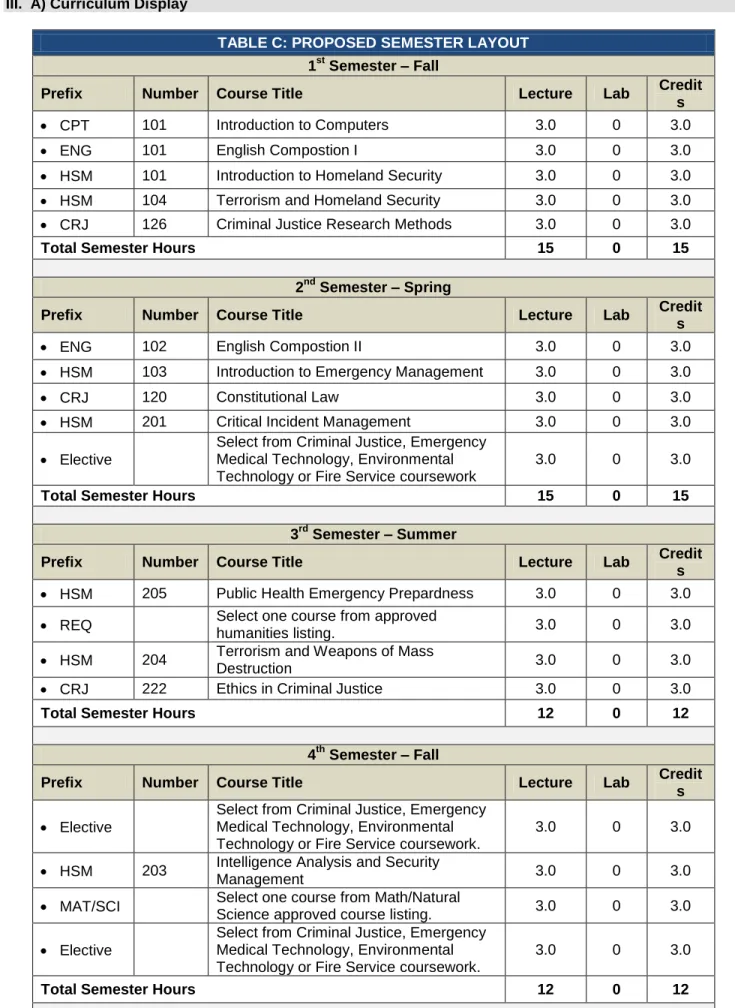
III. A) Curriculum Display
TABLE C: PROPOSED SEMESTER LAYOUT
1st Semester – Fall
Prefix Number Course Title Lecture Lab Credit
s
CPT 101 Introduction to Computers 3.0 0 3.0
ENG 101 English Compostion I 3.0 0 3.0
HSM 101 Introduction to Homeland Security 3.0 0 3.0
HSM 104 Terrorism and Homeland Security 3.0 0 3.0
CRJ 126 Criminal Justice Research Methods 3.0 0 3.0
Total Semester Hours 15 0 15
2nd Semester – Spring
Prefix Number Course Title Lecture Lab Credit
s
ENG 102 English Compostion II 3.0 0 3.0
HSM 103 Introduction to Emergency Management 3.0 0 3.0
CRJ 120 Constitutional Law 3.0 0 3.0
HSM 201 Critical Incident Management 3.0 0 3.0
Elective
Select from Criminal Justice, Emergency Medical Technology, Environmental Technology or Fire Service coursework
3.0 0 3.0
Total Semester Hours 15 0 15
3rd Semester – Summer
Prefix Number Course Title Lecture Lab Credit
s
HSM 205 Public Health Emergency Prepardness 3.0 0 3.0
REQ Select one course from approved
humanities listing. 3.0 0 3.0
HSM 204 Terrorism and Weapons of Mass
Destruction 3.0 0 3.0
CRJ 222 Ethics in Criminal Justice 3.0 0 3.0
Total Semester Hours 12 0 12
4th Semester – Fall
Prefix Number Course Title Lecture Lab Credit
s
Elective
Select from Criminal Justice, Emergency Medical Technology, Environmental Technology or Fire Service coursework.
3.0 0 3.0
HSM 203 Intelligence Analysis and Security
Management 3.0 0 3.0
MAT/SCI Select one course from Math/Natural
Science approved course listing. 3.0 0 3.0
Elective
Select from Criminal Justice, Emergency Medical Technology, Environmental Technology or Fire Service coursework.
3.0 0 3.0
TABLE C: PROPOSED SEMESTER LAYOUT
5th Semester – Spring
Prefix Number Course Title Lecture Lab Credit
s
HSM 202 Transportation and Border Security 3.0 0 3.0
PSC 201 or 215
American Government/State and Local
Government 3.0 0 3.0
Elective
Select from Criminal Justice, Emergency Medical Technology, Environmental Technology or Fire Service coursework.
3.0 0 3.0
Elective
Select from Criminal Justice, Emergency Medical Technology, Environmental Technology or Fire Service coursework.
3.0 0 3.0
Total Semester Hours 12 0 12
PROGRAM TOTALS 66 0 66
b) If applicable, provide the course title and description for all new courses that will be added to the college’s local catalog. Place an asterisk (*) beside those that will also be new to the SBTCE Statewide CAC.
*HSM 101 Introduction to Homeland Security
This course is an overview of homeland security as an interdisciplinary system. The components of the homeland security system and their relationships will be examined, including law enforcement,
intelligence, transportation and border security, emergency management and public health preparedness. *HSM 103 Introduction to Emergency Management
This course includes an overview of the management techniques for establishing and maintaining an emergency management system in the public sector. Students will be introduced to the four functions of emergency management (mitigation, preparedness, response, and recovery) and the emergency manager's role in each.
*HSM 104 Terrorism and Homeland Security (Currently CRJ 239)
This course provides an overview of the issues of terrorism and Homeland Security efforts by drawing on several disciplines. An emphasis is placed on problems and countermeasures within an all-hazards approach to protecting people and assets in conjunction with criminal justice agencies.
*HSM 201 Critical Incident Management
This course explores the management and leadership principles necessary for the successful resolution of critical incidents. The National Incident Management System and the Incident Command System will be examined to provide an all hazard, interdisciplinary approach to critical incident management.
*HSM 205 Public Health Emergency Preparedness
This course provides in depth examination of preparedness activities for disasters that directly affect the public health system. Specific public health emergency types will be examined, their threats defined and procedures for prevention, immediate action and recovery and management of aftermath explored. *HSM 204 Terrorism and Weapons of Mass Destruction
This course examines terrorist tactics involving weapons of mass destruction and responses to these types of incidents. Topics include chemical, biological, radiological and explosive weapons as well as the hazards to the public and first responders.
*HSM 203 Intelligence Analysis and Security Management (Currently CRJ 245)
This course examines intelligence analysis and its relationship to the security management of terrorist attacks, man-made disasters and natural disasters and the related vulnerabilities of our national defense and private sectors. Students will discuss issues regarding intelligence support of homeland security measures implemented by the United States and explore how the intelligence community operates.
Prereq: CRJ 239 (Proposed HSM 104)
*HSM 202 Transportation and Border Security (Currently CRJ 241)
This course provides an in-depth view of modern border and transportation security. Specific topics include security for seaports, ships, aircraft, trains, trucks, pipelines, buses, etc. as well as the technology needed to detect terrorists and their weapons. Includes discussion on legal, economic, political, and cultural aspects of the problem.
c) Provide a brief explanation of the planned assessments of student learning outcomes that will be used.
Course-level assessment of student learning outcomes will include tests, papers, projects and presentations, with common assignments and final exams for multiple sections of the same course. Program-level assessment will employ TTC's Curriculum Assessment Plan, which requires identification of program-level learning outcomes, where in the program the outcomes are assessed, methods for assessment, expected levels of performance, data collection, results, and plans for improvement. Program learning outcomes for Homeland Security Management include the following:
Identify the threats from terrorism and apply the concepts of intelligence analysis.
Explain the four principles of emergency management and their impacts on local planning and practices in homeland security preparedness.
d) If the program requires clinical support, provide narrative demonstrating that the college has secured commitments from service area employers to support an adequate number of
clinical/work experience sites (i.e. should meet the needs of the number of students displayed in the enrollment charts).
IV. Proposal Narrative: Faculty
a) List all administration, faculty, and staff positions that will support the program. Do NOT include individual names. Instead, list the position title and indicate if it is a new or existing position. Explain any changes or additions to existing positions (e.g. shared department heads, administrative
assistants, etc.)
- Administration
Department Head for Criminal Justice (existing position-5% of job duties). - Faculty
1 New full-time faculty postion (1st year; 3 adjunct faculty beginning 2014). - Staff
Divisional Administrative assistant (existing position-5% of job duties).
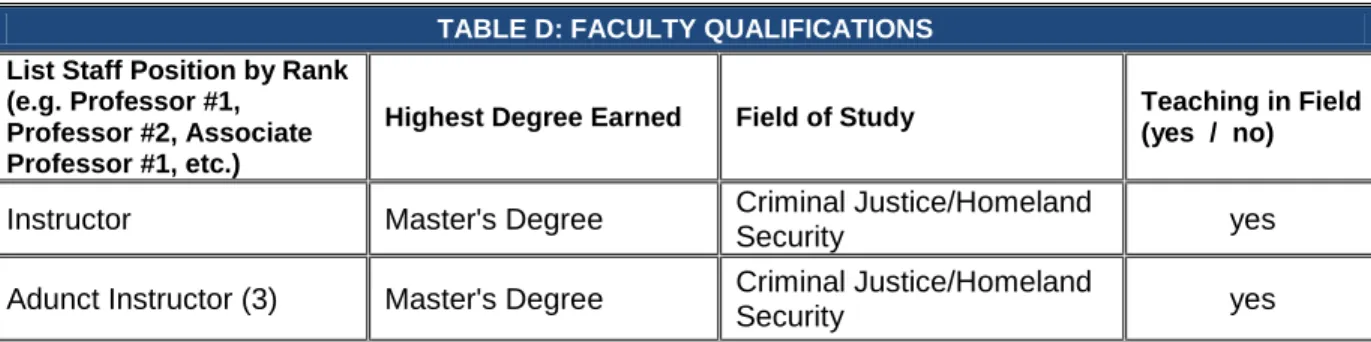
b) Complete the chart below outlining required qualifications for each faculty position listed above. TABLE D: FACULTY QUALIFICATIONS
List Staff Position by Rank (e.g. Professor #1,
Professor #2, Associate Professor #1, etc.)
Highest Degree Earned Field of Study Teaching in Field
(yes / no)
Instructor Master's Degree Criminal Justice/Homeland
Security yes
Adunct Instructor (3) Master's Degree Criminal Justice/Homeland
Security yes
c) Discuss institutional plans for faculty development, including, but not limiting discussion to release time for research, consulting, conferences, or curriculum development.
TTC supports faculty development in the form of travel, conference attendance, in-house professional development activities, and tuition assistance for college coursework. Faculty teaching in the HSM program will attend appropriate state and national conferences. Additionally, faculty will work with a local advisory committee made up of key emergency management leaders in Berkeley, Charleston and Dorchester counties.
d) Provide definitions for faculty full-time equivalents (FTE).
Normal full-time faculty load for instructors is 15-18 credit hours. All full-time faculty members count as 1 FTE; FTE generated by part-time faculty is calculated by credit hours taught by part time faculty divided by 15.
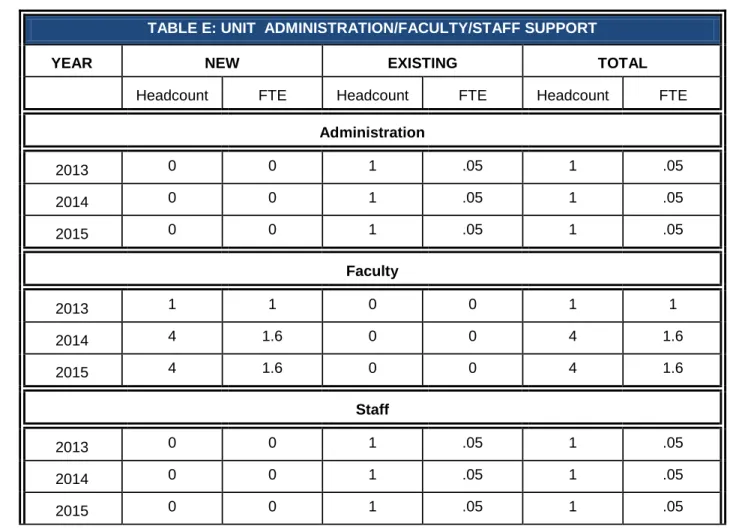
e) Complete the chart below to include ALL positions listed in question A.
Note: All new positions should be placed in the ‘New’ column and remain in the ‘New’ column for each subsequent program year. The same applies for all existing positions. A detailed example can be found in the “Faculty” module on T-Web.
TABLE E: UNIT ADMINISTRATION/FACULTY/STAFF SUPPORT
YEAR NEW EXISTING TOTAL
Headcount FTE Headcount FTE Headcount FTE
Administration 2013 0 0 1 .05 1 .05 2014 0 0 1 .05 1 .05 2015 0 0 1 .05 1 .05 Faculty 2013 1 1 0 0 1 1 2014 4 1.6 0 0 4 1.6 2015 4 1.6 0 0 4 1.6 Staff 2013 0 0 1 .05 1 .05 2014 0 0 1 .05 1 .05 2015 0 0 1 .05 1 .05
Trident Technical College, A.A.S., Homeland Security Management, Program Proposal, CAAL 5/2/2013 - Page V. Proposal Narrative: Physical Plant
a) Discuss physical plant requirements, indicating any needs for additional physical plant space within the first three years of program operation. Explain any costs associated with the acquisition of physical plant space for the program.
The program will require office space for one full-time faculty member, but no additional physical plant costs.
VI. Proposal Narrative: Equipment
a) Discuss equipment needs for the program and explain the planned sources of funding for equipment. Not applicable
b) Itemize each piece of equipment that exceeds $5,000. Not applicable
VII. Proposal Narrative: Library Resources
a) Provide a quantitative analysis of the current library resources related to the proposed program in adherence to a standard guide (e.g. the ALA Standards for College Libraries). Compare/contrast with the holdings of other institutions who have programs with similar objectives.
TTC has a good variety of library resources (i.e. journals, newspapers, films, and books) . General Subject Databases currently include Academic OneFile, AP NewsMonitor Collection , eBook Collection, Films on Demand (academic videos), General Onefile, LearningExpress Library, Opposing Viewpoints in Context, and the Points of View Reference Center, any of which can be used to access current information on Homeland Security and related issues. Additionally, the PASCAL service provides for access to all academic library collections in the state. An instructor or student can get almost any title in the state (not in our collection) within a couple of days.
b) Discuss current library holdings in relation to the proposed program. Provide as many program-specific examples as possible of relevant resources currently available at the institution (e.g. The Mechatronics Handbook… for a new Mechatronics program).
TTC currently utilizes several databases that include but are not limited to Military & Government Collections, AP News Monitor Collection, Opposing Viewpoints, Lexis Nexis, Films on Demand, and General One
file/Acedemic One File). All are updated very regularly, some even daily
.
These resources are loaded with various newspaper and journal articles, documents and other scholary documents.In addition to existing databases, the college has several e-books and print titles related to the proposed program.
eBooks:
No Greater Threat : America After September 11 and the Rise of a National Security State - By: Michaels, C. William. 2005.
Subjects: POLITICAL SCIENCE / Law Enforcement; POLITICAL SCIENCE / Political Freedom & Security /; Terrorism; Civil rights
Community Preparedness and Response to Terrorism. 2, The Role of Community Organizations and Business - By: Johnson, James A.; Kennedy, Michael H.; Delener, Nejdet. 2005.
Subjects: SOCIAL SCIENCE / Disasters & Disaster Relief; NATURE / Natural Disasters; Terrorism--United States--Prevention; Emergency management--United States; Civil defense--United States; Community organization--United States; Preparedness--United States
Review of EPA Homeland Security Efforts : Safe Buildings Program Research Implementation Plan National Academies, Press. 2003.
Subjects: ARCHITECTURE / Buildings / Public, Commercial & Industrial; Public buildings--Security measures--United States--Environmental aspects; Civil defense--United States; National security--United States; Terrorism--Environmental aspects
Making Twentyfirstcentury Strategy: An Introduction to Modern National Security Processes and Problems -By: Drew, Dennis M.; Snow, Donald M. 2006.
Subjects: Strategy; National security
Print Titles:
Willful neglect: the dangerous illusion of homeland security – by Faddis, Charles S. Publication: Lyons Press 2010
Subjects: National Security, Civil Defense
Cyber war : the next threat to national security and what to do about it 1st ed. – by Clarke, Richard A. Publication: Ecco. 2010
Subjects: Cyberterrorism, Information Warfare, Computer Crimes Should the U.S. close its borders? – by Haugen, David
Publication: Greenhaven Press. 2010 Subjects: Terrorism and Border Control
c) Explain any costs associated with library resources for the first three years of the program (e.g. books, AV, serials).
The current ebook collection for topics such as (i.e. homeland security, terrorism, weapon systems), are about 5 years old. TTC plans to add to the existing collection of ebooks. Purchases would include full text titles, allowing 24/7 access to multiple students (as opposed to one person checking something out). TTC estimates spending approximately $500 per year for the first three years (i.e., total $1500).
VIII. Proposal Narrative: Accreditation, Licensure, or Certification
a) Explain whether the program is subject to specialized or professional accreditation/approval by any state, regional, or national agency (other than the Commission on Higher Education).
Not applicable
b) If so, discuss plans to seek such accreditation, including the timeline. Estimate any costs associated with the accreditation plans (within the first three years of the program).
Not applicable.
c) Discuss any licensure or certification requirements for graduates and the extent to which the program will prepare graduates for these exams.
Trident Technical College, A.A.S., Homeland Security Management, Program Proposal, CAAL 5/2/2013 - Page IX. Proposal Narrative: Estimated Costs
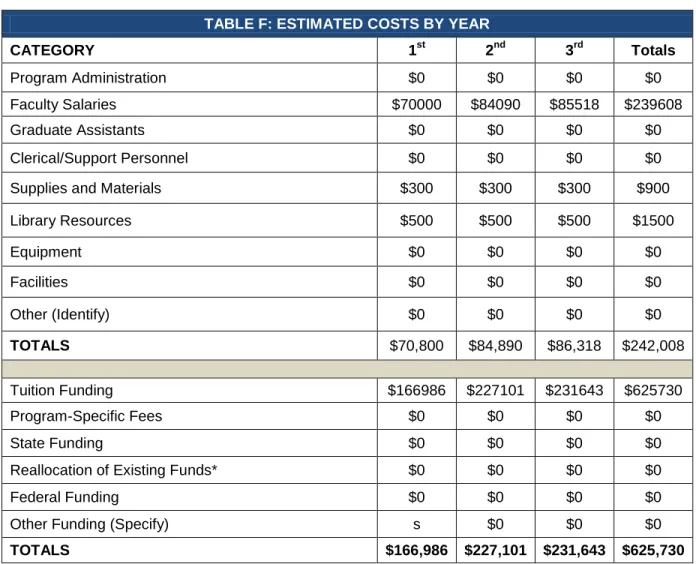
a) Complete the chart below to include estimated costs.
TABLE F: ESTIMATED COSTS BY YEAR
CATEGORY 1st 2nd 3rd Totals
Program Administration $0 $0 $0 $0
Faculty Salaries $70000 $84090 $85518 $239608
Graduate Assistants $0 $0 $0 $0
Clerical/Support Personnel $0 $0 $0 $0 Supplies and Materials $300 $300 $300 $900 Library Resources $500 $500 $500 $1500 Equipment $0 $0 $0 $0 Facilities $0 $0 $0 $0 Other (Identify) $0 $0 $0 $0 TOTALS $70,800 $84,890 $86,318 $242,008 Tuition Funding $166986 $227101 $231643 $625730 Program-Specific Fees $0 $0 $0 $0 State Funding $0 $0 $0 $0
Reallocation of Existing Funds* $0 $0 $0 $0
Federal Funding $0 $0 $0 $0
Other Funding (Specify) s $0 $0 $0
TOTALS $166,986 $227,101 $231,643 $625,730
*Specify significant internal sources of reallocated funds. (Add additional rows as necessary.)
b) Explain any “unique costs” or requirements/requests for special state appropriations will be required or requested?
Not applicable.
c) Identify other funding sources, as noted in the last line of the estimated costs table.
Not applicable