Speed Optimizations in Bitcoin Key Recovery Attacks
Nicolas Courtois
University College London
[email protected]
Guangyan Song
University College London[email protected]
Ryan Castellucci
White Ops[email protected]
ABSTRACT
In this paper we study and give the first detailed benchmarks on existing implementations of the secp256k1 elliptic curve used by at least hundreds of thousands of users in Bitcoin and other cryptocurrencies. Our implementation improves the state of the art by a factor of 2.5, with focus on the cases where side channel attacks are not a concern and a large quantity of RAM is available. As a result, we are able to scan the Bitcoin blockchain for weak keys faster than any previous implementation. We also give some examples of passwords which have we have cracked, showing that brain wallets are not secure in practice even for quite complex passwords.
Keywords
Bitcoin, Elliptic Curve Cryptography, Crypto Currency, Brain Wallet
1.
INTRODUCTION
Bitcoin is a cryptocurrency, an electronic payment system based on cryptography. It was created by Satoshi Nako-moto1 in 2008 [13]. In 2009, Bitcoin was launched as open-source software. Bitcoin is designed to be a fully decen-tralised peer-to-peer network — self-governing without sup-port from trusted entities such as banks or governments. Bitcoin transactions are like checks but signed cryptographi-cally instead of using ink. Transactions are broadcast to the peer-to-peer network and verified by each node. A public ledger called a ”blockchain” records transactions pseudony-mously.
Ownership of bitcoins implies that a user can spend bit-coins associated with a specific address (equivalent to a bank account). In order to spend the coins, a payer must digitally sign the transaction using their private key. The signed transaction is then broadcast to the peer-to-peer network. 1
It is not known whether Satoshi Nakomoto is a real or pseudonym name or if it represents one person or a group
Everyone on the network can verify the signature that has been sent out. Anyone can spend all the bitcoin in a bit-coin address as long as they hold the cosponsoring private key. Once the private is lost, the bitcoin network will not recognize any other evidence of ownership.
Bitcoin uses digital signature protect the ownership bit-coin and private key is the only evidence of owning bitbit-coin. Thus it is very important to look at the technical details of the digital signature scheme used in bitcoin.
1.1
Structure of the paper
In this paper we study and give the first detailed bench-marks on existing secp256k1 elliptic curve implementations used in Bitcoin. Section 2 introduces background knowledge about elliptic curve cryptography and brain wallets. Section 3 reviews previous research work in this area. Section 4 gives detailed benchmark for existing method and our own imple-mentation. Our implementation improves the state of the art by a factor of 2.5. Section 5 is the conclusion of this paper.
2.
BACKGROUND
2.1
Elliptic Curve Cryptography
Elliptic curve cryptography (ECC) was independently pro-posed by Neal Koblitz[11] and Victor Miller [12] in 1985. It is a public-key cryptography protocol where each of the par-ticipant has a pair of keys. There is one private key which is kept as a secret by the owner and one public key which can be shared with anyone. In the past 10+ years ECC has been increasingly used in practise since its inclusion in standards by organisations such as ISO, IEEE, NIST, NSA etc. Elliptic curves are more efficient and offer smaller key sizes at the same security as other widely adopted public key cryptography schemes such as RSA [14].
An Elliptic Curve over finite fieldFp where p is a large
prime, can be formed by choosing the variables a and b within the field Fp. The elliptic curve includes all points
(x, y) which satisfy the elliptic curve equation modulo p (where x and y are numbers inFp). It is typically defined
in the short Weierstrass form:
y2 modp=x3+ax+bmodp
wherea, b∈Fp satisfy 4a3+ 27b2 modpis not 0, which
guaranteesx3+ax+bcontains no repeated factors and then the elliptic curve can be used to form a group. The elliptic curve contains all pointsP= (x, y) forx, y∈Fpthat satisfy
the elliptic curve equation and together with a special point
∞call the point at infinity2.
The elliptic curve used in Bitcoin is called secp256k1. Secp256k1 curve is proposed in Certicom [7] in addition to NIST curve for 256 bits prime. It is defined over prime field
Fpwhere
p= 2256−232−29−28−27−26−24−1 The curve equationEis y2=x3+ax+bwherea= 0 and b= 7.
2.1.1
Key Pair Generation
An elliptic curve key pair is associated with a particular set of valid domain parameters [10]. Let E be an elliptic curve defined over a finite field Fp. Let P be a point in
E(Fp), and suppose that P has prime ordern. Then the
cyclic subgroup ofE(Fp) generated byP is
hPi={∞, P,2P,3P, . . . ,(n−1)P}
The prime p, the equation of the elliptic curveE, the point P and its order n are the public domain parameters. A private key is an integer d that is selected uniformly at random from the interval [1, n−1], and the corresponding public keyQ=dP.
Algorithm 1Key pair generation [10] Input: Domain parametersD= (p, E, P, n) Output: Public keyQ, private keyd
1: Selectd∈R[1, n−1].
2: ComputeQ=dP. 3: Return (Q, d).
Note that the process of computing a private keydgiven public keyQis exactly the elliptic curve discrete logarithm problem (ECDLP). Hence it is very important to chose a set of domain parameters so that the ECDLP is hard to solve. In addition the numberd should berandom in the sense that it should have large entropy AND there should be no way to distinguish a source which produces these values from a source which generates them uniformly at random. In particular the min-entropy should also be high and there should be no efficient guessing strategy of any sort.
2.2
Brain Wallet
A Bitcoin wallet is a collection of Bitcoin addresses and stores the corresponding keys for those addresses. Bitcoin wallets come in different forms, including desktop software, mobile apps, online services, hardware, smart card and pa-per.
As we discussed earlier in section 2.1.1, the private key is a number which we presume to be totally random. Normally the private key will be a long hex string which is very hard for a person to remember and store safely. No matter what form of wallet you are using, there always exists a chance that you might lose your wallet in a cybersecurity breach.
Brain wallets are another solution, which do not need the users to keep anything in safe and still be able to recover 2In code implementation,∞is normally be represented as point (0,0), but not always, as (0,0) might on the curve.
their private key. Instead of storing the private key and protecting it, one can store it in a human mind. A brain wallet creates private key from a (typically) human chosen password or a passphrase, using the SHA-256 hash algorithm turn it into a 256-bit number. As SHA-256 is deterministic method, users can always use the same password to recreate their private key. Note that since brain wallets use the hash directly as the private key, the security of storing private keys now depends only on how unpredictable the passwords are.
3.
RELATED WORK
We are not the first ones try to crack Bitcoin brain wal-lets, a lot of other security researchers are doing it. Many victims have found their money stolen and posted it in fo-rums. The first ethical/research brain wallet cracker was an-nounced publicly in a recent hacking conference DEF CON 23 (Aug 2015). Ryan Castellucci, a whitehat hacker pre-sented his research on cracking brain wallets, and also pub-lished his software [6]. Ryan’s attack was done on an Intel i7 PC with 4 hyper-threaded cores. The attack speed can reach approximately 16,250 password per second on each thread and he had cracked more than 18,000 brain wallet addresses. The software Ryan has published uses an existing open source secp256k1 bitcoin elliptic curve implementation mainly written by Pieter Wuille, one of Bitcoin core developers. This implementation is widely used in Bitcoin clients and is considered the current best in terms of code level optimisa-tion (detailed benchmarks are given in table 2).
Later Vasek et al. published their cybercrime analysis results on brain wallets addresses cracked using Ryan’s soft-ware implementation in FC 2016. Their work were more focused on brain wallets usage measurements and did not try to improve the speed of the attack.
4.
SPECIAL DESIGNED POINT
MULTIPLI-CATION METHOD FOR ATTACK
The process of cracking Bitcoin brain wallets is to repeat-edly generate public keys using guessed passwords. Key generation method as we described in 2.1.1, is to compute Q=dP. Hered is a SHA256 hash of the generated pass-word, P is a fixed point which is the base point G for secp256k1. We first benchmark the current best implemen-tation, libsecp256k1. All benchmark results are running on a laptop with the following specifications:
• CPU: Intel i7-3520m 2.9GHz
• RAM: 4G
• OS: 64-bit Windows 8
The time cost for computing one public key given a random private key takes : 47.2 us.
4.1
Fixed Point Multiplication Methods
The most basic and naive method for point multiplication Q=kP with a unknown pointPis double-and-add method [10]. The idea is to use binary representation fork:
k=k0+ 2k1+ 22k2+· · ·+ 2mkm
where [k0. . . km]∈ {0,1}andmis the length ofk, in bitcoin
Figure 1: Brain wallet generated by password “password”
Algorithm 2double-and-add method for point multiplica-tion of unknown points[10]
1: Q:= infinity
2: forifrom 0 tomdo
3: ifki= 1 thenQ:=Q+P (using point addition)
4: P := 2P (using point doubling) 5: end for
6: return Q
The expected number of ones in the binary representa-tion of k is approximately m2, so double-and-add method will need m
2 +mD computations in total. However, if the pointPis fixed and some storage is available, then the point multiplication operationQ=kP can be accelerated by pre-computing some data that depends only onP. For example if the points 2P,22P, . . . ,2m−1P are precomputed, then the double-and-add method (algorithm 2) has expected running time (m
2)A, and all doublings are eliminated.
In [3] the authors introduced a new method for fixed point multiplication. The precomputing step stores every multiple 2iP. Let (K
d−1, . . . , K1, K0)2w be the base-2w
representa-tion ofk, whered= [m/w], and letQj=Pi:Ki=j2
wiP for each j, 1≤j≤2w−1, Then kP = d1 X i=0 Ki(2wiP) = 2w−1 X j=1 (j X i:Ki=j 2wiP) = 2w−1 X j=1 jQj =Q2w−1+ (Q2w−1+Q2w−2) +· · ·+ (Q2w−1+Q2w−2+· · ·+Q1) (1)
By reviewing the literature and checking some other exist-ing methods in [10] we noticed they are all memory friendly implementations which do not take a lot of memory space for precomputation. However, we are working on a different task and aim to repeatedly run point multiplication method for great many times. We have implemented an extreme version of window method which will take much more pre-computation space than methods introduced in [10].
In our implementation, the precomputation step will com-putePj=jP where 1≤j≤2w−1 then for eachPjwe
com-putePi,j= 2wiPj, which will cost 2w−1 times more memory
space than [3, 10], but expected running time for each point multiplication will reduce to approximately (d−1)A
Algorithm 3 Our implementation of windowing method with larger precomputation table
INPUT: Window width w, d = [m/w], k = (Kd−1, . . . , K1, K0)2w
OUTPUT:kP
1: Precompute Pi,j = 2wijP,0≤ i≤d−1 and 1 ≤j ≤
2w−1 2: A←infinity 3: forifrom 0 tod−1do 4: A←A+Pi,j wherej=Ki 5: end for 6: return A
We have implemented code that can take any window widthw. Results and corresponding memory usages based on different window size are shown in table 1
4.2
Point Representation
Representing a point as an affine coordinateP(x, y) on an elliptic curve over Fp, the field operations for
calculat-ing point addition need 2 multiplications, 1 square and one modular inverse (for short, 2M+1S+1I). Modular inverse is more expensive operation compared to multiplication and square. We list our benchmarks using different packages in C to demonstrate the difference for modular inverse compu-tation compared to multiplication and square. The packages we have benchmarked are: openssl-1.0.2a (released in March 2015) and mpir-2.5.2 (released in Oct 2012), and the Pieter Wuille’s implementation on Github [15]3.
The results are shown in table 2. The benchmarking shows modular inverse is much more expensive than multiplica-tion and squaring. It is also important to notice, for MPIR big number library, the square operation is more expensive than multiplication, and for openssl library, 1 square = 0.75 multiplication. As modular inverse is more expensive than multiplication, it may be advantageous to represent points using other coordinates.
4.2.1
Projective Coordinates
For elliptic curve overFp where the curve equation isy2 =
x3+ax+b. The standard projective coordinates represent elliptic curve points as (X:Y :Z),Z6= 0, correspond to the affine point (X
Z, Y
Z). The projective equation of the elliptic
3
with the following configuration: USE NUM GMP USE FIELD 10x26 USE FIELD INV NUM USE SCALAR 8x32 USE SCALAR INV BUILTIN
Table 1: Time cost for different window width w, point addition method secp256k1 library [15] secp256k1 gej add ge
w=4 w=8 w=12 w=16 w=20
d 64 32 22 16 13
number of additions 63 31 21 15 12 precomputation memory 81.92 KB 655.36 KB 7.21 MB 83.89 MB 1.09 GB
time cost 46.36 us 22.76 us 15.35 us 11.23 us 9.23 us
Table 2: Benchmarking openssl and MPIR library for field multiplication, square and modular inverse in affine coordinate
multiplication mod p square mod p mod inverse MPIR 0.07 us 0.15 us 0.13 us 0.15 us 1.8 us openssl 0.08 us 0.43 us 0.06 us 0.43 us 18.0 us secp256k1 0.049 us 0.039 us 1.1 us
curve is:
Y2Z=X3+aXZ2+bZ3
The point at infinity ∞ corresponds to (0:1:0), where the negative of (X :Y :Z) is (X :−Y :Z)
4.2.2
Jacobian Coordinates
Elliptic curve points in Jacobian coordinate are represented in the following format (X : Y : Z), Z 6= 0, corresponds to the affine point (ZX2,
X
Z3). The projective equation of the
elliptic curve is
Y2=X3+aXZ4+bZ6
The point at infinity ∞ corresponds to (1:1:0), while the negative of (X :Y :Z) is (X :−Y :Z).
The field operations needed for point addition and dou-bling are shown in table 3. We see that Jacobian coordinates yield the fastest point doubling, while mixed Jacobian-affine coordinates yield the fastest point addition.
We refer the reader to [10, 5] for other detailed equations in different coordinates. Here we only interested in point addition functions using mixed coordinates.
4.2.3
secp256k1 point addition formulas
In the latest version, secp256k1 point addition formulas are based on [4] which introduced strongly unified addition formulas for standard projective coordinates. Bitcoin devel-opers implemented a mixed coordinate formula (Jacobian-Affine) version based on [4].
LetP = (X1:Y1:Z1) be a Jacobian projective point on elliptic curve y2 =x3+ax+b, andQ = (X2 :Y2 : 1) be another point on the curve, suppose thatP 6=±Q,P+Q= (X3 :Y3:Z3) is computed by the following equations:
X3= 4(K2−H) Y3= 4(R(3H−2K2)−G2) Z3= 2F Z1 (2) where A=Z12, B=Z1·A, C=X2·A, D=Y2·B, E=X1+C F=Y1+D, G=F2, H=E·G, I=E2, J=X1·C, K=I−J
4.2.4
Bernstein-Lange point addition formulas
In [2], Bernstein introduced the following method which take 7M+4S using Jacobian-Affine coordinate, the explicit formulas are given as follows [1]
X3=r2−J−2V Y3=r·(V −X3)−2Y1·J Z3= (Z1+H)2−Z12−H 2 (3) where U2 =X2·Z12, S2 =Y2·Z13 H =U2−X1, I= 4H2 J=H·I, r= 2(S2−Y1), V =X1·I
4.3
Detailed Field Operation Benchmarks
From the results of table 2 we saw that Wuille’s secp256k1 library [15] has much faster field multiplication and square speed than openssl and mpir library. Wuille’s field imple-mentation is optimised based on the special prime used in secp256k1 curve. Libsecp256k1 has 5x52 and 10x26 field implementations for 64 bits and 32 bits integers4. Here we use the 10x26 representation and each 256 bit value is rep-resented as a 32 bit integer array with size of 10. We refer readers to filefield 10x26 impl.hin libsecp256k1 for more de-tails. Libsecp256k1 already implemented the equation from [1, 10] in method secp256k1 gej add ge var, which uses 8 multiplications, 3 squares and 12 multiply integer / addition / negation. Equation 2 is implemented in another method calledsecp256k1 gej add ge, which uses 7 multiplications, 5 squares and 21 multiply integer / addition / negation. We have implemented equation 3 which takes 7 multiplication, 4 squares and 22 multiply integer / addition / negation.
It is important to notice the squaring and multiplication differences we discussed in table 2. In [9] Bernstein listed the best operation counts based on different assumptions: S = 0M, S = 0.2M, S= 0.67M, S=0.8M and S=1M. In [8], the author showed that the ratioS/M is almost independent of the field of definition and of the implementation, and can be reasonably taken equal to 0.8. Our benchmark results is 4Depends on whether compiler and target support 64 bit integers
Table 3: Operation counts for point addition and doubling. A = affine, P = standard projective, J = Jacobian [10, 5]
Doubling General addition Mixed coordinates* 2A→A 1I,2M,2S A+A→A 1I,2M,1S J+A→J 8M,3S 2P→P 7M,3S P+P→P 12M,2S
2J→J 4M,4S J+J→J 12M,4S
* Here mixed coordinates means Jacobian-Affine mixed coordinates
very similar to S = 0.8M. In [1], other field operations are considered as 0M, in table 4 our benchmark results shows field addition and other operations have approximately 0.1M cost.
The secp256k1 gej add ge method which is also the de-fault method for key generation, uses 6 secp256k1 fe cmov operations which has a cost approximately 0.2 M. The ra-tionale for writing code in this way is stated by Wuille in the following comment:
”This formula has the benefit of being the same for both ad-dition of distinct points and doubling”[15]
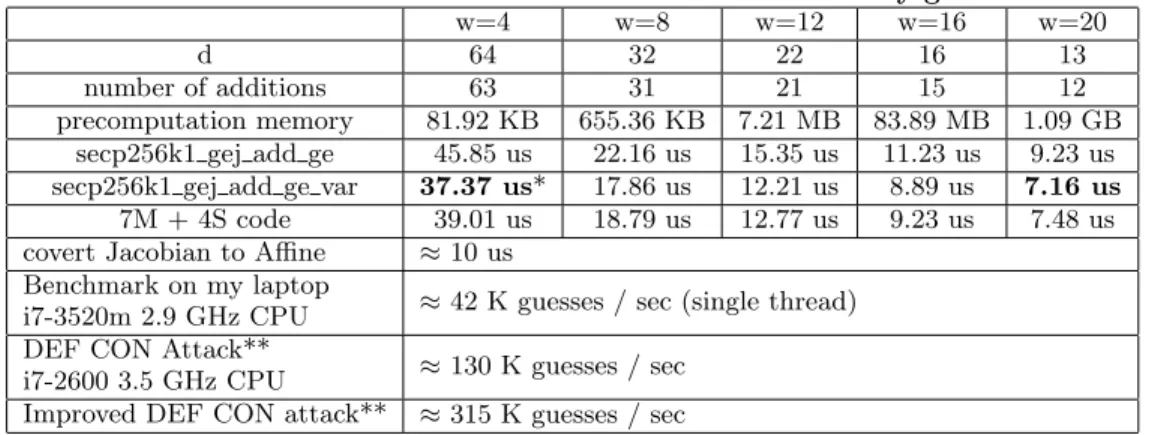
The purpose of making addition and doubling using the same function is to prevent side channel attacks, as point doubling is otherwise much cheaper than point addition. Our experiments are done based on the benchmark results of S/M ratio with specified machine setting (earlier in section 4) and specific library configuration (footnote in section 4.2). Different operating systems or library configurations might have different results. One should choose between our code and secp256k1 gej add ge method. Detailed benchmark re-sults are given in table 5
DEF CON attack [6] published code on github in August 2015 uses a faster version of secp256k1 library 5, and the results is marked as * in table 5. Our best result using 1.09 GB precomputation memory gives≈2.5 times speed upfor key generation process than the current known best attack.
In theory the best point addition method is 7M+4S intro-duced in [2]. However in practice, when field multiplication and square are well optimised, other field operations (such as addition, negation) become more significant than theoret-ical value, see table 4. Our results show that for our laptop specification, 8M+3S method is better than 7M+4S.
In order to compare the results with DEF CON attack, we also benchmark our implementation and the DEF CON re-leased software on Amazon server. Experiments are done on an m4.4xlarge Amazon EC2 instance6. Results are shown in table 6. The results confirm a 2.5 times improvement. Note that when running on Amazon EC2 (Intel Haswell CPU), the theoretical best method (7M+4S) performs a little bit better than 8M+3S.
Based on the current price for Amazon EC2 service, we observe the following cost for implementing such brain wallet attack: 17.9 billion passwords check per US dollar; 55.86 dol-lars to check a trillion passwords. We have found more than 18,000 passwords using this tool. Some sample passwords, 5
Also written by Pieter Wuille one year ago, this version is performance focused and using 8M+3S
6
https://aws.amazon.com/ec2/instance-types/
including some quite difficult ones are listed in appendix A.
5.
CONCLUSION
In this paper we have analysed and improved the state of the art on the implementation of the secp256k1 elliptic curve and similar curves. We provide the first benchmarks on ex-isting implementations and provide a faster implementation for specific applications where private keys are not manip-ulated or there exist other protections against side channel attacks [e.g. physical and electro-magnetic isolation] and when larger amounts of RAM are available. For example we are able to examine passwords in brain wallets 2.5 times faster than the state of the art implementation presented at DEF CON 2 months ago. We have released our source code. As an example application of this research, we have been able to crack thousands of passwords including some quite difficult ones. Our research demonstrates again that brain wallets are not secure and no one should use them.
6.
REFERENCES
[1] D. J. Bernstein and T. Lange. Explicit-formulas database, 2007.
[2] D. J. Bernstein and T. Lange. Faster addition and doubling on elliptic curves. InAdvances in
cryptology–ASIACRYPT 2007, pages 29–50. Springer, 2007.
[3] E. F. Brickell, D. M. Gordon, K. S. McCurley, and D. B. Wilson. Fast exponentiation with
precomputation. InAdvances in
Cryptology-EUROCRYPT’92, pages 200–207. Springer, 1993.
[4] E. Brier and M. Joye. Weierstraß elliptic curves and side-channel attacks. InPublic Key Cryptography, pages 335–345. Springer, 2002.
[5] M. Brown, D. Hankerson, J. L´opez, and A. Menezes.
Software implementation of the NIST elliptic curves over prime fields. Springer, 2001.
[6] R. Castellucci. Cracking cryptocurrency brainwallets. https:
//www.defcon.org/html/defcon-23/dc-23-index.html. [7] S. Certicom. Sec 2: Recommended elliptic curve
domain parameters.Proceeding of Standards for Efficient Cryptography, Version, 1, 2000.
[8] H. Cohen, A. Miyaji, and T. Ono. Efficient elliptic curve exponentiation using mixed coordinates. In
Advances in Cryptology ASIACRYPT 98, pages 51–65. Springer, 1998.
[9] T. L. Daniel J. Bernstein. Explicit-formulas database. https://www.hyperelliptic.org/EFD/.
[10] D. Hankerson, A. J. Menezes, and S. Vanstone.Guide to elliptic curve cryptography. Springer Science &
Table 4: Field operation counts and benchmark results
#Multiplication #Square #add/neg/*int #fe cmov total time cost 1M ≈0.8 M ≈0.1 M ≈0.2 M
secp256k1 gej add ge 7 5 15 6 ≈0.681 us
secp256k1 gej add ge var 8 3 12 0 ≈0.562 us
7M + 4S code 7 4 21 0 ≈0.594 us
Table 5: Time cost for different window widthwfor EC key generation
w=4 w=8 w=12 w=16 w=20
d 64 32 22 16 13
number of additions 63 31 21 15 12 precomputation memory 81.92 KB 655.36 KB 7.21 MB 83.89 MB 1.09 GB
secp256k1 gej add ge 45.85 us 22.16 us 15.35 us 11.23 us 9.23 us secp256k1 gej add ge var 37.37 us* 17.86 us 12.21 us 8.89 us 7.16 us
7M + 4S code 39.01 us 18.79 us 12.77 us 9.23 us 7.48 us covert Jacobian to Affine ≈10 us
Benchmark on my laptop
i7-3520m 2.9 GHz CPU ≈42 K guesses / sec (single thread) DEF CON Attack**
i7-2600 3.5 GHz CPU ≈130 K guesses / sec Improved DEF CON attack** ≈315 K guesses / sec
* DEF CON attack [6] is equivalent to this result
** Results are reported by Ryan Castellucci running his DEF CON code and our improved code on 8 threads with linux gcc compiler.
Table 6: Benchmark with DEF CON results on Amazon EC2 instance
processes passwords per second brainflayer (DEF CON) 16 219,460 win size 20 8M+3S 16 533,196 win size 24 8M+3S 16 556,294 win size 24 7M+4S 16 558,449 Business Media, 2006.
[11] N. Koblitz. Elliptic curve cryptosystems.Mathematics of computation, 48(177):203–209, 1987.
[12] V. S. Miller. Use of elliptic curves in cryptography. In
Advances in Cryptologyˆa ˘A ˇTCRYPTOˆa ˘A ´Z85 Proceedings, pages 417–426. Springer, 1985.
[13] S. Nakamoto. Bitcoin: A peer-to-peer electronic cash system.Consulted, 1(2012):28, 2008.
[14] R. L. Rivest, A. Shamir, and L. Adleman. A method for obtaining digital signatures and public-key cryptosystems.Communications of the ACM, 21(2):120–126, 1978.
[15] P. Wuille. bitcoin secp256k1 library, version 2015/08/11. https://github.com/bitcoin/secp256k1.
APPENDIX
A.
CRACKED PASSWORD SAMPLES
Our open source tool was given to students for our code
breaking competition, more than 100 new passwords were found by master students: Iason Papapanagiotakis, Jeonghyuk Park, Ellery Smith, Weixiu Tan and Wei Shao.
1. say hello to my little friend 2. to be or not to be
3. Walk Into This Room 4. party like it’s 1999 5. yohohoandabottleofrum 6. dudewheresmycar 7. dajiahao 8. hankou 9. {1summer2leo3phoebe 10. 0racle9i 11. andreas antonopoulos 12. Arnold Schwarzenegger 13. blablablablablablabla 14. for the longest time 15. captain spaulding

![Table 1: Time cost for different window width w, point addition method secp256k1 library [15]](https://thumb-us.123doks.com/thumbv2/123dok_us/9077478.2398855/4.918.231.679.267.335/table-time-different-window-width-addition-method-library.webp)
![Table 3: Operation counts for point addition and doubling. A = affine, P = standard projective, J = Jacobian [10, 5]](https://thumb-us.123doks.com/thumbv2/123dok_us/9077478.2398855/5.918.247.666.123.190/table-operation-counts-addition-doubling-standard-projective-jacobian.webp)