RESEARCH ARTICLES
Impact of a Dual PharmD/MBA Degree on Graduates’ Academic
Performance, Career Opportunities, and Earning Potential
Elinor C.G. Chumney, PhD, MSc, Kelly R. Ragucci, PharmD, and Kathy J. Jones, MA South Carolina College of Pharmacy, Charleston, SC
School of Business, The Citadel
Submitted June 8, 2007; accepted September 16, 2007; published April 15, 2008.
Objective.To evaluate the academic experience and satisfaction of students who completed a dual PharmD/MBA degree program and the program’s long-term impact on the students’ career choice and earning potential.
Methods. GPAs, job placement, and starting job salaries were compared between graduates who completed the dual PharmD/MBA program and those who completed only the PharmD program. A satisfaction survey instrument was administered to 17 students who completed the dual PharmD/MBA degree program in May 2007. Data from a standardized job placement and starting salary survey instrument completed by all PharmD graduates were also obtained, as well as all students’ final grade point averages (GPAs). GPAs, job placement, and starting job salaries were compared between grad-uates who had completed the dual PharmD/MBA program and those who had completed only the PharmD program.
Results.The graduating GPAs of dual-degree students were higher than those of both pharmacy (3.52 vs 3.41,p .0.10) and business (3.82 vs. 3.68, p5 0.018) students not enrolled in the dual-degree program. Dual-degree students were slightly less likely to enter a residency (17% vs. 27%,p50.44) than other pharmacy graduates. Among those who elected not to pursue a residency, both mean starting salaries ($111,090 vs. $101,965) and mean total first-year compensation ($127,290 vs. $110,388) were significantly higher for dual-degree graduates compared to the PharmD graduates.
Conclusions. Students enrolled in the dual-degree program did slightly better academically than students who completed only the MBA or PharmD programs and indicated a high level of satisfaction with the program. Dual-degree graduates reported increased career opportunities and were slated to earn significantly more during their first year in the workforce. These results affirm continuation of our program and make the case for support of similar programs across the nation.
Keywords:dual degree, master of business administration (MBA) degree, curriculum, grade point average, salary, career opportunities
INTRODUCTION
Over the last 2 decades, dual doctor of pharmacy (PharmD)/master of business administration (MBA) de-gree programs have been developed at a number of col-leges of pharmacy throughout the United States. These programs have 2 primary objectives: (1) to instill in stu-dents the business background and skills necessary to enter management positions within pharmacy and (2) to allow students to earn an MBA degree in less time and at a lower expense than if they were to pursue the 2 degrees
independently.1The dual degree is considered highly de-sirable for persons seeking careers in institutional practice settings, the pharmaceutical industry, pharmacy benefit management organizations, and academia. In fact, many professional pharmacy associations, including the Amer-ican Society of Health-System Pharmacists (ASHP), have advocated the creation of such programs for the purpose of filling leadership positions in pharmacy.
The American Association of Colleges of Pharmacy (AACP) states that 30 (34%) US colleges of pharmacy currently offer a PharmD/MBA degree.2Because the ma-jority of these programs are relatively new and generally include only a small number of students, there is very little information in the literature on actual student experiences or job placement and salaries after graduation. There is an implicit assumption that an MBA must certainly be an Corresponding Author:Kelly R. Ragucci, PharmD,
Associate Professor, Pharmacy and Clinical Sciences South Carolina College of Pharmacy, MUSC Campus, P.O. Box 250192, Charleston, SC 29425. Tel: 843-792-1674. Fax: 843-792-0436. E-mail: [email protected]
asset to a pharmacist’s career in a variety of practice set-tings, but again, information on both student satisfaction and the effect of completing such a program is limited.
As outlined in our companion Journal publication, the dual PharmD/MBA degree program between the South Carolina College of Pharmacy (SCCP)-Charleston and The Citadel’s School of Business Administration is one of the largest programs of its kind in the nation.3The faculty and administration at the SCCP determined a need to offer such a program to students in order to help meet the need for pharmacists who understand general business principles as well as direct patient care. Originally, a com-mittee consisting of 3 faculty members from the College of Pharmacy (1 PhD, 1 PharmD, and 1 MBA) and 2 faculty members from the Citadel’s School of Business Adminis-tration was formed. The program was developed to allow students to achieve both degrees in the same 4-year period it would normally take to finish a PharmD degree alone. Students were allowed to select MBA courses to satisfy pharmacy elective requirements and vice versa. In addi-tion, a portion of their MBA tuition was waived under a previously existing agreement between area colleges. Together, these conveyed a significant savings in credit hours and tuition over that required of students who might pursue both degrees concurrently outside of the program. As constructed, pharmacy students take the GMAT and apply to The Citadel’s School of Business Adminis-tration during the spring semester of their first year in the College of Pharmacy. In addition to being registered as full-time students in the SCCP pharmacy program (hav-ing completed at least 1 semester), students must fulfill all application requirements at the Citadel’s School of Busi-ness Administration. These include a satisfactory GMAT score (GMAT$410) and undergraduate GPA, 2 letters of reference, and an application essay (Appendix 1). The students then take MBA courses full-time during the sum-mer of their second- and third-professional years and con-currently with pharmacy courses during their second- and third-professional years (no more than 3 MBA credit hours can be taken during the spring and fall semesters). Required courses includeFinancial and Managerial Ac-counting, Management Information Systems, Personal Communication, Organizational Theory, and Strategic Management. All of the MBA courses are offered in the evenings, so no scheduling conflicts arise. Of those courses on the list, students in the PharmD only program are also required to takePharmacy Management, Designs for Outcomes Research, and Pharmacy Law/Ethics. In addition, there are several MBA courses that may count toward the 8 PharmD elective credit hours required, in-cludingProfessional Communications, Management In-formation Systems, Financial Management, Marketing
Management, Organizational Behavior, Strategic Man-agement, Consumer Behavior, and Human Resource Management. Although the pharmacy curriculum is set, there is some flexibility in the order in which the MBA classes may be taken.
Because the first and foremost mission of the college is to produce qualified pharmacists, applications for the dual-degree program are postponed until students are well into their second semester of classes at the College of Pharmacy. This would give students the opportunity to settle into the pharmacy curriculum and the unique demands of graduate school so that they could better judge whether they were interested in and capable of han-dling additional coursework toward an MBA. Because there were initially a few cases of students with relatively low first-professional year pharmacy GPAs who chose to pursue the dual degree, applications have since been lim-ited to those students with a cumulative first-professional year GPA greater than or equal to a 3.0. However, this policy was implemented after this particular graduating class began the program and therefore has no bearing on the results.
The initial interest in the dual PharmD/MBA was overwhelming, resulting in a cohort of dual-degree stu-dents and a sample size large enough to enable us to draw meaningful conclusions based on survey and academic data. We surveyed this group midway through the pro-gram to evaluate their academic experience and satisfac-tion and found that they were performing above average in both programs and expressed a high level of satisfac-tion with the program, strongly agreeing that the program was meeting their needs. In addition to again assessing students’ level of satisfaction with the program and aca-demic performance, the purpose of this follow-up survey was to determine what if any difference this dual degree made upon graduation.
METHODS
All 76 students graduating from the South Carolina College of Pharmacy-Charleston in 2007 were asked to complete a 12-item survey instrument about job inter-views, job offers, eventual placement, starting salaries, and bonuses (Appendix 2). A Student’sttest was used to determine whether the observed difference in salaries was statistically significant (a50.05). Analyses were per-formed using Stata 8.0 software (College Station, TX). The 17 PharmD/MBA dual-degree graduates were asked to complete additional open-ended questions about their experience within the dual-degree program: how difficult did they find the program, did they feel it was worth the effort, and whether/how the dual degree facilitated their job placement.
To determine whether the dual-degree students con-tinued to perform well in the PharmD program despite the extra demands on their time, we compared their graduat-ing GPAs to those of their classmates (n 559). Again, attest was used to determine whether the observed dif-ference was statistically significant. To measure whether these dual PharmD/MBA students were also performing well in the MBA program, their mean graduating GPA at The Citadel was compared with that of the other 2007 MBA graduates (n568).
RESULTS
Seventy-five (99%) of the 2007 graduates from the College of Pharmacy class completed the survey instru-ment. Dual-degree graduates listed exposure to the busi-ness side of pharmacy, interaction with students outside of the College of Pharmacy, and improved problem-solv-ing, leadership, communication, and writing skills among the most rewarding aspects of the program. Several men-tioned the necessity of a business background in today’s world of increasing health care costs and felt better equip-ped to balance providing optimal patient care with mini-mizing costs. Furthermore, they unanimously reported that the MBA degree helped to set them apart in the in-terview process, and many noted that inin-terviewers were particularly interested in the program.
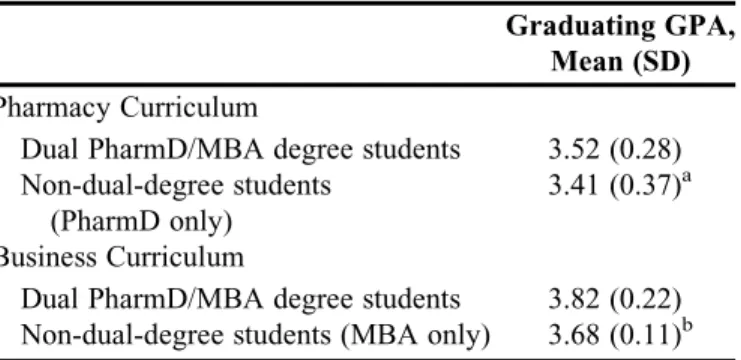
Students enrolled in the dual-degree program did bet-ter over the course of their academic career than their counterparts (Table 1). The average graduating GPAs of the PharmD students who elected to enroll in the dual-degree program were higher (mean GPA53.52) than the average for the rest of their class (mean GPA 53.41), although this difference was not statistically significant. The average graduating GPA of the dual-degree students in the MBA curriculum was significantly higher than that
of the rest of their class (mean GPA 3.82 vs. 3.68, p50.018).
Dual-degree students reported a higher number of job interviews (3.9 vs. 2.5,p50.013). Approximately 50% of the graduates ended up in community pharmacy, regard-less of their participation in the dual-degree program (47% of PharmDs and 53% of PharmD/MBAs, p 5
0.7). Because we collected information on the students’ long-term goals, we were able to code the responses based on whether they indicated a plan to move into a manage-ment position or to own/open their own pharmacy, and we found that significantly more dual-degree students (47% vs. 20%,p 5 0.03) indicated that one or both of these goals were their intent.
Dual-degree students were slightly less likely to enter a residency (17% vs. 27%,p50.44) than other pharmacy graduates. Because residency salaries are generally much lower than traditional hospital or community pharmacy salaries, we analyzed salary data on the subset of students who elected not to pursue a residency (n555). Both mean salaries ($110,090 vs. $101,965) and total compensation ($127,290 vs. $110,388, including sign-on bonuses and other inducements awarded during the first year) were significantly higher for dual-degree graduates compared to their PharmD graduate colleagues (Table 2).
DISCUSSION
The increase in the number and popularity of dual PharmD/MBA degree programs in the United States1-6 parallels that of similar dual-degree programs in the col-leges of nursing7-9and medicine.10-14There are currently 30 PharmD/MBA dual-degree programs, 56 master of science (MS), master of nursing (MN), or MSN/MBA dual-degree programs, and 49 doctor of medicine (MD)/ MBA dual-degree programs (Table 3).2,14,15Despite the widespread popularity of these programs and the implicit assumption that an MBA must certainly be an asset to
Table 1. Mean Graduating Grade Point Averages of Students Enrolled in a Dual PharmD/MBA Degree Program Compared to Those of Their Non-Dual-degree Peers
Graduating GPA, Mean (SD)
Pharmacy Curriculum
Dual PharmD/MBA degree students 3.52 (0.28) Non-dual-degree students
(PharmD only)
3.41 (0.37)a Business Curriculum
Dual PharmD/MBA degree students 3.82 (0.22) Non-dual-degree students (MBA only) 3.68 (0.11)b
Abbreviations: PharmD5doctor of pharmacy; MBA: master of business administration; GPA: grade point average
ap.0.10, t5 1.29 b
p50.018, t5 2.43
Table 2. Average Starting Salary and Total First-Year Compensation for Dual PharmD/MBA Degree Graduates Compared With Traditional PharmD Graduates
Degree Program Average Starting Salary, $ Average Total First Year Compensation, $ Dual PharmD/MBA degree students (n513) 111,090 127,290 Non-dual-degree students (PharmD only, n555) 101,965a 110,388b
Abbreviations: PharmD: doctor of pharmacy; MBA: master of busi-ness administration
a
p50.015, t5 2.51 b
a health professional’s career, this is the first published research comparing job placement and level of remuner-ation between a relatively large sample of students who chose to participate in one of these programs and those who did not. Considering the fact that few students typi-cally enroll in dual-degree programs each year at any given institution, the number of graduates included in the survey (n517) was relatively large.
This study demonstrated that dual PharmD/MBA stu-dents continued to have an overall high level of satisfac-tion with the program and performed better academically than their peers in both curriculums.3These dual PharmD/ MBA students might have self-selected into the program with an accurate assessment of their ability to simulta-neously handle the demands of 2 rigorous curriculums. When interviewed, the students attributed their success in both programs to strong time-management skills and a commitment to excel. As stated earlier, the program is designed to allow students to enroll in the dual program only after completing the first 2 semesters of the phar-macy curriculum, allowing the students to determine their interest and capability of handling additional coursework. These results, the increased number of job interviews, and boost in initial earnings afforded by the dual degree upon graduation affirm the continued use of this process at this institution.
In addition, we found that students in the dual-degree program were less likely to enter a residency program. This is interesting but perhaps not surprising, as these students are not necessarily interested in careers in tradi-tional clinical pharmacy. On the other hand, perhaps more education and awareness of pharmacy practice manage-ment residencies is warranted, as none of our students applied for such residencies. Many students were either not aware that they existed or did not believe that this additional training was necessary.
The significant difference in salaries between dual-degree and single-dual-degree students suggests that perhaps
these students have better negotiating skills and/or are beginning their careers in managerial roles. With the cur-rent shortage of pharmacists and the fact that many indi-viduals are not interested in or trained for managerial roles, these graduating pharmacists are often offered these positions at the start of their careers or shortly after enter-ing the workforce.
Our study is potentially limited by student recall bias and the possibility that factors other than a second degree were involved in the higher salaries our dual-degree students received. Although there are many pos-sible confounding variables that were not included in our analysis (such as student interview skills and motivation), potential employers found our dual-degree students highly desirable. It may be that many of the attributes potential employers favored are the same ones that led these students to pursue a second degree in the first place. Although students have been highly satisfied with the program overall, improvements such as a need for addi-tional advising/mentoring (especially from faculty members with PharmD/MBA backgrounds) and more assistance in registration and financial aid have been noted.3In order to address these issues, the College of Pharmacy has appointed a faculty member with a PharmD/MBA back-ground to work with the Citadel to expand their estab-lished mentoring program. With regard to registration, additional course sections have been added and class ceil-ings increased to accommodate student interest in the program. To address concerns regarding financial aid, the financial aid offices at both institutions met to deter-mine the best approach for resolving issues related to their disparate federal funding cycles. The authors believe that the success of the program and the low number of drop-outs can be attributed to consistently addressing these concerns and continuing to improve communication between both Colleges. In addition, as mentioned previ-ously, students are only allowed to enroll in the program after completing the first 2 semesters of the doctor of pharmacy curriculum, which enables them to fully assess their interest and capability. We believe that this is also a key element in preventing later withdrawals.
CONCLUSION
Although approximately one third of all colleges of pharmacy in the United States now offer dual PharmD/ MBA degrees, this is the first published formal assess-ment and analysis comparing academic performance, job placement, and salaries of dual-degree students with those in a traditional program. Students enrolled in the dual program did better academically than their counterparts in both the pharmacy and business curriculums and had higher mean job salaries upon graduation. In addition,
Table 3. Comparison of Dual-degree Programs in Business Administration by Colleges of Health Profession2,14,15
College Dual Degree(s)
Colleges Offering Dual MBA Degrees, No. (%)
Pharmacy PharmD/MBA 30/89 (34)
Medicine MD/MBA 49/125 (39)
Nursing MS/MBA, MN/MBA, or MSN/MBA
56/418 (13)
Abbreviations: PharmD: doctor of pharmacy; MBA: master of busi-ness administration; MD: medical doctor; MSN: master of science in nursing; MS:master of science; MN: master of nursing
these students indicated an overall high level of satisfac-tion with the dual-degree program. These results affirm the continuation of the dual PharmD/MBA program be-tween The Citadel’s School of Business Administration and the South Carolina College of Pharmacy and provide evidence of significant benefits that could be used to bol-ster support for and participation in similar programs across the nation.
REFERENCES
1. Thai A, Draugalis JR. Dual PharmD/MBA programs 2001-2002: a descriptive report.Am J Pharm Educ.2002;66:372-7.
2. Dual-Degree Programs Anticipated for 2008-2009. American Association of Colleges of Pharmacy (AACP) website. Available at: www.aacp.org/Docs/MainNavigation/InstitutionalData/
6867_Tab4PSAR.pdf. Accessed June 21, 2007.
3. Chumney ECG, Ragucci KR. Survey of student satisfaction and academic performance in a Dual PharmD/MBA Degree Program.
Am J Pharm Educ.2006;70(2):Article 29.
4. Boyd J, Zinkhan F. Campbell University joint Doctor of Pharmacy/ Master of Business Administration program.Am J Pharm Educ.
1993;57:105S.
5. Lubawy W, Yokel R, Blowin R, et al. Advanced degree programs integrated with the doctor of pharmacy curriculum as a foundation for the future.Am J Pharm Educ.2000;64:129S.
6. Cotton H. An MBA for pharmacists?Am J Pharm Educ.
1979;19(8):54.
7. Berlin LE, Wilsey SJ. Bednash GD. 2004-2005 Enrollment and Graduations in Baccalaureate and Graduate Programs in Nursing. Washington, DC: American Association of Colleges of Nursing; 2005.
8. Minnick A, Weisman CS, Curgian L. The acceptance and growth of MSN/MBA programs.J Nurs Admin.1994;24:63-8.
9. Minnick A. Education in administration: trends in MSN/MBA and MSN in nursing administration.J Nurs Admin.1998;28: 57-62.
10. Larson DB, Chandler M, Forman H. MD/MBA programs in the United States: evidence of a change in health care leadership.Acad Med.2003;78:335-41.
11. Shalowitz JI, Nutter DO, Snarr JF. Medicine and management: a combined educational program.J Health Adm Educ.
1996;14:305-13.
12. Sherill WW. Dual-degree MD-MBA students: a look at the future of medical leadership.Acad Med.2000;75(10):S37-39.
13. Kuo JS. Swimming with the sharks – the MD, MBA.Lancet.
1997;350:828.
14. Association of American Medical Colleges (AAMC) web site. Available at: http://services.aamc.org/currdir/section3/
degree2.cfm?data5yes&;program5mdmba Accessed June 21, 2007. 15. American Association of Colleges of Nursing (AACN) 2007-2008. Enrollment and Graduation in Baccalaureate and Graduate Programs of Nursing. Washington, DC: AACN; 2008.
Appendix 1. MBA Curriculum and Plan of Study for Dual PharmD/MBA Degree Students at the South Carolina College of Pharmacy
PharmD/MBA Degree Students at the South Carolina College of Pharmacya,b
Year of PharmacySchool MBA Courses
MBA Credit Hours
Year 1-2 (Summer) Financial Accounting for Decision Making (BADM 601) 3 hours Economics for Decision Making (BADM 606) 3 hours Professional Communications (BADM 608) 3 hours
Year 2 (Fall) Pharmacy Management (PHMPR 663) 3 hours
Organizational Theory (BADM 607) 1.5 hours
Foundations of Marketing (BADM 609) 1.5 hours Year 2 (Spring) Managerial Accounting for Decision Making (BADM 603) 1.5 hours
Fundamentals of Finance (BADM 605) 1.5 hours
Year 2-3 (Summer) Management Information Systems (BADM 612) 3 hours
Financial Management (BADM 614) 3 hours
Marketing Management (BADM 616) 3 hours
Year 3 (Fall) Pharmacy Law/Ethics (PHMPR 711) 3 hours
Organizational Behavior (BADM 618) 3 hours
Year 3 (Spring) Designs for Outcomes Research (PHMPR 709) 2 hours
Statistics for Outcomes Research (PHMPR 751) 1 hour
Strategic Management (BADM 625) 3 hours
Year 4 Grand Rounds (PHMPR 838 and 839) 1 hour
Pharmacy Administration Rotation (PHMPR 849) 4 hours Outcomes Management Rotation (PHMPR 855) 4 hours
aAdmission Requirements: (1) Be a full-time student in the PharmD program, having completed at least one semester; (2) Submit application to The Citadel’s School of Business Administration along with the following: GMAT scores; undergraduate GPA; 2 letters of reference; and application essay
b
This is the curriculum that the 2007 graduates completed and the admission requirements they applied under; the MBA curriculum has recently been changed to all 3 credit hour classes with 6 hours of electives and we now require a 3.0 GPA in the pharmacy curriculum for admission
Appendix 2. South Carolina College of Pharmacy Class of 2007 Exit Survey (Administered April and May 2007) 1. Which of the following descriptions fits you best at this time:
a. Accepted a pharmacist job/position
b. Received pharmacist job offers but am undecided at this time c. Accepted a residency position
d. Not seeking a pharmacist position at this time (please clarify at end of survey) 2. How many positions have you interviewed for?
3. How many job offers have you received?
4. If you have taken a job, is it full time or part time?
5. If you have taken a job, is it in South Carolina or out-of-state? 6. If you have taken a job, is it:
a. Community
i. Community chain company, if so please specify: ii. Independent pharmacy, if so please specify: iii. Grocery chain company, if so please specify: b. Hospital, if so please specify:
c. Nuclear, if so please specify, if so please specify: d. Residency, if so please specify:
e. Other, if so please specify: 7. What is your annual salary: 8. Will you receive a sign-on bonus?
a. If yes, please specify the amount:
9. Will you receive tuition reimbursement or other compensation with the first year from your future employer: a. If yes, please specify the amount:
10. Please include any other details of your contract related to projected advancement and/or special training programs offered by your future employer:
11. What are your long-term (10 years) career goals? 12. Are you in the dual PharmD/MBA degree program?
a. If so, how difficult did you find the dual degree program? b. If so, did you feel it was worth the effort?
c. Please elaborate on whether (and if so, how) the MBA degree helped to set you apart in the interview process or played a part in your job placement: