Scope Document
–
‘Compendium Version’
Railway Systems
Contracts
Document no: HS2-HS2-SY-SPE-000-000014
Revision Date approved Reason for revision P01 17th June 2020 First issue
Additions from previously released HRS23 CCS and TM and HRS13-18 Track Systems versions included in Appendix 2 amendments table for information.
P02 26th June 2020 Update to text in Preface and Sections 1 and 4 to clarify number of OCS contracts to be awarded, use of the term Candidate due to PACC and the maintenance requirements. Deletion of reference to CPD under a separate contract in Section 5 M&E.
Scope Document – ‘Compendium Version’ Railway Systems Contracts Document no: HS2-HS2-SY-SPE-000-000014
Revision: P03
Contents
Preface vi 1 Introduction 1 1.2 HS2 1 1.3 HS2 Ltd 2 1.4 HS2 route description 21.5 Railway Systems Contractors and Others 5
2 Contractor’s general obligations 7
2.1 Introduction 7
2.2 Human resources and contract administration 7
2.3 Systems integration 8
2.4 Design, environmental requirements and consents 9 2.5 Design and Building Information Modelling (BIM) 10
2.6 Safety 10
2.7 Construction and logistics 11
2.8 Track Systems Contract geographical boundaries 14
2.9 Testing and commissioning 16
2.10 Maintenance and technical support contracts 18
3 Description of the Works – Track Systems 20
3.1 Introduction 20
3.2 Track Systems Supply Contracts 22
3.3 Track Systems Contracts 25
3.4 Track systems/MWCC interfaces 27
4 Description of the Works – Overhead Catenary System 29
4.1 Introduction 29
4.2 System details 30
4.3 Logistics 32
4.4 OCS /MWCC interfaces 32
4.5 Maintenance and technical support contracts 32 5 Description of the Works – Tunnel and Lineside M&E Systems 34
5.1 Introduction 34
5.2 Tunnel ventilation systems 36
5.3 Tunnel cross-passage systems 37
5.4 Tunnel low voltage distribution and lighting 38
5.5 Other tunnel works 38
5.6 Open route LV distribution 40
6 Description of the Works – HV Traction and Non-Traction
Power Systems 42
6.1 Introduction 42
6.2 Traction power system 44
6.3 HV non-traction power system 45
6.4 Interfaces and general requirements 47
6.5 Maintenance and technical support contracts 51 7 Description of the Works - Operational Telecommunications
and Security 52
7.1 Introduction 52
7.2 Operational Telecommunications and Security scope 52
7.3 Data transmission network 53
7.4 Operational telephony system 54
7.5 Tunnel radio system 54
7.6 Telecommunication towers 55
7.7 Relocatable equipment buildings 56
7.8 Route wide security 56
7.9 GSM-R radio access network 57
7.10 Interface management responsibilities 58
7.11 System integration facility 59
7.12 Cabling and cable protection 60
7.13 Civil engineering works 60
7.14 Maintenance and technical support services 60 8 Description of the Works - Third Party Telecommunications 62
8.1 Introduction 62
8.2 HS2 service performance requirements 62
8.3 Third Party Telecommunications scope 63
8.4 Interfaces with other HS2 contracts 64
9 Description of the Works - Engineering Management System 65
9.1 Introduction 65
9.2 System scope 65
9.3 System integration 67
9.4 System development and testing 68
9.5 System integration facility 68
9.6 Interfaces with other contractors 69
9.7 Maintenance and technical support services 71
10 Description of the Works – CCS and TM 72
10.1 Introduction 72
10.2 HS2 operational requirements 73
10.3 CCS and TM scope 73
Scope Document – ‘Compendium Version’ Railway Systems Contracts Document no: HS2-HS2-SY-SPE-000-000014
Revision: P03
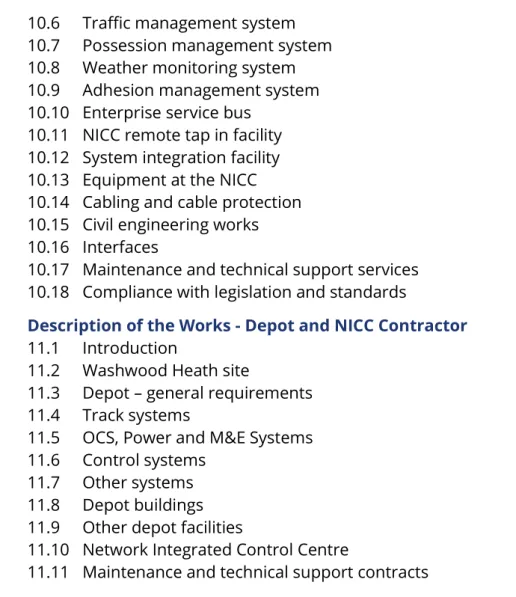
10.6 Traffic management system 75
10.7 Possession management system 76
10.8 Weather monitoring system 76
10.9 Adhesion management system 77
10.10 Enterprise service bus 77
10.11 NICC remote tap in facility 77
10.12 System integration facility 78
10.13 Equipment at the NICC 78
10.14 Cabling and cable protection 79
10.15 Civil engineering works 79
10.16 Interfaces 79
10.17 Maintenance and technical support services 80 10.18 Compliance with legislation and standards 80 11 Description of the Works - Depot and NICC Contractor 81
11.1 Introduction 81
11.2 Washwood Heath site 83
11.3 Depot – general requirements 86
11.4 Track systems 86
11.5 OCS, Power and M&E Systems 87
11.6 Control systems 88
11.7 Other systems 88
11.8 Depot buildings 89
11.9 Other depot facilities 90
11.10 Network Integrated Control Centre 90
11.11 Maintenance and technical support contracts 91
Appendix 1 Acronyms 92
Appendix 2 Revision history 96
List of figures
Figure 1- HS2 Route Map showing Phases One, 2a and 2b 3 Figure 2 - Route schematic showing contract boundaries and access
points 16
Figure 3 - Washwood Heath Depot and NICC 85
List of tables
Table 1 - Railway systems contracts 6
Table 2 - Summary of rail connections and facilities 13 Table 3 - Track Systems Contractors’ geographical areas and key
data 15
Table 4 - HS2 Ltd defined maintenance levels 18
Table 6 - OCS Contract key data 29 Table 7 - Tunnel & Lineside M&E Systems Contract key data 35
Table 8 - HV Power Systems Contract key data 42
Table 9 - HS2 Station customer footfall (thousands /day) 62
Table 10 - CCS and TM Contract key data 72
Scope Document – ‘Compendium Version’ Railway Systems Contracts Document no: HS2-HS2-SY-SPE-000-000014
Revision: P03
Preface
This Railway Systems Scope Document ‘Compendium Version’ describes the technical coverage, or scope, of each of the proposed Tier 1 design and build railway systems contracts. Sections 1 and 2 are applicable to all design and build contracts and should be read in conjunction with the contract-specific scope description in Sections 3 to 11. A list of acronyms is provided in Appendix 1 and a revision history in Appendix 2.
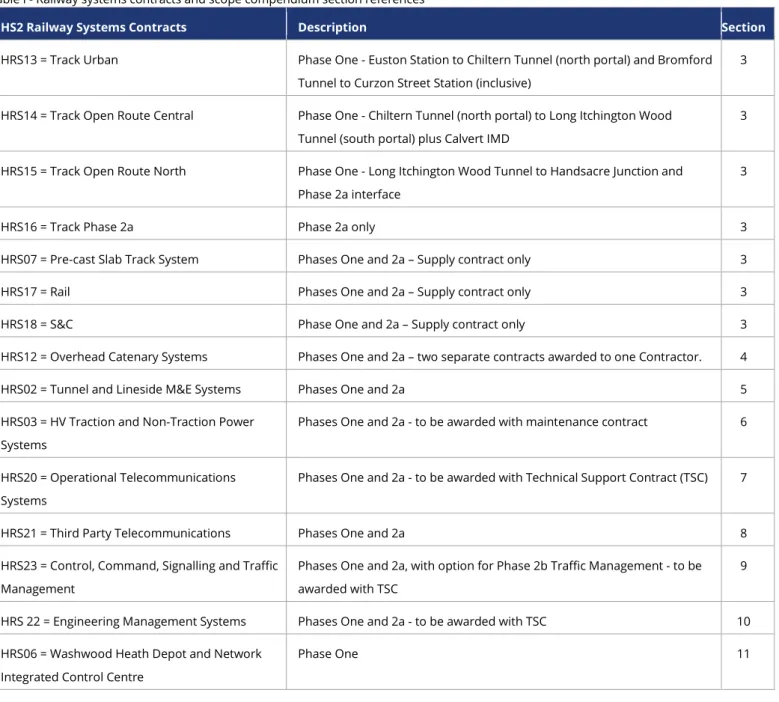
The table below provides the title, reference number and applicability of each contract. HS2 rail systems supply contracts are also included.
Table i - Railway systems contracts and scope compendium section references
HS2 Railway Systems Contracts Description Section
HRS13 = Track Urban Phase One - Euston Station to Chiltern Tunnel (north portal) and Bromford
Tunnel to Curzon Street Station (inclusive)
3
HRS14 = Track Open Route Central Phase One - Chiltern Tunnel (north portal) to Long Itchington Wood
Tunnel (south portal) plus Calvert IMD
3
HRS15 = Track Open Route North Phase One - Long Itchington Wood Tunnel to Handsacre Junction and
Phase 2a interface
3
HRS16 = Track Phase 2a Phase 2a only 3
HRS07 = Pre-cast Slab Track System Phases One and 2a – Supply contract only 3
HRS17 = Rail Phases One and 2a – Supply contract only 3
HRS18 = S&C Phase One and 2a – Supply contract only 3
HRS12 = Overhead Catenary Systems Phases One and 2a – two separate contracts awarded to one Contractor. 4
HRS02 = Tunnel and Lineside M&E Systems Phases One and 2a 5
HRS03 = HV Traction and Non-Traction Power Systems
Phases One and 2a - to be awarded with maintenance contract 6
HRS20 = Operational Telecommunications Systems
Phases One and 2a - to be awarded with Technical Support Contract (TSC) 7
HRS21 = Third Party Telecommunications Phases One and 2a 8
HRS23 = Control, Command, Signalling and Traffic Management
Phases One and 2a, with option for Phase 2b Traffic Management - to be awarded with TSC
9
HRS 22 = Engineering Management Systems Phases One and 2a - to be awarded with TSC 10
HRS06 = Washwood Heath Depot and Network Integrated Control Centre
1
Introduction
1.1.1 The content of this document is subject to revision and expansion in the Works Information, to be included in the Contract, which will be issued to the shortlisted Applicants/Candidates with the Invitation to Tender (ITT). This Works Information will include a full description of the scope of each contract, the processes and procedures that High Speed 2 (HS2) Ltd wishes successful contractors to apply, together with a detailed set of system requirements.
1.1.2 HS2 Ltd reserves the right to make reasonable additions or amendments to the content of this Scope Document during the Railway Systems procurements. In particular, and without limitation, changes to the general obligations and constraints, or the scope of work, may occur when HS2 Ltd commences the formal tender stage. 1.1.3 HS2 Ltd does not offer any warranties, guarantees or assurances as to the accuracy
or completeness of the information contained in this document and quantities or measurements are only intended to be indicative and for the guidance of potential Applicants/Candidates.
1.2
HS2
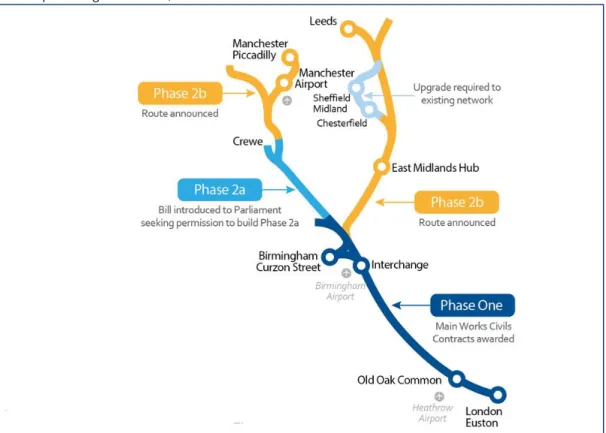
1.2.1 HS2 is the name given to the project or programme of works, comprising Phase One and Phase Two, which is further divided into Phase 2a and 2b, as illustrated in Figure 1.
1.2.2 Authority for construction of Phase One has been obtained through the High Speed Rail (London – West Midlands) Act 2017, which received royal assent on 23 February 2017.
1.2.3 Authority for construction of Phase 2a is contained in the High Speed Rail (West Midlands to Crewe) Bill, which is passing through the United Kingdom (UK) Parliament and is expected to receive royal assent in 2020.
1.2.4 The Secretary of State for Transport is developing proposals in relation to Phase 2b, in preparation for a hybrid Bill.
1.2.5 In each case, once royal assent is obtained, the HS2 legislation grants powers to build and maintain HS2 and its associated works. These powers include the acquisition of interests in the land, the ability to change rights of way and modify existing infrastructure. The powers also enable HS2 Ltd to make necessary changes to existing legislation in order to facilitate construction and operation of HS2.
Scope Document – ‘Compendium Version’ Railway Systems Contracts Document no: HS2-HS2-SY-SPE-000-000014
Revision: P03
1.3
HS2 Ltd
1.3.1 HS2 Ltd is the company responsible for developing and promoting the UK’s new high-speed rail network. It is funded by the UK government and sponsored by the Department for Transport.
1.3.2 HS2 Ltd is responsible for ensuring that the HS2 rail network is:
• designed, built and operated with the highest safety standards
• built and operated sustainably, responsibly and with respect for the communities, wildlife and places it affects
• reliable, seamless and easy to use for all passengers and well-integrated with existing transport systems
1.3.3 HS2 Ltd is committed to working with all our suppliers to build a skilled workforce that supports economic growth across the UK.
1.3.4 Further information will be included in the ITT concerning these commitments and how HS2 Ltd intends to work with its supply chain to fulfil them.
1.4
HS2 route description
1.4.1 This Scope Document relates to HS2 Phases One and 2a.
1.4.2 The Phase One route comprises approximately 220 km of predominantly double-track high-speed railway running north from Euston Station in London to a junction with the West Coast Main Line at Handsacre in Staffordshire, with a spur from Water Orton in Warwickshire to a terminus at Birmingham Curzon Street. It includes
intermediate stations at Old Oak Common in London and Birmingham Interchange. 1.4.3 Phase One also includes a grade-separated junction (Delta Junction) to the east of
Birmingham, with connections to facilitate the eastern leg of HS2 to Leeds (Phase 2b).
1.4.4 Phase 2a extends from Streethay Junction at Fradley, approximately 2.5 km north-west of Lichfield, to Crewe Junction. It comprises approximately 58 km of double track high-speed railway and includes two spurs south of Crewe that will allow trains to transfer between the HS2 and the West Coast Main Line, as well as provision for a further northern extension towards Manchester (Phase 2b).
Figure 1- HS2 Route Map showing Phases One, 2a and 2b
1.4.5 The Phase One route passes through three bored tunnels at its southern end: first Euston Tunnel (7.4 km long), then Northolt Tunnel (14.2 km long) and then Chiltern Tunnel (16.2 km long), all of which include combined ventilation and intervention shafts at intervals up to 3.3 km. On the Birmingham Spur there is a bored tunnel (Bromford) which is 5.86 km long which includes one combined ventilation and intervention shaft. There are 11 shafts across the Phase One route.
1.4.6 Along the Phase One route there are six cut-and-cover tunnels, including one which is a combination of cut-and-cover and bored tunnel (Long Itchington Wood). There are box-sections at Oak Common Station and Victoria Road, with the Northern Approaches to Euston comprising a combination of retained cutting and an enclosed cavern, all of which all vary in size and structure. On the Phase 2a sections, there are two bored tunnels at Whitmore and Madeley. Other short tunnels may be required along the route, subject to civil engineering design development.
1.4.7 Many of the HS2 tunnels are fitted with “porous portals” which are extensions to the tunnels and are required for the mitigation of micro-pressure waves instigated by the passing of high-speed trains.
Scope Document – ‘Compendium Version’ Railway Systems Contracts Document no: HS2-HS2-SY-SPE-000-000014
Revision: P03
1.4.9 There are two sets of track loops for use by passenger and maintenance trains on the Phase One route, approximately located at 56 km and 116 km points where London Euston Station is the origin at 0 km.
1.4.10 The HS2 infrastructure is designed for the operation of high-speed passenger rolling stock units, each of 200 metres in length. Two units can operate in formation such that the longest trains in normal operation are 400 metres in length. No provision is made for the operation of freight trains.
1.4.11 The HS2 operational requirements are:
• Maximum operational line speed of 360 kph with varying line speeds along the route
• 18 trains per hour in both directions
• Bi-directional operation at the maximum permissible line speed
1.4.12 Two types of rolling stock are planned for operation on HS2. ‘Captive’ trains will be designed for services that operate entirely on the new HS2 infrastructure.
‘Conventional Compatible’ trains will be designed to the same performance
specification (journey times, etc) but will be compatible with the UK conventional rail network (CRN), to enable journeys to continue to destinations beyond the new infrastructure.
1.4.13 The Phase One Rolling Stock Maintenance Depot (RSMD) is at Washwood Heath in Birmingham, 3.5 km from Curzon Street station. It will initially be used to serve the first ‘Conventional Compatible’ HS2 fleet but will be designed to accommodate ‘Captive’ trains also. The site also houses the Network Integrated Control Centre (NICC), which will be used to control the railway infrastructure of HS2 Phases One, 2a and 2b.
1.4.14 There will be an HS2 infrastructure maintenance depot (IMD) at Calvert, (which lies approximately 33 km north of the Chiltern Tunnel) and an infrastructure
maintenance base (IMB-R) at Stone on Phase 2a. The Stone IMB-R site is designed to enable conversion to an IMD to support Phase 2b infrastructure maintenance. There will also be an IMB-R at West Ruislip, just north of the Northolt Tunnel. All these bases will be rail connected.
1.4.15 The Calvert IMD site will initially be established as a construction railhead that utilises the final proposed layout for the IMD. As the usage of the railhead reduces over the course of the construction phase, the site will be converted into the permanent IMD by provision of associated buildings and infrastructure.
1.4.16 The Stone IMB-R site is designed to act as a construction railhead during the Phase 2a construction window in a similar way to that described at Calvert IMD. On completion of Phase 2a construction, the Stone site will be converted to an IMB-R with the ability to act as a light maintenance facility for on-track plant with provision of workshop buildings and associated infrastructure. The design of the Stone site will enable conversion to an IMD to support Phase 2b infrastructure maintenance. 1.4.17 The West Ruislip IMB-R will be a small-scale stabling siding for on-track plant to be
cleaned and replenished with consumables. There will be no permanent buildings, welfare or other facilities at West Ruislip IMB-R.
1.4.18 There will be permanent connections with the CRN at Calvert, Handsacre Junction and Crewe.
1.4.19 The details of all of the permanent infrastructure arrangements for these facilities and their potential for use during the construction phase, will be set out in the Works Information.
1.4.20 The Phase One route has a bat mitigation structure at Sheep House Wood near to Calvert. This is a metal caged structure formed over both the HS2 and CRN lines.
1.5
Railway Systems Contractors and Others
1.5.1 The railway systems design and build contracts are referred to in this document as Railway Systems Contracts. In this Scope Document, we refer to ‘Others’ to mean other contractors with whom the Railway Systems Contractors will be working and sharing the site.
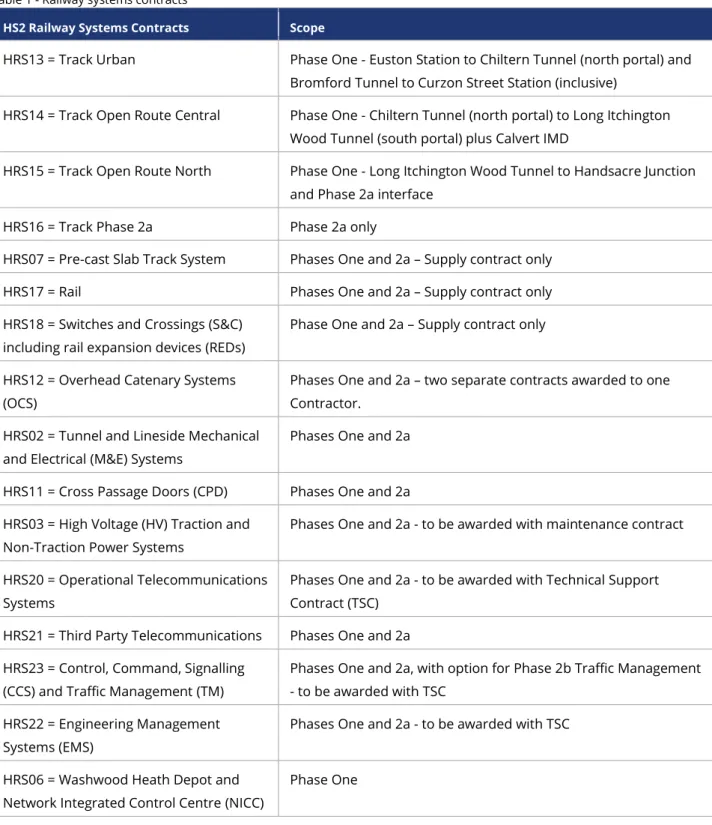
1.5.2 Table 1 below provides the title, reference number and applicability of each contract, including the key supply contracts.
1.5.3 In addition to the Railway Systems Contractors listed below, HS2 Ltd has appointed (or is appointing), other major suppliers and contractors:
• Phase One Enabling Works contractors (EWC)
• Phase One Main Works Civil contractors (MWCCs)
• Phase One Stations designers and contractors (Euston, Old Oak Common, Birmingham Interchange, Birmingham Curzon Street)
• Delivery partner(s) for Phase Two
Scope Document – ‘Compendium Version’ Railway Systems Contracts Document no: HS2-HS2-SY-SPE-000-000014
Revision: P03
1.5.4 HS2 Ltd is also appointing suppliers of common components or contractors for the provision of other services. Some of these may have important interfaces with the railway systems programme.
Table 1 - Railway systems contracts
HS2 Railway Systems Contracts Scope
HRS13 = Track Urban Phase One - Euston Station to Chiltern Tunnel (north portal) and Bromford Tunnel to Curzon Street Station (inclusive)
HRS14 = Track Open Route Central Phase One - Chiltern Tunnel (north portal) to Long Itchington Wood Tunnel (south portal) plus Calvert IMD
HRS15 = Track Open Route North Phase One - Long Itchington Wood Tunnel to Handsacre Junction and Phase 2a interface
HRS16 = Track Phase 2a Phase 2a only
HRS07 = Pre-cast Slab Track System Phases One and 2a – Supply contract only HRS17 = Rail Phases One and 2a – Supply contract only HRS18 = Switches and Crossings (S&C)
including rail expansion devices (REDs)
Phase One and 2a – Supply contract only
HRS12 = Overhead Catenary Systems (OCS)
Phases One and 2a – two separate contracts awarded to one Contractor.
HRS02 = Tunnel and Lineside Mechanical and Electrical (M&E) Systems
Phases One and 2a
HRS11 = Cross Passage Doors (CPD) Phases One and 2a HRS03 = High Voltage (HV) Traction and
Non-Traction Power Systems
Phases One and 2a - to be awarded with maintenance contract
HRS20 = Operational Telecommunications Systems
Phases One and 2a - to be awarded with Technical Support Contract (TSC)
HRS21 = Third Party Telecommunications Phases One and 2a HRS23 = Control, Command, Signalling
(CCS) and Traffic Management (TM)
Phases One and 2a, with option for Phase 2b Traffic Management - to be awarded with TSC
HRS22 = Engineering Management Systems (EMS)
Phases One and 2a - to be awarded with TSC
HRS06 = Washwood Heath Depot and Network Integrated Control Centre (NICC)
2
Contractor’s general
obligations
2.1
Introduction
2.1.1 This section sets out some of the general obligations in relation to systems integration, design, construction, testing and commissioning that will be defined further in the Works Information documents for the Railway Systems Contractors. 2.1.2 At all stages in the programme, Railway Systems Contractors will be expected to
work collaboratively together, using the processes and procedures that will be set out in the Works Information, in order to ensure that the project delivers its strategic goals and benefits (to be included in the Contract).
2.1.3 Railway Systems Contractors will also be expected to engage, directly and indirectly, with a significant number of local stakeholders, including local authorities and communities, to ensure that their aspirations are considered in both the planning stage and the delivery of the works.
2.1.4 In most cases, HS2 Ltd, as Project Manager under the contract, will take the lead in relation to technical and scope management, systems integration, construction co-ordination and management of testing and commissioning. In some cases, HS2 Ltd will expect the Railway Systems Contractors to fulfil leading roles in relation to site co-ordination, leadership of certain technical interfaces, or leadership in collation of construction consent applications. In each case, the role of HS2 Ltd and the role of each of the Railway Systems Contractors will be defined in the Works Information which will be provided at the tender stage.
2.2
Human resources and contract administration
2.2.1 HS2 is a major programme of work and a nationally significant infrastructure investment, so HS2 Ltd expects all its contractors to support a number of strategic objectives in relation to the management of human resources. These include requirements in respect of skills, education and employment and in relation to equality, diversity and inclusion. HS2 Ltd expects contractors to work to high employment relations standards and to share its vision and values in respect of health and safety.
2.2.2 Because the programme of work is complex and includes many contracts, large and small, HS2 Ltd also expects contractors to adopt its established processes for
contract administration and project controls. We also have certain software systems that we will expect contractors to adopt.
Scope Document – ‘Compendium Version’ Railway Systems Contracts Document no: HS2-HS2-SY-SPE-000-000014
Revision: P03
2.2.3 HS2 Ltd is establishing several initiatives that will help drive the construction and transport sectors forward. For example, in developing a culture of innovation and the adoption of technological solutions and offering support to small and medium-sized enterprises (SMEs). Details will be included in the Works Information.
2.3
Systems integration
2.3.1 HS2 is a major programme of work that includes complex engineering scope, apportioned between several contracts, managing different systems and
sub-systems. This work must be brought together in the design, construction, testing and commissioning stages in order to achieve a safe, reliable, high-performance railway that operates trains at 360 km/h and can meet a demanding train service
specification.
2.3.2 HS2 Ltd will act as Prime System Integrator to lead systems integration for the programme, working closely with suppliers, contractors and stakeholders to create an end-state railway that is safe, operable, maintainable, ready for revenue service. 2.3.3 As Prime Systems Integrator, HS2 Ltd will take overall responsibility for the
integration of the railway system including the management of tools and processes that support delivery of this outcome. As part of this role, HS2 Ltd will manage the demonstration of system performance, reliability, availability, maintainability and safety. HS2 Ltd has also defined system architectures to support interface
management and will be setting technical specifications.
2.3.4 The Railway Systems Contractors and their supply chain are expected to work closely with HS2 Ltd in support of this Integrator role and will be expected to have an
understanding of their own role in these processes and to support the integration work for the overall benefit of the programme. They and their supply chains will be expected to fulfil one or more of three roles:
• Lead Systems Integrator: Nominated leader for the delivery of specific Integration aspects, e.g. requirements associated with capability or functionality of the
Railway that coordinates all applicable contractors to achieve the fulfilment of specific Integration Requirements.
• Participating System Manufacturer/Supplier: Nominated to participate in developing specific Integration aspects, e.g. requirements associated with capability or functionality of the Railway.
• Provider of data/information: Nominated to provide data or information necessary for others to develop specific Integration aspects.
2.3.5 HS2 Ltd will require close technical collaboration and planning between all its contractors and suppliers, as well as between engineers, constructors and sub-contractors. Railway Systems Contractors are expected to consider this in the formulation of their teams at every stage in the project life-cycle, including during design, construction, testing and commissioning in order to achieve key integration milestones that will be used to measure the successful delivery of the programme. Further details will be set out in the Works Information.
2.4
Design, environmental requirements and consents
2.4.1 The Railway Systems Contractors will be responsible for design of the systems within their scope of work, in accordance with the requirements set out in Works
Information. In some cases, this will include design of the works against system performance requirements and in other cases they will be required to complete the design based on a concept or scheme design that has been produced by HS2, undertaking validation if required.
2.4.2 Railway Systems Contractors will be expected to optimise their designs in order to meet HS2 Ltd’s performance, reliability, availability, maintainability and safety (PRAMS) requirements. They will also be required to comply with the European Union Commission Implementing Regulation (EU) 402/2013, which relates to a Common Safety Method (CSM) for risk evaluation and assessment, in addition to meeting all relevant UK legislation.
2.4.3 The design of any permanent buildings and infrastructure will need to be delivered in accordance with the HS2 design vision and all relevant HS2 design approach documents included with the Works Information. Contractors may also be required to achieve a Building Research Establishment Environmental Assessment
Methodology (BREEAM) ‘Excellent’ rating for their designs.
2.4.4 The Railway Systems Contractors may be required to work with HS2 Ltd to obtain consents for design and construction of the works, including statutory planning consents and other consents required by the HS2 Act. Detail of the requirements and the processes that the contractors are expected to adopt will be set out in the Works Information.
2.4.5 Railway Systems Contractors may also be required to undertake design, installation and removal of temporary works or design, installation and commissioning of stages of the permanent works in order to provide the final configured operational railway. Details of proposed commissioning stages for implementation of Phase One and 2a will be set out in the Works Information.
Scope Document – ‘Compendium Version’ Railway Systems Contracts Document no: HS2-HS2-SY-SPE-000-000014
Revision: P03
2.4.6 HS2 Ltd is working with the UK Government and non-governmental bodies in relation to a range of practical measures aimed at greenhouse gas reduction. Each Railway Systems Contractor will be expected to work with HS2 Ltd and their own supply chains in order to minimise the carbon footprint of HS2 as far as practicable. This will include active consideration of carbon emissions at all stages of the
programme: applying tools that assess the potential to reduce carbon through design, construction and operation, as well as using materials and design innovation to reduce embedded carbon in construction materials and carbon emissions from construction works. HS2 Ltd also welcomes design proposals that reduce the energy requirements of the scheme, maximise the energy-efficiency of operations, or which support the use of low carbon energy and carbon sequestration.
2.5
Design and Building Information Modelling (BIM)
2.5.1 The effective exchange of information between HS2 Ltd and its contractors is critical to the success of a programme of this scale and complexity. Each Railway Systems Contractor will be required to develop and support an interface with HS2 Ltd’s common data environment (CDE) for the deployment and full utilisation of BIM, to create and exchange designs, design information, as-built drawings and other asset information.
2.5.2 Further details of this interface and the requirements to support the use of a CDE will be set out in the Works Information.
2.6
Safety
2.6.1 Safety, respect, leadership and integrity are HS2 Ltd’s core values and our contractors are required to support these values.
2.6.2 The roles of Client and Principal Designer under the Construction (Design and Management) Regulations, 2015, will be undertaken by HS2 Ltd.
2.6.3 In some cases, Railway Systems Contractors will be required to fulfil the role of Principal Contractor (PC), as defined by these Regulations. They may also be expected to fulfil the roles of Contractor and Designer where appropriate. The following PC arrangements will be expected to apply:
• The Track Systems Contractor will be PC for the line of route within a geographical area, including all open route and tunnelled sections and the construction railheads.
• The HV Traction and Non-Traction Power Systems Contractor will be the PC for the Railway Systems compounds containing high voltage electrical power systems.
• The Tunnel and Lineside M&E Systems Contractor will be the PC for the shafts associated with tunnels, portal buildings and associated compounds.
• The Operational Telecommunications Contractor may be required to act as PC for remote radio compounds.
• The Control, Command, Signalling and Traffic Management Contractor may be required to act as PC for certain stages of the NICC systems installation or for remote locations.
• The WWH Depot and NICC Contractor will be the PC for the RSMD and for the NICC control centre.
2.6.4 Each PC will be responsible for provision of staff briefing, security and management of all their working areas and site compounds, including granting and controlling access by HS2 Ltd and Others. Detailed PC boundaries and arrangements will be included in the Works Information.
2.7
Construction and logistics
2.7.1 The Railway Systems Contractors will be required to manage all aspects of supply, delivery and logistics to support site installation and construction activities, followed by testing and commissioning, including provision of all personnel and equipment that are necessary to complete their scope of work in accordance with the
requirements of the Works Information.
2.7.2 There are a number of important HS2 stakeholders and programme partners, including Department for Transport, Network Rail, Transport for London and East-West Rail, with whom HS2 Ltd has entered programme or contract-level agreements. All HS2 contractors are expected to collaborate with such stakeholders, under the direction and guidance of HS2 Ltd.
2.7.3 All Railway Systems Contractors may also be required to undertake specific responsibilities for community engagement, local security, logistics and materials handling or wider co-ordination, as required by the HS2 Act and as set out in the Works Information. In some cases, these will be led by the Track Contractors, or other appointed contractors. These obligations are in addition to responsibilities generally placed on Principal Contractors under the Construction (Design and Management) Regulations.
Scope Document – ‘Compendium Version’ Railway Systems Contracts Document no: HS2-HS2-SY-SPE-000-000014
Revision: P03
Ltd and strategically located along the route, including at tunnel shafts and portals. On the open route sections, these are at approximately 4-5 km intervals and will consist of suitable levelled ground on which the contractors will be expected to install site offices and welfare facilities, or equipment to support delivery of the works. Only a limited amount of space will be available in these compounds, so contractors are required to consider this when planning their logistics arrangements. In particular, car parking is expected to be very limited along the trace.
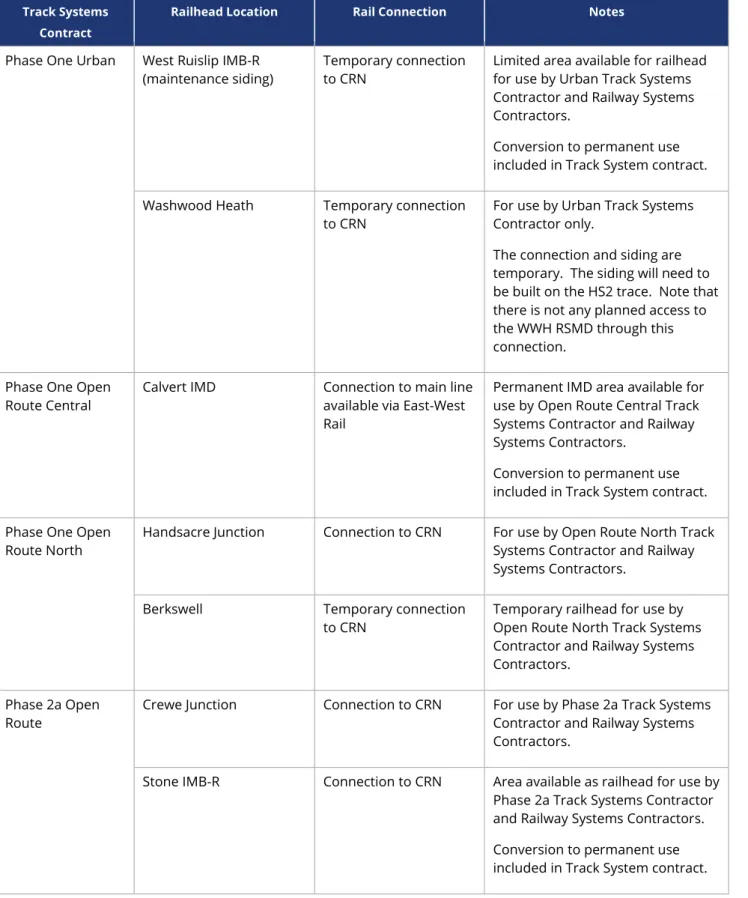
2.7.5 Track Systems Contractors install and manage construction railheads at locations that will be specified in the Works Information. The Track Systems Contractors will be required to design, install, operate and maintain these temporary construction railheads for their own use and the use of other Railway Systems Contractors. These sites have outline planning consent for use during construction and in some cases, authorisation for connection to the CRN has been established by HS2 Ltd.
2.7.6 All Railway Systems Contractors will be expected to work closely with HS2 Ltd, the Track Systems Contractors and Others to optimise the use of all the shared facilities. 2.7.7 Table 2 below is a provisional summary of these construction railheads, the
permanent or temporary CRN connection arrangements and the associated facilities at each site.
Table 2 - Summary of rail connections and facilities
Track Systems Contract
Railhead Location Rail Connection Notes
Phase One Urban West Ruislip IMB-R (maintenance siding)
Temporary connection to CRN
Limited area available for railhead for use by Urban Track Systems Contractor and Railway Systems Contractors.
Conversion to permanent use included in Track System contract.
Washwood Heath Temporary connection to CRN
For use by Urban Track Systems Contractor only.
The connection and siding are temporary. The siding will need to be built on the HS2 trace. Note that there is not any planned access to the WWH RSMD through this connection.
Phase One Open Route Central
Calvert IMD Connection to main line available via East-West Rail
Permanent IMD area available for use by Open Route Central Track Systems Contractor and Railway Systems Contractors.
Conversion to permanent use included in Track System contract.
Phase One Open Route North
Handsacre Junction Connection to CRN For use by Open Route North Track Systems Contractor and Railway Systems Contractors.
Berkswell Temporary connection to CRN
Temporary railhead for use by Open Route North Track Systems Contractor and Railway Systems Contractors.
Phase 2a Open Route
Crewe Junction Connection to CRN For use by Phase 2a Track Systems Contractor and Railway Systems Contractors.
Stone IMB-R Connection to CRN Area available as railhead for use by Phase 2a Track Systems Contractor and Railway Systems Contractors. Conversion to permanent use included in Track System contract.
Scope Document – ‘Compendium Version’ Railway Systems Contracts Document no: HS2-HS2-SY-SPE-000-000014
Revision: P03
2.7.8 The Track Systems Contractors, or other Railway Systems Contractors and Suppliers, will be required to participate in the design, installation, testing and commissioning of works related to the CRN interfaces. For example, the Control, Command,
Signalling (CCS) and Traffic Management (TM) Contractor will design signalling equipment controlled by the NICC, which may include equipment located on the CRN. HS2 Ltd’s On Network Works team will be responsible for all signalling
equipment controlled by Network Rail, which may include equipment located on HS2 property and both teams will be responsible for testing and commissioning their respective elements.
2.7.9 Arrangements for the design and installation of primary cable containment will vary. In general, the Track Systems Contractors will be responsible along the open route and the M&E System Contractor will be responsible in tunnels. In each case, the layout and route capacity will be determined by HS2 Ltd. Secondary cable
containment will be provided by the Railway Systems Contractors as specified in the Works Information.
2.8
Track Systems Contract geographical boundaries
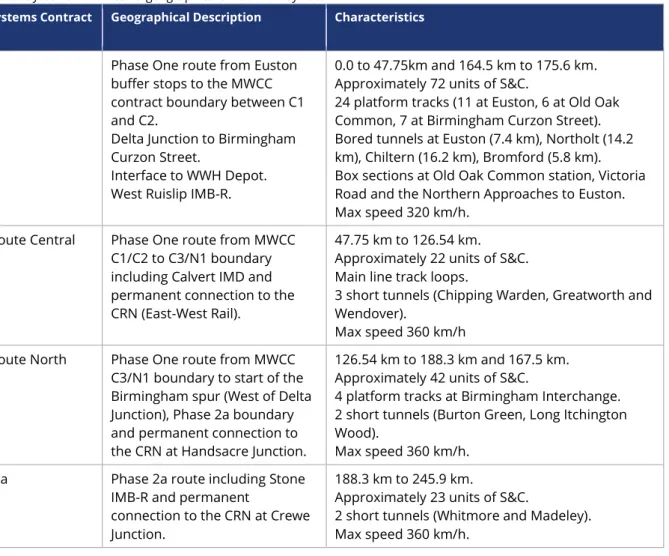
2.8.1 The Track Systems Contractors will provide important safety, logistics and co-ordination roles along the trace. A summary of the geographical areas of each of these Contractors, together with key data related to their areas, is included in Table 3 below.
Table 3 - Track Systems Contractors’ geographical areas and key data
Track Systems Contract Geographical Description Characteristics
Urban Phase One route from Euston buffer stops to the MWCC contract boundary between C1 and C2.
Delta Junction to Birmingham Curzon Street.
Interface to WWH Depot. West Ruislip IMB-R.
0.0 to 47.75km and 164.5 km to 175.6 km. Approximately 72 units of S&C.
24 platform tracks (11 at Euston, 6 at Old Oak Common, 7 at Birmingham Curzon Street). Bored tunnels at Euston (7.4 km), Northolt (14.2 km), Chiltern (16.2 km), Bromford (5.8 km). Box sections at Old Oak Common station, Victoria Road and the Northern Approaches to Euston. Max speed 320 km/h.
Open Route Central Phase One route from MWCC C1/C2 to C3/N1 boundary including Calvert IMD and permanent connection to the CRN (East-West Rail).
47.75 km to 126.54 km. Approximately 22 units of S&C. Main line track loops.
3 short tunnels (Chipping Warden, Greatworth and Wendover).
Max speed 360 km/h Open Route North Phase One route from MWCC
C3/N1 boundary to start of the Birmingham spur (West of Delta Junction), Phase 2a boundary and permanent connection to the CRN at Handsacre Junction.
126.54 km to 188.3 km and 167.5 km. Approximately 42 units of S&C.
4 platform tracks at Birmingham Interchange. 2 short tunnels (Burton Green, Long Itchington Wood).
Max speed 360 km/h. Phase 2a Phase 2a route including Stone
IMB-R and permanent
connection to the CRN at Crewe Junction.
188.3 km to 245.9 km.
Approximately 23 units of S&C.
2 short tunnels (Whitmore and Madeley). Max speed 360 km/h.
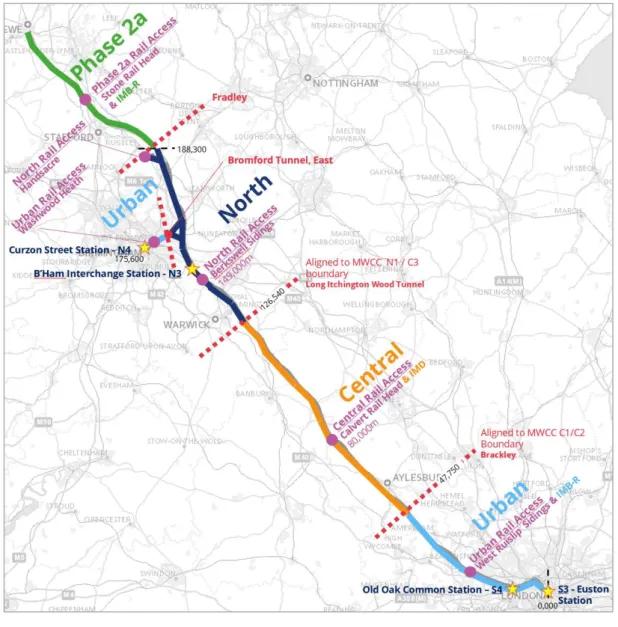
2.8.2 A schematic overview of the route, showing the geographical split between Track System Contracts, rail access and railheads for use during the construction phase, is shown in Figure 2 below.
Scope Document – ‘Compendium Version’ Railway Systems Contracts Document no: HS2-HS2-SY-SPE-000-000014
Revision: P03
Figure 2 - Route schematic showing contract boundaries and access points
2.9
Testing and commissioning
2.9.1 The Railway Systems Contractors will be responsible for carrying out the factory testing, site testing and commissioning of their own systems or sub-systems in accordance with HS2 Ltd’s testing and commissioning (T&C) procedures. These may include product and system-level testing, activities relating to static verification testing, site acceptance testing and static integration testing.
2.9.2 Where specified in the Works Information, Railway Systems Contractors will be required to provide an off-site testing facility for the purpose of software and hardware validation, integration testing, and validation of changes, provided and maintained until completion of the works.
2.9.3 The Railway Systems Contractors and Suppliers will also be required to undertake work during static integration and dynamic integration testing, to support the T&C co-ordination work of HS2 Ltd as Prime Systems Integrator.
2.9.4 HS2 Ltd will provide a System Integration Facility (SIF) to allow a number of command, control and communication systems to be proven in an off-line
environment, prior to testing and commissioning, and to support the integration of systems during their development and delivery. The Railway Systems Contractors will be expected to make use of the SIF where appropriate to provide early
demonstration of successful integration and interfacing of control and supervision systems within their scope.
2.9.5 After contract completion or sectional completion, the SIF will also be used to support ongoing maintenance including fault finding, simulation of failures and the testing of both hardware and software system upgrades.
2.9.6 The Railway Systems Contractors may be required to provide and operate specialist test equipment, including rail-mounted plant or specialist trains as defined in the Works Information.
2.9.7 HS2 Ltd may require early access to the works before sectional completion or completion, in accordance with the Conditions of Contract and as set out in the Works Information. The Railway Systems Contractors may be required to provide inspection and maintenance services of such assets before sectional completion or completion.
2.9.8 The Railway Systems Contractors will be required to produce drawings, design data and training in order to enable HS2 Ltd to operate, maintain, modify and develop the works and to operate and maintain the railway. There will also be requirements for provision of equipment, spares, health and safety information and operations and maintenance (O&M) manuals.
2.9.9 The Railway Systems Contractors will also be required to provide professional support to HS2 Ltd as Infrastructure Manager during trial operations in order to secure successful internal and external approvals that are necessary in order to bring trains into service.
2.9.10 The London Euston station build is currently being planned as a staged approach with additional platforms being constructed later. Details of this will be confirmed in the Works Information.
Scope Document – ‘Compendium Version’ Railway Systems Contracts Document no: HS2-HS2-SY-SPE-000-000014
Revision: P03
2.10
Maintenance and technical support contracts
2.10.1 In certain cases, HS2 Ltd may require Railway Systems Contractors to undertake technical support, or install system upgrades, undertake asset inspection or maintenance after completion or sectional completion.
2.10.2 The Railway Systems Contractors are expected to support the following maintenance principles:
• Provide predictive and preventive maintenance tools to support safe and
sustainable HS2 infrastructure that meets customers’ expectations and achieves HS2’s commitment to Whole Life Value for Money (WLVfM) and Performance, Availability, Reliability, Maintainability and Safety (PRAMS) targets.
• Provide an innovative approach to existing railway data management, processing and analysis to support intelligent asset management.
• Offer in-built diagnostics with remote access and reporting.
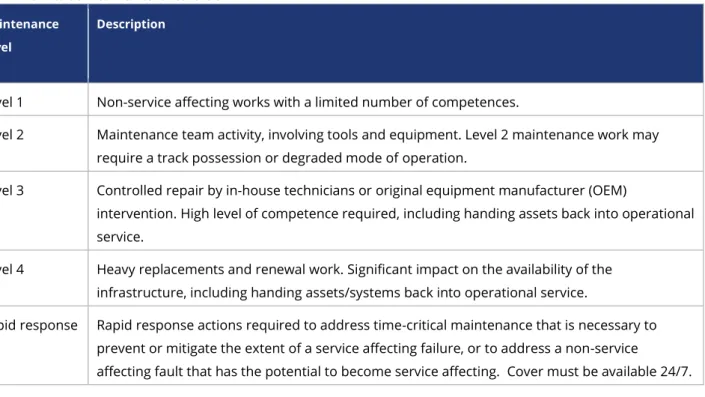
2.10.3 HS2 Ltd adopts a standard set of defined maintenance levels, shown in Table 4 below.
Table 4 - HS2 Ltd defined maintenance levels
Maintenance Level
Description
Level 1 Non-service affecting works with a limited number of competences.
Level 2 Maintenance team activity, involving tools and equipment. Level 2 maintenance work may require a track possession or degraded mode of operation.
Level 3 Controlled repair by in-house technicians or original equipment manufacturer (OEM)
intervention. High level of competence required, including handing assets back into operational service.
Level 4 Heavy replacements and renewal work. Significant impact on the availability of the infrastructure, including handing assets/systems back into operational service.
Rapid response Rapid response actions required to address time-critical maintenance that is necessary to prevent or mitigate the extent of a service affecting failure, or to address a non-service
affecting fault that has the potential to become service affecting. Cover must be available 24/7.
2.10.4 These services will be the subject of parallel contractual arrangements, (Maintenance Contracts or Technical Support Contracts) and are set out in the relevant sections of this Scope Description.
2.10.5 In some cases, the procurement of maintenance or technical support will be undertaken after the award of Design and Build contracts but with original
equipment manufacturers or specialist suppliers. HS2 Ltd will work with the Railway Systems Contractors to procure these future services.
Scope Document – ‘Compendium Version’ Railway Systems Contracts Document no: HS2-HS2-SY-SPE-000-000014
Revision: P03
3
Description of the Works
–
Track
Systems
3.1
Introduction
3.1.1 There will be four geographical Track Systems Contracts, known as Urban, Open Route Central, Open Route North and Phase 2a.
3.1.2 The successful Track Systems Contractors will be responsible for the design, construction, testing and commissioning of all plain line track, switches and crossings (S&C), rail expansion devices (REDs), track drainage and open route primary cable containment.
3.1.3 The Track Systems Contractors will be required to work with three significant supply contracts covering Phases One and 2a, for the precast slab track system, long-welded rail and S&C. These supply contracts are described in Section 3.2. 3.1.4 The Track Systems Contractor’s scope of work at Calvert IMD includes the track,
signalling, train control, communications systems and buildings for that site. Track and buildings are also to be provided at Stone IMB-R. Hard-standing and utilities will be required at West Ruislip IMB-R. These sites (as well as other sites) are to be used as railheads under the supervision of the track contractor during construction and then later converted into their end-state condition. Further detail of the permanent system requirements at these maintenance facilities will be included in the Works information.
3.1.5 The track systems within the RSMD at Washwood Heath (Birmingham) do not form part of any track contract or related supply contract but will be included in the scope of the Depot and NICC Contract.
3.1.6 Design, construction, testing and commissioning of permanent or temporary connections to the CRN will not be included in the scope of the Track Systems Contracts.
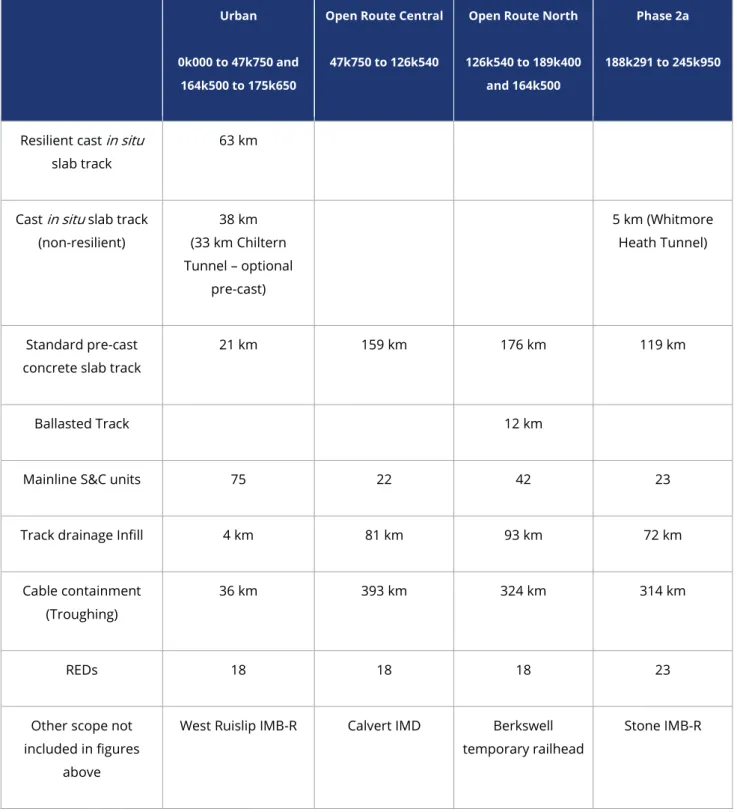
3.1.7 The Table below provides an indication of the scope of work and key data for each of the Track Systems Contracts.
Table 5 - Track Systems Contracts key data (track km)
Urban
0k000 to 47k750 and 164k500 to 175k650
Open Route Central
47k750 to 126k540
Open Route North
126k540 to 189k400 and 164k500
Phase 2a
188k291 to 245k950
Resilient cast in situ slab track
63 km
Cast in situ slab track (non-resilient) 38 km (33 km Chiltern Tunnel – optional pre-cast) 5 km (Whitmore Heath Tunnel) Standard pre-cast concrete slab track
21 km 159 km 176 km 119 km
Ballasted Track 12 km
Mainline S&C units 75 22 42 23
Track drainage Infill 4 km 81 km 93 km 72 km
Cable containment (Troughing)
36 km 393 km 324 km 314 km
REDs 18 18 18 23
Other scope not included in figures
above
West Ruislip IMB-R Calvert IMD Berkswell temporary railhead
Scope Document – ‘Compendium Version’ Railway Systems Contracts Document no: HS2-HS2-SY-SPE-000-000014
Revision: P03
3.2
Track Systems Supply Contracts
3.2.1 The following supply contracts will be awarded by HS2 Ltd for Phase One and 2a:
• Precast slab track system
• Rail
• S&C and REDs
3.2.2 The Invitation to Tender will include further details of the scope of each of these contracts and the commercial relationships between the Track Systems Contractors and these suppliers.
Precast Slab Track System
3.2.3 HS2 Ltd has conducted an advanced procurement to identify and appoint a supplier of the pre-cast slab track and related professional services. This Precast Slab Track System contract is based on a two stage approach:
• During the first stage, the supplier will be in contract with HS2 Ltd to develop a design, including rail fastenings, of a track slab solution that meets HS2 Ltd’s technical requirements.
• During the second stage, each Track Systems Contractor will be required to enter a contract with this supplier, to undertake the manufacture and supply of the pre-cast track slabs to the previously accepted design.
3.2.4 The Track Systems Contractors will be required to work with HS2 Ltd to integrate the pre-cast concrete slab track system design that has been undertaken by the Precast Concrete Slab Track System supplier into the Works.
3.2.5 Under the terms of this supply contract, the supplier will provide the Track Systems Contractors with the following support services:
• Quality control and assurance throughout the manufacturing and installation process.
• Implementation of a slab identification and maintenance traceability.
• Development of the design through to Approved for Construction (AFC).
• Assistance in resolving technical queries.
• Provision of a detailed production schedule for the manufacture of the pre-cast track slab units.
3.2.6 The supply contact will contain an option for the supplier to undertake the logistics management and delivery of track slabs to the Track Systems Contractor’s
nominated nodal delivery point, the exact location of which will be agreed with HS2 Ltd.
Rail
3.2.7 HS2 Ltd will undertake the procurement of main line long-welded rail (LWR) under the terms of a separate Phase One and 2a Rail supply contract, so that rail can be provided to the Track Systems Contractors for incorporation into the Works. 3.2.8 The Track Systems Contractors will be expected to provide rail for the IMB-Rs and
the IMD.
3.2.9 For the main line tracks, long-welded rails will be CEN 60 (Eurocode BS EN 13674-1) profile, standard grade steel, with a minimum length of 108 m between rail ends, welded by an approved ‘solid phase’ welding technique such as flash butt welding. HS2 Ltd is working on the assumption that the supplied rail strings will be ≥ 216 m
long. The Track Systems Contractors will provide HS2 Ltd with their anticipated rail quantities and delivery requirements to manage the timely delivery of the LWR in support of the construction schedule.
3.2.10 The rail supplier will be responsible for product assurance and compliance with the relevant HS2 standards.
3.2.11 Under the terms of this rail supply contract, HS2 Ltd will arrange for the rail to be delivered to nodal delivery points identified by the Track Systems Contractors (i.e. to an agreed railhead or a connection with the CRN). The Track Systems Contractors will arrange onward delivery to the site of work.
3.2.12 The Track Systems Contractors will be required to take receipt of the rail, manage logistics at the railheads and convey the rail to site, where it will be installed and joined using a welding method in accordance with HS2 standards.
S&C and REDs
3.2.13 HS2 Ltd will conduct a separate procurement to identify and appoint a supplier of the mainline S&C and REDs and related professional services. This contract will be based on a two stage approach:
• During the first stage, the supplier will be in contract with HS2 Ltd to develop a design that meets HS2 Ltd’s technical requirements.
Scope Document – ‘Compendium Version’ Railway Systems Contracts Document no: HS2-HS2-SY-SPE-000-000014
Revision: P03
• During the second stage, each Track Systems Contractor will be required to enter a contract with the supplier, to develop the site-specific details of the S&C,
manufacture units, undertake quality assurance and deliver units to agreed locations for incorporation into the Works.
3.2.14 HS2 Ltd defines high-speed S&C units as those with a through line speed between 160 km/h - 400 km/h, with a range of diverging speeds (according to the turnout type) of 80 km/h - 230 km/h. All high-speed S&C units are to a transitional geometric design with swing-nose crossings. Where the diverging speed is >100 km/h
(regardless of main line speed), high-speed S&C will be specified.
3.2.15 Where the diverging speed is ≤ 100 km/h, usually at station throats, S&C may be of
a circular geometrical design (UIC) and may have fixed-nose crossings.
3.2.16 Where traffic volumes dictate, swing-nose crossings may be specified in preference to fixed-nose crossings.
3.2.17 The S&C units, including rails, fastenings, bearers/blocks, points operating equipment, detection and controlling systems, together with points heating elements and condition monitoring, will be supplied to the Track Systems
Contractors, in accordance with the terms of the second stage contract. The Track Systems Contractor will be responsible for installation of the S&C layout and the testing and commissioning of the S&C units.
3.2.18 The S&C supplier will also provide and install the drives/motors/machines and associated equipment, interfacing with the lineside controllers which will be supplied, installed and commissioned by the CCS and TM Contractor. The Track Systems Contractors will be required to take responsibility for installation of all S&C equipment.
3.2.19 The S&C supplier will also provide heating elements as an integral part of the S&C system, for installation by the Track Systems Contractor. The Tunnel and Lineside M&E Systems Contractor will provide power and trackside transformers (with flying leads on 110 V cables) that connect to the heating elements. They will also provide the control function and sensors to enable the functioning of the points heating equipment. The Track Systems Contractor will be responsible for fitting the points heating elements on the rail.
3.2.20 The Track Systems Contractors will be required to provide and install S&C in the IMB-Rs and the IMD.
3.2.21 The Track Systems Contractors will undertake all work necessary to complete the installation of S&C in order to meet the HS2 Ltd performance requirements, as defined in the relevant technical standards, working closely with HS2 Ltd as Prime Systems Integrator in order to complete testing and commissioning.
3.2.22 The same supply contract will also be used for provision of REDs, which will be required on viaducts and bridges with large expansion lengths. The Track Systems Contractors will be required to work with HS2 Ltd and Others to determine the location of these devices.
3.3
Track Systems Contracts
3.3.1 Four track form types have been selected by HS2 Ltd to meet the speed and future tonnage requirements of the line.
• Standard pre-cast concrete slab track
• Cast in situ slab track
• Resilient in situ slab track
• Ballasted track
3.3.2 Specific locations for each track form and details of design options, will be set out in the Invitation to Tender.
3.3.3 The line speed along the route will vary, but the maximum operating speed for passenger trains will be 360 km/h.
3.3.4 The application of vertical, lateral and longitudinal design loading shall be in accordance with Eurocode EN 1991. Service loading from passenger trains is expected to reach a maximum of 17 tonnes axle load under normal operational conditions. The maximum cumulative loading for Phase One infrastructure,
expressed as million gross tonnes per annum (MGTPA), will be 41 MGTPA for initial services, rising to 63 MGTPA once the full train service is implemented. Further details of these requirements will be provided in the Works Information. 3.3.5 HS2 Ltd will retain responsibility of the Project Master Alignment (PMA) which
specifies the route wide alignment for the operational railway. The PMA defines the contiguous horizontal track centre-line, elevation and cant. HS2 Ltd will provide this alignment information to the Track Systems Contractor for incorporation into the detailed alignment design and track system design. The as-built track alignment and any subsequent adjustment until the works are taken over by the Employer will be the responsibility of the Track Systems Contractors.
Scope Document – ‘Compendium Version’ Railway Systems Contracts Document no: HS2-HS2-SY-SPE-000-000014
Revision: P03
3.3.6 The Track Systems Contractors will work with HS2 Ltd and their designers to achieve the design objectives of each track system. This includes the route-wide integration of HS2 acoustic design requirements and optimisation of material usage in respect to environmental impacts, including consideration of HS2 carbon lifecycle objectives. 3.3.7 Pre-cast concrete slab track will be installed in the open route section of Phase One
and 2a with the option to install this form over other discrete lengths. Chiltern Tunnel is classified as standard pre-cast concrete slab track but will be subject to design development by HS2 Ltd, following the appointment of the Precast Slab Track System supplier.
3.3.8 The Track Systems Contractors will be required to assure the design and supply of cast in situ slab track, including the track fastening system, within their overall design responsibility. This will include vertical and horizontal rail adjustment capability in line with HS2 technical standards and using design solutions endorsed by HS2 Ltd. The fastening system will be required to be a proven design for high-speed railways and to conform to European Standards and HS2 Technical Standards.
3.3.9 Resilient in situ slab track will be required by HS2 Ltd in certain specified tunnel and station areas. This track is necessary to meet HS2 ground-borne noise and vibration performance requirements, (including in Euston, Northolt and Bromford Tunnels). This track-form typically utilises booted blocks or booted bearers.
3.3.10 HS2 Ltd will provide the input parameters for the track system design to be undertaken by the Urban Track Systems Contractor that will enable the design to meet or exceed the acoustic performance requirements.
3.3.11 There will also be short sections of ballasted track in the transition to the connections with the CRN, within the IMB-R at Stone and IMD at Calvert.
3.3.12 The Track Systems Contractor will be responsible for the design and installation of primary cable containment along the open route. The Tunnel and Lineside M&E System Contractor will be responsible for the design and installation of primary cable containment in tunnels. In each case, the layout and capacity will be agreed with HS2 Ltd. Secondary cable containment, diverging from the primary cable containment, will be designed and installed by the appropriate Railway Systems Contractors, as specified in the Works Information.
3.3.13 The Track Systems Contractor may be required to drill rails in plain line and S&C in order to fix bonds and cable connections that are required by other Rail Systems Contractors.
3.3.14 The Track Systems Contractor will also be responsible for:
• Installation of the Buried Earth Conductor (BEC). The BEC will provided by the Tunnel and Lineside M&E System Contractor. This cable will be installed beneath the primary cable containment.
• Installation of acoustic mitigation, including low-level noise barriers, or noise absorption matting where required to reduce wheel/rail contact noise known as rolling contact noise.
3.3.15 The Track Systems Contractors may also be responsible for design of minor civil engineering works that are required to complete the track system.
3.4
Track systems/MWCC interfaces
3.4.1 The MWCC will complete a track formation layer, generally known as the frost
protection layer (FPL) in the open route, that will support the designated track form. 3.4.2 The formation will be subject to performance requirements (defined in terms of
tolerance, load-bearing, settlement rate, etc), to be met by the MWCC and subject to acceptance by HS2 Ltd prior to handover to the Track Systems Contractors.
3.4.3 The Track Systems Contractors will also be expected to work closely with HS2 Ltd’s specialist monitoring and technical support contractors, including geotechnical advisors, who will be independently assessing formation settlement and heave by monitoring and using prediction tools, which will support decisions to commence track installation.
3.4.4 The Track Systems Contractors will also be required to undertake re-profiling and secondary compaction of the FPL prior to commencement of track installation activities.
3.4.5 In open route pre-cast concrete slab track sections, the re-profiled FPL will form a base on which the Track Systems Contractors will lay an in situ concrete
hydraulically-bound layer (HBL), before installation and grouting of the pre-cast concrete slabs. The design and technical requirements for this HBL layer will form part of the pre-cast concrete slab track system design, provided to the Track Systems Contractors by HS2 Ltd.
3.4.6 The Track Systems Contractors will also be responsible for design and installation of an impermeable layer to span the interval between two or more tracks in the open route. This impermeable layer will convey water to cross-drains or longitudinal
Scope Document – ‘Compendium Version’ Railway Systems Contracts Document no: HS2-HS2-SY-SPE-000-000014
Revision: P03
integrate with the drainage catch pits provided by the MWCC will be required in curved track sections.
3.4.7 In tunnels and any other areas of cast in situ stab track, including all areas of S&C, the MWCC will complete the first stage concrete layer including any walkways or up-stands either side of the track. The Track Systems Contractors will be responsible for the design and installation of a suitable concrete bearing layer, cast in situ to support any pre-cast concrete elements in the track.
3.4.8 In areas of cast in situ stab track, including all areas of S&C, the Track Systems Contractor will be responsible for design and installation of any surface detailing required to convey water to the main drainage. In bored tunnels, the main drainage will be sited on the tunnel invert, encased in the first stage concrete laid by the MWCC and connected to the drainage system.
3.4.9 The MWCC will incorporate walkways and/or vertical upstands on either side of the track in tunnels and on viaducts for emergency evacuation and maintenance access.
4
Description of the Works
–
Overhead Catenary System
4.1
Introduction
4.1.1 There will be two separate OCS contracts, one for Phase One and one for Phase 2a, awarded to the same Contractor.
4.1.2 The Overhead Catenary System Contractor will be responsible for design, supply, manufacture, installation, testing and commissioning of the OCS systems in open route, stations and tunnels for HS2 Phase One and Phase 2a.
4.1.3 In this document, Overhead Catenary System Contractor is abbreviated to OCS Contractor.
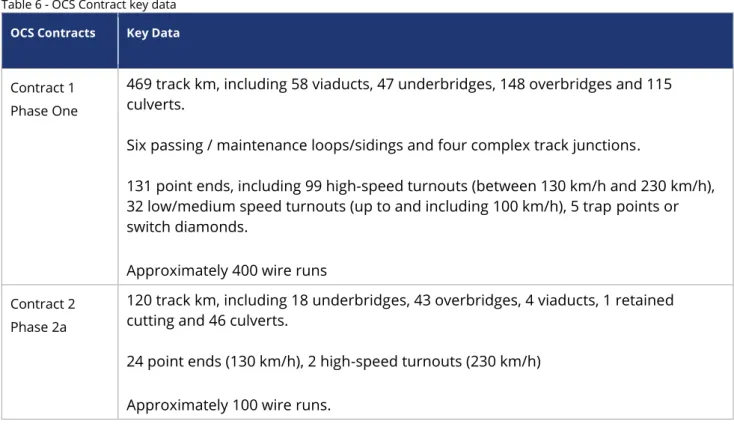
4.1.4 Table 6 below contains indicative key data related to the OCS contracts in open route for Phase One and Phase 2a. For details of tunnels refer to Table 3.
Table 6 - OCS Contract key data
OCS Contracts Key Data
Contract 1 Phase One
469 track km, including 58 viaducts, 47 underbridges, 148 overbridges and 115 culverts.
Six passing / maintenance loops/sidings and four complex track junctions.
131 point ends, including 99 high-speed turnouts (between 130 km/h and 230 km/h), 32 low/medium speed turnouts (up to and including 100 km/h), 5 trap points or switch diamonds.
Approximately 400 wire runs Contract 2
Phase 2a
120 track km, including 18 underbridges, 43 overbridges, 4 viaducts, 1 retained cutting and 46 culverts.
24 point ends (130 km/h), 2 high-speed turnouts (230 km/h) Approximately 100 wire runs.
Scope Document – ‘Compendium Version’ Railway Systems Contracts Document no: HS2-HS2-SY-SPE-000-000014
Revision: P03
4.2
System details
4.2.1 An advance contract for the Phase One and 2a OCS System and Basic Design has been placed by HS2 Ltd. This design has been developed to support HS2’s Phase One and 2a high-speed electric train operations and will deliver 25 kV AC nominal voltage to the train pantograph(s).
4.2.2 The output from this contract will be a 360 km/h TSI-compliant OCS Basic Design range, including a system known as V360-TSI for use up to 360 km/h and a reduced-tension variant known as V360-14/14 for use up to 230 km/h.
4.2.3 HS2 Ltd will mandate the use of this V360 basic design range for all HS2 main line OCS applications. Details of these designs will be included in the Works Information. 4.2.4 The design will comprise all the constituent longitudinal electrical conductors,
including auto-transformer feeder wire/cables, earth wire/cables and any
supplementary parallel reinforcing feeder wire/cable that may be necessary to form the on-track element of the electrification system.
4.2.5 The V360 main conductors and general technical characteristics will be as follows:
• The design tension of the contact and catenary wires will be 27.5 kN and 14 kN respectively for the V360-TSI design.
• The design tension of both contact and catenary wires will be 14 kN for the V360-14/14 reduced-tension variant.
• The contact wire will be specified as copper-tin alloy conductor, which has a 150 mm² cross-sectional area.
• The catenary wire will be specified as 65 mm² cross-sectional area bronze cable.
• The droppers will be specified as bronze cable, which has a 12 mm² cross-sectional area and complies with NF C34-110-2.
• System encumbrance will be 1.40 m.
• The contact wire will be pre-sagged in each span, with the amount of sag required calculated as 1/2000 of the span length, measured at mid span.
• The contact wire will generally be fixed at a height of 5.120 m (above rail level measured at the catenary mast support and registration assembly) throughout the route, except at the interface with Network Rail where it may be graded to the existing system height.
• The system design will not contain head-span or stitch-wire arrangements. 4.2.6 The OCS Contractor will be responsible for application of this design and
specification to the detailed design of the OCS, including production of the OCS allocation design.
4.2.7 The OCS Contractor will be responsible for fabrication, installation, testing and commissioning of all components of the system, including, but not be limited to the following:
• mast and portal foundations
• tunnel drilling and attachments
• main steelwork
• small parts steel (SPS)
• earthing and bonding for the OCS
• support and registration equipment
• in-span equipment
• wiring (including aerial earth and feeders) and in-span equipment
• switches and disconnectors
• electrification signage
• stores and fabrication facilities for construction operations
4.2.8 Voltage transformers will be designed and supplied by the HV Power Systems
Contractor and the OCS Contractor, depending on location and systems architecture, but installed and commissioned by the OCS Contractor.
4.2.9 HS2 Ltd will be responsible for the master alignment design, providing information to the Track Systems Contractors and the OCS Contractor for incorporation into their detailed designs.
4.2.10 The OCS Contractor will be required to work closely with HS2 Ltd, the Rail Systems Contractors and Others to integrate the design, construction, testing and
commissioning of the OCS with the other rail systems, civil engineering and stations. 4.2.11 Three trackform designs will be developed by HS2 Ltd to meet the speed and future
tonnage requirements of the line. The trackform designs will include:
• standard pre-cast concrete slab track
• cast in situ standard track
• resilient in situ slab track
4.2.12 There will also be a section of approximately 12 km of ballasted track at the connections to the CRN.
4.2.13 The HS2 infrastructure maintenance facilities, at Calvert IMD and Stone IMB-R will not be electrified.