Development of a Concept to Integrate
Technical Product Data and Business Data
Motivation, Conceptual Framework, and Consecutive Research
Jens F. Lachenmaier
Lehrstuhl für Wirtschaftsinformatik I
Universität Stuttgart
Abstract
As Industrial Enterprises have to deal with many challenges, it is no longer affordable to treat the engineering and the business perspective separately. By combining technical product data from the engineering perspective with established key-performance-indicators (KPIs) from the business perspective in a product-oriented Data Warehouse (pDWH), it will be possible to relate the KPIs to properties of a product. The consecutive research establishes a link between the two domains. In this research in progress paper existing literature from these two domains, some basic assumptions, a conceptual frame-work, as well as the course of action will be discussed.
1
Introduction
Companies struggle with many different issues such as the shortening of product lifecy-cles and the growing complexity of their business in general. Especially industrial enter-prises face fierce competition and have to improve their internal structures to stay com-petitive. An important part of the internal processes, which influences the company’s performance, is decision-making. Therefore, it has to be ensured that decision-makers are provided with reliable, correct, timely, and complete information. This is an important part of information management in a company and essential to create a competitive ad-vantage (Krcmar, 2011).
2
Proceeding Research
2.1
Business Perspective
The business perspective consists on the one hand of operational systems that focus on transactions, like Enterprise-Resource-Planning-, Material-Requirements-Planning-, and Supply-Chain-Management-systems. On the other hand, there is an agreement on the business side, that the data from the different systems should be homogenized in order to analyze the business performance and to support decision-making processes. This could be achieved with business intelligence (BI) systems and especially Data Warehouses that are considered the basis for BI. (Kemper et al., 2010)
2.2
Engineering Perspective
In most industrial companies, there is a separate IT-landscape for the engineering domain. It is often referred to as CAx-systems, as it contains among others computer-aided-design, computer-aided-manufacturing and computer-aided-quality-systems. These sys-tems are integrated in order to automatize certain steps during manufacturing (Asiabanpour et al., 2009). During product design, typically 3D-models of the product are created, which consist of many features. If the design is feature-based, it is possible to exchange the features with other technical CAx systems (Deng, et al., 2002; Dong & Vijayan, 1997).
2.3
Research Gap
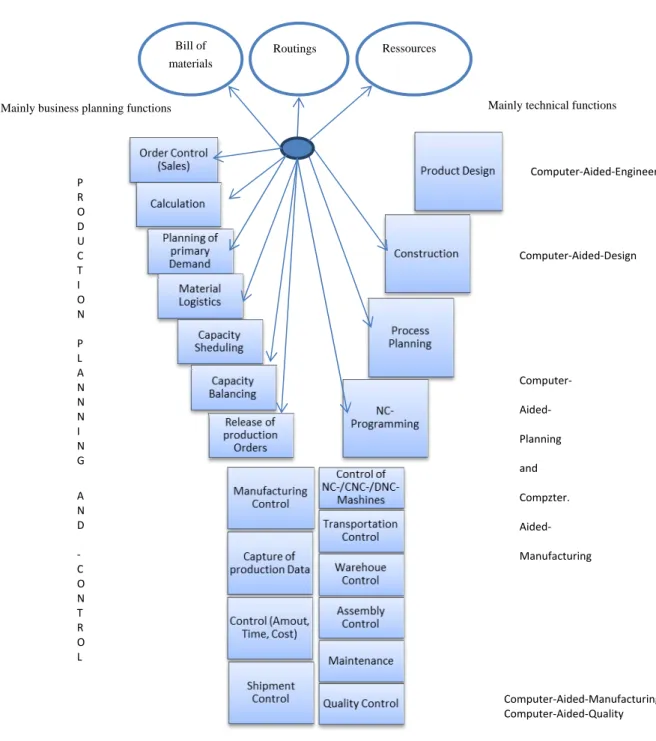
Already the Y-Model, which was developed during the 1990s by Scheer, shows that there is no established link between the two perspectives (cf. Figure 1). It shows on the left side the business planning functions that are nowadays covered by Enterprise-Ressource-Planning-systems; on the right side, there are the technical functions with the correspond-ing CAx-systems.
Figure 1: Y-Model – adapted from (Scheer, 1995)
So far, the integration has only been established within the two separate domains. The only shared information in practice is the bill of materials (e.g. Koliha, 2006).
Some authors in literature have identified this gap (N.N. 2011; Zeilhofer-Ficker, 2010; Lasi & Kemper, 2011). There may be different solutions to integrate the two different IT-system landscapes (e.g. concepts that can be subsummized as Computer-Integrated-Manufacturing or workflow management), but they do not focus on the support of
deci-Bill of materials
Routings Ressources
Mainly business planning functions Mainly technical functions
P R O D U C T I O N P L A N N N I N G A N D ‐ C O N T R O L
Computer‐Aided‐Engineering
Computer‐Aided‐Design
Computer‐Aided‐Manufacturing and Computer‐Aided‐Quality
Computer‐ Aided‐ Planning and Compzter. Aided‐ Manufacturing
sion-making. This paper proposes to solve the problem using business intelligence. The approach focuses on a product-oriented Data Warehouse (pDWH), which combines the technical construction data of a product with different kinds of transactional business data. Examples might be manufacturing and recycling costs or processing time to identify which properties of products – like the material or geometric features - cause which out-comes on the business side. A pDWH is proposed by Kemper, Baars & Lasi (2011) as it offers the possibility to combine business and technical data in a separate system, aggre-gate and analyze it using standard Online-Analytical-Processing-Techniques as well as its focus on supporting decision makers.
3
Conceptual Framework for Consecutive Research
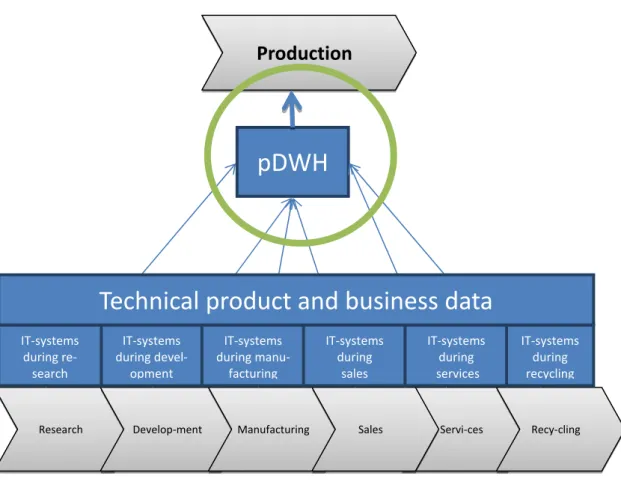
One of the first steps in research is structuring the topic in a conceptual framework (Miles, 2009). It contains all relevant factors that should be considered and their assumed relationships.
Figure 2: Conceptual Framework
Research Develop‐ment Manufacturing Sales Servi‐ces Recy‐cling
pDWH
Production
IT‐systems during devel‐ opment IT‐systems during manu‐ facturing IT‐systems during sales IT‐systems during re‐ search IT‐systems during services IT‐systems during recyclingThe conceptual framework (cf. Figure 2) is based on a typical product lifecycle, starting with research and development, continuing with production sales, services, and finally recycling. During these different phases, the operative IT systems generate and store technical product data and transactional business data. This transactional and feature-based data can be extracted, transformed, and loaded (ETL) into a product-oriented Data Warehouse (pDWH). The focus of the research is the development of such a pDWH. Therefore, ETL-processes have to be defined; the data has to be modeled in star schemas to be suitable for storage and analysis in a Data Warehouse and other requirements have to be collected and fulfilled. (e.g. physical design, non-functional requirements). (Silvers, 2008), (Gluchowski et al., 2008), (Kimball., 2010) With an existing prototype, it will be possible to determine how the pDWH can influence and support decision making during production. Using iterative development cycles, the pDWH will evolve over time (Goeken, 2006; Kemper et al., 2010).
This conceptual framework is meant to structure and define the scope for all related re-search. Therefore, it has to be ensured that there are not any important parts missing.
4
Consecutive Research
The research follows the design-oriented approach (Österle et al., 2011), which concen-trates on developing concepts for innovative information systems that can be implement-ed by companies. The objective is to design an information system, the result type is to develop a prototype of the pDWH, and the stakeholders are decision-makers who work in production contexts.
After an initial analytics phase, which is necessary to identify and describe the business problem that should be solved, the focus will be on the design of a pDWH. The need for a product-oriented Data Warehouse has been documented by investigating the current state of the art with regard to the integration of technical and business oriented IT-systems. Additionally, interviews will be conducted to ensure that the pDWH will fit the needs of decision makers.
As the pDWH should not only work in a single company, but for a larger variety of com-panies, it is not possible to ask all prospective users if they have all the information they need and if the Data Warehouse fulfills all their requirements as proposed by Kimball (Kimball et al., 2008). Therefore, this paper proposes a more generic approach: The Data Warehouse will be created based on the information needed to support decision making processes. Gluchowski et al. call this logical deduction of the information demand. (Gluchowski et al., 2008)
Later on, the extracted data from the operative systems has to be matched with the infor-mation that is necessary and has to be modeled into star schemas.
5
Discussion and Conclusion
The necessity of a concept for integrating both the business and the technical perspective has been shown, but some aspects of the research are still open for discussion: First, it has to be discussed if all relevant factors are included in the conceptual framework. Second, how to proceed with the design of the DWH.
A product-oriented Data Warehouse is beneficial in all phases of the product lifecycle. It supports decision-making during construction, production, and recycling. In the future, it might even be possible to anticipate the consequences of changes during product design to optimize the product regarding issues that occur later and thereby increasing business performance based on a company’s experience with similar products in the past. Not only will this give the management a more complete picture of what is really going on in their company, but it can also help to reduce costs and the time to market.
References
Asiabanpour, B., Mokhtar, A., Hayasi, M., Kamrani, A., & Nasr, E. A. (2009). An Overview On Five Approaches for Translating CAD Data into Manufacturing Informatuon. Journal of Advanced Manufacturing Systems, 8(1), 89-114.
Deng, Y. M., Britton, G. A., Lam, Y. C., Tor, S. B., & Ma, Y. S. (2002). Feature-based CAD-CAE integration model for injection-moulded product design. International Journal of Production Research, 40(15), 3737-3750. doi: 10.1080/00207540210141643
Dong, J., & Vijayan, S. (1997). Features extraction with the consideration of manufacturing processes. International Journal of Production Research, 35(8), 2135-2156. doi: 10.1080/002075497194778
Gluchowski, P., Gabriel, R. & Dittmar, C. (2008). Management Support Systeme und Business Intelligence computergestützte Informationssysteme für Fach- und Führungskräfte (2nd. ed.). Berlin Heidelberg: Springer.
Goeken, M. (2006). Entwicklung von Data-Warehouse-Systemen Anforderungsmanagement, Modellierung, Implementierung (1. ed.). Wiesbaden: Dt. Univ.-Verl.
Kemper, H.-G., Baars, H. & Lasi, H. (2011). Business Intelligence - Innovative Einsatzfelder in der Industrie, in: Kemper, H.G., Baars, H., Lasi, H. Felden, C., Krebs, S., Stock, S. (Eds..): Perspektiven der Business Intelligence - Festschrift anlässlich des 60. Geburtstags von Peter Chamoni, München, Hanser.
Kemper, H.-G., Baars, H. & Mehana, W. (2010). Business Intelligence - Grundlagen und praktische Anwendungen eine Einführung in die IT-basierte Managementunterstützung
(3. ed.). Wiesbaden: Vieweg + Teubner.
Kimball. R., Ross, M., Thornthwaite, W., Mundy, J. & Becker, B. (2008). The data warehouse lifecycle toolkit [practical techniques for building data warehouse and buiness intelligence systems] (2. ed.). Indianapolis, Ind.: Wiley.
Kimball, R. (2010). The Kimball Group reader relentlessly practical tools for data warehousing and business intelligence. Hoboken, N.J.Chichester: Wiley, John.
Koliha, M. W. (2006). CAD and BOM data get connected. Design News, 61(8), 75-80. Krcmar, H. (2011). Einführung in das Informationsmanagement. Berlin Heidelberg Dordrecht [et.al.]: Springer.
Lasi, H., & Kemper, H.-G. (2011). Integrationsansätze zur Verbesserung der Entscheidungsunterstützung im Innovationsmanagement. HMD - Praxis der Wirtschaftsinformatik (278), 94-103.
Miles, M. B. (2009). Qualitative data analysis an expanded sourcebook (2. ed., [Reprint]). Thousand Oaks, Calif. [u.a.]: Sage.
N.N. (2011), ERP/MES/CAD: Durchgängigkeit der Informationen über alle Ebenen ist Voraussetzung - Industrial IT wird ausgebaut. Industrieanzeiger (6).
Österle, H., Becker, J., Frank, U., Hess, T., Karagiannis, D., Krcmar, H., Sinz, E. J. (2011). Memorandum on design-oriented information systems research. European Journal of Information Systems, 20(1), 7-10. doi: 10.1057/ejis.20 0,55.
Scheer, A.-W. (1995). Wirtschaftsinformatik Referenzmodelle für industrielle Geschäftsprozesse. Berlin Heidelberg [u.a.]: Springer.
Silvers, F. (2008). Building and maintaining a data warehouse. Boca Raton, Fla. London: Auerbach: Taylor & Francis.
Zeilhofer-Ficker, I. (2010). Durchgängige Daten für die Produktionsplanung - immer noch Vision statt Wirklichkeit. Produktion, Materialwirtschaft & Logistik.