The Graduate School
TABLE OF CONTENTS
Contents
3
EXECUTIVE SUMMARY
4 INTRODUCTION
6
UNDERSTANDING FEE-BASED PROGRAMS
What is the difference between fee-based and state-based programs?
What fee-based programs does the UW offer?
How do fee-based programs operate?
How is the financial model for fee-based programs determined?
How do fee-based students pay for their education?
Who benefits from fee-based programs?
History of fee-based programs
UNDERSTANDING FEE-BASED STUDENTS
Trends: Who is the typical fee-based student?
Where do fee-based graduates go?
CAMPUS PERSPECTIVES
Incompatible Systems and Processes
Communication and Transparency
Customer Service and Service Resources
Program Quality, Access and Outcomes
Costs
MOVING FORWARD
APPENDIX
Glossary
Fee-Based Enrollment by Program (2007 – 2013)
Core Administration Survey Questions
Fee-Based Student Focus Group Questions
Brief History of Fee-Based Programs
EXECUTIVE SUMMARY
This report provides an overview of the current state of fee-based programs at the University of Washington, administered through Professional & Continuing Education (PCE). Fee-based programs represent a growing proportion of graduate education, particularly for master’s degrees. While historically students in fee-based programs have been mid-career professionals seeking additional credentials for advancement or transition, increasingly the profile of students in fee-based programs is nearly identical to students in state-based programs. Given the growth in fee-based programs, accompanied by this demographic shift, a report to better understand the history and current state of fee-based programs is prudent. Moreover, in the past few years some state-based programs transitioned to the fee-based structure, resulting in increased costs to students. Students have voiced concerns about these transitions. In 2012, the University of Washington initiated a moratorium on transitioning programs through July 1, 2015.
Data for this report was collected through surveys and conversations with the core administrative and service units such as Student Financial Aid, Student Fiscal Services, Career Services, UW Libraries, UW-IT and the Graduate School’s Office of Academic Affairs & Planning and Graduate Enrollment and Management Services. Interviews were conducted with fee-based academic directors, and three focus-group sessions were held with students currently in fee-based programs.
Key findings include:
General student satisfaction with the academic quality of fee-based programs; Dynamic and diverse academic offerings among fee-based programs;
Growth in fee-based programs, particularly at the master’s level; Overall student profile similar to state-based master’s students;
Concerns about transparency of information, particularly concerning tuition and fees; Difficulty in registering for classes because of a lack of system integration;
Incomplete and/or inaccurate information in PCE advising resulting in a range of obstacles for students, academic programs and the Graduate School staff;
Resource challenges for UW Libraries in their efforts to transition to online student access for materials. Limitations on student academic experience because costs of taking electives;
Challenges for students in acquiring academic student employment;
The rapid growth of fee-based programs as a solution to decreased state funding must be carefully weighed and monitored. In addition, minimum academic standards for admission to fee-based programs must be maintained. There is no question, however, that fee-based programs offer an excellent opportunity for the University of Washington to extend its reach and diversify its academic offerings.
INTRODUCTION
The purpose of this report is to demystify fee-based programs (that is, academic programs that operate without state funding) and help to identify key issues, concerns, and opportunities that faculty, administrators, students, and staff need to consider as the number of fee-based programs continues to increase.
Fee-based programs have been part of the University of Washington’s landscape for many years. In 1983, the University launched the first fee-based programs, the executive MBA and the EDGE Engineering program. Both sought to meet student and industry demand. They have been very successful and have many champions such as Mike Brennan, the director of development services for the City of Bellevue. He came to the UW after nearly 20 years in the workforce to earn an Executive Master’s in Public Administration in 2005. He explained why: “As you enter the workforce, after your bachelor’s, you find that the things you do, the experiences you have, are very different from what you had expected. There’s a huge leadership element that is part of the work world. A master’s degree can be very useful and very effective in providing the leadership knowledge and theory needed in a work setting.”
Since 1983, the University has continued to foster the growth of these programs as they perfectly capture the spirit of innovation and flexibility that is central to the mission and vision of the University of Washington. The Master of Communication in Digital Media is a prime example. Launched in 2001, the Communication in Digital Media degree has tripled the size of its Communication Leadership program. Director Hanson Hosein stressed that the fee-based structure enables the program to stay up-to-date with technology, new forms of digital storytelling and leadership training. It is, therefore able to remain highly relevant to students, who come in with expectations of a trailblazing curriculum. Many students in fee-based programs are looking to advance their careers or shift to new professional directions. The Executive Master of Health Administration, for instance, targets professionals who are moving up in local, regional and national sectors of the U.S. health system.
Work experiences, such as an internship or practicum, are common in these degrees. Graduate students in the Museology, for example, are required to complete 180 hours of internship work over the two-year course. The Master of Science in Computational Linguistics includes internships with companies such as Microsoft, Inxight Software and the Palo Alto Research Center. The Master of Science in Biomedical Regulatory Affairs includes on-the-job experience and gives students networking opportunities with professionals from the medical products industry in the Northwest.
These degree programs mix discipline-based knowledge with work-related skills. The Master of Science in
Biomedical Regulatory Affairs emphasizes industry ethics and writing effective and accurate technical documents and reports, and it includes a course that addresses the business dimension of clinical trials. The Computer Science professional master’s program’s course on “business basics for computer science professionals” focuses on strategy, finance, accounting and human resources. The Digital Media program notes its goal of helping students “develop a strong personal and professional network for their future career moves.” Networking is facilitated by the presence of advisory boards and part-time lecturers drawn from industry and the community. These University of Washington programs are community and industry oriented; the Computational Linguistics program notes that “graduates of this master’s program will gain the expertise needed for employment as language software development engineers and linguistics data specialists.”
Many programs are designed for part-time students and accommodate students’ work schedules. Classes often take place during evenings or on weekends, and some programs offer teleconferencing and online options. The Professional Master’s Degree in Computer Science is a part-time program for people who want to gain additional expertise while still working full time. Most of the students are full-time software design engineers and software developers, who are returning to school after about five years of work experience. The Executive Master of Health Administration (MHA) is specifically designed to allow students to earn their master’s degrees without leaving their current positions.
Fee-based programs have been, and continue to be, a primary means for the University of Washington to serve industry and students, and to demonstrate its commitment to lifetime learning. Over the past several years, the UW has witnessed a steady increase in the number of UW degrees and courses offered through fee-based funding models. In part, this increase has been in response to the continued reductions in state funding. Fee-based models have grown as they provide UW academic units with alternative ways of providing educational programs and content to students in the context of severe budget constraints. With these increases we see fee-based students
that fit the profile of state-based students and are as likely to be in day programs as weekend and evening programs.
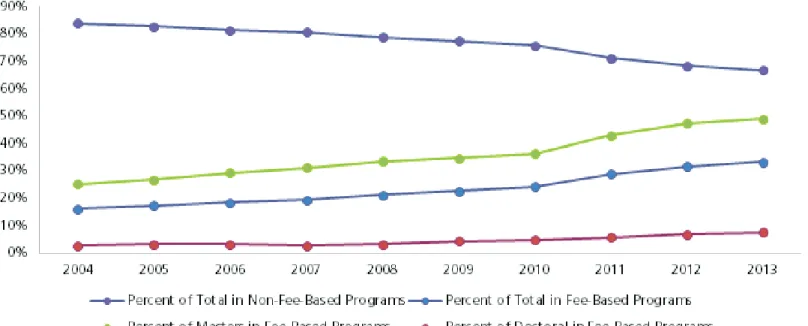
Between autumn 2007 and 2013, enrollment in fee-based graduate degree programs (master’s and doctoral) increased 108 percent from 2,045 to 4,249 students. Fee-based students now account for 33 percent of all matriculated degree-seeking graduate students (as opposed to 19 percent in 2007), and 42 percent of new enrollment (2013-14 academic year) within the UW Graduate School. Part of this increase is attributed to
international students in master’s fee-based programs. In fact,master’s student population would have decreased in 2012 without the 40 percent increase in international fee-based graduate students.
Figure 1. Percent of Students in Fee-Based Programs
On the upside, in the best cases, fee-based programs provide to diverse groups of students access to many of the UW’s resources, including its world-class faculty and top-notch research facilities, its technical and capital infrastructures, and, of course, the UW brand. Moreover, fee-based programs can be incredibly innovative and responsive to market needs.
However, fee-based programs raise concerns, as well. Fee-based programs are typically more expensive than their state-based counterparts, and their students’ access to financial support is more limited. In response to recent fiscal limitations, some state-based programs transitioned to fee-based models, leaving students in difficult positions as they faced substantial and unexpected tuition increases. Because they must meet their financial projections, fee-based programs walk a fine line to ensure that the quality of their programming is never compromised by the need for student enrollment.
UNDERSTANDING FEE-BASED PROGRAMS
In this section we offer an overview of fee-based programs and students in comparison to state-based programs and tuition-based students.
WHAT IS THE DIFFERENCE BETWEEN FEE-BASED AND STATE-BASED PROGRAMS?
Programs that are fee-based (self-sustaining) are funded entirely by the fees paid by enrolled students and are not partially funded by the state of Washington. Tuition-based (state-supported) programs are funded by a
combination of state subsidies and student tuition dollars. As a result, fee-based programs generally cost more, and state financial aid and state tuition exemption are generally not available to students registered in them.
Although the technical difference between fee-based and tuition-based programs is purely financial, this financial distinction has resulted in different procedures for how students pay and register for courses. Tuition-based students manage their course registration and tuition through MyUW or the UW Registrar; however, fee-based students usually pay for and register for courses through UW Professional & Continuing Education (PCE). Regardless of this distinction, fee-based students and tuition-based students are treated similarly in many important ways:
Students in fee-based programs are regular UW matriculated students. Fee-based students must meet regular UW admissions standards.
A degree earned through a fee-based program is a regular UW degree from a school or college; the diploma looks exactly the same as one granted by a state-based program.
Fee-based students pay all the same student fees (student technology fee, services and activities fee) as tuition-based students.
Fee-based students have all the same rights, responsibilities and services as their tuition-based counterparts, including access to health insurance, student housing, IMA, U-PASS, etc.
WHAT FEE-BASED PROGRAMS DOES THE UW OFFER?
As of July 2013, the UW offers 81 fee-based graduate degree programs, including four doctoral programs, through 19 UW schools and colleges. While the UW offers a variety of fee-based programs and certificates, the majority of students enrolled in fee-based programs are pursuing graduate degrees. Fee-based courses occur year-round, on- and off-campus, daytime and evening. Most of the programs are offered on one of the three UW campuses, though 15 are exclusively online or online hybrids. A complete list of degree programs and enrollment by major (as of July 2013) can be found in Table 1 (Appendix).
Enrollments
The highest enrollments of fee-based students are in the College of Engineering (910 students), School of Business (712) and the Information School (541). Fee-based programs with the highest individual enrollments are the Masters of Business Administration-Evening Degree (293), the Masters of Library and Information Science (211 students) and the Masters of Information Management (194).
Growth
The past several years have seen an increase in the number of degrees offered through fee-based funding models and an increase in students enrolling in those programs. Total fee-based students now account for 33 percent of all graduate students (19 percent in 2007), and fee-based master’s students account for 49 percent of all master’s students (31 percent in 2007). Between autumn 2007 and autumn 2013, the UW experienced:
104 percent increase in fee-based master’s enrollment versus a 5.5 percent decrease in tuition-based masters’ enrollment
209 percent increase in fee-based doctoral enrollment versus a 6 percent increase in tuition-based doctoral enrollment
110 percent increase in total fee-based enrollment (master’s and doctoral combined) versus a 0.05 percent decrease in total tuition-based enrollment (master’s and doctoral combined)
130 percent increase in new fee-based master’s student enrollment versus a 0.17 percent decrease in new tuition-based master’s student enrollment
Figure 2. Master’s Student Enrollment By School/College, Autumn 2013
Figure 3. Master’s Student Enrollment (Tuition- vs. Fee-Based), Autumn Quarter 2007-2013
HOW DO FEE-BASED PROGRAMS OPERATE?
Professional & Continuing Education (PCE), a division of UW Educational Outreach, administers over 70 percent of the UW’s fee-based programs, including 75 degree programs with nearly 3,000 students and more than 2,600 student FTEs. PCE typically oversees recruitment, registration, accounting, program management and communications for these programs. Responsibility for admissions and graduation remains within the academic unit and the Graduate School, as is the case with traditional state-based programs.
0 200 400 600 800 1,000 1,200 1,400 Tuition-Based Fee-Based 0 1,000 2,000 3,000 4,000 5,000 6,000 2007 2008 2009 2010 2011 2012 2013 Tuition-Based Fee-Based
Admissions
The admissions process for fee-based graduate programs remains largely the same as for state-based:
As with any UW graduate degree, prospective applicants must apply for admission to the program, be admitted by the individual academic unit, and have enrollment eligibility confirmed by the Graduate School prior to registration.
Each fee-based program establishes its own admission requirements. Although programs are allowed to develop separate departmental admissions criteria, basic Graduate School requirements remain the same for ALL graduate students.
Some fee-based programs accept students each quarter; but in others, students apply only once per year. A students admitted to a fee-based program is not automatically admitted to a similar state-based program
within the same academic unit. Students must apply separately for admission to gain entry into other UW programs.
Course Registration and Payment
As mentioned above, fee-based students use a different process to register for classes and pay for their courses than students in state-based programs. Instead of registering through MyUW and making payments through Student Fiscal Services, fee-based students register through PCE and pay their program/course fees upon registration (fee-based programs that aren’t managed by PCE do this themselves). PCE’s registration systems and accounting processes are not automatically integrated into the regular UW systems, but are added manually by PCE staff. Students enrolled in state-based programs can choose to take fee-based courses as part of their load on a space-available basis, but they must register and pay additional fees for those courses through PCE. In addition, the courses are not counted as part of the credits when determining the student’s quarterly state tuition amount. Likewise, fee-based students can take a state-based course on a space-available basis by petitioning the department providing the course; but students will pay course fees to PCE that commensurate with their student status as a fee-based matriculated students in their respective programs.
Program Creation and Management
Academic units present the program framework and parameters (curriculum, faculty mix, lab resources, number of students to be served, etc.) to PCE, which performs a market analysis and review of program parameters to determine the proposed program’s financial viability.
PCE and the academic unit draft a proposal, working closely with the Graduate School’s Academic Affairs & Planning Office. During this proposal development process, an appropriate program degree is determined; and the Memorandum of Agreement (MOA) between PCE and the academic program is drafted.
Prior to final approval by the provost and UW Board of Regents, the new degree program must be reviewed by the Graduate School on the UW Seattle campus and by the appropriate faculty oversight committees on the UW Bothell and UW Tacoma campuses before final approval of the Provost and UW Board of Regents.
One difference between state-based and fee-based programs concerns risk. PCE coordinates a “risk fund” for new programs to help aggregate risk with other programs.
Although PCE charges program management fees, academic units wanting to create a fee-based program often elect to have PCE manage the program because the services that PCE provides—including student recruitment, marketing, accounting (including fee collection, billing, and payments), program management, student support services, and technological support—can be important for program success and often exceed what the academic unit is able to provide
While PCE provides program and financial management for fee-based programs, the responsibility for the academic quality of the program lies with the hosting academic unit. As with state-based programs, the degree program and academic unit oversee fee-based students’ academic progress, advising, requirements for program completion, and recommend graduation directly to the Graduate School.
Program Success and Termination
Programs that generate net revenue have those funds returned to the hosting academic unit. Such revenue surpluses are flexible and can be used for many purposes, including those not tied to the fee-based program itself, such as funding new faculty for the unit’s doctoral program, sponsoring travel and creating scholarships.
When a program no longer meets market demand, warning signs have likely already existed (fewer applicant inquiries or applications, market saturation, projection that costs will exceed tuition and fees, etc.). If program closure appears to be necessary after market research study and several years of negative revenue, the program
director, after consulting with the PCE vice provost and PCE executive council, will work with the academic unit, Graduate School, and provost’s office to end the program according to the reorganization, consolidation, and elimination procedures.
HOW IS THE FINANCIAL MODEL FOR FEE-BASED PROGRAMS DETERMINED?
Course Fees Versus Tuition
While tuition for state-based programs is a flat rate for a courseload of 10-18 credits, each fee-based program charges its own per-credit course fee, or quarterly program fee. PCE helps programs determine these fees based on estimated expenses, peer program tuition rates, price sensitivity and market demand associated with that program.
Generally, fee-based programs are more expensive because they do not have a state-supported subsidy. Most fee-based programs have a single program fee for residents and non-residents alike, which is often much less than the equivalent non-resident tuition for a state-based degree program. In effect, non-resident and international students typically pay more for state-based programs than for fee-based programs.
Comparing costs of state-based programs and fee-based programs, as well as among fee-based programs themselves, is difficult since most fee-based programs charge by credit hour (versus FTE), and the number of required credit hours varies by program.
PCE’s fee-based programs ranged between $335 (Speech & Hearing Sciences post-baccalaureate) to $925 (MS in Computer Science and Engineering) per credit hour (autumn 2012)
Unlike their tuition-based counterparts, students enrolled in fee-based programs cannot use tuition exemptions to offset the cost of instruction. Students enrolled in state-based programs are charged tuition rates according to their grade classification, residency status, tuition tier and the total number of registered credit hours (tuition charges are the same for two to 10 registered credits).
In autumn 2012, average quarterly tuition charges for state-based master’s graduate programs ranged between $4,643 (Humanities) and $9,126 (Law) for full-time residents, and $8,474 (Education) and $13,502 (Law) for non-resident graduate students. International master’s graduate students were charged anywhere from $7,621 (Medicine) to $13,096 (Business) in autumn 2012.
All students matriculated in PCE fee-based degrees programs and students in state-based programs are also assessed quarterly fees, including the technology fee, services and activities fee, intramural activities center bond fee, facilities renovation fee, and a $42 PCE registration fee.
Charges to Degree Program
All fee-based programs are charged UW institutional overhead; those administered by PCE also pay program and infrastructure costs charged by PCE. In fiscal year 2013, each PCE fee-based degree program is subject to: $26,787 flat fee charge for the program management services provided by PCE.
$1,630 per course “UWEO Infrastructure” charge (covering such services as PCE marketing, information technology, etc.)
A net UW overhead rate of 11.38 percent of gross revenue (14.28 percent standard UW overhead rate, less a 2.90 percent subsidy provided by UWEO.)
The revenue generated from a fee-based student in a state-based course typically remains in the fee-based program without any incurred instructional costs.
Indirect and Hidden Expenses for Support Services
The large growth of fee-based students at the UW has also created a corresponding increased demand for general services provided by the UW’s student service and administrative units such as Student Fiscal Services, Student Financial Aid, Libraries and others.
While PCE pays standard overhead to the UW provost, it also charges academic units a 1 percent additional overhead to support the UW’s student service units. PCE worked with the UW auditor to assess the true costs of additional fee-based students for the campus community and provide subsequent financial support for staffing positions to meet the increased service needed (e.g.,fiscal officers in Student Fiscal Services and Student Financial Aid.) PCE meets annually with central service support units to assess growth and their funding needs in serving the growing fee-based student population, and to allocate additional funds from the 1 percent extra overhead to provide those services.
HOW DO FEE-BASED STUDENTS PAY FOR THEIR EDUCATION?
In most cases, fee-based students are not eligible for the University’s financial aid programs, including tuition exemption, institutional tuition waivers, undergraduate/graduate university grant programs, and the Husky Promise. However, it is possible for students in fee-based programs to qualify for some federal and state grants, loans and departmental scholarship programs.
University Aid
The University of Washington offers several financial aid opportunities, very few of which are available to fee-based students.
Graduate students enrolled in fee-based programs are not eligible for tuition exemption benefits associated with ASE positions, such as TAs or RAs. Tuition exemption is a waiver of state tuition. But fee-based students neither pay tuition, nor do they contribute the 9 percent of state tuition that is returned to Student Financial Aid and set aside for tuition waivers.
Fee-based graduate students can be hired as ASEs and are paid the same stipend levels as their tuition-based counterparts; but since they are not eligible for (state-funded) tuition waivers to pay fees, the remaining amount must be paid directly by the hiring department, research grant or the student herself (as their tuition reimbursement is paid at Tier I and not necessarily the cost of their program).
In autumn 2013, just 0.76 percent of fee-based students held TA positions, and 1.1 percent held RA positions. While the number of fee-based master’s students requesting financial aid (via submission of a FASFA) more than
doubled between 2007 and 2011, the number of tuition-based master’s students requesting aid has remained stagnant.
Although calculated need for all master’s students increased (from 46 percent in 2007 to 55 percent in 2011), a larger percentage of tuition-based master’s students qualified for need—and for greater average amounts— than fee-based master’s students (59 percent and 50 percent, respectively, in 2011).
While loans for tuition-based students rose 24 percent between 2007 and 2011, loans for fee-based master’s students rose 13 percent and remained 12.2 percent greater than those for tuition-based students despite lower computed need.
Table 1. UW Master’s Student Financial Need and Aid
Fiscal Year 2007-2008 Fiscal Year 2011-2012
Tuition-based Fee-based Total Tuition-based Fee-based Total Submitted FAFSA 4,879 2,379 7,258 4,949 3,680 8,629 Demonstrated Need 2,419 950 3,369 2,913 1,838 4,751 Average Loan Disbursed 25,956 31,916 27,637 32,197 36,109 33,711 State Aid
The state of Washington offers grants and loans, but fee-based students are not eligible for state need grants. Federal Aid
Fee-based students and tuition-based students alike are eligible for federal loans, though subsidized (Stafford) loans are no longer available for any graduate and professional students.
Employer Subsidies
In order to increase their value and contributions in the workplace, some fee-based students’ employers provide education reimbursements to encourage employees to seek continuous education and training. These subsidies provide limited monetary funding for course fees and materials; and because they can be paid directly to employees, rather than to the University, determining how many students utilize employer subsidies is nearly impossible. (PCE was not able to provide data for employer reimbursement participation.)
Student Debt
few years. Between 2007 and 2011, the number of fee-based master’s students graduating without debt fell from 37 percent to 32 percent (and fell from 35 percent to 32 percent for tuition-based masters students). Conversely, the number of graduating fee-based master’s students with more than $20,000 in debt rose from 39 percent to 49 percent (and rose from 30 percent to 40 percent for tuition-based master’s students).
WHO BENEFITS FROM FEE-BASED PROGRAMS?
Students
Because the state does not provide assistance for all of the academic programs designed by the schools and colleges at the UW, fee-based programs and individual credit classes have been, and continue to be, developed. Students can benefit from fee-based programs in the following ways:
Convenience through evening, weekend, and online course options Practical, real-world knowledge that can be immediately used on the job
Relevant content that is taught by UW faculty and top UW-approved industry professionals in touch with the latest developments in the field
Academic Units
Fee-based degree programs within state-supported academic units take advantage of the UW’s resources including the array of faculty, the robust technical and capital infrastructures, and the UW brand. The fee-based funding model gives departments the freedom and flexibility to be innovative. While they still must meet the bottom line, they don’t need external review or administrative permission to use funds for program development or course offerings. Aside from buffering academic units from state budget cuts, the revenues generated by fee-based programs can be utilized for departmental reinvestment, recruitment funds, faculty travel, or even hiring tenure track faculty. Indeed, strong fee-based programs and strong professional master’s degrees can strengthen traditional Ph.D. programs, too.
University
Fee-based programs provide another mechanism for the UW to provide access to its many resources and spur innovation in areas that we might not see otherwise. They have allowed the UW to be responsive to market demand and to create excellent programs that serve our community well.
HISTORY OF FEE-BASED PROGRAMS—A Timeline
1912 University of Washington Extension Division created. 1917
1920s-1930s
1932 Washington state’s level of appropriation to the
division was so insufficient that all new programs needed to be self-supporting.
Washington state legislature passed a law requiring that the Extension Service be financially self-sufficient.
Rapid growth of academic professionalism and enrollment at UW produced higher admission standards. Students who didn’t meet the new admissions standards were permitted to take courses through the Extension Service for fees that were higher than tuition for regular courses.
A Seattle Times article reported that students could purchase an education at “wholesale rates” through the Extension Service because they were not subject to student body dues/fees.
Division of Adult Education created
The Extension Service expanded and experimented with modes of instruction such as partnering with KCTS-TV to develop “telecourses” in order to reach distance learners, the Bureau of Community Development, and the Liberal Arts Seminars lecture series.
As the influx of “baby boomers” into the workplace generated skilled employment demand, UW released the “Statement of the Role of the University” emphasizing that UW should focus its “educational concerns not only on the teaching of undergraduates but also on the conduct of graduate, post-doctoral and professional programs.”
Continuing Education adopted a single fee scale for evening and day classes.
A financial emergency triggered a wholesale reevaluation of all UW programs, and Continuing Education restructured and changed its name to University Extension. Due to cutbacks in federal support, the University granted the MEDEX program a self-sustaining status, allowing the program to retain tuition and fees.
Two new master’s degree fee-based programs, the Executive MBA (not administered through UWEO) and the EDGE Engineering program (distance learning degree administered by UWEO) were created.
The technology revolution and flexible funding model facilitated the growth of certificates and innovative degree programs.
University of Washington Educational Outreach (UWEO) introduced the Professional and Continuing Education (PCE) division as the “public-facing brand” for its educational programs, specifically professional certificate and master’s programs for adults.
UWEO administered 37 graduate degree and five evening undergraduate degree programs. In response to large budget cuts to the University,
eight previously state-based graduate programs were converted to a fee-based funding model.
To better realize the effects of revenue and funding decisions made under the new Activity-Based Budgeting (ABB) model, UW imposed a moratorium in summer 2012 on transitioning state-based degree programs to the fee-based model—no existing state-based programs can convert from to a fee-state-based funding model until July 1, 2015. At the time the moratorium was issued, 21 active fee-based degree programs had shifted from state-based to fee-based. The Washington State House of Representatives
considered House Bill 1669, which would have required public undergraduate institutions to notify students six months before switching programs to a self-sustaining fee-based model. (Usually this transition comes with an increase in program costs, which deters students and leaves them with massive amounts of debt.) The 2013 legislative session ended before the state Senate could vote on the measure, so the bill has not yet become a law. UWEO administered more than 75 graduate degree programs and 55 certificate programs.
Division of Adult Education expanded to provide education to adults across the state.
1943 1946
The Division of Adult Education changed its name to Continuing Education in 1964 to emphasize the increasing importance of graduate and professional programs. 1960 1964 1969 1950s 1921 1981 1983 1990s 2007 2009 2009-11 2012 2013
Fee-based students can be in undergraduate programs, certificate programs, master’s or doctoral programs. They can be in residential programs, online programs or hybrid programs. The majority are graduate students in master’s programs. In this section we look at the demographics and the education outcomes of these master’s students. Between autumn quarters 2007-2013:
104 percent increase in fee-based master’s enrollment versus a 5.5 percent decrease in tuition-based masters’ enrollment
209 percent increase in fee-based doctoral enrollment versus a 6 percent increase in tuition-based doctoral enrollment
110 percent increase in total fee-based enrollment (master’s and doctoral combined) versus a 0.05 percent decrease in total tuition-based enrollment (master’s and doctoral combined)
130 percent increase in new fee-based master’s student enrollment versus a 0.17 percent decrease in new tuition-based master’s student enrollment
110 percent increase in fee-based total students
104 percent increase in fee-based master’s students 209 percent increase in fee-based doctoral students 135 percent increase in new fee-based total enrollment 130 percent increase master’s fee-based enrollment
43 percent of all new enrollment (tuition-based and fee-based students combined) Total fee-based students account for 33 percent of all graduate students; 19 percent in 2007
Fee-based masters account for 49 percent of all master’s graduate students; 31 percent in 2007
WHAT ARE THE TRENDS?
Are fee-based programs primarily serving “non-traditional” students? Within the last several years, fee-based master’s students are trending:
Younger
The average age is 32 (age 30 for tuition-based master’s students) More ethnically diverse
9.6 percent are underrepresented minorities (up from 7.5 percent in 2007, and in comparison to 11.2 percent of tuition-based master’s students)
Full-time enrollment
50 percent are enrolled full-time (up from 43 percent in 2007, and in comparison to 79 percent of tuition-based master’s students)
Non-resident
60 percent are Washington state residents (down from 67 percent in 2007, and in comparison to 65 percent of tuition-based master’s students)
International
13.4 percent are international students ( up from 9.8 percent in 2007, and in comparison to 11.5 percent of tuition-based master’s students)
International students now comprise a larger percentage of master’s fee-based programs than their tuition-based counterparts.
Less professional experience
Just 21 percent of fee-based program applicants in 2012 had more than five years of professional working experience, down from 43 percent in 2007 (according to PCE applicant surveys).
21 percent of fee-based program applicants are unemployed (up from 0% in 2007)
The highest concentration of employed fee-based program applicants are employed in health-care/social services fields (24 percent) and education (10 percent), versus information/publishing (25 percent) and government/public administration (23 percent) in 2007.
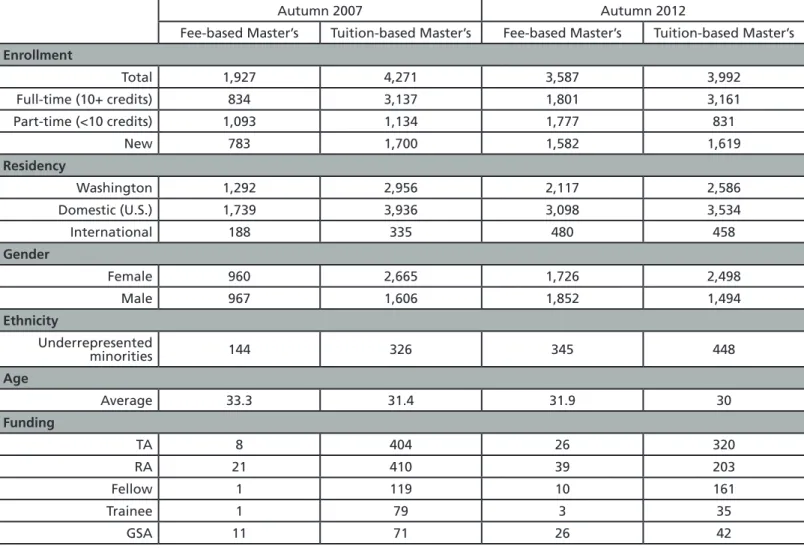
Table 2. Who Are Fee-Based Students?
Autumn 2007 Autumn 2012
Fee-based Master’s Tuition-based Master’s Fee-based Master’s Tuition-based Master’s
Enrollment Total 1,927 4,271 3,587 3,992 Full-time (10+ credits) 834 3,137 1,801 3,161 Part-time (<10 credits) 1,093 1,134 1,777 831 New 783 1,700 1,582 1,619 Residency Washington 1,292 2,956 2,117 2,586 Domestic (U.S.) 1,739 3,936 3,098 3,534 International 188 335 480 458 Gender Female 960 2,665 1,726 2,498 Male 967 1,606 1,852 1,494 Ethnicity Underrepresented minorities 144 326 345 448 Age Average 33.3 31.4 31.9 30 Funding TA 8 404 26 320 RA 21 410 39 203 Fellow 1 119 10 161 Trainee 1 79 3 35 GSA 11 71 26 42
WHERE DO FEE-BASED GRADUATES GO?
A 2012 PCE survey of fee-based program applicants found that 46 percent planned to return to the same employment fields after completing their degrees (33 percent planned on entering a different field, 21 percent were unsure). In the 2011-12 Graduate School exit survey, graduating master’s students reported that their post-graduation plans were*:
Secure a position and stay in Washington state: Fee-Based = 82 percent, Tuition-Based = 78 percent Employment in INDUSTRY: Fee-Based = 60 percent, Tuition-Based = 30 percent
Employment in GOVERNMENT: Fee-Based = 9 percent, Tuition-Based = 11 percent Employment in BUSINESS: Fee-Based = 57 percent, Tuition-Based = 27 percent
CAMPUS PERSPECTIVES
In this section of the report we turn to campus perspectives. These perspectives include those core offices that provide the infrastructure and student services for all graduate education (Registrar, Student Financial Aid, Student Fiscal Services, Career Services, Libraries, etc.), as well as views of graduate program advisors (GPAs), various offices within the Graduate School, directors of fee-based programs, and, of course, graduate students themselves. While we are able to map a range of experiences, we note that some common themes emerged across many of these campus constituents. These themes signal key areas for improvements as fee-based programs grow in size and number.
INCOMPATIBLE SYSTEMS AND PROCESSES
A consistent concern from many administrative offices, graduate program advisors and fee-based students on all three campuses is the difficulty and confusion of negotiating incompatible systems and differential processes for the registration and billing of fee-based versus tuition-based students.
The majority of the issues are experienced within the student services offices, who deal with the impact of poorly integrated systems, duplicate functions, and increased student support services. Issues include:
paper-based, manual registration,
duplicate manual data entry (primarily in PCE),
student support services associated with the tuition bill and confusion over how PCE payments are made, erroneous/unauthorized changes in student status (matriculated to non-matriculated, etc.).
Core administrative units such as the Registrar, Student Fiscal Services and Student Financial Aid consistently hear from students in fee-based programs about the inability to register online and the issues related to multiple billing systems and the lack of a combined financial statement.
Fee-based students do not register for their classes online through MyUW, as tuition-based students do. Rather, PCE staff members manually register students into PCE’s own system, EOS. Students have reported that not only is there a fee to register (which they know is not charged to tuition-based students), but that the registration process is very inconvenient – students must fax, mail, phone in, or hand-deliver a paper form that indicates the courses they want to take.
Students report a lag between submitting their registration and seeing it listed on their MyUW accounts. Fee-based students often have to take extra steps to get registered, such as signing UWEO’s “promise to pay agreement” if they can’t pay before the start of the quarter in which financial aid is disbursed.
Likewise, the billing and payment process for fee-based students is confusing and frustrating.
Fee-based programs administered by PCE use a separate billing system from Student Fiscal Services, which is used by all other UW students.
Fee-based students pay their course fees directly to PCE.
However, they must pay some fees, such as lab, technology and U-PASS fees, to Student Fiscal Services. Fee-based students do not have online access to their accounts through PCE, so they cannot track their
payments, financial aid disbursements.
Because PCE staff must manually enter financial aid into the system, the timing of posting is inconsistent and students do not know when their aid has been processed.
The separate systems and processes for registration and payment create significant manual work and increased risk of errors or (federal) non-compliance for core administration units. To ensure accuracy, these units have had to develop multiple custom interfaces, database programming, and specialized, time-consuming manual procedures involving additional staff to closely track fee-based students and accommodate PCE’s unique systems and processes. Graduate program advisors (GPAs) echo this. Nearly 80 percent of fee-based GPAs reported that both they and their fee-based students experience “significant or some difficulty” with student registration, while 72 percent reported that their students had “significant or some difficulty” with tuition and fiscal matters.
CHALLENGES FOR THE UW LIBRARIES
Because a number of fee-based programs are partially—or wholly online—the UW Libraries face unique challenges in meeting student needs with current resource allocations. Requests for library services, including assistance with research, the need for photocopies of articles and books, and the growing demand for streaming media, are not typically built into fee-based program budgets. As a result,the Libraries have absorbed the costs for these services. While the UW Libraries remain committed to meeting student requests, there is no question that greater attention must be paid to the resource impact on the Libraries.
COMMUNICATION AND TRANSPARENCY
A key issue for students, core administrators, and graduate program advisors alike is communication and transparency of the fee-based model, fees, policies, and how they differ from those in a state-based model. Many fee-based students, particularly those in programs that transitioned from state-based, do not have clear information about the ramifications of being in a fee-based program. This lack of clarity is especially pronounced regarding financial assistance when joining or transitioning with the program.
Not all students know that TAs/RAs might be difficult to get.
Some programs do not hire fee-based students because of the extra cost to their departments, or their tuition is not fully covered because it is typically higher than the standard state-based tuition levels.
Fee-based students report that occasionally funds are available within their programs for fee waivers; but, the information is ad hoc, rather than systematic.
While many tuition-based students also lack full knowledge about tuition tiers/rates and tuition waivers, it appears to fee-based students that there is a lack of equitable distribution of information concerning financial assistance.
According to focus groups with fee-based graduate students, students enrolled in long-established fee-based programs and those who had strong career path options reported adequate transparency about costs and funding opportunities. On the other hand, students who were in hybrid programs (those that were partly state-based and partly fee-based) reported that, in general, information and processes pertaining to the state-based part were clearer and easier to negotiate.
Students in programs that recently transitioned to fee-based expressed the highest levels of frustration. While, they felt good about the quality of the education, they indicated their program’s needed to communicate more regularly and clearly with students about their program of study and the challenges associated with being fee-based students. As fee-fee-based students don’t use MyUW to register, they are less likely to use this important information portal, and, consequently, they miss critical information and notices regarding the UW educational community.
Administrators and graduate program advisors also described their increasing difficulty in coordinating
administrative tasks in relation to fee-based students and the programs managed by PCE, as many students and staff receive confusing and inaccurate information.
While many administrators were quick to note that PCE staff members are pleasant and professional, these administrators were not clear which PCE staff member to contact for various issues, and they said they suspected that a hierarchical organizational structure consolidates knowledge at the top while internal miscommunication has translated into a lack of knowledge of policies and correct procedures.
Coordinating administrative tasks and counseling fee-based students is made more difficult because PCE maintains separate and unique agreements with each degree program—and that those agreements are not clear to core administrators.
CUSTOMER SERVICE AND SERVICE RESOURCES
Administrative units reported that they experience greater difficulty in providing the same quality of services to fee-based students as they provide to tuition-based students, and they consistently receive feedback from students in fee-based programs about lack of ability to register online, multiple billing systems and confusion about policies related to the added layer of PCE administration.
It should be noted that the bulk of problems in delivering services is for fee-based programs that are operated by UWEO (the administrative home of PCE). Students in fee-based programs that are operated by departments— but register and bill through the student database— seem to experience a much higher customer satisfaction (as
evidenced by fewer complaints, recurring questions, and issues).
Graduate program advisors agree: Nearly 80 percent of polled GPAs who administer both state-based and fee-based programs report that fee-fee-based programs are more difficult to administer, and students in those programs require more attention. Some of the issues that contribute are:
Fee-based programs billing through PCE’s billing system, EOS (versus student database) Delayed manual registration in SDB after PCE registration in UWEO system
Per credit charges (versus a flat tuition charge for 10-18 state-based credits) Programs that don’t operate within the standard quarter calendar of enrollment
Proliferation at the graduate level for individual program tuition costs (Fee-based programs don’t follow the three- tier system.)
No PCE office at UW Bothell or UW Tacoma campuses for students to visit
Poor communication between PCE, administrative units, graduate programs and students Incomplete and/or incorrect advising of fee-based graduate students and applicants
“Fast-tracked” fee-based program creation puts pressure on units to recruit applicants before programs are officially established and obtains sufficient staffing and resources to properly advise students and administer the program
As the number of fee-based programs and students has increased, core administrative units and GPAs reported that they devote disproportionally more resources to servicing fee-based programs and students.
These additional services include, but are not limited to: manual registration troubleshooting
manual disbursement of aid and payment of charges determination of program eligibility for financial aid
re-programming and maintaining the student database to handle fee-based requirements federal reporting
identifying advising errors and coordinating with programs and PCE to correct new program code creations in the student database
application creation for new programs
developing research and library services for different modes of delivery (online, etc.) and for emerging/ specialized new fields of study, databases/systems
policy training for new staff who administer programs
providing career services for professional students with advanced employment experience
Staff members in units, such as the Graduate School’s Graduate Enrollment Management Services, spend hours counseling misadvised students, unraveling problems and requesting assistance from other units for resolution. None of the core administrative units felt that they were sufficiently resourced to improve service to fee-based students and programs, despite the fact that some of them receive funds from PCE to address the increased demands of a growing fee-based community at the UW.
PROGRAM QUALITY, ACCESS AND OUTCOMES
Generally, fee-based students report being satisfied or very satisfied with the educational quality, and that the courses met or exceeded their expectations. A Graduate School exit survey of graduating master’s degree students in 2011-2012 found that fee-based students rated their programs an average 4.20 out of 5, while tuition-based students rated their programs 4.05. In 2009, this rating was 4.08 and 4.05, respectively. However, students cited many concerns that impact their program’s educational quality:
Electives
As students are charged per credit, there exists a clear disincentive to take electives outside their programs that might broaden academic depth and range. Students are hesitant to take electives that end up increasing the cost of their educations, and they know tuition-based students are not similarly restricted since they pay a set amount for up to 18 credits. On a related note, some programs allow students to choose a degree project option for completing their program – either a portfolio (at two credits) or a capstone (at six credits). While many recognize that the capstone is of greater educational value, they often opt for the portfolio simply because it is more economical. The constant need to measure the value of a class or educational opportunity against the additional
Faculty Access
While students in some programs report that they have excellent access to full-time and department-based faculty, others report that their instructors, while very good, were not part of the campus community in the same way that tuition-based student instructors are. This distinction was most pronounced in programs that had both fee-based and tuition-based students. Fee-based students reported feeling like the “poorer step-child.”
Program Rankings
Some students expressed some concerns about the balance between competitive admissions versus the program’s need to meet cost, thereby creating a temptation or incentive to lower admission standards. Many students reported choosing their programs because of their high rankings and wanted to ensure that those rankings would be maintained.
Diversity
As they are less likely to take elective courses outside their programs of study, fee-based students expressed concerns about the diversity of their programs and educational experience. If they aren’t interacting with a cross-section of students, they are not acquiring the broad exposure to different ideas, disciplines and persons that is an important opportunity for the entire UW learning community.
Employment
Students reported a range of expectations about job prospects upon completing their degrees. Job prospects were strong and earning power consistent with the overall cost of their degree programs for students in programs such as Master of Pharmaceutical Bioengineering (PHARBE), Doctor of Audiology, Master of Nursing, Doctor of Physical Therapy, or Master of Science program in Medical Speech-Language Pathology. Others, however, were less optimistic and expected to have to relocate to find employment. Because many of the students were taking out loans to fund their educations, they anticipated facing considerable debt in addition to relatively low-paying jobs.
The purpose of this report is to raise key issues, strengths and weakness associated with fee-based academic programs. The substantive growth in these programs, and the anticipated growth, presents the University of Washington with an opportunity to address the issues and develop a strategic process for enhancing the excellence and high quality of these programs, as well as student satisfaction.
There is no question of the many positive aspects of fee-based programs. Directors of programs report tremendous flexibility and freedom to be innovative and cutting edge. They speak positively of the demand to be responsive to industry needs and student interests. Many students cited great satisfaction with their programs of study and reported low frustration levels. At a time of state support cuts, fee-based programs allow the University to continue to grow and develop new programs.
Combined with these positive reports, however, were calls for improvement from students, support staff and service units.
1. The most pronounced was the need for greater transparency and communication.
Because many students don’t know that they are in fee-based programs, they are unaware of the
ramifications, particularly in terms of financial support and disincentives to take electives that have higher credit hours.
The various costs associated with being in a fee-based program are unclear to students.
The information presented on program websites is uneven. Some students report having clear information about what it means to be in a fee-based program, what the course of study will be, what kind of financial support is available and how to apply for that support, and what kinds of employment opportunities with degree completion. Other students reported the opposite.
Many students reported that they spent a great deal of time seeking assistance because they didn’t know whom to contact for help.
2. Other issues that surfaced are related to oversight and quality. Program quality should continue to be
determined by outcomes (employment), student satisfaction (per student exit survey responses) and admissions standards. However, greater attention should be given to:
Pressures on enrollment
There will be ongoing needs to address how to balance the pressure to accept applicants into programs in order to meet bottom-line economic needs with maintaining student quality. The Graduate School more frequently, for example, receives requests to accept applicants into master’s programs who lack an undergraduate degree.
Curricular issues
The ability of fee-based students to take classes that enhance their education beyond just the degree (as state-based students generally are able to do) without having the decision driven strictly by per credit cost is a significant challenge.
Quality assurance and student experience
The quality of the programs of study rests with the units offering the programs. However, many departments that have both state-based and fee-based programs view their fee-based programs as academically separate (despite the fact that both fee-based and state-based programs undergo the academic review process). This needs to change. Students perceive this difference in oversight as “second-class” citizenship, and they are unsure of whom to see when they encounter problems. While fee-based students may have fit a different profile from state-based a number of years ago, increasingly, the profiles are identical.
3. Without question, financial aid demands further discussion. While some students said they received employer assistance, the majority were paying for their education through student loans. Tuition waivers available to tuition-based students are not available to fee-based students. However, ideas to consider include:
PCE or departments could create a funding structure for graduate students similar to that in tuition-based programs in order to make fellowships/scholarships available.
PCE or departments could set aside funds to ensure fellowships/scholarships for students with financial need.
programs has placed unexpected stresses on resources from the UW Libraries to the UW Career Center, to UW-IT, to the Office of Financial Aid. This report describes some of these stresses, such as the UW Libraries’ efforts to meet online students’ needs, but many more issues need to be understood and addressed.
5. Finally, the lack of coordination between the different systems used in fee-based and state-based programs is significant. This results in redundancies and unnecessary confusion for staff, faculty and students, including:
UW PCE registration systems and accounting processes are not automatically integrated into the regular UW systems
Counselors in the Office of Student Financial Aid do not currently have access to view the UWEO registration information for fee-based students.
GPAs cannot advise students without seeing their registrations. Students cannot register for classes through MyUW.
Moving forward, the University of Washington needs to commit to full transparency and ongoing communication with applicants and students. As key members of the university community, students should be informed about new program development through the appropriate student governance mechanisms. And, if programs transition from state-based to fee-based (currently there is a moratorium on such transitions), students in those programs should be told that the program will be transitioning and what the implications are.
Moving forward, the University of Washington administrators need to work together to address quality issues, some of which can be addressed through policy revisions. Other issues center on the University’s culture and the need for better =understanding and vision of who fee-based programs serve.
Moving forward, the University should develop a comprehensive plan that integrates fee-based programs and the infrastructure of UWEO/PCE into the systems and accounting processes employed for state-based programs. UWEO clearly follows a set of procedures to determine the market viability of proposed programs. And all new graduate fee-based programs are vetted through the same process as new state-based programs. However, it is not clear that there currently exists a larger plan for the growth and expansion of fee-based programs.
A comprehensive plan would establish:
Guidelines to ensure and protect the value of UW degrees.
Better understanding how fee-based programs positively impact the local/state economy. Greater attention and financial compensation to service units.
A common core administrative system for all students in degree granting programs, which would provide for the primary features of a student information system – admissions, registration, billing and accounts receivables, etc. This common core administration system should not duplicate expensive capabilities like registration across multiple systems (see appendix).
Protocols for producing and communicating consistent, transparent information to students in all fee-based programs.
A comprehensive plan would enable the University of Washington to guide the extraordinary growth of fee-based programs in ways that best serve the University staff, faculty and students.
APPENDIX
Glossary
Fee-Based Enrollment by Program (2007 – 2012) Core Administration Survey Questions
Fee-Based Student Focus Group Questions Brief History of Fee-Based Programs
GLOSSARY
ENROLLMENT: The process through which a student applies and is admitted to a program of study and registers for classes.
(COURSE) FEE: The amount of money a student pays for education, based on credit costs.
FEE-BASED PROGRAM: A program of study that is supported by student (course) fees only (no state-based support). FEE-BASED STUDENT: A student enrolled in a fee-based program of study.
PCE: UW Professional and Continuing Education, a division of UW Educational Outreach. NEW ENROLLMENT: Students enrolled in the most recent academic year.
STATE-BASED PROGRAM: A program of study that is supported by student tuition and state funding. TUITION: The amount of money a student pays for education based on an 18-credit ceiling.
TUITION-BASED STUDENT: A student in a state-based program of study. UWEO: UW Educational Outreach
FEE-BASED ENROLLMENT BY PROGRAM
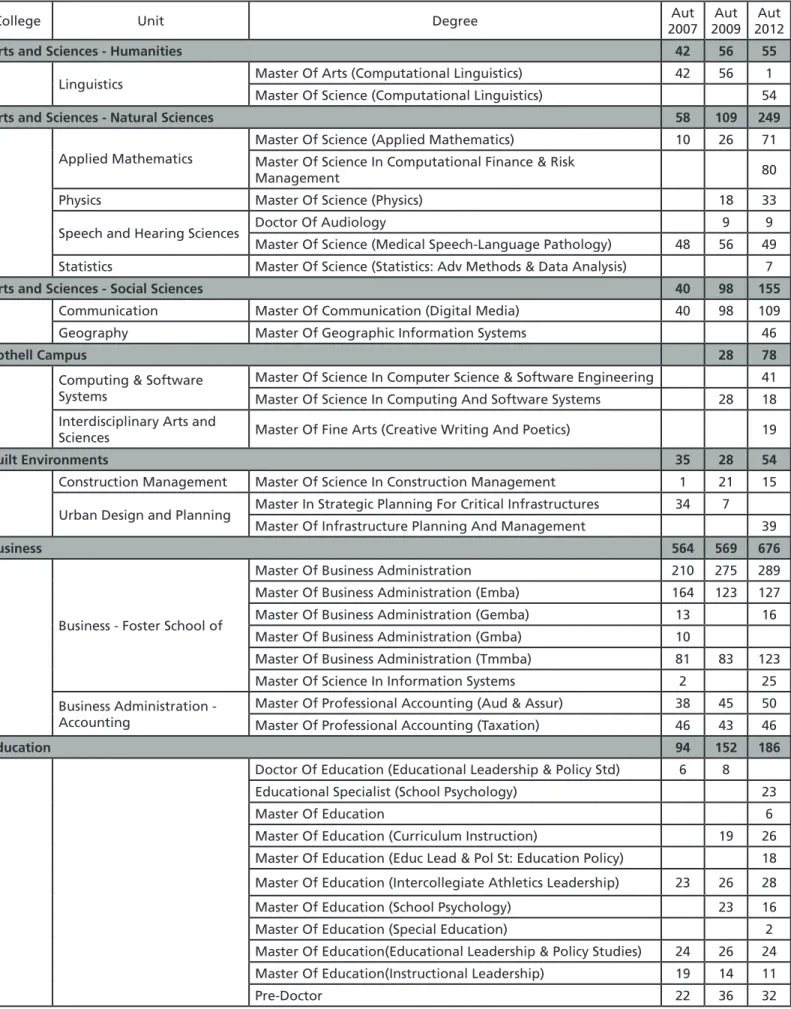
Table 4. Fee-based Enrollment by Program (Autumn 2007-2012)
College Unit Degree 2007Aut 2009Aut 2012Aut
Arts and Sciences - Humanities 42 56 55
Linguistics Master Of Arts (Computational Linguistics) 42 56 1 Master Of Science (Computational Linguistics) 54
Arts and Sciences - Natural Sciences 58 109 249
Applied Mathematics
Master Of Science (Applied Mathematics) 10 26 71 Master Of Science In Computational Finance & Risk
Management 80
Physics Master Of Science (Physics) 18 33 Speech and Hearing Sciences Doctor Of Audiology 9 9
Master Of Science (Medical Speech-Language Pathology) 48 56 49 Statistics Master Of Science (Statistics: Adv Methods & Data Analysis) 7
Arts and Sciences - Social Sciences 40 98 155
Communication Master Of Communication (Digital Media) 40 98 109 Geography Master Of Geographic Information Systems 46
Bothell Campus 28 78
Computing & Software Systems
Master Of Science In Computer Science & Software Engineering 41 Master Of Science In Computing And Software Systems 28 18 Interdisciplinary Arts and
Sciences Master Of Fine Arts (Creative Writing And Poetics) 19
Built Environments 35 28 54
Construction Management Master Of Science In Construction Management 1 21 15 Urban Design and Planning Master In Strategic Planning For Critical Infrastructures 34 7
Master Of Infrastructure Planning And Management 39
Business 564 569 676
Business - Foster School of
Master Of Business Administration 210 275 289 Master Of Business Administration (Emba) 164 123 127 Master Of Business Administration (Gemba) 13 16 Master Of Business Administration (Gmba) 10
Master Of Business Administration (Tmmba) 81 83 123 Master Of Science In Information Systems 2 25 Business Administration -
Accounting
Master Of Professional Accounting (Aud & Assur) 38 45 50 Master Of Professional Accounting (Taxation) 46 43 46
Education 94 152 186
Doctor Of Education (Educational Leadership & Policy Std) 6 8 Educational Specialist (School Psychology) 23
Master Of Education 6
Master Of Education (Curriculum Instruction) 19 26 Master Of Education (Educ Lead & Pol St: Education Policy) 18 Master Of Education (Intercollegiate Athletics Leadership) 23 26 28 Master Of Education (School Psychology) 23 16 Master Of Education (Special Education) 2 Master Of Education(Educational Leadership & Policy Studies) 24 26 24 Master Of Education(Instructional Leadership) 19 14 11
Engineering 262 382 739
Aeronautics and Astronautics
Gnm - A A 1
Master Of Aerospace Engineering 17 13 21 Master Of Aerospace Engineering (Comp Materials&Structures) 2 16 Master Of Science In Aeronautics & Astronautics 26 26 19 Bioengineering Master Of Medical Engineering 21 14 7
Master Of Pharmaceutical Bioengineering 28 Civil And Environmental
Engineering
Gnm - Sustrn 2
Master Of Science In Civil Engineering 11 13 131 Master Of Sustainable Transportation 18 Computer Science and
Engineering Master Of Science (Computer Science & Engineering) 128 133 135 Electrical Engineering Master Of Science In Electrical Engineering 99 109 Engineering - College of Master Of Science In Engineering (Manufacturing) 2 1
Human Centered Design and Engineering
Master Of Science (Technical Communication) 1
Master Of Science In Hum Ctr Des & Engr (Global Tech & Com) 5 Master Of Science In Hum Ctr Des & Engr (User-Centered Des) 6 10 Master Of Science In Human Centered Design And Engineering 17 107 Master Of Science In Technical Communication 27 16 Industrial and Systems
Engineering Master Of Science In Industrial Engineering 9 Mechanical Engineering Master Of Science In Engineering (Mechanical Engineering) 1 22
Master Of Science In Mechanical Engineering 28 41 100
Information School 301 338 528
Master Of Library & Information Science (Law Librarianship) 9 Master Of Library And Information Science 202 207 347 Master Of Science In Information Management 99 131 172
Interdisciplinary Graduate Programs 161 176 210
Health Services
Administration Master Of Health Administration 101 112 145 Museology Master Of Arts (Museology) 60 64 65
Interschool or Intercollege Programs 21 14 35
Bioengineering Master Of Medical Engineering 21 14 7 Master Of Pharmaceutical Bioengineering 28
Law 110 141 103
Master Of Laws (Health Law) 11 13 Master Of Laws (Ip) 32 35 24 Master Of Laws In Taxation 78 95 66
Medicine 111 158 310
Bioengineering Master Of Medical Engineering 21 14 7 Master Of Pharmaceutical Bioengineering 28 Medex Master Of Clinical Health Services 46 144
Master Of Clinical Health Services (Extended) 2 Rehabilitation Medicine Doctor Of Physical Therapy 90 98 129
Nursing 24 57 215
Adult Nurse Practitioner Grad Cert Prg Adv Prac Nsg 2 Doctor Of Nursing Practice 5 32 Infant Mental Health Grad Cert Prg Adv Prac Nsg 11
Master Of Nursing 24 36
Master Of Nursing (Gepnm) 15 Master Of Science (Nursing - Gepns) 1 Master Of Science (Nursing: Cipct) 40 Neonatal Nurse Practitioner Grad Cert Prg Adv Prac Nsg 1 Nurse Midwifery Grad Cert Prg Adv Prac Nsg 2 Perinatal Nurse Specialist Grad Cert Prg Adv Prac Nsg 3
Pre-Doctor 22 88
Pre-Doctor (Gepnd) 14
Pharmacy 42 37
Master Of Science In Biomedical Regulatory Affairs 42 37
Public Administration (Affairs) 63 71 78
Executive Master Of Public Administration 70 72 Master Of Public Administration 63 1 Master Of Public Administration (Accelerated Global) 6
Public Health 94 96 93
Health Services Master Of Public Health (Health Serv - Community Practice) 28 29 32 Master Of Public Health (Health Services) 66 67 61
Social Work 129 175 205
Master Of Social Work (Advanced Generalist Practice) 129 175 134 Master Of Social Work (Integrated Health & Mental Health) 38 Master Of Social Work (Multigenerational Practice) 33
Tacoma Campus 15
CORE ADMINISTRATION SURVEY QUESTIONS
What are your unit’s major responsibilities for serving fee-based students/programs? Are these responsibilities different from those for tuition-based students/programs?
Have you experienced any difficulty with providing those services to fee-based students/programs, and if so, is this difficulty greater than for tuition-based students/programs?
Have you had to develop separate or new processes to accommodate the growth of fee-based student population?
Do you receive sufficient resources to successfully serve fee-based students/programs?
Have you received feedback from students or other UW units regarding how fee-based students/programs experience your services?
Do you have any additional input, considerations, or recommendations that you’d like to provide for the report?
Are there other UW units/programs that should be consulted with and invited to provide input for this report (besides the following: Registrar (including Bothell/Tacoma), Student Financial Aid, Student Fiscal Services, Graduate Enrollment Management Services, department graduate program advisors, PCE, UW-IT, Academic Affairs)?
FEE-BASED STUDENT FOCUS GROUP QUESTIONS
Could you please provide your first name, age, and program of study? How did you find out that you were in a fee-based program?
How would you assess the educational quality of your program?
How has being in a fee-based program impacted your education or graduate student experience from a financial perspective or a general support perspective?
What, if any, restrictions have you encountered as a result of being in a fee-based program?
For those of you who are in fee-based programs that transitioned from state-based programs, how were you informed about the transition and what information did you receive about the ramifications of the transition? What has been your experience with course registration and paying your tuition/fees?
Some fee-based programs have employer subsidies. Is that the case with anyone here? How are you paying for your education?
What are your employment prospects upon graduating? Is there anything else you would like to offer?
A BRIEF HISTORY OF FEE-BASED PROGRAMS AT THE UNIVERSITY OF WASHINGTON*
The University of Washington Extension Division was first organized in May, 1912 by Professor Edwin Start. The division sought to achieve two goals: “the first and most obvious is that of extending the teaching capacity of the university beyond its campus and carrying it to as many possible of the people who desire and can profit by it. The second . . . is utilizing the resources of the university for the public welfare”.1 At the start of World War I, the
division changed its emphasis to wartime activities and its name to the University Extension Service.
Originally, the division was funded by both the general operating revenue from the state and fees paid by students. However, by 1917 the state’s level of appropriation to the division was so insufficient that all new programs needed to be self-supporting. In 1921 the state legislature passed a law requiring that the Extension Service be financially self-sufficient. The 1920s and 1930s were a time of rapid growth and academic professionalization for the entire University, and enrollment standards were raised and the number of activities offered increased.
During the 1940s and 1950s, students and industry had very different needs of the University. The Division of Adult Education was created in 1943, and in 1946 the program was expanded to provide education to adults across the state. New adult education courses proved to be enormously successful, and following the end of World War II, the division expanded its course offerings once again. During the 1950s, the Extension Service began experimenting with new program methods such as using television to reach distance learners. The service established two programs, supported by state funding, that were aimed at providing lectures and University resources within adjacent communities.
Two major trends in the 1960s changed the face of the University and established what would become the modern University system: Baby Boomers began enrolling in higher education, and the rapidly changing workplace saw in an increase in of jobs requiring higher education and a decrease in labor jobs. The “Statement of the Role of the University” approved by the Faculty Senate and the Board of Regents in 1960 emphasized that the University should focus its “educational concerns not only on the teaching of undergraduates, but also on the conduct of