State Mandates for Treatment
for Mental Illness and
State Mandates for
Treatment for Mental
Illness and Substance
Use Disorders
Gail K. Robinson Jerome B. Connolly Melanie Whitter Candy A. Magaña
Acknowledgments
The authors of this report are Gail K. Robinson, Ph.D., vice president, Community and Behavioral Health Practice at Abt Associates, Inc.; Jerome B. Connolly, president, Connolly Strategies and Initiatives; Melanie Whitter, senior associate at Abt Associates, Inc.; and Candy A. Magaña, research assistant at Abt Associates, Inc. Shelagh Smith, M.P.H., provided assistance and guidance as the Government project officer and Jeffrey Buck, Ph.D, provided direction. Both are with the Center for Mental Health Services (CMHS) at the Substance Abuse and Mental Health Services Administration (SAMHSA). Andrew McKinley of Netscan, a for-mer division of the National Conference of State Legislators, also contributed to the develop-ment of this report.
Disclaimer
Material for this report was prepared by Abt Associates, Inc., for SAMHSA, Department of Health and Human Services (DHHS), under Contract Number 282-98-0006, Task Order No. 47. The content of this publication does not necessarily reflect the views, opinions, or policies of CMHS, SAMHSA, or DHHS.
Public Domain Notice
All material appearing in this report is in the public domain and may be reproduced or copied without permission from SAMHSA or CMHS. Citation of the source is appreciated. However, this publication may not be reproduced or distributed for a fee without the specific, written authorization of the Office of Communications, SAMHSA, DHHS.
Electronic Access and Copies of Publication
This publication can be accessed at http://www.samhsa.gov. For additional free copies of this document, please call SAMHSA’s National Mental Health Information Center at 1-800-789-2647 or 1-866-889-1-800-789-2647 (TTD).
Recommended Citation
Robinson, G., Connolly, J., Whitter, M., & Magaña, C. (2006). State Mandates for Treatment for Mental Illness and Substance Use Disorders (DHHS Pub. No. (SMA) 07-4228). Rockville, MD: Center for Mental Health Services, Substance Abuse and Mental Health Services
Administration.
Originating Office
Office of the Associate Director for Organization and Financing, Center for Mental Health Services, Substance Abuse and Mental Health Services Administration, One Choke Cherry Road, 6-1063, Rockville, MD 20857
Contents
I.
Introduction . . . 1
II.
Methodology. . . 3
III.
State Mandated Benefits . . . 5
A. History of State Legislative Action on Mental Illness and
Substance Use Disorders Coverage. . . 5
Initial Focus on Substance Use Disorders . . . 5
Movement to Parity Legislation in the Early 1990s . . . 5
Parity. . . 6
Laws Approaching Parity Become the Norm in
State Legislation . . . 6
States Revise Laws . . . 8
Reversal Continues: States Blame Rising
Costs on Mandated Benefits . . . 8
B. Federal Mental Health Parity Legislation . . . 14
Influences of the Federal Parity Law. . . 14
State Legislatures Respond to the Federal Law. . . 14
C. Exemptions . . . 40
States Grant Exemptions from Parity and
Mandated Benefits . . . 40
D. Mental Illness and Substance Use Disorders . . . 41
States Differentiate Between Coverage for
Mental Illness and Substance Use Disorders. . . 41
IV.
State Laws . . . 45
A. State Standards for Mental Health Workers . . . 45
B. State Standards for Addiction Treatment Workers . . . 46
V.
Analysis of Prescriptive Authority in the States. . . 47
A. Psychiatrists and Psychologists . . . 47
B. Advanced Practice Nurses and Physician Assistants . . . 47
C. State Actions on Psychotropic Drugs in Schools. . . 56
VI.
Conclusion . . . 57
References. . . 58
List of Exhibits
T
able
1:
Early Trends in State Law Mandating Behavioral
Health Coverage . . . 6
T
able
2.a: Chronology of State-Legislated Benefits by Year . . . 10
T
able
2.b: Chronology of State-Legislated Benefits by State. . . 12
T
able
3:
Mental Illness and Substance Use Disorders Coverage
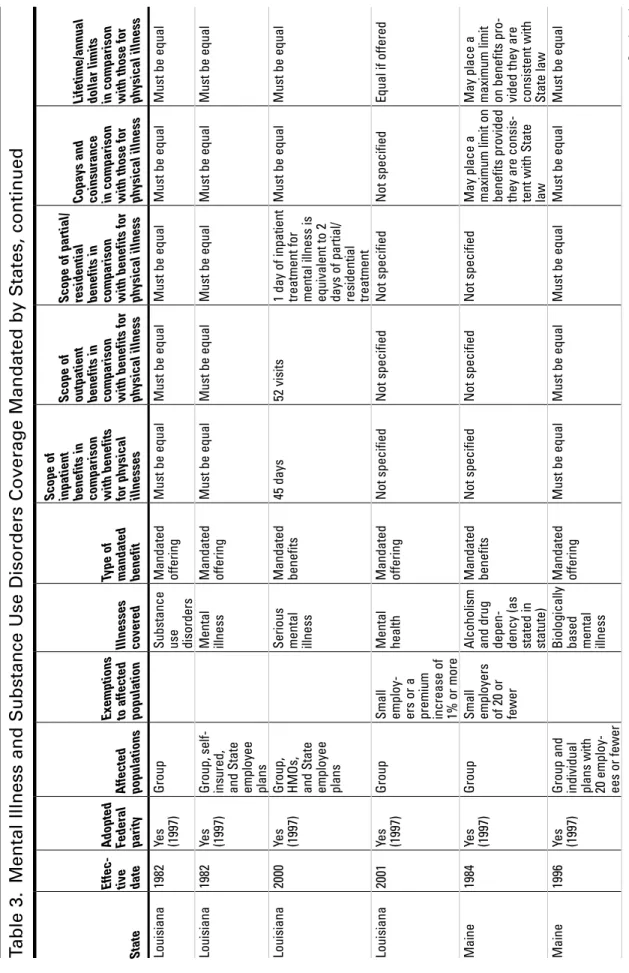
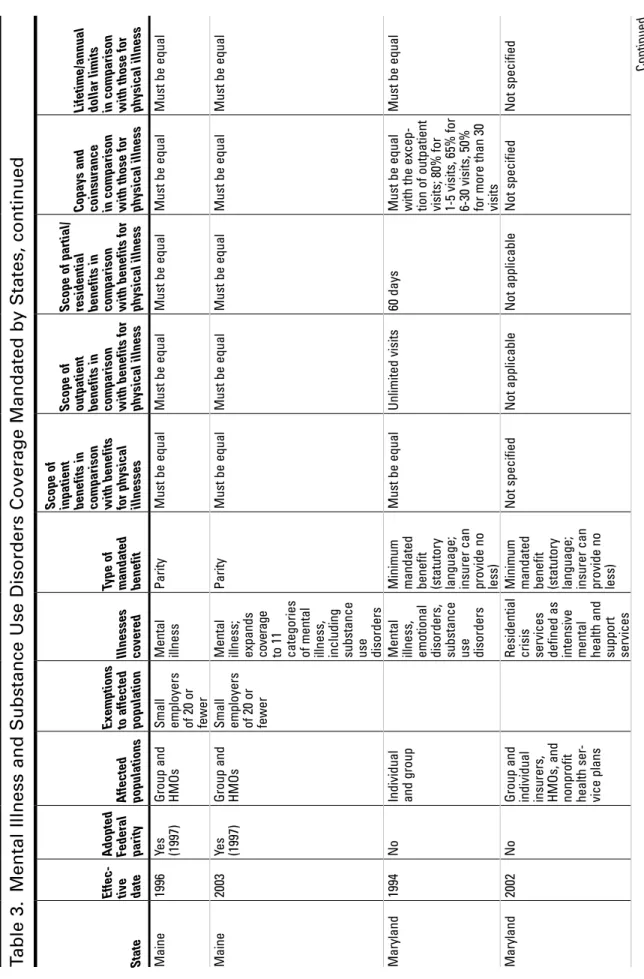
Mandated by States . . . 16
T
able
4:
Exemptions Based on Size of Employer . . . 40
T
able
5:
Exemptions Based on Premium Increases . . . 40
T
able
6:
States Requiring Parity or Mandating Minimum Benefits—
Mental Health . . . 41
T
able
7:
States Requiring Parity or Mandating Minimum Benefits—
Substance Use Disorders . . . 43
T
able
8:
Advanced Practice Titles . . . 48
T
able
9:
Advanced Practice Nurses—Prescriptive Authority . . . 49
T
able
10:
Where Physician Assistants Are Authorized to Prescribe . . . 53
I.
Introduction
1. State-mandated benefits for mental
illness and substance use disorders
This section identifies States that require insurance companies to provide coverage for their insurees who have mental or substance use disorders. It also describes the type of coverage and diagnostic conditions to which the insurance applies. Typically, States use one of three methods to require insurance companies to cover behavioral health conditions:■ Mandated offering. Coverage that requires
insurers to provide equal mental and physical health benefits if the insurers
choose to offer coverage for behavioral
health conditions.
■ Mandated benefits. Coverage that requires
insurance for specific behavioral health conditions.
■ Parity. Coverage that requires insurance
for behavioral health conditions equal to insurance provided for physical health conditions.
The tables in this section distinguish between these three types of insurance coverage.
2. State laws regulating behavioral
health care workers
Behavioral health services are provided by a variety of mental health and addiction treatment professionals, many of whom are licensed or certified at the State level. The term “behavioral” in this report refers to mental conditions and substance use disor-ders. This section describes how States authorize them to practice subject to State licensure and/or certification standards.
3. Analysis of State-recognized
prescriptive authority for
psychotropic drugs
This section analyzes State-recognized pre-scriptive authority for psychotropic medica-tion. A related section discusses jurisdictions that have considered or enacted legislation prohibiting school employees from requiring or recommending psychotropic drugs for children.
T
he purpose of this report is to describe the current status of State-mandated insurance coverage for mental and substance use disor-ders, and to identify trends in this type of coverage. The report is organized into three main topics: State-mandates benefits; State laws regu-lating mental health and addiction treatment workers; and those workers’ prescriptive authority to prescribe psychotropic medication.1. State-mandated benefits for
behavioral health care
The information on State-mandated benefits for behavioral health coverage relies on an analysis of State laws conducted by the Health Policy Tracking Service, a division of Netscan, formerly affiliated with the Nation-al Conference of State Legislators, which has been tracking State legislative developments with respect to behavioral health coverage requirements for several years.
This information was supplemented by a State-by-State review of more recently passed or amended statutes, which enabled a com-parison of behavioral health laws from a chronological as well as a content perspec-tive. A review of law and regulation reveals the myriad ways States have elected to address insurance coverage specifically for mental illness and substance use disorders, including inpatient and outpatient scope of benefits, copay amounts, coinsurance requirements, and annual and lifetime dollar limits, all in comparison with the same cate-gories for physical illness.
In addition, the report required an analysis of the types of coverage required by States with respect to mental and
sub-stance use disorders, including the coverage definitions referred to above and the various limits, qualifications, and exemptions employed by States.
2. State laws regulating behavioral
health care workers
State laws and regulations regarding quali-fied mental health and addiction treatment workers were identified using Lexis-Nexis®.
Relevant information regarding licensure; regulation; scope of practice, including pre-scriptive authority; and mental health and addiction treatment professionals was also obtained from professional organizations and Web sites.
3. Analysis of State-recognized
prescriptive authority for
psychotropic drugs
State laws and regulations granting prescrip-tive authority to specified mental health and addiction professionals were identified using Lexis-Nexis®. In addition, any relevant
information regarding prescriptive authority and related scope of practice issues was obtained from professional organizations and Web sites.
Methodology
T
his report was compiled in the second half of 2004. A review and analysis of existing State laws since the early 1970s was conducted to provide the background and context for examining State choices in mandating insurance coverage for behavioral health. In 2007, only the section on prescriptive authority was updated.A. History of State Legislative Action
on Mental Illness and Substance Use
Disorders
1Coverage
Initial Focus on
Substance Use Disorders
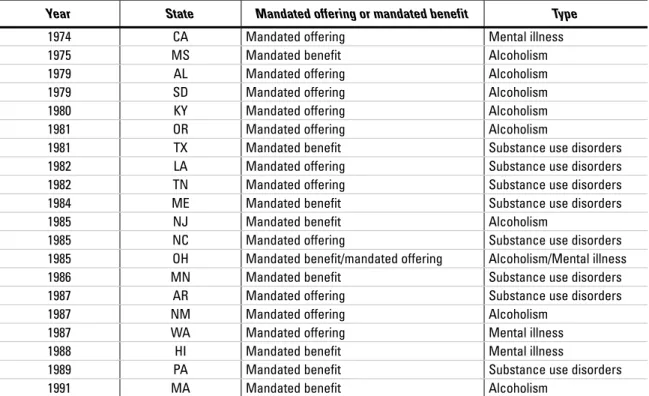
State legislation has been used to require insurers to provide coverage for specific health conditions. Coverage of mental illness and substance use disorders was considered by legislatures more than 30 years ago when, in 1974, California passed a mandated offer-ing bill on mental illness. In 1979, Alabama, Mississippi, and South Dakota enacted legis-lation requiring health insurers (group health insurers and health maintenance organiza-tions (HMOs)) to cover 30 days of treatment for alcoholism.
In the early 1980s, additional States, pri-marily in the South, passed mandated benefit
or mandated offering laws on substance use
disorders. In the mid- to late-1980s, three other jurisdictions—Ohio, Washington, and Hawaii—enacted legislation on substance use disorders similar to California’s mandated
offering statute for mental illness. Despite
activity around mental health issues in a few States, the majority of legislative activity in the 1970s and 1980s related to substance use disorders, specifically alcoholism. During this period, 10 States enacted mandated offering
laws for substance use disorders, and 7 passed legislation requiring substance use disorders benefits (Table 1).
Movement to Parity Legislation in the Early 1990s
Parity legislation requires equal coverage for
physical and mental illnesses. Another approach States may take is to require
man-dated benefits for certain conditions. A third
type, or mandated offering, requires insurers to provide equal mental and physical benefits only if they choose to offer coverage of such behavioral health conditions. Examples of each type of State legislation are described in States listed below.
Vermont, Kansas, and Alabama provide perhaps the clearest examples of these types of legislative requirements. Alabama is con-sidered a mandated offering State, as it requires health care service plans and health maintenance organizations to treat mental and physical illnesses equally if the insurers
choose to offer coverage of such behavioral
health conditions.Kansas is a mandated
benefit State, as State law requires insurers
to provide coverage for substance use disorders and mental illness, and the mini-mum inpatient and outpatient coverage is specified. Perhaps the strongest parity law among the States is that of Vermont, which requires equal coverage for physical and mental illness (including substance use disorders).
State Mandated
Benefits
Parity
During the 1990s, States increased enacting mental health parity legislation rather than focusing on mandated benefits for treatment of substance use disorders and alcoholism provisions. In 1991, North Carolina and Texas were at the forefront of this trend when the first parity statutes requiring equal insurance coverage for mental and physical illnesses became law in those States. Before that year, no jurisdiction had required parity coverage. These two States applied the law’s requirements to limited populations, however, targeting benefits to those insured through the State employee health plan.
In 1993, Maryland did not pass comprehen-sive parity legislation, but enacted a mandated benefit law for mental illness and substance use disorders that included similar provisions.
The statute prohibited any contract providing health care benefits from discriminating
against people with mental illness, emotional disorders, or substance use disorders, and required insurers to cover treatment and diag-nosis of those conditions under the same terms applied to physical illness.
Laws Approaching Parity Become the Norm in State Legislation
By 1996, the number of States following the trend toward parity laws had more than dou-bled with the addition of mandated mental health benefits in New Hampshire and Rhode Island (1994), mental illness and substance use disorders parity in Minnesota, an amend-ment to an existing limited parity law in Maine (1995), and legislative resolutions requiring a study of the issue in Louisiana and Oklahoma (1996).
Legislatively, 1997 was a landmark year for State action on this issue. Governors in Arkansas, Colorado, Connecticut, and
Table 1. Early Trends in State Law Mandating Behavioral
Health Coverage
Year State Mandated offering or mandated benefit Type
1974 CA Mandated offering Mental illness
1975 MS Mandated benefit Alcoholism
1979 AL Mandated offering Alcoholism
1979 SD Mandated offering Alcoholism
1980 KY Mandated offering Alcoholism
1981 OR Mandated offering Alcoholism
1981 TX Mandated benefit Substance use disorders
1982 LA Mandated offering Substance use disorders
1982 TN Mandated offering Substance use disorders
1984 ME Mandated benefit Substance use disorders
1985 NJ Mandated benefit Alcoholism
1985 NC Mandated offering Substance use disorders
1985 OH Mandated benefit/mandated offering Alcoholism/Mental illness
1986 MN Mandated benefit Substance use disorders
1987 AR Mandated offering Substance use disorders
1987 NM Mandated offering Alcoholism
1987 WA Mandated offering Mental illness
1988 HI Mandated benefit Mental illness
1989 PA Mandated benefit Substance use disorders
Vermont signed bills requiring parity in health insurance coverage between mental illness and physical conditions. The Vermont law, which included treatment for alcohol and substance use disorders, is still consid-ered by many to be the most comprehensive law in the country.
Bills in 11 other States—Arizona, Dela-ware, Indiana, Kansas, Louisiana, Montana, Nevada, North Carolina, South Carolina, Tennessee, and West Virginia—were enacted to comply with the Federal Health Insurance Portability and Accountability Act. These measures included limited mandates compa-rable to those enacted by Congress in 1996. While the laws required insurers to offer additional benefits, they did not mandate full parity.
Around the same time, North Carolina enacted a statute that applied only to the teachers’ and State employees’ comprehensive major medical plan. This measure expanded the State’s existing parity law to include sub-stance use disorders benefits.
In 1998, Delaware enacted a statute requiring parity insurance coverage between mental health services and other medical treatment, Tennessee passed a minimum man-dated benefit for mental health, and South Dakota enacted limited parity legislation that required equal coverage for biologically based mental illnesses and all other illnesses.
The following year was also a momentous one for State legislation on these issues: 11 more States enacted bills. In 1999, Virginia adopted a mental health parity law, and 10 States followed its lead: bills were signed in Montana (equal coverage for biologically based or serious mental illnesses), New Jersey (limited parity), Oklahoma (mandated bene-fit), Nebraska (mandated offering), Hawaii (full parity for three serious mental illnesses),
Nevada (limited mandated benefit), Connecti-cut (expansion of an existing parity law), Missouri (limited mandated benefit), Louisi-ana (limited parity), South Dakota (clarifica-tion of “biologically based mental illnesses”), and California (full parity for severe mental illnesses).
By 2000, 19 States had adopted some parity legislation for either mental illness, substance use disorders, or both. New Mexi-co enacted legislation requiring group health plans to provide both medical/surgical and mental health benefits, Massachusetts passed a mental health parity bill and a limited man-dated benefit for substance use disorders, and South Carolina adopted a law requiring equal benefits for mental illness treatment and sub-stance use disorders for State employees cov-ered under the jurisdiction’s health insurance plans. Alabama, Kentucky, and Utah enacted mandated offering laws.
In 2001, Arkansas was added to the list of “parity” States by passing legislation requir-ing equal treatment for mental health care covered by ARKids First, its Children’s Health Insurance Program (CHIP). Illinois enacted a law that required full parity bene-fits for serious mental illness and minimum mandated benefits for other mental condi-tions. Delaware expanded its mental health parity statute to include substance use disorders.
During the same year, Maine adopted leg-islation requiring several State departments to study potential cost savings resulting from legislation requiring parity coverage for men-tal disorders, eating disorders, and substance use disorders. Oregon opted to create a joint interim task force to examine and make rec-ommendations on achieving parity between mental and physical health benefits in insur-ance plans.
Kansas passed a bill requiring group health insurance plans, including HMOs that provided coverage for mental health benefits for the diagnosis and treatment of mental ill-nesses. It also mandated that the plans pro-vide the same deductibles, coinsurance, and other limitations for mental and physical conditions.
Also in 2001, Mississippi enacted a law that required small employer plans to offer coverage for mental health treatment, and compelled large employers to provide benefits for mental health treatment. Indiana added a substance use disorders parity provision, if treatment was needed in conjunction with mental illness, to the State employee health plans, while Rhode Island expanded the defi-nition of mental illness and passed minimum mandated benefit laws establishing maximum allowable limits on outpatient services.
States Revise Laws
Despite large increases in parity legislation in 2001, the year also signaled the first signs of revisions in the States. Perhaps the first indicator was when Texas legislators amended coverage provided to State
employees to reduce benefits from full parity for serious mental illness to a minimum mandated benefit, and set limitations on inpatient and outpatient treatment. Despite these changes, however, the law continued to allow unlimited lifetime benefits, and set copayments, coinsurance, and annual limits equal to those for physical illness.
In 2002, State actions around parity legis-lation were mixed. While many legislatures considered parity bills with 28 States debat-ing bills, only 8 of them adopted statutes. Alabama, Colorado, Maryland, Michigan, New Hampshire, and West Virginia passed expansive legislation, while Kentucky and New Jersey enacted laws that contained
miti-gating or compromising provisions. The most far-reaching of the measures was the parity law adopted in West Virginia.
Legislation in other States further circum-scribed the breadth of existing parity laws. Kentucky increased by 1 (from 50 to 51 employees) the size of a company whose group health plan would be exempt from the mental illness parity requirement. New Jersey passed mental illness and substance use disorders provisions that applied only to plans that offered coverage for individuals. This law did not replace existing laws that required more extensive coverage, such as for group plans and State employee insur-ance, but instead stipulated the minimum scope of inpatient and outpatient benefits for individuals insured if the health plan offered coverage for biologically based mental illnesses and substance use disorders. The intent of the New Jersey statute was to provide individuals with a less expensive option than those offered by group policies.
Reversal Continues: States Blame Rising Costs on Mandated Benefits
In 2003, small employers began to assert that the steady rise in insurance costs was pre-venting them from offering additional cover-age. They also asserted that a contributing factor was the increasing number of required benefits. In response, legislators began con-sidering and enacting legislation that waived or provided exemptions from State mandates This action allowed insurers to offer reduced or “bare-bones” health insurance policies.
That year, four States—Colorado, Montana, South Dakota, and Texas— enacted legislation that allowed the sale of less expensive insurance policies that did not contain State-mandated benefits. Those laws eliminated previous requirements for mental illness and substance use disorders treatment.
In addition, Colorado and Maryland adopt-ed legislation requiring a study and reassess-ment of the cost of existing mandates, including behavioral health requirements. In contrast, other States (Maine, Indiana, and North Dakota) continued to enact reaching legislation. Kansas and Hawaii amended or deleted the sunset clauses in their mental health benefit statutes, allowing those laws to continue.
In 2004, a more precipitous decline occurred in legislative activity considering parity bills. The drop can be attributed either to success (32 States had enacted parity and/ or mandated benefits legislation); or suspi-cion (required benefits were suspected of increasing health insurance costs).
Law-making activity in 2003 and 2004 reflected a concern for, and analysis of, the role that mandated benefits had on insurance premium costs. For example, a statute enact-ed in Louisiana exemptenact-ed health insurers from delivering, issuing, or renewing a health policy that included any additional or
required mandated benefit from January 1, 2004, until December 31, 2008. The State also passed legislation allowing insurers or HMOs to offer “health flex benefit policies” (a type of “bare-bones” coverage) to small employers. These plans were not required to include State-mandated benefits.
In 2004, several State legislatures consid-ered and passed laws creating exceptions to parity and/or mandated benefits, similar to the law adopted in Texas in 2001. For exam-ple, Kentucky enacted legislation that created a 3-year moratorium on (prohibiting the adoption of any new) mandated benefits and allowed insurers the option of declining from offering any additional State-mandated bene-fits through December 31, 2007. Washington adopted a statute permitting insurers to offer
small employers policies featuring limited benefits. These plans did not include cover-age for numerous services, such as mental health and chemical dependency treatment.
In the same year, legislators in Kentucky considered but did not pass legislation that would have permitted insurers to offer a cat-astrophic health benefit plan that excluded coverage of any or all State mandates. Wash-ington legislators discussed but did not pass a measure that would have allowed insurers to offer small employers a stripped-down policy. The policy was not required to provide cov-erage for psychological and other services as long as there was disclosure, meaning pur-chasers were informed of the limitation in advance.
As 2005 began, the movement away from sweeping parity legislation was expected to continue. Nevertheless, prospects for legisla-tion seemed likely in Iowa and Washington. Table 2.a depicts the chronological develop-ment of State legislation with respect to pari-ty from 1995 to 2005. Table 2.b displays the same information alphabetically, by State.
Table 2.a. Chronology of State-Legislated Benefits by Year
State Year Type Terms and conditions
North Carolina 1991 Parity Mental illness
Texas 1991 Parity Mental illness
Maryland 1993 Mandated benefit Mental illness
Substance use disorders
Minnesota 1994 Parity Mental illness
Substance use disorders
New Hampshire 1994 Mandated benefit Mental illness
Rhode Island 1994 Mandated benefit Mental illness
Maine 1995 Parity Amendment
Louisiana 1996 Parity Study
Oklahoma 1996 Parity Study
Alaska 1997 Mandated offering Federal Mental Health Parity Act
Arizona 1997 Mandated offering Federal Mental Health Parity Act
Arkansas 1997 Parity Mental illness
Colorado 1997 Parity Mental illness
Connecticut 1997 Parity Mental illness
Delaware 1997 Mandated offering Federal Mental Health Parity Act
Indiana 1997 Mandated offering Federal Mental Health Parity Act
Kansas 1997 Mandated offering Federal Mental Health Parity Act
Louisiana 1997 Mandated offering Federal Mental Health Parity Act
Montana 1997 Mandated offering Federal Mental Health Parity Act
Nevada 1997 Mandated offering Federal Mental Health Parity Act
North Carolina 1997 Parity Substance use disorders
Applied to State employees plan North Carolina 1997 Mandated offering Federal Mental Health Parity Act South Carolina 1997 Mandated offering Federal Mental Health Parity Act
Tennessee 1997 Mandated offering Federal Mental Health Parity Act
Vermont 1997 Parity Mental illness
Substance use disorders West Virginia 1997 Mandated offering Federal Mental Health Parity Act
Delaware 1998 Parity Mental illness
South Dakota 1998 Parity Mental illness
Tennessee 1998 Mandated benefit Mental illness
California 1999 Parity Mental illness
Connecticut 1999 Parity Mental illness (expansion)
Hawaii 1999 Parity Mental illness
Louisiana 1999 Parity Mental illness
Missouri 1999 Mandated benefit Mental illness
Montana 1999 Parity Mental illness
Nebraska 1999 Mandated offering Mental illness
Nevada 1999 Mandated benefit Mental illness
New Jersey 1999 Parity Mental illness
Oklahoma 1999 Mandated benefit Mental illness
South Dakota 1999 Parity Clarification
Virginia 1999 Parity Mental illness
Alabama 2000 Mandated offering Mental illness
Kentucky 2000 Mandated offering Mental illness
Substance use disorders
Massachusetts 2000 Parity Mental illness
New Mexico 2000 Mandated benefit Mental illness
South Carolina 2000 Parity Mental illness
Substance use disorders Applied to State employees plan
Table 2.a. Chronology of State-Legislated Benefits by Year, continued
State Year Type Terms and conditions
Utah 2000 Mandated offering Mental illness
Arkansas 2001 Parity Mental illness (expansion to CHIP)
Delaware 2001 Parity Substance use disorders
Added to parity laws
Illinois 2001 Parity Mental illness
Indiana 2001 Parity Substance use disorders
Applied to State employees plan
Kansas 2001 Mandated offering Mental illness
Mississippi 2001 Mandated benefit Mental illness
Rhode Island 2001 Mandated benefit Mental illness (expansion)
Texas 2001 Mandated benefit Applied to State employees plan
Retrenchment
Alabama 2002 Mandated offering Mental illness (expansion)
Kentucky 2002 Mandated offering Retrenchment
Maryland 2002 Mandated benefit Mental illness
Substance use disorders (expansion)
New Hampshire 2002 Mandated benefit Substance use disorders
Added to parity laws
New Jersey 2002 Mandated offering Mental illness
Substance use disorders Retrenchment
West Virginia 2002 Parity Mental illness
Substance use disorders
Colorado 2003 Mental illness
Substance use disorders Retrenchment
Bare-bones policies without mandated benefits
Hawaii 2003 Extended sunset date
Indiana 2003 Mandated offering Substance use disorders
Added to parity laws
Kansas 2003 Extended sunset date
Maine 2003 Parity Substance use disorders
Added to parity laws
Michigan 2003 Mandated benefit Mental illness
Substance use disorders
Montana 2003 Mental illness
Substance use disorders Retrenchment
Bare-bones policies without mandated benefits
North Dakota 2003 Mandated benefit Mental illness
Substance use disorders
Expansion of existing parity statute
South Dakota 2003 Mental illness
Substance use disorders Retrenchment
Bare-bones policies without mandated benefits
Texas 2003 Mental illness
Substance use disorders Retrenchment
Bare-bones policies without mandated benefits
Kentucky 2004 Moratorium
Table 2.b. Chronology of State-Legislated Benefits by State
State Year Type Terms and conditions
Alabama 2000 Mandated offering Mental illness
Alabama 2002 Mandated offering Mental illness (expansion)
Alaska 1997 Mandated offering Federal Mental Health Parity Act
Arizona 1997 Mandated offering Federal Mental Health Parity Act
Arkansas 1997 Parity Mental illness
Arkansas 2001 Parity Mental illness (expansion to CHIP)
California 1999 Parity Mental illness
Colorado 1997 Parity Mental illness
Colorado 2003 Mental illness
Substance use disorders Retrenchment
Bare-bones policies without mandated benefits
Connecticut 1997 Parity Mental illness
Connecticut 1999 Parity Mental illness (expansion)
Delaware 1997 Mandated offering Federal Mental Health Parity Act
Delaware 1998 Parity Mental illness
Delaware 2001 Parity Substance use disorders
Added to parity laws
Hawaii 1999 Parity Mental illness
Hawaii 2003 Extended sunset date
Illinois 2001 Parity Mental illness
Indiana 1997 Mandated offering Federal Mental Health Parity Act
Indiana 2001 Parity Substance use disorders
Applied to State employees plan
Indiana 2003 Mandated offering Substance use disorders
Added to parity laws
Kansas 1997 Mandated offering Federal Mental Health Parity Act
Kansas 2001 Mandated offering Mental illness
Kansas 2003 Extended sunset date
Kentucky 2000 Mandated offering Mental illness
Substance use disorders
Kentucky 2002 Mandated offering Retrenchment
Kentucky 2004 Moratorium
Louisiana 1996 Parity Study
Louisiana 1997 Mandated offering Federal Mental Health Parity Act
Louisiana 1999 Parity Mental illness
Maine 1995 Parity Amendment
Maine 2003 Parity Substance use disorders
Added to parity laws
Maryland 1993 Mandated benefit Mental illness
Substance use disorders
Maryland 2002 Mandated benefit Mental illness
Substance use disorders (expansion)
Massachusetts 2000 Parity Mental illness
Michigan 2003 Mandated benefit Mental illness
Substance use disorders
Minnesota 1994 Parity Mental illness
Substance use disorders
Mississippi 2001 Mandated benefit Mental illness
Missouri 1999 Mandated benefit Mental illness
Montana 1997 Mandated offering Federal Mental Health Parity Act
Montana 1999 Parity Mental illness
Table 2.b. Chronology of State-Legislated Benefits by State, continued
State Year Type Terms and conditions
Montana 2003 Mental illness
Substance use disorders Retrenchment
Bare-bones policies without mandated benefits
Nebraska 1999 Mandated offering Mental illness
Nevada 1997 Mandated offering Federal Mental Health Parity Act
Nevada 1999 Mandated benefit Mental illness
New Hampshire 1994 Mandated benefit Mental illness
New Hampshire 2002 Mandated benefit Substance use disorders
Added to parity laws
New Jersey 1999 Parity Mental illness
New Jersey 2002 Mandated offering Mental illness
Substance use disorders Retrenchment
New Mexico 2000 Mandated benefit Mental illness
North Carolina 1991 Parity Mental illness
North Carolina 1997 Parity Substance use disorders
Applied to State employees plan North Carolina 1997 Mandated offering Federal Mental Health Parity Act
North Dakota 2003 Mandated benefit Mental illness
Substance use disorders
Expansion of existing parity statute
Oklahoma 1996 Parity Study
Oklahoma 1999 Mandated benefit Mental illness
Rhode Island 1994 Mandated benefit Mental illness
Rhode Island 2001 Mandated benefit Mental illness (expansion)
South Carolina 1997 Mandated offering Federal Mental Health Parity Act
South Carolina 2000 Parity Mental illness
Substance use disorders Applied to State employees plan
South Dakota 1998 Parity Mental illness
South Dakota 1999 Parity Clarification
South Dakota 2003 Mental illness
Substance use disorders Retrenchment
Bare-bones policies without mandated benefits
Tennessee 1997 Mandated offering Federal Mental Health Parity Act
Tennessee 1998 Mandated benefit Mental illness
Texas 1991 Parity Mental illness
Texas 2001 Mandated benefit Applied to State employees plan
Retrenchment
Texas 2003 Mental illness
Substance use disorders Retrenchment
Bare-bones policies without mandated benefits
Utah 2000 Mandated offering Mental illness
Vermont 1997 Parity Mental illness
Substance use disorders
Virginia 1999 Parity Mental illness
Washington 2004 Bare-bones policies without mandated benefits
West Virginia 1997 Mandated offering Federal Mental Health Parity Act
West Virginia 2002 Parity Mental illness
B. Federal Mental Health Parity
Legislation
Influences of the Federal Parity Law
While States were grappling with parity leg-islation and mandated benefits for behavioral health issues, the same issues were being dis-cussed and enacted at the Federal level, albeit much later.
In 1996, President Bill Clinton signed the Mental Health Parity Act, which prohibited group health insurers that offered mental health benefits from imposing more restric-tive annual or lifetime limits on spending for mental illness than on physical conditions. Because the statute applied only if mental health benefits were offered in an insurance plan, it was generally considered to be a
“mandated offering” law. The statute did
not apply to cost sharing, nor did it include substance use disorders conditions. More-over, employers with fewer than 50 employ-ees could be exempt from the law’s provi-sions if they expected to experience a premium increase of at least 1 percent due to the addition of the benefit.
After the law expired in December 2000, Congress considered a stronger, more com-prehensive mandated offering bill in 2001. Despite some success in both chambers, the bill failed to survive a House-Senate confer-ence committee. As an alternative, Congress extended the 1996 Mental Health Parity Act through December 2002. Later, the law was extended 1 more year, through December 2003. During this time, additional attempts to pass a mental health parity bill were unsuccessful. In the fall of 2003, Congress again extended the mental health parity statute through December 2005.
State Legislatures Respond to the Federal Law
The 1996 Federal act applies to all insurers and prohibits them from imposing annual or lifetime dollar limits that are more restrictive than those for other illnesses. But insurers are not prohibited from restrict-ing office visits and hospital stays. The act does not preempt State law, but also does not require the States to enact it for it to take effect.
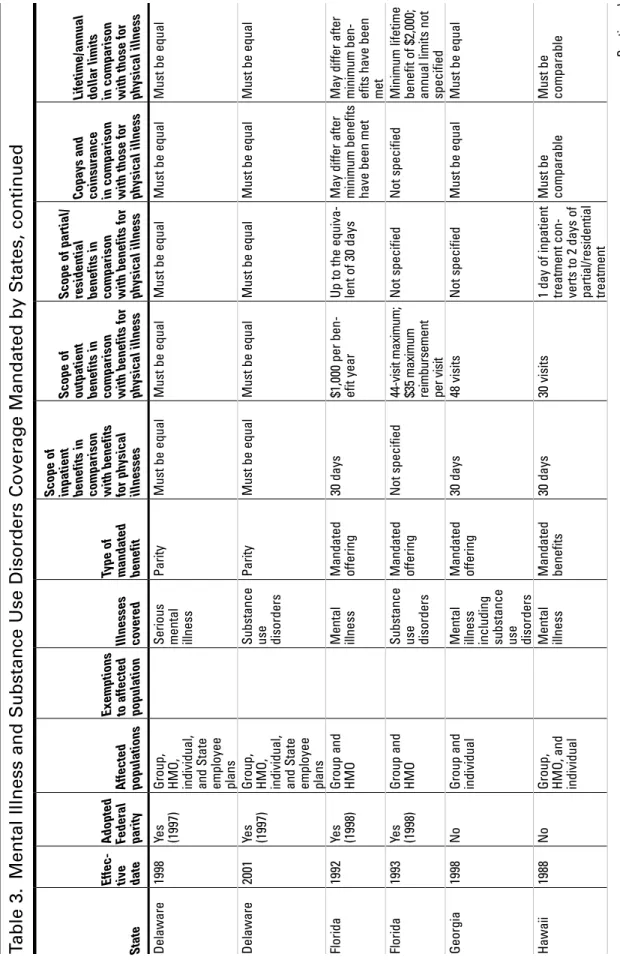
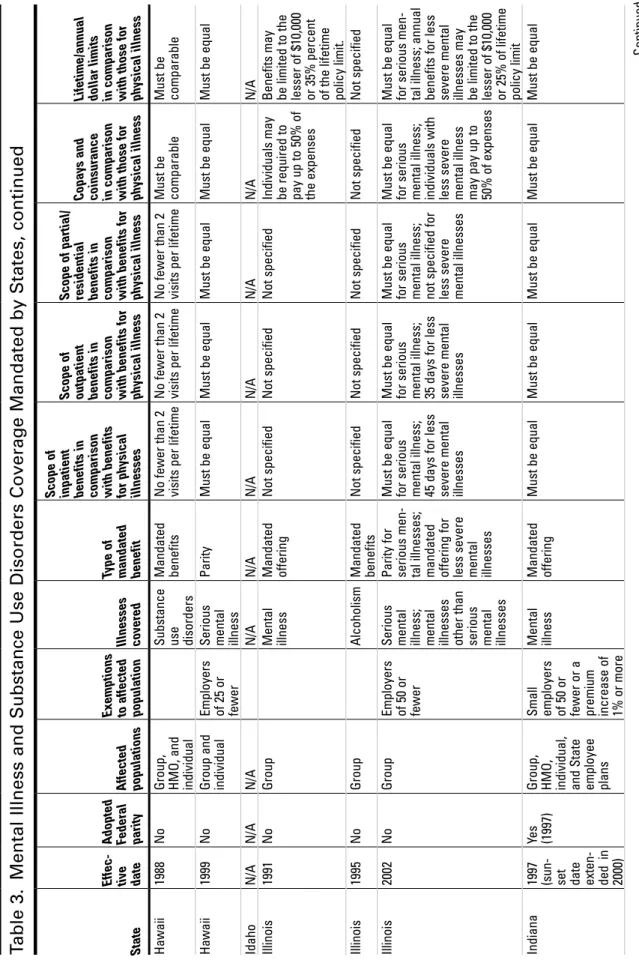
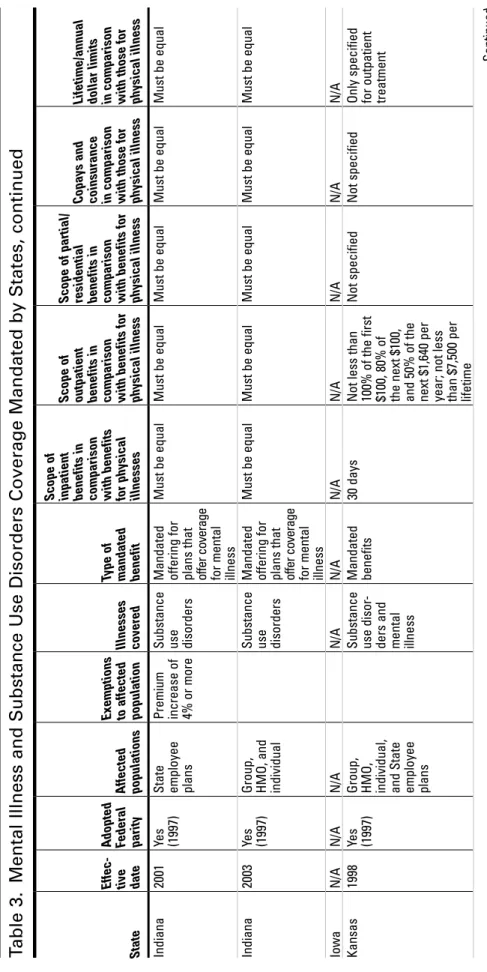
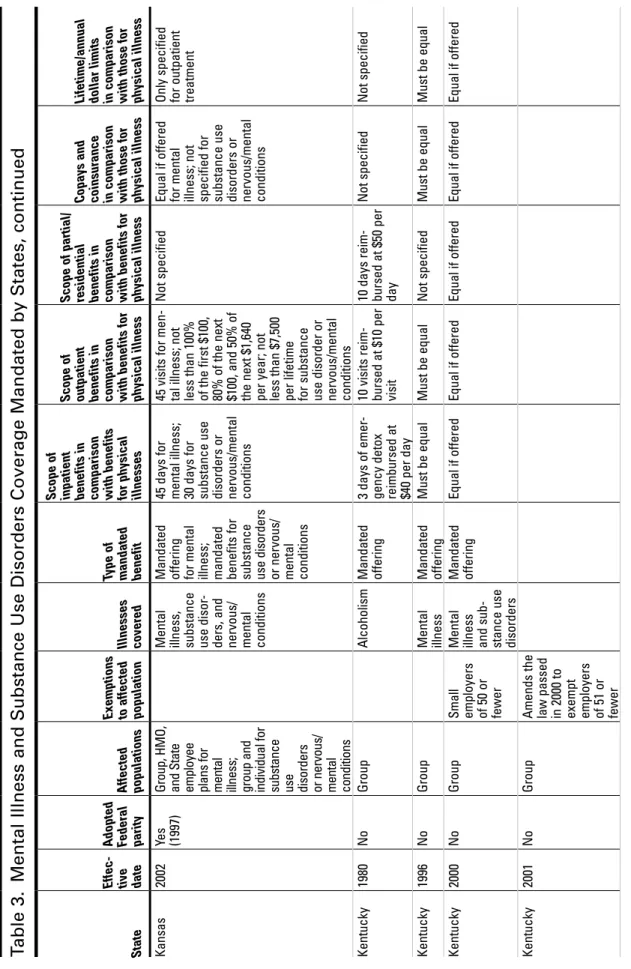
Fourteen States have adopted the Federal mental health parity (mandated offering) statute, and several States that have not done so have enacted their own mandated offering statute. Thus, most States mandate that coverage for mental health must be equal to that for physical conditions, if
mental health coverage is offered.
In addition, many States have chosen to require a combination of coverage require-ments. For example, Arkansas, which has not adopted the Federal law, mandates parity for mental illness yet has enacted mandated offering for substance use disorders
conditions.
Still other States differentiate between types of insurance plans when enacting either parity or mandated offering requirements. For example, Minnesota mandates parity for mental illness and substance use disor-ders for individuals insured by HMOs. In contrast, mandated offering applies to those same maladies for people who are insured in group or individual health plans.
State statutes include myriad approaches to the amount of coverage received by an individual, such as the extent of inpatient, outpatient, and residential care; the size of copays; and allowable annual and lifetime dollar limits. Half of the States have elected to require the same inpatient and outpatient
benefits for mental health services as for physical illness. In others, day or visit limits have been adopted, and a few have specified a minimum annual dollar amount for the benefit. Slightly fewer States, but still nearly half, require parity between the residential (inpatient) benefits offered for physical ill-ness and those provided for mental health. States handle copayments and deductibles in a number of ways. Most (31) require the same consideration for physical and mental health services.
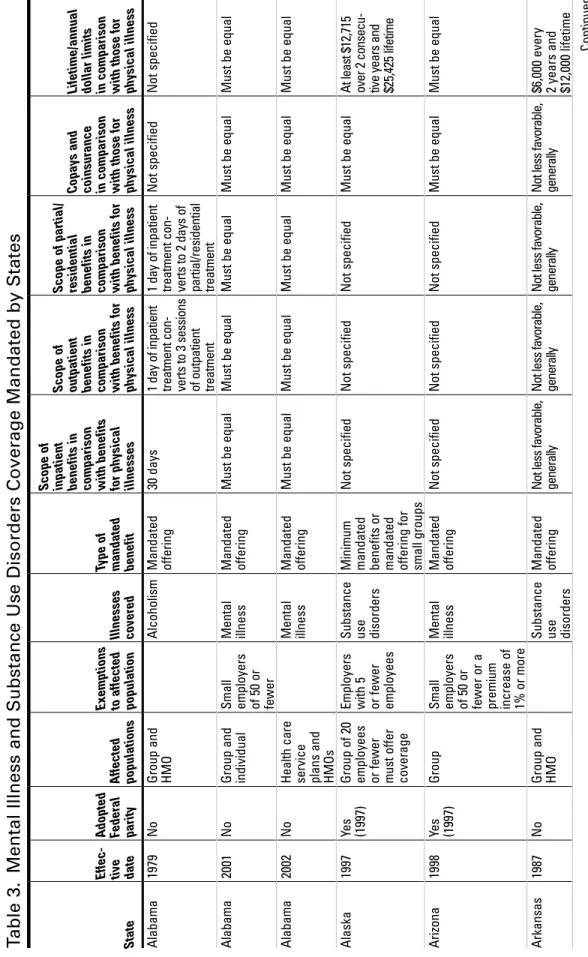
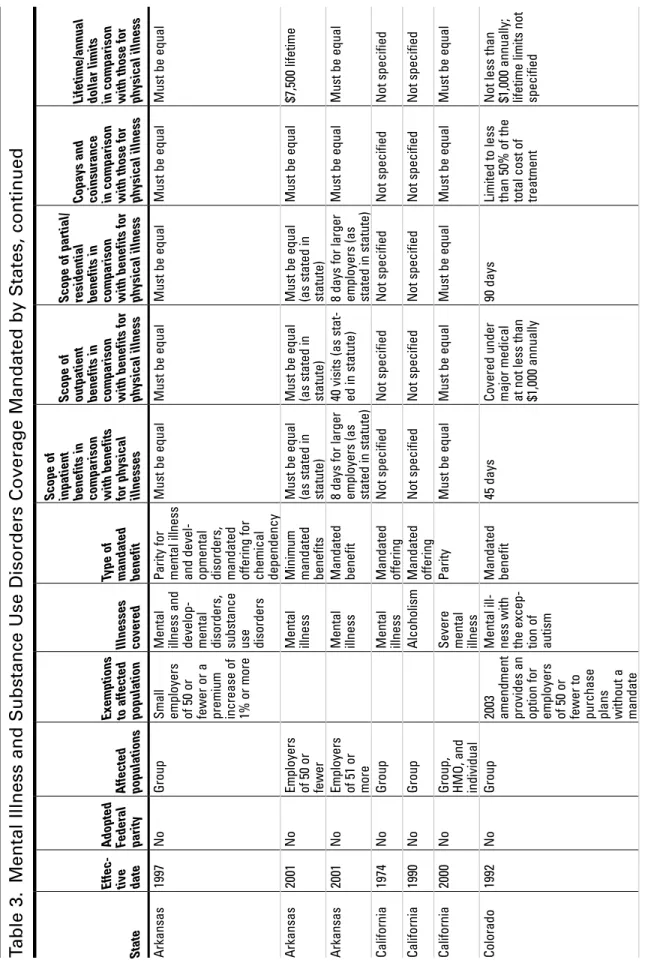
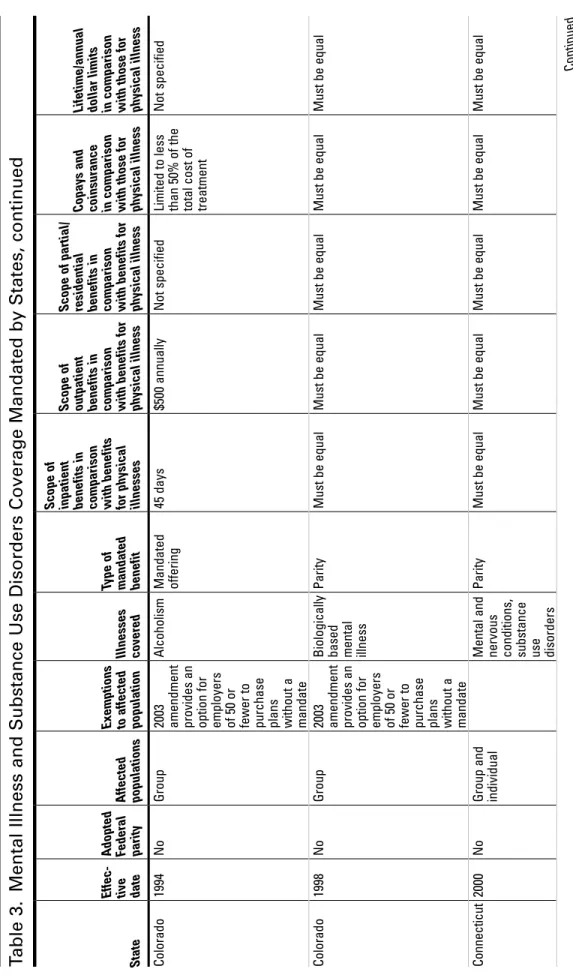
Table 3 displays the mental illness and substance use disorders coverage provisions mandated by the States as of December 31, 2004. States adopting the Federal law and those enacting parity provisions of their own also are identified. The table also includes the scope of inpatient, outpatient,
and residential benefits, and any provisions specifying a lifetime or annual dollar limit (compared with that for physical illness). Additionally, table 3 presents the 22 States that required parity at the end of 2004. Of those 22 States, 17 provide general parity, while the remainder provide parity for one or more of the following categories: serious mental illness, developmental disorders, biologically based mental illnesses, and behavioral health services covered by HMOs. In alphabetical order, the “parity” States are Arkansas, California, Colorado, Connecticut, Delaware, Hawaii, Illinois, Maine, Massachusetts, Minnesota, Montana, New Hampshire, New Jersey, New Mexico, North Carolina, Oklahoma, Rhode Island, South Carolina, South Dakota, Vermont, Virginia, and West Virginia.
Table
3.
Mental
Illness
and
Substance
Use
Disorders
Coverage
Mandated
by
States
StateEffec tive date
A do pt ed Fe de ra l parity A ffe ct ed populations Exemp tions to a ffe ct ed population Ill ne ss es covered Ty pe o f mandated benefit Sc op e of in pa tie nt be ne fit s in
comparison with
b en ef its for physical illnesses Sc op e of
outpatient bene
fit
s
in
comparison with
b en ef its fo r physical illness Scope of partial/ re si de nt ia l be ne fit s in
comparison with
b en ef its fo r physical illness Copays and co in su ra nc e in c om pa ri so n with those for physical illness Li fe tim e/ an nu al do lla r l im its in c om pa ri so n with those for physical illness Alabama 1979 No Gr ou p an d HMO Alcoholism Mandated offering 30 days 1 da y of in pa tie nt treatment con -ve rts to 3 s es sio ns of outpatient treatment 1 da y of in pa tie nt treatment con -ve rts to 2 d ay s of partial/residential treatment Not specified Not specified Alabama 2001 No Gr ou p an d individual Sm al l em pl oy er s of 5 0 or fewer M en ta l illness Mandated offering Must be equal Must be equal Must be equal Must be equal Must be equal Alabama 2002 No He al th c ar e se rv ic e pl an s an d HMOs M en ta l illness Mandated offering Must be equal Must be equal Must be equal Must be equal Must be equal Alaska 1997 Ye s (1997) Gr ou p of 2 0 em pl oy ee s or fe w er must offer coverage Em pl oy er s w ith 5 or fe w er em pl oy ee s Su bs ta nc e us e disorders M in im um
mandated bene
fit s or mandated offering for small groups Not specified Not specified Not specified Must be equal At least $1 2, 71 5 over 2 consecu -tiv e ye ar s an d $2 5, 42 5 lifetime Arizona 1998 Ye s (1997) Gr ou p Sm al l em pl oy er s of 5 0 or fewer or a pr em iu m in cr ea se o f 1% or more M en ta l illness Mandated offering Not specified Not specified Not specified Must be equal Must be equal Arkansas 1987 No Gr ou p an d HMO Su bs ta nc e us e disorders Mandated offering N ot le ss fa vo ra bl e, generally N ot le ss fa vo ra bl e, generally N ot le ss fa vo ra bl e, generally N ot le ss fa vo ra bl e, generally $6,000 every 2 ye ar s an d $12,000 lifetime Continued
Table
3.
Mental
Illness
and
Substance
Use
Disorders
Coverage
Mandated
by
States,
continued
StateEffec tive date
A do pt ed Fe de ra l parity A ffe ct ed populations Exemp tions to a ffe ct ed population Ill ne ss es covered Ty pe o f mandated benefit Sc op e of in pa tie nt be ne fit s in
comparison with
b en ef its for physical illnesses Sc op e of
outpatient bene
fit
s
in
comparison with
b en ef its fo r physical illness Scope of partial/ re si de nt ia l be ne fit s in
comparison with
b en ef its fo r physical illness Copays and co in su ra nc e in c om pa ri so n with those for physical illness Li fe tim e/ an nu al do lla r l im its in c om pa ri so n with those for physical illness Arkansas 1997 No Gr ou p Sm al l em pl oy er s of 5 0 or fewer or a pr em iu m in cr ea se o f 1% or more M en ta l ill ne ss a nd develop -m en ta l
disorders, subs
ta nc e us e disorders Parity for mental illness and devel
-opmental disorders, mandated offering
for chemical dependency Must be equal Must be equal Must be equal Must be equal Must be equal Arkansas 2001 No Em pl oy er s of 5 0 or fe w er M en ta l illness M in im um
mandated bene
fit s M us t b e eq ua l (a s st at ed in statute) M us t b e eq ua l (a s st at ed in statute) M us t b e eq ua l (a s st at ed in statute) Must be equal $7,500 lifetime Arkansas 2001 No Em pl oy er s of 5 1 or more M en ta l illness Mandated benefit 8 da ys fo r l ar ge r em pl oy er s (a s stated in statute) 40 visits (as stat -ed in statute) 8 da ys fo r l ar ge r em pl oy er s (a s stated in statute) Must be equal Must be equal California 1974 No Group M en ta l illness Mandated offering Not specified Not specified Not specified Not specified Not specified California 1990 No Group Alcoholism Mandated offering Not specified Not specified Not specified Not specified Not specified California 2000 No Gr ou p, HMO, and individual Se ve re m en ta l illness Pa rit y Must be equal Must be equal Must be equal Must be equal Must be equal Colorado 1992 No Group 20 03 am en dm en t pr ov id es a n option for em pl oy er s of 5 0 or fe w er to
purchase plan
s w ith ou t a mandate Mental ill -ne ss w ith the excep -tio n of autism Mandated benefit 45 days Co ve re d un de r m aj or m ed ic al at not less than $1,000 annually 90 days Li m ite d to le ss th an 5 0% o f t he to ta l c os t o f treatment N ot le ss th an $1,000 annually; lif et im e lim its n ot specified Continued
Table
3.
Mental
Illness
and
Substance
Use
Disorders
Coverage
Mandated
by
States,
continued
StateEffec tive date
A do pt ed Fe de ra l parity A ffe ct ed populations Exemp tions to a ffe ct ed population Ill ne ss es covered Ty pe o f mandated benefit Sc op e of in pa tie nt be ne fit s in
comparison with
b en ef its for physical illnesses Sc op e of
outpatient bene
fit
s
in
comparison with
b en ef its fo r physical illness Scope of partial/ re si de nt ia l be ne fit s in
comparison with
b en ef its fo r physical illness Copays and co in su ra nc e in c om pa ri so n with those for physical illness Li fe tim e/ an nu al do lla r l im its in c om pa ri so n with those for physical illness Colorado 1994 No Group 20 03 am en dm en t pr ov id es a n option for em pl oy er s of 5 0 or fe w er to
purchase plan
s w ith ou t a mandate Alcoholism Mandated offering 45 days $500 annually Not specified Li m ite d to le ss th an 5 0% o f t he to ta l c os t o f treatment Not specified Colorado 1998 No Group 20 03 am en dm en t pr ov id es a n option for em pl oy er s of 5 0 or fe w er to
purchase plan
s w ith ou t a mandate
Biologically base
d m en ta l illness Parity Must be equal Must be equal Must be equal Must be equal Must be equal Connecti cut 2000 No Gr ou p an d individual Mental and ne rv ou s co nd iti on s, su bs ta nc e us e disorders Parity Must be equal Must be equal Must be equal Must be equal Must be equal Continued
Table
3.
Mental
Illness
and
Substance
Use
Disorders
Coverage
Mandated
by
States,
continued
StateEffec tive date
A do pt ed Fe de ra l parity A ffe ct ed populations Exemp tions to a ffe ct ed population Ill ne ss es covered Ty pe o f mandated benefit Sc op e of in pa tie nt be ne fit s in
comparison with
b en ef its for physical illnesses Sc op e of
outpatient bene
fit
s
in
comparison with
b en ef its fo r physical illness Scope of partial/ re si de nt ia l be ne fit s in
comparison with
b en ef its fo r physical illness Copays and co in su ra nc e in c om pa ri so n with those for physical illness Li fe tim e/ an nu al do lla r l im its in c om pa ri so n with those for physical illness Delaware 1998 Ye s (1997) Gr ou p, HM O, in di vi du al , an d St at e employee plans Se rio us m en ta l illness Parity Must be equal Must be equal Must be equal Must be equal Must be equal Delaware 2001 Ye s (1997) Gr ou p, HM O, in di vi du al , an d St at e employee plans Su bs ta nc e us e disorders Parity Must be equal Must be equal Must be equal Must be equal Must be equal Florida 1992 Ye s (1998) Gr ou p an d HMO M en ta l illness Mandated offering 30 days $1,000 per ben -efit year Up to the equiva -lent of 30 days M ay d iff er a fte r m in im um b en ef its have been met M ay d iff er a fte r minimum ben -ef its h av e be en met Florida 1993 Ye s (1998) Gr ou p an d HMO Su bs ta nc e us e disorders Mandated offering Not specified 44-visit maximum; $3 5 m ax im um re im bu rs em en t per visit Not specified Not specified Minimum lifetime benefit of $2,000; an nu al li m its n ot specified Georgia 1998 No Gr ou p an d individual M en ta l ill ne ss in cl ud in g su bs ta nc e us e disorders Mandated offering 30 days 48 visits Not specified Must be equal Must be equal Hawaii 1988 No Gr ou p, HMO, and individual M en ta l illness Mandated benefits 30 days 30 visits 1 day of inpatient treatment con -verts to 2 days of pa rti al /re si de nt ia l treatment M us t b e comparable M us t b e comparable Continued
Table
3.
Mental
Illness
and
Substance
Use
Disorders
Coverage
Mandated
by
States,
continued
StateEffec tive date
A do pt ed Fe de ra l parity A ffe ct ed populations Exemp tions to a ffe ct ed population Ill ne ss es covered Ty pe o f mandated benefit Sc op e of in pa tie nt be ne fit s in
comparison with
b en ef its for physical illnesses Sc op e of
outpatient bene
fit
s
in
comparison with
b en ef its fo r physical illness Scope of partial/ re si de nt ia l be ne fit s in
comparison with
b en ef its fo r physical illness Copays and co in su ra nc e in c om pa ri so n with those for physical illness Li fe tim e/ an nu al do lla r l im its in c om pa ri so n with those for physical illness Hawaii 1988 No Gr ou p, HMO, and individual Su bs ta nc e us e disorders Mandated benefits N o fe w er th an 2 visits per lifetime N o fe w er th an 2 visits per lifetime N o fe w er th an 2 visits per lifetime M us t b e comparable M us t b e comparable Hawaii 1999 No Gr ou p an d individual Em pl oy er s of 2 5 or fewer Se rio us m en ta l illness Parity Must be equal Must be equal Must be equal Must be equal Must be equal Idaho N/A N/A N/A N/A N/A N/A N/A N/A N/A N/A Illinois 1991 No Group M en ta l illness Mandated offering Not specified Not specified Not specified In di vi du al s m ay be required to pay up to 50% of the expenses Benefits may be li m ite d to th e le ss er o f $ 10 ,0 00 or 35% percent of th e lif et im e policy limit. Illinois 1995 No Group Alcoholism Mandated benefits Not specified Not specified Not specified Not specified Not specified Illinois 2002 No Group Em pl oy er s of 5 0 or fewer Se rio us m en ta l ill ne ss ; m en ta l ill ne ss es other than se rio us m en ta l illnesses Parity for serious men -tal illnesses; mandated offering for le ss s ev er e m en ta l illnesses M us t b e eq ua l fo r s er io us m en ta l i lln es s; 45 days for less se ve re m en ta l illnesses M us t b e eq ua l fo r s er io us m en ta l i lln es s; 35 days for less se ve re m en ta l illnesses M us t b e eq ua l fo r s er io us m en ta l i lln es s; no t s pe ci fie d fo r le ss s ev er e mental illnesses M us t b e eq ua l fo r s er io us m en ta l i lln es s; individuals with le ss s ev er e mental illness m ay p ay u p to 50% of expenses M us t b e eq ua l for serious men -ta l i lln es s; a nn ua l be ne fit s fo r l es s se ve re m en ta l ill ne ss es m ay be li m ite d to th e le ss er o f $ 10 ,0 00 or 25% of lifetime policy limit Indiana 1997 (sun -se t date exten -ded in 2000) Ye s (1997) Gr ou p, HM O, in di vi du al , an d St at e
employee plan
s Sm al l em pl oy er s of 5 0 or fewer or a pr em iu m in cr ea se o f 1% or more M en ta l illness Mandated offering Must be equal Must be equal Must be equal Must be equal Must be equal Continued
Table
3.
Mental
Illness
and
Substance
Use
Disorders
Coverage
Mandated
by
States,
continued
StateEffec tive date
A do pt ed Fe de ra l parity A ffe ct ed populations Exemp tions to a ffe ct ed population Ill ne ss es covered Ty pe o f mandated benefit Sc op e of in pa tie nt be ne fit s in
comparison with
b en ef its for physical illnesses Sc op e of
outpatient bene
fit
s
in
comparison with
b en ef its fo r physical illness Scope of partial/ re si de nt ia l be ne fit s in
comparison with
b en ef its fo r physical illness Copays and co in su ra nc e in c om pa ri so n with those for physical illness Li fe tim e/ an nu al do lla r l im its in c om pa ri so n with those for physical illness Indiana 2001 Ye s (1997) St at e employee plans Pr em iu m in cr ea se o f 4% or more Su bs ta nc e us e disorders Mandated offering for plans that of fe r c ov er ag e for mental illness Must be equal Must be equal Must be equal Must be equal Must be equal Indiana 2003 Ye s (1997) Gr ou p, HMO, and individual Su bs ta nc e us e disorders Mandated offering for plans that of fe r c ov er ag e for mental illness Must be equal Must be equal Must be equal Must be equal Must be equal Iowa N/A N/A N/A N/A N/A N/A N/A N/A N/A N/A Kansas 1998 Ye s (1997) Gr ou p, HM O, in di vi du al , an d St at e
employee plan
s Su bs ta nc e use disor -de rs a nd m en ta l illness Mandated benefits 30 days N ot le ss th an 10 0% o f t he fi rs t $100, 80% of the next $100, and 50% of the ne xt $ 1, 64 0 pe r year; not less th an $ 7, 50 0 pe r lifetime Not specified Not specified Only specified for outpatient treatment Continued
Table
3.
Mental
Illness
and
Substance
Use
Disorders
Coverage
Mandated
by
States,
continued
StateEffec tive date
A do pt ed Fe de ra l parity A ffe ct ed populations Exemp tions to a ffe ct ed population Ill ne ss es covered Ty pe o f mandated benefit Sc op e of in pa tie nt be ne fit s in
comparison with
b en ef its for physical illnesses Sc op e of
outpatient bene
fit
s
in
comparison with
b en ef its fo r physical illness Scope of partial/ re si de nt ia l be ne fit s in
comparison with
b en ef its fo r physical illness Copays and co in su ra nc e in c om pa ri so n with those for physical illness Li fe tim e/ an nu al do lla r l im its in c om pa ri so n with those for physical illness Kansas 2002 Ye s (1997) Gr ou p, H M O, and State em pl oy ee pl an s fo r m en ta l illness; group and individual for
substance use diso
rd er s or n er vo us / m en ta l conditions M en ta l ill ne ss , su bs ta nc e use disor -de rs , a nd
nervous/ men
ta
l
conditions
Mandated offe
rin g for mental ill ne ss ; mandated benefits for su bs ta nc e us e di so rd er s or nervous/ m en ta l conditions 45 d ay s fo r m en ta l i lln es s; 30 d ay s fo r su bs ta nc e us e disorders or nervous/mental conditions 45 visits for men -tal illness; not less than 100% of the first $100, 80 % o f t he n ex t $100, and 50% of th e ne xt $ 1, 64 0 pe r y ea r; no t less than $7,500 per lifetime fo r s ub st an ce us e di so rd er o r nervous/mental conditions Not specified Equal if offered for mental illness; not sp ec ifi ed fo r su bs ta nc e us e disorders or nervous/mental conditions Only specified for outpatient treatment Kentucky 1980 No Group Alcoholism Mandated offering 3 days of emer -ge nc y de to x re im bu rs ed a t $40 per day 10 visits reim -bu rs ed a t $ 10 p er visit 10 days reim -bu rs ed a t $ 50 p er day Not specified Not specified Kentucky 1996 No Group M en ta l illness Mandated offering Must be equal Must be equal Not specified Must be equal Must be equal Kentucky 2000 No Gr ou p Sm al l em pl oy er s of 5 0 or fe w er M en ta l ill ne ss and sub -stance use disorders Mandated offering Equal if offered Equal if offered Equal if offered Equal if offered Equal if offered Kentucky 2001 No Group Amends the law passed in 2000 to ex em pt em pl oy er s of 5 1 or fewer Continued