NRVB0540T1G,
MBR0540T3G,
NRVB0540T3G
Surface Mount
Schottky Power Rectifier
SOD
−
123 Power Surface Mount Package
The Schottky Power Rectifier employs the Schottky Barrier
principle with a barrier metal that produces optimal forward voltage
drop
−
reverse current tradeoff. Ideally suited for low voltage, high
frequency rectification, or as a free wheeling and polarity protection
diodes in surface mount applications where compact size and weight
are critical to the system. This package provides an alternative to the
leadless 34 MELF style package.
Features
Guardring for Stress Protection
Very Low Forward Voltage
Epoxy Meets UL 94 V
−
0 @ 0.125 in
Package Designed for Optimal Automated Board Assembly
AEC
−
Q101 Qualified and PPAP Capable
NRVB Prefix for Automotive and Other Applications Requiring
Unique Site and Control Change Requirements
All Packages are Pb
−
Free*
Mechanical Characteristics
Device Marking: B4
Polarity Designator: Cathode Band
Weight: 11.7 mg (approximately)
Case: Epoxy Molded
Finish: All External Surfaces Corrosion Resistant and Terminal
Leads are Readily Solderable
Lead and Mounting Surface Temperature for Soldering Purposes:
260C max. for 10 Seconds
ESD Rating:
Human Body Model = 3B
Machine Model = C
*For additional information on our Pb−Free strategy and soldering details, please download the ON Semiconductor Soldering and Mounting Techniques Reference Manual, SOLDERRM/D.
B4 = Device Code M = Date Code G = Pb−Free Package
http://onsemi.com
SCHOTTKY BARRIER
RECTIFIER
0.5 AMPERES, 40 VOLTS
SOD−123 CASE 425 STYLE 1
MARKING DIAGRAM
Device Package Shipping†
ORDERING INFORMATION
MBR0540T1G SOD−123
(Pb−Free) (8 mm Tape, 7” Real)3,000/Tape & Reel
MBR0540T3G SOD−123
(Pb−Free) (8 mm Tape, 13” Real)10,000/Tape & Reel
†For information on tape and reel specifications, including part orientation and tape sizes, please refer to our Tape and Reel Packaging Specifications Brochure, BRD8011/D.
(Note: Microdot may be in either location)
NRVB0540T1G SOD−123
(Pb−Free) (8 mm Tape, 7” Real)3,000/Tape & Reel
NRVB0540T3G SOD−123
(Pb−Free) (8 mm Tape, 13” Real)10,000/Tape & Reel B4MG
G 1
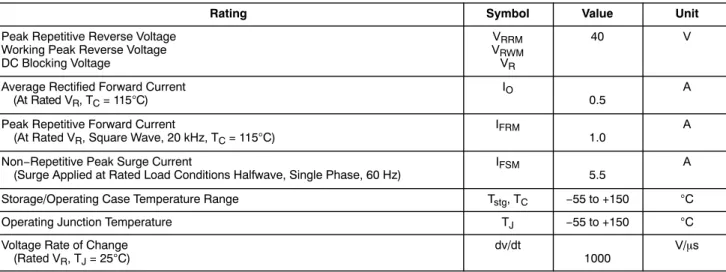
MAXIMUM RATINGS
Rating Symbol Value Unit
Peak Repetitive Reverse Voltage Working Peak Reverse Voltage DC Blocking Voltage
VRRM
VRWM
VR
40 V
Average Rectified Forward Current (At Rated VR, TC = 115C)
IO
0.5 A
Peak Repetitive Forward Current
(At Rated VR, Square Wave, 20 kHz, TC = 115C)
IFRM
1.0 A
Non−Repetitive Peak Surge Current
(Surge Applied at Rated Load Conditions Halfwave, Single Phase, 60 Hz) IFSM 5.5 A Storage/Operating Case Temperature Range Tstg, TC −55 to +150 C
Operating Junction Temperature TJ −55 to +150 C
Voltage Rate of Change (Rated VR, TJ = 25C)
dv/dt
1000 V/ms Stresses exceeding Maximum Ratings may damage the device. Maximum Ratings are stress ratings only. Functional operation above the Recommended Operating Conditions is not implied. Extended exposure to stresses above the Recommended Operating Conditions may affect device reliability.
THERMAL CHARACTERISTICS
Characteristic Symbol Value Unit
Thermal Resistance − Junction−to−Lead (Note 1)
Thermal Resistance − Junction−to−Ambient (Note 2) RRtjatjl
118
206 C/W
1. Mounted with minimum recommended pad size, PC Board FR4. 2. 1 inch square pad size (1 X 0.5 inch for each lead) on FR4 board.
ELECTRICAL CHARACTERISTICS
Characteristic Symbol Value Unit
Maximum Instantaneous Forward Voltage (Note 3) vF TJ = 25C TJ = 100C V
(iF = 0.5 A)
(iF = 1 A)
0.51
0.62 0.460.61
Maximum Instantaneous Reverse Current (Note 3) IR TJ = 25C TJ = 100C mA
(VR = 40 V)
(VR = 20 V)
20 10
13,000 5,000 3. Pulse Test: Pulse Width 250 ms, Duty Cycle 2.0%.
0.2 10
1.0
0.1
0.6 1.2
0.4 0.8 1.0
Figure 1. Typical Forward Voltage Figure 2. Maximum Forward Voltage
0.2
vF, INSTANTANEOUS FORWARD VOLTAGE (VOLTS)
10
1.0
VF, MAXIMUM INSTANTANEOUS FORWARD VOLTAGE (VOLTS)
i F
, INST
ANT
ANEOUS FOR
W
ARD CURRENT
(AMPS)
0.1
0.6 1.2
0.4 0.8 I F, INST
ANT
ANEOUS FOR
W
ARD CURRENT
(AMPS)
TJ = 125C
TJ = 100C
TJ = -40C
TJ = 25C
TJ = 125C
TJ = 100C TJ = 25C
100
1.0 25C
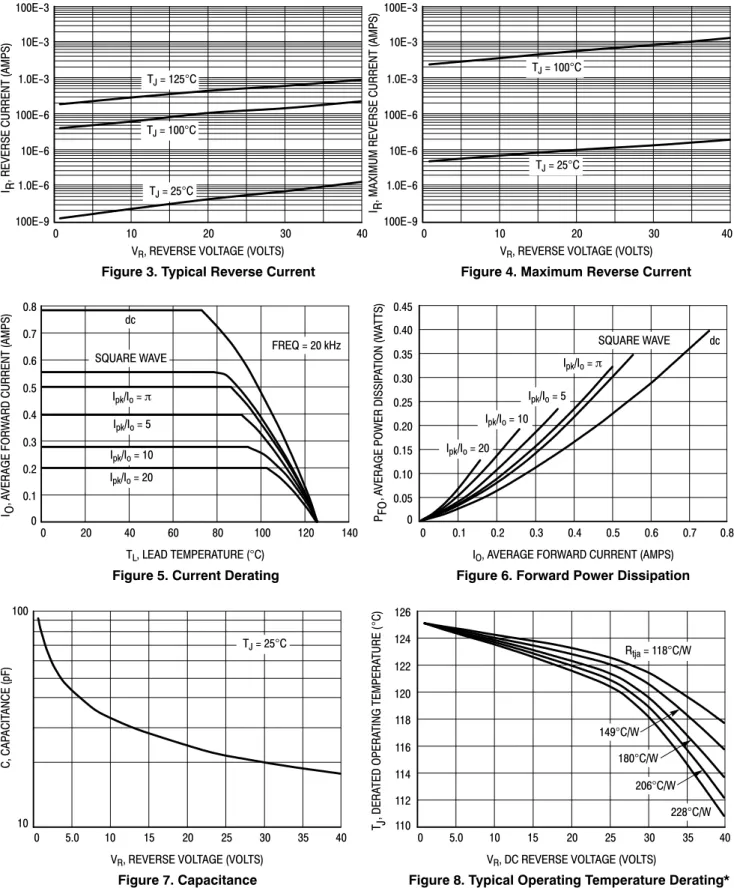
Figure 3. Typical Reverse Current Figure 4. Maximum Reverse Current
40 0
VR, REVERSE VOLTAGE (VOLTS) 100E-3 1.0E-3 100E-6 10E-6 1.0E-6 100E-9
VR, REVERSE VOLTAGE (VOLTS)
I
10 20 30
, REVERSE CURRENT
(AMPS)
R
40 0
I
10 20 30
, MAXIMUM REVERSE CURRENT
(AMPS)
R
TJ = 125C
TJ = 100C
TJ = 25C
TJ = 100C
TJ = 25C
10E-3 100E-3 1.0E-3 100E-6 10E-6 1.0E-6 100E-9 10E-3
Figure 5. Current Derating Figure 6. Forward Power Dissipation
20 60
0
TL, LEAD TEMPERATURE (C)
0.8 0.4 0.3 0.2 0.1 0
IO, AVERAGE FORWARD CURRENT (AMPS)
0.1 0 0.45 0.40 0.35 0.15 0.05 0 0.4 40 , A VERAGE FOR W ARD CURRENT (AMPS) I O
80 100 120
0.5
0.2 0.3 0.5 0.8
0.10
PFO
, A
VERAGE POWER DISSIP
A TION (W A TTS) 140 0.6
SQUARE WAVE dc
Ipk/Io = p
Ipk/Io = 5
Ipk/Io = 10
Ipk/Io = 20
Ipk/Io = 20
Ipk/Io = 10
Ipk/Io = 5
Ipk/Io = p
SQUARE WAVE dc 0.7 0.30 0.20 0.25 0.6 0.7 FREQ = 20 kHz
Figure 7. Capacitance Figure 8. Typical Operating Temperature Derating*
30 0
VR, REVERSE VOLTAGE (VOLTS) 100
10
VR, DC REVERSE VOLTAGE (VOLTS)
25 40 0 118 114 112 110 C, CAP ACIT ANCE (pF) T 15
5.0 10 20 25 35 40 5.0 10 15 20 30 35
116 120 126 , DERA TED OPERA TING TEMPERA
TURE ( C)
J
* Reverse power dissipation and the possibility of thermal runaway must be considered when operating this device under any reverse voltage conditions. Calculations of TJ therefore must include forward and reverse power effects. The allowable operating
TJ may be calculated from the equation: TJ = TJmax− r(t)(Pf + Pr) where
r(t) = thermal impedance under given conditions, Pf = forward power dissipation, and
Pr = reverse power dissipation
This graph displays the derated allowable TJ due to reverse bias under DC conditions only and is calculated as
TJ = TJmax− r(t)Pr, where r(t) = Rthja. For other power applications further calculations must be performed.
Rtja = 118C/W
180C/W 149C/W
206C/W 228C/W TJ = 25C
122 124
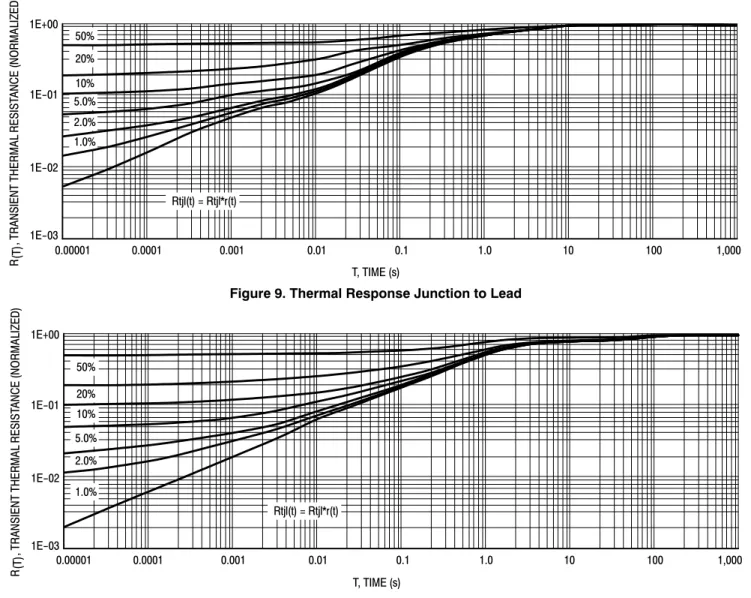
Figure 9. Thermal Response Junction to Lead
Figure 10. Thermal Response Junction to Ambient
100 0.1
0.00001
T, TIME (s) 1E+00
1E-01
1E-02
1,000
R
0.0001 0.001 0.01 1.0 10
1E-03
, TRANSIENT
THERMAL
RESIST
ANCE
(NORMALIZED)
(T)
T, TIME (s) 1E+00
1E-01
1E-02
R
1E-03
, TRANSIENT
THERMAL
RESIST
ANCE
(NORMALIZED)
(T)
Rtjl(t) = Rtjl*r(t) 50%
20% 10% 5.0% 2.0% 1.0%
100 0.1
0.00001 0.0001 0.001 0.01 1.0 10 1,000
Rtjl(t) = Rtjl*r(t) 50%
20% 10% 5.0% 2.0% 1.0%
PACKAGE DIMENSIONS
SOD−123
CASE 425−04 ISSUE G
NOTES:
1. DIMENSIONING AND TOLERANCING PER ANSI Y14.5M, 1982.
2. CONTROLLING DIMENSION: INCH.
ÂÂÂÂ
ÂÂÂÂ
E
b
D A
L C
1
2
A1
DIM MIN NOM MAX
MILLIMETERS INCHES
A 0.94 1.17 1.35 0.037
A1 0.00 0.05 0.10 0.000
b 0.51 0.61 0.71 0.020
c
1.60 0.15
0.055
D 1.40 1.80
E 2.54 2.69 2.84 0.100
---3.68 0.140
L 0.25
3.86 0.010
HE
0.046 0.002 0.024 0.063 0.106 0.145
0.053 0.004 0.028 0.071 0.112 0.152
MIN NOM MAX
3.56
HE
---
---0.006 ---
---
---*For additional information on our Pb−Free strategy and soldering details, please download the ON Semiconductor Soldering and Mounting Techniques Reference Manual, SOLDERRM/D.
SOLDERING FOOTPRINT*
STYLE 1: PIN 1. CATHODE
2. ANODE
1.22 0.048 ÉÉ
ÉÉ
ÉÉ
ÉÉ 0.91
0.036
2.36 0.093
4.19 0.165
ǒ
mm inchesǓ
SCALE 10:1ÉÉ
ÉÉ
ÉÉ
ÉÉ
q
---
---q 0 10 0 10
ON Semiconductor and are registered trademarks of Semiconductor Components Industries, LLC (SCILLC). SCILLC reserves the right to make changes without further notice to any products herein. SCILLC makes no warranty, representation or guarantee regarding the suitability of its products for any particular purpose, nor does SCILLC assume any liability arising out of the application or use of any product or circuit, and specifically disclaims any and all liability, including without limitation special, consequential or incidental damages. “Typical” parameters which may be provided in SCILLC data sheets and/or specifications can and do vary in different applications and actual performance may vary over time. All operating parameters, including “Typicals” must be validated for each customer application by customer’s technical experts. SCILLC does not convey any license under its patent rights nor the rights of others. SCILLC products are not designed, intended, or authorized for use as components in systems intended for surgical implant into the body, or other applications intended to support or sustain life, or for any other application in which the failure of the SCILLC product could create a situation where personal injury or death may occur. Should Buyer purchase or use SCILLC products for any such unintended or unauthorized application, Buyer shall indemnify and hold SCILLC and its officers, employees, subsidiaries, affiliates, and distributors harmless against all claims, costs, damages, and expenses, and reasonable attorney fees arising out of, directly or indirectly, any claim of personal injury or death associated with such unintended or unauthorized use, even if such claim alleges that SCILLC was negligent regarding the design or manufacture of the part. SCILLC is an Equal Opportunity/Affirmative Action Employer. This literature is subject to all applicable copyright laws and is not for resale in any manner.
PUBLICATION ORDERING INFORMATION
N. American Technical Support: 800−282−9855 Toll Free USA/Canada
Europe, Middle East and Africa Technical Support:
Phone: 421 33 790 2910
Japan Customer Focus Center
Phone: 81−3−5817−1050
LITERATURE FULFILLMENT:
Literature Distribution Center for ON Semiconductor P.O. Box 5163, Denver, Colorado 80217 USA
Phone: 303−675−2175 or 800−344−3860 Toll Free USA/Canada
Fax: 303−675−2176 or 800−344−3867Toll Free USA/Canada
Email: [email protected]
ON Semiconductor Website: www.onsemi.com Order Literature: http://www.onsemi.com/orderlit For additional information, please contact your local Sales Representative