Randall Brandt
Founder & Principal
Building a Customer
Experience Roadmap
© 2015 Voice Crafter. All Rights Reserved. 1
Building a Customer Experience
Roadmap
The road to desired business results runs directly through customer experiences and behaviors, but not all organizations seem to recognize this. Managers who approach business with a “make-and-sell” mentality often are overly-focused on internal operations, production, sales, and “running” an efficient organization. They view the market from an “inside-out” perspective, and approach it with an “if I build it, they will buy it” mindset.1 Companies with an inside-out perspective “become attached to what they produce and sell, and to their own organizations.”2 In contrast, organizations that adopt an “outside-in”
perspective start with customer needs, expectations, and requirements. They ask themselves, “What things, from the customer’s perspective must we anticipate, understand, and do well?” Outside-in organizations devote a lot of effort to learning about customer needs and requirements – and the consequences of satisfying and delivering value to customers. These firms emphasize alignment of people, policies, processes, and practices with what it takes to win and keep customers.
Organizations that seek to leverage an outside-in approach
can take much of the guess work out of efforts to achieve customer alignment by building a Customer Experience (CX) Roadmap.
This paper describes and illustrates the process of building a customer experience roadmap.
1
W
HAT
I
S A
C
USTOMER
E
XPERIENCE
R
OADMAP
?
The thinking behind CX roadmaps originated with management models that were developed during the 1990’s and early 2000’s. For example, both the “Service-Profit Chain”3 and “Action-Profit Linkage Model”4 were built around two basic ideas:
The road to desired business results runs directly through customer experiences and
behaviors, but not all organizations seem to recognize this.
© 2015 Voice Crafter. All Rights Reserved. 2
If people, operations, and product/service delivery are aligned with customer needs, expectations, and requirements, an organization will be able to deliver the value that customers are seeking; and
By delivering value to customers, an organization will reap the rewards of customer loyalty, growth in revenues, and increased profitability.
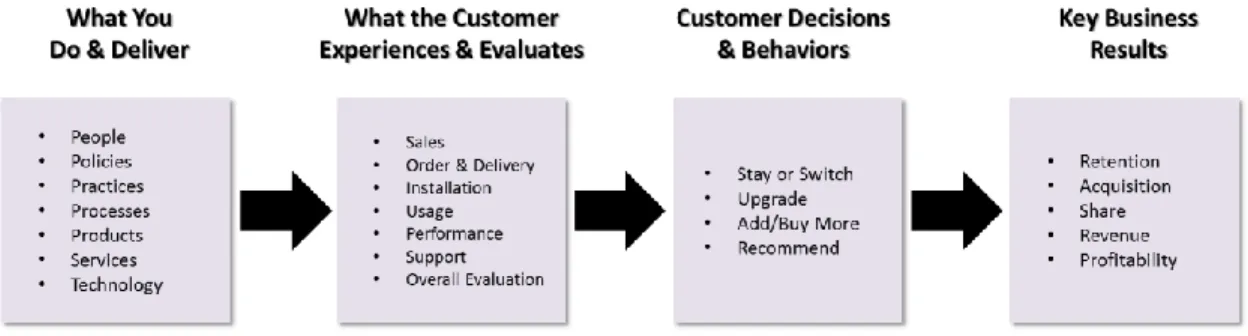
CX roadmaps attempt to help managers visualize the chain of effects described above. A CX roadmap is a graphical tool that illustrates:
How what an organization does and delivers – how it presents itself in the marketplace,
Translates into what customers experience and evaluate,
Leading to customer decisions and behaviors that drive financial and other key business results
Figure 1 provides a high-level overview of a hypothetical CX roadmap in an information technology setting. It illustrates the basic elements that link a company to its customers, and ultimately, customer decisions and behaviors to key business results. When a CX roadmap is actually constructed, the elements in each of the four blocks – along with their inter-connections – are fleshed-out in greater detail.
© 2015 Voice Crafter. All Rights Reserved. 3
CX roadmaps enable managers to see “who” and “what” within an organization shape each critical element of the customer experience. CX roadmaps also help managers visualize the “downstream” consequences of customer decisions and behaviors that are driven by customer evaluations of their experiences with a brand or firm.
A customer experience roadmap provides at least three key benefits to managers and organizations:
A CX roadmap paints a picture of how various departments or functional areas in an organization have a hand in shaping specific elements of the customer experience. This enables managers to think outside their own silos, and to coordinate with other departments and functions to deliver a better customer experience.
It provides direction for linking customer data and metrics to other business data and metrics. This enables managers to perform analyses that connect customer experience to business processes and results. For example, a CX roadmap can help managers assemble and analyze data needed to demonstrate the ROI for improving customer satisfaction, or it can be used to determine where to set the bar for internal metrics and KPI’s based on customer expectations and requirements.
Building a CX roadmap will make an organization better prepared to take actions to improve customer experience based on insights drawn from the Voice of the Customer.
Failure to connect customer experience to business processes and results, and failure to take action based on customer feedback are two of the three most common reasons organizations are unable to get the most from investments in capturing and leveraging the Voice of the Customer. Building a CX roadmap can help overcome these two obstacles.
2
H
OW
A
RE
CX
R
OADMAPS
C
ONSTRUCTED
?
CX roadmaps typically are constructed by a cross-functional team of managers, using a facilitated process. The process begins with a customer experience “module,” similar to the one shown in Figure 2. The CX module displays the primary elements of the customer experience that drive a customer’s overall evaluation of a brand or firm. It also shows the more granular, secondary elements associated with each primary CX element.
© 2015 Voice Crafter. All Rights Reserved. 4
After examining the CX module, the roadmap construction team is charged with two tasks:
Visualize and describe the “downstream” impact of a customer’s overall evaluation of his/her experience – identify and connect specific customer decisions, behaviors, and key business results, in as much detail as possible
Visualize and describe how secondary CX elements connect “upstream” to people, policies, practices, processes, products, services, and technology – once again in as much detail as possible.
3
B
UILDING THE
“D
OWNSTREAM
”
P
ORTION OF THE
CX
R
OADMAP
Constructing the “downstream” portion of the CX roadmap boils down to answering the question, “if a customer’s overall evaluation of his/her experience with us is favorable, what will happen as a result?”
Figure 3 illustrates the customer decisions, behaviors, and business results the team might expect if the customer’s experience is a good one. In this case, the team believes that “happy” customers will be more likely to repurchase and/or increase purchasing from the company. They also will be more likely to recommend the company to others. In addition, the team believes that these happy customers will be more tolerant of price increases (at least within limits). As a
© 2015 Voice Crafter. All Rights Reserved. 5
result, the team expects that the company will increase revenues, share of spend, and market share, as a result of customer retention and new customer acquisition attributable to have “done the right things well” in connection with customer experience.
In practice, the downstream portion of a CX roadmap usually is more complex than the one shown in Figure 3. This is a good thing, because it shows that when managers concentrate on and discuss the potential effects of customer experience on customer decisions, behaviors, and key business results, they realize that many outcomes and consequences may be on the line.
4.
B
UILDING THE
“U
PSTREAM
”
P
ORTION OF THE
CX
R
OADMAP
Once team members have visualized and documented the “downstream” consequences of the customer experience, it is time to ask, “What must we do well from the customer’s perspective in order to ensure that the customer evaluates his/her experience favorably?” This requires the team to focus in on specific (secondary) elements of the customer experience that are the “drivers” of a customer’s overall CX evaluation.
© 2015 Voice Crafter. All Rights Reserved. 6
Figure 4 shows specific elements for the “Support” aspect of the customer experience, and although not shown in this figure, keep in mind that each of the primary CX elements has its own set of secondary, more specific elements.
In the case of Support, there are three secondary elements listed:
Ease of Reaching a Customer Support Representative
Getting Help Without Having to be Transferred
Resolving Problems on the First Contact or Attempt
For illustrative purposes, let’s focus on the third of the above CX elements.
Constructing the “upstream” portion of the CX roadmap requires the team to address two critical questions about “Resolving Problems on the First Contact or Attempt:”
Who within the organization touches the customer and/or has a hand in shaping this element of the customer experience?
What are the relevant policies, practices, processes, technologies, and other aspects of business performance that play a role in shaping this CX element?
© 2015 Voice Crafter. All Rights Reserved. 7
Figure 5 illustrates how the team might answer the above two questions. The “owners” of first contact problem resolution include:
Customer contact center representatives, who are the first persons to interact with customers, and who are charged with attempting to address a customer’s request or resolve his/her problem
Customer contact center supervisors, who are charged with managing and mentoring contact center representatives, and who may be the next person to interact with a customer if the representative cannot handle the problem or request
CRM, which manages the customer information and account activity data on which contact center personnel may rely for critical background information needed to address customer requests or problems
Technical support personnel, who manage the IT and telephony infrastructure on
which both contact center and CRM personnel are dependent
Senior management and legal, who are primarily responsible for establishing rules and policies governing how customer requests and problems are to be handled, as well as the degree to which contact center representatives are empowered to take direct action to handle problems and requests
© 2015 Voice Crafter. All Rights Reserved. 8
In attempting to identify the elements of business performance that play a role in shaping customer experience regarding first contact problem resolution, the team might come up with the following:
Telephony, including automated call routing systems, as well as the technology that enables customers and contact center representatives to interact
Workflow processes that dictate how representatives interact with customers, what steps they take to direct the conversation, and in what order
Staffing levels at any point in time, which strongly impact whether/how quickly customers can get through to a contact center representative
Rules and empowerment, which play a major role in determining whether the representative with whom a customer interacts initially can handle his/her request, or must transfer or escalate
Access to customer information that representatives need to completely understand the customer and his/her situation, so that an appropriate response can be formulated and delivered
Having made these “upstream” connections between a specific CX element, and people, policies, practices, processes, and other relevant aspects of business performance, the team has gone a long way toward enabling the organization to plan and implement actions designed to improve the customer experience: They have identified the people and areas of the organization that should be included, and they have targeted (at least initially) the business performance elements that may need to be fixed, if this element of the customer experience is identified as a priority for improvement.
When the team has defined and documented upstream connections for all secondary customer experience elements, construction of the CX roadmap is complete. The organization now has a clear and detailed view of the road to desired business results, how it runs through the customer experience, and how people and practices in the organization need to be aligned with individual customer experience elements in order for the desired business results to be achieved.
When managers are fully focused on the potential impact of good or poor customer experiences, they realize that many key business outcomes may be on the line.
© 2015 Voice Crafter. All Rights Reserved. 9
C
ONCLUSION
Organizations seeking to align people and activities with the elements of customer experience that matter will benefit greatly by building a customer experience roadmap. Managers can pool their vision and understanding to create a clear image of the path to desired business outcomes. A customer experience roadmap details who and what must be managed effectively to “do the right things well” in the eyes of customers. It helps an organization achieve financial and other key business results by putting customer experience at the heart of a company’s operations and management.
© 2015 Voice Crafter. All Rights Reserved. 10
End Notes
1 Gulati, R. (2010). Re-Organize for Resilience: Putting Customers at the Center of Your Business.
Cambridge, Massachusetts: Harvard Business Press.
2 Ranjay Gulati, as quoted by Sara Jane Gilbert in The Outside-In Approach to Customer Service. Retrieved
from http://hbswk.hbs.edu/item/6201.html.
3 Heskett, J.L., Sasser, W.E., and L.A. Schlesinger (1997). The Service Profit Chain. Cambridge,
Massachusetts: Harvard Business Press.
4 Epstein, M. and R. Westbrook (2001). “Linking Actions to Profits in Strategic Decision Making.” MIT
Sloan Management Review. 42 (3); pp.39-49.