Dated
Issued by Units ARSN
Triple3 Volatility Advantage Fund
This Product Disclosure Statement (PDS) dated 5 May 2014 is issued by Grant Samuel Fund Services Limited ABN 48 129 256 104, AFSL 321517, (Grant Samuel Fund Services, (GSFS), the Responsible Entity or we), the responsible entity for the Triple3 Volatility Advantage Fund ARSN 168 796 718 ABN 13 174 490 942 APIR Code GSF0009AU. It is important that you read this PDS carefully before deciding whether to invest. The Application Form accompanying this PDS, which contains important terms relating to the Fund, should also be read before deciding to invest.
In preparing this PDS, we have not taken into account the investment objectives, needs or financial position of any person. Before making an investment decision on the basis of this PDS, investors should consider whether investing in the Fund is suitable to their individual circumstances and seek advice from a qualified financial adviser.
Important information
The offer in this PDS is available only to persons receiving this PDS (electronically or otherwise) in Australia and does not constitute an offer or recommendation in any jurisdiction, or to any person to whom it would be unlawful to make such an offer. No information or representation in connection with the Fund, which is not contained within this PDS, should be relied upon in making an investment decision about the Fund. No person is authorised to make representations in respect of the Fund which are not contained in this PDS.
An investment in the Fund is subject to investment and other risks, including possible delays in payment and loss of income and capital invested. Investments in the Fund are not deposits with or other liabilities of the Responsible Entity or any of its related bodies corporate, affiliates, associates or officers. None of these entities guarantee any particular rate of return or the performance of the Fund, nor do they guarantee the repayment of capital from the Fund. For more details on the risks, please refer to Section 5 of this PDS, ‘Risks of investing in the Triple3 Volatility Advantage Fund.’ No person other than the Responsible Entity has caused or authorised the issue of this PDS nor do any of them take any responsibility for the preparation of this PDS or the establishment or performance of the Fund. The Australian Securities and Investments Commission (ASIC) takes no responsibility for the contents of this PDS. The information in this PDS is up-to-date at the time of preparation. However, some information may change from time to time. If a change is considered materially adverse, we will issue a supplementary PDS or a new PDS. Information in this PDS that is not materially adverse to investors can be updated by us. The updated information will be available on our website, www.gsfm.com.au. Please check our website, contact your financial adviser, or call us on (02) 9324 4356 for any updates prior to investing. A paper copy of any updates will be provided free of charge on request.
A paper copy of this PDS (and any supplementary documents) can also be obtained free of charge on request by calling the Responsible Entity using the details in the Corporate Directory, or by contacting your financial adviser.
Grant Samuel Fund Services Level 19, Governor Macquarie Tower 1 Farrer Place
Sydney NSW 2000 Phone: (02) 9324 4356 Website: www.gsfm.com.au Email: [email protected] Mailing address
Grant Samuel Fund Services Limited Locked Bag 5002
<
Contents
Key features
4
1 Disclosure benchmarks
11
2 About Grant Samuel Fund Services
and Triple Three Partners Pty Limited
13
3 About the Triple3 Volatility Advantage Fund 14
4 Benefits of investing in the Triple3 Volatility
Advantage Fund
26
5 Risks of investing in the Triple3 Volatility
Advantage Fund
27
6 Fees and other costs
30
7 Dealing with your investment
36
8 How managed investment schemes
are taxed
42
9 Material contracts
44
10 Additional information
45
Terms used in the PDS
46
Important investment terms explained
47
Key features
>
Triple3 Volatility Advantage Fund Where to find more
information
ARSN 168 796 718
Units available under this PDS Class A
Responsible Entity Grant Samuel Funds Services Limited (GSFS or Responsible Entity) Section 2
Investment Manager Triple Three Partners Pty Ltd (T3P or Investment Manager) The portfolio managers for the Fund are Simon Ho, Chief Investment Officer and John Zhu, Portfolio Manager.
Section 2 & 9
Investment return objective The Fund aims to generate long-term absolute returns that are negatively correlated to Standard & Poor’s 500® (also known as the
S&P 500 Index®1) (SPX), with an emphasis on positive returns when
the SPX experiences falling (or ‘bear’) markets.
It is expected that the investment strategy will perform best in periods where the SPX is falling and volatility is high. In periods where the SPX remains stable or increases only steadily, the investment strategy is expected to generate cash-like returns.
Section 3
Minimum suggested time frame for holding investment
At least 5 years.
Base currency The Fund is denominated in Australian dollars. More information can be found in ‘Currency Management’ in Section 3.
Asset classes The Fund invests in two asset classes: volatility and cash. Volatility
The volatility component of the Fund invests in exchange traded options. Specifically, the Fund invests in CBOE Volatility Index2 (VIX) options,
S&P 500 Index (SPX) options, and VXX Exchange Traded Note (VXX) options and VXX Exchange Traded Notes.
These assets are traded and located in the United States of America (USA) and are denominated in US dollars (USD).
Cash
The cash component of the Fund invests in cash and cash-like instruments and may also invest in derivatives such as OTC interest rate investment contracts (for example Total Return Swaps) and bank bill futures traded on the Australian Securities Exchange (ASX) (Cash). Cash held to satisfy margin requirements for exchange traded options (that comprise the volatility component) is held in US dollars (USD) and located in the USA.
Foreign exchange (FX) contracts are used to convert AUD to and from USD and are primarily traded with Australian counterparties and located in Australia.
Cash not paid to satisfy margin requirements is invested in Cash. The cash assets of the Fund are located in Australia and are dominated in Australian dollars (AUD) (with the exception of some Cash that may be denominated in USD).
The range of cash-like instruments that the Fund is permitted to invest in include short term call deposits, and cash equivalent securities including Treasury notes, bank bills of exchange, certificates of deposit, corporate and asset backed promissory notes.
More information on the ‘Volatility Component’ and ‘Cash Component’ of the Fund can be found in Section 3.
1. Standard & Poor’s and S&P are registered trademarks of Standard & Poor’s Financial Services LLC (S&P), a part of McGraw Hill Financial Inc. 2. The CBOE Volatility Index® (VIX®) is a Registered Trademark of the Chicago Board Options Exchange (CBOE).
Triple3 Volatility Advantage Fund Where to find more information
Investment strategy and how the Fund is managed
The Fund aims to achieve its investment objective by investing a portion of the Fund in VIX options (and other volatility related options) to gain exposure to volatility on the SPX (being the volatility component). The majority of the Fund is invested in cash and cash-like instruments which include derivatives such as OTC interest rate investment contracts (for example Total Return Swaps) and bank bill futures traded on the Australian Securities Exchange (ASX) (Cash), and is expected to generate cash- like returns in periods where the SPX remains stable or increases only steadily and volatility is low. It is expected that the investment strategy will perform best when the SPX is falling because, in these periods, volatility tends to fluctuate a lot, thereby creating more investment opportunities. When the SPX is rising or stable, volatility fluctuates less, resulting in fewer investment opportunities. The more volatility, the more investment opportunities the Fund will be presented with to buy VIX options (and other volatility related options) when the Investment Manager considers they are undervalued and sell them when they consider they are overvalued. Regardless of market conditions, the portion of the Fund invested in volatility remains relatively constant, with the majority of the Fund invested in Cash (being the cash component).
The VIX is a measure of 30 day implied volatility (which is derived from option prices) on the SPX. The variability, or ‘volatility’, of equity returns historically rise when equities fall. This makes the VIX an appropriate instrument for targeting returns negatively correlated to the returns of the SPX.
The Fund’s volatility component invests primarily in VIX options, but it can use SPX options and VXX options to implement the investment strategy, as these are also SPX volatility products.
A portion of the cash component will be held to satisfy the margin requirements for exchange traded options and futures. Cash not held to satisfy margin requirements is invested in AUD and USD Cash and is expected to generate cash-like returns in periods where the SPX remains stable or increases only steadily and volatility is low. The following assumptions underpin the investment strategy’s ability to produce investment returns:
• the VIX will remain negatively correlated to the SPX i.e. as the SPX goes down the VIX will rise and vice versa; and
• option prices will continue to display a strong and persistent source of risk premium, i.e. there will continue to be a positive difference between the expected return on options and the risk-free rate.
Further information regarding the ‘Investment strategy and how the Fund is managed’ can be found in Section 3.
Further information regarding the VIX is provided in Section 3.
The risks associated with the Fund’s investment strategy are set out in Section 5. The Fund’s risk management strategy is set out in Section 3.
Investment limits The Fund does not have any specific diversification guidelines. However, the Fund adheres to the following risk constraints: • ensuring the aggregate call option position of the Fund is positive
or zero at all times i.e. the sum total of all call options held by the Fund cannot be less than zero;
• ensuring the aggregate put option position of the Fund is zero or positive at all times i.e. the sum total of all put options held by the Fund cannot be less than zero; and
The risks associated with the Fund’s investment strategy are set out in Section 5. The Fund’s risk management strategy is set out in Section 3.
> Key features
Triple3 Volatility Advantage Fund Where to find more
information
Fund structure The Fund is a registered managed investment scheme that is an unlisted Australian unit trust. GSFS is the responsible entity of the Fund.
GSFS has appointed a number of key service providers, including T3P as the investment manager, that are involved in the ongoing operation and administration of the Fund.
A diagram showing the flow of investment money through the Fund’s structure is set out in Section 3. The risks associated with the Fund’s structure are set out in Section 5. Further information regarding the key service providers is set out in Section 3.
Valuation, location and custody of assets
The Fund’s assets are valued each business day by the Fund’s administrator.
Assets and liabilities of the Fund are generally valued at their market value in accordance with the Fund’s constitution.
The Fund invests in US exchange traded derivatives (in particular, options), US exchange traded notes and in USD cash, AUD cash, Foreign Exchange (FX) contracts, cash-like instruments such as short term call deposits, and cash equivalent securities including Treasury notes, bank bills of exchange, certificates of deposit, corporate and asset backed promissory notes and derivatives such as interest rate investment contracts (for example Total Return Swaps) which are traded over-the-counter, and bank bill futures traded on the Australian Securities Exchange (ASX).
The US exchange traded derivatives and US exchange traded notes are traded in the USA, held by counterparties located in the USA and are denominated in US dollars.
USD cash to satisfy margin calls is held by Goldman Sachs International and is located in the USA. Goldman Sachs International is located in the United Kingdom (UK).
Any USD cash holdings, not held by Goldman Sachs International, are held by an independent custodian, J.P. Morgan.
All other assets of the Fund are located in Australia and denominated in Australian dollars or in the USA and denominated in USD. The Cash assets of the Fund are held by an independent custodian, J.P. Morgan, with the exception of any derivative contracts (and associated collateral and margins paid) which are held by clearers and counterparties based in Australia and the UK.
FX contracts will be held by counterparties in Australia, the UK and the USA.
Further information regarding the Fund’s valuation policy is set out in Section 1.
The target asset allocation ranges for the Fund are included in Section 3.
Further information regarding the custodian is set out in Section 3.
< Key features
Triple3 Volatility Advantage Fund Where to find more
information
Derivatives The Fund may invest in exchange-traded derivatives and over-the-counter (OTC) derivatives.
The Fund uses exchange traded derivatives (specifically options) to implement the volatility component of the Fund’s investment strategy. When managing the cash component of the Fund, the Fund may also invest in derivatives such as interest rate investment contracts (for example Total Return Swaps) which are traded over-the-counter, and bank bill futures traded on the Australian Securities Exchange (ASX) to gain or reduce exposure to relevant markets and manage interest rate risk.
The exchange traded contracts used by the Fund are standardised and subject to the rules and regulations of the exchange and regulatory authorities in the USA and Australia.
The OTC derivatives are governed by standard International Swaps and Derivatives Association (ISDA) agreements.
Further information regarding the Fund’s use of derivatives is provided in Section 3.
The risks associated with the use of derivatives are described in Section 5.
Leverage The Fund will not borrow except to use overdraft facilities as and when required for the efficient settlement of transactions. The Fund will not borrow for speculative purposes.
However, the Fund uses exchange traded derivatives (specifically options) to create the portfolio, and these contracts have implicit leverage.
The Fund may also invest in derivatives, as part of the Fund’s management of its cash assets, such as OTC interest rate investment contracts (for example Total Return Swaps), and exchange traded bank bill futures to gain or reduce the Fund’s exposure to relevant markets and manage interest rate risk. The maximum anticipated gross leverage in the Fund is 250% of the net asset value of the Fund. The net leverage of the Fund however is expected to be below 100%.
Further information regarding borrowing can be found in Section 3. An example of the impact of leverage on investment returns and losses is set out in Section 3. The risks associated with Leverage are described in Section 5.
Short selling The Fund does not engage in short-selling securities, but may sell option contracts that it does not already own. However, the Fund must ensure that the aggregate (sum total) of all bought and sold call or put options must be positive or zero. That is, the Fund cannot be net short call or put options.
The ability to invest in long and short option positions is key to the Fund’s investment strategy. In selling options, the Fund bears the risk of an increase in price of option (for example, if the Fund sells an option which it does not own and the price of the option increases after the Fund sells the option, the Fund will have to buy the option at higher price than the price at which it was sold).
Further information regarding short selling is provided in Section 3. The risks associated with short selling are described in Section 5.
Liquidity We expect that at least 80% of the Fund’s assets are capable of being realised within 10 days at the value ascribed to those assets when calculating the Fund’s net asset value.
Section 3
Withdrawals Withdrawal requests are processed each business day and will usually be paid within five business days. However, there may be circumstances where withdrawals are suspended or delayed, for
Further information about withdrawals is provided in Section 7.
> Key features
Triple3 Volatility Advantage Fund Where to find more
information
Labour, environmental, social and ethical considerations
The Fund invests in cash and cash-like instruments and may also invest in derivatives such as OTC interest rate investment contracts (for example Total Return Swaps) and bank bill futures traded on the Australian Securities Exchange (ASX) (Cash), exchange traded VIX Index options, S&P 500 Index options, VXX Exchange Traded Note options and VXX Exchange Traded Notes and this does not provide an opportunity for the Responsible Entity or the Investment Manager to take into consideration labour standards, environmental, social or ethical considerations when making investment decisions (including selecting, retaining or realising investments) in respect of the Fund.
Risk level of the Fund High
There are risks associated with investing in the Fund (including associated with the Fund’s investment strategy and structure), for example, risks associated with using options and holding assets overseas.
The key risks are set out in Section 5.
Risk management The Investment Manager manages risk by employing the following risk management guidelines:
• Generally approximately 10% of the Fund will be invested in the volatility component, while the remaining 90% will be invested in Cash.
• Selling an option can result in infinite losses. The Fund mitigates this risk by adhering to the following risk constraints:
– ensuring the aggregate call option position of the Fund is positive or zero at all times i.e. the sum total of all call options held by the Fund cannot be less than zero;
– ensuring the aggregate put option position of the Fund is zero or positive at all times i.e. the sum total of all put options held by the Fund cannot be less than zero; and
– limiting the total loss of all options positions of the Fund at each VIX option expiry date to 5% of the net asset value of the Fund. However there is no guarantee as to the maximum loss that might be incurred.
• The external administrator reconciles the Fund’s portfolio and profit & loss calculations daily to ensure that the assets in the Fund are correct and that the risk constraints as outlined in the point above are adhered to.
• Exchange traded derivatives are centrally cleared, which means that counterparty credit risk is mitigated.
• The exchange traded options traded are highly liquid and mean the portfolio can be updated swiftly.
• The Fund invests in option contracts that are denominated in USD and will result in an exposure to changes in the value of the USD relative to the AUD. Typically the exposure to USD is expected to be less than 10% of the Fund’s net asset value and the USD positions will not be hedged back to AUD.
• OTC counterparties are subject to a credit assessment on an annual basis. The Fund will engage the services of OTC counterparties with an S&P credit rating of A- or better.
The key risks are set out in Section 5. Further information about the risk management of the Fund is set out in Section 3.
< Key features
Triple3 Volatility Advantage Fund Where to find more
information
Custody and administration J.P. Morgan Chase Bank N.A. (Sydney Branch) (J.P. Morgan). Goldman Sachs International is the clearer for the Fund. All exchange traded futures and options entered into with other brokers must be given up to the clearer. GSFS reserves the right to add additional clearers to the Fund over time.
Section 3
Fund performance Please see www.gsfm.com.au for information about the Fund’s performance, including performance history. Due to the historical nature of performance information and the volatility of returns, future returns may differ from past returns.
Changes to Fund detail We have the right to close or terminate the Fund and change the Fund’s investment return objective, investment strategy, benchmark, asset classes and asset allocation ranges and limits, without prior notice in some cases.
We will inform investors of any material change to the Fund’s details in their next regular communication or as otherwise required by law, which in some circumstances, may require prior notice to investors or the issue of a supplementary PDS or new PDS. Information in this PDS that is not materially adverse to investors may be updated by us and will be available on our website, www.gsfm.com.au. A paper copy of any updates will be provided free of charge on request.
Triple3 Volatility Advantage Fund Where to find more information Product features
Management costs3,4 1.45%pa of the Net Asset Value of the Class A units of the Fund plus Expense Recoveries capped at 0.10% of the Net Asset Value of the Class A units of the Fund and a performance fee.
Further information on the Management costs is provided in Section 6.
Performance fee3,4 A Performance Fee is calculated each business day as 20% of the difference between the daily dollar return of the Fund and the daily dollar return of the Performance Benchmark and may be payable to GSFS annually.
Further information on the Performance Fee and Performance Fee Benchmark is provided in Section 6.
Buy-sell Spread3 Buy +0.20% / Sell -0.20% Section 6
Minimum initial investment1 $25,000 Section 7
Minimum additional investment1
$5,000 Section 7
Minimum balance1 $5,000 Section 7
Minimum withdrawal1 $5,000 Section 7
Applications and withdrawals2 Daily Section 7
Payment of proceeds of withdrawal2
Generally 5 business days Section 7
Distribution2 Generally quarterly. However there may be periods when no distributions are made.
Section 7
Reporting
Monthly Fund update A monthly fund update is available on the website www.gsfm.com.au Section 1
Regular reporting Confirmation of all applications and withdrawals Monthly statements
Section 1
Unit pricing Unit prices are calculated each business day and posted on the website: www.gsfm.com.au
Section 7
Annual Fund reporting Annual financial report for the Fund** Annual Investment Statement Section 1
Annual tax reporting Annual Tax Statement Section 8
** Available at www.gsfm.com.au
1. We retain the discretion to waive these minimums. If you invest through an IDPS operator such as a master trust or wrap account platform, these minimums may not apply to you. Please refer to ‘Indirect investors’ in Section 7 of this PDS and to the information provided to you by your service provider.
2. Please refer to Section 7 ‘Dealing with your investment’ of this PDS. These items are subject to change at the discretion of Grant Samuel Fund Services.
3. Please refer to Section 6 ‘Fees and other costs’ of this PDS for complete details on fees and charges and how they are calculated. 4. All fees are inclusive of GST and any applicable stamp duty and net of any applicable reduced input tax credits.
Key features >
1 <
Disclosure benchmarks
This PDS addresses the following benchmarks:
Benchmark 1: Valuation of assets
This benchmark addresses whether valuations of the Fund’s non-exchange traded assets are provided by an independent administrator or an independent valuation service provider.
Non-exchange traded assets
GSFS adheres to the benchmark by having independent valuation service providers for the Fund’s
non-exchange traded instruments (including cash and cash instruments, and OTC derivative contracts). These are valued using market data sourced from independent third party valuation providers.
J.P. Morgan, the Fund’s administrator, has various pricing and valuation policies and procedures which are reviewed by GSFS periodically. These are consistent with industry standards and result in valuation and unit price calculations being independently verifiable.
In accordance with their documented procedures and policies, J.P. Morgan determines the valuation for each asset each day. The non-exchange traded investments of the Fund will either be valued at a value determined from independent third party vendors which provide prices based on a combination of actual trade data, dealer trading desk contributions, matrix pricing and internal modelling and research capabilities or by J.P. Morgan in consultation with the Responsible Entity and Investment Manager and in accordance with industry standards.
J.P. Morgan uses these valuations when it calculates the total market value of the Fund’s assets and the Fund’s unit prices each day. All unit prices are reviewed for reasonableness by GSFS.
Exchange traded assets
J.P. Morgan values the exchange traded derivatives at their market value; which are the prices provided by the relevant market exchange on which the Fund’s assets are bought and sold.
Benchmark 2: Periodic reporting
This benchmark addresses whether we will provide periodic disclosure of certain key information on an annual or monthly basis.Except as provided for below, GSFS adheres to the benchmark as it has and implements a policy to provide investors with regular reporting on key Fund information which can be accessed at www.gsfm.com.au.
This includes:
• Net Asset Value (NAV), entry and exit prices for each business day posted on the Fund’s Unit Prices and Distributions page;
• Distribution details posted periodically on the Fund’s Unit Prices and Distributions page; and
• Monthly net (after fees) returns for the Fund can be found on the Fund’s Performance page.
Monthly updates
The Monthly Updates for the Fund provide an overview of the Fund’s performance and investment activities over the previous month and are available at www.gsfm.com.au or can be obtained free of charge by contacting us.
The Monthly Update provides:
• Current total Net Asset Value (NAV) of the Fund; • Current unit price for withdrawals;
• Changes to key service providers (if any); • Net performance (after fees);
• Material changes to the Fund’s investment strategy (if any);
• Material changes to the Fund’s risk profile (if any); and • Changes to the individuals playing a key role in the
Disclosure benchmarks > 1
Annual reporting
The following information is provided to investors on an annual basis:
• The actual allocation to each asset type;
• Monthly or annual investment returns since inception; • Liquidity profile of the Fund’s assets;
• Maturity profile of the Fund’s liabilities; • Fund leverage ratio; and
• Changes to key service providers of the Fund during the year. We may provide this information more frequently where it is considered a material change to the Fund.
We will provide this information in the June Quarterly Update which will be available on our website at www.gsfm.com.au or can be obtained free of charge by contacting us.
Benchmark 2 is not met in respect of the following: • GSFS does not disclose the names of the Fund’s
derivative counterparties as this information is considered commercial-in-confidence. The Fund’s derivative counterparties are Australian based banks. All are rated A- or better.
The Responsible Entity
Grant Samuel Fund Services Limited is the Responsible Entity for the Fund. As Responsible Entity, GSFS issues units in the Fund and is responsible for its operation.
Investment Manager
The Responsible Entity has appointed Triple Three Partners Pty Ltd (T3P) to act as Investment Manager for the Fund. T3P is an independent research and investment management firm that specialises in volatility as an asset class. The firm services institutional clients around the world providing volatility research services and alpha products.
T3P focuses on developing systematic, absolute return strategies by combining its forecasting capability with stringent risk controls to produce customised products for clients. The team utilises quantitative and systematic alpha generation processes and within a risk management framework.
The investment team
The investment team at T3P is comprised of six dedicated research and investment professionals and is led by Simon Ho. The portfolio managers for the Fund are Simon Ho, CIO and John Zhu, Portfolio Manager. Simon Ho, Chief Investment Officer
Simon founded T3P in 2009. He has over 20 years of industry experience, where he held senior options trading and risk management roles at firms including: Goldman Sachs London, Merrill Lynch New York, and JP Morgan Singapore. He is involved in various initiatives within the options industry to develop volatility-based products and is a regular options expert contributor to various TV and print media outlets. Simon completed a Bachelor of Social Science (Economics) at the University of New South Wales in 1992.
As the CIO, Simon spends a substantial amount of his time overseeing the management of the Volatility Advantage investment strategy.
John Zhu, Portfolio Manager
John has over 8 years’ experience in financial markets, in both quantitative research and trading. His previous roles include quantitative trading at ABN Amro and Royal Bank of Scotland and options market-making at Optiver. John completed his BSc Honours (First Class) in Applied Mathematics specialising in quantitative finance at Sydney University in 2006, where he won the prestigious University Medal.
John is responsible for implementation of the strategy of the Fund on a day to day basis. John primarily spends his time on investment activities applicable to the Volatility Advantage investment strategy.
At the date of this PDS there has been no adverse regulatory finding against the Investment Manager or individuals in the investment team.
2 <
About Grant Samuel Fund Services
Fund structure
The Fund is a registered managed investment scheme that is an unlisted Australian unit trust. The Fund pools the money invested to buy assets on behalf of all the investors in the Fund.
Investors in the Fund hold Class A units in the Fund, which represent their beneficial interest in the assets of the Fund, but do not give an interest in any particular asset of the Fund. We may at our discretion, issue additional classes of units in the Fund with different terms and conditions to the Class A units. As at the date of this PDS, Class A units are the only class of units on issue.
Investment objective
The Fund aims to generate long-term absolute returns that are negatively correlated to Standard & Poor’s 500® (also known as the S&P 500 Index®1) (SPX), with an emphasis on positive returns when the SPX experiences falling (or ‘bear’) markets.
It is expected that the investment strategy will perform best in periods where the SPX is falling and volatility is high. In periods where the SPX remains stable or increases only steadily, the investment strategy is expected to generate cash-like returns.
Investment structure
The following diagram shows the Fund’s structure and the flow of investment money through the structure.
About the Triple3 Volatility Advantage Fund
> 3
Grant Samuel Funds Services Limited (GSFS)
the responsible entity (Australia)
Triple3 Volatility Advantage Fund
(Fund) (Australia)
Triple Three Partners Pty Ltd Investment Manager
(Australia) Unit holders issued
Class A units in the Fund
Fund investments: the money invested by individual investors is used to buy assets on behalf of all the investors in the Fund (or investors in the relevant class if applicable).
â
â
ß
â
à
Cash flowà
RelationshipInvestment strategy and how the Fund
is managed
Investment strategy
The Fund aims to achieve its investment objective by investing a portion of the Fund in VIX options (and other volatility related options being SPX options and VXX options) to gain exposure to volatility on the SPX (the volatility component). The majority of the Fund is invested in cash and cash-like instruments which include derivatives such as OTC interest rate investment contracts (for example Total Return Swaps) and bank bill futures traded on the Australian Securities Exchange (ASX) (Cash), and is expected to generate cash-like returns in periods where the SPX remains stable or increases only steadily and volatility is low (the cash component).
It is expected that the investment strategy will perform best when the SPX is falling because, in these periods, volatility tends to fluctuate a lot, thereby creating more investment opportunities. When the SPX is rising or stable, volatility fluctuates less, resulting in fewer opportunities. The more volatility, the more investment opportunities the Fund will be presented with to buy VIX options (and other volatility related options) when the Investment Manager considers they are undervalued and sell them when they consider they are overvalued. Regardless of market conditions, the portion of the Fund invested in volatility remains relatively constant, with the majority of the Fund invested in Cash.
The Fund has an investment horizon of 5 years. The investment strategy is made up of two components:
Volatility Component – a portion of the Fund is invested in volatility as an asset class, primarily by buying and selling exchange traded options (specifically, VIX options, SPX options and VXX options) denominated in USD. The volatility component of the Fund is designed to provide the Fund with exposure to the volatility of the SPX. The VIX is a measure of the implied volatility of the SPX over rolling 30 day periods. The level of volatility measured by the VIX is typically negatively correlated to SPX. Further information regarding the options contracts and the VIX
T3P’s approach to investing is based on an investment system which uses mathematical models to calculate the ‘fair’ value of option prices and volatilities for the VIX and SPX. This output is then compared to live market prices for options to determine which options are comparatively overpriced or under-priced. Using this information, a portfolio algorithm then determines the optimal combination of options. The Investment Manager carries out trading instructions advised by the system and provides human oversight to ensure that portfolio limits are respected.
Further information regarding the volatility component is included in ‘More about the Volatility Component’. Cash Component– the majority of the Fund will be invested in cash and cash-like instruments which include derivatives such as OTC interest rate investment contracts (for example Total Return Swaps) and bank bill futures traded on the Australian Securities Exchange (ASX) (Cash). Cash held to satisfy the margin requirements for the exchange traded options (that comprise the volatility component) is held in USD. Cash not held to satisfy margin requirements will be invested in Cash and is expected to generate cash-like returns in periods where the SPX remains stable or increases only steadily and volatility is low. Management of the cash component will be undertaken by the Investment Manager together with the Responsible Entity.
Further information regarding the cash component is included in ‘The Cash Component’ later in this section of the PDS.
Generally approximately 10% of the Fund will be invested in exchange traded options (i.e. the volatility component), while the remaining 90% will be invested in Cash. However, because the exchange traded options have implicit leverage, the majority of the Fund’s risk exposure is derived from the volatility component. Please see Section 3 ’Leverage’ for further information regarding the implicit leverage of options.
> 3 About the Triple3 Volatility Advantage Fund
More about the Volatility Component
The Volatility Component of the Investment strategy uses three products:
1. SPX options – these are option contracts in which the underlying value is based on the level of the S&P 500®, which is a capitalisation weighted index of 500 actively traded large cap common stocks in the USA. 2. VIX options – the VIX is a measure of 30 day implied
volatility (which is derived from options prices) on the SPX. The variability, or ‘volatility’, of equity returns historically rises when equities fall. This makes the VIX an appropriate instrument for targeting returns negatively correlated to the returns of the SPX. Further information regarding options and the VIX is set out in ’Options and the VIX explained’.
3. VXX options – a VXX is an exchange-traded note based on S&P 500 VIX Short-Term Futures Index. VXX options offer exposure to a long basket of first and second month VIX futures contracts. So, while the underlying asset for a VIX option is the VIX future, the underlying asset for a VXX option is the VXX exchange-traded note.
Of the three products above, the volatility component of the Fund invests primarily in VIX options.
Options and the VIX explained
An option gives its buyer the right, but not the obligation, to buy (in the case of a call option) or sell (in the case of a put option) an underlying asset at a certain price (the strike price), at a future date.
Implied volatility is a key input in calculating an option’s price. It represents how variable the expected price of an underlying asset will be between the date of purchase until maturity. The VIX is a measure of the implied volatility of the SPX over rolling 30 day periods. For example, a high VIX value means investors see significant risk that the SPX will move sharply, whether downward or upward.
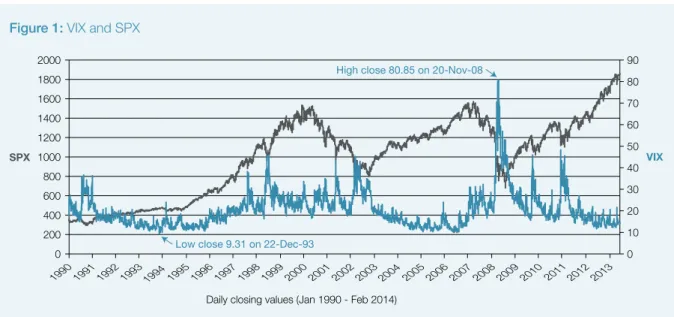
The level of volatility measured by the VIX is typically negatively correlated to SPX, indicating that when equities fall, volatility tends to rise. This makes VIX an appropriate instrument for targeting returns that are negatively correlated to the SPX (see Figure 1). Volatility
Cash
Volatility Cash
The two pie charts above illustrate that although the majority of the Fund is invested in cash, it is not a traditional ‘cash fund’. The majority of the Fund’s risk exposure is derived from the volatility component of the investment strategy.
Cash weighting of Fund
Risk weighting of Fund
3 < About the Triple3 Volatility Advantage Fund
How the Fund is managed
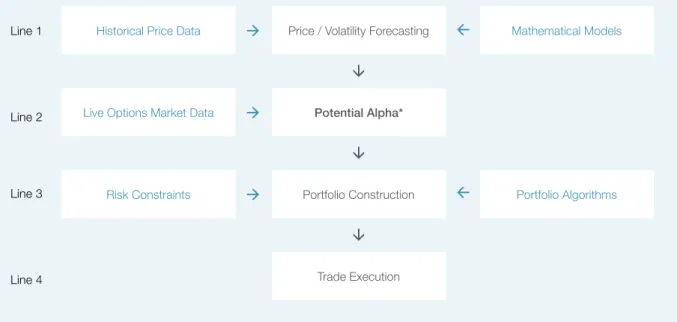
The Volatility ComponentThe Investment Manager uses mathematical models to analyse historical price data. The process is systematic. The models generate a forecast of options prices and volatilities for SPX, VIX and VXX options for a range of different strikes prices. This is illustrated in line 1 of Diagram 1 on the following page.
The Investment Manager then compares the forecasts generated by the mathematical models to the live options market data, to determine which options appear under-priced and which options appear overpriced. By comparing model values to market prices, potential alpha is identified. (Alpha is the difference between a fund’s expected returns and its actual returns. Alpha is sometimes interpreted as the value that a portfolio manager adds, above and beyond a relevant index’s risk/reward profile). This is shown in line 2 of Diagram 1.
Before the portfolio can be constructed, risk constraints need to be considered. The risk constraints of the Fund are:
• The aggregate of all bought and sold call or put options must be positive or zero. That is, the Fund is not permitted to be net short call or put options at any expiry date. This limit is in place to ensure that the Fund is not exposed to potentially unlimited losses; and • the total loss of all options positions of the Fund at
each VIX option expiry date is limited to 5% of the net asset value of the Fund. This means that in a period where the strategy is investing in January VIX options, the portfolio of January VIX options will not lose more than 5% of the net asset value of the Fund. However there is no guarantee as to the maximum loss that might be incurred.
Using all of the information above, the Investment Manager will then use a portfolio algorithm to determine the optimal combination of options for the portfolio such that:
• the chance of generating a positive return is maximised; • the risk constraints of the Fund detailed above are
adhered to; and
• where possible, the returns from buying and selling the options will be negatively correlated to the SPX in
The graph above illustrates the negative correlation associated between the SPX and the VIX. That is, often at times when the SPX goes down, the VIX increases and vice versa. There is no guarantee that this relationship is going to persist in the future. Past performance is not a reliable indicator of future performance.
Figure 1: VIX and SPX
0 10 20 30 40 50 60 70 80 90
0 200 400 600 800 1000 1200 1400 1600 1800 2000
1990 1991 1992 1993 1994 1995 1996 1997 1998 1999 2000 2001 2002 2003 2004 2005 2006 2007 2008 2009 2010 2011 2012 2013
VIX High close 80.85 on 20-Nov-08
Low close 9.31 on 22-Dec-93 SPX
About the Triple3 Volatility Advantage Fund > 3
Diagram 1: How the Volatility Component of the Fund is managed – a graphical representation. A portfolio of options is then constructed. This is
illustrated in line 3 of Diagram 1 below. Finally, the Investment Manager carries out the trading instructions advised by the portfolio algorithm, purchasing and selling options for the portfolio. This is represented in line 4 of Diagram 1 below.
The Investment Manager also provides human oversight to ensure that the portfolio risk constraints as detailed on the previous page are respected. Trading may occur several times a week.
The Cash Component
The majority of the Fund will be invested in Cash. The cash assets of the Fund are used first to satisfy margin requirements of the exchange traded options which comprise the volatility component. Foreign exchange contracts are used to convert AUD to and from USD. Any Cash not used for this purpose is invested in high quality short-dated money market instruments such as short term call deposits and cash equivalent securities including Treasury notes; bank bills of exchange; certificates of deposit; corporate and asset backed promissory notes. In addition, the Fund may also invest in derivatives such as OTC interest rate investment contracts (for example Total Return Swaps), and exchange traded bank bill futures to manage AUD interest rate risks.
The Cash assets of the Fund will be limited to: • cash equivalent securities that are rated A1 or A1+
by Standard & Poor’s (S&P). In addition, to restrict investment to cash equivalent securities and deposits of a certain credit quality the lowest acceptable bank rating is A-; and
• derivatives such as OTC interest rate investment contracts (for example Total Return Swaps) and bank bill futures traded on the Australian Securities Exchange (ASX). The Fund may only enter into and execute derivative trades with counterparties which maintain at a minimum an issuer credit rating of at least A- (S&P) or as otherwise approved by the Responsible Entity.
*Potential Alpha is identified by comparing model values to market prices.
Historical Price Data
Live Options Market Data
Risk Constraints
Price / Volatility Forecasting
Potential Alpha*
Portfolio Construction
Trade Execution
Mathematical Models
Portfolio Algorithms
â
â
â
Line 1Line 2
Line 3
Line 4
ß
ß
ß
ß
About the Triple3 Volatility Advantage Fund 3 <
Key assumptions underpinning the investment strategy
The following assumptions underpin the investment strategy’s ability to produce investment returns: • the VIX will remain negatively correlated to the SPX
i.e. as the SPX goes down the VIX will rise and vice versa; and
• option prices will continue to display a strong and persistent source of risk premium, i.e. there will continue to be a positive difference between the expected return on options and the risk-free rate. The risks associated with this investment strategy, the Fund’s structure and investing in the Fund and how these risks are managed are discussed later in this section in ‘Risk management and monitoring’ and in ‘Risks of investing in the Triple3 Volatility Advantage Fund’ in Section 5.
You should ensure that you understand the investment terms used in this section before you invest in the Fund. Please refer to ‘Important investment terms explained’ at the back of this PDS.
Changes to investment strategy
We reserve the right to change the Fund’s investment return objective, investment strategy, benchmark, asset classes and asset allocation ranges and limits, without prior notice in some instances. We will inform you of any material change to the Fund’s details in the next regular Fund communication or as otherwise required by law. Notices of material changes will also be available on our website www.gsfm.com.au.
The types of assets in which the Fund may invest The Fund invests in exchange-traded derivatives (options) and OTC derivatives, cash and cash equivalents (Cash).
Asset types by asset class Allocation range Min Max
Exchange Traded Derivatives1 Options on US Volatility Indices – VIX Options on US Share Indices – SPX Options on US Exchange Traded Notes – VXX
ASX 90 Day Bank Accepted Bill Futures
0 10%
US Exchange Traded Notes – VXX2 0 10%
Cash2
(including cash at bank, money market instruments, bank bills of exchange, certificates of deposit, and asset backed promissory notes)
Australian government bonds2 Treasury notes
Australian corporate bonds2 Corporate backed promissory notes
OTC Derivatives1, 2
Interest rate investment contracts (such as Total Return Swaps)
0 100%
0 100%
0 50%
0 10%
1. The maximum allocation to all derivatives in aggregate will be 10% of the Net Asset Value of the Fund.
2. The maximum allocation of all cash and cash-like instruments (Cash) is 100% of the Net Asset Value of the Fund.
Currency management
The Fund is denominated in Australian dollars. However, the options contracts entered into by the Fund will be in US dollars. Typically the exposure to USD is expected to be less than 10% of the Fund’s net asset value. T3P generally seeks to mitigate currency risk by converting foreign currency holdings back to Australian dollars. However, the Fund is not hedged to Australian dollars. This means that the portion of the Fund invested in the volatility component will be exposed to changes in the value of the USD relative to the AUD (that is, movements in the foreign exchange rate may increase or decrease the value of the Fund in Australian dollar terms).
Borrowing
The Fund may borrow to use overdraft facilities as and when required for the efficient settlement of transactions against all or any part of the investment portfolio, and pledge securities in the investment portfolio for the purpose of the efficient settlement of transactions. The Fund will not borrow for speculative purposes or to leverage the portfolio. The Responsible Entity intends that the aggregate of new borrowings and any pre-existing borrowings will not exceed 20% of the investment portfolio’s value.
Use of derivatives
The Fund may invest in exchange-traded derivatives and OTC (over-the-counter) derivatives.
Derivatives are instruments whose value is derived from the value of an underlying asset and include futures, options and swaps. The types of derivatives that the Fund may invest in are options on the VIX, options on the SPX and options on VXX Exchange Traded Notes, OTC interest rate investment contracts and exchange-traded bank bill futures.
The Fund primarily uses exchange traded derivatives (specifically options) to implement the volatility component of the Fund’s investment strategy (that is, generate long-term absolute returns that are negatively correlated to the SPX). The investment rationale for using derivatives is to implement the volatility component of the Fund’s investment strategy. Derivatives exchanges create a visible and transparent market place for buying and selling exchange traded derivatives. The exchange traded contracts used by the Fund are standardised and subject to the rules and regulations of the exchange and regulatory authorities in the USA and Australia.
The Fund primarily uses exchange traded options, which are centrally cleared through the Chicago Board Options Exchange (CBOE) Clearing House; the clearing house will be the counterparty. The CBOE is based in the USA and was established in 1973. It is the largest options exchange in the USA.
The Options Clearing Corporation (OCC) is the sole issuer of all securities options listed at the CBOE and is the entity through which all CBOE option transactions are ultimately cleared. The OCC substantially reduces the credit risk aspect of trading securities options as the OCC requires that every buyer and every seller have a clearing member and that both sides of the transaction are matched. It also has the authority to make margin calls on firms during the trading day. The OCC has an AAA credit rating from Standard & Poor’s Corporation. Goldman Sachs International is the clearing member providing options clearing and settlement facilities for the Fund. Goldman Sachs International is based in the UK. Only clearing houses with international capability and strong global reputations will be appointed to clear the Fund’s exchange traded futures and options transactions.
When managing the cash component of the Fund’s investment strategy, the Fund may also invest in derivatives such as OTC interest rate investment contracts (for example Total Return Swaps) and bank bill futures traded on the Australian Securities Exchange (ASX) to gain or reduce exposure to relevant markets and manage risk.
OTC derivative contracts are privately negotiated directly with the counterparty and are governed by standard International Swaps and Derivatives Association (ISDA) agreements. Generally the agreements require counterparties to post collateral for any instruments governed by the agreements on a mark to market basis which means that the value of the exposure to the counterparty fluctuates daily as the market value of the investment changes. These OTC derivative contracts expose the Fund to credit risk, as if a counterparty’s creditworthiness declines the assets posted as collateral may become impaired and only partially recoverable potentially resulting in losses by the Fund.
The Fund may only enter into and execute OTC derivative trades with counterparties which maintain at a minimum an issuer credit rating of at least A- (S&P) or as otherwise approved by the Responsible Entity.
Please refer to ‘Derivatives risk’ ‘Collateral risk’ and ‘Counterparty risk ’in Section 5 ‘Risks of investing in the Triple3 Volatility Advantage Fund’ for more details on the risks associated with the use of derivatives.
Short selling
The Fund does not engage in short-selling securities, but may sell option contracts that it does not already own. However, the Fund must ensure that the aggregate of all bought and sold call or put options must be positive or zero. That is, the Fund cannot be net short call or put options.
The ability to invest in long and short option positions is key to the Fund’s investment strategy. In selling options, the Fund bears the risk of an increase in price of option. For example, if the Fund sells an option which it does not own and the price of the option increases after the Fund sells the option, the Fund will have to buy the option at higher price than the price at which it was sold.
The Fund manages the risks of selling options by adhering to the following risk constraints:
• ensuring the aggregate call option position of the Fund is zero or positive at all times;
• ensuring the aggregate put option position of the Fund is zero or positive at all times; and
• limiting the total loss at each VIX option expiry date to 5% of the net asset value of the Fund. However there is no guarantee as to the maximum loss that might be incurred.
The Fund will short sell an option where the Investment Manager’s forecasting models indicates the option at the present time is expensive.
Please refer to ‘Short selling risk’ and ‘Derivative risk’ in Section 5 ‘Risks of investing in the Triple3 Volatility Advantage Fund’ for more details on the risks associated with short selling.
Leverage
Leverage is defined as where a fund’s exposure to the underlying assets is greater than the capital invested in those underlying assets. Leverage can be created through borrowing, or through the use of derivative instruments which can result in economic leverage such that the notional or effective exposure of a fund to these assets exceeds the net asset value of the fund.
The Fund is not permitted to borrow money to invest. However, the Fund uses derivatives to implement the investment strategy, and these contracts have implicit leverage. For more information regarding how the Fund uses derivatives and the collateral requirements of derivatives counterparties refer to ‘Use of derivatives’ in Section 3.
It is worth noting that there are two distinct ways that leverage can be utilised:
1. Risky Use – to control a larger quantity of the underlying asset given the same amount of capital; and
2. Conservative Use – to control the same quantity of the underlying asset with less capital.
The following example demonstrates how these methods may be implemented in practice.
For simplicity fictional assets are used in the following examples. They are for illustrative purposes only and do not necessarily reflect the characteristics of other option contracts in similar circumstances. The volatility and margin requirements of option contracts are subject to change at any time.
Example – $100,000 is invested into the Fund
Underlying asset XYZ trading at $10 per share
Derivative on XYZ A one-month call option, with a strike price of $10 on XYZ, is trading at $1 (assume each option corresponds to one XYZ share)
Objective Buy XYZ with a view that XYZ will increase in price
Case 1. Without leverage Buy 10,000 XYZ shares (10,000 x 10 = $100,000)
Case 2. With leverage (risky use) Buy 100,000 options, gaining exposure to 100,000 XYZ shares (10 times or 1000% leverage)
Case 3. With leverage (conservative use) Buy 10,000 options paying $10,000, surplus cash $90,000 (same exposure as Case 1, 100% leverage)
The Fund follows the Case 3, the ’conservative use’ approach to leverage as the core of its investment philosophy. The principal risk control mechanism is that the Fund cannot be net short options and is required to limit the total loss from each VIX option at expiry to 5% of the net asset value of the Fund. These features not only limit the risk of loss, but also constrain the leverage that can practically be employed.
As demonstrated in the above example, leverage is used to gain the same level of asset exposure using less capital. Instead of paying $100,000 for 10,000 XYZ shares, only $10,000 is used to establish the same position and the remaining $90,000 is used to generate interest income for the Fund.
The Investment Manager anticipates the maximum gross leverage in the Fund will be 250% of the net asset value of the Fund. The net leverage of the Fund however is expected to be below 100%.
Below is a worked example showing the impact of leverage on the Fund’s investment returns and losses. It compares the Fund’s ‘conservative use’ of leverage with the use of no leverage at all.
Assumption: that all transaction costs are negligible under both scenarios. Example – $100,000 is invested into the Fund
Derivatives bought and sold by the Fund XYZ is trading at $10 per share
A one-month call option with strike price $10 has a premium of $2 A one-month call option with strike price $12 has a premium of $1
Quantities Buy 12,500 $10-strike calls, sell 12,500 $12-strike calls
Cost to the trade 12,500 x ($2 - $1) = $12,500
Cash (from your investment) $100,000
Gross Exposure to XYZ 25,000 (call options) x $10 (stock price) = $250,000
Gross Leverage for portfolio $250,000 / $100,000 = 250%
(This is within the anticipated range of 0-250% gross leverage) If XYZ declines to $5
Loss in value of options position -$12,500 / $100,000 (call options expire worthless) = -12.5% If XYZ goes up to $15
Gain in value of options position Final payoff for $10-strike call = $15 - $10 = $5 Final payoff for $12-strike call = $15 - $12 = $3 Total gain = ($5 - $3) x 12,500 - $12,500 = $12,500
Risk management and monitoring
The Investment Manager manages risk by employing the following risk management guidelines:
• Generally approximately 10% of the Fund will be invested in the volatility component, while the remaining 90% will be invested in Cash.
• Selling an option can result in infinite losses. The Fund mitigates this risk by adhering to the following risk constraints:
– ensuring the aggregate call option position of the Fund is positive or zero at all times i.e. the sum total of all call options held by the Fund cannot be less than zero;
– ensuring the aggregate put option position of the Fund is zero or positive at all times i.e. the sum total of all put options held by the Fund cannot be less than zero; and
– limiting the total loss of all options positions of the Fund at each VIX option expiry date to 5% of the net asset value of the Fund. However there is no guarantee as to the maximum loss that might be incurred.
• The external administrator reconciles the Fund’s portfolio and profit & loss calculations daily to ensure that the assets in the Fund are correct and that the risk constraints as outlined in the point above are adhered to.
• Exchange traded derivatives are centrally cleared, which means that counterparty credit risk is mitigated. • The products traded are highly liquid which means
the portfolio can be updated swiftly.
• The Fund invests in option contracts that are denominated in USD and will result in an exposure to changes in the value of the USD relative to the AUD. Typically the exposure to USD is expected to be less than 10% of the Fund’s net asset value and will not
3 < About the Triple3 Volatility Advantage Fund
• OTC counterparties are subject to an ongoing credit assessment on an annual basis. The Fund will engage the services of OTC counterparties with an S&P credit rating of A- or better.
On a daily basis the Investment Manager monitors Profit and Loss; Fund positions, the Fund’s risk constraints detailed above and reconciles the Fund’s positions to broker reports.
For further information on the risks of investing in the Fund please refer to ‘Risks of investing in the Triple3 Volatility Advantage Fund’ in Section 5.
Location and custody of assets
The Fund invests in US exchange traded derivatives (in particular, options), US exchange traded notes and in USD cash, AUD cash, Foreign Exchange (FX) contracts, cash-like instruments such as short term call deposits, and cash equivalent securities including Treasury notes, bank bills of exchange, certificates of deposit, corporate and asset backed promissory notes and derivatives such as interest rate investment contracts (for example Total Return Swaps) which are traded over-the-counter, and bank bill futures traded on the Australian Securities Exchange (ASX).
The US exchange traded derivatives and US exchange traded notes are traded in the USA, and denominated in USD; the derivatives being held in the USA by the clearer and the securities being held by the custodian.
Goldman Sachs International has been appointed to provide option clearing and settlement facilities. Goldman Sachs International is located in the United Kingdom. The USD exchange traded derivatives and US exchange traded notes are held by Goldman Sachs International in the USA. USD cash held to satisfy margin calls on the derivative contracts and associated collateral are held by Goldman Sachs International in the USA.
Any USD cash holdings, not paid to Goldman Sachs International, are held by an independent custodian, J.P. Morgan.
Foreign exchange contracts used to convert AUD to and from USD are held by counterparties in Australia, the UK and the USA.
All other assets of the Fund are located in Australia and denominated in Australian dollars.
The AUD Cash holdings of the Fund may only be invested in bank accounts with Australian authorised deposit taking institutions or cash equivalent investments including short term call deposits, and cash equivalent securities including Treasury notes, bank bills of exchange, certificates of deposit, corporate and asset backed promissory notes. These Cash assets of the Fund are held by an independent custodian, J.P. Morgan.
The derivatives used to manage the cash component of the investment strategy such as interest rate investment contracts (for example Total Return Swaps) which are traded over-the-counter, and bank bill futures traded on the ASX and associated collateral and margins paid) are held by clearers and counterparties based in Australia.
Liquidity
The Responsible Entity reasonably expects that at least 80% of the Fund’s assets are capable of being realised, at the value ascribed to those assets in calculating the Fund’s Net Asset Value, within 10 days.
Please refer to ‘Liquidity risk’ in Section 5 ‘Risks of investing in the Triple3 Volatility Advantage Fund’. About the Triple3 Volatility Advantage Fund
Service providers
We have appointed a number of key service providers that are involved in the ongoing operation of the Fund. GSFS has a policy which sets out the procedures for selecting, monitoring and reviewing the performance of third party service providers. GSFS conducts annual and other periodic reviews to ensure compliance with service level obligations.
Investment Manager
We have appointed T3P as the investment manager of the Fund. Please refer to ‘The Investment Manager’ in Section 2 ‘About Grant Samuel Fund Services and Triple Three Partners Pty Ltd’ for more details on the investment manager.
Custodian, administrator and unit registry We have appointed J.P. Morgan to provide custody, fund administration, portfolio accounting, unit registry, portfolio compliance reporting, unit pricing, financial reporting, and taxation reporting services for the Fund. J.P. Morgan will hold the Cash assets that the Fund invests in which include: short term call deposits, and cash equivalent securities including Treasury notes, bank bills of exchange, certificates of deposit, corporate and asset backed promissory notes on behalf of the Responsible Entity and act in accordance with our instructions. JPMorgan may appoint sub custodians from time to time. GSFS may remove J.P. Morgan as the custodian and administrator of the Fund and appoint another custodian and administrator in its place at any time without notice to investors.
There is a Service Level Agreement (SLA) in place with J.P. Morgan which clearly delineates the responsibilities of all parties.
Brokers
The Investment Manager uses a panel of US based execution only brokers (that is brokers who buy and sell securities on the instructions of clients who do not require investment advice) to execute transactions on the CBOE on behalf of the Fund. The Investment Manager conducts regular assessments of broker performance. The Investment Manager may change brokers without notice to investors.
Clearing
We have appointed Goldman Sachs International to provide options clearing and settlement facilities for the Fund. We may appoint other or additional clearers from time to time. For more information please refer to ‘Use of derivatives’ in Section 3 of this PDS.
OTC derivative counterparties
The Fund may only enter into and execute derivative trades with counterparties which maintain at a minimum an issuer credit rating of at least A- (S&P) or as otherwise approved by the Responsible Entity.
Auditor, Tax Agent and Compliance Consultant We have appointed PricewaterhouseCoopers (PwC) as the independent auditor of the Fund and Compliance Plan as required by the Corporations Act.
GSFS has appointed KPMG as external tax agent to perform tax related services in regard to the Fund’s distributions, tax returns and taxation advice and other matters.
> 4
Benefits of investing in the
Triple3 Volatility Advantage Fund
The benefits of investing in the Fund include: • the ability to use the Fund which seeks to deliver
positive returns when the SPX is falling, as a portfolio diversification tool;
• the opportunity to invest in a strategy that is not readily available in the Australian market place; • exposure to an asset class in which it would
otherwise be difficult for an individual investor to invest in for a relatively small initial investment; • the prospect of positive returns when the SPX is
falling and cash-like returns when the SPX remains stable or rises;
• disciplined risk management process; and • regular reporting including monthly and quarterly
fund updates, regular investment statements and an annual tax statement.
5 <
Risks of investing in the
Triple3 Volatility Advantage Fund
All investments carry risk. The likely investment return and the risk of losing money is different for each managed investment scheme as different strategies carry different levels of risk depending on the underlying mix of assets that make up each fund. Investing in the Fund exposes investors to the following specific risks: Derivative risk – The Fund may invest in derivatives including options on the VIX, options on the SPX, options on the VXX, OTC interest rate investment contracts and exchange traded bank bill futures. The Fund’s use of these derivative instruments involves risks different from, or possibly greater than, the risks associated with investing directly in securities and other more traditional investments. Derivatives are financial contracts that are used to obtain or reduce market exposures. The value of a derivative is linked to the value of an underlying asset, rate or index and can be highly volatile. As many derivatives have a leverage component, adverse changes in the value or level of the underlying asset, rate or index can result in a loss substantially greater than the amount invested in the derivative itself. Risks associated with using derivatives may include, but are not limited to, the value of the derivative failing to move in line with that of the underlying asset, counterparty or clearer risk and potential illiquidity which may occur if a particular derivative instrument is difficult to purchase or sell, if the transaction is particularly large, or if the relevant market itself is illiquid. Accordingly, while the use of derivatives can offer the Fund the opportunity for higher returns, it can also magnify losses to the Fund and there is no assurance that any derivatives strategy used by the Fund will succeed.
Although not all of these risks can be eliminated, the Responsible Entity and Investment Manager manage these risks as far as is practicable by:
• adhering to the risk constraints of the Fund
particularly in regard to there being no net shorting of any put or call positions);
• regularly monitoring the derivative positions of the Fund;
• monitoring and ensuring that the Fund can pay all of the obligations associated with derivatives from the appropriate amount of cash or physical assets held by the Fund;
• not borrowing against the assets of the Fund for the
Leverage risk – Certain transactions may give rise to a form of leverage. In particular, the Fund uses derivatives and many derivatives have a leverage component. While leverage creates an opportunity for greater total returns for the Fund, it may also magnify losses. In addition, there is a risk that the leveraged positions will tend to be more volatile, and thus the Fund may experience greater volatility than investments in a comparable portfolio without leverage.
Short selling risk – The Fund may enter into short positions by selling options. In selling options, the Fund bears the risk of an increase in price of option which could lead to a substantial loss (for example, if the Fund sells an option which it does not own and the price of the option increases after the Fund sells the option, the Fund will have to buy the option at higher price than the price at which it was sold). Please refer to Section 3 of this PDS for more information on short selling.
Key person risk – T3P to some extent is dependent upon the expertise of its existing investment team. Consequently, the Fund’s performance could be adversely affected if key members of the investment team do not continue to provide their services to T3P. The reliance on any key person is reduced as the investment process involves a quantitative and systematic process. Refer to Section 3 ‘Investment strategy and how the Fund is managed’ for further information regarding the construction of the portfolio. Market risk – Changes in legal, tax and economic conditions, political events, investor sentiment and market variables such as interest rates and exchange rates can all influence (negatively or positively) the value of the Fund’s investments.
Liquidity risk – Liquidity risk is the risk that:
• It may be difficult to realise within a reasonable time frame the full value of particular securities in which the Fund is invested because of market conditions or liquidity issues with respect to the specific securities; or
• The Fund itself may become illiquid. This could have a detrimental effect on the value of the investments, or may impact an investor’s ability to withdraw from the Fund.