Service-Oriented Infrastructure:
Enabling the Data Center of the
Future
AUTHOR Jim Cooke
Prepared by Cisco Systems, Inc.
Organizations are paying a high price for data storage and data processing. In fact, if organizations continue to use the traditional data center infrastructure, data center costs could potentially consume their entire IT budget. To meet the ever-increasing demand for storage while simultaneously lowering the total cost of ownership (TCO), Cisco Internet Business Solutions Group (IBSG) believes that organizations must transition to a new data center infrastructure—the service-oriented infrastructure.
The High Cost of Data
Currently, the average enterprise spends more than half of its IT budget on data centers.1 For example, a Fortune 500 company with an annual IT budget of US$1.6B spends approximately US$800M on its data center alone.2 With data centers
consuming such a large portion of the overall IT budget, other projects—with the potential to significantly increase revenue—may be severely under funded.
Unfortunately, data center expenses are increasing dramatically due to the growing demand for storage, the challenges of securing data, and the complexities of controlling and delivering data efficiently. According to META Group, the costs of data center operations are expected to increase 70 percent over the next 10 years—an annual rate of approximately 6 percent.3
If IT budgets were to remain flat, in three years, organizations would not be able to invest in new applications development because the IT budget would cover only the data center and support and maintenance activities. If this scenario were to continue, in 11 years, the data center would consume the entire IT budget.
Traditional Data Center Infrastructure
META Group’s projections are based on organizations using the traditional data center infrastructure, which is inherently inflexible. In this infrastructure, two major elements comprise the data center: storage and computing. Storage includes both capital assets such as disk drives and tape drives and operational components such as disaster recovery, backups and management support. Computing includes capital assets such as servers and mainframes and the associated operational components to support them.
In the traditional data center infrastructure, storage resources and computing resources are bound directly to the applications and the users who access them. That is, an application is installed on a particular server and runs only on that server and the disk drives attached to it. The applications, in turn, are dedicated to a group of users— typically users within a particular business unit. (See Figure 1.)
Figure 1: Traditional data center infrastructure
When organizations use the traditional data center infrastructure, storage and
computing resources are aligned with business units, increasing both capital asset and management costs. Capital asset costs increase because each business unit purchases its own applications, storage resources and computing resources. Applications and resources are frequently duplicated across the organization, and the organization ends up purchasing more capital assets than it would otherwise require. For example, before transforming its own data center, Cisco had one server for every seven employees. The problem is further compounded because the extra applications and resources drive up management costs.
The traditional data center infrastructure is also extremely inefficient, with average utilization at only 25 percent.4 With each business unit purchasing dedicated storage and computing resources, workloads are typically light. If a resource is under-utilized, the unused storage or computing capacity cannot be shared. For example, the server that runs the human resources application may be utilized only 20 percent; while the server that runs the accounting application may experience high utilization—up to 90
percent. Because storage and computing resources are linked directly to applications, the human resources server cannot relieve the burden on the accounting server.
In the traditional data center, applications drive the infrastructure, creating a
heterogeneous environment with multiple operating systems and hardware platforms. This increases management costs because the organization must hire or train personnel to manage the different types of operating systems and hardware platforms.
Finally, a heterogeneous environment is ultimately more difficult to secure. Because each operating system and hardware platform handles security differently, more effort is required to implement and enforce uniform security measures, and human error is much more likely, creating possible security holes.
Service-Oriented Infrastructure
When defining the data center of the future, Cisco IBSG applied the concepts of a service-oriented architecture (such as abstraction, modularity and scalability) to the infrastructure. In fact, the service-oriented infrastructure is designed to be the foundation of a service-oriented architecture—providing the highly adaptable infrastructure required to deliver services internally over the organization’s network and externally over the Internet.
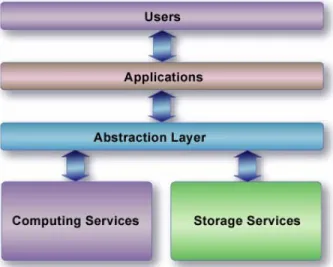
To provide this flexibility, the service-oriented infrastructure eliminates the need to directly bind storage and computing resources to applications. Instead, storage and computing resources are available as virtualized services. Essentially, this means that resources have a common interface that makes a cluster of servers or storage arrays appear to the application or server as a single system. An abstraction layer provides the connection between the virtualized services and the applications. (See Figure 2.)
When an application requests storage or computing services, the abstraction layer provides the intelligence to route that request to the appropriate server or storage device. For example, if a database application requests processing power, the abstraction layer identifies a server that is running the appropriate operating system and has the available resources to fulfill that request and then directs the request to that server. Because it can allocate and release resources as needed, the abstraction layer enables true resource pooling, which increases both efficiency and utilization. The
organization requires fewer storage and computing resources, decreasing both capital asset and management costs.
Figure 2: Service-oriented infrastructure
Establishing Standards to Decrease Costs
The service-oriented infrastructure requires organizations to standardize their environment—moving from a highly heterogeneous environment to a more homogeneous environment. The more standardized the environment becomes, the more adaptable it is and the easier it is to manage. Organizations no longer need to hire or train IT staff to manage multiple operating systems and diverse technologies. Instead, the IT staff can focus on a core set of technologies, reducing management costs and driving down TCO.
The IT staff freed up by the more efficient infrastructure can be redirected to high-value activities such as application development and deployment—activities that directly affect business processes and the organization’s ability to generate revenue.
In addition to reducing management costs, the service-oriented infrastructure enables organizations to create a more secure and reliable environment. Because the new infrastructure is built on standardized technologies, it is easier to establish security policies and apply them uniformly across the entire data center. The new infrastructure is more reliable because the pooled services can provide failover capabilities.
Starting on the Roadmap to the Data Center of the Future
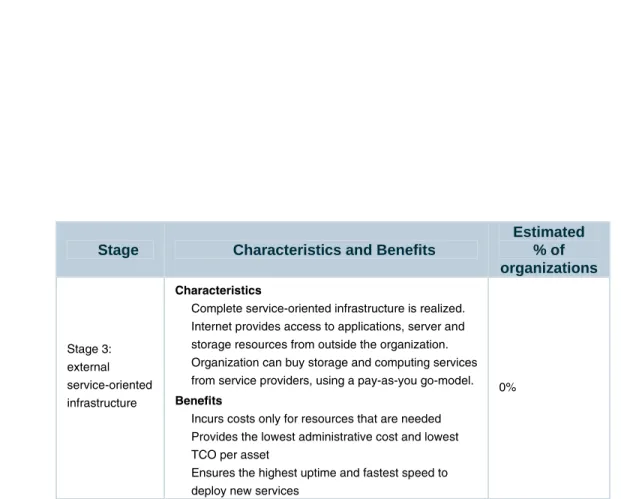
Based on Cisco’s own experience in transforming its data center, IBSG has identified four stages in the roadmap to implementing a service-oriented infrastructure. The characteristics and benefits of each stage are summarized in the following table:
Stage Characteristics and Benefits
Estimated % of organizations Stage 0: distributed data center Characteristics
Data center of the past. Applications drive infrastructure.
Business units make independent investments in applications and associated infrastructure.
Heterogeneous technologies are not easily integrated and difficult to manage and scale.
TCO is very high, and utilization is low.
70–80%
Stage 1: standardized data center
Characteristics
Organization creates standards.
Standardized assets are logically centralized, which leads to physical consolidation of assets.
Infrastructure begins to drive applications.
Benefits
Reduces assets, lowers costs and frees up office space
Simplifies environment, reduces redundancy, and decreases management, training and vendor costs Increases uptime
Provides payback in less than 12 months, on average
10–20% Stage 2: internal service-oriented infrastructure Characteristics
Abstraction layer is implemented; data center assets become pooled internal resources.
Server resources are virtualized.
Storage resources are becoming virtualized.
Benefits
Increases utilization of resources Reduces capital asset costs Decreases TCO and training costs Increases uptime and improves scalability Speeds up deployment of new services
Stage Characteristics and Benefits
Estimated % of organizations
Stage 3: external service-oriented infrastructure
Characteristics
Complete service-oriented infrastructure is realized. Internet provides access to applications, server and storage resources from outside the organization. Organization can buy storage and computing services from service providers, using a pay-as-you go-model.
Benefits
Incurs costs only for resources that are needed Provides the lowest administrative cost and lowest TCO per asset
Ensures the highest uptime and fastest speed to deploy new services
0%
It is important to note that all of the technologies required to implement stage 3 are not yet available. However, Cisco IBSG expects that the enabling technologies—which are required to overcome the remaining barriers of speed and quality of service over the Internet—will be developed in the next few years. (See Figure 3.)
Proving the Business Value
Cisco has experienced firsthand the benefits of implementing the service-oriented infrastructure. The company recently transitioned its storage resources from stage 1 to stage 2. Storage utilization is now 47 percent (compared to the industry average of 25 percent), and Cisco has saved approximately US$225M. Other benefits include higher availability and lower maintenance costs.
Cisco is in the process of moving its computing resources from stage 0 to stage 1. Cisco started the process with 5,501 servers, or one server for every seven employees. By standardizing the operating system alone, Cisco expects to save approximately US$17M. By standardizing the server environment to a small-box, Intel-based architecture, Cisco anticipates saving nearly 450 percent in total capital and operational costs.
As Cisco standardizes its environment, it will also benefit from centralized
management of the data center. For example, the IT department will be able to make configuration changes and updates remotely across the network.
There are numerous examples of other companies that have started the transition to a service-oriented infrastructure. Although these companies are at various stages in the roadmap to a service-oriented infrastructure, they have all achieved significant results.
British Telecom (BT), for example, moved from stage 0 to stage 1 by consolidating
and standardizing from more than 100 servers with multiple operating systems to six servers with one operating system. BT recouped its investment in only 18 months. Availability levels exceeded expectations, and failover improved from one hour to five minutes.5
Continental Airlines moved from stage 0 to stage 1, with substantial results: The
payback period was less than one year with a return on investment (ROI) greater than 100 percent. In addition to a one-time cost savings of several million dollars, the airline achieved a recurring savings of more than US$1M per annum. On top of these financial returns, application performance increased 30–50 percent.6
QUALCOMM moved from stage 1 to stage 2 and increased server utilization from 5
percent to nearly 100 percent. The company consolidated servers by a 30-to-one ratio, reduced data center space by a 20-to-one ratio and reduced equipment costs by
AIG Technologies moved from stage 1 to stage 2 and cut server-provisioning time in half (from 6 hours to 3 hours) while substantially increasing server utilization. AIG also consolidated servers by a 20-to-one ratio and reduced rack space by a ratio of eight-to-one.8
Adoption Requires a Change in Focus
Although the rewards are substantial, implementing a service-oriented infrastructure is not without its challenges. It requires a complete shift in the way the organization views the data center. For example, rather than thinking of the data center in terms of asset management, the IT staff must approach it as a service provider. The staff must view the data center as a set of services with associated service level agreements, and the goal must be to implement those services at the lowest possible cost while maintaining high availability and tight security.
Business units, on the other hand, must relinquish their control over applications, storage resources and computing resources and rely on the IT staff to provide the services they need.
The following are guidelines for helping organizations make this transition:
Overcome resistance to change—The biggest obstacle to implementing a
service-oriented infrastructure is people’s innate tendency to resist change. Overcoming this resistance is critical for success. Communication and change management can reduce resistance and accelerate the transition to the new data center infrastructure.
Determine the standards—Standardizing the infrastructure is not a trivial task. To
determine the standards, organizations must analyze data center technologies and the needs of business units. In many cases, an organization’s de facto standard—what is used in 70–75 percent of the environment—should become the official standard.
Standardize—Organizations must adjust capital investments to adhere to the chosen
standards. To implement these standards, organizations may need to make an upfront capital investment or change the process of choosing applications and purchasing hardware and software. This will affect not only the business units but also the software and hardware vendors.
Reallocate resources—Implementing the service-oriented infrastructure may require significant restructuring of both assets and people. Organizations must decide how to reallocate the people and the assets that have been freed up. After these decisions are made, the payback is relatively rapid.
Set a reasonable pace—Organizations do not have to transition to a service-oriented
infrastructure immediately. They can retain—at least temporarily—some legacy applications and technologies. However, organizations must ensure that from this point forward, they adopt only technologies that meet the new standards.
Engaging Cisco IBSG Services
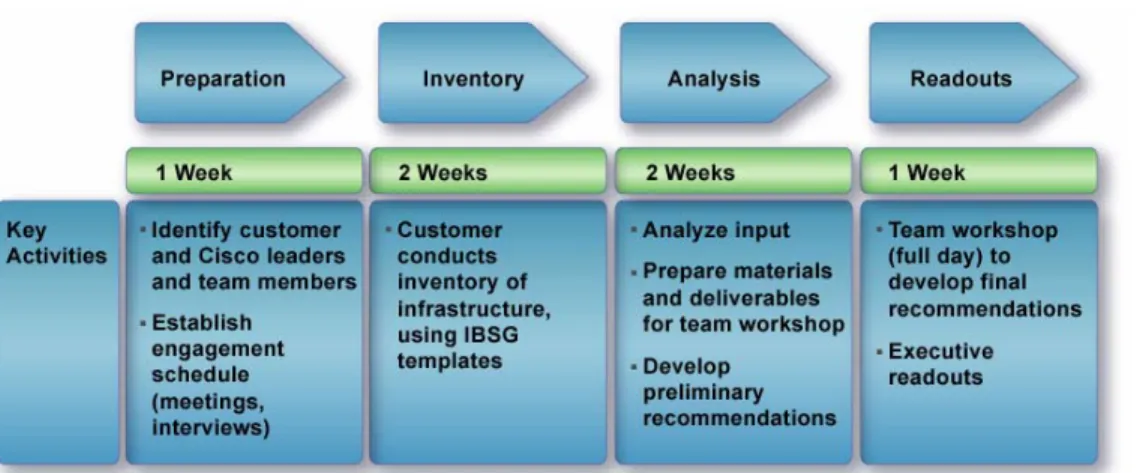
If organizations need help in making the transition to a service-oriented infrastructure, IBSG can provide the expertise they need. IBSG helps customers apply advanced technologies to automate their business processes and transform their organization. IBSG consultants partner with organizations over a six-week period to identify consolidation opportunities (which reduce short-term and long-term costs in the IT infrastructure) and to produce a high-level technology assessment with an associated roadmap of priorities and estimated savings. (See Figure 4.) The outcome of this engagement will help organizations identify the best opportunities for applying these concepts and allow them to begin their journey toward the data center of the future.
Resources
1
Drew Robb, “The Data Center of the Future,” CIO Update, Dec. 16, 2003
(http://www.cioupdate.com/trends/article.php/3289721)
2
Fortune Global 500 list, Fortune Magazine, 2004
3
Robb, “Data Center of the Future”
4
Robb, “Data Center of the Future”
5
Sun Server Consolidation Case Study: British Telecom, D.H. Brown Associates, Inc., Jan. 2002 (http://www.sun.com/datacenter/consolidation/docs/britishtelecom.pdf)
6
Product and Solution Information: Mastering the Business of Intelligence, Hewlett-Packard, 2003 (http://h71028.www7.hp.com/ERC/downloads/uploads_casestudy_business_intel_
brochure.pdf)
7
QUALCOMM Lowers TCO Using VMware ESX Server, Vmware (an EMC Corp.), 2003 (http://www.vmware.com/pdf/qualcomm.pdf)
8
AIG Technologies Uses VMware ESX Server to Boost ROI, Enhance Business Response, Vmware (an EMC Corp.), 2003 (http://www.vmware.com/pdf/aig.pdf)