Mechanical and Aeronautical Engineering
Hand Book
Contents
1.0 Introduction...1
2.0 Being a Student...1
2.1 Introduction...1
2.2 Self-reliance ...1
2.3 Professionalism ...1
3.0 Advisors...2
3.1 Introduction...2
3.2 Advisor - Student Relationship...2
3.3 What is the Advisor's Responsibility? ...2
3.4 What is the Student’s Responsibility? ...2
4.0 Program Objectives & Outcomes...3
4.1 Introduction...3
4.2 Program Objectives...3
4.3 Program Outcomes...3
5.0 Curricula...5
5.1 Introduction...5
5.2 Standard AE & ME Requirements...5
Internal Transfer Exceptions...….8
5.3 Minors and Concentrations ...9
Manufacturing Engineering Certificate Required Courses...….10
5.4 Honors Program ...10
Tables 5 and 6 Curricula Sheets Table 5.1a Aeronautical Engineering Curriculum Class 2007, 2008 and 2009………..13
Table 5.1b Aeronautical Engineering Audit Sheet Class 2007, 2008 and 2009………14
Table 5.2a Mechanical Engineering Curriculum Class 2007, 2008 and 2009………15
Table 5.2b Mechanical Engineering Audit Sheet Class 2007, 2008 and 2009……….…16
Table 5.3a Aeronautical Engineering Curriculum Class 2010 and Later………17
Table 5.3b Aeronautical Engineering Audit Sheet Class 2010 and Later ………18
Table 5.4a Mechanical Engineering Curriculum Class 2010 and Later ………19
Table 5.4b Mechanical Engineering Audit Sheet Class 2010 and Later ……….……20
Table 5.5 Manufacturing Engr. Cert. Mech. Engr. Curriculum Class 2007, 2008 and 2009.….21 Table 5.6 Manufacturing Engr. Cert. Mech. Engr. Curriculum Class 2010 and Later….………22
Table 5.7 Aeronautical Engr. Curriculum Honors Program Class 2007, 2008 and 2009 ...23
Table 5.8 Mechanical Engr. Curriculum Honors Program Class 2007, 2008 and 2009………24
Table 5.9 Aeronautical Engineering Curriculum Honors Program Class 2010 and Later ...25
Table 6.0 Mechanical Engineering Curriculum Honors Program Class 2010 and Later ...26
Table 6.1 Double Major Aeronautical/Mechanical Eng. Curriculum 2007, 2008 and 2009...27
Table 6.2 Double Major Aeronautical/Mechanical Eng. Curriculum 2010 and Later ...28
6.0 Other Programs...29
6.1 Dual Degree ...29
6.2 Second Degree ...29
6.3 Double Majors ...29
6.4 Engineering MBA – MS 4 + 1 Program ...30
6.5 Changing Majors...30
6.6 Pre-PT ...30
7.2 Professional Engineering Exam...31
8.0 Career Planning...31
8.1 Career Development Center...31
8.2 Cooperative Education Program ...31
8.3 Cross-Registration ...31
8.4 Undergraduate Research & Directed Study...32
8.5 Study Abroad program...32
8.6 Student Academic Records ...32
9.0 Societies & Activities...32
9.1 Professional Societies ...32
9.2 Honor Societies...33
9.3 Activities ...33
9.4 Awards ...33
10.0 Clarkson Services...34
10.1 Student Administrative Services...34
10.2 Student Development Courses...34
10.3 Local Activities...34
11.0 References...35
12.0 Faculty...36
13.0 Affirmative Action Equal Opportunity Policy...38
Appendices A - Foundation Liberal Arts ...39
B - Humanities and Social Sciences Minors ...40
C - Dual Degree...41
D - Double Major ...42
E - Undergraduate Declared Minor Form ...43
F - Undergraduate Change of Major ...44
G - Off Campus Coursework ...45
H - MP Course Approval ...47
I - Cross Registration ...48
J - Manufacturing Concentration...50
K - Pre-PT Program ...51
1.0 Introduction
You will find herein information about the academic advisors, the curriculum, Clarkson services, special programs, and advice about career planning. If the information you need is not in this document, or if you require more detailed information, consult the references listed at the end. If these sources lack the answer you are looking for, see your advisor.
This handbook will be revised from time-to-time to keep pace with changes in the Department. Curricular requirements may change between revisions. Thus the handbook may not always contain the completely current curricular information. Therefore, the curricular information herein does not generally guarantee that a particular course will be taught.
2.0 Being a Student
2.1 IntroductionYou may have already heard from friends, family members, or guidance counselors that you will experience a different form of education when you enter college; it is not like high school. Now, that doesn't imply that you should be apprehensive about college, but it does imply that you should keep your eyes open to the new environment and learn to adjust.
2.2 Self-reliance
During the next four years you will find yourself gaining more and more self-reliance. But self-reliance doesn't mean that you have to do everything yourself; it does mean that you ask for help when you need it and stand on your own two feet when you don't. Developing self-reliance should be one of your goals in college.
2.3 Professionalism
One adjustment to college is to think of yourself as a student - professional; a student who will soon be a professional engineer. Like any professional position, there are certain expectations that you must fulfill. The best way to meet these expectations is to keep on top of things; don't let yourself fall behind. Also, go to classes prepared; have all your work and reading done, and have questions ready. Participate in the discussions, practice the problems the professors assign, and push yourself to do your best. You are building the base for your professional career; build a strong base.
The professors do not cover everything that you must know in class; they expect that you will study beyond the lecture. You will find that the professors are more like guides, and you have to play the teacher as well as the student more than you had to in high school. By forcing you to play a stronger role in your education, they are preparing you for the professional world where there are no obvious teachers.
In your senior year you will participate in a two-semester, capstone design course. In this course you will collaborate with other students in a project team. Working in this way is typical of professional life. Learn well how to do it.
Near the end of each semester each professor will give you a "course evaluation form" to fill out. The comments you make regarding the course and the professor are taken seriously. The professors' salaries, tenure, and promotion are influenced by the information on this form, and it is important that you are objective and professional in filling out these forms.
3.0 Advisors
3.1 IntroductionEach student has been assigned an academic faculty advisor from the MAE Department. The advisor-advisee lists with a picture of each MAE faculty member are displayed in the Center for Advanced Materials Processing (CAMP) adjacent to Room 253.
You may wish to change your advisor, perhaps because you have developed career interests that overlap those of another member of the MAE faculty, or for other reasons. To make a change, go to the Mechanical and Aeronautical Engineering Department office in room 253 CAMP. Request a new advisor from the secretary there. There is no need to inform your original advisor.
3.2 Advisor - Student Relationship
Visit your advisor as often as you need and do it more frequently than once a semester. This will make the advising process easier and more productive. For example, your advisor will be able to write more effective employment or other recommendations for you. So, call and schedule a meeting. 3.3 What is the Advisor's Responsibility?
The advisor’s help may include career advice or help in choosing courses. Advisor’s will meet with each of their advisees during the course selection period. They prepare for these
meetings by knowing the curriculum well. That means knowing substitute courses, course options available, and the best course for a certain area of interest. Finally, the advisor must know you, the student. Knowing your goals and interests will help them to suggest courses that suit you. After discussing your curriculum, the advisor will sign your Course Enrollment Worksheet and release your advisor hold on PeopleSoft. The advisor usually establishes special office hours for course selections and post signup sheets outside there offices.
3.4 What is the Student's Responsibility?
The student, not the advisor, is responsible for meeting Clarkson’s graduation requirements. If you have not met the graduation requirements, you will not graduate, regardless of the advice
you have received. Therefore, know the requirements and begin now to plan your Clarkson career.
Then you can go into the course selection meeting with your choices for classes pre-selected. Details and problems can then be ironed out during your visit. Students should prepare for these meetings by reviewing their current transcript on the PeopleSoft database and printing a curriculum sheet for their class year off of the MAE Website. Students should be aware of the courses they have taken and need to take. Master Schedules of course offerings are available on the Student Administrative Services (SAS) Website www.clarkson.edu/sas/master/index.html prior to the course selection period.
4.0 Program Objectives and Outcomes
4.1 IntroductionThis section describes the objectives, and the outcomes supporting those objectives, for the Mechanical Engineering (ME) and Aeronautical Engineering (AE) degree programs of the MAE Department.
4.2 Program Objectives
There are three program objectives for both the AE and ME programs.
4.2.1 AE.
1. Graduates will competently apply engineering methods to solve professional problems associated with the design, manufacture, and maintenance of aircraft and related systems and they will understand the social, ethical, and environmental context of their work.
2. Graduates will communicate clearly, collaborate competently in teams, and assume leadership roles.
3. Graduates will have the habit of continuous professional development.
4.2.2 ME.
1. Graduates will competently apply engineering methods to solve professional problems associated with the design, manufacture, and maintenance of mechanical systems and they will understand the social, ethical, and environmental context of their work.
Objectives 2 and 3 are the same as in the AE program.
4.3 Program Outcomes
4.3.1 Introduction. The program outcomes are the generic abilities that graduates will demonstrate that they have acquired. Acquisition of competence in these abilities shows that a graduate has met the program objective that applies to her or his program. The defining characteristics of professional problems and the process used to solve them lead directly to these generic program outcomes. Although the generic abilities to be acquired are the same for the AE and ME degrees, the technical content of the programs of course differ, as section 4.2 implies.
A professional problem is vaguely defined compared to the information necessary to solve it. Its clarification depends, however, upon proposing solutions. Some of the requirements its solution must meet may be in conflict, therefore no solution can satisfy all of them. A solution will be complex, requiring utilization and synthesis of knowledge from several fields, or requiring the discovery of new knowledge. Hence, collaboration and study will be necessary. There will be a range of possible solutions, but no unique solution: the problems are "open-ended." This is their quintessential characteristic.
“Competence,” used to characterize the acceptable performance level of certain outcomes, means sufficient ability to perform the task, unaided by the instructor, at the level of the course. This "sufficient ability" rises to the entry professional level in the required, senior-year courses.
4.3.2 Outcomes List. A brief explanatory paragraph follows each outcome. The AE and ME curricula have been designed to support these outcomes. The curricula are discussed in section 5.0. 1. Competence in employing the solution process to solve professional problems.
The solution process is a sequence of choices used to solve professional problems of any type. It has identifiable stages: problem statement, specification, concept generation, concept selection, develop details, plan, construct, test. At each state, collaborators substitute assumptions for incomplete knowledge. These assumptions may lead to incorrect choices; hence the process is iterative. Mathematical models are constructed as aids in making decisions. The solution process is explicitly taught in the design curriculum. It is examined and exercised in the engineering science courses. However, it is also encountered in other places, such as in the liberal arts. Here however, “construct and test” might be replaced by “write (or paint or sculpt or compose) and be reviewed by critics.” 2.Competence in transforming a physical system into a mathematical model, using a combination of scientific knowledge, physical intuition, and mathematical techniques, and in extracting meaning from that model by numeric or analytic solutions, approximation, or estimation, to evaluate a proposed solution or make a decision.
This outcome is the justification for the basic science, mathematics, and engineering science courses in our curriculum. These courses provide the necessary insight into mathematical modeling of engineering processes or devices. A mathematical model is a mathematical description of a device or process. It is used to predict the performance of the device or process. For example, the model might predict under what loading a device would fail or it might predict how much energy a process consumes. Model-making requires integration of knowledge of the physics of the device or process and mathematical skill. The practitioner must also understand the errors a model introduces and the decision limits they imply. Every technical course provides opportunities for modeling experience.
3.Clear communication in written, oral, and graphical form.
Communication in a team going through the solution process means discussing design and analysis choices, writing technical specifications, reporting calculations, keeping clear and complete records, and finally making drawings of the design that contains the information necessary to build it. Communication also includes written and oral reports, essays, presentation graphics and the like. All components of the curricula support this outcome in some fashion.
4.Competence in collaboration with individuals of differing backgrounds.
The complexity of professional problems forces collaboration, i.e., teamwork. However, students have different schedules, different priorities, are accustomed to working at their own pace, and have different levels of knowledge and maturity, and commitment to a particular project. Overcoming these obstacles and learning to work together competently requires time and experience. The laboratory and design courses explicitly provide this experience.
5. A competent understanding of the interaction of a proposed solution with the social, economic,
The interactions of the device being designed with the social, economic, man-made, and natural environments enters forcefully and specifically into the solution process: these interactions shape the solution. Consequently, they appear in design specifications. Some are encountered in other technical courses in the form of boundary and initial conditions. Awareness of the political, social, economic, and environmental context of their work from a philosophical perspective is important. The “context” in this case has a temporal meaning, too: an historical context. This context gives additional insight into the effect a proposed solution might have. The liberal arts and business requirements of the curriculum provide opportunities to gain a broader and deeper understanding in this area.
6. Instill the habit of continued learning so, as professionals, graduates will prepare themselves to
solve new or more difficult problems.
Solving professional problems usually requires acquisition of knowledge new to the solvers, at least. Also, new ideas are constantly being generated as technology advances. Global competition forces companies to be flexible. Therefore they look for employees who are flexible and can move between projects with a minimum of retraining. Thus, an employee must adopt a policy of continuous learning to avoid obsolescence. Opportunities to acquire this habit exist in every course.
5.0 Curricula
5.1 IntroductionThe instruction and experience built into the AE and ME curricula are the means by which students acquire competence in the abilities described by the program outcomes. Course descriptions may be found at www.clarkson.edu/sas/master/index.html.
5.2 Standard AE and ME Requirements
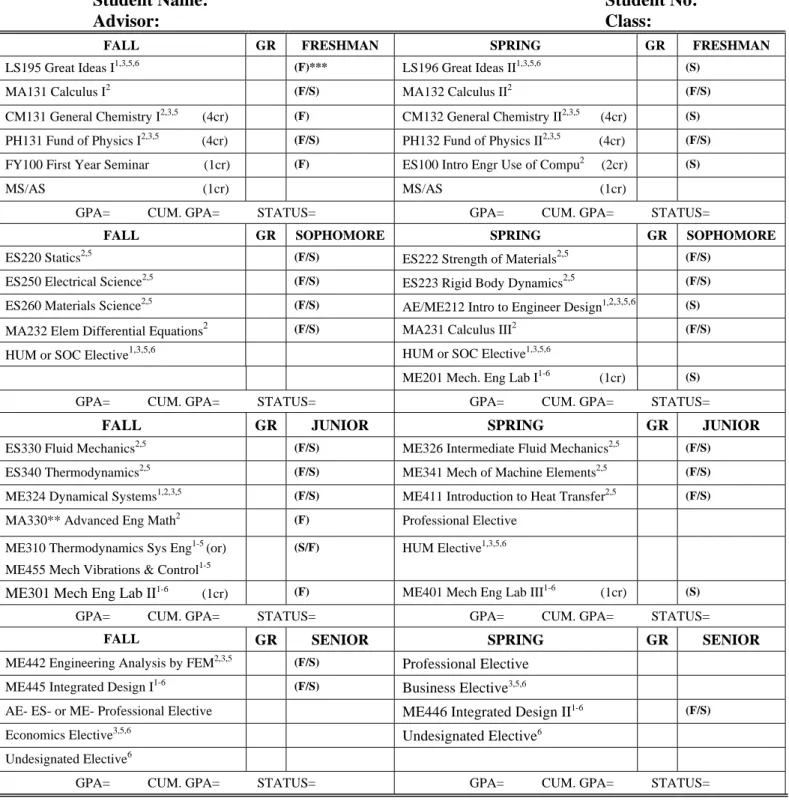
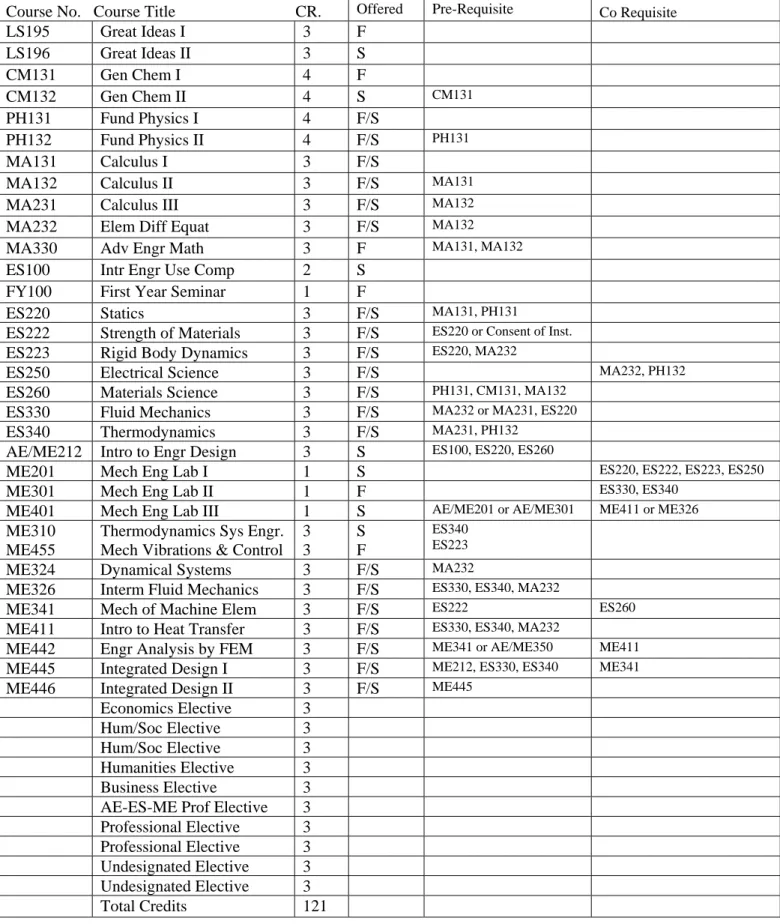
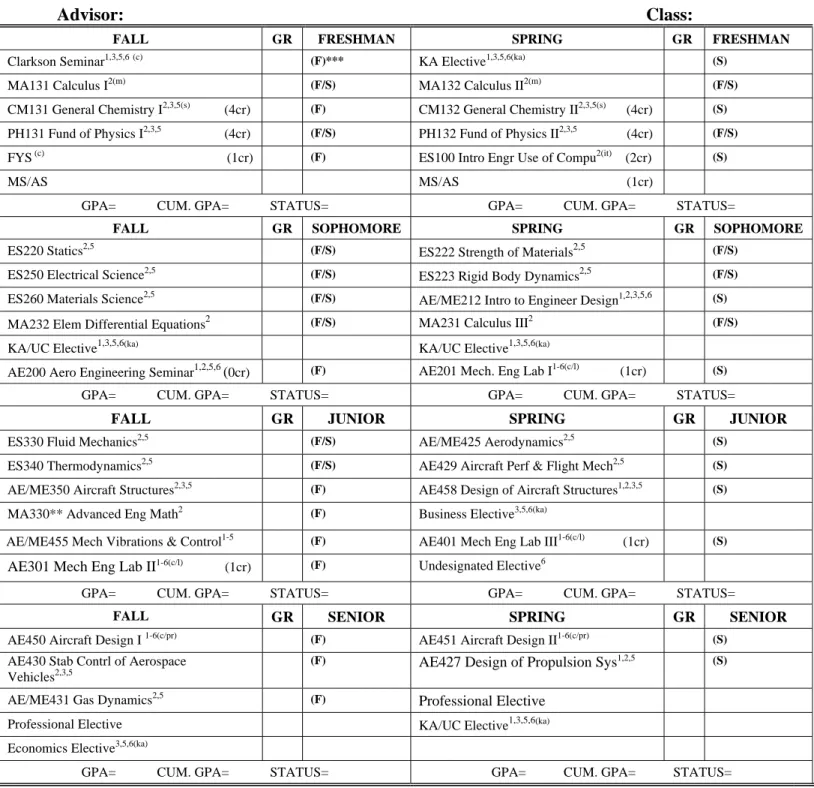
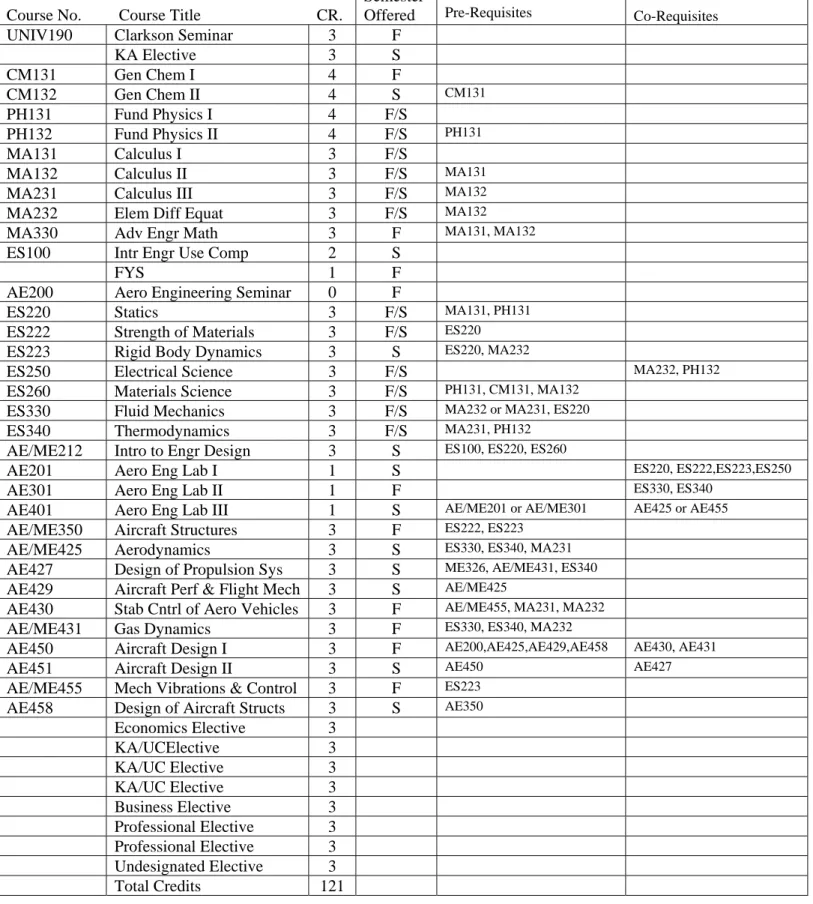
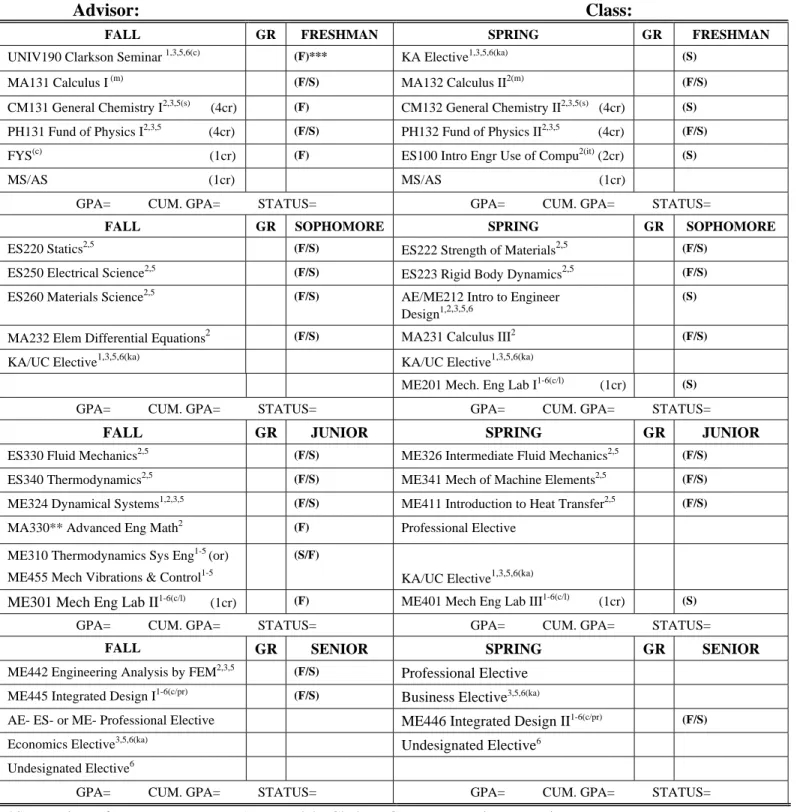
5.2.1 AE and ME Curricula. To graduate, a student must accumulate at least 120 credit hours (cr) and have a minimum cumulative total grade point average of 2.000. The credits are distributed for each degree program and graduation year as follows: Tables 5.1a and 5.1b show the standard AE curriculum for the classes of 2007, 2008 and 2009. Tables 5.2a and 5.2b show the standard ME curriculum for the classes of 2007, 2008 and 2009. Tables 5.3a and 5.3b show the standard AE curriculum for the class of 2010. Tables 5.4a and 5.4b show the standard ME curriculum for the class of 2010.
5.2.2 Common Experience Curriculum. There are a total of five courses which must be taken to cover six knowledge areas. At least one of these courses must be a University course. University courses are interdisciplinary courses that cover two or more knowledge areas. One of the knowledge area electives must be an economics course, EC350 is recommended. This impacts on the selection of Liberal Arts courses for the classes of 2010 and later. The equivalent course requirements for the classes of 2007, 2008 and 2009 are the 18 credits of Liberal Arts courses listed on the next page.
5.2.3 Mathematics Requirement. The required mathematics sequence consists of MA131, MA132, MA232, MA231 and MA330, with the exception that the combination of MA331 and MA383 can substitute for MA330. Students pursuing a Minor in Mathematics should take the combination of MA331 and MA383 to satisfy this requirement. Students interested in pursuing graduate studies in engineering are also strongly encouraged to take MA331 and MA383 to satisfy this requirement. MA330 is not open to students who have taken or are taking MA331 or MA383.
5.2.4 Liberal Arts Requirement (18 credits)
General Rules. Students must complete 12 Foundation Liberal Arts (FLA) credits beyond the “Great Ideas” sequence, LS195 and LS196. Each student must devise a study program to use these courses to broaden and deepen her or his understanding of the interaction of professional engineering methods and solutions with the social, economic, and man-made and natural environment. One of the program’s courses must be an economics course and one must be a humanities course (HUM designator). Each of the other two may be either a humanities course, or a social sciences course (SOC designator), or an interdisciplinary humanities – social sciences course (H/S designator).
Alternate Methods. A student may satisfy the FLA requirement by registering a study program with the MAE Department using Appendix A, or by registering for a minor in the Department of Humanities and Social Sciences (H&SS) using Appendix B. Either must be done prior to the fall semester of the student’s sophomore year.
MAE Program. Complete Appendix A and bring it to the Mechanical and Aeronautical Engineering Department office (253 CAMP). Examples of possible programs follow.
One might choose to study “Professional Ethics” because ethical choices influence the professional problem-solving process. A possible set of courses might then be:
LP240 Contemporary Moral Issues (HUM); LP210 Law, Rights, and Justice (H/S); LP341 Professional Ethics (HUM).
A study program in “Capitalism and the Environment” might be:
LP342 Environmental Ethics (HUM);
LP343 Environmental Literature and Policy (H/S); LC225 Environment, Technology, and Society (SOC).
One could go further and take EC150 Principles of Microeconomics (or EC350 Principles of Micro and Engineering Economics) as the economics elective. EC360 Environmental Economics, for which either EC150 or EC350 are prerequisites, could then be taken as an undesignated elective.
A program called “The Solution Process in the Humanities” might be:
LF205 Painting and Drawing (HUM); LF365 Creative Writing I (HUM); LF340 The Modern Novel (HUM).
Finally, a program called “Science and Society” might be:
LC385 History of Modern Science (SOC);
LC225 Environment, Technology, and Society (SOC); LF320 Imagining Science (HUM).
The preceding examples illustrate the flexibility students have in designing a study program. Note that the economics course may not always be directly connected to the program. Also, a program will be constrained by the courses available during a student’s tenure. This limitation can be ameliorated by taking courses elsewhere, such as by cross-registration at one of the Associated Colleges of the St. Lawrence.
H&SS Minor. An H&SS minor consists of a coherent set of five courses, three of which must be taken at Clarkson, and completion of a “Minors Portfolio.” Students may choose a “Thematic Minor,” a “Disciplinary Minor,” or a “Student-Designed” minor. Thematic minors are interdisciplinary and consist of related humanities and social sciences courses addressing a common theme. The courses of a disciplinary minor must be within one of the disciplinary areas of the H&SS Department. A student-selected minor must be proposed to and approved by the Division of Liberal Arts.
Additional details may be obtained from the Division of Liberal Arts or the Mechanical and Aeronautical Engineering Department office.
5.2.4 Course in the School of Business (3 credits). This may be any course bearing a "business" (BUS) designator.
5.2.5 Professional Electives – (AE 6 credits – ME 9 credits).
The two AE-program professional electives and two of the three ME program electives may be MAE elective courses, courses offered by other engineering departments, by the Mathematics and Computer Science, Physics, and Chemistry departments, by the School of Business, or a three-credit multi-disciplinary (MP) project course, as long as they meet requirements (1) – (4), below. The remaining ME program elective must be at least a 300-level AE, ES, or ME course.
(1) They are of a technical nature such that they strengthen the engineering background of the student. The management courses that satisfy this requirement are listed below:
OM331 Operations/Production Management, OM476 Management of Technology, OM485 Quality System Management, IS400 Development of Business Applications on the Internet
Use Appendix H to get an MP3xx course approved for meeting graduation requirements.
(2) They do not contain material which is a duplication of material covered in previously taken courses or which will be covered in a required course;
(3) They are advanced level courses (300 or above);
(4) They have received prior approval from the student's academic advisor. The fundamental criteria for approval shall be that the courses be consistent with the student's professional objective and academic program, and otherwise meet the foregoing criteria.
Students are advised to complete a plan for their professional electives no later than the fall of their junior year.
Any exception to these policies governing professional electives must be approved in writing by the department Chair or Executive Officer.
5.2.6 Undesignated Electives (AE 3 credits, ME 6 credits). An undesignated elective may be any course which does not contain a significant amount of material already covered in a student's program. MP xxx, 3-credit courses may be used as undesignated electives: follow the instructions in paragraph 5.2.5(1), above. Only undesignated electives may be taken "pass or no entry."
5.2.7 Non-Credit Bearing Requirements.
Freshman Seminar. Students should complete the Freshman Seminar course (FY100) during their freshman year, but in any case prior to graduation. This requirement will be waived for students who are granted at least 25 credits when they transfer to Clarkson.
Aeronautical Engineering Seminar. This seminar will introduce aerodynamic and structural concepts and terminology, principles of flight and propulsion systems, and recent advances in related areas. The seminar will draw on the MAE faculty, the AE-related expertise of active pilots, visitors from industry and universities, and senior AE students with experience in design, build, fly, and competition. It will be lively and interactive. Field trips and films will be included.
5.2.8 Special Notes for Both Degrees
Replacement Courses. For students transferring to the MAE department, blanket exceptions have been granted for the courses below:
Internal Transfer Exceptions ES100 with CS141, EM120 and 121
ES250 with EE322 ES260 with ME290 ES330 with CH301
ES340 with ES448, CH271 AE/ME212 with CE212 ME411 with CH302
CM131 with CM103 and CM105 CM132 with CM104 and CM106
Replacement courses cannot be used to remove "F" grades.
Pass No-Entry. The only courses in either the ME or the AE curriculum that can currently be taken on a pass or no-entry basis are undesignated electives. Approval must be obtained using a form from Student Administrative Services (SAS). The SAS office will convert the instructor's letter grade
to Pass (P). A grade of C or better will be considered passing. In the case of non-pass, the course will not appear on your transcript. ROTC (Army and Air Force) students are not permitted to enroll in MS or AS courses on a pass or no-entry basis. Consult the Clarkson Regulations for more information on pass or no-entry.
Independent Study. Students may have a special interest within the field of Mechanical or Aeronautical Engineering that they would like to study. This can be done by arranging for a professor to advise the study and registering for one of the independent study course numbers (AE/ME365, AE/ME366, AE/ME367, AE/ME465, AE/ME466) using a special section number that the course advisor will give you.
AE/ME212. Engineering students transferring at least 54 credits from another institution who do not receive transfer credit for AE/ME212 may substitute an advanced design course for AE/ME212. The course substituted for AE/ME212 may not be used to satisfy other design requirements.
Retaking MA131 and PH 131. Freshmen students who receive a grade of D+ or D in MA131 Calculus I or PHY 131 Fundamentals of Physics I in the Fall semester should consider repeating these courses the following spring and should discuss this with their advisors. Note that MA 132 (MA131) is a co-requisite for PH132 (PH131). Thus PH 132 cannot be taken when repeating MA131, even if PH 131 has been passed.
AE and ME Labs. The 200-level courses will be taken in the spring by sophomores, the 300-level courses in the fall by juniors, and the 400-300-level courses in the spring by juniors.
5.3Minors, Concentrations
5.3.1Minors. To complement and enrich their degree programs, students may complete course work in designated minor programs. Minors enable students to specialize in a separate and identifiable field outside their major. Minors require at least 15 hours of relevant course work, including at least 6 credit hours taken outside the student’s major field. Completion of an approved minor will be entered on a student’s transcript. AE and ME students find that completing a minor in mathematics is straightforward. As noted in section 5.2.2, students pursuing a Minor in Mathematics should take the combination of MA331 and MA383 to substitute for MA330. MA330 is not open to students who have taken or are taking MA331 or MA383. Four courses on the list from which they may choose are part of the AE and ME Programs. The Catalog lists available minors.
Students may also complete professional concentrations. These are areas of specialization within a major field. Professional concentrations require at least 15 credit hours of relevant course work. Completion of an approved professional concentration will be entered on a student’s transcript. The Catalog lists the available professional concentrations. Two are offered by the MAE Department; see section 5.3.2 and 5.3.3.
5.3.2 Manufacturing Engineering Concentration. The Mechanical and Aeronautical Engineering Department has a Professional Concentration in Manufacturing Engineering. Its requirements are set out in the list below. Interested students must fill out an application form (Appendix J) available from the Mechanical and Aeronautical Engineering Department office.
Course changes to the Manufacturing Engineering concentration requirements must be approved by the Mechanical and Aeronautical Engineering Department chair or executive officer.
Manufacturing Engineering Certificate Required Courses ES260 MA383 OM331 ME390 OM485 Materials Science
Applied Statistics I or MA330 Advanced Engineering Mathematics Operations/Production Management
Manufacturing Processes Quality Management
Elective Courses – Three Required ES351 ES357 ES360 ES365 ES405 ME393 Materials Characterization Laboratory Microelectronic Circuit Fabrication
Materials Science and Engr. II Polymer Materials
Design of Experiments and Analysis of Data
Analyses of Materials Processing
Fundamentals of Robotics
ME399 ME444 ME457 ME490 ME492 Computer-aided Manufacturing (CAM) Computer-aided Engineering Composite Mechanics and Design Mechanical Behavior of Materials Welding Metallurgy
Tables 5.5 and 5.6 suggest plans for earning a Manufacturing Engineering certificate.
Some management courses that are required for the Manufacturing Engineering Concentration (Production Management and Quality Management) have MA383 as a prerequisite. The School of Business will accept MA330 instead of MA383 for entry into their courses.
5.3.3 Materials Engineering Concentration. Clarkson University offers a professional concentration in Materials Engineering. A brochure describing this program may be obtained in the Mechanical and Aeronautical Engineering Department office.
5.4. Honors Program
For the University Honors Program (HP), the foundation computer requirement has been replaced with an Honors computer course and the “course in every school” requirement with a second year project course, Honors students have been placed in specially designed sections of LS196, the Honors science seminar and the Honors thesis are used for the undesignated electives, and one professional elective, and two Liberal Arts seminars fill the six-credit Hum/Soc requirement. The typical student will earn 25 credits in Honors classes.
Students who have been admitted to the program and are pursuing ME or AE majors should work with the Honors Program Director and the MAE department HP advisor (Professor Moosbrugger) on curriculum matters.
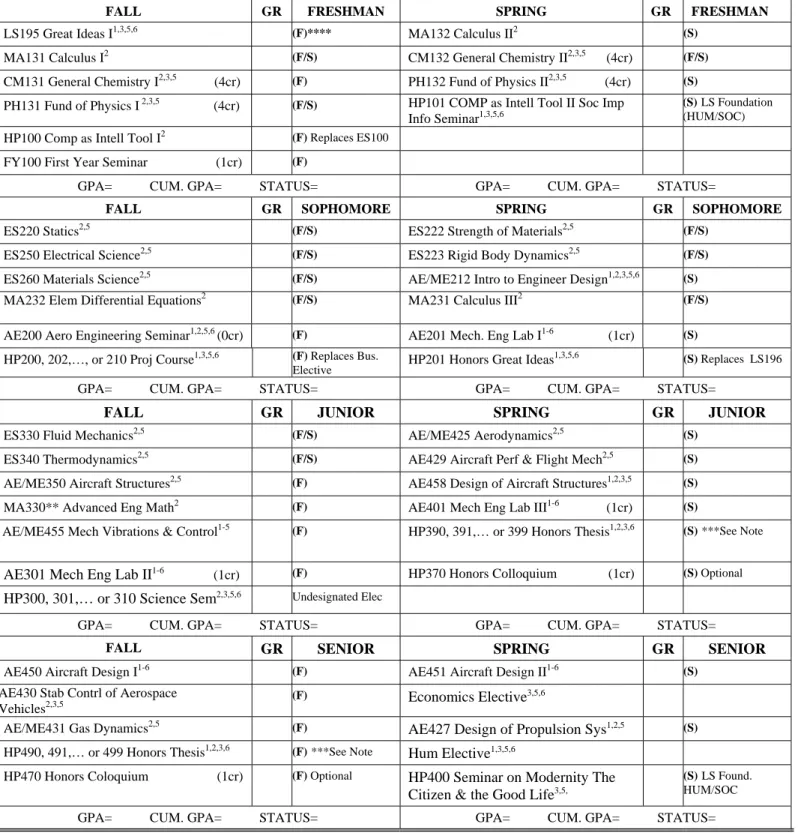
Table 5.7 shows how the Honors Program may be combined with the AE degree program for the classes of 2007, 2008 and 2009 and Table 5.8 shows how the Honors Program may be combined with the ME degree program for the classes of 2007, 2008 and 2009. Table 5.9 shows how the Honors Program may be combined with the AE degree program for the class of 2010 and Table 6.0 shows how the Honors Program may be combined with the ME degree program for the class of 2010.
A student may elect to use her or his honors thesis (HP390…HP399 or HP490…HP491) to replace one or two professional electives in either the aeronautical or the mechanical engineering program. However, to be accepted as meeting our graduation requirements the thesis must at least:
1. Meet the requirements for professional electives given in section 5.2.4; 2. Support program outcomes 1,2,3, and 6 given in section 4.3.2;
3. Be completed (including evaluation) no later than the end of the student’s final semester at Clarkson;
4. Receive an evaluation mark equivalent to at least the minimum passing grade for undergraduates given in the Clarkson Regulations. (Note: a “P” received for an honors thesis is the equivalent of a 3.25.)
5. Students wishing to use an Honors Thesis as a professional elective must submit the form in Appendix L for approval for each of the 300- and 400-level Honors Theses Courses.
Students in the Mechanical Engineering (ME) program are required to have at least one professional elective that bears the “AE,” “ES,” or “ME” designator. The content of an Honors Thesis done for the ME program will be the equivalent to an ES-designated course, at least, and therefore can be used to satisfy this restricted designator requirement.
Tables 5 and 6
Curricula Sheets
Table 5.1a AERONAUTICAL ENGINEERING CURRICULUM CLASSES OF 2007, 2008 AND 2009*
Student Name: Student No: Advisor: Class:
FALL GR FRESHMAN SPRING GR FRESHMAN
LS195 Great Ideas I1,3,5,6 (F)*** LS196 Great Ideas II1,3,5,6 (S)
MA131 Calculus I2 (F/S) MA132 Calculus II2 (F/S)
CM131 General Chemistry I2,3,5 (4cr) (F) CM132 General Chemistry II2,3,5 (4cr) (S)
PH131 Fund of Physics I2,3,5 (4cr) (F/S) PH132 Fund of Physics II2,3,5 (4cr) (F/S)
FY100 First Year Seminar (1cr) (F) ES100 Intro Engr Use of Compu2 (2cr) (S)
MS/AS MS/AS (1cr)
GPA= CUM. GPA= STATUS= GPA= CUM. GPA= STATUS=
FALL GR SOPHOMORE SPRING GR SOPHOMORE
ES220 Statics2,5 (F/S) ES222 Strength of Materials2,5 (F/S)
ES250 Electrical Science2,5 (F/S) ES223 Rigid Body Dynamics2,5 (F/S)
ES260 Materials Science2,5 (F/S) AE/ME212 Intro to Engineer Design1,2,3,5,6 (S)
MA232 Elem Differential Equations2 (F/S) MA231 Calculus III2 (F/S)
HUM or SOC Elective1,3,5,6 HUM Elective1,3,5,6
AE200 Aero Engineering Seminar1,2,5,6 (0cr) (F) AE201 Mech. Eng Lab I1-6 (1cr) (S)
GPA= CUM. GPA= STATUS= GPA= CUM. GPA= STATUS=
FALL GR JUNIOR SPRING GR JUNIOR
ES330 Fluid Mechanics2,5 (F/S) AE/ME425 Aerodynamics2,5 (S)
ES340 Thermodynamics2,5 (F/S) AE429 Aircraft Perf & Flight Mech2,5 (S)
AE/ME350 Aircraft Structures2,3,5 (F) AE458 Design of Aircraft Structures1,2,3,5 (S)
MA330** Advanced Eng Math2 (F) Business Elective3,5,6 AE/ME455 Mech Vibrations & Control1-5 (F) AE401 Mech Eng Lab III1-6 (1cr) (S)
AE301 Mech Eng Lab II1-6
(1cr) (F) Undesignated Elective6
GPA= CUM. GPA= STATUS= GPA= CUM. GPA= STATUS=
FALL GR SENIOR SPRING GR SENIOR
AE450 Aircraft Design I 1-6 (F) AE451 Aircraft Design II1-6 (S)
AE430 Stab Contrl of Aerospace Vehicles2,3,5
(F)
AE427 Design of Propulsion Sys1,2,5 (S)
AE/ME431 Gas Dynamics2,5 (F) Professional Elective
Professional Elective HUM or SOC Elective1,3,5,6 Economics Elective3,5,6
GPA= CUM. GPA= STATUS= GPA= CUM. GPA= STATUS=
*Superscripts refer to outcomes as described in the MAE Student Handbook. **or MA331 and MA383.
***Courses are offered as follows: F – Fall, S – Spring, F/S – Fall and Spring
Table 5.1b AERONAUTICAL ENGINEERING AUDIT SHEET CLASSES OF 2007, 2008 AND 2009
Course No. Course Title CR.
Semester
Offered Pre-Requisites Co-Requisites
LS195 Great Ideas I 3 F LS196 Great Ideas II 3 S CM131 Gen Chem I 4 F
CM132 Gen Chem II 4 S CM131
PH131 Fund Physics I 4 F/S
PH132 Fund Physics II 4 F/S PH131
MA131 Calculus I 3 F/S MA132 Calculus II 3 F/S MA131
MA231 Calculus III 3 F/S MA132
MA232 Elem Diff Equat 3 F/S MA132
MA330 Adv Engr Math 3 F MA131, MA132
ES100 Intr Engr Use Comp 2 S FY100 First Year Seminar 1 F AE200 Aero Engineering Seminar 0 F
ES220 Statics 3 F/S MA131, PH131
ES222 Strength of Materials 3 F/S ES220
ES223 Rigid Body Dynamics 3 F/S ES220, MA232
ES250 Electrical Science 3 F/S MA232, PH132
ES260 Materials Science 3 F/S PH131, CM131, MA132
ES330 Fluid Mechanics 3 F/S MA232 or MA231, ES220
ES340 Thermodynamics 3 F/S MA231, PH132
AE/ME212 Intro to Engr Design 3 S ES100, ES220, ES260
AE201 Aero Eng Lab I 1 S ES220, ES222,ES223,ES250
AE301 Aero Eng Lab II 1 F ES330, ES340
AE401 Aero Eng Lab III 1 S AE/ME201 or AE/ME301 AE425 or AE455
AE/ME350 Aircraft Structures 3 F ES222, ES223
AE/ME425 Aerodynamics 3 S ES330, ES340, MA231
AE427 Design of Propulsion Sys 3 S ME326, AE/ME431, ES340
AE429 Aircraft Perf & Flight Mech 3 S AE/ME425
AE430 Stab Cntrl of Aero Vehicles 3 F AE/ME455, MA231, MA232
AE/ME431 Gas Dynamics 3 F ES330, ES340, MA232
AE450 Aircraft Design I 3 F AE200,AE425,AE429,AE458 AE430, AE431
AE451 Aircraft Design II 3 S AE450 AE427
AE/ME455 Mech Vibrations & Control 3 F ES223
AE458 Design of Aircraft Structs 3 S AE350
Economics Elective 3 Hum/Soc Elective 3 Hum/Soc Elective 3 Humanities Elective 3 Business Elective 3 Professional Elective 3 Professional Elective 3 Undesignated Elective 3 Total Credits 121
Table 5.2a MECHANICAL ENGINEERING CURRICULUM CLASS OF 2007, 2008 AND 2009*
Student Name: Student No: Advisor: Class:
FALL GR FRESHMAN SPRING GR FRESHMAN
LS195 Great Ideas I1,3,5,6 (F)*** LS196 Great Ideas II1,3,5,6 (S)
MA131 Calculus I2 (F/S) MA132 Calculus II2 (F/S)
CM131 General Chemistry I2,3,5 (4cr) (F) CM132 General Chemistry II2,3,5 (4cr) (S)
PH131 Fund of Physics I2,3,5 (4cr) (F/S) PH132 Fund of Physics II2,3,5 (4cr) (F/S)
FY100 First Year Seminar (1cr) (F) ES100 Intro Engr Use of Compu2 (2cr) (S)
MS/AS (1cr) MS/AS (1cr)
GPA= CUM. GPA= STATUS= GPA= CUM. GPA= STATUS=
FALL GR SOPHOMORE SPRING GR SOPHOMORE
ES220 Statics2,5 (F/S) ES222 Strength of Materials2,5 (F/S)
ES250 Electrical Science2,5 (F/S) ES223 Rigid Body Dynamics2,5 (F/S)
ES260 Materials Science2,5 (F/S) AE/ME212 Intro to Engineer Design1,2,3,5,6 (S)
MA232 Elem Differential Equations2 (F/S) MA231 Calculus III2 (F/S)
HUM or SOC Elective1,3,5,6 HUM or SOC Elective1,3,5,6
ME201 Mech. Eng Lab I1-6 (1cr) (S)
GPA= CUM. GPA= STATUS= GPA= CUM. GPA= STATUS=
FALL GR JUNIOR SPRING GR JUNIOR
ES330 Fluid Mechanics2,5 (F/S) ME326 Intermediate Fluid Mechanics2,5 (F/S)
ES340 Thermodynamics2,5 (F/S) ME341 Mech of Machine Elements2,5 (F/S)
ME324 Dynamical Systems1,2,3,5 (F/S) ME411 Introduction to Heat Transfer2,5 (F/S)
MA330** Advanced Eng Math2 (F) Professional Elective ME310 Thermodynamics Sys Eng1-5 (or)
ME455 Mech Vibrations & Control1-5
(S/F) HUM Elective1,3,5,6
ME301 Mech Eng Lab II1-6
(1cr) (F) ME401 Mech Eng Lab III1-6 (1cr) (S)
GPA= CUM. GPA= STATUS= GPA= CUM. GPA= STATUS=
FALL GR SENIOR SPRING GR SENIOR
ME442 Engineering Analysis by FEM2,3,5 (F/S) Professional Elective
ME445 Integrated Design I1-6 (F/S) Business Elective3,5,6
AE- ES- or ME- Professional Elective ME446 Integrated Design II1-6 (F/S)
Economics Elective3,5,6 Undesignated Elective6
Undesignated Elective6
GPA= CUM. GPA= STATUS= GPA= CUM. GPA= STATUS=
*Superscripts refer to outcomes as described in the MAE Student Handbook. **or MA331 and MA383.
Table 5.2bMECHANICAL ENGINEERING AUDIT SHEET CLASS OF 2007, 2008 AND 2009
Course No. Course Title CR.
Semester
Offered Pre-Requisite Co Requisite
LS195 Great Ideas I 3 F LS196 Great Ideas II 3 S CM131 Gen Chem I 4 F
CM132 Gen Chem II 4 S CM131
PH131 Fund Physics I 4 F/S
PH132 Fund Physics II 4 F/S PH131
MA131 Calculus I 3 F/S
MA132 Calculus II 3 F/S MA131
MA231 Calculus III 3 F/S MA132
MA232 Elem Diff Equat 3 F/S MA132
MA330 Adv Engr Math 3 F MA131, MA132
ES100 Intr Engr Use Comp 2 S FY100 First Year Seminar 1 F
ES220 Statics 3 F/S MA131, PH131
ES222 Strength of Materials 3 F/S ES220 or Consent of Inst.
ES223 Rigid Body Dynamics 3 F/S ES220, MA232
ES250 Electrical Science 3 F/S MA232, PH132
ES260 Materials Science 3 F/S PH131, CM131, MA132
ES330 Fluid Mechanics 3 F/S MA232 or MA231, ES220
ES340 Thermodynamics 3 F/S MA231, PH132
AE/ME212 Intro to Engr Design 3 S ES100, ES220, ES260
ME201 Mech Eng Lab I 1 S ES220, ES222, ES223, ES250
ME301 Mech Eng Lab II 1 F ES330, ES340
ME401 Mech Eng Lab III 1 S AE/ME201 or AE/ME301 ME411 or ME326
ME310 ME455
Thermodynamics Sys Engr. Mech Vibrations & Control
3 3
S F
ES340 ES223
ME324 Dynamical Systems 3 F/S MA232
ME326 Interm Fluid Mechanics 3 F/S ES330, ES340, MA232
ME341 Mech of Machine Elem 3 F/S ES222 ES260
ME411 Intro to Heat Transfer 3 F/S ES330, ES340, MA232
ME442 Engr Analysis by FEM 3 F/S ME341 or AE/ME350 ME411
ME445 Integrated Design I 3 F/S ME212, ES330, ES340 ME341
ME446 Integrated Design II 3 F/S ME445
Economics Elective 3 Hum/Soc Elective 3 Hum/Soc Elective 3 Humanities Elective 3 Business Elective 3
AE-ES-ME Prof Elective 3
Professional Elective 3 Professional Elective 3 Undesignated Elective 3 Undesignated Elective 3 Total Credits 121
Table 5.3a AERONAUTICAL ENGINEERING CURRICULUM CLASS OF 2010 AND LATER*
Student Name: Student No: Advisor: Class:
FALL GR FRESHMAN SPRING GR FRESHMAN
Clarkson Seminar1,3,5,6(c) (F)*** KA Elective1,3,5,6(ka) (S)
MA131 Calculus I2(m) (F/S) MA132 Calculus II2(m) (F/S)
CM131 General Chemistry I2,3,5(s) (4cr) (F) CM132 General Chemistry II2,3,5(s) (4cr) (S)
PH131 Fund of Physics I2,3,5 (4cr) (F/S) PH132 Fund of Physics II2,3,5 (4cr) (F/S)
FYS (c) (1cr) (F) ES100 Intro Engr Use of Compu2(it) (2cr) (S)
MS/AS MS/AS (1cr)
GPA= CUM. GPA= STATUS= GPA= CUM. GPA= STATUS=
FALL GR SOPHOMORE SPRING GR SOPHOMORE
ES220 Statics2,5 (F/S) ES222 Strength of Materials2,5 (F/S)
ES250 Electrical Science2,5 (F/S) ES223 Rigid Body Dynamics2,5 (F/S)
ES260 Materials Science2,5 (F/S) AE/ME212 Intro to Engineer Design1,2,3,5,6 (S)
MA232 Elem Differential Equations2 (F/S) MA231 Calculus III2 (F/S)
KA/UC Elective1,3,5,6(ka) KA/UC Elective1,3,5,6(ka)
AE200 Aero Engineering Seminar1,2,5,6 (0cr) (F) AE201 Mech. Eng Lab I1-6(c/l) (1cr) (S)
GPA= CUM. GPA= STATUS= GPA= CUM. GPA= STATUS=
FALL GR JUNIOR SPRING GR JUNIOR
ES330 Fluid Mechanics2,5 (F/S) AE/ME425 Aerodynamics2,5 (S)
ES340 Thermodynamics2,5 (F/S) AE429 Aircraft Perf & Flight Mech2,5 (S)
AE/ME350 Aircraft Structures2,3,5 (F) AE458 Design of Aircraft Structures1,2,3,5 (S)
MA330** Advanced Eng Math2 (F) Business Elective3,5,6(ka) AE/ME455 Mech Vibrations & Control1-5 (F) AE401 Mech Eng Lab III1-6(c/l) (1cr) (S)
AE301 Mech Eng Lab II1-6(c/l)
(1cr) (F) Undesignated Elective6
GPA= CUM. GPA= STATUS= GPA= CUM. GPA= STATUS=
FALL GR SENIOR SPRING GR SENIOR
AE450 Aircraft Design I 1-6(c/pr) (F) AE451 Aircraft Design II1-6(c/pr) (S)
AE430 Stab Contrl of Aerospace Vehicles2,3,5
(F)
AE427 Design of Propulsion Sys1,2,5 (S)
AE/ME431 Gas Dynamics2,5 (F) Professional Elective
Professional Elective KA/UC Elective1,3,5,6(ka) Economics Elective3,5,6(ka)
GPA= CUM. GPA= STATUS= GPA= CUM. GPA= STATUS=
*Superscripts refer to outcomes as per ABET and the Clarkson Common Experience Requirements. **or MA331 and MA383.
Table 5.3b AERONAUTICAL ENGINEERING AUDIT SHEET CLASS OF 2010 AND LATER
Course No. Course Title CR.
Semester
Offered Pre-Requisites Co-Requisites
UNIV190 Clarkson Seminar 3 F
KA Elective 3 S CM131 Gen Chem I 4 F
CM132 Gen Chem II 4 S CM131
PH131 Fund Physics I 4 F/S
PH132 Fund Physics II 4 F/S PH131
MA131 Calculus I 3 F/S MA132 Calculus II 3 F/S MA131
MA231 Calculus III 3 F/S MA132
MA232 Elem Diff Equat 3 F/S MA132
MA330 Adv Engr Math 3 F MA131, MA132
ES100 Intr Engr Use Comp 2 S
FYS 1 F
AE200 Aero Engineering Seminar 0 F
ES220 Statics 3 F/S MA131, PH131
ES222 Strength of Materials 3 F/S ES220
ES223 Rigid Body Dynamics 3 S ES220, MA232
ES250 Electrical Science 3 F/S MA232, PH132
ES260 Materials Science 3 F/S PH131, CM131, MA132
ES330 Fluid Mechanics 3 F/S MA232 or MA231, ES220
ES340 Thermodynamics 3 F/S MA231, PH132
AE/ME212 Intro to Engr Design 3 S ES100, ES220, ES260
AE201 Aero Eng Lab I 1 S ES220, ES222,ES223,ES250
AE301 Aero Eng Lab II 1 F ES330, ES340
AE401 Aero Eng Lab III 1 S AE/ME201 or AE/ME301 AE425 or AE455
AE/ME350 Aircraft Structures 3 F ES222, ES223
AE/ME425 Aerodynamics 3 S ES330, ES340, MA231
AE427 Design of Propulsion Sys 3 S ME326, AE/ME431, ES340
AE429 Aircraft Perf & Flight Mech 3 S AE/ME425
AE430 Stab Cntrl of Aero Vehicles 3 F AE/ME455, MA231, MA232
AE/ME431 Gas Dynamics 3 F ES330, ES340, MA232
AE450 Aircraft Design I 3 F AE200,AE425,AE429,AE458 AE430, AE431
AE451 Aircraft Design II 3 S AE450 AE427
AE/ME455 Mech Vibrations & Control 3 F ES223
AE458 Design of Aircraft Structs 3 S AE350
Economics Elective 3 KA/UCElective 3 KA/UC Elective 3 KA/UC Elective 3 Business Elective 3 Professional Elective 3 Professional Elective 3 Undesignated Elective 3 Total Credits 121
Table 5.4a MECHANICAL ENGINEERING CURRICULUM CLASS OF 2010 AND LATER*
Student Name: Student No: Advisor: Class:
FALL GR FRESHMAN SPRING GR FRESHMAN
UNIV190 Clarkson Seminar 1,3,5,6(c) (F)*** KA Elective1,3,5,6(ka) (S)
MA131 Calculus I (m) (F/S) MA132 Calculus II2(m) (F/S)
CM131 General Chemistry I2,3,5(s) (4cr) (F) CM132 General Chemistry II2,3,5(s) (4cr) (S)
PH131 Fund of Physics I2,3,5 (4cr) (F/S) PH132 Fund of Physics II2,3,5 (4cr) (F/S)
FYS(c) (1cr) (F) ES100 Intro Engr Use of Compu2(it) (2cr) (S)
MS/AS (1cr) MS/AS (1cr)
GPA= CUM. GPA= STATUS= GPA= CUM. GPA= STATUS=
FALL GR SOPHOMORE SPRING GR SOPHOMORE
ES220 Statics2,5 (F/S) ES222 Strength of Materials2,5 (F/S)
ES250 Electrical Science2,5 (F/S) ES223 Rigid Body Dynamics2,5 (F/S)
ES260 Materials Science2,5 (F/S) AE/ME212 Intro to Engineer Design1,2,3,5,6
(S)
MA232 Elem Differential Equations2 (F/S) MA231 Calculus III2 (F/S)
KA/UC Elective1,3,5,6(ka) KA/UC Elective1,3,5,6(ka)
ME201 Mech. Eng Lab I1-6(c/l) (1cr) (S)
GPA= CUM. GPA= STATUS= GPA= CUM. GPA= STATUS=
FALL GR JUNIOR SPRING GR JUNIOR
ES330 Fluid Mechanics2,5 (F/S) ME326 Intermediate Fluid Mechanics2,5 (F/S)
ES340 Thermodynamics2,5 (F/S) ME341 Mech of Machine Elements2,5 (F/S)
ME324 Dynamical Systems1,2,3,5 (F/S) ME411 Introduction to Heat Transfer2,5 (F/S)
MA330** Advanced Eng Math2 (F) Professional Elective ME310 Thermodynamics Sys Eng1-5 (or)
ME455 Mech Vibrations & Control1-5
(S/F)
KA/UC Elective1,3,5,6(ka)
ME301 Mech Eng Lab II1-6(c/l)
(1cr) (F) ME401 Mech Eng Lab III1-6(c/l) (1cr) (S)
GPA= CUM. GPA= STATUS= GPA= CUM. GPA= STATUS=
FALL GR SENIOR SPRING GR SENIOR
ME442 Engineering Analysis by FEM2,3,5 (F/S) Professional Elective
ME445 Integrated Design I1-6(c/pr) (F/S) Business Elective3,5,6(ka)
AE- ES- or ME- Professional Elective ME446 Integrated Design II1-6(c/pr) (F/S)
Economics Elective3,5,6(ka) Undesignated Elective6
Undesignated Elective6
GPA= CUM. GPA= STATUS= GPA= CUM. GPA= STATUS=
*Superscripts refer to outcomes as per ABET and the Clarkson Common Experience Requirements. **or MA331 and MA383.
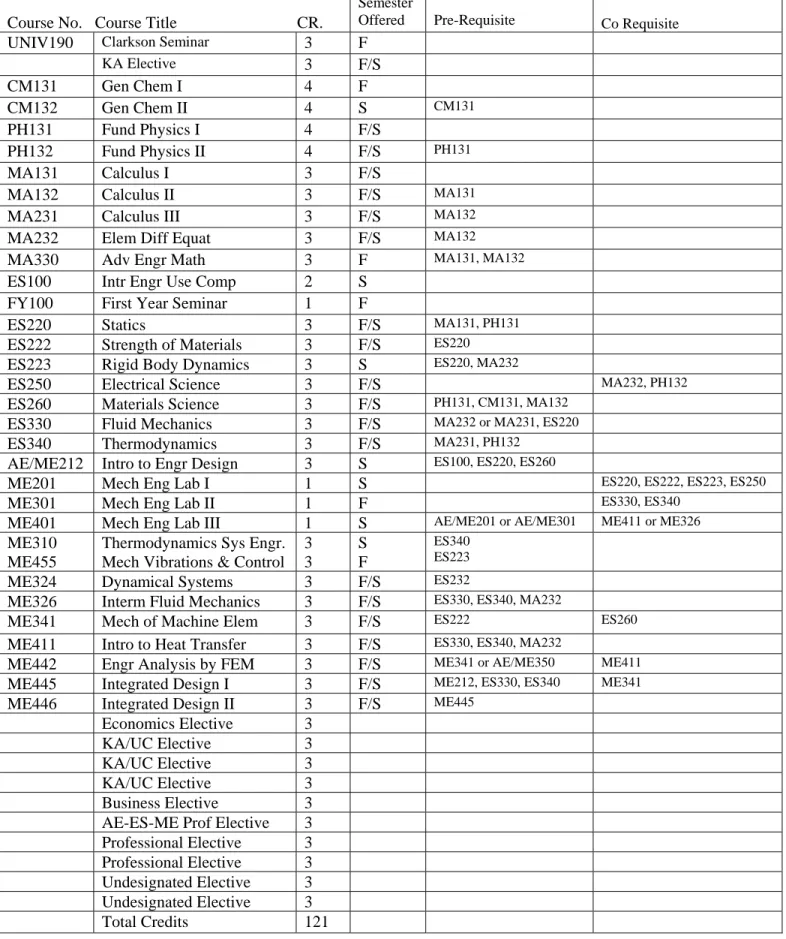
Table 5.4b MECHANICAL ENGINEERING AUDIT SHEET CLASS OF 2010 AND LATER
Course No. Course Title CR.
Semester
Offered Pre-Requisite Co Requisite
UNIV190 Clarkson Seminar 3 F
KA Elective 3 F/S
CM131 Gen Chem I 4 F
CM132 Gen Chem II 4 S CM131
PH131 Fund Physics I 4 F/S
PH132 Fund Physics II 4 F/S PH131
MA131 Calculus I 3 F/S
MA132 Calculus II 3 F/S MA131
MA231 Calculus III 3 F/S MA132
MA232 Elem Diff Equat 3 F/S MA132
MA330 Adv Engr Math 3 F MA131, MA132
ES100 Intr Engr Use Comp 2 S FY100 First Year Seminar 1 F
ES220 Statics 3 F/S MA131, PH131
ES222 Strength of Materials 3 F/S ES220
ES223 Rigid Body Dynamics 3 S ES220, MA232
ES250 Electrical Science 3 F/S MA232, PH132
ES260 Materials Science 3 F/S PH131, CM131, MA132
ES330 Fluid Mechanics 3 F/S MA232 or MA231, ES220
ES340 Thermodynamics 3 F/S MA231, PH132
AE/ME212 Intro to Engr Design 3 S ES100, ES220, ES260
ME201 Mech Eng Lab I 1 S ES220, ES222, ES223, ES250
ME301 Mech Eng Lab II 1 F ES330, ES340
ME401 Mech Eng Lab III 1 S AE/ME201 or AE/ME301 ME411 or ME326
ME310 ME455
Thermodynamics Sys Engr. Mech Vibrations & Control
3 3
S F
ES340 ES223
ME324 Dynamical Systems 3 F/S ES232
ME326 Interm Fluid Mechanics 3 F/S ES330, ES340, MA232
ME341 Mech of Machine Elem 3 F/S ES222 ES260
ME411 Intro to Heat Transfer 3 F/S ES330, ES340, MA232
ME442 Engr Analysis by FEM 3 F/S ME341 or AE/ME350 ME411
ME445 Integrated Design I 3 F/S ME212, ES330, ES340 ME341
ME446 Integrated Design II 3 F/S ME445
Economics Elective 3 KA/UC Elective 3 KA/UC Elective 3 KA/UC Elective 3 Business Elective 3
AE-ES-ME Prof Elective 3
Professional Elective 3 Professional Elective 3 Undesignated Elective 3 Undesignated Elective 3 Total Credits 121
Table 5.5 MANUFACTURING ENGINEERING CERTIFICATE PROGRAM MECHANICAL ENGINEERING CURRICULUM
CLASS OF 2007, 2008 and 2009
FRESHMAN
LS195 Great Ideas I1,3,5,6 LS196 Great Ideas II1,3,5,6
MA131 Calculus I2 MA132 Calculus II2
CM131 General Chemistry I2,3,5 (4cr) CM132 General Chemistry II2,3,5 (4cr)
PH131 Fund of Physics I2,3,5 (4cr) PH132 Fund of Physics II2,3,5 (4cr) FY100 First Year Seminar (1cr) ES100 Intro Engr Use of Compu2 (2cr)
MS/AS (1cr) MS/AS (1cr) SOPHOMORE
ES220 Statics2,5 ES222 Strength of Materials2,5 ES250 Electrical Science2,5 ES223 Rigid Body Dynamics2,5
ES260 Materials Science2,5 AE/ME212 Intro to Engineer Design2,3,5,6 MA232 Elem Differential Equations2 MA231 Calculus III2
HUM or SOC Elective1,3,5,6 HUM or SOC Elective1,3,5,6
ME201 Mech. Eng Lab I1-6 (1cr) JUNIOR
ES330 Fluid Mechanics2,5 ME326 Intermediate Fluid Mechanics2,5 ES340 Thermodynamics2,5 ME341 Mech of Machine Elements2,5 ME324 Dynamics of Mech Systems1,2,3,5 ME411 Introduction to Heat Transfer2,5 MA330** Advanced Eng Math2 Professional Elective – OM485 ME310 Thermodynamics Sys Eng1-5 (or)
ME455 Mech Vibrations & Control1-5 HUM Elective1,3,5,6
ME301 Mech Eng Lab II1-6
(1cr) ME401 Mech Eng Lab III1-6 (1cr) SENIOR
ME442 Engineering Analysis by FEM2,3,5 Professional Elective - Mfg. Elective*
ME445 Integrated Design I1-6 Business Elective3,5,6
– OM331
ES- or ME- Professional Elective – ME390 ME446 Integrated Design II1-6
Economics Elective3,5,6 Undesignated Elective6
– Mfg. Elective*
Undesignated Elective6 - Mfg. Elective*
Table 5.6 MANUFACTURING ENGINEERING CERTIFICATE PROGRAM MECHANICAL ENGINEERING CURRICULUM
CLASS OF 2010 AND LATER
FRESHMAN
UNIV190 Clarkson Seminar 1,3,5,6(c) KA Elective1,3,5,6(ka) MA131 Calculus I2(m) MA132 Calculus II2(m)
CM131 General Chemistry I2,3,5(s) (4cr) CM132 General Chemistry II2,3,5(s) (4cr) PH131 Fund of Physics I2,3,5 (4cr) PH132 Fund of Physics II2,3,5 (4cr) FYS(c) (1cr) ES100 Intro Engr Use of Compu2(it) (2cr) MS/AS (1cr) MS/AS (1cr)
SOPHOMORE
ES220 Statics2,5 ES222 Strength of Materials2,5 ES250 Electrical Science2,5 ES223 Rigid Body Dynamics2,5
ES260 Materials Science2,5 AE/ME212 Intro to Engineer Design2,3,5,6 MA232 Elem Differential Equations2 MA231 Calculus III2
KA/UCElective1,3,5,6(ka) KA/UC Elective1,3,5,6(ka)
ME201 Mech. Eng Lab I1-6(c/l) (1cr) JUNIOR
ES330 Fluid Mechanics2,5 ME326 Intermediate Fluid Mechanics2,5 ES340 Thermodynamics2,5 ME341 Mech of Machine Elements2,5 ME324 Dynamics of Mech Systems1,2,3,5 ME411 Introduction to Heat Transfer2,5 MA330** Advanced Eng Math2 Professional Elective – OM485 ME310 Thermodynamics Sys Eng1-5 (or)
ME455 Mech Vibrations & Control1-5 KA/UC Elective1,3,5,6(ka)
ME301 Mech Eng Lab II1-6(c/l)
(1cr) ME401 Mech Eng Lab III1-6(c/l) (1cr) SENIOR
ME442 Engineering Analysis by FEM2,3,5 Professional Elective - Mfg. Elective*
ME445 Integrated Design I1-6(c/pr) Business Elective3,5,6
– OM331(ka)
ES- or ME- Professional Elective – ME390 ME446 Integrated Design II1-6(c/pr)
Economics Elective3,5,6(ka) Undesignated Elective6
– Mfg. Elective*
Undesignated Elective6 - Mfg. Elective*
Table 5.7 AERONAUTICAL ENGINEERING CURRICULUM CLASS OF 2007, 2008 AND 2009 – HONORS PROGRAM*
Student Name: Student No: Advisor: Class:
FALL GR FRESHMAN SPRING GR FRESHMAN
LS195 Great Ideas I1,3,5,6 (F)**** MA132 Calculus II2 (S)
MA131 Calculus I2 (F/S) CM132 General Chemistry II2,3,5 (4cr) (F/S)
CM131 General Chemistry I2,3,5 (4cr) (F) PH132 Fund of Physics II2,3,5 (4cr) (S)
PH131 Fund of Physics I 2,3,5 (4cr) (F/S) HP101 COMP as Intell Tool II Soc Imp Info Seminar1,3,5,6
(S)LS Foundation (HUM/SOC)
HP100 Comp as Intell Tool I2 (F) Replaces ES100
FY100 First Year Seminar (1cr) (F)
GPA= CUM. GPA= STATUS= GPA= CUM. GPA= STATUS=
FALL GR SOPHOMORE SPRING GR SOPHOMORE
ES220 Statics2,5 (F/S) ES222 Strength of Materials2,5 (F/S)
ES250 Electrical Science2,5 (F/S) ES223 Rigid Body Dynamics2,5 (F/S)
ES260 Materials Science2,5 (F/S) AE/ME212 Intro to Engineer Design1,2,3,5,6 (S)
MA232 Elem Differential Equations2 (F/S)
MA231 Calculus III2 (F/S)
AE200 Aero Engineering Seminar1,2,5,6 (0cr) (F) AE201 Mech. Eng Lab I1-6 (1cr) (S)
HP200, 202,…, or 210 Proj Course1,3,5,6 (F) Replaces Bus.
Elective HP201 Honors Great Ideas
1,3,5,6 (S) Replaces LS196
GPA= CUM. GPA= STATUS= GPA= CUM. GPA= STATUS=
FALL GR JUNIOR SPRING GR JUNIOR
ES330 Fluid Mechanics2,5 (F/S) AE/ME425 Aerodynamics2,5 (S)
ES340 Thermodynamics2,5 (F/S) AE429 Aircraft Perf & Flight Mech2,5 (S)
AE/ME350 Aircraft Structures2,5 (F) AE458 Design of Aircraft Structures1,2,3,5 (S)
MA330** Advanced Eng Math2 (F) AE401 Mech Eng Lab III1-6 (1cr) (S)
AE/ME455 Mech Vibrations & Control1-5 (F)
HP390, 391,… or 399 Honors Thesis1,2,3,6 (S)***See Note
AE301 Mech Eng Lab II1-6
(1cr) (F) HP370 Honors Colloquium (1cr) (S) Optional
HP300, 301,… or 310 Science Sem2,3,5,6 Undesignated Elec
GPA= CUM. GPA= STATUS= GPA= CUM. GPA= STATUS=
FALL GR SENIOR SPRING GR SENIOR
AE450 Aircraft Design I1-6 (F) AE451 Aircraft Design II1-6 (S)
AE430 Stab Contrl of Aerospace Vehicles2,3,5
(F) Economics Elective3,5,6
AE/ME431 Gas Dynamics2,5 (F) AE427 Design of Propulsion Sys1,2,5 (S)
HP490, 491,… or 499 Honors Thesis1,2,3,6 (F)***See Note Hum Elective1,3,5,6
HP470 Honors Coloquium (1cr)
(F) Optional HP400 Seminar on Modernity The
Citizen & the Good Life3,5,
(S)LS Found.
HUM/SOC
GPA= CUM. GPA= STATUS= GPA= CUM. GPA= STATUS=
*Superscripts refer to outcomes as described in the MAE Student Handbook. **or MA331 and MA383. ***HP390 & HP 490 may each serve as a Professional Elective: Appendix L approval required for each. ****Courses are offered as follows: F – Fall, S – Spring, F/S – Fall and Spring
Table 5.8 MECHANICAL ENGINEERING CURRICULUM CLASS OF 2007, 2008 AND 2009 – HONORS PROGRAM*
Student Name: Student No: Advisor: Class:
FALL GR FRESHMAN SPRING GR FRESHMAN
LS195 Great Ideas I1,3,5,6 (F)**** MA132 Calculus II2 (F/S)
MA131 Calculus I2 (F/S) CM132 General Chemistry II2,3,5 (4cr) (S)
CM131 General Chemistry I2,3,5 (4cr) (F) PH132 Fund of Physics II2,3,5 (4cr) (F/S)
PH131 Fund of Physics I2,3,5 (4cr) (F/S)
HP101Comp as Intell Tool II Soc Imp Info Seminar1,3,5,6
(S)LS Foundation (HUM/SOC)
HP100 Comp as Intell Tool I2 (F)Replaces ES100
FY100 First Year Seminar (1cr) (F)
GPA= CUM. GPA= STATUS= GPA= CUM. GPA= STATUS=
FALL GR SOPHOMORE SPRING GR SOPHOMORE
ES220 Statics2,5 (F/S) ES222 Strength of Materials2,5 (F/S)
ES250 Electrical Science2,5 (F/S) ES223 Rigid Body Dynamics2,5 (F/S)
ES260 Materials Science2,5 (F/S) AE/ME212 Intro to Engineer Design1,2,3,5,6 (S)
MA232 Elem Differential Equations2 (F/S) MA231 Calculus III2 (F/S)
HP200,…, or 210 Project Course1,3,5,6 (F) Replaces Bus. Elective
ME201 Mech. Eng Lab I1-6 (1cr) (S)
HP201 Honors Great Ideas1,3,5,6 (S) Replaces LS196
GPA= CUM. GPA= STATUS= GPA= CUM. GPA= STATUS=
FALL GR JUNIOR SPRING GR JUNIOR
ES330 Fluid Mechanics2,5 (F/S) ME326 Intermediate Fluid Mechanics2,5 (F/S)
ES340 Thermodynamics2,5 (F/S) ME341 Mech of Machine Elements2,5 (F/S)
ME324 Dynamical Systems1,2,3,5 (F/S) ME411 Introduction to Heat Transfer2,5 (F/S)
MA330** Advanced Eng Math2 (F) ME401 Mech Eng Lab III1-6 (1cr) (S)
ME310 Thermodynamics Sys Eng1-5 (or) ME455 Mech Vibrations & Control1-5
(S) (F)
HP390,391,… or 399 Honors Thesis1,2,3,6
(S)***See Note
HP300,301,…, or 310 Science Seminar Undesignated Elec. HP370 Honors Colloquium (1cr) (S)Optional
ME301 Mech Eng Lab II1-6
(1cr) (F)
GPA= CUM. GPA= STATUS= GPA= CUM. GPA= STATUS=
FALL GR SENIOR SPRING GR SENIOR
ME442 Engineering Analysis by FEM2,3,5
(F/S) Economics Elective3,5,6
ME445 Integrated Design I1-6 (F/S) HUM Elective1,3,5,6
AE- ES- or ME- Professional Elective ***See Note ME446 Integrated Design II1-6 (F/S)
HP490, 491,…or 499 Honors Thesis1,2,3,6 (F)***See Note
HP400 Seminar on Modernity The Citizen & the Good Life3,5
(S)LS Foundation (HUM/SOC)
Undesignated Elective6
HP470 Honors Colloquium (1cr) (S)Optional
GPA= CUM. GPA= STATUS= GPA= CUM. GPA= STATUS=
*Superscripts refer to outcomes as described in the MAE Student Handbook. **or MA331 and MA383. ***HP390 & HP 490 may each serve as a Professional Elective: Appendix L approval required for each. ****Courses are offered as follows: F – Fall, S – Spring, F/S – Fall and Spring
Table 5.9 AERONAUTICAL ENGINEERING CURRICULUM CLASS OF 2010 AND LATER – HONORS PROGRAM*
Student Name: Student No: Advisor: Class:
FALL GR FRESHMAN SPRING GR FRESHMAN
UNIV 190 Clarkson Seminar1,3,5,6(c) (F)**** MA132 Calculus II2(m) (S)
MA131 Calculus I (m) (F/S) CM132 General Chemistry II2,3,5(s) (4cr) (F/S)
CM131 General Chemistry I2,3,5(s) (4cr) (F) PH132 Fund of Physics II2,3,5 (4cr) (S)
PH131 Fund of Physics I 2,3,5 (4cr) (F/S) HP101 COMP as Intell Tool II Soc Imp
Info Seminar1,3,5,6(ka) (S) Replaces KA/UC
Elective
HP100 Comp as Intell Tool I2(it) (F) Replaces ES100
FYS(c) (1cr) (F)
GPA= CUM. GPA= STATUS= GPA= CUM. GPA= STATUS=
FALL GR SOPHOMORE SPRING GR SOPHOMORE
ES220 Statics2,5 (F/S) ES222 Strength of Materials2,5 (F/S)
ES250 Electrical Science2,5 (F/S) ES223 Rigid Body Dynamics2,5 (F/S)
ES260 Materials Science2,5 (F/S) AE/ME212 Intro to Engineer Design1,2,3,5,6 (S)
MA232 Elem Differential Equations2 (F/S)
MA231 Calculus III2 (F/S)
AE200 Aero Engineering Seminar1,2,5,6 (0cr) (F) AE201 Mech. Eng Lab I1-6(c/l) (1cr) (S)
HP200, 202,…, or 210 Proj Course1,3,5,6(ka) (F) Replaces Bus.
Elective HP201 Honors KA Elective
1,3,5,6(ka) (S) Replaces KA
Elective
GPA= CUM. GPA= STATUS= GPA= CUM. GPA= STATUS=
FALL GR JUNIOR SPRING GR JUNIOR
ES330 Fluid Mechanics2,5 (F/S) AE/ME425 Aerodynamics2,5 (S)
ES340 Thermodynamics2,5 (F/S) AE429 Aircraft Perf & Flight Mech2,5 (S)
AE/ME350 Aircraft Structures2,5 (F) AE458 Design of Aircraft Structures1,2,3,5 (S)
MA330** Advanced Eng Math2 (F) AE401 Mech Eng Lab III1-6(c/l) (1cr) (S)
AE/ME455 Mech Vibrations & Control1-5 (F) HP390, 391,… or 399 Honors Thesis1,2,3,6 (S)***See Note AE301 Mech Eng Lab II1-6(c/l)
(1cr) (F) HP370 Honors Colloquium (1cr) (S) Optional
HP300, 301,… or 310 Science Sem2,3,5,6 Undesignated Elec
GPA= CUM. GPA= STATUS= GPA= CUM. GPA= STATUS=
FALL GR SENIOR SPRING GR SENIOR
AE450 Aircraft Design I1-6(c/pr) (F) AE451 Aircraft Design II1-6(c/pr) (S)
AE430 Stab Contrl of Aerospace
Vehicles2,3,5 (F) Economics Elective
3,5,6(ka)
AE/ME431 Gas Dynamics2,5 (F) AE427 Design of Propulsion Sys1,2,5 (S)
HP490, 491,… or 499 Honors Thesis1,2,3,6 (F)***See Note KA/UC Elective1,3,5,6(ka)
HP470 Honors Coloquium (1cr)
(F) Optional HP400 Seminar on Modernity The
Citizen & the Good Life3,5,(ka/uc)
(S) Replaces
KA/UC Elective
GPA= CUM. GPA= STATUS= GPA= CUM. GPA= STATUS=
*Superscripts refer to outcomes as described in the MAE Student Handbook. **or MA331 and MA383. ***HP390 & HP 490 may each serve as a Professional Elective: Appendix L approval required for each. ****Courses are offered as follows: F – Fall, S – Spring, F/S – Fall and Spring