http://innove.org/ijist/
Context-Aware Recommender Systems for Learning
Abstract
— Ubiquitous learning is a set of methods using new
technologies to enhance learning and expand the traditional perspective of the learning process itself. In a broad sense, one of the main objectives of ubiquitous learning is to provide learners the right resource at the right time and in the best way. In order to provide learners with adequate learning experience, factors such as learner’s characteristics and context should be considered. Managing the learner context can help delivering the best resource adaptation services. Learning object proposed to the learner is obtained from learner context using the decision tree model. On the present paper, a recommender system for ubiquitous learning using learner context and a decision tree model is presented, and k-fold cross validation is used in the experiment for estimation and performance validation of our recommender system for U-learning.Keywords
—
Adaptive u-learning systems; learner context; Ubiquitous learning; Recommender system; Decision tree; Context awarenessI. INTRODUCTION
The emergence of new types of interactive systems like ubiquitous computing in education helps consider new approaches and new learning environments. However, the quality of the educational service depends on the ability of these new learning approaches to provide learners with, on one hand, educational content tailored to the learner profile and context, and on the other hand, processes that guide them truly in their learning process. Adaptive education systems are designed to meet this need. Ubiquitous learning is a way to use new technologies to improve the quality of learning, providing learners with the right resource at the right time and in the best way.
Adaptation in traditional learning systems often focuses on the learner profile; it does not always take into account the context in which learning takes place explicitly. Adaptation in a ubiquitous system of learning is therefore regarded as an extension of it. It essentially consists of selecting relevant resources not only to the learner profile (e.g. the knowledge, skills, preferences, interests, etc.) but also to his current context (e.g. the physical environment, technologies, mobility, tools, time, location, noise, luminosity, etc.).
One of the most accurate definitions of the context is given by Dey and Abowd (2000) [1] These authors refer to context as: ” any information that can be used to characterize the situation of entities (i.e. whether a person, place or
object) that are considered relevant to the interaction between a user and an application, including the user and the application themselves. Context is typically the location, identity and state of people, groups and computational and physical objects”.
Context-aware systems are able to adapt their operations to the current context without explicit user intervention and thus aim at increasing usability and effectiveness by taking environmental context into account [2]. According to Henricksen, Indulska and Rakotonirainy [3], the acquisition of contextual information is made using physical sensors that can be integrated directly into other tools, or virtual sensors for extracting contextual information from virtual spaces such as programs, systems operation, network, etc., or logical sensors that use the information of the physical and virtual sensors to deduce other information.
The main purpose of this paper is to provide a recommender system for ubiquitous learning based on decision tree, and use it to extract the adaptation rules from a variety of learner context. For estimation and performance validation of our recommender system, we will use the k-fold cross validation.
This work represents a continuation of a previous work [22] where we suggested a recommender system based on four elements from learner context (mobility, noise, luminosity and connectivity), to which we now added a single supplementary element (learning style). And that’s because we presume it is the element with the most impact on providing the learner with a learning object adapted to his profile. Our work will depend on two of the learning style values: Visual or Verbal, considering those are the values that have the most influence on the learning object format (Text, audio or Video)
This paper is structured as follows. Section 2 concentrates on background. Section 3 presents techniques & methods. Section 4 describes a context-aware recommendation using context information and a decision tree. Section 5 presents the experimental result. Finally, Section 6 displays the main conclusions and future research.
II. BACKGROUND
In this section we will discuss the four main concepts to achieve our approach, these concepts are: Firstly the ubiquitous learning, secondly the context to describe the
Ismail JELLOULI
Faculty of Sciences, Tetouan,Morocco [email protected]
Badr Eddine EL Mohajir
Faculty of Sciences, Tetouan,Morocco [email protected] Mohammed Al Achhab
National School of Applied Sciences, Tetouan, Morocco
Inssaf El Guabassi
Faculty of Sciences, Tetouan, Morocco
http://innove.org/ijist/
situation of a person (e.g. location, time, noise level, luminosity, orientation, system properties, navigation history, etc.), in our case the person is the learner, thirdly the learning styles and finally the recommendation system to produce personalized search results by performing analysis of user actions.
A. Ubiquitous learning
According to Hwang and al.[21]the definition of u-learning is : « any learning environment that allows students to access learning content in any location at any time can be called a u-learning environment, no matter whether wireless communications or mobile devices are employed or not».
This definition doesn’t provide new elements compared to that of mobile learning.
In addition, ubiquitous learning is characterized by:
Context awareness: This implies that the system is able to explore the environment to determine the current context and conduct learning activities in a particular context. In other words, the system can detect its environment and react accordingly. It is about the detection, acquisition and interpretation of the elements of the context and its changes.
Adaptation: adapting learning resources (content, services, tools, materials, etc.) or selecting the right way to carry out activities according to the current context.
B. Context and conext awareness
Recently, many discussions took place about the meaning and definition of context and context-awareness. Dey and Abowd [12] define context as a piece of information that can be used to characterize the situation of a participant in an interaction. Context awareness [13] means that the system is able to explore the environment to determine the current context and conduct learning activities in a particular context. In other terms, the system first detects and reacts to his environment in relation to the latter by following these three phases the detection, acquisition and interpretation of the context elements and its changes.
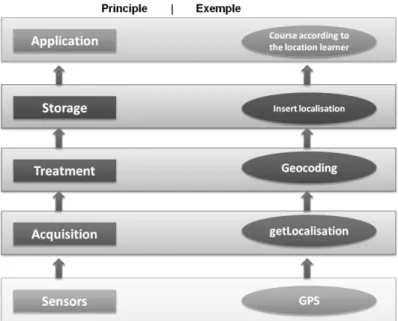
The various layers are described as follows:
Sensors: the collection of physical and virtual sensors
Acquisition: Recovery by components
Treatment: At this level we find the implementation of methods to interpret learner context and making information from multiple sensors compositions
Storage: The recovered contextual data is structured,stored and made available to the client through a public interface
.
Application: The methods that exploit learner context
The figure 1 shows the layered architecture of the context (Principle and example)
C. Learning Style
Several studies in psychology and educational science have emphasized the impact of the learning style on the learning process and encourage its integration into teaching strategies in order to facilitate learner’s tasks and improve their outcomes.
So what is a learning style? And what are his models? And finally what’s the proper learning style for our approach?
Each individual has a personal style of reading and learning, its own way of organizing concepts and information. This is what is known in pedagogy and psychology as: learning styles. This justifies that a learning situation cannot be perceived in the same way by all learners.
Learning style models that focus on preferences for teaching and learning conditions [19]
Learning style models that focus on how the learner processes information in terms of privileged means [17]
Learning style models that deal with the learner's personality [18]
In our approach, we will be based on two learning styles that are: Visual or verbal, because this information influences the format of the learning object (Video, Audio, or Text)
Fig. 1. Layered architecture of the context
D. Recommender system
Recommender systems are tools for such filtering. The main purpose of these systems is to facilitate decision-making for users by offering them information according to their preferences.
http://innove.org/ijist/
It is possible to classify referral systems in different ways. The most frequent classification is a classification based on two approaches: content-based recommendations [14] [15] [4] and collaborative filtering [5]. In addition to these two approaches, Burke [16] proposes to consider three other approaches: the demographic-based recommendation, the utility-based recommendation and the knowledge-based recommendation [6].
Content-based recommendation consists of analyzing the content of resources or descriptions of these resources to determine which resources are likely to be useful or interesting to a given user.
The notion of collaborative filtering is the basis of the recommendation, the methods of filtering by the content being rather linked to the so-called personalized information retrieval systems. It no longer relies on the concept of proximity of a "new item - user profile" pair but seeks to bring the current user closer to a set of existing users.
III. TECHNIQUES & METHODS
In this section we will discuss the two main techniques and methods to implement our approach, these tools are: Firstly the decision tree to classify a population of individuals into homogeneous groups according to discriminating attributes, secondly the cross-validation which is a method for estimating the reliability of a model based on a sampling technique
A. decision tree
A set of classification rules based on tree-organized attributes-related tests. Decision trees are a recent and efficient method of data mining, which predicts a qualitative variable using variables of any type (qualitative and / or quantitative). This flexibility is an advantage over some classification tools, provided for predictors of a single type
This is an iterative method, called recursive partitioning of data. Indeed, the method constructs classes of individuals, the most homogeneous possible, by positing a succession of binary questions (of type yes / no) on the attributes of each individual. There are different algorithms that have been proposed for decision trees: ID3 [9], CHAID [11], C4.5 [10], and CART [8];all the approaches follow the paradigm divide-and-conquer.
The basic algorithm for inducing a decision tree from the learning or training sample set is as follows:
Decide if a node is terminal, will decide if a node must be labeled as a leave. (e.g. all the examples are in the same class, there are less errors, etc.).
Select a test to be associated with a node. (e.g. randomly, using statistical criteria, etc.).
Affect a class to a terminal node. All classes are attributed, except those which are used with the cost or risk functions.
Validate the tree using a cross-validation or other techniques.
A perfect decision tree is a decision tree such that all the examples of the training set are correctly classified.
B. Cross-validation
Cross-validation is a simple and widely used statistical method for selecting models [20]. The cross-validation criterion evaluates the performance of a model in predicting new data. In the case of linear regression models, for example, this criterion has an advantage over that of the sum of the residual squares, which provides little indication of a model's ability to predict new observations. The scope of application of the method extends over several domains such as: selection of variables, estimation of densities, data mining, etc.
Various techniques have been developed to carry out cross validations with small samples by constructing test samples and partially independent learning samples. Among the techniques of cross validation we mention:
leave-one-out cross-validation
k-fold cross-validation
Leave-υ-out cross-validation
split-sample method
In our approach, we will use k-fold cross-validation, because this technique is useful when no test sample is available and the learning sample is too small to extract a test sample
IV. CONTEXT-AWARERECOMMENDATION
Most of the common recommendation systems are only targeting online shopping platforms, restaurants and tourist targets, We aim to design a system that is more important and more general, because our application domain is the ubiquitous learning, which have became achievable thanks to technologies enabling context-awareness.
The main purpose of this article is to describe a recommender system for ubiquitous learning based on decision trees; in fact, the decision tree is used to extract the adaptation rules from a variety of learner context.
Now, the first question that arises is: What is the learner context on which our decision tree will be based? This later will help us to extract the adaptation rules. At that point, additional questions will arise for example: what are the decisions taken for each rule?
According to the basic principle of decision tree building, the three essential components of a decision tree are:
Attributes that represent a variable with multiple values constituting the tree nodes, in our case, the attributes are the learner context (e.g. connectivity, technologies, mobility, tools, time, location, noise, luminosity, battery level, Memory, Activity, etc.).
Classes representing the adaptation based on the decisions, in our case, the classes are the format of the Learning objects offered to our learners (e.g. text, audio or video).
Data samples that represent all possible combinations of different values of Attributes and classes.
http://innove.org/ijist/ A. System description
In this paper, we propose a recommender system using learner context and decision trees for efficient recommendation for ubiquitous learning, one of the main objectives of ubiquitous learning is to provide learners the right resource at the right time and in the best way, It essentially consists of selecting relevant resources not only to the learner profile (e.g. the knowledge, skills, preferences, interests, etc.), but also to his current context (e.g. the physical environment, technologies, mobility, tools, time, location, noise, luminosity, etc.)
Fig. 2. Our recommender system for ubiquitous learning based on decision tree
The recommender system proposed in this paper is articulated in two parts (figure 2).The first part is Context-based Data Mining, which presents all possible combinations of different values of Learning Object choices (i.e. text, audio or video), and context information (i.e. mobility, noise, luminosity, connectivity, learning style). The second part focuses on recommendation algorithm generation, based on the decision tree, i.e. we will generate a tree from samples, to construct the adaptation rules.
Finally, after presenting the recommendation list to our learner, considering his feedback is very important in order to reduce the probability of learning objects that he is not interested in.
Now the question is: On what context model we will build in order to recommend Learning Objects to our learners? That represents a very essential component in our system.
B. Context model
We construct our context model by answering the question: "What are the resources of my close environment?", this is why, our contextual elements are defined from the learner environmental adaptation points
Our context model is represented by the quintuple V=<N, L, M, C, LS>, where N represents the Noise level, L is the Luminosity, M represents the Mobility, C is the connectivity, and LS is the learning style of the learner.
The following is the definition of the various components of our context model:
Noise (N) : the noise level must be below a certain level of learner distraction , otherwise adapting the Learning Objects to the noise level is obligatory, we note that the normal ( level must be : 70 dBA <B <75dBA
Luminosity (L) : To ensure that each learning session can be correctly achieved -The studies on the subject have shown that non sufficient or high lighting had important consequences on eyestrain, and therefore the difficulty of learning, also we note that the normal luminosity level must be : 1000 Lux<L<1500 Lux
Mobility (M): If the learner is moving, we can not assign a text type for Learning Object, but it will be appropriate to offer him an audio type of Learning Object, the values for this attribute are: “yes” or “no”.
Connectivity (C): If the learner has a very low connection, the system will offer him a text type for Learning Object, the values of this attribute are: “high” or “low”.
Learning style (LS): Learning style is the way in which each individual learner begins to concentrate on, the values of this attribute are: “Visual” or “Verbal”.
Therefore the context i of a learner is defined as follows:
Vi=<N
i, L
i, M
i, C
i,LS
i>
Each of these dimensions is important in our model, because they define the learner context necessary to provide him an adaptive learning suitable to his current context.
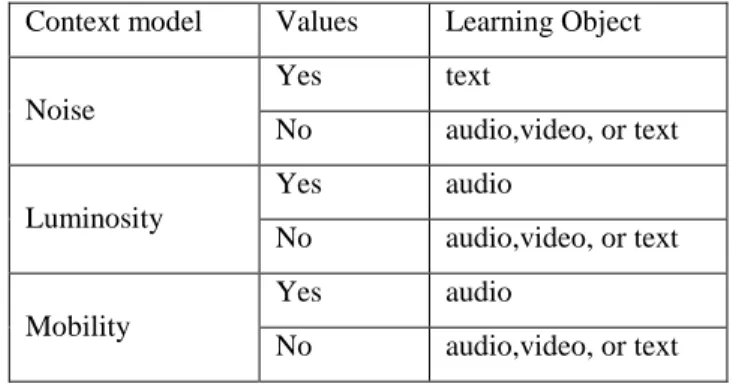
Table 1 represents the appropriate learning objects for each context elements
Context model Values Learning Object
Noise
Yes text
No audio,video, or text
Luminosity
Yes audio
No audio,video, or text
Mobility
Yes audio
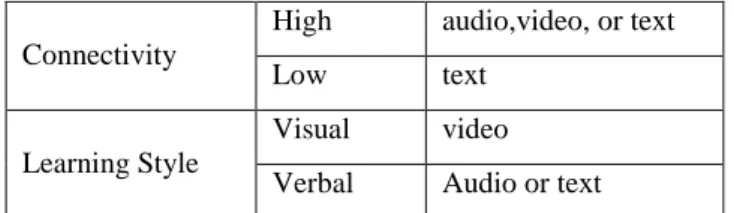
http://innove.org/ijist/ Connectivity
High audio,video, or text
Low text
Learning Style
Visual video
Verbal Audio or text
Table 1: learning objects according to context model
C. Context-based data mining
The Data mining is a multidisciplinary domain, which can extract automatically or semi-automatically hidden, relevant and unknown information from a very large quantity of data, our data samples represent all possible combinations
2
5 that equals 32 (table 2) of different values of Attributes (i.e. mobility, noise, luminosity, connectivity, learning style) and classes (i.e. text, audio or video).Situation Noise (N)
Luminosity (L)
Mobility (M)
Connectivity (C)
Learning style ( LS)
Learning Object ( LO)
1 Yes Yes Yes High Visual Audio
2 Yes Yes Yes High Verbal Audio
3 Yes Yes Yes Low Visual Audio
4 Yes Yes Yes Low Verbal Audio
5 Yes Yes No High Visual Audio
6 Yes Yes No High Verbal Audio
7 Yes Yes No Low Visual Audio
8 Yes Yes No Low Verbal Audio
9 Yes No Yes High Visual Audio
10 Yes No Yes High Verbal Audio
11 Yes No Yes Low Visual Audio
12 Yes No Yes Low Verbal Audio
13 Yes No No High Visual Text
14 Yes No No High Verbal Text
15 Yes No No Low Visual Text
16 Yes No No Low Verbal Text
17 No Yes Yes High Visual Audio
18 No Yes Yes High Verbal Audio
19 No Yes Yes Low Visual Audio
20 No Yes Yes Low Verbal Audio
21 No Yes No High Visual Audio
22 No Yes No High Verbal Audio
23 No Yes No Low Visual Audio
24 No Yes No Low Verbal Audio
25 No No Yes High Visual Audio
26 No No Yes High Verbal Audio
27 No No Yes Low Visual Audio
28 No No Yes Low Verbal Audio
29 No No No High Visual Video
30 No No No High Verbal Video
31 No No No Low Visual Text
32 No No No Low Verbal Text
Table 2 : our data samples
In our approach we construct a recursive decision tree by selecting the attribute that maximize Information Gain (2)
http://innove.org/ijist/
Where p (j) is the probability of having a characteristic element of j in the set S
∑
∑ (
)
Let S be a set consisting of s data samples, Let attribute A, the target attribute, contain v distinct values, {a1, a2, … av}, Sv the subset elements where the attribute value is Av, | Sv | = Number of items of Sv and | S | = Number of elements of S.
Information Gain (2) is used to measure impurity separation, in fact a node is pure if all the individuals associated belong to the same class, there are other functions such as Gini (3) Index and Rule Towing (4).
∑
(
)
(
)
(∑
)
Where pc is the relative frequency of class c in the set S containing m classes. If S is pure, gini (S) = 0.
.We looks for the test case that maximizes the gain. Calculating the Entropy and the Information Gain is a repetitive procedure for constructing nodes of the tree, that's why, concerning the construction of our decision tree, any algorithm such as ID3 [9], CHAID [11], C4.5 [10], and CART [8] could be used and gets good results.
E. decision tree construction
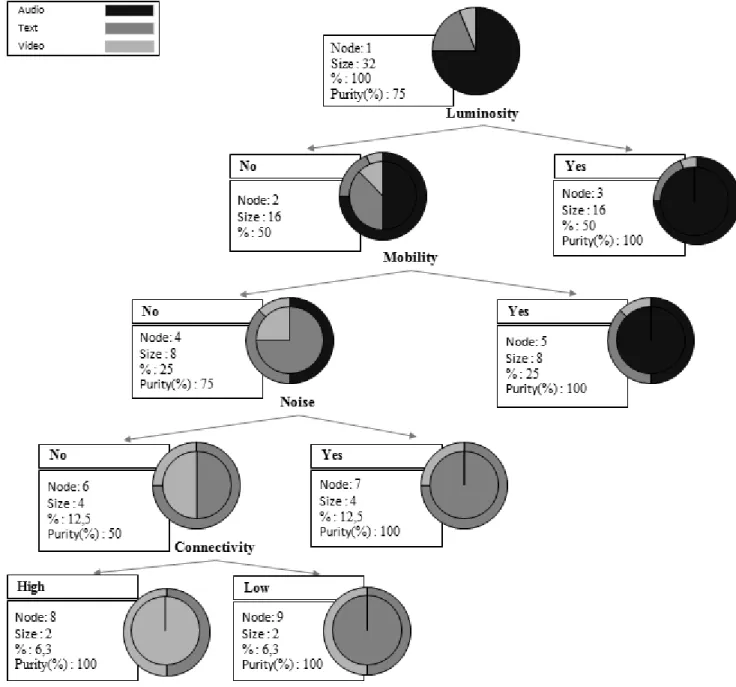
In our approach we used decision trees because it can divide a population of individuals into homogeneous groups according to discriminating attributes based on a fixed and known target. Five learner contexts such as noise, luminosity, mobility, connectivity, and learning style are considered for analyzing the relationship between learner context and Learning Object choice. The decision tree construction using the CART (classification and regression tree) algorithm [8] represents an analysis result as shown in Figure 3.
The decision tree constructed is transformed into a set of rules. Each branch, coming from root to leaf, represents a rule, in the following the algorithm of figure 4 will deduce the learning objects that will be used according to the learner context.
(1)
(2)
(3)
http://innove.org/ijist/
Fig. 3. Decision tree construction for Ubiquitous Learning
F. construction of the rules
Algorithm 1 is generated from our decision tree as described in the previous section, the decision tree constructed is considered as a set of rules. Each branch represents a rule.
For example, on the first right branch, if a learner is surrounded by high level luminosity, then only the audio format may be proposed to this learner. Otherwise if the luminosity level is low, we check whether the learner is on the move or not and provide an adequate format for the new situation, and so on.
Algorithm 1
IF luminosity == "yes" THEN setLearningObject ("audio") ELSE
setLearningObject ("audio") OR
setLearningObject ("text") OR
setLearningObject ("video")
IF mobility== "yes" THEN setLearningObject ("audio") ELSE
setLearningObject ("text") OR
setLearningObject ("video")
IF noise == "yes" THEN setLearningObject ("text") ELSE
http://innove.org/ijist/ OR
setLearningObject ("video")
IF connectivity== "high" THEN setLearningObject ("video") ELSE IF connectivity== "low" THEN
setLearningObject ("text") END IF
END IF END IF END IF
V. EXPERIMENT
The main purpose of this paper is to provide a recommender system using context information (i.e. Noise, Luminosity, Mobility, Connectivity, and Learning style) and a decision tree model for ubiquitous learning, In other words, the decision tree is used to extract the adaptation rules from a variety of learner context. In this section, we used k-fold cross validation for estimation and performance validation of our recommender system based on the decision tree.
In following the steps of k-fold cross validation: 1. the original sample is divided into k samples 2. For i = 1,…, k :
a. Train the classifier using all the examples that do not belong to Fold i
b. Test the classifier on all the examples in Fold i
c. Compute ni, that represent the number of
examples in Fold I that where wrongly classified
3. Return the following to the classifier error (5) :
∑
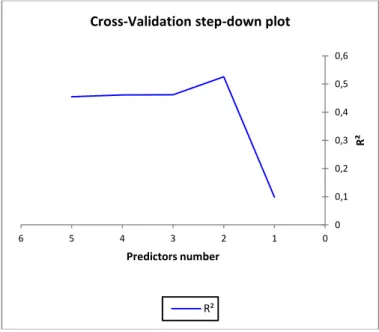
K-fold cross validation is used in the experiment for estimation and performance validation of our recommender system, the predictor selection plot suggests that inclusion of 3 predictors in the model is optimal (Figure 4).
Fig. 4 . Cross-validation Step-down Plot
The Cross-validation Predictor Count table (Table 3) suggests that Mobility, Luminosity are the most important predictors, being included in 1000 and 999 of the 2190 cross-validated regressions.
0 0,1 0,2 0,3 0,4 0,5 0,6
0 1 2
3 4
5 6
R²
Predictors number
Cross-Validation step-down plot
R²
(5)
Predictor Round_1 Round_2 Round_3 …. Round_97 Round_98 Round_99 Round_100 Total
Mobility
10 10 10 …. 10 10 10 10 1000
Luminosity
10 10 10 …. 10 10 10 10 999
Noise
0 0 8 …. 0 0 10 0 100
Connectivity
0 0 2 …. 0 0 7 0 61
Learning style
0 0 0 …. 0 0 3 0 30
Total 20 20 30 …. 20 20 40 20 2190
http://innove.org/ijist/
Many studies and approaches have worked on adapting learning objects according to learning style and context, the results we obtained in our work has shown that the priority of context in the adaptation process is way higher than learning style, and that the latter only starts affecting the adaptation process after context circumstances become optimal (i.e. mobility = no, noise=no; Luminosity =no and connectivity = high). Let’s say a learner has a visual learning style, but is on the move or is surrounded by a high level of luminosity: the system will find itself obliged to suggest formats that are different to the learner learning style to keep the learning object presentable.
VI. CONCLUSIONANDFUTUREWORK
The fast development of mobile, wireless communication and sensor technologies has provided new possibilities for supporting learning activities. Ubiquitous learning, which is learning that can take place anywhere and anytime, is the best example. In this work, we presented an approach considering context information in providing adapted learning object with ubiquitous settings; in this paper, therefore, a recommender system for ubiquitous learning using context information of the learner and a decision tree model is presented.
The presented approach contributes to a recommender system for ubiquitous learning in three ways:
First, it aims to demonstrate how to use the decision tree to generate the rules adaptation.
Second it aims to demonstrate the architecture of a recommender system based on the decision trees considering the learner context.
Third it aims to demonstrate how to use k-fold cross validation for estimation and performance validation of a recommender system. The major directions for future work regarding the system feature include the following: Implementing and evaluating the proposed approach, implementing a recommender system that use the full context and produce the full adapted educational activity and infrastructure.
Finally the sample size was an important limitation of this study. Data mining is also related to large amounts of data, which includes millions entries in general. Therefore the results can be more generalizable with larger sizes of datasets.
REFERENCES
[1] Dey, A.K. Abowd, G.D. Towards a Better Understand- ing of Context and Context-Awareness. CHI 2000 Workshop on the What, Who, Where, When, and How of Context- Awareness (2000)
[2] M. Baldauf, S. Dustdar, and F. Rosenberg, “A survey on context-aware systems”, Int. J. Ad Hoc and Ubiquitous Computing, vol. 2, no. 4, (2007), pp. 263-277
[3] Henricksen, K., J. Indulska and A. Rakotonirainy. 2002. « Modeling Context Information in Pervasive Computing Systems ». In Proc. of the First International Conference on Pervasive Computing, Pervasive 2002 (August 2002). Vol. 2414, p. 167-180. Zurich, Switzerland: Lecture Notes in Computer Science, Springer Verlag, LNCS
[4] Di Noia, T., Mirizzi, R., Claudio Ostuni, V., Romito, D., Zanker, M.: Linked open data to support content-based recommender systems. In: 8th International Conference on Semantic Systems(ACM), New York (2012)
[5] Herlocker, J.L., Konstan, J.A., Terveen, L.G., Riedl, J.T.: Evaluating collaborative filtering recommender systems. ACM Trans. Inf. Syst., 22(1), 5–53 (2004)
[6] Burke, R. "Knowledge-based recommender systems", In Encyclopedia of Library and Information Science, 2000
[7] J. R. Quinlan, Induction of decision trees, Machine learning 1 (1) (1986) [8] [8] Leo Breiman, Jerome Friedman, Charles J. Stone, and R. A. Olshen. Classification and Regression Trees. Chapman and Hall/CRC, 1 edition, January 1984.
[9] J. R. Quinlan, Induction of decision trees, Machine learning 1 (1) (1986) 540 81–106
[10] J. R. Quinlan, C4. 5: programs for machine learning, Elsevier, 2014 [11] Kass G., An exploratory technique for investigating large quantities of
categorical data, Applied Statistics, 29(2), 119-127, 1980.
[12] Dey, A.K. Abowd, G.D. (2000) 'Towards a Better Understand- ing of Context and ContextAwareness', CHI 2000 Workshop on the What, Who, Where, When, and How of ContextAwareness
[13] Schilit B., Adams N. and Want R., “Context-aware computing applications”, Workshop on Mobile Computing Systems and Applications, Santa Cruz, CA, pp 85-90, 1994
[14] Adomavicius, G., Tuzhilin, A.: Towards the next generation of recommender systems: a survey of the state-of-the-art and possible extensions. IEEE Trans. on Data and Knowledge Engineering, 17(6), 734–749 (2005)
[15] Pazzani, M.J., Billsus, D.: Content-Based Recommendation Systems. In: Brusilovsky, P., Kobsa, A., Nejdl, W. (eds.) the Adaptive Web. LNCS, vol. 4321, pp. 325–341. Springer-Verlag, Springer (2007) [4] Di Noia, T., Mirizzi, R., Claudio Ostuni, V., Romito, D., Zanker, M.: Linked open data to support content-based recommender systems. In: 8th International Conference on Semantic Systems (ACM), New York (2012)
[16] 7- R. BURKE : Hybrid Web Recommender Systems. pages 377–408, 2007.
[17] Honey, P., Mumford A., The Learning Styles Helper’s Guide. Maidenhead :Peter Honey Publications Ltd,2000
[18] Myers I., (1998). Guide to the Development and Use of the Myers-Briggs Type Indicator. CPP, Inc., 3rd édition
[19] GRASHA, Anthony F. Grasha-Reichmann Student Learning Styles Scales. ETS m 1976, 1975.
[20] Friedman, J., T. Hastie et R. Tibshirani., The elements of statistical learning, vol. 1, Springer series in statistics Springer, Berlin, 2001 [21] Hwang, G.-J., Tsai, C.-C., & Yang, S. J. H. 'Criteria, Strategies and
Research Issues of Context-Aware Ubiquitous Learning', Educational Technology & Society, 11(2), 81-91, 2008