Url: http://usnsj.com/index.php/JEE Email: [email protected]
Improving the Students’ Reading Skill through Translation Method
Suggestion for the Citation and Bibliography
Citation in text:
Ismail, Syahruza, & Basuki (2017)
Bibliography:
Ismail, H., Syahruza, J.K., & Basuki. (2017). Improving the Students’ Reading Skill through Translation Method. Journal of English Education, 2(2, Dec.), 124-131.
Hijril Ismail
UniversitasMuhammadiyahMataram [email protected]
+6282340228542
Juang Kurniawan Syahruzah
Universitas PGRI Yogyakarta [email protected]
+6283129995878
Basuki
UniversitasvMuhammadiyahvPurworejo [email protected]
+6285726122253
o-ISSN: 2502-6909 p-ISSN: 2502-9207
Vol. 2, No. 2, December 2017
URL: http://usnsj.com/index.php/JEE/article/view/2.2.124-131
Received : 11 November 2017 Reviewed : 19 November 2017 Published : 13 December 2017
© 2017 JEE All rights reserved
Abstract
T
he aims of this research are to find out how the implementation of translation can improve the students’ reading skill and how the students’ responses to the use of translation method in the teaching and learning process. This research is a classroom action research. The participant is 39 students. The research instrument used is in the form of observation checklist, test, and questioners. The finding of the research shows that the implementation of translation improves the students’ reading skill in the teaching process and the test result. The result of evaluation which carried out in end of the cycle I obtained thatthe lowest score is 40 and the highest score is 82 then the average score is 58.1, cycle II gets the lowest score is 50 and the highest score is 85 then the average score is 60,9, and cycle III get the lowest score is 60 and the highest score is 85 and the average score is 65.8. Therefore, it can be concluded that the translation method can improve the students’ reading skill of grade VII D of MTs. Muhammadiyah Yogyakarta and the students’ responses are positive when the teacher applied translation method in teaching and learning process.Keywords: reading skill, translation method, teaching and learning, cultural diversity
AUTHORS INFO ARTICLE INFO
A. Introduction
E
nglish is one of the international languages becomes the major language of printed information. It can be in technology, economics, commerce and science. The most important way which is vital in processing information is reading. By having the reading skills to comprehend passages, textbooks and references written in English, the students are able to absorb information and knowledge. Based on the school-based curriculum in the junior high schools that language skills are categorized as receptive skills and productive skills. Speaking and writing are productive skill while listening and reading are receptive skills.Reading is a tool of communication in written language through the texts form. It is the most efficient way to gain information about many aspects of life, including science and technology. By reading, people can absorb a number of information. Reading has a very important role and becomes a daily necessity for every person who wants to acquire whatever information which is required. Reading is an essential skill for learners of English as a foreign language. For most of learners it is the most important skill to master in order to ensure success not only in learning English, but also in learning in any content class where reading in English is required. With strengthened reading skills, learners will make greater progress and development in all other areas of learning
Reading is a vital skill for everyone, including students. Mickulecky & Jeffries (2004) say that reading is very important since it can enhance students’ general language skills in English; assisting students to think in English, enlarging students’ English vocabulary, improving their writing, and it can be a good way to obtain about new ideas, facts and experiences. Therefore, on the basis of this opinion, the reading skill has been viewed as something that can help students to enrich their insight in English language.
According to Harmer (2003) reading is one of the receptive skills of English. Yet, the four language skills are closely related to each other. The ability to read texts in English is important as a bridge to understand the textbook. If students continue their studies to the senior high school and university, they are required to understand many books written in English.
In teaching and learning reading skill there are a number of particular problems which will need to be addressed. The first problem is reading comprehension. The problems are related to background knowledge, cultural knowledge, and knowledge of text type. Background knowledge is the students’ previous knowledge or knowledge of the world. If students lack prior knowledge in reading a text, they cannot understand it because they do not know what the text is about. A reader uses background knowledge to integrate new information from a text into his prior information. In addition, cultural differences affect reading comprehension. An unfamiliar cultural context and content knowledge of culture and knowledge of vocabulary cause problems in reading, because the students do not clearly understand the other culture. In addition, an inadequate knowledge of text type is a problem in reading texts. The text type such as newspaper articles, fairy tales, and business letters, if the students do not know what kind of the text, they cannot understand what the text is about. Students can understand a text if they are familiar with the text type (Alderson, 2002 in Chawang, 2008).
The second problem is limited vocabulary. The problem involves difficulties with words. These difficulties include problems with technical vocabulary, super ordinates, synonyms, antonyms, and words with several meanings. Students will have great difficulty in understanding the text as a whole because lack vocabulary. To be successful, they have to recognize a high proportion of the vocabulary (Paren, 1996 in Harmer, 2003).
The third problem is complex and very long sentences. According to Chawwang (2008) complex sentences are sentences that contain many clauses or reduced clauses and abstract concepts. Harmer (2003) says that texts with longer sentences will be more difficult to understand than shorter sentences.
and interpretation are often used interchangeably. While both activities involve transferring a message between two different languages, translation refers to transfer between written texts and interpretation refers to spoken discourse and the unrehearsed transfer of a spoken message from one language to another (Richards &Schmidt, 2002).
Those descriptions above are the reasons to conduct the research entitled Improving the Students’ Reading Skill through Translation Method of grade VII D at MTs Mualimin Muhammadiyah Yogyakarta.
B. Literature review
1. Reading Skill
Richards &Schmidt (2002) assert that listening, speaking, reading, and writing are generally called language skills. Sometimes speaking and writing are called the active/productive skills and reading and listening are the passive/receptive skills. Richards and Schmidt (2002) define reading skill as abilities required for skillful reading, such as discerning main ideas, understanding sequence, noticing specific details, making inferences, making comparisons, and making predictions in second and foreign language instruction, particularly with adults. These skills are sometimes taught separately. Patel and Jain (2008) state that reading is understanding the meaning of printed words i.e. written symbols. Reading is an active process which consists of recognition and comprehension skill. Reading is an important activity in life with which one can update his/her knowledge. Reading skill is an important tool for academic success.
Gray in Patel &Jain (2008) classifies that reading is form of experience. Reading brings us in contact with the minds of great authors, with the written account of their experiences. Strickland, Galda, & Cullinan (2007) say that reading is a dynamic process in which an active reader engages with a text in order to create meaning. This creation of meaning requires a greet deal of work by the reader. Reading is a visual process - vision is a symbolic process of seeing an item or symbol and translating it into an idea or image. Images are processed into concepts and whole dimensions of thought (Bennette, 2001). Brown (2004) says that reading is a process of negotiating meaning. The reader brings to the text a set of schemata for understanding it, and it takes the product of that interaction. In second language teaching and learning, Nunan (1999) defines reading as a process of reconstructing meaning rather than decoding form, and the reader only resorts to decoding if other means fail.
Mareilon (2007) states that reading is making meaning from print and from visual information. But reading is not simple. Reading is an active process that requires a great deal of practice and skill. Reading is a fluent process of reader combining information from a text and their own background knowledge to build meaning (Nunan, 2003).
Based on the definition above, the researcher can make sum up that reading is receptive skill to understand printed words likes discerning main ideas, understanding sequence, noticing specific details, making inferences, making comparisons, and making predictions in second and foreign language instruction. And also the researcher can say that reading is an ability to understand written English as it is presented in textbooks, newspaper, magazine, menu, massages and in academic materials.
2. The Goals of Reading
Reading is an ability which is extremely important for students for enhance their insight in particularly in English language. The writer appraises that one of the way for increasing students’ reading ability is by knowing the purposes of the reading. There are many aims of reading which put forward by many experts. Rivers and Temperely (1978) in Nunan (1999) address seven main purposes of reading: 1) to obtain information for some purpose or because we are serious about some topic: 2) to obtain instructions on how to perform some tasks for our work or daily life (e.g. knowledge how an appliance works); 3) To act in a play, play a game, do a puzzle; 4) To keep in touch with friends by correspondence or to understand business letters; 5) To know when or where something will take place or what is available; 6) To know what is happening or has happened (as reported in newspaper, magazines, report); and 7) To have enjoyment or excitement. Grellet (1983) mentions two main reasons for reading: 1) Reading for pleasure; and 2) Reading for information (in order to find out something or in order to do something with the information you get).
3. The Principles for Teaching Reading
Richard and Schmidt (2002) point out that principles in teaching are beliefs and theories that teachers hold concerning effective approaches to teaching and learning and which serve as the basis for some of their decision-making. Harmer (2001) classifies that there are six principles behind teaching reading as follows:
a. Reading is not a passive skill
Reading is an incredibly active occupation. To do it successfully, one has to understand what the words mean, see the picture the words are painting, understand the arguments, and work out if one agrees with them. If one does not carry out these things – and if students do not perform these things – then one only just scratch the surface of the text and one quickly forgets it.
b. Students need to be engaged with what they are reading.
As with everything else in lessons, students who are not engaged with the reading text, not actively interested in what they are doing, are less likely to benefit from it. When they are really fired up by the topic or the task they get much more from what is in front of them.
c. Student should be encouraged to respond to the content of a reading text, not just to the language
It is important to study reading texts for the way they use language, the number of paragraphs they contain and how many times they use relative clauses. But the meaning, the massage of the text, is just as important and teachers must give students a chance to respond to that massage in some way. It is especially important that they should be allowed to express their feelings about the topic, thus provoking personal engagement with it and the language.
d. Prediction is a major factor in reading
When one reads texts in his/her own language, one frequently has a good idea of the content before he/she actually reads. Book covers give him/her a hint of what is in the book; photographs and headlines hint at what articles are about and reports look like reports before one reads a single word.
The moment one gets this hint, the book cover, headline, the word processed page, his/her brain starts predicting what he/she is going to read, expectations are set up and the active proves of reading is ready to begin. Teachers should give students ‘hits’ so that they can predict what is coming too. It will make them better and more engaged readers.
e. Match the task to the topic
face of it, they look a bit silly. Teachers will probably be more interested in what Hamlet means and what the menu foods actually are (Harmer 2001).
Once a decision has been taken about what reading text the students are going to read, teachers need to choose going reading tasks- the right kind of questions, engaging and useful puzzles etc. The most interesting text can be undermined by asking boring and inappropriate questions; the most commonplace passage can be made really exciting with imaginative and challenging tasks.
f. Good teachers exploit reading texts to the full
Any reading text is full of sentences, words, ideas, descriptions etc. It does not make sense just to get students to read it and then drop it to move on to something else. Good teachers integrate the reading text into interesting class sequences, utilizing the topic for discussion and further tasks, using the language for study and later activation.
4. Translation Method
Translation method is the process of rendering written language that was produced in one language (the source language) into another (the target language), or the target language version that results from this process. Translation in which more emphasis is given to overall meaning than to exact wording is known as free translation. A translation that approximates to a word for word representation of the original is known as a literal translation. A translation that has been produced by a computer is known as a machine translation. The terms translation and interpretation are often used interchangeably. While both activities involve transferring a message between two different languages, translation refers to transfer between written texts and interpretation refers to spoken discourse and the unrehearsed transfer of a spoken message from one language to another (Richards &Schmidt, 2002).
C. Methodology
The research was the classroom action research at MTs Mualimin Muhammadiyah Yogyakarta. The subject of the research was the students of grade VII D which number of 39 students as the participant because they have less skill in reading. It can be known from the result of pre-reading comprehension test which undertaken by researcher with the lowest score was 35 and the main score was 55,46 and also based on the result interview of an English teacher. The research instrument utilized by the writer is in the form of observation checklist, test and questioners. The observation checklist is mainly used to write the students’ progress from time to time. Test is one important element in the research namely to find out the implementation of translation method can improve the students’ reading skill or not. The questioner used to know the students’ responses to the use of translation method in teaching.
The research data were collected through: the first, observation was undertaken by other researchers to gather the data of students’ activity when the action was taking place; the second, the test was performed in the end of meeting in the each cycle to know that there is an improvisation of each cycle or not, the item test consisted of 30 questions in the five forms of multiple choices and the duration is about 90 minutes, and the third, questioners was employed for gaining students’ responses on procedure implemented which is applied when teaching and learning process is taking place. Research Procedure used was a self-reflective spiral of planning, acting, observing, reflecting and re-planning as the basic for understanding how to take action to improve an education situation (Kemmis & McTagart, 1992).
D.Findings and Discussion
together; and 3) Students’ vocabularies were still poor and they found it difficult to answer some questions.
On the second II, The teacher carried out evaluation by giving a multiple choice test to the students. They completed the evaluation in about 80 minutes. Here are the results of the test: The lowest score was 50. There were eight students who got 50. The highest score was 85 and there was only one student who got 85. The mean was 60.9. The result of reflection in cycle II; 1) Answering WH question could assist students to answer many questions about reading; 2) Practicing dialogue in teaching and learning process could enhance students pronunciations; and 3) Find out the synonym and antonym the words could be a bridge to increase the students’ vocabularies.
On the cycle III, the teacher carried out an evaluation by giving a multiple choice test to the students. They completed the evaluation in about 80 minutes. The result of the evaluation: There were fourteen students who got 60. The lowest score was 60 and highest score 85 and there was only one student who got 85. The mean was 65.8. The result of reflection in cycle III, the third cycle was completely performed, the researchers concluded that; 1) Translating a text could be became a bridge to enhance the students’ vocabulary and it could assist them to comprehend a text. 2) Asking students orally before introducing a topic could help them to understand the next activities easily. 3. The limited time could assist students for really using the time as well as possible.
Table 1 Compression of Results Assessment of Cycle I, Cycle 2, and Cycle 3
No Students’ number
Score
No Students’ number
Score Cycle
I Cycle II Cycle III Cycle I Cycle II Cycle III
1 7812 70 75 80 21 7937 57 60 65
2 7815 47 50 60 22 7943 49 55 60
3 7816 40 55 65 23 7944 55 55 65
4 7817 42 50 60 24 7947 58 55 60
5 7822 50 60 60 25 7951 67 70 70
6 7827 52 55 65 26 7960 76 75 75
7 7831 50 50 65 27 7973 56 56 70
8 7840 70 70 70 28 7978 65 65 65
9 7849 63 65 70 29 7981 67 65 65
10 7851 57 57 60 30 7982 40 55 60
11 7856 72 75 75 31 7993 67 65 65
12 7862 53 55 60 32 7997 63 65 65
13 7865 82 85 85 33 8006 66 65 70
14 7870 45 50 60 34 8012 77 80 80
15 7888 65 65 65 35 8013 64 60 65
16 7889 47 50 60 36 8014 65 60 60
17 7892 72 80 85 37 8033 46 55 65
18 7907 54 55 54 38 8035 40 50 60
19 7919 65 65 65 39 8036 50 50 60
20 7936 42 50 60
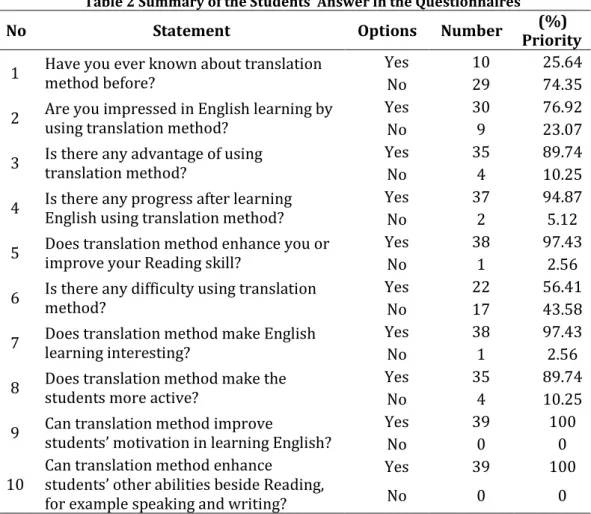
students (94.87 %) of thirty nine students admitted that they made progress in learning English using translation method. Thirty eight students (97.43 %) of thirty nine students answered that translation method enhanced them to improve their reading skill. Twenty two students (56.41 %) of thirty nine students found a difficulty in using translation method while seventeen students (43.58 %) of thirty nine students did not find any difficulty in using translation method. Thirty eight students (97.43 %) of thirty nine students admitted that translation method made English learning interesting. All students agreed that translation method can improve student’s motivation in learning English and can enhance students’ others ability beside reading, for example speaking and writing.
Table 2 Summary of the Students’ Answer in the Questionnaires
No Statement Options Number Priority (%)
1 Have you ever known about translation method before? Yes 10 25.64
No 29 74.35
2 Are you impressed in English learning by using translation method? Yes 30 76.92
No 9 23.07
3 Is there any advantage of using translation method? Yes 35 89.74
No 4 10.25
4 Is there any progress after learning English using translation method? Yes 37 94.87
No 2 5.12
5 Does translation method enhance you or improve your Reading skill? Yes 38 97.43
No 1 2.56
6 Is there any difficulty using translation method? Yes 22 56.41
No 17 43.58
7 Does translation method make English learning interesting? Yes 38 97.43
No 1 2.56
8 Does translation method make the students more active? Yes 35 89.74
No 4 10.25
9 Can translation method improve students’ motivation in learning English? Yes 39 100
No 0 0
10
Can translation method enhance
students’ other abilities beside Reading, for example speaking and writing?
Yes 39 100
No 0 0
Shortly, from the result of questioners above, the writer concludes that translation method can be served as one alternative method in teaching English especially to improve the students’ reading skill and students’ response was positive when translation method was applied in teaching reading.
E. Conclusion
Based on the data analysis and discussion, the writer can make conclusion that there is an improvement of students’ score in reading skill. It can be seen from the result of evaluation in each cycle; on cycle I is obtained that the lowest is 40. The highest score is 82 and the mean is 58.1. On the cycle II is gotten the lowest score is 50. The highest score is 85 and the mean is 60.9, and on the cycle III gotten the lowest score is 60. The highest score is 85 and. The mean score is 65.8. The students’ response was positive when the teacher applied translation method in teaching and learning process especially to improve reading skill.
F. References
Bennette, J. (2001). A Course in Light Speed Reading, a Return to Natural Intuitive Reading. USA: American Institute of Hypnotherapy.
Brown, H.D. (2000). Principles Language Learning and Teaching, 4th Edition. Longman: Edison Wesley Longman, Inc.
__________. (2001). Teaching by Principles, 2nd Edition. New York: Addison Wesley Longman, Inc. __________. (2007). Principles Language Learning and Teaching, 5th Edition. Longman: Person
Education, Inc.
__________. (2009). Language Assessment Principles and Classroom Practices. White Plains, NY: Person Education, Inc.
Chawwang, N. (2008). Investigation of English Reading Problems: Nakhonratchasima: Srinakharinwirot University press.
Coghlan, D. & Brannick, T. (2005). Doing Action Research in Your Own Organization, 2nd edition, USA: SAGE Publications.
Creswell, J.W. (2012). Education Research, Planning, Conducting, and Evaluating Quantitative and Qualitative Research. 4th Edition. USA: Person Education, Inc.
Davies, P. (2002). Success in English teaching. Oxford: Oxford University Press.
Fauzi, M. & Supiandi, L. (2008). Let’s Study English Untuk Kelas VII. Jakarta: Intimedia Cipta Nusantara.
Grellet, F. (1983). Developing Reading Skill. London: Cambridge University press.
Haris, K.R., Steve G., & Alison, B. (2007). Teaching Reading Comprehension to Students with Learning Difficulties. New York. The Guilford Press
Harmer, J. (2003a). How to teach English. London: Longman.
Harmer, J. (2003b). The Practice of English Language Teaching, 3rd Edition. London: Longman. Henning, J.E., Stone, J.M., Kelly, & James, L. (2009). Using Action Research to Improve Instruction -
an Interactive Guide for Teachers. London: Francis Routledge
Juan, E.S. &Flor, A.M. (2006). Current Trends in the Development and Teaching of the Four Language Skills. New York: Mouton de Gruyter Berlin
Macau, C.M. (2003). Teaching Foreign Languages Through Translation: Considering Multiple Intelligences. London: Translation and Interpretation Department Press.
McNiff, J. & Whitehead, J. (2002). Action Research: Principles and Practice. 2nd Edition. London: British Library Cataloguing
Mikulecky, B.S. & Linda, J. (2004). More Reading Power. Reading for Pleasure, Comprehension Skills, Thinking Skills, Reading Faster. 2nd Edition. New York: Longman.
Moreilon, J. (2007). Collaborative Strategies for Teaching Reading Comprehension. Chicago: American Library Association.
Nunan, D. (2003). Practical English Language Teaching. North America: McGraw Hill / Contemporary.
Nunan, D. (1999). Second Language Teaching and Learning. Masschyserts: Heinle and Heinlepulicher.
Patel, M.F & Jain, P.M. (2008). English Language Teaching (Methods, Tools & Techniques). Jaipur: Sunrise Publishers & Distributors
Richards, J.C. & Richard, S. (2002). Longman Dictionary of Language Teaching & Applied Linguistic, 3rd Edition. Longman: person education
Richards, J.C. & Renandya, W.A. (2002). Methodology in Language Teaching. USA: Cambridge University Press.
Sagor, R. (2000). Guiding School Improvement with Action Research. USA: Association for Supervision and Curriculum Development
Strickland, S.D., Kathy, G, & Joanne K.M. (2006). Supporting Struggling Readers and Writers: Strategies for Classroom Intervention 3-6. USA: Stenhouse Publishers.