223
AESTHETICS OF RUDERAL VEGETATION IN THE URBAN AND
PERI-URBAN AREAS OF OLTENIA (ROMANIA)
RĂDUȚOIU DANIEL1*,ȘTEFĂNESCU DRAGOȘ-MIHAIL1
University of Craiova, Biology Department, 15, Libertăţii Street, 200583 *Corresponding author, e-mail: [email protected]
keywords:aesthetics,ruderalvegetation, urban, Oltenia, Romania.
ABSTRACT
This paper renders the importance of the main ruderal plant associations in unarranged urban and peri-urban areas that bring a high contribution to the aesthetics of these places through their floristic composition.
Plants included in this category of vegetation are regarded as "ruderal weeds". The sprawl of the main cities and towns of Oltenia – Craiova, Calafat, Băilești (Dolj County), Rm. Vâlcea, Horezu, Călimăneşti, Drăgăşani, Bălceşti (Vâlcea County), DrobetaTurnu Severin, Orşova (Mehedinţi County), Slatina, Caracal, Corabia (Olt County), Tg. Jiu, Bumbeşti Jiu, Novaci (Gorj County), led to the increase of the surface occupied by this type of vegetation. The preservation or bankruptcy of the factories located at the outskirts of some large cities in Oltenia are other causes of the increase of the surface occupied by this type of vegetation.
After analyzing the floristic composition of these surfaces occupied by ruderal vegetation, it was found that there is an appreciable diversity both in terms of number of species and colours of the flowers of these plants. Starting from this last finding, we consider useful to use this type of vegetation for aesthetic purposes.
INTRODUCTION
What is rated as "aesthetic" depends to a large extent on the assessor, the level of education of the person making the assessment and the period when it is done (Van den Berg et al. 1998).
The study of this category of vegetation from Oltenia has drew the attention of numerous botanists:(Buia et Popescu (1952); Buia et Păun (1960); Buia et al. (1961), Cîrțu (1971); Maloș (1968); Păun (1966), Popescu (1974); Popescu et al. (2003a, 2003b); Costache I. (2005), Răduțoiu D. (2006); Niculescu M. (2016) etc.
Suburban and exurban growth are affectingbiodiversity in many places once thought of as too remote to attract such levels of development (Miller & Hobbs, 2002).
The need for such studies is especially acute in areas ofhuman settlement.
In the USA, urbanization is considered to be one of the main causes that has led to a decline in biodiversity, greatly affecting endangered species (Czech et al., 2000). If we also add agriculture practiced in the last period of time, we can say that urbanization and agriculture are the perfect match for biodiversity loss and reduction of the characteristic areas of many species of plants and animals.
The major problem is the rapidity with which these transformations take place in urban and peri-urban areas.
However, there are plants that, over a certain period of time, change the physiognomy of the place through the varied colors of the flowers. The colorless flowers ("gray") never represent more than 30% of the association, but often even less (Wittig 2011).
224
MATERIAL AND METHODS
The working methods used to accomplish this work consisted in numerous field trips in these places made in order to observe the vegetation in all its phases. There were taken photos with a Panasonic digital camera to show the succession of vegetation and the variety of colors we encountered.
Numerous relevés were made in the areas where we encountered a uniform physiognomy in order to properly classify the analyzed phytocoenoses.
After analyzing the field data, the associations that were present at the periphery of the analyzed cities were identified and the areas with the highest floristic diversity and, implicitly, variety of colors were delimited.
RESULTS AND DISCUSSIONS
As a result of the research carried out in urban and peri-urban areas of the main cities of Oltenia, we can say that the floristic and vegetation diversity in these places is high.
From the floristic inventory of these areas, we can say that the most spread species are:Daucus carota, Conyza canadensis, Linaria vulgaris, Crepis foetida subsp. rhoeadifolia, Melilotus albus, Melilotus officinalis, Salvia nemorosa, Berteroa incana, Cephalaria transylvanica, Cichoriumi ntybus, Crepis setosa, Verbascum phlomoides, Picris hieracioides, Echium vulgare, Chondrilla juncea, Artemisia absinthium, Cirsium arvense, Erigeron annuus, Lactuca serriola, Reseda lutea, Elymus repens, Plantago lanceolata, Polygonum aviculare, Hypericum perforatum, Bromus hordeaceus, Taraxacum officinale, Lathyrus tuberosus, Marrubrium vulgare (la periferia orașelor din sudul Olteniei), Medicago minima, Lolium perenne, Anthemis arvensis, Arenaria serpyllifolia, Rorippa pyrenaica, Capsella bursa-pastoris, Cirsium vulgare, Cardaria draba, Potentilla argentea, Centaurea micranthos, Lotus corniculatus, Arctium lappa, Malva sylvestris, Geranium pusillum, Lamium purpureum, Silenelatifolia subsp. alba, Ballotanigra, Geumurbanum, Chenopodium album, Sonchus arvensis, Amaranthus blitoides, Ambrosia artemisiifolia, Solanum nigrum, Dipsacus fullonum, Stachys germanica, Bromus inermis, Falcaria vulgaris, Poa angustifolia, Carduus acanthoides, Chelidonium majus, Convolvulus arvensis, Descurainia sophia, Medicago lupulina, Centaurea cyanus, Diplotaxis muralis, Cynodon dactylon, Lamium amplexicaule, Lithospermum arvense, Papaver rhoeas, Sisymbrium loeselii, Linaria genistifolia, Viola arvensis, Achillea collina, Ajuga genevensis, Calamagrostis epigeios, Echium italicum, Eryngium campestre, Poa bulbosa, Matricaria recutita, Poa annua, Pulicaria dysenterica, Oxalis corniculata, Chamaesyce maculata, Rosa canina, Sisymbrium orientale,Tragopogon dubius, Onopordum acanthium, Centaurea solstitialis, Tanacetum vulgare etc.
According to a first analysis of the most frequent taxa in urban and peri-urban areas, we can notice that there are species that have varied colours of flowers: white (Cardaria draba, Daucus carota, Melilotus albus, Solanum nigrum, Silene latifolia subsp. alba), blue (Cichorium intybus, Centaurea cyanus), yellow (Linaria vulgaris, Reseda lutea, Rorippa pyrenaica, Geum urbanum, Oxalis corniculata, Lotus corniculatus, Chelidonium majus, Tragopogon dubius, etc.), mauve (Cephalaria transylvanica), red (Papaver rhoeas). If we refer to the phytocoenoses of these places, we can say that they fall mainly within the associations of the alliance Dauco-Melilotion Görs 1966. They come in contact with those of the alliance Onopordion acanthi (Potentillo argenteae – Artemisietum absinthii Falinski 1965).
225
In many research stations, we found a good representation of nitrophilous phytocoenoses made up of biennial or perennial species belonging to the alliance Arctionlappae R. Tx. 1937.
Fig. 1. Physiognomy of the phytocoenoses of the association Dauco-Cephalarietumtransylvanicae at the periphery of Craiova (orig.)
Unlike the phytocoenoses of the alliance Dauco-Melilotion, we can say that the associations of this alliance predominantly have a certain color, observable from a distance: e.g. white (Conietum maculati) or purple (Cirsietum lanceolati-arvensis Mititelu 1972 nom. inv., Balloto – Malvetum sylvestrisGutte 1966).
Tabel 1
Associations of the alliance Dauco – Melilotion
Number of association 1 2 3 4 5
Number of relevés 78 19 46 74 38
Altitude (m) 50-430 55-95 50-95 110-520 110-460 Species characteristic to associations
Berteroa incana V - I - II
Melilotus albus I - IV I I
Potentilla argentea - I I I II
Cephalaria transylvanica - V I - -
Sisymbrium orientale - I I - -
Onopordum acanthium - - - I I
Tanacetum vulgare I - - IV II
Centaurea calcitrapa - I - I I
Dauco-Melilotion
Echium vulgare III I V I I
Cichorium intybus II I II I I
Melilotus officinalis II I II I I
Reseda lutea I - I - I
Daucus carota III I I I II
226
Linaria genistifolia - I I - I
Crepissetosa - I I - I
Onopordion
Verbascum phlomoides I - I I I
Stachys germanica I I - - I
Salvia nemorosa - II I I I
Cynoglossum officinale I I II I I
Torilis japonica - I - - -
Onopordetalia
Cirsium vulgare I - II I I
Carduus acanthoides III I II I II
Ballota nigra II I - II I
Artemisia absinthium I - II II V
Malva sylvestris I - I I I
Linaria vulgaris I I - II I
Centaurea solstitialis I I - - -
Dipsacus fullonum - - II I -
Lavatera thuringiaca - - - I -
Artemisietea vulgaris
Elymus repens I - I II II
Cirsium arvense I I I I II
Convolvulus arvensis III I I II III
Lactuca serriola I I I II I
Anchusa officinalis - I I I I
Cardaria draba I - I I I
Silene latifolia subsp. alba I - I I I
Matricaria perforata I - I II II
Urtica dioica I - - II I
Variaesyntaxa
Polygonum aviculare I - I I II
Plantago lanceolata I I I I I
Conyza canadensis III - I I II
Poaangustifolia I I - - I
Capsella bursa-pastoris I - I I II
Taraxacum officinale I I I I I
Arctium lappa I - I I I
Potentilla reptans - - I I I
Dactylis glomerata - - I I I
Sonchus arvensis I - - I II
Rumex crispus I - I I I
Plantago major - - I I II
Conium maculatum I - - I II
Lepidiumr uderale - - I - I
Eryngium campestre I I I - I
Geranium pusillum I I I - I
Hordeum murinum I - - - I
Amaranthus retroflexus - - - I I
Place and number of relevés:
227
relevés), Rm. Vâlcea (12 relevés); Drăgășani (8 relevés), Bălcești (8 relevés); Caracal (10 relevés); Tg. Jiu (8 relevés).
2. Dauco-Cephalarietum transylvanicae M. et Ana-Maria Coroi1998: Craiova (14 relevés), Băilești (5 relevés).
3. Echio-Melilotetum R. Tx. 1947: Craiova (10 relevés), Calafat (8 relevés), Băilești (8 relevés), Caracal (6 relevés), DrobetaTurnu Severin (8 relevés), Corabia(6 relevés).
4. Tanaceto-Artemisietum vulgaris Sissingh 1950: Bumbești Jiu (11 relevés), Novaci (9 relevés), Tg. Jiu (7 relevés), Bălcești (8 relevés), Slatina (6 relevés), Rm Vâlcea (8 relevés), Drăgășani (7 relevés), Horezu (12 relevés), Călimănești (6 relevés).
5. Potentillo argenteae – Artemisietum absinthiiFalinski 1965: Tg. Jiu (4 relevés), Bălcești (5 relevés), Slatina (3 relevés), Bumbești Jiu (4 relevés), Rm Vâlcea (4 relevés), Drăgășani (4 relevés), Horezu (4 relevés), Călimănești (4 relevés), Corabia (6 relevés).
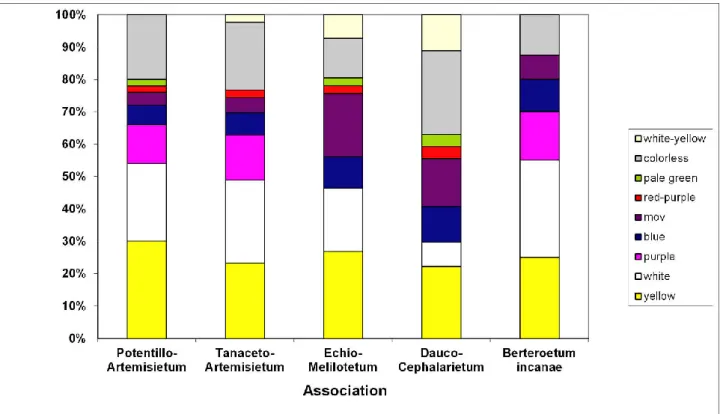
The chromatic variability is higher in the case of associations belonging to the Dauco-Melilotion and Onopordion alliances (Figure 2). The percentage of colorless flowers ("gray") is low.
Fig. 2. Representation of the chromatic variability within the analyzed associations (orig.)
CONCLUSIONS
In conclusion, we can say that the use of this type of vegetation in the aesthetics of a site has many advantages: reduction of the financial costs needed to maintain another type of vegetation, ensuring chromatic variability for a good period of time (June to September), ensuring a greater floral diversity compared to the cultivated vegetation; self-maintenance, minimization of maintenance work, etc.
228
BIBLIOGRAPHY
1. Buia Al., Popescu-Mihăilă Ana1952 – Contribuţii la flora regiunii Craiova. Buletin Ştiinţific. Secţiunea de Ştiinţe Biologice, Agronomice, Geologice şi Geografice. Tom. IV. nr. 3: 519-536. Bucureşti.
2. Buia A.&Păun M. 1960 – Materiale pentru flora şi vegetaţia împrejurimilor oraşului Craiova. SSNG. Com. de Bot., 1957-1959, Bucureşti, 281-296.
3. Buia A., Păun M. &Maloş C. 1961 – Pajiştilenaturale din Regiunea Craiova şiîmbunătăţirealor (II). Probleme Agricole. Anul XIII: 31-40.
4. Cîrţu D. 1971 – Vegetaţia ruderală de pajişti, căi de comunicaţie şi terenuri bătătorite din interfluviul Jiu-Desnăţui. Subcomisia OMN, filial Oltenia, Gorj. Stud.Cerc.: 223-228. Craiova.
5. Costache I. 2005. Flora şi vegetaţia bazinului hidrografic inferior al râului Motru. Teza de doctorat. 290 pag. București.
6. Czech B., Krausman P. R., and Devers P. K.2000. Economic associations among causes of species endangerment in the United States. Bioscience50: 593–601. 7. Maloş C. 1968 – Contribuţii la studiul florei şi vegetaţiei din Bazinul Superior al
Motrului. BuletinŞtiinţific. Nr. X.: 72-83.
8. Mathey J., Rink, D. 2010. Urban Wastelands – a chance for biodiversity in cities? Ecological aspects, social perceptions and acceptance of wilderness by residents, in: Müller, N., Werner, P., Kelcey, J.G. (Eds.), Urban biodiversity and design. Wiley-Blackwell, Chichester, pp. 406-424.
9. Maurer, U., Peschel, T., Schmitz, S., 2000. The flora of selected urban land-use types in Berlin and Potsdam with regard to nature conservation in cities. Landscape Urban Planning: 46, 209-215.
10. Miller, J.R., Hobbs, R.J., 2002. Conservation where people live and work. Conserv. Biol.:16, 330-337.
11. Niculescu, Mariana., 2016. Diversity, distribution and ecology of the freshwater natural habitats from Southern of Oltenia, Romania- Scientific Papers-Series a
Agronomy, Volume: 59 ISSN-1222-5339,
https://apps.webofknowledge.com/Search.do?product=WOS&SID=C2iDut4m8HPpd xgZPs8&search_mode=GeneralSearch&prID=05baa3a9-21cf-4989-81bf
daf67bb9f815
12. Păun M. 1966 –Asociaţiile de buruieni (buruienăriile) din culturile, pajiştile, şi locurile ruderale din Raionul Balş. Regiunea Oltenia. Bul. Ştiinţific Vol. VIII. Institutul Agronomic " T. Vladimirescu ": 27-41. Craiova.
13. Popescu G. 1974 – Studiul floristic şi geobotanic al Bazinului hidrografic al Bistriţei-Vîlcii. 303 pag. Teza de doctorat, Bucureşti.
14. Popescu G., Costache I. &Răduţoiu D.2003a. Consideration regarding the anthropophile Flora from the cities: Craiova, Băileşti, Calafat, Tg. Jiu and Tg. Cărbuneşti. Consideraţii cu privire la Flora antropofilă din oraşele: Craiova, Băileşti, Calafat,Tg. Jiu şiTg. Cărbuneşti”.Annales of the University of Craiova, Vol. VII (XLIII) 15. Popescu G., Costache I. &Răduţoiu D.2003b. Speciiruderale din lungulcăilor de comunicaţie cu posibilităţi de infestare a culturilor la S.D.E. Banu Mărăcine in APLICAŢII TEHNOLOGICE – GHID DE PRACTICĂ. TipografiaUniversităţii din Craiova. 19-22.
16. Răduțoiu D. 2006. “Flora şivegetaţia Bazinului Cernei de Olteţ”.Teza de doctorat. Bucureşti. 278 pag.
17. Van den Berg, A.E., Vlek, C.A.J., Coeterier, J.F., 1998. Group differences in the aesthetic evaluation of nature development plans: a multilevel approach. J. Environm. Psych. 18(2), 141-157.