Secure Broker-Less Publish/Subscribe Systems Using Identity-Based
Encryption
Vundrajavarapu Ajay Kumar
1, Sri K.Satyanarayana Raju
2 1M.Tech (IT), S.R.K.R Engineering College, A.P., India.
2Asst Professor, Dept. of Information Technology, S.R.K.R Engineering College, A.P., India.
Abstract —publish–subscribe is a messaging pattern where senders of messages, called publishers, do not program the messages to be sent directly to specific receivers, called subscribers. provisioning of basic security mechanisms such as authentication and confidentiality is highly challenging in a content based publish/subscribe system. Authentication of publishers and subscribers is difficult to achieve due to the loose coupling of publishers and subscribers. Likewise, confidentiality of events and subscriptions conflicts with content-based routing. This paper presents a novel approach to provide confidentiality and authentication in a broker-less content-based publish/subscribe system. The authentication of publishers and subscribers as well as confidentiality of events is ensured, by adapting the pairing-based cryptography mechanisms, to the needs of a publish/subscribe system. Furthermore, an algorithm to cluster subscribers according to their subscriptions preserves a weak notion of subscription confidentiality. In addition to our previous work [20], this paper contributes 1) use of searchable encryption to enable efficient routing of encrypted events, 2) multicredential routing a new event dissemination strategy to strengthen the weak subscription confidentiality, and 3) thorough analysis of different attacks on subscription confidentiality. The overall approach provides fine-grained key management and the cost for encryption, decryption, and routing is in the order of subscribed attributes. Moreover, the evaluations show that providing security is affordable w.r.t. 1) throughput of the proposed cryptographic primitives, and 2) delays incurred during the construction of the publish/subscribe overlay and the event dissemination.
Keywords
—
Content-based,publish/subscribe,peer-to-peer, broker-less, security, identity-based encryptionI. Introduction
P
ublished messages are characterized into classes, without knowledge of what, if any, subscribers there may be. Similarly, subscribers express interest in one or more classes, and only receive messages that are of interest, without knowledge of what, if any, publishers there are.Pub/sub is a sibling of the message queue paradigm, and is typically one part of a larger message-oriented middleware system. Most messaging systems support both the pub/sub and message queue models in their API, e.g. Java Message Service (JMS).This pattern provides greater network scalability and a more dynamic networkhas focused only on providing expressive and scalable pub/sub systems, but little attention has been paid for the need of security. Existing approaches toward secure pub/sub systems mostly rely on the presence of a traditional broker network [20], [2], [9], [12], [7], [18], [16]. These either address security under restricted expressiveness, for example, by using only keyword matching for routing events [12], [20] or rely on a network of (semi-)trusted brokers [19], [17], [12]. Furthermore, existing approaches use coarse-grain epoch based key management and cannot provide fine-grain access control in a scalable manner [12], [20]. Nevertheless, security in broker-less pub/sub systems, where the subscribers are clustered according to their subscriptions, has not been discussed yet in the literature. Building on our results of [13], this paper presents a new approach to provide authentication and confidentiality in a broker-less pub/sub system. Our approach allow subscribers to maintain credentials according to their subscriptions. Private keys assigned to the subscribers are labeled with the credentials. A publisher associates each encrypted event with a set of credentials. We adapted identity-based encryption (IBE) mechanisms [4], [8] 1) to ensure that a particular subscriber can decrypt an event only if there is a match between the credentials associated with the event and the key; and 2) to allow subscribers to verify the authenticity of received events. Furthermore, we address the issue of subscription confidentiality in the presence of semantic clustering of subscribers. A weaker notion of subscription confidentiality is defined and a secure overlay maintenance protocol is designed to preserve the weak subscription confidentiality. In addition to [3], we also present 1) extensions of the cryptographic methods to provide efficient routing of encrypted events by using the idea of searchable encryption, 2) “Multicredential routing” a new event dissemination strategy which strengthens the weak subscription confidentiality, and 3) a thorough analysis of different attacks on subscription confidentiality.
II .P
ROBLEMS
TATEMENTThe provisioning of basic security mechanisms such as authentication and confidentiality is highly challenging in a contentbased publish/subscribe system. Authentication of publishers and subscribers is difficult to achieve due to the loose coupling of publishers and subscribers. Likewise, confidentiality of events and subscriptions conflicts with content-based routing. This paper presents a novel approach to provide confidentiality and authentication in a broker-less content-based publish/subscribe system. The authentication of publishers and subscribers as well as confidentiality of events is ensured, by adapting the pairing-based cryptography mechanisms, to the needs of a publish/subscribe system. Furthermore, an algorithm to
cluster subscribers according to their subscriptions preserves a weak notion of subscription confidentiality.
III .
R
ELATEDW
ORKContent-Based Publish/Subscribe:
For the routing of events from publishers to the relevant subscribers, we use the content-based data model. The event space, denoted by , is composed of a global ordered set of d distinct attributes (Ai): f(A1, A2, ... Ad). Each
attribute Ai is characterized by a unique name, its data type, and its domain. The data type can be any ordered type such as integer, floating point, and character strings. The domain describes the range of possible attribute values. The operator O typically includes equality and range operations for numeric attributes and prefix/suffix operations for strings. An event consists of attributes and associated values. An event is matched against a subscription f if the values of attributes in the event satisfy the corresponding constraints imposed by the subscription. We consider pub/sub in a setting where there exits no dedicated broker infrastructure. Publishers and subscribers contribute as peers to the maintenance of a self-organizing overlay structure. To authenticate publishers, we use the concept of advertisements in which a publisher announces beforehand the set of events.
Attacker Model
There are three major goals for the proposed secure pub/ sub system, namely to support authentication, confidentiality, and scalability. Authentication. To avoid noneligible publications, only authorized publishers should be able to publish events in the system. Similarly, subscribers should only receive those messages to which they are authorized to subscribe. Confidentiality. In a broker-less environment, two aspects of confidentiality are of interest: 1) the events are only visible to authorized subscribers and are protected from illegal modifications, and 2) the subscriptions of subscribers are confidential and unforgeable. Scalability. The secure pub/sub system should scale with the number of subscribers in the system. Three aspects are important to preserve scalability: 1) the number of keys to be managed and the cost of subscription should be independent of the number of subscribers in the system, 2) the key server and subscribers should maintain small and constant numbers of keys per subscription, and 3) the overhead because of rekeying should be minimized without compromising the fine-grained access control.
Identity-Based Encryption
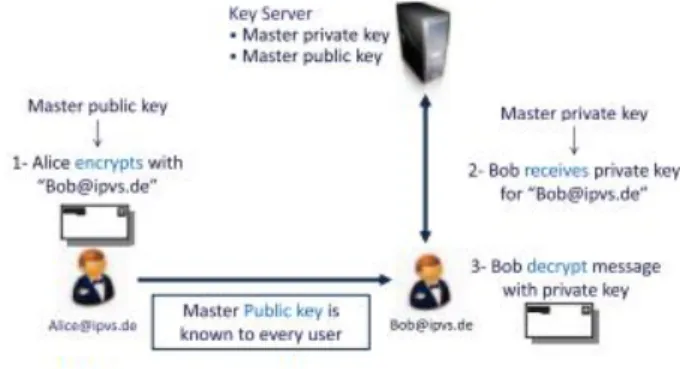
While a traditional PKI infrastructure requires to maintain for each publisher or subscriber a private/public key pair which has to be known between communicating entities to encrypt and decrypt messages, identity-based encryption [6] provides a promising alternative to reduce the amount of keys to be managed. In identity-based encryption, any valid string which uniquely identifies a user can be the public key of the user. A key server maintains a single pair of public
and private master keys. The master public key can be used by the sender to encrypt and send the messages to a user with any identity, for example, an e-mail address. To successfully decrypt the message, a receiver needs to obtain a private key for its identity from the key server. Fig. 1 shows the basic idea of using identity-based encryption. We want to stress here that although identity-based encryption at the first glance appears like a highly centralized solution, its properties are ideal for highly distributed applications. A sender needs to know only a single master public key to communicate with any
are then signed with the private key of the publisher, as shown in Fig. 2. The overlay network is maintained according to the containment relationship between the subscriptions. Subscribers with coarser subscriptions are placed near the root and forward events to the subscribers with less coarser subscriptions. To maintain such a topology, each subscriber should know the subscription of its parent and child peers. When a new subscriber arrives, it sends the connection request (CR) along with its subscription to a random peer in the overlay network. The connection request is forwarded by possibly many peers in the overlay network before it reaches the right peer to connect. Each forwarding peer matches the subscription in the request with the subscription of its parent and child peers to decide the forwarding direction. Maintaining a relationship between subscriptions clearly contradicts subscription confidentiality. Therefore, we show the approach to ensure a weaker notion of subscription confidentiality.
Numeric Attributes
The event space, composed of d distinct numeric attributes, can be geometrically modeled as a d-dimensional space such that each attribute represents a dimension in the space. With the spatial indexing approach, the event space is hierarchically decomposed into regular subspaces, which serve as enclosing approximation for the subscriptions, advertisements, and events. The decomposition procedure divides the domain of one dimension after the other and recursively starts over in the created subspaces. Fig. 3 visualizes the advancing decomposition with the aid of a binary tree. Subspaces are identified by a bit string of “0” and “1”s. A subspace represented by dz1 is covered by the subspace represented by dz2, if dz2 is a prefix of dz1. Subscription or advertisement of a peer can be composed of several subspaces. A credential is assigned for each of the mapped subspace. For instance, in Fig. 3, f2 is mapped to
two subspaces and therefore possesses two credentials f000; 010g. An event can be approximated by the smallest
(finest granularity) subspace that encloses the point represented by it. To deliver the encrypted event, a ciphertext must be generated for each subspace that encloses the event so that the peer whose subscription mapped to any of these subspaces should be able to successfully decrypt the event. For example, an event 0010 is enclosed by the five subspaces 0010, 001, 00, 0, and . For an event space with a large set of numeric attributes, the number of mapped subspaces and, therefore, credentials for a subscription can be very large. This affects the scalability of the system. We address this problem by decomposing the domain of each attribute into subspaces separately. The spatial indexing procedure is the same as above; however, in this case, a separate decomposition tree is built for each attribute. Each peer receives credentials separately for each attribute in its subscription. The number of credentials maintained for each subscription or advertisement is bounded.
IV. Conclusion
and subscribers according to their subscriptions and advertisements.In this paper, we have presented a new approach to provide authentication and confidentiality in a broker-less contentbased pub/sub system. Private keys assigned to publishers and subscribers, and the ciphertexts are labeled with credentials. We adapted techniques from identitybased encryption 1) to ensure that a particular subscriber can decrypt an event only if there is a match between the credentials associated with the event and its private keys and 2) to allow subscribers to verify the authenticity of received events. Furthermore, we developed a secure overlay maintenance protocol and proposed two event dissemination strategies to preserve the weak subscription confidentiality in the presence of semantic clustering of subscribers. The evaluations demonstrate the viability of the proposed security mechanisms and analyze attacks on subscription confidentiality.
R
EFERENCES[1] E. Anceaume, M. Gradinariu, A.K. Datta, G. Simon, and A.
Virgillito, “A Semantic Overlay for Self- Peer-to-Peer Publish/
Subscribe,” Proc. 26th IEEE Int’l Conf. Distributed Computing Systems (ICDCS), 2006.
[2] J. Bacon, D.M. Eyers, J. Singh, and P.R. Pietzuch, “Access Control in Publish/Subscribe Systems,” Proc. Second ACM Int’l
Conf. Distributed Event-Based Systems (DEBS), 2008.
[3] W.C. Barker and E.B. Barker, “SP 800-67 Rev. 1. Recommendation for the Triple Data Encryption Algorithm
(TDEA) Block Cipher,” technical report, Nat’l Inst. of Standards
& Technology, 2012.
[4] J. Bethencourt, A. Sahai, and B. Waters, “Ciphertext-Policy Attribute-Based Encryption,” Proc. IEEE Symp. Security and Privacy, 2007.
[5] D. Boneh, G.D. Crescenzo, R. Ostrovsky, and G. Persiano,
“Public Key Encryption with Keyword Search,” Proc. Int’l
Conf. Theory and Applications of Cryptographic Techniques on Advances in Cryptology (EUROCRYPT), 2004.
[6] D. Boneh and M.K. Franklin, “Identity-Based Encryption
from the Weil Pairing,” Proc. Int’l Cryptology Conf. Advances
in Cryptology, 2001.
[7] S. Choi, G. Ghinita, and E. Bertino, “A Privacy-Enhancing Content-Based Publish/Subscribe System Using Scalar Product
Preserving Transformations,” Proc. 21st Int’l Conf. Database
and Expert Systems Applications: Part I, 2010.
[8] V. Goyal, O. Pandey, A. Sahai, and B. Waters, “Attribute -Based Encryption for Fine-Grained Access Control of Encrypted Data,” Proc. ACM 13th Conf. Computer and Comm. Security
(CCS), 2006.
[9] M. Ion, G. Russello, and B. Crispo, “Supporting Publication and Subscription Confidentiality in Pub/Sub Networks,” Proc.
Sixth Int’l ICST Conf. Security and Privacy in Comm. Networks
(SecureComm), 2010.
[10] H.-A. Jacobsen, A.K.Y. Cheung, G. Li, B. Maniymaran, V.
Muthusamy, and R.S. Kazemzadeh, “The PADRES Publish/ Subscribe System,” Principles and Applications of Distributed
Event-Based Systems. IGI Global, 2010.
[11] M. Jelasity, A. Montresor, G.P. Jesi, and S. Voulgaris,
“PeerSim: A Peer-to-Peer Simulator,”
http://peersim.sourceforge.net/, 2013.
[12] H. Khurana, “Scalable Security and Accounting Services
for Content-Based Publish/Subscribe Systems,” Proc. ACM
Symp. Applied Computing, 2005.
[13] A. Lewko, A. Sahai, and B. Waters, “Revocation Systems with Very Small Private Keys,” Proc. IEEE Symp. Security and
Privacy, 2010.
[14] B. Lynn, “The Pairing-Based Cryptography (PBC)
Library,” http://crypto.stanford.edu/pbc/, 2010.
[15] F.P. Miller, A.F. Vandome, and J. McBrewster, Advanced Encryption Standard. Alpha Press, 2009.
[16] M. Nabeel, N. Shang, and E. Bertino, “Efficient Privacy Preserving Content Based Publish Subscribe Systems,” Proc.
17th ACM Symp. Access Control Models and Technologies, 2012.
[17] L. Opyrchal and A. Prakash, “Secure Distribution of
Events in Content-Based Publish Subscribe Systems,” Proc.
10th Conf. USENIX Security Symp., 2001.
[18] L.I.W. Pesonen, D.M. Eyers, and J. Bacon, “Encryption -Enforced Access Control in Dynamic Multi-Domain
Publish/Subscribe Networks,” Proc. ACM Int’l Conf.
Distributed Event-Based Systems (DEBS), 2007.
[19] P. Pietzuch, “Hermes: A Scalable Event-Based
Middleware,” PhD dissertation, Univ. of Cambridge, Feb. 2004.
[20]C. Raiciu and D.S. Rosenblum, “Enabling Confidentiality
in Content-Based Publish/Subscribe Infrastructures,” Proc. IEEE Second CreatNet Int’l Conf. Security and Privacy in Comm.