PHYSIOLOGICAL PARTICULARITIES OF HYGROPHILOUS PLANTS
FROM DOMOGLED-CERNA VALLEY NATIONAL PARK
BUSE DRAGOMIR LUMINITA1, NICULESCU MARIANA2
1University of Craiova, Faculty of Horticulture, Departament of Plant Physiologie, 19 Libertatii Street,200583, Craiova, [email protected] 2University of Craiova, Faculty of Agronomy, Departament of Botany, 19 Libertatii Street,200583, Craiova *Corresponding author, e-mail: [email protected]
Key words: hygrophyllous plants, photosinthesis, transpiration, water content
ABSTRACT
The vegetal asociation Telekio-Petasitetum (Morariu 1967, Resmerita et Ratiu, 1974) is well represented in Domogled –Cerna Valley National Park, across Cerna’s valley and its main tributaries. The two enlightening species, Petasites hybridus and Telekia speciosa are characterized by their tall stem, big leaf area and a high photosynthetic efficiency. The water regime of these plants is a characteristic for the hygrophilous species, with a high water content in tissues and raised transpiration values. Due to their evolved root system and their good capacity of regeneration, the plants that have been taken in this study have an important ecological role, forming true corridors along rivers and contributing at the consolidation of river banks.
INTRODUCTION
Domogled-Cerna Valley National Park is a protected area located on the administrative territory of Caras-Severin, Mehedinti and Gorj County, in the South-Western side of Romania.
The National Park stretches across Cerna Mountains and Godeanu Mountains (on the right side) and Vâlcan Mountains and Mehedinti Mountains (on the left side).
Domogled Cerna Valley founded in 1990 with an area of 61211 hectares was declared protected area on March 6, 2000.
The National Park is characterized by an impressive floristic diversity, due to the complexity of climatic conditions and physical and geographical aspects. The scenery found along the valley is gorgeous, being dominated by towering massifs like Godeanu, Cerna Mountains, Mehedinti and Vâlcan Mountains that watch over the Cerna river basin. Limestone formations combine here with rigid rocks and rich vegetation, creating a rare natural phenomenon that must be preserved.
The importance of the site consists in the richness of the flora, of great value in biological, geobotanical and ecological reports, especially regarding the association of various geographical origins species which also generated specific local vegetal associations (Nature 2000 Formulary).
taxa giving the name of the association (Radutoiu D., Marinescu, E.,2014)
Radutoiu D.(2008) find this association in Cerna de Oltet region, and Radutoiu D. Marinescu E. (2014), in Tirnovu Mare-Latorita at 800-1100m altitude, in Nordic exposure.
MATERIAL AND METHODS
Experiences have been effectuated in may-july 2015 in Domogled-Cerna Valley Park, in three different locations:
- Olanu Valley, Lat N 45008,,16,9,, , Long E 220 38, 38,5 ,, 600 m altitude, S-E
exposure
- Iauna Mica Valley, Lat. N 45 004 ,15,7,,Long. E 22 033 ,44,2,,, 672 m altitude, N
exposure
- Cerna Valley, Lat. N 45 005 , 58,2 ,,Long. E 22 0 38 , 57,7,,, 475 m altitude, E
exposure.
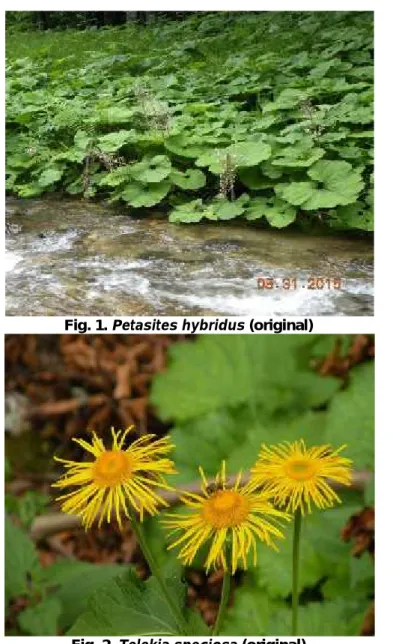
For the determinations were used species Petasites hybridus (fig.1) and Telekia speciosa(fig. 2).
Petasites hybridus , ord Asterales, Asteraceae family is a perennial herbaceous plant with a distinctive smell. In the soil it has a thick, gnarled and branched rhizome from which start very long fleshy roots and also thick (1 cm across), cylindrical, smooth, having more than 1 m in length stolons. The plant flowers in March-April, before the appearance of leaves. Steams which carry the inflorescence have a height of 15-40 cm, are unbranched, straight, thick. Inflorescences are long, at the beginning of the flowering process they are dense, later they get sparse. Flowers are tubular, red, have a length of 10-11 mm. Leaves are very large, round, with a diameter of 50 cm, heart-shaped. The petiole is thick, 30-80 cm long, cylindrical, empty inside. The plant grows on stream banks, in wet places, around springs, from plain areas to mountains.
Telekia speciosa, ord Asterales, familia Asteraceae, is an perennial herb , with a height of 60-150 cm.
The stem is finely haired, green–violet, violet–dark or reddish brown and strongly scented.
Flowers form 5–7 cm (2–3 in.) wide, single flower-like capitula surrounded by involucral bracts. Capitulum’s ray-florets yellowish orange, tongue-like; disk florets brownish yellow, tubular, small. Stamens 5. Gynoecium composed of 2 fused carpels. Involucral bracts overlapping in many rows, outer ones leafy, ovate, recurved, hairy; inner ones wide. Capitula borne in a lax corymbose cluster.
Leaves: Alternate, lower stalked, upper stalkless, almost amplexicaul. Blade lower down ovate, cordate based, 30–40 cm (12–16 in.) long, higher up widely elliptic, double-toothed, thin, rough underneath, almost glabrous on top.
Fig. 1.Petasites hybridus(original)
Fig. 2.Telekia speciosa(original)
On the biological material were determined: the intensity of leaf transpiration, the intensity of photosynthesis, the content of assimilatory pigments and the water content. Transpiration, photosynthesis and respiration in leaves were determined using LCi portable device.
The chlorophyll content of leaves was determined with the Minolta portable chlorophyll meter (SPAD units).
The water content and the dry matter were gravimetrically determined by maintaining the biological material to a temperature of 1050C until reaching a constant
weight(Nicolae I., 2008).
RESULTS AND DISCUSSIONS 1. Photosynthesis
The high photosynthetic efficiency has a great importance, leading to the accumulation of a great quantity of biomass and to fast growths in short periods of time.
The light factor is not a limited one for these plants; they are able of achieving high values of photosynthesis, even at low intensities of light.
Gr. 1. The intensity of leaves photosynthesis ((µmolCO2/m2/s)
2. Content in assimilating pigments
Determinations made in june at leaves of the plants from the three locations have not highlighted significant differences in what concerns the content of chlorophyll pigments. In comparison with Telekia speciosa,at which the maximum content was of 43 SPAD unities,Petasites hybridusrecorded the maximum value of 54 SPAD unities (gr. 2).
The higher quantity of assimilative pigments and the foliar structure with mesofil and large ribs give this plant an advantage in adaptation, realizing a fast grow of both aerial parts and the root system which strongly fixes the plant in the unstable soil.
Gr. 2. The chlorophyll content of leaves (SPAD unities)
3. Leaf transpiration
The intensity of leaf transpiration records very high values at both species (gr. 3). These values are due to the great quantity of absorbed water, the big foliar surface and the high number of stomata from the leaves. In semi-shadow conditions, the intense transpiration can be utile, leading to the elimination of the water excess, but in conditions of illumination and at raised temperatures, especially at plants which have no root system
0 10 20 30 40
Cerna
Valley Iauna MicaValley OlanulValley
Petasites Telekia
0 10 20 30 40 50 60
Cerna valley Iauna Mica Valley Olan Valley
Gr. 3. The intensity of leaves transpiration (mmol H2O/m2/s)
The water content of leaves records maximum values at plants which are situated in the Iauna Mica Valley - Nordic exposure (gr. 4). Of the two species studied, Petasites hybridus presents much higher values of the water content, with a maximum of 85%, in comparison withTelekia speciosa, at which the maximum is of 73%.
Gr. 4. The water content of leaves (%)
CONCLUSIONS
- Hygrophilous species Petasites hybridus and Telekia speciosa are well represented in Domogled Cerna Valley National Park
- These perennial species with a high stem and well developed root system have an important ecological role, fixing the banks
- High values of the photosynthesis intensity lead to the accumulation of a great
11,5 12 12,5 13 13,5 14 14,5
Cerna Valley Iauna Mica
Valley Olanu Valley
Petasites Telekia
0 20 40 60 80 100
Cerna Valley Iauna Mica
Valley Olanu Valley
- Water content of leaves is very high; highest values have been measured at
Petasites.
REFERENCES
Ciocârlan V. 2000 - Flora ilustrată a României, Pteridophyta et Spermatophyta.,
Bucureşti, Edit. Ceres: 1138 pp.
Doniţă, N., Popescu, A., Paucă-Comănescu, M., Mihăilescu, S., Biriş, I. A.,
2005 ,Habitatele din România,Bucureşti Edit. Tehnică Silvică, 496 pp
Doniţă, N., Popescu, A., Paucă-Comănescu, M., Mihăilescu, S., Biriş, I. A.,
2006 , Habitatele din România. Modificări conform amendamentelor propuse de România
şi Bulgaria la Directiva Habitate (92/43/EEC),Bucureşti, Edit. Tehnică Silvică
Nicolae, I.,2008,Practicum de fiziologie vegetala, Ed. Sitech, Craiova
Radutoiu, D.,Marinescu E., 2014, Study of hygrophilous vegetation from Tirnovu Mare- Latorita, Valcea- Romania, Annals of the University of Craiova, vol. XIX(LV), 571-576
Radutoiu, D.,2008, Flora si vegetatia Bazinului Cernei de Oltet, Ed. Sitech, Craiova, 407p
Sanda, V., Ollerer K.,Burescu, P.,2008, Fitocenozele din Romania, Ed. Arsdocendi, Univ. din Bucuresti
Sârbu, Anca, 2007 , Arii speciale pentru protecţia şi conservarea plantelor în
România, Bucureşti: Edit. Victor B. Victor.
*** 2007 - Interpretation Manual of European Union Habitats - EUR27. European Commission. DG Environment. Nature and biodiversity
***http://natura2000.mmediu.ro/upl//formulare/ROSCI0069%20-%20F.pdf *** http://www.brc.ac.uk/plantatlas/index.php?q=node/498
*** http://phd.lib.uni-corvinus.hu/650/2/Csabai_Judit_ten.pdf