1067 | P a g e
AWARENESS AND UTILIZATION OF LIBRARY
RESOURCES BY LIBRARY USERS’ OF NIMS
UNIVERSITY CENTRAL LIBRARY, JAIPUR, INDIA
Suleiman Hussaini
1, Dr Rajeev Vashistha
2, Hassana Jimah
31
Research Scholar,
2Associate Professor, Department Of Library and Information Science,
Nims University, Jaipur India.
3
PG Students, Department of Library and Information Science, A.B.U Zaria, Nigeria.
ABSTRACT
The main argument behind this paper was to determine the awareness and utilization library resources by library users’ of NIMS Central Library, Jaipur India. In this study, a descriptive survey method was used, using
a questionnaire as a data collection tool. 60 library users were selected randomly from the NIMS University Central Library and managed by a questionnaire, of which 52 copies were completed and returned. The research questionnaires were analyzed by the frequency counts and simple percentages. The findings showed that participants surveyed disclose that female preferred the library more than their male counterparts less than 30 years of age. It was also noted that the majority of respondents indicated that 34 (65.3%) of library resources, indicated that gazetteers were not available. Users of the NIMS Central Library use more books / e-books, journal/ electronic journals, newspapers / magazines, and Internet /computer. It concluded that for the proficient and effective use of the library for teaching, learning and research, the academic institution must provide a live library of updated library resources to get together the information requirements of the library users’. It recommended that the management of the library or university should bring in the use of library literacy education to teach users how to properly manage the library. This will encourage more users who are not aware of the library resources. Finally, Board Display Services should be expanded sufficiently to reflect the available resources to users’ and thus representing all library resources.
Keywords:
Availability, Awareness, Library Resources, Library Users’, NIMS University, Central
Library, Utilization.
1.
INTRODUCTION
The library contains several types of reading materials, ie books, magazines, maps, microforms, audio
1068 | P a g e
Library users visit the library to receive sufficient, significant and up-to-date information in print andnon-printed forms for effective teaching, learning and research that meets their information needs, allowing them to
make important decisions [1]. However, they can obtain this information through research, which includes the
search for new ideas, facts and information through scientific and methodological research [2]. Therefore, the
library is stacked with diverse type of recorded information,: like books, periodicals, reference materials,
manuscripts, periodicals, etc. e-resources such as microforms, films, tapes and slides. Videos and data stored on
electronic media such as disks and CDs are available in the libraries [3]. Academic libraries are libraries created
in colleges, such as polytechnics, universities, colleges of education etc. Its main function is to provide
resources and information services to achieve the overall objectives of the parent education and research
program [4].
However, the University alone cannot achieve the commendable goals of education without the Library [5].
As a result, academic libraries are established to support the teaching, learning, research and charitable services
of their parent organizations through the acquisition, processing, storage, retention and provision of information
[6]. Aina [2004] in [7] considers library users as all those who exploit the services given by the library.
1.1 Library Resources
The term "resource" refers to the source of supply, in general. It is said that a person is "witty" when he can deal
with difficult situations [8]. Fayose [2000] in [9], library resources have been discovered as materials that allow
libraries to effectively perform the functions of providing resources to clienteles like books and other media. It
also contains everything that is used to provide the requested information service from the client. According to
Kent and Lancour [1971] in [10], library resources includes, among others, books, manuscripts, periodicals,
government publications, brochures, catalogs, reports, files, microfilm, microfiche and micro cards. Punched
cards, computer tapes and so on. [11] included that library resource comprise prints and electronics, including
textbooks, magazines, notebooks, summaries, newspapers, magazines, reports, databases on CD-ROM, Internet,
e-mail, video cassettes, floppy disks, computers and microforms.
Awareness is to know that something exists or to understand a situation or a subject at current moment found on
information/experience [12]. It can also be understood as knowledge of a situation, truth, conscience,
knowledge, achievement, understanding and perception. Recognition of attention and intimacy in a given
position or development [13]. The use of resources and information services is the amount the library resources
and services are used in teaching, learning and research. The extent to which library resources are used in
university libraries is generally reflected in library statistics, compiled daily by library staff [14]. [15] identify
use as an activity that measures the value of a library article or information system. Therefore, use is the only
measure we adopt to determine why a document is retained in the library collection, and its use is necessary for
1069 | P a g e
2.
BACKGROUND OF THE STUDY
In conjunction with the mission of creating career paths for the future, NIMS has become the largest and
best self-financing university in Northern India. NIMS was established in the same way as the leading
universities in the world and well known in research and teaching in all disciplines. Nearby the Aravali
Mountains, located in Jaipur, India. The university is among the ten top medical universities in India and the
hub of education in health sciences to humanities, technical training to advance engineering, personnel
management to corporate management, creative literature for multimedia, innovative arts and architecture. The
university has an ideology for effective teaching. The curricular and co-curricular activities are planned and
managed by faculty members from different departments. College of Medicine and Hospital provide a base for
highly qualified and experienced professors of leading institutions of national and international importance. Our
Institute of Advanced Engineering and Technology seeks to be among the best in the country, thanks to IIT and
ILS faculty members.
3.
STATEMENT OF THE PROBLEM
The importance of the library lies in the accessibility, awareness and exploiting of resources by users of
academic institutions [17]. However, the University Library faces a critical challenge in responding to the new
demand of the 21st century with growing demographic growth linked with a lack of appropriate usage of library
resources. [18], [19]. Studies have shown that Mann (1974), during his research has shown that students can
complete their field of study with relatively little use of library books. This assertion was also confirmed in
subsequent studies by Popoola (2008), Seth and Parida (2006), Ugwu (2008), Nnadozie and Nnadozie (2008)
[20] stressed out that the ease of use of library resources is automatically transferred to as information access.
The sad fact is that, despite the number of studies on the utilization of library resources, there is no
comprehensive study demonstrating the awareness and use of library resources among library users’ in this
strategic institution [21], [22]. This compels us to ask ourselves whether it is because of the insufficient
availability of these resources, inadequate knowledge and inadequate utilization of these resources.
Therefore, the study was designed to determine awareness and utilization of library resources from the
central library of Nims University, Jaipur, Rajasthan, India.
4.
SCOPE OF THE STUDY
The scope of the study covered the awareness and utilization of sixty library users’ at NIMS University Central
Library, Jaipur India.
5.
OBJECTIVES OF THE STUDY
1. To identify varied forms of library users’ available to library users’ in NIMS University Central library,
1070 | P a g e
2. To establish the level of awareness of library resources by library users’ of NIMS University Centrallibrary, Jaipur India.
3. To find out the extent to which library users’ utilize library resources in NIMS University Central library,
Jaipur India.
6.
RESEARCH QUESTIONS
1. What are the varied forms of library resources available to library users’ in NIMS University Central
library, Jaipur India?
2. What is the level of awareness of library resources by library users’ of NIMS University central library,
Jaipur India?
3. What is the extent of utilization of library resources by library users’ in NIMS University Central library,
Jaipur India?
7.
LITERATURE REVIEW
Douglas [23] conducted a study entitled "e-books or textbooks: students prefer textbooks," noting that students,
despite the arrival of computers interactive technologies, in their class, textbooks are preferred more by the
students than e-books for learning and this preference does not change because of knowledge of the center. Both
Adeoye and Popoola [2011] in [24] highlighted the effectiveness, availability, accessibility and usage of
information resources in their studies. [25] conducted a study and discovered that many users still prefer
electronic print. Based on this finding, they suggest that e-book offers from the publishers and libraries may be
higher than many users' preferences. Oyewusi and Oyeboade (2009) in [26] carried out a study at Ladoke
Akintola University in Ogbomosho, Nigeria, to study the access and utilization of library resources among
students. A questionnaire was distributed to 600 university students, 393 of which were suitable for data
analysis and finalization. Respondents were asked to provide rationale for making use of the library. The survey
revealed that 76.8% of the respondents believed that, the library is a place used to read and study, 7.9% for
research, and 4.3% go to the library to be loaned books. While 7.4% doze and socialize in the library. It was
further revealed that Nigerian students perceive the library to be a serious academic workplace. [27] found out
that most graduate students exploit e-books more frequently than students, who were more frequently used by
students and academics in the humanities and social sciences. He persistently said that e-books are used by
students for entertainment, and fiction e-book was the most popular, not textbooks, non-fiction and research
monographs. Komolafe-Opadeji (2011) in [28] investigated the use of the Internet and e-resources among
graduate students at a Nigerian private university and found that students frequently access the Internet and
share at no cost e-resources from Google and Wiki and e-databases such as JSTOR, Questia e.t.c and High
Beam. [29] evaluated electronic resources in agriculture in the context of the Agricultural University of Kerala.
The study found that 100% of users were known with the use of digital e-resources that were available on the
1071 | P a g e
using information from the library based on the program and Services. [30] conducted a study on awareness,accessibility and use of electronic databases among academics Babcock University staff. It was found that
respondents had knowledge about journals 59 (69.4%), JSTOR 48 (56.5%), Theses & Dissertation 46 (54.1),
and Ebscohost 43 (50.6). The analysis also showed that most respondents did not know book Boon, the World
Bank's Open Knowledge Warehouse and the National Virtual Library 22 (25.9%), 28 (32.9%) and 25 (29.4%),
respectively. It is also concluded that nine of the 13 audited databases were assessed by respondents on average.
This means creating awareness about all electronic resources shared by the Library. Okiy (2000) and
Ajileye-Laogun (2002) in [31] evaluated the use of the library by students and teachers. It was found out that students
and teachers make use of the library materials for teaching and research at the State University Delta , Abraka,
and OAU, Ile-Ife.
8.
METHODOLOGY
A descriptive survey research design was used for the study using questionnaires to collect data from the study
participants. The tool was used to gather detailed information about the participants' studied. Among the target
groups for library users, a random sample of 60 participants was selected from the library uses’. Of these, 52
representing 87% of the total, were distributed and retrieved from the participants of the NIMS Central Library,
Jaipur, India. The collected data were analyzed and presented in tables containing descriptive statistics,
especially percentage, and graph replicas.
9.
RESULTS
1072 | P a g e
Figure 1 shows the distribution of library users by sex. The results showed that 32% (61.5%) of the femalesurveyed were the main users of the library, while 20 (38.4%) of the respondents were users of the male library.
This means female beneficiaries often use the library more than the men surveyed and are more numerous than
their male counterparts at the NIM Medical Library, Jaipur, India.
Figure 2, Age of the respondents
Figure 2 above, shows the age of the participants. The results showed that 48 (92.3%) of the respondents who
used library resources in the library were less than 30 years old. 2 (3.8%) between the ages of 30 and 40 years
and 2 (3.8%) 50 years above. The age limit 41-50 was not in the library at the during this investigation. This
1073 | P a g e
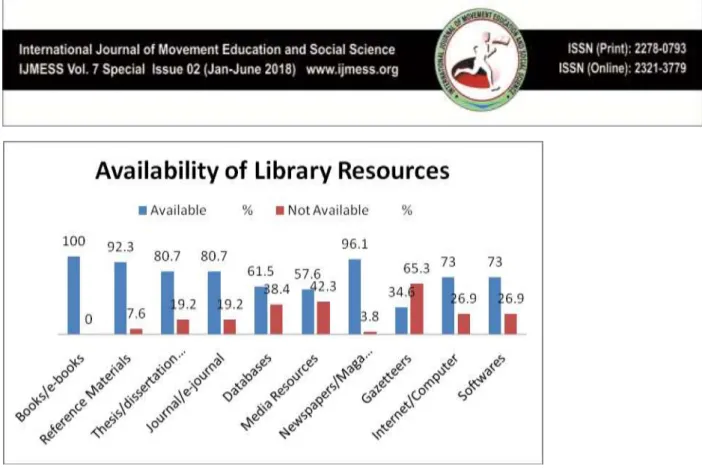
Figure 3, Availability of resources in the library
From Figure 3 above, all respondents indicated that books / e-books 52(100%) were available in the library.
Other sources indicated that the reference materials 48 (92.3%), Dissertation / Thesis / Project 42 (80.7%),
Journals/ Electronic Journal 42 (80.7%), Databases 32 (61.5%), Media Sources 30 (57.6%) Internet/ Computer
38 (73.0%) and software 38 (73.0%) are available to them in the library. On the other hand, a majority of
respondents indicated that the Gazetteers 34 (65.3%) is not available in the library. The findings showed that the
NIMS library is stacked well with enough library resources for the users’ daily use.
TABLE 1: Level of Awareness of Library Resources N=52
S/N Awareness of Resources Aware
F %
Not Aware
F %
1 Internet/Computer 38 73.0 14 26.9
2 Software 24 46.1 28 53.8
3 Media Resources 24 46.1 28 53.8
4 Newspapers/Magazines 44 84.6 8 15.3
5 Databases 24 46.1 28 26.9
6 Thesis/dissertation/Project 34 65.3 18 34.6
7 Journal/e-journal 42 80.7 10 19.2
1074 | P a g e
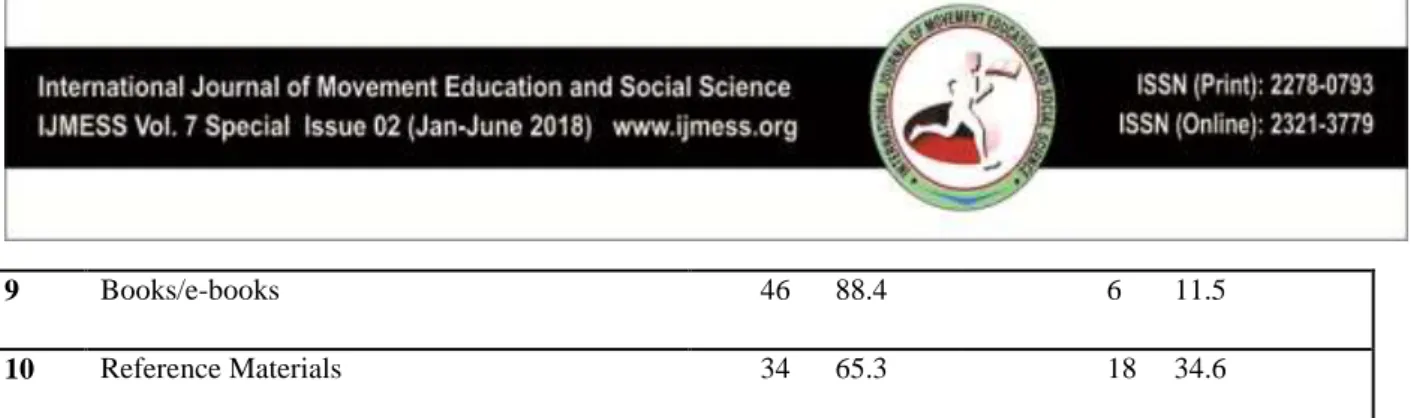
9 Books/e-books 46 88.4 6 11.5
10 Reference Materials 34 65.3 18 34.6
Table 1 above shows the level of awareness of the library resources of the respondents. The results showed that
the respondents were fully aware with the resources of the library such as Internet / Computer that represents
38% (73.0%), Dissertation / Thesis / Project 34 (65.3%), Books/e-books 46(88.4%), Electronic journals /
Journals 42 (80.7%), ) and reference materials 34 (65.3%). This study is supported by the findings of [32],
which showed that most of the respondents are familiar with the academic journal, databases, thesis and
dissertations, respectively. This study also supports the results of [33]. On the other hand, small proportion of
respondents indicated that they were not aware with the resources of the library, such as the Software that
represents 24 (46.1%), Media resources 24 (46.1%) and Gazetteers 20 (38.4%).
TABLE 2: Extent of Utilization of Library Resources N=52
S/N Library Resources Yes
F %
No
F %
1 Newspapers/Magazines 46 88.4 6 11.5
2 Gazetteers 24 46.1 28 53.8
3 Media resources 20 38.4 32 61.5
4 Internet/computer 32 61.5 20 38.4
5 Databases 20 38.4 32 61.5
6 Reference materials 36 73.0 14 26.9
7 Books/e-books 46 88.4 6 11.5
8 Software 22 42.3 30 57.6
9 Journal/e-journal 36 69.2 16 30.7
10 Thesis/dissertation/Project 34 65.3 18 34.6
Table 2 above shows the use of library resources by the users of the library. The outcome of the results showed
that the majority of respondents indicated to use library resources Newspapers / Magazines representing 46
1075 | P a g e
e-journal 36 (69.2%) and Thesis / dissertation / project 34 (65.3%). This study also supports the results ofWilliam et al., (2010), Julie et al., (2014), Wang and Bay (2016) and Komolafe-Opadeji (2011) in [34]. However, very little respondents indicated that they do not use library resources, such as Media resources 20
(38.4%), Databases 20 (38.4%), and Software 22 (42.3%)
10.
SUMMARY OF THE FINDINGS
Summary of results showed the following;
1. It was revealed that those females surveyed were more likely to attend the library than their male counterparts
under the age of 30.
2. It was also revealed that the majority of the respondents 34(65.3%) reported that library resources such as
gazetteers were not available to them.
3. The majority of respondents are aware of library resources, such as the Internet / computer, dissertation /
thesis / project, books / e-books and journals / e-journal.
4. Users of the NIMS Central Library use more books / e-books, journals / electronic journals, newspapers /
magazines, and Internet / computer
11.
CONCLUSION
It can be concluded that the effectiveness and efficiency of teaching, learning and research in each university
institution is to provide vibrant library stacked with library resources updated to meet up the information
requirements of library users which would allowing them to make important and relevant decisions. Thus
improves the library sustainability by attracting many users.
12.
RECOMMENDATIONS
Based on the above findings, some recommendations were made, including:
1. The information should be used from the library to be read and written by the parties concerned or to manage
the library / university to teach users how to properly cope with the library. This will encourage more users who
do not know the library resources.
2. Map presentation services should be properly developed to reflect the resources available to users, which will
display all resources in the library.
3. Must expand other e-books / e-books / electronic journals / CD. The databases, software, and ICT devices,
1076 | P a g e
REFERENCES
[1] O.Q. Ganiyu, E.A. Edale, and A.I. Oluwafemi, A study of Availability and Utilization of Library Electronic
Resources by Undergraduate Students in Private Universities in Ogun State, Nigeria. International Journal of
Library and Information Science, 6(2), 2014, 28-34.
[2] O. Omotunde, M. Ehioghae, T.K. Aluko-Arowolo, A.O. Onasote. Utilization of Library Resources for
Effective Research Output among postgraduate Students in Adventist University of Africa. Global Advance
Research Journal of Social Science (GARJSS), 3(4), 2014, 52-57.
[3] C.B. Ishola, S.O. Obadare, Availability, Access to and level of Use of Academic Library Information
Resources: Study of selected Academic Libraries in South-Westhern Nigeria. Journal of Educational and
Practice. 5(28), 2014, 20-33.
[4] M.A. Bitagi, K.S Garba, Evaluating Study of Information Resources and Services Utilization for Research in
Academic Libraries in Niger State, Nigeria, International Journal of Research in Business Management, 2(5),
2014, 122-127
[5] H.A. Moruf, and J.O Muhammed, The Use of Library Resources by Teachers in Oyo State: A Study of
selected Secondary Schools In Akinyele Local Government Area, Nigeria. Journal of Research Method in
Education (IOSR-JRME). 5(3), 2015, 49-54
[6] H. Suleiman, V. Rajeev, A.O. Jimoh, and H. Jimah, Automation of Library Services for Enhanced Users’
Satisfaction of Information Resources in Academic Libraries in Nigeria, Proc of International Conference on
Recent Innovation in Science, Engineering, Humanities and Management (ICRISEHM-17) Chhatrapati Shahu
Maharaj Shikshan Sanstha’s (CSMSS) College of Polytechnic, Kanchanwadi, Aurangabad-(MS) India, 2017.
[7] H. Suleiman, Rajeev, H. Jimah, Information Needs of Library Users’ in Kano State University of Science
and Technology, Wudil Nigeria. 8th International Conference on Recent Development in Engineering, Science,
Humanities and Management (ESHM-17) Institute of Engineers, Delhi State Centre India. 2017
[8] N.C. Jonathan, N. Udo, Information Resources, Retrieval and Utilization for Effective Research in Tertiary
and Research Institutions. Asian Journal of Humanities and Social Sciences (AJHSS). 1(3), 2013, 43-50
[9] H. Suleiman, V. Rajeev, A. Garba, H. Jimah, Cloud Computing in Nigeria University System: An Overview.
2nd International Conference on Emerging Trends in Engineering, Science and Management (ESM-17) Indian
Federation of United Nations Association, New Delhi (India) 2017.
[10] O. Jimoh, S. Hussaini, U. Ibrahim, Collection development policy: A survey of academic libraries in
Federal and State Universities, Kaduna State Nigeria, Proc. of 5Th LIPS Conf. on Ownership to Access:
Leveraging the Digital Paradigm, Ambedkar University Delhi in Association with Society for Library
professionals and Special Library Association, Asian Chapter Lothian Road, Kashmere Gate, Delhi India, 2016.
[11] M.O. Adeoye, S.O. Popoola, Teaching Effectiveness, Availability, Accessibility and Use of Library and
1077 | P a g e
Philosophy and Practices. Retrieved on 29th April, 2018 fromhttp://webpages.uidaho.edu/mbolin/adeoye-popoola..htm
[12] E.A. Okon, B.Ahiauzu, Towards Effective Development of Electronic Information Resources in Nigerian
University Library, Library Management, 29(6/7), 2008,504-514.
[13] L.O. Akpojotor, Awareness and Usage of Electronic Information Resources among Postgraduate Students
of Library and Information Science in Southern Nigeria. Journal of Library Philosophy and Practice, 2016.
[14] Ibid Ref. No. 4
[15] B.L. Cox, and M.H. Janti, Capturing business intelligence required for targeted marketing, demonstrating
value, and driving process improvement, Library and Information Science Research. 34(4), 2012, 308-316.
[16] Ibid Ref No. 14
[17] A.I. Ntui, A.E. Udah, Accessibility and Utilization of Library Resources by Teachers in Secondary Schools
in Calabar Education Zone of Cross River State, Nigeria. Global Journal of Humanities Psychology, 15(8),
2015, 1-12.
[18] O. Oladime, G.B. Adio, Effective Utilization of University Library Resources by Undergraduate Students:
a Case Study of Federal University Oye-Ekiti, Nigeria. Library Philosophy and Practice. 2017, 1-18
[19] C.B. Ishola, S.O. Obadare, Availability, Access to and level of Use of Academic Library Information
Resources: Study of selected Academic Libraries in South-Westhern Nigeria. Journal of Educational and
Practice. 5(28), 2014, 20-33.
[20] Ibid
[21] C.N. Owate, I. Okpa, The Availability and Utilization of School Library Resources in Some selected
Secondary School (High School) River State. Educational Research and Reviews. 8(16), 2013, 1449-1460.
[22] N. Adetoro, Availability and Use of Information Material by Person’s with Visual Impairment in Nigeria.
Information Society and Justice, 4(2), 2011, 5-18
[23] W.W. Douglas, D. David, B. Baker and A. Crystal, E-books or textbooks: Students prefer textbooks.
Computers & Education, 55, 2010, 945–948
[24] M. Jamil, R, Tariq, S. Jamil, Library Resources: Utilization by Teachers and Students. Bulletine of
Education and Research, 35(2), 2013, 19-35.
[25] J. Waters, A Comparison of E-book and Print Book Discovery, Preferences, and Usage by Science and
Engineering Faculty and Graduate Students at the University of Kansas. Science and Technology Librarianship,
Winter, (75), 2014. 24.
[26] Ibid Ref No. 25.
[27] S. Wang, and X. Bai, University Students Awareness, Usage and Attitude Towards E-books: Experience
1078 | P a g e
[28] N.B. Edem, N. Egba, Availability and Utilization of Electronic Resources by Postgraduate Students in aNigeria University Library: A case study of University of Calabar, Nigeria. Information and Knowledge
Management (IISTE), 6(2), 2016, 60-69.
[29] A.T. Francis. Evaluation of Use of Consortium of e-Resources in Agriculture in Context of Kerala
Agricultural University. DESIDOC Journal of Library & Information Technology, 32 (1), 2012, 38-44.
[30] R.F. Aina, Awareness, accessibility and use of electronic databases among academic staff of Babcock
University. Business School and Management Review, 3 (6), 2014. Retrieved from:
htt://arabianjbmr.com/pdfs/KD_VOL_3_6/4.pdf
[31] C.B. Ishola, S.O. Obadare, Availability, Access to and level of Use of Academic Library Information
Resources: Study of selected Academic Libraries in South-Westhern Nigeria. Journal of Educational and
Practice. 5(28), 2014, 20-33.
[32] Ibid Ref No. 31.
[33] Ibid Ref No. 30.