42
All Rights Reserved © 2013 IJARCSEESoftware Quality Models: A Comparative Study
J. Ghayathri, E. Mohana Priya
Abstract- Software testing requires the use of a model for test
selection and test verification. Model-based testing is very
effective for software design and development. Model-based
testing has a lot of benefits, test suite growth with the product,
manage the model instead of cases, automation is cheaper and
more effective, one implementation per model, then all cases are
free. Model-based testing is a general term that signifies an
approach that bases common testing tasks such as test case
generation and test result evaluation on a model of application
under test. The fundamental tasks for Model-based testing
including gathering the necessary information to build a model,
the steps in building a model, and generating and evaluating tests
from a model. There are a number of models, but few models
are good for testing. By using some models such as McCall,
Boehm, FURPS, Dromey and ISO 9126 the qualities are tested.
Each model has its own quality characteristics along with the
factors and subfactors. One of the great advantages of
model-based development is the opportunity to start simulation and
testing activities. This allows the developer to focus on specific
errors at each development stage. The benefit of quality models
is that they are simpler to use and the benefit of quality
management is that they probably more to the point capture the
idea of quality. Software quality model is the representation of
the characteristics of the software that describe the quality. This
paper discusses the features of the models McCall, Boehm,
FURPS, Dromey and ISO 9126. By using these models the
quality characteristics are compared.
Index Terms- Quality Models; Quality Assurance; Quality
Characteristics; Quality Criteria; Quality factors; Metrics and
Quality Management
J.Ghayathri, Department of Computer Science (PG), Kongu Arts and Science College.
Erode. TamilNadu, India. PH:9842379818
E.Mohana Priya, Department of Computer Science (PG), Kongu Arts and Science College,
Erode,TamilNadu, India. PH: 98656286:87
I. INTRODUCTION
The main goal of quality model is to achieve quality
(more quality factors) with cost and performance as prime
consideration. In technical terms quality is Conformance to
specification, Meeting customer needs, Fitness for use [11].
There are numerous such models, and each describes different
aspects of software behavior [1]. Then generation by model
checking and generation by using an event-flow model are the
techniques used in Model-based testing [2].
Conformance to specification: Quality that is defined as a
matter of products and services whose measurable
characteristic satisfy a fixed specification – that is,
conformance to an in beforehand defined specification.
Meeting customer needs: Quality that is identified
independent of any measurable characteristics. That is, quality
is defined as the products or services capability to meet
customer expectations – explicit or not. The definitions of five
different approaches (views) are gained for the product
qualities are as follows:
The transcendent view that defines quality as something that can be recognized but not defined.
The product view that defines quality by specifying the product characteristics that contributes to quality.
The user view, that regards quality as subjective attribute that is “in the eye of the beholder:.
The manufacturing view, that quality as conformance to specification.
The value-based view that regards quality as inherently connected to the costs to achieve it.
There are many models in Quality Assurance (QA) such as McCall’s, Boehm, FURPS, Dromey’s and ISO quality
model. The quality of the implementation model largely
determines the quality that is correctness and efficiency [3].
43
All Rights Reserved © 2013 IJARCSEEhigh quality of software. An important factor in Software
Quality Assurance (SQA) and other are explaining
relationships between some factors of SQA such as
reusability, maintainability, usability and etc. And then also
there is relationship between SQA factors and attributes of
object oriented [5]. Quality assurance make sure the product
will be completed based on the approved specifications,
standards and functionality [9]. The testing of software is
important for assessing the software to determine its quality
then it consumes more effort for systems that require higher
levels of reliability [10].
The software quality assurance issue brings four key subjects:
How much of the software development cost to invest in software testing.
Communication to the user of the software.
Defects detected in the package and released into the “production” environment.
Consequences of defects beyond the intended use of software application [6].
Quality assurance tasks, such as testing, profiling,
performance evaluation, have been done in developers and
generated field [7].
II. QUALITY MODELS
A. McCall’s Quality Model (1977)
One of the more renowned predecessors of today’s
quality models is the quality model presented by Jim McCall
et al. In quality model McCall attempts to bridge the gap
between users and developers by focusing on a number of software quality factors that reflect both the users’ views and the developers’ priorities. This model is constructed using
tree-like fashion. In this model quality factors are not directly
measured and set of metrics is needed to develop relationship
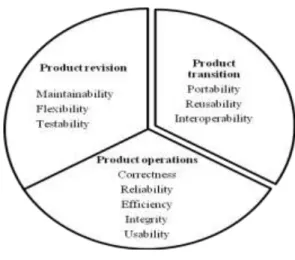
[4,8].Then three major perspectives for defining and
identifying the quality of a software product: product revision
(ability to undergo changes), product transition (adaptability
to new environments) and product operations (its operation
characteristics). Product revision includes maintainability to
locate and fix a fault in the program within its operating
environment, flexibility is the making changes required by
changes in the operating environment and testability is to
ensure that it is error-free and meets its specification. Product
transition is all about portability to transfer a program from
one environment to another, reusability is reusing the software
in a different context and interoperability to couple the system
to another system. Quality of product operations depends on
correctness which a program fulfils its specification, reliability
is the system ability not to fail, efficiency categorized into
execution efficiency and storage efficiency and generally
meaning the use of resources, integrity is the protection of the
program from unauthorized access and usability is the ease of
the software. The difficulty in applying this model is no
consensus about what high level quality factors are important
[15].
Fig. 1: The McCall quality model
Each quality factor is positively influenced by a set
of quality criteria, and the same quality criterion impacts a
number of quality factors. If an effort is made to improve one
quality factor, another quality factor may be degraded. Some
quality factors positively impact others. These are some of the
problems in McCall quality model.
The model furthermore details the three types of quality
44
All Rights Reserved © 2013 IJARCSEEFig. 2: Three three types of quality characteristics in a
hierarchy of factors, criteria and metric
Fig. 3: McCall’s Quality Model
The quality factors describe different types of system
behavioral characteristics, and the quality criterions are
attributes to one or more of the quality factors. The problem in
this model is no standards, no methods and no tools to
measure these quality factors.
B. Boehm’s Quality Model (1978)
The Boehm’s model attempts to qualitatively define
software quality by a given set of attributes and metrics.
Boehm's model is similar to the McCall Quality Model in that
it also presents a hierarchical quality model structured around
high-level characteristics, intermediate level characteristics,
primitive characteristics - each of which contributes to the
overall quality level. The high-level characteristics address
three main questions that a buyer of software has:
McCalls Quality Characteristics
Factors (11)
Describes the external view of the software
(Viewed by users)
Quality Criteria (13)
Describes the internal view of the software
(Seen by developer)
Metrics
Defined and used to provide a scale and method for measurement
Correctness
Traceability
Completeness
Consistency
Reliability
Accuracy
Error tolerance
Storage efficiency
Access control
Access audit
Operability
Training
Communicativene ss
Execution efficiency Efficiency
Integrity
Usability
Simplicity
Conciseness
Instrumentation
Self-descriptiveness
Expandability
Modularity
Software-system independence
Machine independence
Communication commonality
Data commonality Generality Maintainability
Testability
Flexibility
Portability
Reusability
45
All Rights Reserved © 2013 IJARCSEE• As-is utility: How well (easily, reliably, efficiently) can I use it as-is?
• Maintainability: How easy is it to understand, modify and
retest?
• Portability: Can I still use it if I change my environment?
The intermediate level characteristic represents Boehm’s 7
quality factors that together represent the qualities expected
from a software system:
TABLE I BOEHM’S QUALITY FACTORS
Quality Factors Purpose
Portability General Utility Characteristics
Reliability As-is Utility Characteristics
Efficiency As-is Utility Characteristics
Usability As-is Utility Characteristics
Testability Maintainability Characteristics
Understandability Maintainability Characteristics
Flexibility Maintainability Characteristics
The primitive characteristics provide the foundation for
defining qualities metrics – which was one of the goals when
Boehm constructed his quality model. Consequently, the
model presents one or more metrics supposedly measuring a
given primitive characteristic.
Though Boehm’s and McCall’s models might appear very similar, the difference is that McCall’s model primarily
focuses on the precise measurement of the high-level characteristics “As-is utility , whereas Boehm’s quality mode
model is based on a wider range of characteristics with an
extended and detailed focus on primarily maintainability. The Boehm’s quality model is very difficult to apply in practice,
but easy to understand and learn [16].
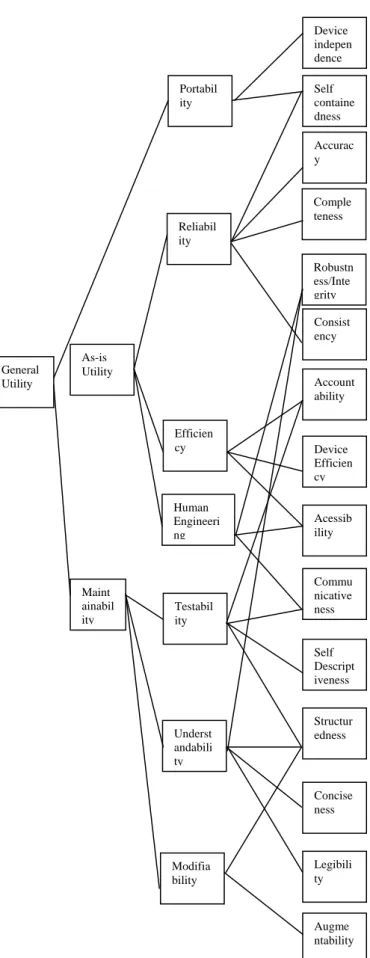
Fig.4: Boehm's Software Quality Characteristics Tree
Portabil ity
Device indepen dence
Self containe dness
Accurac y
Reliabil ity
Comple teness
Robustn ess/Inte grity
Account ability
Device Efficien cy
Acessib ility
Commu nicative ness
Self Descript iveness
Underst andabili ty
Consist ency
Efficien cy
Human Engineeri ng
Testabil ity
Modifia bility
Structur edness
Concise ness
Legibili ty
Augme ntability General
Utility
As-is Utility
46
All Rights Reserved © 2013 IJARCSEEC. FURPS/FURPS+
The FURPS model that is structured in basically the same
manner as the previous two quality models. The FURPS
model originally presented by Robert Grady .
FURPS stands for:
• Functionality – which may include feature sets, capabilities
and security
• Usability - which may include human factors, aesthetics,
consistency in the user interface, wizards and agents, user
documentation, and training materials?
• Reliability - which may include frequency and severity of
failure, recoverability, predictability, accuracy, and mean time
between failure.
• Performance - imposes conditions on functional
requirements such as speed, efficiency, availability, accuracy,
throughput, response time, recovery time, and resource usage. • Supportability - which may include testability, extensibility,
adaptability, maintainability, compatibility, configurability,
serviceability,installability, localizability (internationalization)
The FURPS-categories are of two different types: Functional
(F) and Non-functional (URPS). These categories can be used
as both product requirements as well as in the assessment of
product quality.
D. Dromey's Quality Model
The Dromey Quality model similar to the McCall’s, Boehm’s and the FURPS quality model, is the quality model
presented by R. Geoff Dromey. Dromey is focusing on the
relationship between the quality attributes and the
sub-attributes, as well as attempting to connect software product
properties with software quality attributes.
As Figure 5 illustrates, there are three principal elements
to Dromey's generic quality model
Product properties that influence quality
High level quality attributes
Means of linking the product properties with the quality attributes.
Fig. 5: Principles of Dromey’s Quality Model
Dromey’s Quality Model is further structured around a 5
step process:
Chose a set of high-level quality attributes necessary for the evaluation.
List components/modules in your system.
Identify quality-carrying properties for the components/modules.
Determine how each property effects the quality attributes.
Evaluate the model and identify weaknesses.
E. ISO
1. ISO 9000
The renowned ISO acronym stands for International
Organization for Standardization.
ISO 9001 is a process oriented approach towards quality
management. That is, it proposes designing, documenting,
implementing, supporting, monitoring, controlling and
improving (more or less) each of the following processes:
Implementa tion
Correctne ss
Internal Contextua l
Descriptiv e
Function ality, reliability
Maintaina bility, efficiency, reliability
Maintain ability, reusabilit y, portabilit y, reliability
47
All Rights Reserved © 2013 IJARCSEEFig. 6: The ISO 9000:2000 standards.
Quality Management Process, Resource Management
Process, Regulatory Research Process, Market Research
Process, Product Design Process, Purchasing Process,
Production Process, Service Provision Process, Product
Protection Process, Customer Needs Assessment Process,
Customer Communications Process, Internal,
Communications Process, Document Control Process, Record
Keeping Process, Planning Process, Training Process, Internal
Audit Process, Management Review Process, Monitoring and
Measuring Process, Nonconformance Management Process
and Continual Improvement Process.
2. ISO 9126
ISO has also release the ISO 9126: Software Product
Evaluation: Quality Characteristics and Guidelines.
Are the required
functions available in the software?
How reliable How easy is is the
to transfer software? the software
to another environment?
Is the How easy is software
to modify easy to use? the software?
How efficient is the
software?
Fig. 7: The ISO 9126 quality model
This standard was based on the McCall and Boehm
models. ISO 9126 also includes functionality as a parameter,
as well as identifying both internal and external quality
characteristics of software products. ISO 9126 proposes a
standard which species six areas of importance, i.e. quality
factors, for software evaluation.
The problem with this model is there is no consensus
regarding what is a top-level quality-factor and what is more
concrete quality criterion [17]. Each quality factors and its
corresponding sub-factors are defined as follows:
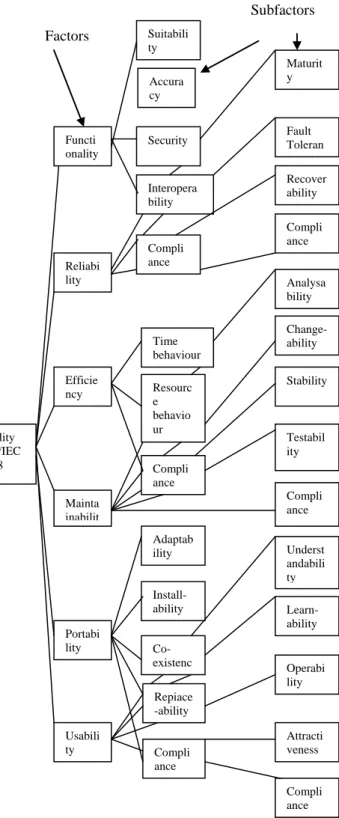
• Functionality: A set of attributes that relate to the existence
of a set of functions and their specified properties.
Suitability, Accuracy, Security, Ability,
Interoperability, Compliance.
• Reliability: Capability of software to maintain its level of
performance under stated conditions for a stated period of
time.
Maturity, Fault tolerance, Recoverability.
• Usability: The effort needed for use, and on the individual
assessment of such use, by a stated or implied set of users.
ISO 9001:2000 “Requirement s for Quality Assurance ISO
9000:2000 “Concepts and terminology”
ISO 9000:200 0
ISO 19011:2000 “Guidelines for Auditing Quality Management Systems”
ISO 9004:2000 “Guidelines for Quality Management of Organizations”
ISO 9000-2:1997
ISO 9000-3:1996
ISO 9004-3:1993
ISO 9004-4:1993
ISO/I EC 9126 Functi onalit y
Reliab ility
Usabi lity Porta
bility
Main taina bility
48
All Rights Reserved © 2013 IJARCSEE
Subfactors
Factors
Fig. 8: ISO 9126: Software Product Evaluation: Quality Characteristics and Guidelines for their Use
Understandability, Learnability, Operability.
• Efficiency: The relationship between the level of
performance of the software and the amount of resources
used, under stated conditions.
Time behavior, Resource behavior.
• Maintainability: The effort needed to make specified
modifications.
Analyzability, Changeability, Stability, Testability.
• Portability: Ability of software to be transferred from one
environment to another.
Adaptability, Installability, Conformance,
Replaceability.
III. COMPARATIVE ANALYSIS
From the comparison table each model has its own characteristics. The McCall’s model supports testability,
correctness, efficiency, reliability, flexibility, integrity,
interoperability, maintainability, usability and portability and
it lacks the characteristics such as understandability,
functionality, human engineering, process maturity,
changeability, clarity, modifiability, documentation, resilience, validity, generality and economy. Boehm’s model
provides the characteristics are testability, efficiency,
understandability, reliability, human engineering,
maintainability, changeability, portability, usability, clarity, Suitabili
ty
Maturit y
Fault Toleran ce
Recover ability
Compli ance
Analysa bility
Stability
Testabil ity
Compli ance
Underst andabili ty
Learn-ability Time
behaviour
Change-ability Security
Interopera bility
Compli ance
Resourc e behavio ur
Operabi lity
Attracti veness
Compli ance Quality
ISO/IEC 9128
Reliabi lity
Mainta inabilit y
Compli ance
Adaptab ility
Install-ability
Co-existenc e
Repiace -ability
Compli ance Functi
onality
Efficie ncy
Portabi lity
Usabili ty
49
All Rights Reserved © 2013 IJARCSEETABLE II
COMPARISON BETWEEN CRITERIA/GOALS OF THE
BOEHM, MCCALL, FURPS, ISO 9126 AND DROMEY
QUALITY MODELS
Quality
Characteristic McC
all
Boeh
m
FURP
S
Dro
mey
ISO
9126
Testability * * *
Correctness *
Efficiency * * * * *
Understandabili
ty
* * * *
Reliability * * * * *
Flexibility * *
Functionality * * *
Human
Engineering
*
Integrity * *
Interoperability * *
Process
Maturity
*
Maintainability * * * * *
Changeability *
Portability * * * *
Reusability * *
Usability * * * *
Clarity *
Modifiability * *
Documentation * *
Resilience *
Validity *
Generality *
Economy *
modifiability, documentation, resilience, validity, generality
and economy and it unable to provide correctness, flexibility,
functionality, integrity, interoperability, reusability and
process maturity. The FURPS model has the qualities are
efficiency, understandability, reliability, flexibility,
functionality, maintainability, usability and documentation
then it fails to support testability, correctness, human
engineering, integrity, interoperability, process maturity,
changeability, portability, clarity, documentation, resilience,
validity, generality and economy. Dromey’s quality model has
the abilities such as efficiency, understandability, reliability,
functionality, process maturity, maintainability and portability
and it unable to support the qualities are testability,
correctness, flexibility, human engineering, integrity,
interoperability, usability, clarity, modifiability,
documentation, resilience, validity, generality and economy
and changeability. ISO 9126 model has the possibilities such
as testability, efficiency, understandability, reliability,
functionality, integrity, interoperability, maintainability,
usability, modifiability and portability and it lacks the
qualities such as correctness, flexibility, human engineering,
process maturity, changeability, clarity, documentation,
resilience, validity, generality and economy.
IV. FURTHUR STUDY
The Management of software quality has also
evolved, it is directed not only toward the development of
software that executes correctly, but also toward satisfying the
objectives for which that software is designed. The
management of software quality requires a set of quality
criteria that the software product must meet, including related
software measures to evaluate this quality. The three models
of software product related to the three views of quality are an
internal quality model, external quality model and
quality–in-use model [12]. An internal metrics measure the software
itself, external metrics measure the behaviour of the
computer-based system that includes the software, and quality
in use metrics measure the effects of using the software in a
specific context of use. Appropriate internal attributes of the
50
All Rights Reserved © 2013 IJARCSEEbehaviour, whereas external behaviour is a prerequisite for
achieving quality in use [14]. The six fundamental steps of
Quality Improvement Paradigms are characterize the project
and its environment, set of goals, choose the appropriate
processes, execute the processes, analyze the data and package
the experience for reuse [13]. The quality models at the time
focused on the final product and on the identification of the key attributes of quality from the user’s point of view. The
assessment framework was later improved; consisting of
quality attributes related to quality factors, which were
decomposed into particular quality criteria and lead to quality
measures. Attempted standardisation work resulted in the
Software Product Evaluation Standard, ISO- 9126. This model
was fairly closely patterned after the original Boehm structure,
with a six primary quality attributes that were subdivided into
27 sub characteristics [14].
V. CONCLUSION
Most of the quality models presented within this paper
probably could be fitted within the user view, manufacturing
view or product view. Some advantages are the quality models
actually reduce the notion of quality to a few relatively simple
and static attributes. The benefit of quality model is that they
are simpler to use. Then the software quality models are the
process of testing the quality with several factors and sub
factors along with metrics. The development of efficient
software quality model that will assist in the creation of
high-quality software will become one of the most important
research areas in the near future.
REFERENCES
[1] Ibrahim K.El-Far and James A. Whittaker, “Model-based Software Testing”, Encyclopedia on Software Engineering, Wiley, 2001.
[2] Jovanavic, Irena, “Software Testing Methods and Techniques”, I.
M. Jovanovic is with the Inzenjering, Mat 26, 2008.
[3] Ines Fey, DaimlerChrysler AG, Berlin, Germany. Ingo Sturmer, Model Engineering Solutions, Berlin, Germany, “Quality
Assurance Methods for Model-based Development: A Survey and Assessment”, SAE International, 2007.
[4] Rikard Edgren, “Software Quality Models and Philosophies”,
2010.
[5] Mohammed Horbi, “Hybrid Model of Software Quality Assurance for Business and Real-time Systems Oriented”, International
Journal of Software Engineering, ISSN 0974-3162 Volume 2,
Number 1(2011), pp.39-45, International Research Publication House.
[6] Jim Nindel-Edwards, Microsoft Inc. USA, Gerhard Steinke , Seattle Pacific University, USA, “Ethical Issues in the software Quality Assurance Function”, Communication of the HMA, 2008
Volume 8 Issue 1.
[7] Arvind S. Krishna, Douglas C. Schmidt, Electrical Engineering and Computer Science, Vanderbilt University, TN USA, Atif
Memon, Adam Porter, Computer Science Department, University
of Maryland College Park, MD USA. Diego Sevilla, Department
of Computer Engineering, University of Murcia, Spain. “Validating Quality of Service for Reusable Sofware via Model-integrated Distributed Continuous Quality Assurance”. National
Science Foundation under Grant Nos. NSF ITR CCR-0312859, CCR-0205265, CCR 0098158, 2004
[8] Sangeetha M, Research Scholar, Dept of CSE & IT, Coimbatore
Institute of Technology, Coimbatore. Akila K, SenthilKumar K.
M, Lecturers, Kumaraguru College of Technology, Dept of Mechatronics, Coimbatore. Arumugam Dr. C, (S.G) Lecturer,
Dept of Mechanical Engineering, Coimbatore Institute of Technology, Coimbatore, “Improved Software Quality Assurance Techniques Using Safe Growth Model”, M.Sangeetha et.al. /
(IJCSE) International Journal on Computer Science and
Engineering, Vol.02, No 06, 2010, 2125-2132, ISSN: 0975-3397. [9] Nayyar Iqbal, Rizwan Jameel Qureshi, Department of Computer
Science, COMSATS Institute of Information Technology, Lahore Pakistan, “Improvement of Key Problems of Software Testing in Quality Assurance”, Sci.Int. (Lahore), 21(1), 25-28,2009. ISSN
1013-5316; CODEN: SINTE 8.
[10] Lu Luo, Paul Li, School of Computer Science, Carnegie Mellon University , “Software Testing Techniques”, 2010.
[11] Jaspreet Kaur, “Software Quality Models and Standards”. [12] LAILA CHEIKHI, Ecole Nationale Superieure d’Informatique et
d’Analyse des Systemes-Universite Mohammed V, ALAIN
ABRAN, Ecole de Technologie Superieure-Universite du Quebec, “Investigation of the Relationships Between the Software Quality
51
All Rights Reserved © 2013 IJARCSEE[13] S.H. Kan, V.R. Basili, L.N. Shapiro, “Software quality: An Overview from the perspective of total quality management”,
IBM SYSTEMS JOURNAL, VOL 33, NO 1,1994.
[14] Ali M. Al-Khouri, “Using Quality Models to Evaluate National ID Systems: the Case of the UAE”, Manuscript received March 27, 2007. Ali M. Al-Khouri is with Emirates Identity Authorit, Abu Dhabi, United Arab Emirates (phone: +97150-613-7020; fax: +9712-404-6661; e-mail: alkhouri@ emiratesid.ae), Source: Adopted from Pfleeger (2001), International Journal of Social Sciences Volume 1 Number 2.
[15] I.Omaima Al-Matrafi, “Software Quality” .
[16] Dr. Raymond A. Paul, “Evolution of Software/System Quality Second Asia-Pacific Conference o QUALITY SOFTWARE”, December 11, 2011.
[17] Naik and Tripathy, “Software Testing and Quality Assurance, Theory and Practice (Chapter 17: Software Quality), NEC- Empowered by Innovation, University of Waterloo, Wiley Publishers since 1801.
J. Ghayathri is currently working as Associate Professor in Computer Science (PG), Kongu Arts and Science College, Erode. TamilNadu, India. PH:9842379818 , E-mail: