ENGINEERS AUSTRALIA
ACCREDITATION BOARDACCREDITATION MANAGEMENT SYSTEM FOR
ENGINEERING EDUCATION PROGRAMS (CURRICULUM BASED)
IN THE OCCUPATIONAL CATEGORY OF ENGINEERING ASSOCIATE
DOCUMENT STATUS
Revision Prepared by Authorised by Issue Date
0
Associate Director – Accreditation. Professor Alan Bradley.
Chair of the Accreditation Board. Professor Robin King.
1 February, 2011
Document No.
G06EA_Curr
Table of Contents
1. INTRODUCTION ... 4
1.1. Structure and Content 4 1.2. Standard of Presentation 5 2. GUIDELINES FOR DOCUMENTATION PREPARATION – INTRODUCTORY SECTION OF SUBMISSION ... 5
2.1. Contact Details 5 2.2. Accreditation Request 5 2.2.1. Engineering Programs ... 5
2.3. Programs for which accreditation is no longer sought 6 2.4. Action Resulting from Previous Accreditation 6 3. GUIDELINES FOR DOCUMENTATION PREPARATION – REVIEW AGAINST ACCREDITATION CRITERIA ... 6
3.1. The Operating Environment 6 3.1.1. Organisational Structure and Commitment to Engineering Education .... 7
3.1.2. Academic and Support Staff Profile ... 8
3.1.3. Academic Leadership and Educational Culture ... 9
3.1.4. Facilities and Physical Resources ... 9
3.1.5. Funding ... 10
3.1.6. Strategic Management of the Student Profile... 10
3.2. Academic Programs 11 3.2.1. Specification of Educational Outcomes ... 11
3.2.2. Title of Program and Award ... 11
3.2.3. Program Structure and Implementation Framework ... 11
3.2.4. Curriculum ... 12
3.2.5. Exposure to Engineering Practice ... 13
3.3. Quality Systems 13 3.3.1. Formal Processes for New Program Approval, Registration, Development and Amendment ... 13
3.3.2. External Stakeholder Input to Continuous Improvement Processes ... 13
3.3.3. Student Input to Continuous Improvement Processes ... 13
3.3.4. Approach to Educational Design and Review ... 14
3.3.5. Approach to Assessment and Performance Evaluation ... 14
3.3.6. Management of Alternative Implementation Pathways and Delivery Modes ... 14
3.3.7. Dissemination of Educational Philosophy ... 15
3.3.8. Benchmarking... 15
3.3.9. Formal processes for Review and Revision of an Existing Program .... 15
3.3.10. Student Administration and Support ... 15
4. SUBMISSION OF INITIAL DOCUMENTATION ... 15
5. INFORMATION TO BE AVAILABLE FOR INSPECTION DURING THE PANEL VISIT ... 16
6. ELECTRONIC TEMPLATES ... 17
7. REFERENCES ... 17
1. INTRODUCTION
The key objective of the submitted documentation is to provide primary evidence that a program satisfies the accreditation criteria set for assessment of education programs in the occupational category of Engineering Associate. This guideline document has been prepared to assist with the preparation of the accreditation submission by the educational institution. The guidelines must be read in conjunc-tion with the Accreditaconjunc-tion Criteria Summary (Reference 2) and most importantly in conjunction with the Accreditation Criteria Guidelines (Reference 3).
1.1. Structure and Content
The submitted documentation will include an introductory section with primary con-tact information, a summary of the accreditation request and a brief report on specific actions in response to any previous accreditation visit report. The major component of the submission will be a succinct and coherent self-analysis, report-ing against the criteria for accreditation.
The accreditation process is fundamentally focussed on systems that are already in place, not to require their creation. To this end much of the documentation re-quested should already exist and not require specific research or development. A well organised submission may well provide the self-analysis against the criteria for accreditation in an overview format with pointers to attached evidence and other support material. It is generally preferred that this overview be published as a stand-alone volume with separate appendices providing the substantiating material in a systematically indexed fashion.
In some cases it will be more practicable to provide such substantiating material in electronic format. In these cases it is requested that the appropriate electronic file be provided in PDF or other common format on a CDROM included with each copy of the documentation. For example it is often more appropriate to provide the full set of academic unit outline documents in electronic form, rather than a volumi-nous hard copy. The overview document should always be provided in hard copy format.
In reporting against the criteria dealing with ‘The Operating Environment’ and with ‘Quality Systems’, a single, unified analysis may well be appropriate. This will be particularly so where a consistent operating framework is maintained for all program streams. In reporting against the criteria dealing with ‘Academic Pro-grams’, it will almost always be appropriate for the submission to branch out, analysing each individual program separately against each criterion in this cate-gory.
Engineers Australia does not want to be prescriptive about the format of the sub-mitted documentation, but is anxious that the presentation is logically structured, easily readable and free-standing.
Each criterion must be addressed in a definitive manner and be sufficient for the evaluation panel to form a judgement on the specific requirement. In the Summary of Accreditation Criteria, (Reference 2), performance indicators are included against each criterion. It is not expected that submissions will respond in de-tail to every individual performance indicator, nor to every element suggested in the guidelines below, rather that sufficient information is pro-vided for an evaluation panel to make a holistic assessment.
The panel may at any stage request further information relevant to the criteria. It will be helpful if the initial documentation indicates, in relation to each heading, any further evidence available in addition to that provided.
Typically an overview presentation addressing criteria associated with ‘The Operating Environment’ and ‘Quality Systems’, that is common to all pro-grams in an engineering school, would be expected to be in the range of 15 - 30 pages. The analysis of each individual program would be expected to be less than 15 pages per program. Appendices may add additional content. 1.2. Standard of Presentation
The standard of presentation is important. A key objective of accreditation is to ensure international comparability and recognition. Submissions should be of a suitable standard for international audit, to demonstrate that Australian engineering education is equal to the best in the world.
The Dublin Accord, (Reference 1), an agreement between signatory countries, recognises substantial equivalence of accreditation systems and standards for en-gineering education programs for the ‘Technician’ (Enen-gineering Associate) occupational category. The Accord is maintained through an ongoing program of mutual inspection and validation.
It is possible at any time that Engineers Australia’s accreditation of programs within any Australian engineering school may be subject to scrutiny and/or participation by observers from other Dublin Accord signatories.
Engineers Australia is currently seeking membership of the Dublin Accord.
If the initial documentation is not considered to meet the following guidelines, the engineering school may be asked to resubmit before a visit is scheduled.
2. GUIDELINES FOR DOCUMENTATION PREPARATION – INTRODUCTORY SECTION OF SUBMISSION
The mandatory information requested in this section establishes the key parame-ters for the accreditation process.
2.1. Contact Details
The following data must be provided in the early pages of the submission. - Name of the educational institution seeking accreditation. - Name and title of the officer responsible for this submission and
contact details (mailing address, phone, fax, e-mail).
- Names and contact details of others who may need to be contacted concerning this submission, and nature of their responsibility. - Website address of the educational institution and the engineering
school. 2.2. Accreditation Request 2.2.1. Engineering Programs
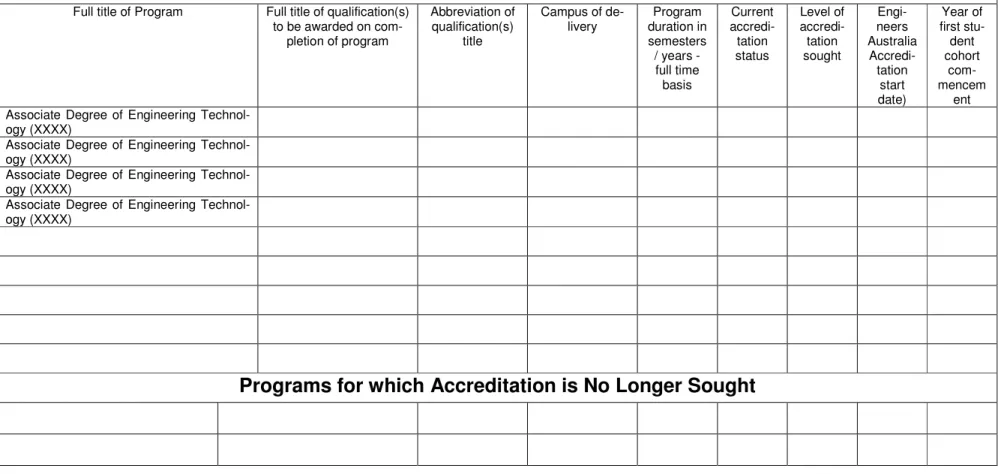
For each engineering program to be submitted for accreditation, the following in-formation must be provided. A tabular format is generally the most appropriate and a suggested proforma – Table 1 - is provided in the Appendix to this document.
- Full title of program.
- Full title of qualification/s awarded on completion, and abbrevia-tion/s.
- Program duration (full time basis).
- Current Engineers Australia accreditation status. - Level of accreditation sought, eg provisional or full. - Original accreditation date.
- Year of first student cohort.
Program and qualification titles must match those appearing in the literature pub-lished by the education provider. Some educational institutions employ a formal qualification title, and a more detailed title which appears on the testamur and/or transcript. Where such distinctions exist, they should be clarified.
Professional Engineering programs, Engineering Technologist programs and En-gineering Associate programs should be listed separately where a submission indicates programs at each of these levels.
Clearly outline any changes to program or qualification titles since the previous ac-creditation (both approved and proposed changes).
2.3. Programs for which accreditation is no longer sought
Any programs that are currently accredited by Engineers Australia and for which accreditation is no longer sought must be listed. A tabular format, similar to that used for 2.2.1 above (Table 1 in the Appendix), is appropriate.
2.4. Action Resulting from Previous Accreditation
Any significant actions taken since the previous accreditation cycle should be iden-tified and explained for the use of the visiting panel.
In particular, specific measures taken to address concerns and recommendations raised in the previous accreditation visit report should be documented.
3. GUIDELINES FOR DOCUMENTATION PREPARATION – REVIEW AGAINST ACCREDITATION CRITERIA
The following subsections provide guidance for undertaking a self-review against the accreditation criteria. These guidelines have been prepared to assist in as-sembling succinct and relevant evidence to demonstrate compliance with the criteria. The guidelines provide an indication of the scope and the detail ex-pected, but is not meant to be prescriptive. The panel will make judgement against the criteria in a holistic manner rather than testing compliance against a pre-determined checklist or a rigorous audit of the response suggestions provided in the guidelines below.
Each of the immediate sub-points listed under Sections 3.1, 3.2 and 3.3 below cor-relate directly with the respective criterion tabulated in Reference 2. Suggestions for response are provided for each criterion. It is acknowledged that some of the response suggestions will be unsuitable or inapplicable in particular cases. On some occasions alternative forms of substantiation may well be more appropriate and this is encouraged.
3.1. The Operating Environment
A unified response, common to all programs or a group of programs, may well be appropriate in responding to the criterion in this section.
3.1.1. Organisational Structure and Commitment to Engineering Education STRUCTURE OF EDUCATIONAL INSTITUTION
• Describe the organisational structure of the educational institution including: - title of chief executive officer of the educational institution (e.g.
Vice-Chancellor) and name of incumbent;
- name of the principal academic entity responsible for engineering education (e.g. Faculty of Engineering), herein called the engineer-ing school, and names of comparable entities in other disciplines; - title of the head of the engineering school (e.g. Dean of Engineering,
Head of School) and name of incumbent;
- title of person at corporate level to whom the head reports (e.g. Deputy Vice-Chancellor, Chief Executive Officer, Director) and name of incumbent.
• In relation to engineering programs, describe the level of accountability the en-gineering school has (subject to institutional approval processes) for:
- program educational design and review, - program delivery,
- management of physical resources and facilities, - financial management,
- appointment and supervision of staff, - professional development of staff, - research and commercial activities. -
RELATIVE SIZE OF THE ENGINEERING SCHOOL
• Provide a clear indication of the dimension of the engineering school in relation to that of the overall education institution using indicators such as student load, budget proportions, or staff numbers.
ENGINEERING SCHOOL STRUCTURE
• Describe the organisational structure of the engineering school, including: - titles and names of officers having responsibility across the
engi-neering school (e.g. associate deans, deputy deans, business manager, executive officer, etc), and names of incumbents; - names of sub-entities (e.g. Department of Civil Engineering) and
scope of their responsibilities;
- titles and names of the heads of sub-entities, and names of incum-bents;
- titles and names of those accountable for program administration and coordination;
- titles and names of those appointed as leaders of academic staff teams accountable for the educational design, delivery and quality management of each individual program.
COMMITTEE STRUCTURES
• With reference to engineering program design, review, continuous improvement and approval, provide an overview of committee structures at institution, school and at sub-entity levels.
STRATEGIC STATEMENT OF INSTITUTIONAL SUPPORT
• Provide evidence of the institution’s long-term commitment to engineering as a discipline, for example through corporate mission statements and strategic plans, or otherwise. Proportional contributions of the engineering school (past and projected) to the corporate achievements of the educational institution may also help with substantiation.
• Provide any available evidence of the engineering school’s engagement in long-term planning processes (excerpts from the engineering school’s strategic plan may for example be appropriate in an appendix)
3.1.2. Academic and Support Staff Profile STAFF PROFILE
• Provide information to demonstrate the strength of the academic and teaching staff profile in each of the program disciplines as well as that of the support staff team. The following suggestions are made.
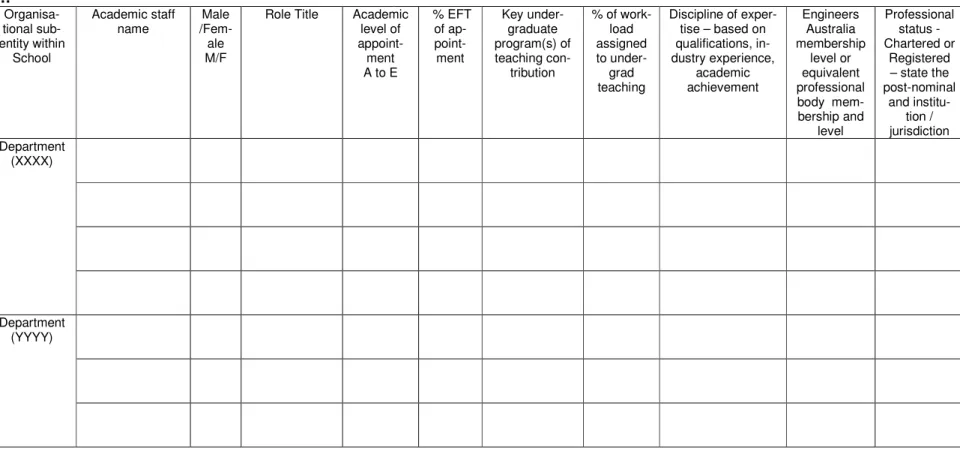
- In a tabular format list the names and any role titles of engineering academic and teaching staff appointed to the school, grouped against the school’s organisational sub-entities.
- Where appropriate, list the key undergraduate program(s) each in-cumbent contributes teaching input to. Indicate the gender of each staff member and level of academic appointment.
- Show also EFT fraction of appointment and EFT distribution of workload against: engineering undergraduate teaching and educa-tional development, research and consulting, management, administration and governance, other activities.
• Table 2 in the Appendix provides a template for providing the information re-quired
• Provide details of numbers and seniority of administrative, technical and profes-sional staff within each organisational sub-entity of the school.
• For each program provide an estimate of the percentage or time fraction of for-mal teaching contact provided from the following sources:
- engineering academic staff appointed to the school,
- academic staff from within the educational institution but external to the engineering school,
- sessional and expert guest teaching from industry professionals. • For each member of engineering academic and teaching staff appointed to the
school as well as for adjunct appointments, provide a 1-2 page CV summarising academic appointment record, qualifications, professional affiliations, experi-ence in professional practice, teaching experiexperi-ence, professional contributions to educational development, engineering research and consulting, publication re-cord and any other professional development activity. A suggested proforma for staff CV’s is provided in the Appendix.
• Analyse the capacity and competency of the teaching staff to cover all areas of the curriculum, and indicate any strategies for reinforcing areas of weakness, staffing new areas of specialisation, and succession planning for academic and organisational leadership. Critically assess the range and depth of staff exper-tise underpinning each technical specialisation.
• Provide an estimate of student to staff ratio using a basis of engineering taught EFTSU to appointed engineering teaching staff EFT - on a school, organisa-tional sub-entity or program basis.
WORKLOAD MANAGEMENT
• Describe the engineering school’s arrangements for managing staff workloads.
3.1.3. Academic Leadership and Educational Culture
• Describe the mechanisms for formal leadership and management of the teach-ing team at the individual program level. Define the level of autonomy and accountability of the program teaching team in the tasks of educational innova-tion, design, review and continuous quality improvement. Describe the formal linkages the program teaching team has with external constituencies, the stu-dent body and program management committees at the institution, school and sub-entity levels.
• Describe any specific initiatives that:
- encourage and enable staff to role model the Engineers Australia Stage 1 competencies in the occupational category of Engineering Associate;
- promote awareness and adoption of current educational thinking and best practices;
- internationalise the curriculum and promote awareness of cross cul-tural issues;
- promote community outreach;
- provide an inclusive operating environment.
• Provide a brief profile of the school’s strategic directions for research, research record and associated professional activities. Indicate the extent and scope of activity, and naming principal areas of research concentration, formally estab-lished structural groups, centres etc. Outline major research achievements, collaborations both within and external to the institution. In particular highlight industry linked research. Discuss the linkages between research and under-graduate teaching.
3.1.4. Facilities and Physical Resources
• Briefly describe the classrooms, laboratories, library and information resources, and computing and communication facilities and services available to students and staff, and comment on their adequacy to meet the objectives of the school and the program/s to be accredited. In particular, give:
- details of learning-support centres or special facilities; - titles of laboratories in active use for teaching;
- facilities available to students for project work, including workshops and technical staff support;
• Discuss any strategic directions for capital investment and facilities develop-ment.
3.1.5. Funding
• Describe the educational institution’s arrangements for funding the engineering school and/or engineering programs. Indicate the factors used in determining the allocation, and how they are weighted.
• Discuss the adequacy of the resources available to meet the objectives of the school, and of the program/s to be accredited. Comment on any recent or pro-spective trends in the school’s financial situation, and their impact on program effectiveness. Indicate what steps are being taken to address any perceived gaps or inadequacies.
• For new programs, using business planning principles, demonstrate viability and show how adequate staff and teaching resources will be brought to bear as the new offering is introduced and progressively implemented.
3.1.6. Strategic Management of the Student Profile ENROLMENT DATA
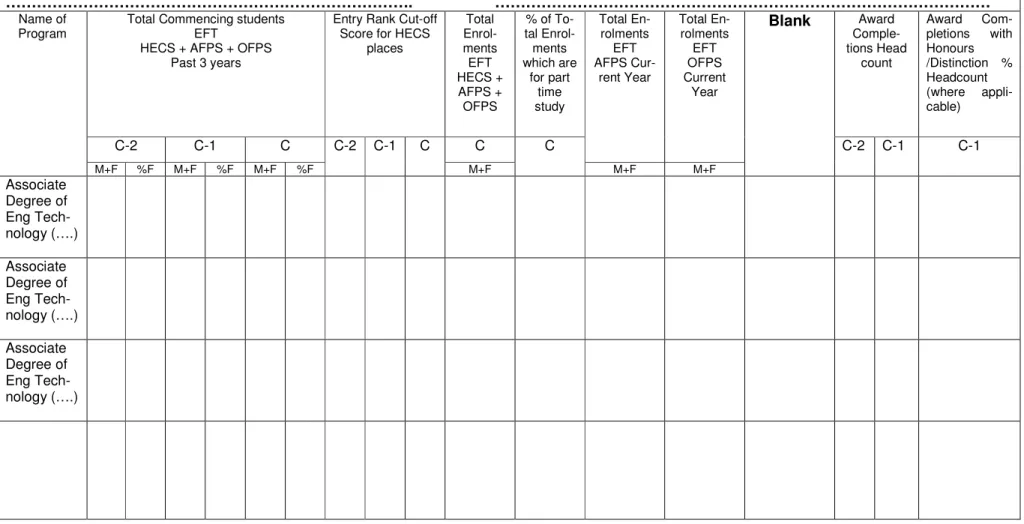
• Provide statistical data for the current and past two years to show trends for commencement enrolment numbers, entry rank cut-off score, graduation rates and Honours/Distinction or any other specific performance identification distribu-tion. Table 3 in the Appendix provides a suggested format. The data needs to be dis-aggregated, where possible, for each program that has been submitted for accreditation.
STUDENT SELECTION AND ENTRY REQUIREMENTS
• Specify rules for entry and selection procedures for applicants in the following categories:
- Commonwealth/HECS funded,
- Australian fee paying, - international fee paying,
- articulating students following agreed pathways from other universi-ties or post-secondary programs.
• Outline any processes for admitting minority groups or classes of students to special pathways.
• Outline policies and processes for assessment of prior learning, the determina-tion of advanced standing and the development of articuladetermina-tion routes for
individual applicants where advanced standing credit is limited to less than 50% of the total program study duration.
PROGRESSION AND GRADUATION RATES
• Provide a brief analysis of student progression rates for each year level and an outline of progression and exclusion rules. Comment on any salient trends for minority cohorts.
3.2. Academic Programs
It is usually appropriate to develop a full and separate response for each in-dividual academic program against criteria 3.2.1 through 3.2.5 below. A suggested approach is provided in the discussion under each criterion.
3.2.1. Specification of Educational Outcomes
• Clearly describe the targeted field of engineering practice, any specialisation of-fered for the program and any particular vocational focus.
• For new programs, summarise briefly the rationale for the program offering based on evidence such as demand analysis; industry needs analysis, national priority statements and the perceived career role of graduates.
• Present the full specification of outcomes for the program including the educa-tional objectives and targeted graduate capabilities. In particular address the projected levels of technical competence, enabling knowledge and skills, engi-neering application skills as well as personal and professional skills and attributes.
• Show clearly how the targeted graduate capabilities statement maps to the En-gineers Australia National Generic Competency Standards – Stage 1
Competency Standard for Engineering Associate, (Reference 4), assuring de-livery of the underpinning knowledge and skills, technical competencies, engineering application skills, personal attributes, values and professional atti-tudes specified in this standard.
3.2.2. Title of Program and Award
• Justify the title of the program and the associated qualification in relation to the program objectives, field of engineering practice, any declared specialist focus and AQF requirements.
• Verify that the published title of the program to be accredited clearly corre-sponds with the title to be recorded on the award/testamur/certificate. 3.2.3. Program Structure and Implementation Framework
• Document in detail the program structural design, clearly indicating the titles of all academic units or subjects and the academic credit each carries within the program structure. Relate the structural design of the program to the educa-tional objectives, designated field of practice and any nominated specialisation. • Provide evidence of the systematic use of individual and collaborative learning
approaches such as lock-step classroom activity, workshop, laboratory and practical work, problem and project based learning as well as exposure to engi-neering practice (see 3.2.5 below).
• Explain the requirements that must be satisfied for the award of the qualification in terms of the structure of academic credits.
• Document all modes and implementation pathways via which the program and the qualification requirements may be completed. This should include any of the following that may apply:
- core or elective academic unit options; - major or minor study streams;
- particular study requirements for Honours/Distinction or any other specific performance identification ;
- study though alternative campuses or institutions; - defined feeder, articulation or bridging routes; - external or distance delivery;
- study abroad; - part time modes;
- remote campus or offshore implementations;
• Clearly define the program study duration and the impact any of the above op-tions may have on this.
• On a percentage basis estimate the proportions of the overall learning experi-ence directed to the following categories.
1. Underpinning knowledge of mathematics, physical sciences, information sys-tems and engineering fundamentals appropriate to the discipline of learning. 2. Application of the above underpinning knowledge to the solution of well
de-fined problems and to the practice of engineering and technology including: the use of standards and codes of practice; specifying and installing sys-tems; design procedures; assessment of technical and policy options; observation, analysis and testing; operations and maintenance and the as-sessment of risk across a broad operational context.
3. Specialisation within an engineering discipline.
4. Professional development including: effective communication skills; the abil-ity to operate as an individual or to provide leadership in a team based environment; the use and management of information systems and an un-derstanding of the business environment.
5. Application of principles, responsibilities and the ethics of engineering prac-tice as well as an awareness of the professional obligations associated with occupational health and safety and environmental sustainability.
The suggested percentage targets for each of the above learning categories are provided in Section 3.2.3 of the Accreditation Criteria Guidelines (Reference 3). • Describe how the profile, background and special needs of individual students
or minority groups are accommodated through special support, remedial routes or other flexible features of the program.
(Much of the above may be adequately documented in internal statements prepared for the purposes of program planning, review and approval and/or in public statements to program constituents.)
3.2.4. Curriculum
• For each academic unit (subject or course), provide an outline summary docu-ment covering objectives, targeted learning outcomes, learning strategies and methods, assessment detail, pre-requisites, content and implementation details. It is crucial that these documents close the loop to show how assessment tasks provide evidence of attainment of the targeted learning outcomes set for the academic unit. These documents also must show how unit learning out-comes and assessment measures map to confirm delivery of the graduate capabilities set for the program as a whole, thus closing the loop at the program level.
(The above requirement may well be satisfied by a compilation of the pub-lished unit (subject or course) outline documents as distributed to students and supplemented with additional information if necessary. The compiled unit outline summaries for each program should be presented as an appendix
(normally CD ROM based) accompanying the main submission documents.) 3.2.5. Exposure to Engineering Practice
• Document any formal work placement requirements for students and the proc-esses and procedures for disseminating, tracking, reviewing and assessing experiences and learning outcomes.
• Provide an overview of the range and depth of professional practice exposure (other than formal work placement) embedded as part of the educational ex-perience within academic units and within the program as a whole.
• Describe how this aspect of learning forms an integral part of the overall educa-tional design and how the learning outcomes of these exposure episodes are tracked and assessed.
3.3. Quality Systems
In responding to each of the criterion in this category, the following analysis and specific items of supporting evidence are suggested as appropriate. In many cir-cumstances a unified response for the School as a whole will be appropriate for this category.
3.3.1. Formal Processes for New Program Approval, Registration, Development and Amendment
• Document any formal processes that are in place for new program approval, registration, development and amendment including key stakeholder input. • The formal process should include consideration of the demand analysis which
establishes the rationale for the program, learning outcomes, educational pro-gram design and development aligned to the designated field of engineering practice and specialist focus.
3.3.2. External Stakeholder Input to Continuous Improvement Processes
• Describe the mechanism(s) for seeking advice from employers, graduates, alumni, industry associations, professional bodies and the broader community. Demonstrate the impact these input and feedback measures are having on the continuous quality improvement of the program.
• For any formally constituted industry advisory body, provide lists of member’s names including their qualifications, industry expertise and their affiliations as well as the terms of reference and representative activities of the body. • Specifically outline any involvement of external constituencies in establishing
and reviewing the educational outcomes specification, in the educational design processes and in monitoring the attainment of program objectives and graduate capabilities at the individual program level.
• Describe how the school’s industry linkages are able to enrich the learning ex-perience for learners through the provision of professional practice exposure and any direct project opportunities.
3.3.3. Student Input to Continuous Improvement Processes
• Outline in detail the specific mechanisms for gaining input and feedback from students, employers, graduates and the wider community. Demonstrate the im-pact these measures have on the quality assurance system.
• In particular emphasise any mechanisms for engagement of the student body in the quality cycle. Describe the scope for student input to review and improve-ment of the operating environimprove-ment, the program and academic unit outcome targets, the program structure, the curriculum detail, the learning approaches and the assessment measures.
• Describe how students are seen as true partners in a learning culture which en-courages continuous quality improvement.
3.3.4. Approach to Educational Design and Review
• Demonstrate how a holistic ‘big picture’ approach is applied to the learning de-sign and review processes. Clearly indicate the scope and staff accountabilities for this task including the forums, breadth of input and frequency of review and the nature of the approach.
• Outline the approach to setting and reviewing program level objectives and tar-geted graduate capabilities as a specification of outcomes.
• Outline any processes that monitor and review the links between the designated learning outcomes, the learning activities and assessment measures within the individual academic units, thus closing the quality loop at the academic unit level.
• Describe how the above information together with processes that map and track the aggregated learning outcomes and assessment mechanisms from individual academic units ensure delivery of the targeted outcomes set for the program as a whole, thus closing the quality loop at the program level.
• Demonstrate the use of documented records of improvement actions and proc-esses and how these have been used to facilitate the continuous quality improvement of the program.
• Provide evidence of ongoing review and improvement, including reference to benchmark data and practices, industry needs and student demand as part of a continuous quality improvement cycle.
3.3.5. Approach to Assessment and Performance Evaluation
• Provide an overview of the processes for management and review of assess-ment. Highlight the details of any systematic or holistic process that maps and links assessment within academic units to assure the broad capabilities of graduates and the maintenance of appropriate standards. Provide details of moderation processes that operate at the academic unit level, assuring the rig-our and validity of assessment measures.
• Provide an overview of the range of approaches to assessment, how the de-ployment of these is controlled within individual academic units, and the strategies for ensuring that the aggregated assessment measures reflect the true capability and level of achievement of the individual.
• Describe the criteria for the award of Honours/Distinction or any other specific performance identification.
3.3.6. Management of Alternative Implementation Pathways and Delivery Modes
• Describe the mechanisms for assuring the equivalence of learning outcomes where alternative implementation pathways are offered.
3.3.7. Dissemination of Educational Philosophy
• Provide evidence of any documentation that communicates, for the benefit of stakeholders and in particular students, a ‘big picture’ description of the pro-gram objectives, outcomes and design philosophy. Such documentation would be expected to show how the individual learning elements and performance measures within academic units map and aggregate to assure the delivery of the program objectives and graduate capabilities and in turn attainment of the Engineers Australia Stage 1 competencies.
3.3.8. Benchmarking
• Outline the details and outcomes of any comparative analysis that has been undertaken with national and/or international practices and where these activi-ties have influenced standards for educational outcomes and assessment processes.
3.3.9. Formal processes for Review and Revision of an Existing Program
• Describe the formal processes at institution, school and sub-entity level for ap-proval of changes or amendments to existing programs. Summarise the requirements that must be satisfied for approval to be considered. 3.3.10. Student Administration and Support
• Provide evidence to demonstrate the robustness of the student administration system. In particular provide details of policy and processes for retention and progress monitoring; performance warning, exclusion and appeal; student advi-sory services, as well as retention and progress monitoring. Describe how these indicators provide input to the processes of continuous quality improvement. • Provide details of published admission requirements and demonstrate the
integ-rity of the admissions processes to ensure that only appropriately qualified applicants enter the programs.
• Describe the processes in place to ensure that each individual graduand has met the program requirements.
4. SUBMISSION OF INITIAL DOCUMENTATION
The documentation should be bound in one or more volumes, (as suggested in Section 1.1 above), and should include a Table of Contents clearly indicating the structural layout of the submission
• The educational institution should submit sufficient copies of the initial docu-mentation to provide:
• one copy for each member of the evaluation panel (normally 4 – 8 cop-ies),
• one reference copy for filing.
The number of copies required will be advised when Engineers Australia acknowl-edges the request for accreditation and schedules key dates.
The initial documentation should be accompanied by: • the institution’s Calendar (one copy),
• the Handbook, Calendar supplement, or other official publication relating to the engineering school, and containing the public statement of program de-tails (4 copies),
• major current items of promotional literature concerning engineering pro-grams (4 sets) and/or website references to these items.
It is appreciated that some detailed items may be more appropriately provided in electronic format rather than hard copy. (In this case the provision of a CDROM image is suggested as in Section 1.1 above.)
All documentation should be submitted to: The Accreditation Officer
Australian Engineering Accreditation Centre Engineers Australia
Suite 206, 2nd Floor, 21 Bedford St North Melbourne Vic 3051
The Accreditation Officer will arrange distribution of documentation to the individual panel members.
Documentation should be received by Engineers Australia no later than 8 weeks prior to the scheduled visit date.
5. INFORMATION TO BE AVAILABLE FOR INSPECTION DURING THE PANEL VISIT
• Copies of all current promotional literature.
• A list showing the name/s of the staff member/s currently responsible for deliv-ery of each academic unit.
• For a representative range of example academic units at each year level and for each program, a dossier of materials including the unit outline document distrib-uted to students, examples of teaching materials and resources, examples of formative and summative assessment materials including examination papers, and specifications for assignments, projects and laboratory activity, examples of graded student work including submissions and examination scripts, journals and portfolios, assignment, project reports, laboratory reports, professional practice log books. Examples of low, medium and high achievement should be available in each case, demonstrating a distinction in grading across the various performance thresholds.
• Of particular interest are graded student design and project report submissions at each year level. A range of graded final year (capstone) project reports are vitally necessary where full accreditation is being considered. Displayed materi-als should be organised clearly against year level and the records for each academic unit separately identified. The range of displayed materials should be selected in order to demonstrate the delivery of the full range of generic capa-bilities in graduates including a clear indication of the standard of technical competence.
• Prime documentation associated with teaching and learning planning, review, management and quality improvement should be made available. Any appropri-ate records of formal proceedings, reports and submissions, trend and data analysis, quality system records or evidence of action implemented should be presented for perusal. This should include records of meetings of program teaching teams, staff-student consultative forums, industry advisory body meet-ings, key documents associated with formal program reviews as well as appropriate meeting records and documented action follow ups at all organisa-tional levels.
• Details of stakeholder surveys including teaching quality and unit/program evaluations, student destination surveys, employer or graduate surveys. As well as access to the survey instruments, any outcome summaries, subsequent re-porting, follow up action and information describing influences this data has had on the continuous improvement processes should be presented.
• Available school and/or research annual reports. • Access to the school’s records management system.
• Access to the institution’s and/or engineering school’s human resource policy documents, including:
- appointment and tenure (an example of selection criteria would be welcome);
- promotion (an example of promotion criteria would be welcome); - professional development – as an engineering academic and
pro-fessional educator;
- supervision and staff counselling;
- appointment, training, supervision and counselling of sessional staff; - any merit-based reward systems.
6. ELECTRONIC TEMPLATES
Sample templates for the following submission documents provided in the appendices, can also be downloaded from the Engineers Australia website
http://www.engineersaustralia.org.au/education/program-accreditation/accredited-programs/ • A suggested proforma for staff CV;
• Listing of Programs Submitted for Accreditation; • Engineering School Academic Staff Profile; and • Admissions and Enrolments
7. REFERENCES
1 S03EA_
Curr Governing and Consultative Bodies, International Framework.
2 S02EA_
Curr Accreditation Criteria Summary
3 G02EA
_Curr Accreditation Criteria Guidelines
4 P05EA Engineers Australia National Generic Competency Standards – Stage 1 Competency Standard for Engineering Associate
APPENDIX
SUGGESTED PROFORMA FOR STAFF CVs
NAME:
TITLE:
CURRENT POSITION AND LEVEL OF ACADEMIC/TEACHING APPOINTMENT:
QUALIFICATIONS:
MEMBERSHIP OF PROFESSIONAL BODIES:
PREVIOUS INDUSTRY APPOINTMENTS:
ACADEMIC/TEACHING APPOINTMENT RECORD:
PROFESSIONAL CONTRIBUTIONS TO EDUCATIONAL DEVELOPMENT:
ENGINEERING RESEARCH FIELD AND PUBLICATION COUNT (WHERE APPROPRIATE):
CONSULTING RECORD:
© Copyright Engineers Australia
TABLE 1 Listing of Programs Submitted for Accreditation
Title of Educational Institution:
………
Title of Engineering Faculty/School:
………
Full title of Program Full title of qualification(s) to be awarded on com-pletion of program Abbreviation of qualification(s) title Campus of de-livery Program duration in semesters / years - full time basis Current accredi-tation status Level of accredi-tation sought Engi-neers Australia Accredi-tation start date) Year of first stu-dent cohort com-mencem ent Associate Degree of Engineering
Technol-ogy (XXXX)
Associate Degree of Engineering Technol-ogy (XXXX)
Associate Degree of Engineering Technol-ogy (XXXX)
Associate Degree of Engineering Technol-ogy (XXXX)
© Copyright Engineers Australia
TABLE 2 Engineering School Academic Staff Profile
Title of Educational Institution:
……… …
Title of Engineering Faculty/School:
………. Organisa-tional sub-entity within School Academic staff name Male /Fem-ale M/F
Role Title Academic level of appoint-ment A to E % EFT of ap- point-ment Key under-graduate program(s) of teaching con-tribution % of work-load assigned to under-grad teaching Discipline of exper-tise – based on qualifications, in-dustry experience, academic achievement Engineers Australia membership level or equivalent professional body mem-bership and level Professional status - Chartered or Registered – state the post-nominal and institu-tion / jurisdiction Department (XXXX) Department (YYYY)
© Copyright Engineers Australia
TABLE 3 Admissions and Enrolments
For each program to be accredited please complete enrolment figures for the past three years C = Current Year, C – 1 = Current year – 1, C – 2 = Current Year – 2. EFT = Effective Full Time Students M = Male and F = Female
Dis-aggregation as indicated.
Title of Educational Institution: Title of Engineering Faculty/School:
………. ………
Name of Program
Total Commencing students EFT
HECS + AFPS + OFPS Past 3 years
Entry Rank Cut-off Score for HECS
places Total Enrol-ments EFT HECS + AFPS + OFPS % of To-tal Enrol-ments which are for part time study Total En-rolments EFT AFPS Cur-rent Year Total En-rolments EFT OFPS Current Year Blank Award Comple-tions Head count Award Com-pletions with Honours /Distinction % Headcount (where appli-cable) C-2 C-1 C C-2 C-1 C C C C-2 C-1 C-1 M+F %F M+F %F M+F %F M+F M+F M+F Associate Degree of Eng Tech-nology (….) Associate Degree of Eng Tech-nology (….) Associate Degree of Eng Tech-nology (….)