1
Act. 7.2 “Development of Project Chains”:
Develop the Avrig Hotel School
Concept
Introduction
2
Table of Contents
1
Activity Scope ... 3
1.1
Project Chains ... 3
1.2
Planning the Hotel School Concept Development ... 4
2
Development Process ... 5
2.1
Review of Existing Documentation ... 5
2.2
Development of a Project Manual ... 5
2.3
Checklist for the Avrig Hotel School Concept ... 5
3
1 Activity Scope
The development of a hotel school concept is part of the European INTERREG CultTour
project and foreseen in work package 7 under the activity 7.2 “Development of project chains
for pilot sites”.
1.1 Project Chains
A project chain is defined as a series of consecutive projects and processes that lead to the
implementation of strategic/long-term objectives of an investment. Such an investment can
be an investment into infrastructure, a product or a service that will be developed, a company
that is set up and put operational, or any other (business) idea that is developed.
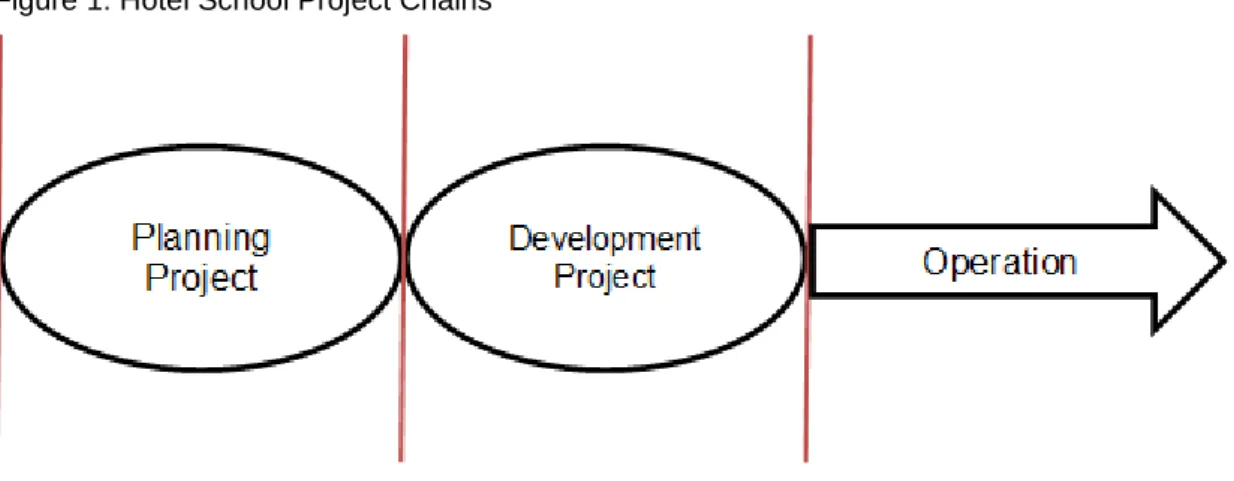
The concept a project chain and its several projects can be illustrated with the figure below.
Figure 1: Hotel School Project Chains
Source: Author’s figure
The main aims of the “project chain concept” are:
To support all the planning/development/implementation steps needed in order to
realise the idea,
To ensure a comprehensive and long-term view on the planning approach adopted,
To reduce the risk of management mistakes and failures,
To provide a base for decision-making and to develop and visualise the costs and
benefits of the entire investment.
4
1.2 Planning the Hotel School Concept Development
One of the project chains for the Municipality of Avrig is the aforementioned development of
a hotel school concept. With competencies in the field of tourism and project management,
the IMC University of Applied Sciences (PP3) supports the development of this hotel school
concept. Its support is reflected in the following aims:
Assist the lead partner (LP) in developing a realistic concept for a hotel school in
Avrig,
Check the completeness and comprehensiveness of already existing documentation,
Give input on structured project planning to ensure an optimal implementation of the
investment management,
Provide draft plans that will be completed and adjusted to the on-site situation by the
LP in Avrig.
5
2 Development Process
The process designed by PP3 to develop the deliverables of W.P.7, Act.7.2 is presented in
the section. It focused on three main activities: reviewing documentation that had been
communicated so far, producing a project manual and defining an operational checklist for
the Avrig Hotel School Concept.
2.1 Review of Existing Documentation
In a first step, material provided by the LP was reviewed. This included the following
documents:
“Synthesis – ‘S.Brukenthal’ Tourism School in Avrig”,
“’S. Brukenthal’ Tourism School Structure”,
“Study for Hotel School” by Adelia Morosan.
2.2 Development of a Project Manual
In a next step, PP3 compiled various projects plans into a project manual. The project
manual covers different elements relevant for a detailed and structured project planning and
serves as the basis for the planning and development of the hotel school concept. It includes
the main elements of scope, schedule, cost but also a project environments/stakeholders
and risk analyses.
This project manual consists of a selection of plans to provide a basis for the planning. In
case that further project plans are needed, the LP is invited to refer to PP3, relevant project
management training offers and/or literature.
2.3 Checklist for the Avrig Hotel School Concept
Finally, a checklist for the Avrig Hotel School Concept was developed. The model used
outlines the most important elements to describe an organization and highlights key areas of
consideration. The checklist is seen as an addendum to the hotel school concept project
manual.
6
3 Activity Output and Recommendations
In total, the LP will receive the following documents from PP3:
1. Activity Introduction,
2. Project Manual including draft project plans for further detailed planning of the hotel
school concept,
3. Checklist for the Avrig Hotel School Concept.
After reviewing the existing documentation, PP3 highly recommends to focus on the following
dimensions:
Further research
and documentation on the different elements pointed out as “not
considered” or “partially considered” in the checklist,
Internal decisions on the concept components where additional specifications are still
necessary, in line with the results of the research conducted,
Comprehensive and detailed planning for the development of the hotel school
concept. In order to do so, the IMC advises to review and complete the project
manual provided as well as to use the aforementioned checklist to ensure a
successful implementation of the concept development phase.
Act. 7.2 “Development of Project Chains”:
Develop the Avrig Hotel School
Concept
Project Manual (Draft Plans)
IMC University of Applied Sciences Krems, Austria
Version
1.0
Project Manager:
Maria Sinca
P a g e
|
2
Index
1.
Introduction
____________________________________________ 3
2.
Project Assignment
_______________________________________ 4
3.
Project Deliverables
_______________________________________ 6
4.
Work Breakdown Structure
__________________________________ 7
5.
Project Milestone Plan
_____________________________________ 8
6.
Bar Chart
______________________________________________ 9
7.
Project Cost Plan
_______________________________________ 10
8.
Project Responsibility Matrix
________________________________ 11
9.
Analysis of Pre-Project and Post-Project Phase
___________________ 13
10.
Project Environment/Stakeholder Analysis
_______________________ 14
11.
Relationships to Relevant Project Environments/Stakeholders
__________ 15
12.
Project Organisation Chart
_________________________________ 16
P a g e
|
3
INTRODUCTION
The following project manual serves as the basis for the planning and development of the hotel
school concept for the Municipality of Avrig, Romania. Planning and developing the concept is
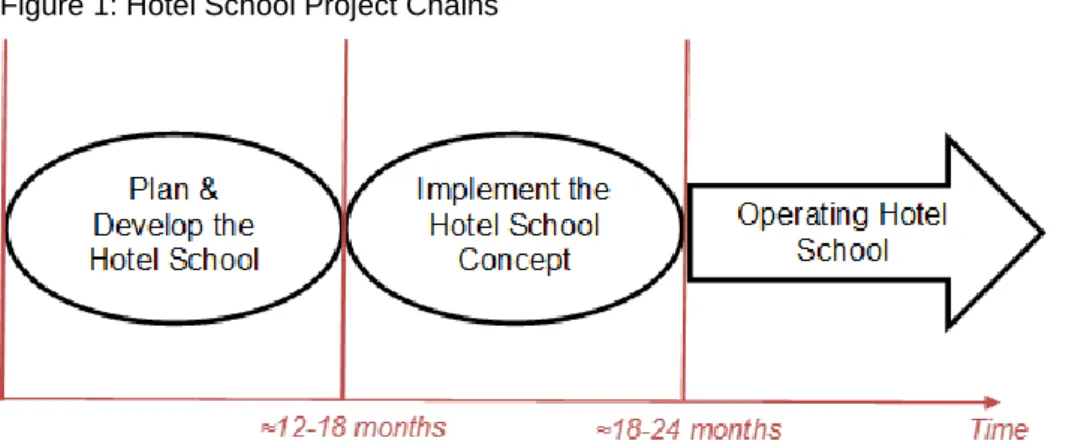
considered as the first project within a series of project chains as outlined in the figure below.
Figure 1: Hotel School Project Chains
Source: Author’s figure
After the end of the
project “Develop the Hotel School Concept”, the project “Implement the
Hotel School Concept” starts. Within this second project all actions are concretely implemented
to prepare for the actual hotel school operation. Operation of the hotel school can commence as
soon as the development project is finished and the school is therefore ready to function.
As indicated in Figure 1, such project chains typically involve one to one year and half for the
first project, consisting in the planning of the concept. Another year and half, up two years, are
usually considered for the implementation, for a total preparation time varying between two
years and half and three years and half before reaching the phase of an operating hotel school.
The project manual covers different elements relevant for a detailed and structured project
planning. It includes the main elements of scope, schedule, cost but also project
environments/stakeholders and risk analyses.
All plans presented here are either drafts or a structure proposed to support the project
planning: they need to be adjusted and finalized. It is the responsibility of the project manager
to review and complete this project manual. Information in order to do so is gathered from the
investor, the project stakeholders and the project team. All plans need to be developed
according to the project specific objectives.
In addition to the project manual, a checklist for the hotel school has been developed. The
checklist is an addendum to the project manual and highlights strategic areas of consideration
and leading questions.
P a g e
|
4
Avrig Hotel School
Concept
PROJECT ASSIGNMENT
Project start date Project end date
01.02.2013 ….
Project objectives Project non-objectives
Design of a concept for a private hotel school nearby the Brukenthal Palace, Avrig
Design of three programmes on vocational-, high school- and post high school level including practical training (internship)
Consideration of additional service options (personality training, venue rental for external events, catering, etc.) Definition of the infrastructure requirements including
functional plan and architectural proposal in cooperation with a lead architect
Definition of the investment cost components based on the space requirements and functional plan
Definition of the operating cost components
Definition of the organisational requirements (human resources, marketing etc.)
Development of a hotel school concept at university level
Development of a concept for a public hotel school
Long-term objectives and justification (business case)
Creating training conditions for the necessary human resources in order to offer high class tourism services and high qualifications for the tourism labour force in Olt Country and Transylvania.
Raise the service standard for national and international visitors
Develop Avrig as a centre of hospitality and tourism education
Enlarge the profile of the City of Avrig by developing tourism and education as further economic components Contribute to the economic and social development of
the City of Avrig and Sibiu County and the sustainable success of the Brukenthal Palace
Provide employment for the local people
Raise the income and the spending capacity of the population
Contribute to the multi-functional tourism concept developed for the city of Avrig (tourism master plan) and the Brukenthal Palace in order to ensure and enhance the attractiveness of the area in general and the Brukenthal Palace specifically
Enhance the image of Avrig as tourism destination
Project phases Project costs Project income
Phase 1: Project Management Phase 2: Research
Phase 3: Strategic Planning Phase 4: Operational Planning
Phase 5: Preparation for Implementation
… …
Project owner Project manager
Arnold Klingeis Maria Sinca
P a g e
|
5
Project Team Member Research (Adelia Morosan) Project Team Member Planning & Development (Maria Sinca) Architect (Conny Feyer)
Educational Expert (…) Infrastructure Expert (…) Financial Expert (Mrs. Klingeis) …
…
Relationships to other projects (synergies or potential conflicts)
Related to various feasibility studies for the Brukenthal Palace (hotel, garden, hotel school) Other European and community projects within the Municipality
Relevant project environments/stakeholders
Samuel von Brukenthal Foundation Local Community Target Market Project Organization Competitors Political Institutions Legal Institutions signature signature
Project manager Project owner
P a g e
|
6
Avrig Hotel School
Concept
PROJECT DELIVERABLES*
Deliverable Type Deliverable
Strategy Concept
Overall strategy for the hotel school List of objectives
Services & Products Concept
Number of classes and students Types of educational programmes Programme curricula
Course objectives
Approval for certification of students
Additional services (personality training, venue rental for external events, catering, etc.) …
* Please refer to the “Checklist for the Avrig Hotel School Concept” for a comprehensive list of
deliverables.
P a g e
|
7
Avrig Hotel School
Concept
WORK BREAKDOWN STRUCTURE*
Version 1.0 Date: … Author: …
* To be completed to meet the project’s objectives.
P a g e
|
8
Avrig Hotel School
Concept
PROJECT MILESTONE PLAN
WP-code Milestone Planned date Actual date
1.1.1 Project initiated and started … …
1.2.6 Research concluded … …
1.3.2 Strategy developed … …
1.4.7 Applications for hotel school accreditations submitted … …
1.5.4 Detailed project plans for implementation prepared … …
1.1.4 Project approved and closed down … …
P a g e
|
9
Avrig Hotel School
Concept
BAR CHART
The timeline for all project activities needs to be established according to the work
break-down structure. For each phase and work package, a specific duration should be defined
for an optimal scheduling of all the activities that need to be carried out.
Scheduling software can be downloaded from the following link:
http://www.ganttproject.biz/
P a g e
|
10
Avrig Hotel School
Concept
PROJECT COST PLAN*
Version 1.0 Date: … Author: …
[double click to edit]
* It is recommended to develop a rough project budget for the five project phases (as listed above) in order to have a cost estimate. A more accurate cost plan can also be done at the level of the work packages (e.g. 1.1.1). Cost items are, for example:
Internal personnel costs
Material costs
Travel costs
External expert costs
WP Code WP Label Cost type Planned
quantity Price Planned costs
Phase 1.1 Project management … … … …
Phase 1.2 Research … … … …
Phase 1.3 Strategic Planning … … … …
Phase 1.4 Operational Planning … … … …
P a g e
|
11
http://www.rgc.at
Avrig Hotel School ConceptPROJECT RESPONSIBILITY MATRIX*
Project roles and relevant environments
WBS-
code WB label proj
e c t o w ne r (t e a m ) proj e c t m a na g e r PTM 1 R e s e a rc h PTM 2 – Pla n ni ng & De v e lo p m e nt PTM 3 … PTM 4 - … PTM 5 - … Ex te rna l Ex pe rt 1 -Fi na n c e Ex te rna l Ex pe rt 2 Edu c a tio n Ex te rna l Ex pe rt 3 In fras tru c ture Ex te rna l Ex pe rt 3 Ar c hi te c t ….. 1.1.1 Project start C P C C … … … 1.1.2 Project controlling P I I … … …
1.1.3 Continuous project coordination P I I … … …
1.1.4 Project close down C P C C … … …
1.2.1 Research educational offer P … … …
1.2.2 Research student and industry markets P … … … C
1.2.3 Research finance I P … … … C
P a g e
|
12
Version 1.0 Date: … Author: …
Legend: P: performance; C: contribution, D: decision; I: information
* To be completed to show responsibilities for each work package.
1.2.5 Perform an environmental analysis I P … … … I
1.2.6 Conclude on research findings and
communicate results P I … … …
1.3.1 Decide on financial and legal structure
of hotel school ownership D I P … … … C
1.3.2 Develop objectives & strategy for hotel
school I I P … … …
1.3.3 Define hotel school organisation I I P … … …
1.4.1 Plan educational offer in detail I P … … … C
1.4.2 Identify target groups and strategic
tourism partners I P … … … C
1.4.3 Develop detailed financial investment
plan I P … … … C
1.4.4 Integrate environmental analysis
findings into planning activity C P … … …
1.4.5 Identify infrastructure needs and
develop rough plans I P … … … C C
1.4.6
Ensure approvals for building / infrastructure, operation and environmental issues
I P … … … I I
1.4.7 Apply for necessary accreditations I P … … … I I
1.5.1 Plan personnel recruiting I P … … … I
1.5.2 Plan infrastructure development I P … … … C C
1.5.3 Plan and implement first marketing
activities … … …
1.5.4
Prepare detailed project plans for realisation of entire hotel school concept
P a g e
|
13
http://www.rgc.at
Avrig Hotel SchoolConcept
ANALYSIS OF PRE-PROJECT AND
POST-PROJECT PHASE
Description of the results of the pre-project phase
Environment relationships relevant for the project
Various feasibility studies within the CultTour project (hotel, garden, school,…) Input from the business plan development for the Brukenthal Palace
…
Decisions/events relevant for the project / Which decisions have been made already? Accomplishment of the feasibility studies
Development of business plans …
Existing documentation relevant for the project Synthesis ‘S.Brukenthal’ Tourism School in Avrig ‘S.Brukenthal’ Tourism School Structure
‘Study for Hotel School’
Expectations regarding the post-project phase
Further development of the environment relationships …..
….
Measures for the post-project phase
Initiation of the second phase of the project chain: “Implement the Hotel School Concept” …..
……
P a g e
|
14
Avrig Hotel School Concept
PROJECT ENVIRONMENT/STAKEHOLDER
ANALYSIS
Hotel School Concept DevelopmentBrukenthal Foundation
Political Institutions
• Municipality of Avrig • Sibiu Country • State of Romania •…Competitors
• Local/regional tourism schools • Local/regional high schools • National tourism schools • Private tourism schools • Hotel chains with in-house
education • ….
Target Market
• Local/regional market • National market • Parents of pupils •…Project Environment Graph
Legal Institutions
• Ministry of Education • Bodies for construction law • Certification bodies • Other accreditation bodies • …Local Community
•Residents of Avrig •Workforce in Avrig •…Version 1.0 Date: … Author: ….
P a g e
|
15
Avrig Hotel School Concept
RELATIONSHIPS TO RELEVANT PROJECT
ENVIRONMENTS/STAKEHOLDERS
Relevant
environment Relationship Measures
WBS code for measure
Target Market Neutral/positive relationship – increased demand
Create and implement an efficient communication strategy as part of the marketing concept
1.5.3 Brukenthal
Foundation Neutral relationship … …
Legal Institutions Neutral relationship … …
Political Institutions Positive relationships on
municipal level … …
Competitors Neutral relationship … …
Local Community Neutral/positive relationship … …
P a g e
|
16
Avrig Hotel School
Concept
PROJECT ORGANISATION CHART
Project Team Member Research Project Team Member Planning Project Manager Project Team Project Contributor Architect Project Contributor Education Project Contributor -Finance Project Contributor Infrastructure Project Owner Project Organisation Project Contributor -…..
[ double click to edit]
Project role Person performing role e-mail
Project owner (team) Arnold Klingeis [email protected]
Project manager Maria Sinca [email protected]
Project Team Member Planning Maria Sinca [email protected]
Project Team Member Research Adelia Moroson [email protected]
Project Contributor Architect … …
Project Contributor Education … …
Project Contributor Infrastructure … …
Project Contributor Finance … …
… … …
P a g e
|
17
Avrig Hotel School
Concept
PROJECT RISK ANALYSIS
WBS-code WP / phase Risk Characteristic/
description Measure
1.1.2 Research Inaccurate estimation
of demand
Overestimation of demand could question the forecasts made in the investment plan
Realistic demand calculation based on rigorous field research and data analysis
1.2.2 Research
Inaccurate cost calculation in the investment plan
Under- or overestimation of resources needed for establishing & operating the hotel school
Realistic cost calculation based on thorough data analysis and external expertise
1.4.6 Operational Planning
Timely approval of hotel school operation, use of the building and environmental factor
Delays in the
administrative approval of the hotel school operation, use of the building and environmental factor
Anticipate administrative approvals early in advance and schedule activities accordingly
1.4.7 Operational Planning
Non accreditation of the hotel school
Unsuccessful applications for necessary
accreditations
Gather all information with relevant institutions and integrate their requirements into the hotel school concept
… … … … …
… … … … …
Interpretation of the risk management:
P a g e
|
18
In case that further project plans are needed, the LP is invited to refer to PP3, relevant project
management training offers and/or literature.
1
Act. 7.2 “Development of Project Chains”:
Develop the Avrig Hotel School
Concept
Checklist for the Avrig Hotel School
Concept
2
The following checklist is an addendum to the hotel school concept project manual. It is based on a model which outlines the most important
elements to describe an organisation. Reviewing the information on the hotel school concept provided by the partner, PP3 indicates which
elements have already been considered in this concept and which ones need further consideration. Explanations and comments are provided in
the comment box.
Component Elements Status per February 2014 Comments
INTERNAL STRUCTURES Strategies, objectives
(raison d‘être) Overall strategy for the hotel school partially considered
A clear and sustainable strategy should be formulated for the hotel school concept, outlining the underlying reason for developing the school.
List of objectives partially considered Clearly list the main objectives, but also the non-objectives of the overall concept and its long-term benefits.
Services & products Number of classes &
students partially considered What is financially feasible? Types of educational
programmes fully considered
Programme curricula partially considered
Specification of the content of the individual programmes based on a research on state-of-the art hospitality curricula.
Define practical training options as part of the curricula. Course objectives partially considered List the objectives of the individual courses offered within each
programme.
Certification of students partially considered
Which certificate is most recognized among employers and educational institutions? What is the legal consideration for the certification?
3
Ancillary services not considered
1. Does the school provide any further services such as: · personality training,
· venue rental for external events, · catering,
· a job platform,
· an interface for local/regional tourism networks,
· further hospitality courses for the regional tourism industry stakeholders?
2. Clarification of the relationship between the hotel school and the various services delivered at the Brukenthal Palace (cf.
Infrastructure). Do the respective expectations match?
Core competencies
Central to running the businesses - training and educational activities
not considered
What does the school stand for and does it do best? Some different examples of education focus could be sustainability, international orientation, employability, etc.
Organisation, culture and
values Legal form and ownership not considered
What will the legal form of the hotel school be? Who will be the owner of the school?
Executive management not considered Who will be the director and the other executives of the school?
Processes not considered How will the organisational processes look?
Departments · Administration · Marketing services · Teaching staff · Accounting & Controlling
· Facility and IT services
not considered
Which departments are needed and what is the amount of staff needed in the different departments for running the first year of the school?
Organisational culture not considered On what will be based the school's identity? (e.g. specific symbols,
norms, rules, communication, degree of internationalisation, etc.)
Personnel
Internal human resources · Founders of the school · Teachers & professors · Students
4
External human resources · Teachers & professors · Partners for Practical training
partially considered
Infrastructure Building fully considered
Classrooms partially considered
Classroom equipment not considered How will the classroom be equipped? (e.g. beamer, whiteboard,
computer...)
Training kitchen partially considered
What will be the interface between the tourists and training facilities within the Brukenthal complex?
Consider size and equipment of the kitchen.
Training Restaurant & Bar partially considered What will be the interface between the tourists and the training facilities within the Brukenthal complex?
Training reception partially considered What will be the interface between the tourists and training facilities within the Brukenthal complex?
Study infrastructure partially considered What facilities does the study infrastructure include? (e.g. library, reading room, space for group work, etc…)
Offices/staff rooms partially considered Consider the amount of offices/staff rooms needed depending on the number of departments and staff.
Student facilities (housing, food services and leisure time)
partially considered
Which facilities are necessary for the students? What further facilities could it include? E.g. sport facilities, rooms for visiting friends and relatives.
Possibility of using the reception and dining facilities of the dormitory as training reception/restaurant.
Sanitary facilities not considered
Intranet for students not considered Establishment of an online platform to facilitate communication
between students, lecturers and the administration.
Computer and software not considered
How many computers will be provided? Which software is needed? (e.g. for communication activities, for training tools such as
5
Budget Investment plan partially considered
Investment plan for establishing & operating costs (Income e.g. Tuition fees, sponsorship, fundraising, grants; set up costs; operating costs e.g. taxes) --> use the financial analysis of the business plan for the Brukenthal Palace as a starting point for the development of an own business plan for the hotel school.
Marketing Hotel school marketing
concept not considered
How will the marketing mix, particularly the promotion part, of the hotel school look?
Individual programmes
marketing concept not considered
How are the individual programmes promoted?
Based on the different target groups, what specific and adapted channels will be used for each of them?
CONTEXT
History and future Target market (demand) partially considered
Considered on a local/regional level. What about the national/international level? What are the motives of future students?
Is there enough demand from the region? The demand has to be secured!
Industry competition –
market analysis partially considered
Considered on a local/regional level.
What about the national/international level? Consider national and international benchmarking examples.
Political factor partially considered What is the political influence on the hotel school?
Economic factor partially considered
What influence does the current economic situation have on the hotel school (e.g. average household income on amount of tuition fees)? What are future economic trends in Romania and Europe that could impact the hotel school?
How to secure income in a sustainable way?
Social factor partially considered
What positive/negative social influences could the hotel school face? (e.g. citizens of Avrig, Sibiu)
6
Ecological factor not considered
What ecological impacts will the establishment of the school have particularly on the park area? Which measures are taken to ensure a sustainable operational management? (for instance ecological processes)
Technological factor partially considered
What impact do technological advancements have on the school and its program? (e.g. social media, online courses, hospitality/cooking innovations)
Legal factor partially considered
What laws influence the establishment and operation of the school? Which laws need to be considered for the certification of students and the degree awarding?
Relationships to relevant external social
environments/stakeholders
Other national educational
providers partially considered
Further providers are listed, but what is the relationship to these providers if one exists?
Industry acceptance partially considered
How can you ensure and increase the acceptance of your school and its graduates among the education sector and the tourism industry (employability)?
National and international
accreditation not considered
What accreditation schemes could be relevant for the school to increase quality and credibility?
What type of accreditation is considered? (public/ private/ public-private partnership; national/international; Ministry or other institutions, etc.)
What are their requirements?
Potential partners for
international cooperation not considered
Could some competitors or other relevant institutions become cooperation partners? (e.g. exchange programmes, guest lectures, sharing resources, etc.)