ARTICLE XX
Section 217. TREE PRESERVATION AND REPLACEMENT STANDARDS
Created Section 217 – Adopted 3.6.07 (Deleted – Section 200 – 216 – 8.19.08)
(a) Purpose.
This tree preservation ordinance has been developed to benefit the environmental and aesthetic quality of the city. The intent is to create an opportunity and promote preservation of the city's natural resources and grow in a way that will provide a healthy environment for the city's future. The purpose of this section is to provide standards for the preservation of trees as part of the land development process; to prevent massive grading of land, both developed and undeveloped, without provision for replacement of trees; and to protect trees during construction whenever possible in order to enhance the quality of life within the city. The regulations of this tree preservation ordinance shall be the definitive, unless otherwise directed by the Perry Land Development Ordinance (PLDO) or City Code. The benefits derived from this ordinance include:
(1) Provide visual buffering and enhance beautification of the city; (2) Moderation of storm water runoff, and improved water quality;
(3) Protect and attempt to enhance property values, thus safeguarding private and public investment;
(4) Protect the unique identity of the city by promoting native plants and the use of the city's signature plant palette;
(5) Control soil erosion;
(6) Reduction of some air pollutants and interception of airborne particulate matter; (7) Preserve stands of trees and "specimen" trees; and
(8) Protect natural vegetation except where its removal is necessary for responsible property development or control of disease and infestation. This section shall serve to dissuade the unnecessary clearing of land and its disturbance, so as to preserve, insofar as possible, the natural and existing growth of vegetation, and to replace whenever possible the removed foliage with new vegetation.
(b) Definition of terms.
The following definitions are to clarify terms found in this section. Terms in this section that are not defined herewith shall be defined by the definition provided by the American Heritage Dictionary, Second College Edition or comparable dictionary. If the term cannot be found or if there is no logical nexus between the term in this section and a dictionary, the zoning administrator shall seek to provide a suitable definition.
Adjoining land, lot, or parcel. A lot or parcel of land that shares all or part of a common lot line with another lot or parcel of land.
Aesthetic. The perception of artistic elements or elements in the natural or created environment that are pleasing to the eye.
Amenities. A natural or created feature that enhances the aesthetic quality, visual appeal, or makes more attractive or satisfying a particular property, place, or area.
Buffer. (1) Open spaces, landscaped areas, fences, walls, berms, or any combination thereof used to physically separate or screen one use or property from another so as to visually shield or block noise, light, or other environmental nuisance; (2) An area along some natural feature designated to protect and/or preserve the essential character of such feature and allow it to be maintained in an undisturbed and natural condition; (3) A natural undisturbed portion of a lot, except for approved access and utility crossings, which is set aside to achieve 100 percent visual barrier between the use on the lot and adjacent lots and/or uses. A buffer is achieved with natural vegetation, and must be replanted subject to approval of the zoning enforcement officer when sparsely vegetated. Clearing of undergrowth from a buffer is prohibited excepted when accomplished under the supervision of the zoning enforcement officer. Land area used to visibly separate one use from another through screening and distance, to shield or block noise, light, glare, visual, or other conditions, to block physical passage to non-similar areas, or to reduce air pollution, dust, dirt, and litter. Also "buffer area" or "buffer strip."
Caliper. A method of measuring the diameter of a tree trunk for the purpose of size grading or classification. The caliper of the trunk is measured six inches above the ground, up to and including four-inch caliper size, and twelve four-inches above the ground for larger sizes.
Clearing. The selective removal of vegetation from a property, whether by cutting or other means. Clear-cutting. The indiscriminate and broad removal of trees, shrubs, or undergrowth with the intention of preparing real property for non-agricultural development purposes. This definition shall not include the selective removal of non-native tree and shrub species when the soil is left relatively undisturbed; removal of dead trees; or normal mowing operations. See also "clearing."
Critical root zone. The minimum area beneath a tree which must be left undisturbed in order to preserve a sufficient root mass to give a tree a reasonable chance of survival. The critical root zone is approximately one foot of radial distance for every inch of tree's DBH, with a minimum of eight feet.
Cut. (1) A portion of land surface or area from which soil, earth, rock. Or other materials has been removed or will be removed by excavation; (2) The height below original ground surface after the material has been or will be removed.
DBH. Diameter-at-breast-height, which is the tree trunk diameter (in inches) at a height of four and one-half feet above the ground. If a tree splits into multiple trunks below four and one-one-half feet, then the trunk is measured at its most narrow point beneath the split.
Deciduous. Plants that annually lose their leaves.
Development. All structures and other modifications of the natural landscape above and below ground or water, on a particular site, including, but not limited to, buildings or other structures, mining, dredging, filling, grading, paving, excavating or drilling operations.
Drip line. A vertical line extending from the outer surface of a tree's branch tips to the ground.
Erosion. The process by which land surface is worn away by the action of wind, water, ice, or gravity. Evergreen. Plants that retain foliage throughout the year.
Existing density factor (EDF). The tree density units awarded for the preservation of existing trees which will remain on site to be protected during construction.
Fill. A portion of land surface to which soil or other solid material has been added; the depth above the original ground; the height above original ground surface after the material has been or will be added. Grade, existing. The vertical location of the existing ground surface prior to cutting or filling.
Grade, finished. The final grade or elevation of the ground surface after cutting or filling and conforming to a proposed and approved design.
Grading. Altering the shape of ground surfaces to specified elevations, dimensions, and/or slopes; this shall include stripping, cutting, filling, stockpiling and shaping or a combination thereof, and shall include the land in its cut or filled condition.
Grubbing. The removal of stumps or roots from a site.
Land clearance. Removal or all trees and/or vegetation from the and surface.
Land disturbance activity. Any activity which may result in soil erosion from water or wind and the movement of sediments into state and local waters or onto lands within the state, including but not limited to clearing, dredging, grading, excavating, transporting, or filling of land but not including agricultural practices such as a family vegetable plot.
Land disturbance permit. Any permit other than a building permit issued by the city that authorizes clearing, grubbing, excavating, filling, or grading activities on a site or portion of a site. Said permit may be clearing, clearing and grubbing, or development permit as defined and authorized under the development regulations of the city.
Landscape plan. A component of a development, site, or other plan required by this ordinance and the landscape ordinance on which is shown those details required by the city landscape ordinance.
Landscape strip. Land area located within the boundary of a lot and required to be set aside and used for landscaping upon which only limited encroachments are allowed.
Landscaping. (1) An expanse of natural scenery; or (2) Any combination a natural and man-planted and maintained features including lawns, trees, shrubs, other plants, decorative or natural ground cover, exposed rock, mulch, wood chips, water features, sculpture, paths, etc.
Natural features. Trees or other living vegetation, and rocks.
Replacement density factor (RDF). The minimum number of tree density units which must be achieved on a property after calculating tree density units for existing trees (EDF) which will remain on site to be protected during construction.
Screening. The method of visually shielding or obscuring one abutting or nearby densely planted vegetation. Screening is designed to reduce the effects of objectionable or potentially objectionable uses and activities between incompatible uses. Breaks in screens shall be permitted to provide adequate ingress and egress as needed.
Sediment. Solid material, both mineral and organic, that is in suspension, is being transported or has been moved from its site of origin by air, water, ice, or gravity; the product of erosion.
Sedimentation. The process by which eroded material is transported and deposited by the action of wind, water, ice, or gravity.
Shrub. Prostrate or upright woody plants, either evergreen or deciduous with a mature height usually less than ten feet.
Site. (1) Any tract, lot, or parcel or land in combination of tracts, lots, or parcels of land which are in one ownership or are contiguous and in diverse ownership where development is to be performed as part of a unit, subdivision, or project; (2) All contiguous land and bodies of water in one ownership, graded or proposed for grading or development as a unit, although not necessarily at one time; (3) Regarding historic properties, a site is the location of a significant event, a prehistoric or historical occupation or activity, or a building or structure, whether standing, ruined, or vanished, where the location itself maintains historical or archaeological value regardless of the value of any existing structure.
Site density factor (SDF). The minimum number of tree density units per acre which must be achieved on a property after development (15 units per acre, exclusive of any acreage within a zoning buffer and any trees required to be preserved or planted in a zoning buffer).
Site plan. A document or group of documents containing sketches, text, drawings, maps, photographs, and other material intended to present and explain certain elements of a proposed development, including physical design, siting of buildings and structures, interior vehicular and pedestrian access, the provision of improvements, and the interrelationship of these elements.
Specimen tree. Any tree which qualifies for special consideration for preservation due to its size, species or historic relevance.
Stripping. Any activity which removes the vegetative surface cover including tree removal clearing, grubbing, and storage or removal of topsoil.
Timber. Harvestable trees; wooded areas.
Timbering. The act of removing harvestable trees and wooded areas for profit.
Topography. The configuration of surface features of a region, including its relief and rivers, lakes, and showing relative elevations.
Tract. An area, parcel, site, piece of land, or property that is subject of a development application.
Tree. Any living, self-supporting woody perennial plant which normally obtains a trunk diameter of at least two inches and a height of at least ten feet, and typically has a main stem or trunk and many branches.
Tree, canopy. These trees that compose the top layer or canopy of vegetation and will generally reach a mature height of greater than 40 feet.
Tree, understory. Those trees that grow beneath the overstory, and will generally reach a mature height of under 40 feet.
Tree density standard. The minimum number of tree density units per acre which must be achieved on a property after development.
Tree density unit. A credit assigned to a tree, based on the diameter of the tree, in accordance with tables contained in this section.
Tree diameter. The cross-sectional dimension of a tree trunk measured at four and one-half feet above the ground. If a tree has more than one trunk, only the largest trunk shall be used to establish the tree diameter for the tree.
Tree protection area. Any portion of a site wherein are located existing trees which are proposed to be retained in order to comply with the requirements of this section. The tree protection area shall include no less than the total area beneath the tree canopy as defined by the dripline of the tree plus any additional area encompassing the critical root zone of a tree or group of trees collectively.
Tree protection plan. A plan that identifies tree protection areas, existing trees to be retained and proposed trees to be planted on a property to meet minimum requirements, as well as methods of tree preservation to be undertaken on the site and other pertinent information.
Tree removal. Any act which causes a tree to die within two years after commission of the act, including but not limited to damage inflicted upon the root system or trunk as a result of:
(1) The improper use of machinery on the trees; (2) The storage of materials in or around the trees; (3) Soil compaction;
(4) Altering the natural grade to expose the roots or to cover the tree's root system with more than four inches of soil;
(5) Pruning judged to be excessive by zoning enforcement officer or not in accordance with the standards set forth by the International Society of Arboriculture (ISA);
(6) Paving with concrete, asphalt, or other impervious surface within such proximity as to be harmful to the tree or its root system; and
(7) Application of herbicides or defoliates to any trees without first obtaining a permit.
Tree save area. An area designated for the purpose of meeting tree density requirements, saving natural trees, and/or preserving natural buffers.
Tree thinning. Selective cutting or thinning of trees for the clear purpose of good forestry management in order to protect said forest from disease or infestation and in no way shall be construed as clear cutting.
Weeds. Any undesired, uncultivated plant, especially one growing. In profusion so as to crowd out a desired crop, disfigure a lawn, etc. For the purposes of this section, weeds shall also include grass and/or underbrush in non-agriculturally used property, which is at least 12 inches tall.
Weeds, untended. Those plants, shrubs, underbrush, grass and other uncultivated plants which grow sporadically without care or attention.
Zoning buffer. A buffer, as defined in and required by the zoning ordinance or as a condition of zoning, special exception, or variance approval for a specific property.
Zoning enforcement officer. The agent of the City of Perry having the primary responsibilities of administration and enforcement of the tree protection ordinance.
(c) Applicability, permitting, and procedures.
The terms and provisions of this section shall apply to all activity which requires the issuance of a land disturbance permit on any real property within the city. No clearing, grubbing, grading, or other removal of existing vegetation that may effect the health of existing tree coverage may occur until it is determined that the proposed development is in conformance with the provisions of this section. Table 1, Summary of Applicability and Exemptions, summarizes those activities which are exempt from the provisions of this section and those for which a tree protection plan must be approved prior to the issuance of a land disturbance permit (LDP).
Table1
Summary of Applicability and Exemptions
Project Type Type of Construction
Applicability 1 and 2 Family
Dwellings Building permit Exempt
Grandfathered projects
Any property included within the limits of a LDP approved prior to the effective date of this section, and remaining portion of a project where 75 percent of area has already been included in LDP's approval prior to
January 11, 2000 which was the effective date of this section. Exempt
Horticultural or agricultural operations
Land clearing for clearly agricultural purposes, including legitimate timber harvesting; plant or tree nurseries; orchards. This exemption shall not be interpreted to include tree harvesting incidental to the development of land, or tree harvesting on land that is anticipated to be
developed for non-horticultural uses. Exempt
Diseased or infested trees
Removal upon advice and written finding of the county extension service, Georgia Forestry Commission, an arborist, an urban forester, or
the zoning enforcement officer. Exempt
Residential and nonresidential subdivisions
Land disturbance limited to areas needed for streets, drainage, and
utilities. Required
Land disturbance beyond areas needed for streets, drainage, and
Building permit for construction of 1 and 2 family dwellings. Exempt
Recreation areas, common areas, and entrances. Required
Multi-family and nonresidential sites
Clearing or clearing and grubbing, limited to areas outside of all
minimum yards, buffers, and 100-year flood plain. Required
Clearing or clearing and grubbing only, proposing disturbance within a
minimum yard or 100-year flood plain. Required
Grading or land disturbance permit Required
Building permit Covered
All projects must meet requirements in Section 217(9) Removal of Trees.
The zoning enforcement officer, as part of the review team, will conduct a preliminary review of all rezoning cases and special use permit applications. Conditions to rezoning will be applied where determined necessary by the preliminary review. These conditions may be either general, or specific in nature, and will reflect the standards or provisions of this section and the PLDO. Compliance to these conditions will be verified by review of a revised site plan prior to the issuance of a land disturbance permit.
Developers and design professionals may meet at any time with the zoning enforcement officer to discuss the tree preservation planning process. The zoning enforcement officer is available for field inspections of site conditions prior to submittal to assist in the design process as it relates to preserving trees. Information can also be disseminated about how to prepare a tree protection plan for submittal in order to minimize plan review time.
(d) Permitting process.
(1) Prior to the submission of any permit drawings, the applicant is encouraged to meet with the zoning enforcement officer to discuss the tree protection ordinance as it relates to the applicant's property. The purpose of the pre-submittal conference is to clarify the provisions and procedures of this section and review applicable standards and guidelines for the submittal of documents, and required tree protection, replacement, and maintenance measures.
(2) Three copies of the tree protection plan, either as separate or combined drawings, along with other permit drawings, are to be submitted as part of the plan approval and/or land disturbance permit process to the Perry Community Development Department. These plans will be reviewed by the zoning enforcement officer for compliance with the city zoning ordinance and either approved, denied, or returned for revisions. Any comments will be made available to the designer for response or revision to the drawings. The plans shall then be resubmitted (along with previous red line comments), with the necessary changes, following the same procedure as if it were an original application. Issuance of a land disturbance permit is contingent upon approval of the tree protection plan.
(e) Procedures.
(1) All tree protection measures shall be installed prior to any land disturbance, and the zoning enforcement officer shall be contacted for a pre-construction conference prior to any land disturbance. To adequately protect the site, tree save areas shall be delineated in the field with tree protection fencing. Land disturbance may proceed only after a permit is obtained and tree protection measures have been installed and approved by the zoning enforcement officer. The zoning enforcement officer will conduct unscheduled inspections during construction to ensure compliance with the approved tree protection plan. The zoning enforcement officer shall have the authority to stop work on a development if site activities do not comply with the approved tree protection plan and/or this section.
(2) A tree removal permit is required to remove any tree larger than six (6) inches in diameter from any property. There will be a fee for obtaining a tree removal permit based on the number of trees to be removed. Some tree removal permits may be granted without a tree removal fee in accordance with Section 4.9 of this section. If any significant trees are removed from any property without a tree removal permit, the property owner shall pay a fine of twice the tree removal fee calculated. Minimum required site tree densities must be maintained at all times. Failure to maintain the required tree densities may result in re-plantings.
(3) Any specimen tree which is removed without appropriate review and approval of the zoning enforcement officer will be replaced by trees equaling a two times an inch for inch replacement of the tree removed. The owner of the property shall be required to replace said tree or trees with replacement trees which will be four-inch minimum caliper. Size alone will determine whether a tree was of specimen quality if the tree is removed without approval and there is no evidence of its condition. Such action may also result in a stop work order issued by the zoning enforcement officer.
(4) In the event any specimen tree or trees should not survive more than 24 months following completion of development, the owner of the property shall be required to replace said tree or trees with replacement trees (three-inch minimum caliper) having an inch for inch replacement of the specimen tree removed on the site as approved by the zoning enforcement officer. Failure to maintain the required tree density factor at any time during the life of the project shall be a violation of this section.
(5) An approved tree protection must be implemented prior to the issuance of a certificate of occupancy. When the developer/owner has installed the required landscaping improvements, he shall request an inspection by the zoning enforcement officer. If the zoning enforcement officer approves the installation, the project will be released for the issuance of a certificate of occupancy. If the zoning enforcement officer does not approve the plan, he shall submit a report stating his reasons for disapproval so that the developer can make the necessary corrections. After the corrections have been made, a re-inspection shall be requested.
(6) Trees which are used to meet the tree density requirements shall be maintained for two years after the date of final inspection. It is the responsibility of the property
owner to water and fertilize trees in order to maintain tree health and vigor. Failure to maintain the required tree density factor at any time during the life of the project shall be a violation of this section.
(7) The developer/owner shall guarantee all plant materials for a minimum of two years from implementation. The zoning enforcement officer shall inspect said improvements and shall make a determination of whether or not the required trees and landscaping are healthy and have a reasonable chance of surviving to maturity. The owner shall be notified by letter of any replacements or restoration that must be made to maintain compliance with this section. All unhealthy and dead plant material shall be replaced within 45 days in conformance with the approved plan.
(8) It shall be the duty of the zoning enforcement officer to enforce the provisions and requirements of this section. The zoning enforcement officer shall have the authority to revoke, suspend, or void any land disturbance permit and shall have the authority to suspend all work on a site or a portion thereof.
(9) Land clearing for clearly agricultural purposes, including legitimate timber harvesting; plant or tree nurseries; orchards, is exempt. However, this exemption shall not be interpreted to include tree harvesting incidental to the development of land, or tree harvesting on land that is anticipated to be developed for non horticultural uses. All legitimate timber harvesting shall be required to provide a 50-foot undisturbed buffer provided and maintained along the entire perimeter of the property, including road frontages, during the land disturbance activity, except for authorized access crossings. Once tree harvesting takes place in conformity with the above regulations, no development of the property shall be permitted that would require the cutting of trees preserved for a period of five years following the timber harvesting.
(f) Tree preservation and protection.
The trees in Perry are a city resource worth protecting and maintaining. Existing trees shall not be disturbed, except as outlined in this section. No person shall cut carve or otherwise damage any tree. No person shall attach rope, wire, nails, or advertising posters to any tree. No person shall set fire or permit any fire to burn when such fire or the heat thereof will injure any portion of any tree. Any large, rare, or historically significant trees on a project site shall be highlighted by the designer (see Section 4.6 B Specimen Trees). It is required that all reasonable efforts be made to save specimen trees. "Reasonable effort" shall include, but not be limited to, alteration of building design, alternate building location, parking area, detention area, drainage system, or relocation of utilities. Careful thought and consideration is expected to be given to saving trees in the development process.
In the plan review process of a proposed project, the first indicator of how well trees have been incorporated in the design process is how will the proposed development impact specimen trees. These trees are considered on an individual basis and a proposal to remove any of them is carefully scrutinized. Another indicator is how will the proposed development impact smaller, significant trees. These trees are typically considered in mass as they relate to the overall preservation of the natural character of the site. Removals which are not adequately justified may require site plan alterations.
The following guidelines and standards shall apply to trees proposed to be retained for credit toward meeting the site density factor on a property.
(1) Planning considerations. Tree space is the most critical factor in tree protection throughout the site development process. The root system can easily extend beyond the dripline of the tree canopy. The root system within the dripline region is generally considered to be the critical root zone. Disturbance within this zone can directly affect a tree's chances for survival. To protect these critical root zones the following planning considerations should be applied:
The use of tree save islands and stands is encouraged rather than the protection of individual (nonspecimen) trees scattered throughout a site. This will facilitate ease in overall organization as related to tree protection.
a. The protective zone of specimen trees or stands of trees or otherwise designated tree save areas shall include no less than the total area beneath the tree(s) canopy as defined by the furthest canopy dripline of the tree(s).
b. Tree preservation and grading requirements are two design constraints, which are most often in conflict. A grade change of a few inches can be detrimental to a tree, yet most sites require extensive cut and fill in order to manage drainage. The use of berms or retaining walls, instead of cutting, to provide detention can be used to preserve significant trees. Detention ponds can be designed around significant trees by adding depth to minimize width where possible. Retaining walls can also be used to mitigate cuts and fills. Tree wells and/or aeration systems can also be provided for trees in areas of fill. c. Underground water and wastewater lines, storm sewers, irrigation lines and both
underground and overhead electric and telephone lines can have a considerable impact on trees. The layout of the project site utility plans should accommodate the required tree protective zones. Utilities should be placed along corridors between tree protective zones. Developers shall coordinate the location of utility lines, including irrigation and electric lighting, with the utility companies in order to prevent root damage within the critical root zones of protected trees and to minimize damage to trees located in protected zones. d. Construction activities such as parking, material storage, concrete washout, burnhole
placement, etc. shall be arranged so as to prevent disturbances within tree protective zones. No disturbance shall occur within the protective zone of specimen trees or stands of trees without prior approval of the zoning enforcement officer.
e. Sidewalks often appear innocuous on plans, but can be very detrimental to trees due to grading requirements. Considerations should be given to move sidewalks as far from tree trunks as possible and provide a finished grade above the existing grade for sidewalks required in close proximity to a tree trunk. Drainage can be routed under sidewalks where an elevated grade is required.
(2) Protection of existing trees.
a. Tree protection devices are necessary to eliminate activities detrimental to trees including, but not limited to:
1. Soil compaction in the critical root zone resulting from heavy equipment, vehicular or excessive pedestrian traffic, or storage of equipment or materials;
2. Root disturbance due to cuts, fills, or trenching;
3. Wounds to exposed roots, trunks, or limbs by mechanical equipment; 4. Other activities such as chemical storage, cement truck cleaning, fire, etc.
b. Trees identified to be preserved and counted as credit towards meeting required site tree density shall have a four-foot tree protection fencing installed at the critical root zones. For methods of tree protection, see Section 4.3 a through g. All tree protection measures shall be installed prior to the start of any land disturbance and maintained until final landscaping is installed. No construction activities are to occur within tree protection areas. Areas designated for parking, materials and equipment storage or staging areas are to be located outside of the drip line of existing trees.
c. The zoning enforcement officer will conduct periodic inspections of the site before work begins and during clearing, construction, and post construction phases of development in order to ensure compliance with these regulations and the intent of this section. Tree protection must remain in functioning condition throughout all phases of development. Failure to comply with and/or maintain approved tree protection measures may result in a stop work order issued by the zoning enforcement officer.
(3) Methods of tree protection. The root system within the drip line is generally considered to be the critical root zone. Most trees can tolerate only a small percentage of critical root zone loss. To protect these critical root zones, a tree protection area shall be established around each tree or group of trees to be retained. The following section describes ways to help control unnecessary encroachment on existing trees. These methods and guidelines will be followed for tree protection throughout all phases of construction. These guidelines are designed to reduce damage to critical root zones and wounds to exposed roots, trunks, and limbs by chemical, mechanical, and other means. Tree protection areas will be delineated on tree protection plan and methods of protection will be clearly noted and detailed.
a. Active protective barriers. Barriers shall be installed along the outer edge of and completely around the critical root zones of all specimen trees or stands of trees, or otherwise designated tree protective zones, prior to any land disturbance. Deviations from this must be approved on an individual basis by the zoning enforcement officer. Barriers will be a minimum four (4) feet high, constructed in a post and rail configuration. A two-inch by four-two-inch post and a one-two-inch by four-two-inch rail, with the post no further than six feet apart, is recommended. Chain link fence with the same post spacing, is also acceptable. All tree protection zones should be designated as such with "tree save area" signs posted visibly on all sides of the fenced in area. All tree fencing shall be maintained throughout the land disturbance and building construction, and should not be removed until all construction and landscaping is complete.
b. Passive protective barriers. Tree save areas and their critical root zones not within 60 feet of any grading, storage, construction or traffic areas may be protected by four-foot
orange plastic safety fencing or continuous plastic flagging. Tree protection materials shall consist of heavy mil, plastic flagging, a minimum four inches in width with dark letters reading "Tree Protection Area. Do Not Enter" or equivalent signage on a continuous durable restraint. Passive tree protection fencing is to be used only for areas remote from construction activity.
c. Boring. No open trenching will be allowed within the protected zone as defined by the protective barricades. All underground utilities to be installed within this protection zone shall be installed by boring underneath the root zone. Any exceptions must be approved by the zoning enforcement officer. Utilities may be tunneled in the root zone at a twenty-four-inch minimum depth providing that plans are approved showing the location and method.
d. Filling/clearing within root zone. Fill dirt no deeper than two inches may be allowed within the drip line of the tree. No grubbing is permitted in the root zone. In the protected root zone, any stumps, dead trees and shrub growth to be removed shall be cut flush or ground out. Stump grinding will be accomplished with equipment and methods acceptable in normal arboriculture operations. All holes will be backfilled completely the same day of the operation.
e. Soil compaction. Where compaction might occur due to traffic or materials storage, the tree protection zone must first be mulched with a minimum four-inch layer of shredded
f. Clearing activities. Roots often fuse and tangle amongst trees. The removal of trees adjacent to tree save areas can cause inadvertent damage to the protected trees. Wherever possible, it is advisable to cut minimum two-foot trenches (e.g. with a ditch witch) along the limits of land disturbance, so as to cut, rather than tear, the roots. Trenching may be required for the protection of specimen trees. The cutting down and then grinding the stump of the adjacent removed trees, as opposed to bulldozing them and ripping their roots, can also aid the protected trees.
g. Tree removal. To minimize potential root loss from soil disturbance in an overlapping root situation. All roots attached to a tree inside a tree save area that extend outside the tree save areas shall be cut by hand if the soil is to be disturbed. The removal of any tree adjacent to a tree within a tree save area shall not be removed by heavy equipment. Cutting the roots by hand or with a ditch witch is acceptable.
(4) Tree protection plan. Any proposal for development or improvement of any tract of land shall include a tree protection, including trees to be planted in order to meet the minimum requirements of this section. Such plan shall be submitted, along with other permit drawings, to the city building department prior to any clearing, grubbing, grading or other removal of the existing vegetation that may affect the health of existing tree coverage. No tree removal shall occur prior to approval of the tree protection plan. The tree protection plan may be submitted as part of a landscape plan, provided that all required information is legible, or as a separate drawing which includes, as a minimum, the following:
a. Name, address, and phone number of owner of record and applicant.
b. Boundary lines of the tract by lengths and bearings, streets adjoining the property, total area of the tract, land lot, land district, north point, graphic scale, and date.
c. Approximate location of all specimen trees and their critical root zones. Indicate those specimen trees proposed for removal or for preservation. Removal of specimen trees is subject to zoning enforcement officer=s approval.
d. Approximate location of all trees or stands of trees. Only trees that are designated on the tree protection plan will be counted towards density requirements.
e. Exact location of specimen trees when their preservation is questionable, or might result in a change of the site design.
f. Location of proposed buildings, structures and paved areas.
g. Locations of all existing and proposed utility lines. (Utility lines must be placed along corridors between critical root zones of trees which will remain on the site.)
h. Limits of land disturbance, clearing, grading, and trenching.
i. Limits of tree protection areas, showing trees to be maintained and planted, specifying species and size.
j. Grade changes or other work adjacent to a tree, which would effect it adversely, with drawings or descriptions as to how the grade, drainage, and aeration will be maintained around the tree.
k. Methods of tree protection shall be indicated for all tree protection zones, including tree fencing, erosion control, retaining walls, tunneling for utilities, aeration systems, transplanting, staking, signage, etc.
l. Procedures and schedules for the implementation, installation, and maintenance of all tree protection measures.
m. Plan should indicate staging areas for parking, materials storage, concrete washout, and debris burn where these areas might affect tree protection.
n. The required site tree density factor must be satisfied. Compliance shall be clearly demonstrated on the tree protection plan. Existing trees or stands of trees used in the density calculation must be clearly indicated on the drawing. A summary table of the number of existing trees to remain and new trees to be planted, by diameter shall be shown along with the calculations showing tree density achieved for the site.
o. Additional information as required on a case by case basis. This could include, but is not limited to, a certified arborist's appraisal of the tree's viability and projected life span. p. The following notes shall be indicated on both the tree protection plan and the grading
plan in large bold letters.
(1) CONTACT THE COMMUNITY DEVELOPMENT DEPARTMENT
AT 478-988-2714 TO ARRANGE A PRE-CONSTRUCTION
CONFERENCE WITH THE ZONING ENFORCEMENT OFFICER PRIOR TO ANY LAND DISTURBANCE.
(2) ALL TREE PROTECTION MEASURES SHALL BE INSTALLED
AND INSPECTED PRIOR TO THE START OF ANY LAND
DISTURBANCE AND MAINTAINED UNTIL FINAL
LANDSCAPING IS INSTALLED. CALL THE COMMUNITY DEVELOPMENT DEPARTMENT AT 478-988-2714 FOR AN INSPECTION BY THE ZONING ENFORCEMENT OFFICER.
(3) NO PARKING, STORAGE, OR ANY OTHER CONSTRUCTION
ACTIVITIES ARE TO OCCUR WITHIN TREE PROTECTION AREAS.
(4) A MAINTENANCE INSPECTION OF TREES WILL BE
PERFORMED AFTER TWO FULL GROWING SEASONS FROM THE DATE OF THE FINAL CONSTRUCTION INSPECTION. PROJECT OWNERS AT THE TIME OF THE MAINTENANCE
INSPECTION ARE RESPONSIBLE FOR ORDINANCE COMPLIANCE.
(5) Determination of site density factor.
a. All projects within the city, with the exception of the construction of individual single-family and detached dwellings, shall maintain or exceed a minimum site density factor of 15 units per acre. The term "unit" is not synonymous with "tree." The density may be achieved by counting existing trees to be preserved, planting new trees in accordance with the minimum standards of this section, or some combination of the two. All trees that are to be counted toward meeting density requirements must be inventoried. The site density requirement must be met whether or not a site had trees prior to development. Minimum tree site density shall be calculated and established pursuant to the formula and analysis set forth in this section. The trees, both retained and new, where feasible shall be reasonably distributed throughout the site with emphasis on tree groupings to achieve results following professional landscape standards.
b. Individual single-family lots, within platted residential subdivisions are required to plant four shade/canopy trees that are at least eight feet tall planted and have a trunk of not less than two caliper inches. Fifty percent of the required planting shall be placed in the front yard. All residential lots shall require that improvements be located so as to provide minimum disturbance to the natural topography of the site and protection to the maximum number of trees.
c. Where the proposed development area is so dense that the minimum site density factor can not reasonably be achieved, the development area shall be reduced by removing parking spaces in excess of the minimum number of spaces required by zoning, placing additional planting islands within the development area, reducing the area to be occupied by buildings, or provide alternative compliance as described in Section 217(g). (Rev
02.1.11)
d. In order to qualify for tree replacement density credit, all canopy/shade replacement trees shall be at least eight feet tall planted and have a trunk of not less than three (3) caliper inches. All understory/flowering replacement trees shall be at least six feet tall planted and have a main trunk of not less than two and one-half caliper inches. All multi-stemmed understory/flowering replacement trees shall have a minimum of three canes, each with a minimum one inch caliper extending clear at least to a height of four feet. All evergreen replacement trees shall be at least a seven gallon size, six feet tall planted, and have a main trunk of not less than two and one-half caliper inches. All tree formed, multi-stemmed, evergreen replacement trees shall have a minimum of three canes, each with a minimum one (1) inch caliper extending clear at least to a height of four feet and be pruned as tree form at time of planting. No more than 40 percent of any one genus may be included in any replanting plan. No more than 25 percent of the replacement trees shall be understory/flowering trees. The replacement trees shall be spaced at 80% of the expected crown as described in the Manual of Wood Landscape Plants, Fifth Edition. For example, the Red Maple tree has an expected crown of 40’. To determine spacing add the expected crown of each tree together and multiply the expected crown of both trees by 0.5 and multiply by 0.8. Using two (2) Red Maple as example you get:
40 + 40 x 0.5 x 0.8 = 32
The minimum required quantity of trees on a site after development must produce a total site density factor (SDF) of 15 units per acre. The site density factor is determined as follows:
SDF = (total site area, in acres) x 15 (Rev. 02.1.11)
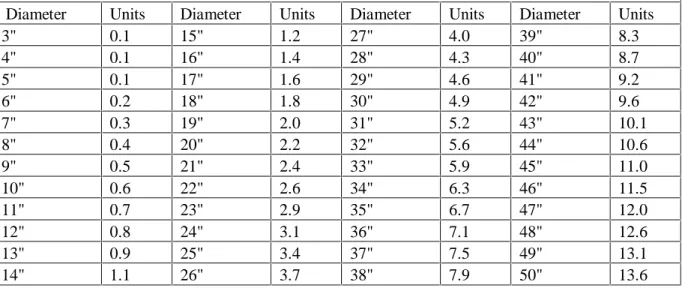
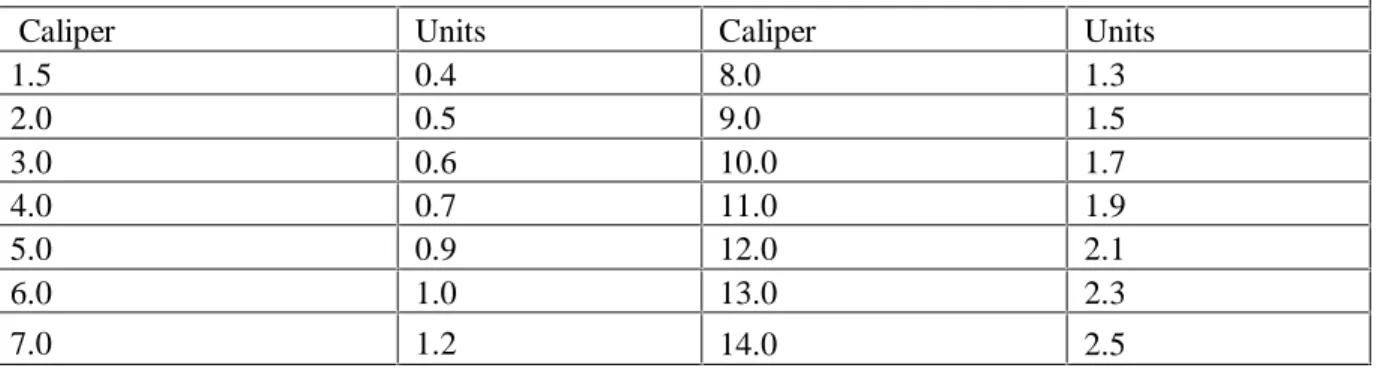
Credit for existing trees proposed to be retained on the site shall be calculated by multiplying the number of trees (by diameter) times the units assigned in Table 2, Credit for Existing Trees. Credit shall be given all trees retained on a property having a diameter of three inches or more, except trees located in a required zoning buffer. Credit for new trees proposed to be replaced on the site shall be calculated by multiplying the number of trees (by diameter) times the units assigned in Table 3, Credit for Replacement Trees. Credit shall be given all new trees replaced on the property except for new trees of less than one and one-half inches in diameter and new trees planted in a required zoning buffer. The number of new trees planted is determined as follows:
Using Table 2, Credit for Existing Trees, calculate the existing density factor (EDF) of trees three-inch diameter (DBH) or greater which will remain on the site and be protected during construction.
Table 2. Credit For Existing Trees (EDF)
Conversion from Tree Diameter in Inches to Tree Density Units for Tree Remaining on Site
Diameter Units Diameter Units Diameter Units Diameter Units
3" 0.1 15" 1.2 27" 4.0 39" 8.3 4" 0.1 16" 1.4 28" 4.3 40" 8.7 5" 0.1 17" 1.6 29" 4.6 41" 9.2 6" 0.2 18" 1.8 30" 4.9 42" 9.6 7" 0.3 19" 2.0 31" 5.2 43" 10.1 8" 0.4 20" 2.2 32" 5.6 44" 10.6 9" 0.5 21" 2.4 33" 5.9 45" 11.0 10" 0.6 22" 2.6 34" 6.3 46" 11.5 11" 0.7 23" 2.9 35" 6.7 47" 12.0 12" 0.8 24" 3.1 36" 7.1 48" 12.6 13" 0.9 25" 3.4 37" 7.5 49" 13.1 14" 1.1 26" 3.7 38" 7.9 50" 13.6
Note: Where there are not enough ten-inch DBH or greater existing trees, three-inch DBH or greater trees may be counted as table indicates (in lieu of planting new trees), provided they have grown in uncrowded conditions and have developed normal spread or they are part of a specimen tree stand.
DBH = diameter at breast height (four and one-half feet above ground)
To calculate the replacement density factor (RDF), subtract the existing density factor (EDF) from the site density factor (SDF).
RDF = SDF--EDF
Example procedure for calculating the required replacement density factor (RDF):
STEP 1 = Calculate the site density factor (SDF) by multiplying the number of site acres by 15. Example = 1.85 acres 15 = 27.75 units.
STEP 2 = Calculate the existing density factor (EDF) of trees that will remain on site to be protected during construction. EDF is determined by converting the tree diameter (DBH) of individual existing trees to density factor units, using Table 2, Credit for Existing Trees. These units are then totaled to determine the EDF for the site.
Example = A total of 12 trees will remain on the 1.85 acre site in Step 1. The trees include: 3 12" pines
4 18" oak 3 20" pine 2 24" oak
When converted to density factor units using Table 2, we arrive at the following values:
DBH No. of Trees Units Total
12" 3 0.8 2.4
18" 4 1.8 7.2
20" 3 2.2 6.6
24" 2 3.1 6.2
Adding together the units of all remaining trees, the sum total of units = 22.40 units.
Since the existing density factor (EDF) is less than the required site density factor (SDF), then replacement trees are required. The minimum site density factor (SDF) for a 1.85 acre site, established in Step 1 has not yet been met.
STEP 3 = Calculate the replacement density factor (RDF) by subtracting the existing density factor (EDF) (Step 2) from the site density factor (SDF) (Step 1). RDF = EDF--SDF
Example: RDF = 27.75(EDF)--22.40(SDF)
STEP 4 = The replacement density factor (RDF) can be converted back to caliper inches using. Table 3 B Credit for Replacement Trees. Any number or combination of transplantable size trees can be used so long as their total density factor units will equal or exceed the replacement density factor (RDF).
Example: On the 1.85 acre site the following number and size of trees will be planted as replacement trees:
Number Size Species Density Factor = Total Units
05 1.5" Dogwood 0.4 = 2.00
04 2.0" Red Maple 0.5 = 2.00
Adding together the units of proposed replacement trees, the sum total of units = 5.40 units.
Proposed replacement units of 5.40 is more than the replacement density factor (RDF) of 5.35 units, thus minimum replacement requirements have been met.
Use Table 3, Credit for Replacement Trees to determine the number and size of trees that must be planted. Any combination of transplantable size trees can be used, so long as their total density factor units equal or exceed the RDF.
Table 3. Credit For Replacement Trees (RDF)
Conversion From Tree Caliper In Inches To Tree Density Units For Proposed Replacement Trees
Caliper Units Caliper Units
1.5 0.4 8.0 1.3 2.0 0.5 9.0 1.5 3.0 0.6 10.0 1.7 4.0 0.7 11.0 1.9 5.0 0.9 12.0 2.1 6.0 1.0 13.0 2.3 7.0 1.2 14.0 2.5
IMPORTANT NOTE: For the purpose of this section, tree calipers are measured at one and one-half feet above the ground or at any point below that for new trees or multi-trunked species, but in no case less than six inches from the ground.
(6) Specimen trees. Some trees on a site warrant special consideration and encouragement for preservation. These trees are referred to as specimen trees. Trees unique due to age, size, species or historic relevance are to be identified during the survey process and special consideration must be made to work around them. It is required that all reasonable efforts be made to save specimen trees. Reasonable effort shall include, but not limited to, alteration of building design, alternate building location, parking area, detention area, drainage system, or relocation of utilities. These trees are to be identified and highlighted on the tree protection plan. Design of buildings, hardscapes and utilities are to be developed with consideration to preserving and featuring specimen trees.
Tree density unit credits are given for existing trees that are saved during the site development process, with greater credits given to specimen trees. In order to encourage the preservation of specimen trees and the incorporation of these trees into the design of projects, additional density credit will be given for specimen trees which are successfully saved by a design feature specifically designated for such purpose. Credit for any specimen tree thus saved for such purpose would be two times the assigned unit value in Table 2, Credit for Existing Trees.
The following criteria are used by the city to identify specimen trees. Both the size and condition criteria must be met for a tree to qualify:
a. Size criteria:
1. Large hardwoods (oaks, poplars, sweetgums, etc.): twenty-seven-inch diameter or larger. 2. Large softwoods (pines, deodar cedar, etc.): thirty-inch diameter or larger.
3. Small trees (dogwoods, redbuds, sourwoods, etc.); eight-inch diameter or larger. b. Condition criteria:
1. Life expectancy of more than 15 years.
2. Relatively sound and solid trunk with no extensive decay.
3. No more than one major and several minor dead limbs (hardwoods only). 4. No major insect or pathological problem.
A lesser sized tree can be considered a specimen tree, if in the judgment of the zoning enforcement officer:
1. It is a rare or unusual species or of historical significance.
2. It is specifically used by a builder, developer, or design professional as a focal point in a project or landscape.
3. It is a tree with exceptional aesthetic quality.
(7) Replacement of specimen trees. In the event any specimen tree should be removed during the land development process, the applicant shall be required to replace any specimen tree being removed with suitable replacement trees elsewhere on the site. Removed specimen trees shall be replaced by species with potential for comparable size and quality. Tree replacement, in addition to the minimum required tree density, shall be required in recompense for the removal of specimen trees. Specimen trees that are removed must be replaced by trees, minimum three-inch caliper, with an inch for inch replacement of the specimen tree removed. To determine if the replacement is reasonable the zoning enforcement officer shall consider intended use of:
a. Existing tree coverage, size, and type.
b. Number of trees to be removed on the entire property. c. Number of trees to be saved on the entire property.
d. Area to be covered with structures, parking, and driveways. e. Grading and drainage requirements.
f. Character of the site and its environs.
Any tree, designated on the tree protection plan to be saved, which is damaged during construction or as a result of construction, as determined by the zoning enforcement officer, shall be replaced with a tree or trees equal to the unit value of the tree damaged. However, any specimen tree damaged as described above shall be replaced with trees equaling an inch for inch replacement of the tree damaged.
In the event any specimen tree or trees should not survive more than 24 months following completion of development, the owner of the property shall be required to replace said tree or trees with replacement trees (three-inch minimum caliper) having an inch for inch replacement of the specimen tree removed on the site as approved by the zoning enforcement officer.
Any specimen tree which is removed without appropriate review and approval of the zoning enforcement officer must be replaced by trees equaling a two times an inch for inch replacement of the tree removed. The owner of the property shall be required to replace said tree or trees with replacement trees which will be four-inch minimum caliper. Size alone will determine whether a tree was of specimen quality if the
tree is removed without approval and there is not sufficient evidence of its condition. Such action may also result in a stop work order issued by the zoning enforcement officer.
(8) Relocation of trees.
a. Trees to be relocated shall be removed with a root ball sized in proportion to their calipers. Root balls shall be 12 inches in diameter for each one inch of tree caliper. Trees four inches in caliper and smaller are to be measured six inches from the ground. Trees four inches to eight inches caliper are measured twelve inches from the ground, trees eight inches caliper or larger are measured from breast height.
b. Trees which are to be relocated in areas which do not require grading are to be placed directly into their new location. Trees to be relocated into the limit of work line shall have tree barriers placed around it in accordance with the plan.
c. Trees to be transplanted off site in full leaf shall be covered entirely with a protective cloth covering prior to transporting. Trees transplanted on site require no covering. d. Trees which are to be relocated in areas to be graded are to be stockpiled. Stockpiled
trees shall be well heeled in and protected from excessive wind and sun. The contractor shall provide water to maintain a healthy condition.
e. Where a tree is to be removed under the provisions of this section, the city may, with consent of the property owner, relocate the tree at the city's expense to city owned property for replanting, either for permanent utilization at the new location, or for future use at another city property.
f. Credit may be given to the property for each relocated tree as though the tree was proposed to remain on the property, if the tree is relocated to a site designated by the city at the owner/developer's expense.
(9) Removal of trees. There will be a fee for obtaining a tree removal permit based on the number of trees to be removed. Provided, however, utility companies or its agents performing routine maintenance on utility easements/rights-of-way shall not be required to obtain a tree removal permit. In addition, the removal of trees including pine trees other than specimen trees from an owner owned, single-family lot are exempt from provisions of this section, provided that the removal does not reduce the required tree density of the lot below the minimum requirements. Homeowners who remove trees on their own residential property, without cost of a person or company engaged in removing the trees for a fee, shall not pay any fee until they remove more than five trees at a time within a single calendar year. A tree removal permit shall be required for removing trees, six inches or larger in diameter. Tree removal conducted on property, regardless of zoning classification, by any person or company for a fee shall require a tree removal permit. If specimen trees are removed from any property without a tree removal permit, the property owner shall pay a fine of twice the tree removal permit fee calculated. All contractors for tree removal must be licensed, bonded, and insured.
a. Safety standards. The contractor shall be solely responsible for pedestrian and vehicular safety and control within the work site and shall provide the necessary warning devices, barricades, and ground personnel needed to give safety, protection, and warning within the area where
tree removal or pruning is to occur. Blocking of public streets shall not be permitted unless prior arrangements have been made with the city and is coordinated with appropriate departments. Traffic control is the responsibility of the contractor and shall be accomplished in conformance with state, county and local highway construction codes.
b. Tree pruning. Pruning is to be performed by tree workers who, through related training and on the job experience, are familiar with the techniques and hazards of this work including trimming, maintenance, repairing or removal, and equipment used in such operations. The use of climbing spurs or irons is not approved in pruning operations on live trees. This type of work is a potentially hazardous occupation and is to be undertaken only by trained personnel or under the supervision of trained personnel, all of whom are covered with workers compensation, property damage, public liability, and completed operations insurance.
c. Tree removal. Trees shall be removed in accordance with accepted industry standards and procedures and in accordance with the following minimum requirements: Extreme care shall be taken so as to prevent limbs, branches and trunks from falling and creating damage to adjacent homes, driveways, sidewalks, trees, shrubs, streets and other property, both public and private. This type of work is a potentially hazardous occupation and is to be undertaken only by trained personnel or under the supervision of trained personnel, all of whom are covered with workers compensation, property damage, public liability, and completed operations insurance.
d. Cleanup. Debris and logs shall not be left on the public right-of-way overnight. It shall be the responsibility of the contractor to remove and dispose of, in a proper and acceptable manner, all logs, brush and debris resulting from the tree removal operation unless otherwise directed by the city. No person shall be issued a tree removal permit unless said person agrees to remove all cut logs, brush, and debris from the premises. Removal of such debris shall be performed daily so as to not disrupt the work of other contractors on the site. Absolutely no burying on site is allowed. No burning on site is allowed without a permit issued by the city fire department.
e. Trees on private property. It shall be the duty of any person or persons owning or occupying property bordering on any street upon which property there may be trees, to prune such trees in such a manner that they will not obstruct or shade street lights, obstruct passage of pedestrians on sidewalks, obstruct vision of traffic signs, or obstruct views of any street intersection. Any trees that are diseased or insect infested shall be removed, sprayed, or treated in such a manner that they will not infect or damage nearby public vegetation or cause harm to the community or citizens therein. The zoning enforcement officer may order trees on private land that causes obstructions, present insect or disease problems, or otherwise present a danger to public health or safety be pruned, removed, or treated.
f. Fees. Permits shall be obtained by any person or company engaged in the removal of trees for a fee. The zoning enforcement officer will review the tree removal plans and inspect the project site when necessary prior to tree removal of any trees. If significant trees are removed from any property without a tree removal permit, the property owner shall pay a fine of three times the tree removal fee calculated. Minimum site tree densities must be maintained at all times. Permit fees shall be as set forth in the fee schedule for the city.
g. Penalties. Any person, firm, corporation, company, or partnership violating any provision of this section shall be punished as provided in Section 180 of the PLDO. Where an offense continues from day to day, each day's continuance thereof shall be deemed a separate offense. The owner of a premises, where anything in violation of this section shall exist, or any person, firm, corporation, company, or partnership who may have assisted in the commission of such violation shall be guilty of a separate offense and, upon conviction thereof, shall be punished as herein provided.
Revised – Section 217(f)(9) g – 8.19.08 (g) Alternative Compliance.
The intent of the Tree Preservation and Replacement Ordinance is to insure that a minimum density of trees is maintained on all developed sites. Occasionally, this intent cannot be met because a project site will not bear the required density of trees. To provide some alternatives in such cases, two methods of compliance are acceptable:
* planting at a location remote from the project site; or. * contributing to the City of Perry Tree Replacement Fund.
The following standards have been established for administering these alternative compliance methods:
The Community Development Department must review and approve all requests for alternative compliance. In no instance, shall 100 percent of the required site density factor be met through alternative compliance. As many trees as can reasonably be expected to survive must be planted on the site in question.
The land disturbance permit will only be issued after the Community Development Department has approved the request and received the necessary documentation and/or funds.
(1) Off-Site Planting (Rev. 02.1.11)
If trees are to be planted at another location, the following criteria must be observed: * The off-site location should be in the same area of the city as the project site.
* A tree replacement plan meeting all applicable standards in these guidelines must be reviewed and approved.
* The following not must be shown on the approved plan:
A tree replacement plan addendum for this project shall be submitted to the City of Perry Community Development Department at least (30) days from the date of this land disturbance permit. This plan shall include the species, size and location of trees to be planted off-site to meet the tree density deficit shown. Release of this project is subject to approval of this plan as well as verification of the installation of the trees.
As another method of alternative compliance, the City of Perry will accept donations, which will be used for the sole purpose of planting trees on public property.
Calculating Contribution Amounts
Contribution calculations are based on two-inch caliper replacement trees with a value of $220.00, representing the average size and cost of materials, labor and guarantee for trees planted in the City of Perry.
To determine the appropriate contribution, first calculate the Density Factor Deficit (DFD) or unit value that cannot be planted on the site. Divide the DFD by .5 (the unit value of a 2@ caliper replacement tree) and multiply by $220.00.
EXAMPLE: A 2.2 acre site has a required Site Density Factor (SDF) of 33.0 an Existing Density Factor (EDF) of 21.4, and can only accommodate a Replacement Density Factor (RDF) of 5.0.
Determine the Density Factor Deficit (DFD) using the formula: DFD=SDF B EFD B Approved RDF
In this example, DFD = 33.0 B 21.4 B 5.0 = 6.6
Determine the acceptable contribution amount as follows: 6.6 divided by .5 x $220.00 = $2,904.00
Fund Administration
The City of Perry Tree Replacement Fund will be administered by the Community Development Department. A quarterly report shall be submitted to the City Manager showing amount collected, amounts spent, and the types and locations of trees planted. The report will be made available to the Perry City Council upon their request.