General design of the education program
of designers in Japan: professional
development for designers
Kazuo Sugiyama Chiba University
Abstract
The present study reports a plan for the education program of designers in Japan; this is a total education system that penetrates from the undergraduate level to the lifetime activity of designers. We originally referred to English educational system of engineers that contains initial professional development (IPD), qualifying professional development (QPD) and continuing professional development (CPD).
As for the activities concerning IPD, since the design is not a field of the accreditation by JABEE, the Japanese Society for the Science of Design tries constructing of the standard that can be used by design departments not only in the engineering college or university but also in the art colleges, referring the standard of the Architectural Institute of Japan. The pilot standard has been prepared, which is ready to be evaluated.
We have two plans about QPD: doctoral education in design, including the discussion of practice oriented degree, and rearing of professional designers. According to CPD of engineers in Japan, all of activities of professional engineers can be converted into points; publishing paper in academic journals is equal to 40 points, for example. Considering points that the thesis doctor in our
university would get, the designers who have got 300 ~ 400 points can be regarded as professional designers or managers of design engineer. Moreover, we try to found the organization of rearing of these professional designers.
We call the CPD for our field as Continuing Professional Development for Designers (CPDD). CPDD keeps the education system of CPD, but should establish domains of education connected to IPD.
This total education system for designers will be an index useful for designers in other countries as well as for Japanese designers.
Papers
Introduction
The present study reports a plan for the education system of designers in Japan. Engineering fields that have the qualification system of engineers have started, or are ready to start, the system of the continuing professional development (CPD). The field of design also should consider establishing of the qualification system, because of the industry-wide trend system. It is needed to explain the specialty of designacy on the base of evaluation common to other engineering fields, to closely coordinate with these fields and clearly show the function as a member of the development, then the field of design began to work. The present study, bearing the qualification system, presents a total education system that penetrates from the undergraduate level to the lifetime activity of designers. First, we originally referred to English education system of engineers that integrates three individual systems: initial professional development (IPD), qualifying professional development (QPD), and continuing professional development (CPD). IPD is for the education of undergraduate. QPD is for the education and the training carried out during a certain period after graduation; through the QPD, the application for the chartered engineer is prepared. CPD is the lifetime education and training after acquisition of the chartered engineer. On the other hand, basic concept of Japanese education system of professional development for engineers has only two phases comparable to IPD and CPD in England.
As for the professional development for designers, we propose the system composed of three subsystems as in England. IPD is certainly involved in the undergraduate education and in that of Master’s course in some cases. QPD is basically equal to that of English system, but the doctoral education and the rearing of professional designers are also considered. CPD is, as mentioned above, the core of this system.
Initial Professional Development
Design is not a field of the accreditation by Japanese Accreditation Board for Engineering Education (JABEE), the council has held by Japan Industrial Design Promotion Organization (JIDPO), Japan Industrial Designer’s Association (JIDA), Japanese Society for the Science of Design (JSSD) and other design industry associations, to discuss the accreditation and the CPD, since May 2002. JSSD plays a central role in making standard of accreditation and CPD. The construct of accreditation considers two courses of design education, the course in the art colleges or departments and that in the engineering colleges or departments (Figure 1). Both types of courses have the common program as design course, and, after that, each original program is run. The design education in the art colleges or departments has a program like National Association of Schools of Art and Design (NASAD) system as the original program; this education does not require the accreditation but performs the self-review. The design education in the engineering colleges or departments has two divided programs as the original one: the common standard by JABEE, design education as engineer education, and the sectoral standard by JABEE, like ABET program. Only the design in engineering schools can get the qualification of engineers. The standard of the Architectural Institute of Japan is referred to.
Figure 1: Construct of accreditation.
As mentioned before, the council established has four working groups. The first one discusses the system and the contents of continuing professional development for designers (CPDD). The second group sets the design education as IPD in order and considers the accreditation. The third group studies the coordination with other overseas. The last working group makes the sectoral standard in the society, including the survey of current curriculum of design schools in Japan.
Here, we present the detail activities about this curriculum survey. There are 6 kinds of subjects, 1) engineering colleges, faculties, and departments, like Chiba university which contains the
Department of Design and Science in the Faculty of Engineering,
2) art colleges, faculties, and departments, like Tokyo National University of Fine Arts and Music,
3) institutes of art and design, like Kyushu Institute of Design 4) college or faculty of education, like Iwate University,
5) household arts colleges, faculties, and departments, like Kyoritu Women’s University, 6) media engineering colleges, faculties, and departments, like Keio University SFC, and 7) others.
Not only engineering schools but also other types of schools may be also accredited so that the Design in art course Design in engineering course
Common program as design course
(Program like NASAD)
Common standard of JABEE Design education as engineer education
Sectoral standard of JABEE (Program like ABET)
+
+
Papers
Considering the standard of accreditation by JABEE, design field originally adds another two requirements as follows. First, the extension of design fields is set, which involves four sections;
1) design planning,
2) design development technology 3) design technology management, and 4) design culture and society.
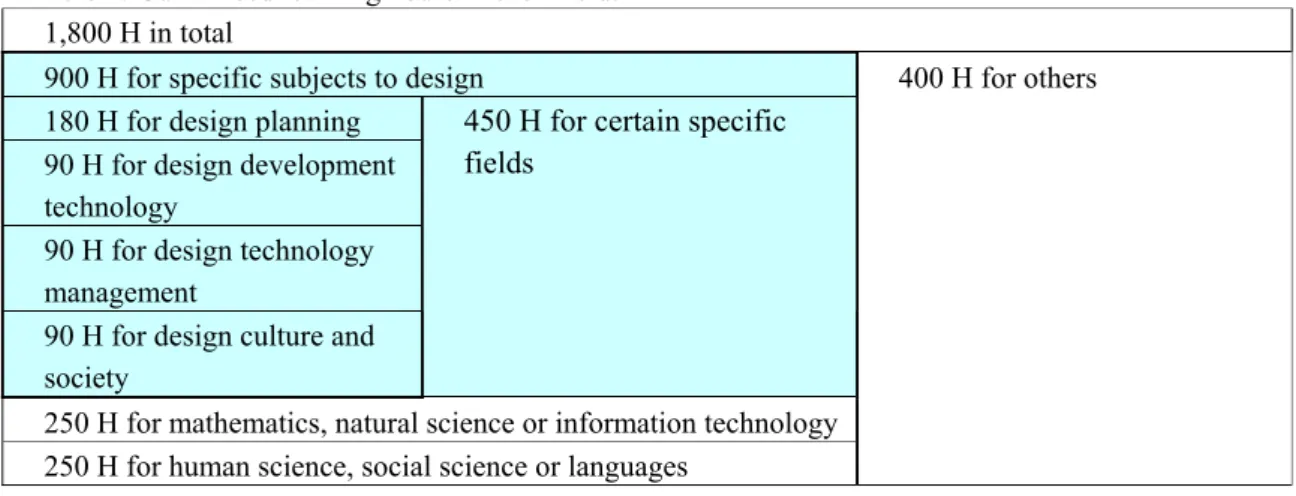
Second, the lesson hour is set; the guaranteed learning hour in the specific subjects is at least 900 hours of which 450, at least, are for the fundamental learning of knowledge and skills (see Table 1). Table 1: Guaranteed learning hours in each field.
1,800 H in total
900 H for specific subjects to design 180 H for design planning
90 H for design development technology
90 H for design technology management
90 H for design culture and society
450 H for certain specific fields
250 H for mathematics, natural science or information technology 250 H for human science, social science or languages
400 H for others
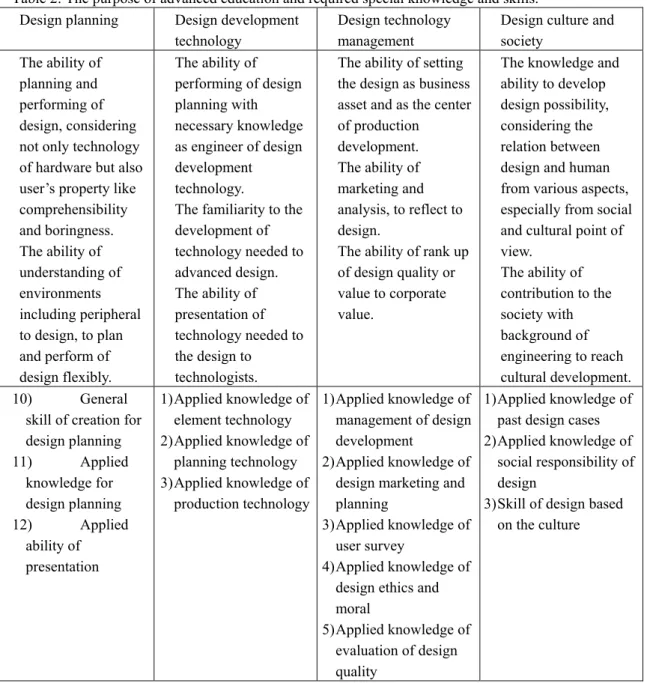
Design planning should have 180 hours at least; comprehensibility of plain and solid for design planning, knowledge of design fields and their function, knowledge of methodology, presentation skills are required. The design development technology should have 90 hours at least; knowledge of materials, planning technology, and production technology is required. The design technology management should have 90 hours at least; the process of design development, the survey, and the evaluation or test of quality are learned. The design culture and society should have 90 hours at least; design history, social response and relation to culture are learned. The purpose of advanced education and required special knowledge and skills according to each area are shown in Table 2.
Table 2: The purpose of advanced education and required special knowledge and skills. Design planning Design development
technology
Design technology management
Design culture and society
The ability of planning and performing of design, considering not only technology of hardware but also user’s property like comprehensibility and boringness. The ability of understanding of environments including peripheral to design, to plan and perform of design flexibly. The ability of performing of design planning with necessary knowledge as engineer of design development technology.
The familiarity to the development of technology needed to advanced design. The ability of presentation of technology needed to the design to technologists.
The ability of setting the design as business asset and as the center of production development. The ability of marketing and analysis, to reflect to design.
The ability of rank up of design quality or value to corporate value.
The knowledge and ability to develop design possibility, considering the relation between design and human from various aspects, especially from social and cultural point of view. The ability of contribution to the society with background of engineering to reach cultural development. 10) General
skill of creation for design planning 11) Applied knowledge for design planning 12) Applied ability of presentation 1) Applied knowledge of element technology 2) Applied knowledge of planning technology 3) Applied knowledge of production technology 1) Applied knowledge of management of design development 2) Applied knowledge of design marketing and planning
3) Applied knowledge of user survey
4) Applied knowledge of design ethics and moral
5) Applied knowledge of evaluation of design quality
1) Applied knowledge of past design cases 2) Applied knowledge of
social responsibility of design
3) Skill of design based on the culture
The pilot standard has been prepared and, now, is ready to be evaluated. Again, we would like to insist the importance of the accreditation standardized by JABEE. If a designer who graduate a certain university accredited by JABEE, he or she will receive immunity from the first examination of professional engineers. Thus, the approval of accreditation is a pathbreaking opportunity for designers to get the title of professional engineers. Holding this title will be crucial also for designers, even if the design fields have no title of the professional engineers, because designers should cooperate with the professional engineers in other field from here on. If, for example, a designer of information design has the title of professional designer, he or she will be the manager
Papers
Qualifying Professional Development
This conference, Doctoral Education in Design, has discussed how the doctor course’s students should be educated and how the practice-oriented doctor systematizes. Besides, we consider another status parallel to the doctor. There are so many designers who conduct activities in companies. They have rich experience of practice and will stimulate designers in the bud in schools. The current universities, however, do not actively welcome the person who does not have the doctor’s degree as a professor, thus, it is rather difficult for company designers to take a post in Japanese higher education fields. We present our plan of rearing of this type of specialist that we call as professional designer.
According to change of law, as CPD, the professional engineers in Japan should have train and upgrade their skills since 4 July 2000; the proof of training is needed. Societies of engineers have set up the council of Professional Development of Engineers (PDE) and have constructed the total system of CPD under the direction of related administrative agency; It is formulated what kind of activities are accredited and how these activities are evaluated.
The activities accredited are as follows:
1) participation into workshops, lectures or symposiums, 2) presentation of paper,
3) participation into workshop in their companies and OJT, 4) technical guidance,
5) work experience, and 6) other activities.
The unit of evaluation of the participation into workshop is an hour; if one participates into a workshop for 2 hours, this person will get 2 points of CPD. The presentation of paper in the society having corporate status gets 1 point per 40 minutes and the presentation of paper in the academic journal with referees gets 40 points per 1 paper. Thus, the activities are evaluated by time duration and conversed into units. The areas of education are different among each domain of engineering (Table 3).
Table 3: Evaluation of activities of education
We illustrate the CPD of civil engineering, for example (see Figure 2). As the areas of education, there are 6 disciplines as the common fundamentals, 7 fields as the special technologies, peripheral technologies, and managements; each area has concrete examples to clear their region. The
registration takes place once a year for applicants. They should clarify contents of education and name of organizer, date, actual activity hour, area of education, signature if needed, units of CPD. Professional engineers should have 150 points during 3 years, 50 points per year, which do not concentrate on only specific activity and area but cover many activities and areas as possible. The proof of register of CPD is issued, as needed.
Activities No .
Contents Uni ts
1 Participation into workshops 1H
Participation into workshops,
lectures or symposiums 2 Participation into lectures or symposiums 1H
3 Oral presentation in the society having no corporate status 0.4 M 4 Oral presentation in the society having corporate status 0.2 M 5 Paper presentation in the academic journal with referees 40
6 Paper presentation 20
Presentation of paper
7 Writing article 3H
8 Participation into workshop in their companies 0.5
H Participation into workshop
in their companies and OJT
9 OJT 10
10 Lecturer of Universities 10
Technical guidance
11 Lecture of workshop in companies 5
12 As responsible official 20
13 As staff 10
Resultful work experience
14 Patents (as inventor) 40
15 Chairman of meeting 2H
16 Participation into meeting 1H
17 Cooperation with university, institute, or international organization
20 others
18 Personal study (e.g. subscription of academic journal) 0.5 H
Papers
Figure 2: The register of CPD in civil engineering
Now we explain the relation between the CPD and the doctor’s degree. The thesis doctor in Chiba University is required 4 or 5 papers published in the academic journals with referees. According to the CPD system, this kind of paper presentation is equal to 160 or 200 points. And, to publish this amount of papers, the candidate should grind to get 150 ~ 200 points, converted into the units. Thus, the thesis doctor can be equal to 300 ~ 400 points that can be got for 6 ~ 8 years (50 points per a year). The designers who get 300 ~ 400 points can be called as professional designer (PD) or manager of design engineer (MDE). To consider the interdisciplinarity of design, the way of getting point need not be so limited, as in the civil engineering; younger person should concentrate on a specific area of education, and experienced person should have wider knowledge. The concrete education style depends on each company’s policy.
Moreover, we try to found the organization of rearing of these professional designers. The current status of the CPD in design field differs from the scale of the company; only designers in the big name companies can get a systematic education according to the CPD program for each job function developed in the companies. Sooner, all fields of engineering concerned with the development will start the CPD authorized by the PDE council and the employment system will change into the contract employee system, then the CPD program dependent on the small number of companies will not function effectively. All designers who are in the companies or in design consultancies, the societies and the universities should collaborate in the CPD. We are planning the course of rearing of MDE in Chiba University. This is a course parallel to the doctor’s course in the graduate school.
To establish the MDE course, we develop favorable environment as explained as follows. First, we got support of Ministry of Economy, Trade and Industry; JIDPO got the research fund about rearing of well-educated professionals. There is an agreement about diffusion of the CPD in design field. Second, we construct the curriculum learning from the manuals of designer education of TOYOTA and PANASONIC. Third, the text should be prepared. This plan will be developed in Asian countries in the foreseeable future.
If the system of PD or MDE is established, the practice-oriented doctor would not be needed; we can be able to welcome experienced company designers as staff in the school. In fact, other engineering fields formulize that higher education schools must also have staffs who have practice experience. The relation between PD/MDE and practice-oriented doctor requires further concrete discussion.
Continuing Professional Development
As shown in the discussion above, the main purpose of the total education system presented here is the CPD which should be in the same line of the IPD and the QPD. We insist again that the design field has no professional engineers and need not to participate in the PDE council. Thus, we call the CPD for design field as Continuing Professional Development for Designers (CPDD). However, the main system of the CPD by the PDE cannot be neglected; we refer to its education system to convert the units. We can use the list of activities accredited and the necessary number of units. But the areas of education, specialized to design field, must be newly constructed. Here, we remember that the area of education in the CPDD should work with the IPD program which accredits the programs of design fields. The area of education in the CPDD concerns to four education fields of IPD mentioned before.
It is characteristic that there are many in-house designers in Japan compared with other countries. Moreover, increasing of mobility of designers among companies is a recent trend. CPDD will bring three main advantages as follows. Firstly, it is easy to standardize the experience of designers; all professional experiences will be converted into the units and expressed quantitatively. Second, companies will actively promote outsourcing of the in-house job training; everyone will be able to evaluate one’s work experience using the point system. Lastly, designers will be on an equal footing with professional engineers in other fields; CPDD will build up a sense of fellowship among designers and engineers.
Concluding remarks
Our plan of the total education system for designers in Japan has a structural feature of the
penetration from undergraduate education, through doctoral education, to the lifetime education of designers. This system can cover all activities of designers for their proper evaluation. We believe that it will be also an index useful for the design field in other countries.